+3 ,**+ ++-῎+.-
Journal of the University of the Air5 No4+3,**+pp4++-῎+.-
Vibrational Circular Dichroism Spectroscopy
A method of studying chiral molecules
Yoshiaki H6B696῍ῌῌSaeko S=>C῍῍῍ ῌ
῍ ῌ
!"#$%&'()*+,- ./012345678 9#$:;8<=>?,- ?$@Aῌ BCDECFGHIJK,- LMNOP
;;Q'RMSMῌTUO5V;WXYZO;D+[- TUO5V;\ῌ#!]46 +*^D_`- LMNab#$cdeDfghi4X)*!]jk<$lM*
WmῌcenopqrstuDdenopqrstuvw<xyJ$+z'{
6LD<ῌ OP;|f4}~JK,LD'*+,- \ῌ' ῌ
lM`FGjk')`-
"ῌ4ῌN<)`TUO5V;#$'`-
'+*ῌ \ῌ4X, u¡D¢£;¤'¥¦`- ^
`ῌ ./0.¡§¡'+`Jῌ ¨©78ª«=>D¬®<K,¯
°±HI'?,²4ῌTUO5V;'+,LD³>#´¤;'¥¦`-
ABSTRACT
Molecular chirality plays a fundamental role in life. The amino acids and sugar have two stereochemical isomers. That is, there are left-handed and right-handed forms. They show the different features to circularly polarized light. The effi- ciency of absorption is different and rotates the polarization axis. These optical activities are called circular dichroism and optical rotation, respectively. Theoreti- cal bases of circular dichroism are reviewed. They are derived by classical electromagnetism and also by quantum mechanics, and indicate there needs a nonzero value of the inner product of electric dipole transition moment and magnetic dipole transition moment to gain the optical activity. The formulae from the classical and modern theories are compared and correlated.
At the last part of this review article, we report our preliminary results of
῍ῌ µ¶· ¸¹\¢
῍῍ ¶º»¼ ¸¹\¢
++-
O O
OH OH
HO Base Base OH
D-form L-form
2-deoxyribose D-form L-form
R R
COOH HOOC NH2 H2N
α-amino acid
vibrational circular dichroism measurement of a ring compound to investigate the ability for prediction and analysis of the observed spectrum by using purely theoretical calculation. We also report the potential ability of vibrational circular dichroism for studying the molecular structure in solution, particularly the compli- cated system where there is a conformational multiplicity and hydrogen bonding.
There is a stereoisomerism, called enantiomerism, in a-amino acids as the components of protein and polypeptide, and in ῍-deoxyriboses that make skeletal units of DNA. Each enantiomer makes the linearly polarized light rotate its axis of the polarization after the light passes the sample. This optical activity arises from the existence of the two mirror-imaged forms in the amino acids and riboses. The term, chirality, is also used for the characteristic that the real image and mirror image cannot be overlapped exactly. The a-amino acids and ῍- deoxyriboses in all lives on the earth have L- and D-forms, respectively, as shown in Fig4ῌ.
The chemical natures, such as melting points and chemical reactivity of the enantiomers are generally the same. However, molecular chirality has an essen- tial role in life. For example, the L-form of monosodium glutamate is used as a
Fig4ῌ Enantiomers ofa-amino acid and ribose ΐ ῒ ῍ ῐ ῌ ῑ ῎ῌ῏
++.
seasoning of food or a delicious essence. On the other hand, the D-form of the monosodium glutamate tastes rather bitter. The role of the mirror imaged forms of the above-mentioned amino acids and riboses ῌῐ-membered sugar῍ have not been well understood. There is a hypothetical explanation that the isomerization or racemization of the L-form amino acids to the D-form in protein causes a serious disease. For example, there is a report that the b-amyloid partially racemized in brain attacks hippocampus, which causes Alzheimer’s disease῍῍.
Great attention has been paid on the possible origin of the chirality, but we have not yet reached to the final answer. Recently, some of the in vitro systems are found which promote an asymmetric autocatalytic reaction by applying an organic chemical method, and are expected as the possible system for amplifying the enantiomeric imbalance starting from a trace amount of chiral initiator with very low enantiomeric excess ῌee῍῎῍. Of course the chiral synthesis is a major and developing field of organic chemistry, and the scientific society of Japan has a very strong basis of this field as shown by the ῎ῌῌ῍ Nobel prize for chemistry given to Prof. Noyori.
There is a report which states that the sun light in the morning is left circularly polarized, whereas the sun light in the afternoon is right circularly polarized῏῍. The study on photoinduced racemization is becoming an attractive field of molecular chirality, although the source of the light is such a high power like laser and far from the natural light.
Under the scientific background described above, we started a study of detec- tion of chiral molecules by a vibrational circular dichroism ῌVCD῍ spectrometer in ῎ῌῌῌ. The purpose of our study is to observe VCD spectra of some fundamen- tal importance in detail and clarify the relation of the VCD spectrum with molecular structure, and hopefully to find out some predictive theory to combine the VCD spectrum and dynamic property of molecular motion. This paper reviews the theoretical basis of the circular dichroism briefly and reports our preliminary results of the experimental work on the typical ring compound and aminoalcohol molecule. The ring compound was chosen to verify the quality of the ab initio MO calculation, and aminoalcohol molecule was chosen to investi- gate the molecular structure in solution, particularly the dynamic properties relating to the hydrogen bonding.
ῌ4 What is Circularly Polarized Light
The electromagnetic wave ῌhereafter the word “light” will be used to mean the electromagnetic wave῍ passes through material by interacting with the electro- magnetic field of the atoms or molecules that constitute the material. That is why the speed of light is reduced in material of high density, although the
Vibrational Circular Dichroism Spectroscopy ++/
χ
entrance exit
(a)
(b)
(c) El
Er
z y
x
El
y
El
Er x
y
x frequency is not changed. The speed down of the light appears as the refraction at the interface of different materials. The speed of light c in a material is related with the refractive index n as follows,
ccῌ
n. ῍-῍
Where cῌ is the speed of light in vacuum.
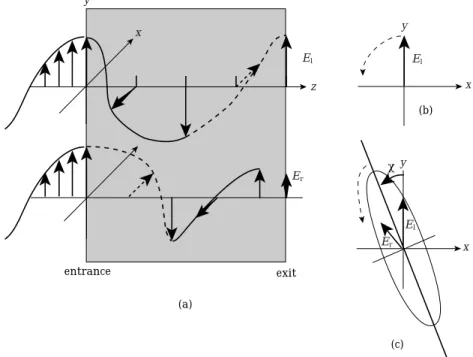
We now consider the mechanism of the rotation of polarized of light. We investigate a linearly polarized light hereafter abbreviated as LPL oscillating along the y-axis and entering into a medium indicated by a gray zone, and propagating along the z-axis as shown in Fig4῎a. LPL can be considered as the sum of left and right circularly polarized lights. The left circularly polarization is defined such that the electric field is rotated anti-clockwise when we look back the light along the direction of propagation as shown in Fig4῎b. We should pay attention that when we say the rotation of the electric field, which means the rotation as the function of time. The curved line of the electric field shown in Fig4῎a is not the wave at some particular time, but shows the electric vector experienced in the medium against the time course. In other word, the z-axis also means the dimension of time.
Fig4῎ Circularly polarized light and elliptically polarized light ῌ
++0
Let the linearly polarized light along the y-axis enter some medium. And Let the speeds of light of left and right circularly polarized lights to be cl and cr ῌcl
ῑcr῍, respectively. The left circularly polarized light ῌdenoted as LCL hereafter῍ passes the medium and reaches the exit faster than the right circularly polarized light ῌdenoted as RCL hereafter῍. As shown in Fig4῏ῌa῍, the time difference between the two polarized lights to run through the medium of length l is
td῏lῌ
῍῎ cr῎῎
cl
῎῏. ῎-῏῍
Therefore, RCL that interferes with LCL at the exit of the medium should enter the medium before LCL by the time of td. That means the interference at the exit occurs between LCL and RCL with a phase difference of
*῏῏pntd῏῏pnlῌ
῍῎ cr῎῎
cl
῎῏ ῎-ῐ῍
where n is the frequency of the light. The phase of RCL has proceeded faster then that of LCL.
The electromagnetic wave has the following fundamental relation,
c῏ln ῎-ῑ῍
Then, equation ῎-ῐ῍ can be rewritten using the above relation as follows,
*῏῏pnlῌ
῍῎ cr῎῎
cl
῎῏῏῏pl
l ῌnr῎nl῍. ῎-ῒ῍
If the amplitudes of the both LCL and RCL have not changed at the exit, the interference of LCL and RCL makes the polarization axis declined as much as
c῏*
ῌ
῏ ῎-ΐ῍as shown in Fig4῏ῌc῍. The optical rotation is thus explained. The angle a is called the angle of rotation. Equation ῎-ῒ῍ also explains that we have a levorota- tory ῌcῐ῍, left rotation῍ when clῑcr, and dextrorotatory ῌright rotation῍ when cl
ῐcr.
The difference of cl and cr should be reflected on the different absorption efficiencies for both circularly polarized lights. That is, the amplitudes of LCL and RCL should be different at the exit of the medium. Then the polarization axis has to be rotated by time, since the speeds of El and Er are different. In case of clῑcr, the axis of polarization, or the vector addition ofEland Er should rotate anti-clockwise. In conclusion, we have the elliptic polarization as shown in Fig4
῏ῌc῍.
ῌ4 Naming of Optically Active Molecule
Historically, the absolute configuration of optically active glyceraldehyde had Vibrational Circular Dichroism Spectroscopy ++1
C C
CHO CHO
H
H OH HO
CH2OH CH2OH
L-form D-form
C H
X
Y Z
X<Y<Z R-form
been assumed as shown in Fig4῎ and the isomers of any other compounds that are synthesized starting from L-form glyceraldehyde have been denoted as L and those from D-form glyceraldehyde have been denoted as D. The symbols L and D stem from levo ῌleft῍ and dextro ῌright῍ in Latin. Therefore, the symbols L and D had no relation with the real direction of optical rotation.
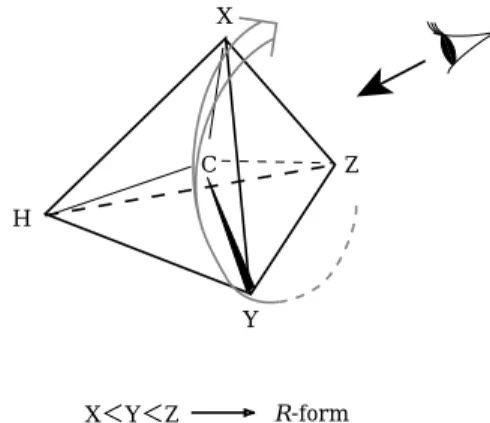
More convenient and logical way to express the chiral isomers was proposed by R. S. Cahn, C. K. Ingold, and V. Prelog in ῌῒῐῑ, and now used in wide community of chemistry. The rules are made of four steps as follow. Step-ῌ: The sequence rule to determine the relative priority is defined for four atoms or groups connected to the chiral center. Step-῍: Put the atom or group of the lowest priority among them behind the chiral center, and look the remaining three at the front of the chiral center. Step-῎: The three atoms or groups are looped according to the sequence order. Step-῏: If the loop is right turn, the chiral isomer is called R ῌrectus: straight or right in Latin῍, and if the loop is left turn, the isomer is call S ῌsinister: left in Latin῍.
The sequence rules are defined as follows:
Fig4῎ Absolute configuration of glyceraldehyde molecule
Fig4῏ R, S- Representation of optically active molecule
῏ ῒ ῌ ΐ ῐ῎ῑ ++2
Rule-ῌ: If the four atoms connected to the chiral center are different, the priority follows the atomic number. The atom with larger atomic number is assigned the higher priority. If two atoms are the same element, the isomer with larger mass number is assigned the higher priority.
Rule-῍: If the sequence order cannot be determined by the rule-ῌ, we compare the atoms next to the first substituents. If necessary, the same procedure is repeated.
Rule-῎: If we met a double or triple bond, we count the atoms of both side of themultiple bond, doubly or triply. For example, we assume ῑCῐA by ῑ
ΐA C῏
ΐC A,
and ῏CῒA by ῏ ΐA ΐA C῏
ΐC ΐC
A. The phenyl group, CῑHῐ+, is treated as one of the Kekele
structures.
The D-glyceraldehyde is now assigned toR chiral isomer, and L-glyceraldehyde is to S isomer as shown in Fig4῏.
῍4 What is Circular Dichroism
Circular dichroism ῌCD῍ accompanying the electronic transition has been used as a sensitive method to detect the optical active molecules. Many theories to explain the optical rotation and CD have been proposed and successfully applied for extensive chemical systems. We summarized the most general theories of CD in the following sections.
῍-ῌ4 Electromagnetic Explanation
First we introduce two classical theories depending on the electromagnetism.
῎-ῌ-ῌ4 Kuhn’s Theory
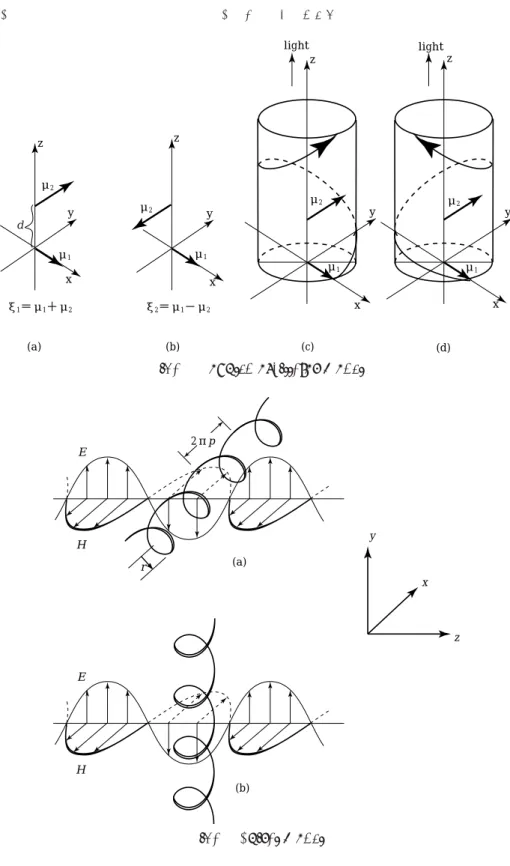
Kuhn assumed two oscillators, mῌ and m῍, separated by some distance, say d, in an asymmetric molecule. That is, two oscillators are coupled and make two orthogonal motions or normal modes. Here we take xῌῐῌmῌ῎m῍῍ and x῍ῐῌmῌ῏m῍῍ as a model as shown in Fig4ῐῌa῍ and ῌb῍, where the normalization coefficients are ignored for simplicity.
We next consider the interaction of the mode xῌ with electromagnetic wave.
Fig4ῐῌc῍ and ῌd῍ show the case when the two oscillators are separated by l/῏. Take the case when the first oscillator mῌ is accelerated by the incident lights, LCL and RCL. The oscillator mῌ of the mode xῌ will stimulate the motion of the oscillatorm῍ as shown in the figure. When the LCL reached the position of m῍, the photon of LCL may be absorbed strongly since the directions of electric vector and dipole moment of m῍ are in coincidence. Whereas, the directions of electric vector of RCL and dipole moment of m῍ are reversed, and the absorption of the
Vibrational Circular Dichroism Spectroscopy ++3
light light
y y y y
x
x x
z z
z z
μ1
μ2
(a) (b) (c) (d)
x ξ1=μ1+μ2
d
μ2
μ1
ξ2=μ1−μ2
μ2
μ1
μ2
μ1
E
E H
H
x y
z 2πp
r (a)
(b)
Fig4ῌ Coupled oscillator model
Fig4῍ Spiral model ΐ ῒ ῍ ῐ ῌ ῑ ῎ῌ῏
+,*
photon may be depressed compared to the case of LCL.
According to Kuhn’s theory, there needs more than two oscillators in a mole- cule, and these oscillators should be separated by some distance and should not be on the same plane nor in parallel.
῏-῍-῎4 One Electron Theory
According to Kuhn’s model described above, the circular dichroism occurs by the difference of the light absorptions for LCL and RCL, which makes the phase difference for both circularly polarized lights as described in section ῍. On the other hand, we can make a model where the circularly polarized light is a combination of the two linearly polarized lights, orthogonal in their electric fields and shifted by ῒῌῒ in its phase. In return for the assumption of the linearly polarization of electromagnetic wave, we need to introduce some mechanism where the electric charges move in spiral in a molecule to cause the circular dichroism.
Let’s assume some molecule to have a spiral structure in it. In Fig4ῐ, a right spiral is shown which is placed along the x-axis and the electromagnetic wave propagates from left to right along the z-axis with the electric field, E, linearly polarized along the y-axis and the magnetic field, H, is perpendicular to E. The radius of the spiral is r. The charge of the molecule is forced to move along the spiral. By the incident light, there induced the electric and magnetic dipole moments ῍m, m῎, given by the derivative of time῍t῎ as the following equations,
mῑῐῌ
῍b c῎
῏(H
ΐt ῏ῐ῍῎
mῑ῏ῌ
῍b c῎
῏ΐE
ΐt ῏ῐ῎῎
where c is the speed of light and b is a constant depending on the molecule.
First, we consider the induced electric dipole moment given by equation ῏-῍῎. Two components, mx and myz, will be induced. The former one is along the spiral axis, and the latter one is perpendicular to the spiral axis. By one turn of the charge, the sum of myz becomes zero, but mx sums up to be ῎pep, where p is the distance that the spiral proceeds along the axis per unit angle ῍radian῎, and e is the unit charge. Therefore, we only need to consider mx. The induced electric dipole moments will oscillate with the same frequency of the incident light.
According the electromagnetism, the oscillating charge will induce the electro- magnetic wave. In our case, the emitted light is polarized along the x-axis. The incident light and induced light will make a combined electric field which is declined by c from the electric field of the incident light as shown in Fig4ῑ.
Letῌs calculate the induced electric dipole moment. The magnetic field of the Vibrational Circular Dichroism Spectroscopy +,+
E0
E, x χ y
incident light can be written by
HHῌcosw῎
῏tz cῐ
ῑ. ῏-῏
Then, equation ῏-῍ is rewritten by incorporating equation ῏-῏ as mmxb
c
H῍b c
n῎῎
῏ wHῌsinw῎
῏tz cῐ
ῑ. ῏-ῐ
The amount of the electric vector E emitted from the dipole moment expressed by equation ῏-ῐ will be derived to be
ΐExmΐNmxῐp῎N
l dz n῎῎
῏ ῌb
cΐHῌΐcosw῎
῏tz cῐ
ῑ ῏-ῑ
where N is the number of molecules per unit volume of the medium.
The electric field can induce a magnetic moment as written in equation῏-῎. In this case, we use a model shown in Fig4ῒb. The electric field of the incident light induce the movement of charge in the spiral actually molecule placed along the y-axis, which in turn induce a magnetic moment along the y-axis, my. The oscillation of this magnetic moment produces the electric feield perpendicu- larly to the magnetic moment, which is along the x-axis. The arithmetic will follow as those described above for the induced electric dipole moment, and we obtain the same amount of the electric field, ΐEmxΐ as equation ῏-ῑ
In a real medium, the directions of molecules are randomly distributed and we need to sum up or integrate all of the contributions and average them according to the recipe of kinetic model of the gas phase molecules. The result is just simple so that the averaged electric field stimulated by the incident light is one third of the sum of ΐExmΐ and ΐExmΐ. In conclusion, we have
E῍
῏ΐExmΐΐEmxΐp῏N
῏l dz n῎῎
῏ ῌ῎b
c ΐEῌΐ ῏-ῒ
where ΐEῌΐis the electric field of the incident light. As is shown in Fig4ΐ, the polarization degree, c, is related with ΐE’ΐand ΐEῌΐ by the following relation.
cῒtancΐE’ΐ ΐEῌΐp῏N
῏l῎ dz n῎῎
῏ ῎b. ῏-ΐ
Fig4ΐVector addition of incident and induced electric fields ῌ
+,,
--4 Derivation of b
There are three kinds of forces that interact with the charge ῌwe will treat an electron as a typical charge῍ on the spiral shown in Fig4. Those are ῍ force, fi, accompanying to the acceleration of the electron motion, ῍ Hooke’s force, fb, against to the displacement of the electron, and ῍ force by the magnetic field of the incident light, fe. These forces should be in balance. The first two forces are related with the displacement, q, of the electron along the spiral by the following equations,
fiῐ῏mq¨, -῍
fbῐ῏kq. -῍
Potential difference for one turn of the spiral, caused by the magnetic field, is
DVῐ῎
῏pr
cῐῑῒH῍ῒ. -῍Since the length of one turn of the spiral is p
ΐ
rr῎῎pp, the potential difference for a unit of q isῒVῒῐ DV
p
ΐ
rr῎῎ppῐ r
c
ΐ
rr῎῎pp ῒH῍ῒ. -῍
Therefore, the force, fe, derived by this potential difference is
feῐeῒVῒῐ er c
ΐ
rr῎῎pp ῒH῍ῒ. -῍
The balance of three forces in equations, -῍, -῍, and -῍ is described by mq¨῎kq῎ er
c
ΐ
rr῎῎pp ῒH῍ῒῐ. -῍
By introducing the relations, HῐwHsinwt and kῐmw, into the above equation, we will obtain the next solution for q, as
qῐ῏ er
mc
ΐ
rr῎῎pp ῌw῏wwῒHῒsinwt. - ῍The x-component ofq isqp
ΐrr῎῎pp, so that the electric dipole moment mx along the x-axis caused by the displacement of q is
mxῐ qpe
ΐ
rr῎῎pp ῐ῏mce ῌ rp
r῎pῌ w῏w
H.῍ -῍
Comparing this equation with that of -῍, we obtain bῐe
mῌ rp
r῎pῌ
w῏w . -῍
By assigning this relation into equation -῍, we can derive the next formula, Vibrational Circular Dichroism Spectroscopy +,-
cpN
l dz n ῌe
mῌ rp
rpῌ
ww . -
Experimentally, we use a specific rotation, a, defined as the optical rotation for the concentration g/ml, and for the optical length of dm. In the case of the concentration of c g/ml and the optical length of dz cm, a will be described as follows,
ac p ῌ
dzῌ
c, - where a is expressed by the degree,c by radian, c by the weight of solute in ml solution. Here we introduce the Avogadro constant, NA, and molecular weight, M. Then, N in equation - is expressed by NNAc
M. Assigning this relation and wpcl, and equation - into -, we obtaina NA
Mῌn ῌ e
mcῌ rp
rpῌ l
ll . -
By replacing some parts of the above formula, like
a NA
e
mcῌ rp
rp , -
we obtain a simplified formula for the specific rotation as follows, a
M ῌn ῌ al
ll . -
From equation - or -, we can deduce some important results. In the wave length region of ll, the sign of a is determined only by the sign of p.
The positive sign of p means that the spiral is right turn, and the negative sign means left turn. The equation - explains the anomalous dispersion observed in CD spectrum of the electric transition and l corresponds to the absorption wavelength where the so-called Cotton effect appears.
From equation - or -, we can deduce another conclusion. That is, for the spectrum to be optically active, r and p should not be zero. The zero value of r corresponds to the case when the charge in molecule oscillates on the straight line, whereas the zero value of p corresponds to the case when the charge in molecule oscillates in a closed circuit.
The formula of - can be divided into two parts, except the coefficient such as
a NA
mcῌ ep
῍
rrpp ῌer
῍
rrpp . -The multiplication of the second part of the above equation with q is an induced electric dipole moment as is indicated by -, and the third part of the equation is in proportion to the induced magnetic moment. Therefore, we de-
ῌ +,.
duced the conclusion that the optical activity needs nonzero induced electric moment and nonzero induced magnetic moment accompanying the optical ab- sorption. Equation ῏-῎῎῍ tells that pῌ means zero value of the induced electric dipole moment and rῌ means zero value of the induced magnetic dipole moment.
῍-ῌ4 Quantum Mechanical Explanation
We have derived the explanation for the optical activity of the molecule from the classical electromagnetism in the preceding section. Here we will try to explain the optical activity by the quantum mechanical point of view and correlate it with that of the electromagnetism.
Time-dependent Schro¨dinger equation for a system characterized by the state, n, with the wavefunction Yῌnῌt῍ and the energy Eῌn is
HῌYῌnῌt῍iῑh
tYῌnῌt῍EnῌYῌnῌt῍. ῏-῎῏῍
The wavefunction Yῌnῌt῍ can be divided into two parts as Yῌnῌt῍YῌnexpῌΐiEῑῌn
h t῍, ῏-῎ῐ῍
where Yῌn is the time-independent wavefunction of space variables. Let us con- sider a new state k, where the molecule is under influence of a dynamic field perturbation, and assume that the perturbation is weak. Then the total Hamilto- nian Hῌt῍ can be written as
Hῌt῍HῌῒH῍ῌt῍. ῏-῎ῑ῍
We will treat only the first order perturbation here. Since Yῌnῌt῍ constitutes a complete system, the wavefunction Ykῌt῍ can be expanded as a Fourier series of Yῌnῌt῍ as follows,
Ykῌt῍
S
cnῌt῍Yῌnῌt῍. ῏-῎ῒ῍By incorporating equations ῏-῎ῑ῍ and ῏-῎ῒ῍ into the general form of the Schroed- inger equation, Hῌt῍Ykῌt῍iῑh
tYkῌt῍, we obtain the time-dependent equation as follows,
῎HῌῒH῍ῌt῍῏
S
cnῌt῍Yῌnῌt῍iῑh t
S
cnῌt῍Yῌnῌt῍. ῏-῎ΐ῍By expanding this equation using HῌYῌnῌt῍EῌnYῌnῌt῍ and Yῌnῌt῍YῌnexpῌΐiEῑῌn
ht῍, and by left multiplying with Yῌk
ῐ, we obtain the next equation,
ckῌt῍
t ῍ῑ
ih
S
cnῌt῍ῐYῌkῒH῍ῌt῍ῒYῌnῑexpῌ῍ΐiῌEῑῌnΐEῌk῍t
h ῎
῏. ῏-῎῍
Suppose that the system was in the state, s, initially. Then the coefficients Vibrational Circular Dichroism Spectroscopy +,/
should be
csῌ῍,cnῌῌ ns. ῏-῎ΐ
We can assume that the coefficient at time t, cst, is close to ῍, and the other coefficients cntns are very small. Then, the coefficients cnt can be written as
cnt ῍
ih
YῌnH῍tYῌseiwnstdt, ῏-῏ῌwhere
wnsEῌnEῌs
h . ῏-῏῍
Now lets consider the system that is perturbed by the dynamic electric field.
The perturbing Hamiltonian can be expressed as
H῍tmaEat. ῏-῏῎
And the perturbing Hamiltonian for the system perturbed by the dynamic magnetic field can be expressed as In the preceding two sections, we used Hfor the magnetic field, but we will use the symbol B for the magnetic filed hereafter to avoid the confusion of the Hamiltonian H and the magnetic field
H῍t maBat. ῏-῏῏
We next examine the system that is perturbed by the circularly polarized light.
Assume that the light propagates along the z-axis, the circularly polarized elec- tric vector E t will be expressed by
E t῎Eῌ ucosw
tz
c vsinw tz
c
, ῏-῏ῐ where the left and right circularly polarized lights are represented by “” and
“” signs, respectively under the right-handed coordinates system, and u and v represent unit vectors along the x- and y-axes, respectively. The corresponding magnetic vector B tcan be obtained by rotating E t around thez-axis by p
῎, so that
B t῎Bῌ
ῌusinw tz
cvcosw tz
c
. ῏-῏ῑ Both E t and B t have only the x- and y- components, and then the perturb- ing Hamiltonian will be written by
H῍tmxExtmyEytmxBxtmyByt. ῏-῏ῒ
From equations ῏-῏ῐ and ῏-῏ῑ, the x- and y- components of E t and B t are deduced to be
+,0
Exῌt῍῎Eῌcoswῌ
῍tΐz c῎
῏, Eyῌt῍῎Eῌsinwῌ
῍tΐz c῎
῏, ῏-῏ΐ῍
Bxῌt῍ῒ῎Bῌsinwῌ
῍tΐz c῎
῏, Byῌt῍῎Bῌcoswῌ
῍tΐz c῎
῏. ῏-῏῍
In these equations, the phase difference wz
c is in common, so that we can omit this term in the following discussions. By assigning these equations into ῏-῏ῒ῍, the perturbing Hamiltonian will be written by
H῍ῌt῍Eῌ῎ΐmxῌeiwtῒeΐiwt῍imyῌeiwtΐeΐiwt῍῏
ῒBῌ῎ῒimxῌeiwtΐeΐiwt῍ΐmyῌeiwtῒeΐiwt῍῏. ῏-῏῍
Then the equation ῏-῏ῌ῍ is rewritten as cnῌt῍῍ῑ
ih ῌ῍
῎
ῌΐEῌmx, nsΐBῌmy, ns῍
ΐ
ῌeiwtῒeΐiwt῍eiwnstdtiῌEῌmy, nsΐBῌmx, ns῍
ΐ
ῌeiwtΐeΐiwt῍eiwnstdt῏ῐ
ῑ, ῏-ῐῌ῍
where, mx, nsῐYῌnῒmxῒYῌsῑ, and so on.
The effect of the ῌeiwteΐiwt῍ term in the perturbing Hamiltonian on the coeffi- cients cnῌt῍ results in the integration
ΐ
ῌeiwteΐiwt῍eiwnstdt. By calculating this integration, the following equation can be derived.ΐ
ῌeiwteΐiwt῍eiwnstdteiῌiῌwwnsnsῒῒw῍tΐ῍w῍ eiῌwnsΐw῍tΐ῍
iῌwnsΐw῍ . ῏-ῐ῍῍
Next we will discuss about the absorption phenomenon. Since the first term of the right hand side of equation ῏-ῐ῍῍ is negligible, this equation can be rewritten as
ΐ
ῌeiwteΐiwt῍eiwnstdteiῌiῌwwnsnsΐw῍tΐΐ῍w῍ . ῏-ῐ῎῍Then equation ῏-ῐῌ῍ becomes cnῌt῍῍ῑ
ihῌΐmx, nsEῌῒimy, nsEῌimx, nsBῌΐmy, nsBῌ῍eiῌwnsΐw῍tΐ῍
iῌwnsΐw῍
ΐV῍,nsῑῌeiῌwnsΐw῍tΐ῍῍
hῌwnsΐw῍ , ῏-ῐ῏῍
where
V῍,nsΐmx, nsEῌῒimy, nsEῌimx, nsBῌΐmy, nsBῌ ῏-ῐῐ῍
The probability Pnῌt῍ of finding the molecule in the state n can be derived as Pnῌt῍῎cnῌt῍῏῎cnῌt῍῏ῐ
῍῎
ῐῐVV῍῍,,nsnsῌῌVV῍῍,ῑ,nsns῍῍ῐῐsinsin῎῎ ῌῌwwnsnsΐΐww῍῍tt
h῎ῌwnsΐw῍῎ . ῏-ῐῑ῍
Vibrational Circular Dichroism Spectroscopy +,1
By taking the hermiticity of ma and ma into consideration, we can obtain V῍,nsV῍,nsῑmx, snmx, nsmy, snmy, nsE῎ῌ
mx, snmx, nsmy, snmy, nsB῎ῌ
ῌ῎imx, snmx, nsmy, snmy, nsEῌBῌ
. ῏-ῐῒ
For an isotropic sample, all directions of space cannot be discriminated. There- fore, every component is summed up and the equation can be rewritten as
V῍,nsV῍,nsῑ῎
῏ma,snma,nsE῎ῌma,snma,nsBῌ῎῎Imma,snma,nsEῌBῌ, ῏-ῐΐ where, Einstein summation convention, aabaaxbxaybyazbz, is applied.
The E῎ῌ, B῎ῌ, EῌBῌ terms in equation ῏-ῐῒ can be converted to the energy of the incident light. We now need to integrate Pnt over all the quantum states in the incident energy range, and differentiate it by t to derive W, the transition rate per a unit time. The result is
W p῏
῏h῎msnῌmnsmsnῌmns῎Immsnῌmnsrn p῏
῏h῎ma,snma,nsma,snma,ns῎Imma,snma,nsrn
, ῏-ῐ
where rn is the energy density energy per volume per Hz.
Now let’s assume that the sample with the concentration Cῌ absorbs a photon of the energy hnfrom the incident light with intensity ofIn. The change in the intensity of light is proportional to the thickness of the sample, or the optical path length l. Assume that the energy difference between the states s and n in equation ῏-ῐ is large enough, and all the molecules are in the state s initially.
Then, by using the relation Incrn, we can derive
῍῎dIn In῏
ῐ
῍
῎B c῏
ῐhnCῌNAdl, ῏-ῐ
where NA is the Avogadro number, and B can be written as Bp῏
῏h῎msnῌmnsmsnῌmns῎Im msnῌmns. ῏-ῑῌ In case of the ordinary absorption, only ma,snma,nsterm in equation ῏-ῑῌ is needed, so that we obtain
lnIῌn In
p῏nCῌNAl
῏hc Dns, ῏-ῑ῍
where Iῌn represents the intensity of light at the entrance of the sample. The term Dns represents the electric-dipole transition strength, which satisfies the relation of
ῌ +,2
Dnsΐma,snma,nsΐmsnῌmns. ῏-ῑ῎῍
By using a ῌn῍, the absorption coefficient, the Lambert-Beer’s law can be written as
Iῌn῍ΐIῌῌn῍eῑaῌn῍Cῌl. ῏-ῑ῏῍
From equations ῏-ῑῌ῍ and ῏-ῑ῏῍, we obtain the following relation, aῌn῍ΐp῏nNA
῏hc Dns. ῏-ῑῐ῍
For the purpose to obtain the total absorption intensity of the spectral band, we need to calculate
ῑ
aῌnn῍dn by taking the band shape into the consideration.Actually, the variation of the frequency n is limited over the spectral band, we can replace n by nῌ, the frequency of the band center. Then, the integration becomes
aΐ
ῑ
aῌn῍dnΐp῏῏nhcῌNADns. ῏-ῑῑ῍We now investigate the circular dichroism intensities. The equation corre- sponding to ῏-ῑ῍῍ can be written as
lnIῌῌn῍
Iῌn῍ ΐp῏nCῌNAl
῏hc ῌDnsῐMnsῒ῎Rns῍, ῏-ῑῒ῍
where
Mnsΐma,snma,nsΐmsnῌmns, ῏-ῑΐ῍
and
RnsΐImῌma,snma, ns῍ΐImῌmsnῌmns῍. ῏-ῑ῍
Then the absorption coefficients aῒῌn῍ become aῒῌn῍ΐp῏nNA
῏hc ῌDnsῐMnsῒ῎Rns῍. ῏-ῑ῍
By integrating this relation over the band, the equation corresponding to ῏-ῑῑ῍ is derived as
aῒΐ
ῑ
aῒῌn῍dnΐp῏῏nhcῌNAῌDnsῐMnsῒ῎Rns῍. ῏-ῒῌ῍Now we can obtain Daΐaῐῑaῑ as
Daΐ
ῑ
῎aῐῌn῍ῑaῑῌn῍῏dnΐῐ῎῍p῏῏hcnῌNA῏ῐRns. ῏-ῒ῍῍Here Rns is called the rotational strength, which is related to the direction and the intensity of the CD spectrum.
At this stage, we understand that a physical explanation of the optical activity Vibrational Circular Dichroism Spectroscopy +,3
or the different reaction of the chiral molecule against LCL and RCL has been derived on the basis of quantum mechanics. The formula of ῏-ῑ or ῏-ῒῌ that is derived from quantum mechanics will be compared to the equation ῏-῎῎ that is derived from classical electromagnetism. Both formulae, ῏-῎῎ and ῏-ῒῌ, contain the contributions from the electric dipole transition and magnetic dipole transi- tion, and we need nonzero value as their inner product.
The ratio Da
a is called the anisotropic factor or the dissymmetric factor, and usually written as g. From equations ῏-ῑῑ and ῏-ῒ῍, g is described as
gDa a ῐRns
Dns
. ῏-ῒ῎
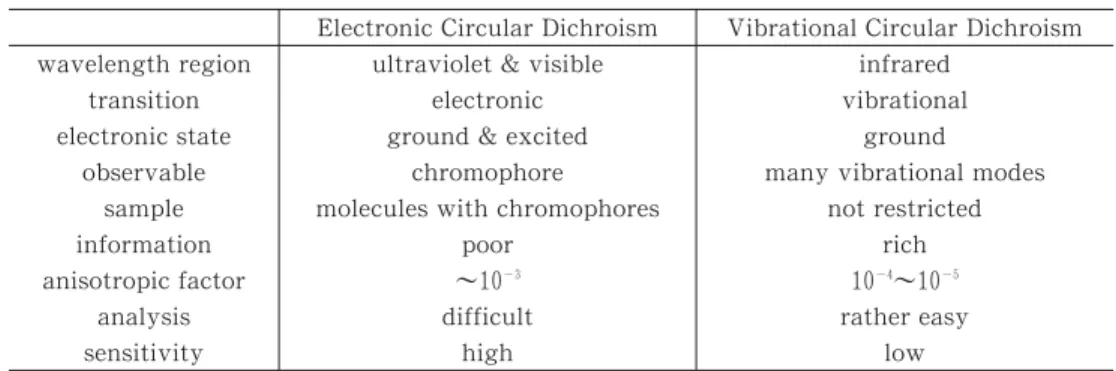
The g value of the electronic transition in visible and ultraviolet region is in order of ῍ῌ῎ to ῍ῌ῏, whereas that of the vibrational transition in infrared region is in order of ῍ῌῐ to ῍ῌῑ. The sensitivity of measurement in infrared region is lower than that in visible and ultraviolet region by an order of ῍ῌ῎. This is why the study of vibrational circular dichroism VCD has been behind the experi- mental study on the electronic chircular dichroism ECD.
ῌ4 Vibrational Optical Activity
As the infrared absorption spectroscopy and Raman scattering spectroscopy are complementary methods in vibrational spectroscopy, there are two methods that measure the vibrational optical activity VOA. These are vibratinal circular dichroism VCD that measures absorption difference of the chiral molecules by the circularly polarized infrared radiations, and vibrational Raman optical activ- ity ROAthat measures the different features of Raman spectra using circularly polarized laser radiation.
The research on VOA started in early ῍ΐῌs. The VCD instrument was con- structed by Holzworth in early stage of developmentῑ, and applied for the measurement of single crystal of NiSOῐῌῒH῎O in῍ΐ῏ῒ, and then to liquid sample in ῍ΐῐΐ. Since then there has been a steady development in measuring tech- niques and theoretical explanations. Recently, a commercial VCD and ROA in- struments are available, and purely theoretical calculation method is incorpo- rated in a widely used ab initio MO calculation package. There have been published a lot of references on VOA. Even so, VOA methods are not well spread over the communities of analytical chemistry, chiral chemistry, pharma- ceutical sciences, and so on. The reason would be that the measurement of VOA has been difficult, and only a few groups have been able to carry out the experimental researches. Therefore, the experiences on VOA spectra are still limited and we do not have enough data to elucidate some empirical rules that relate the spectral features with geometrical and/or other natures of molecules.
ῌ +-*
Any key band would be helpful even when we do not have some clear theoreti- cal explanations of them for practical purposes, but any effort has not been paid along this line, maybe because of their experimental difficulties and limited data available.
We now have easy-to-use apparatus available commercially as described above and the theoretical tool to predict the observed VOA spectrum ῍at this moment, only VCD spectrum can be treated῎ with sufficient accuracy enough to assign the observed spectrum. The time is maturing to carry out extensive survey of the chiral molecules. This is our motivation to start the VOA, especially VCD research. We aim to experience, first, to measure some small but typical mole- cules in great detail and most carefully, for the evaluation of the potentiality of the VCD method.
Table ῍ shows the comparison of characteristics of electronic circular dichro- ism ῍ECD῎ and vibrational circular dichroism ῍VCD῎. ECD has the higher sensi- tivity than VCD and there have been so many experiences stored in modern scientific researches. However the ECD spectrum is rather simple and broad, therefore the information from the spectrum is limited. On the contrary, VCD activity is accompanied by each vibrational mode, aside its intensity. Therefore, VCD should have so many pieces of information in essence. Although their analyses are rather difficult since there is no apparent relation between VCD strength and its direction with the corresponding infrared absorption band.
ῌ4 Method for Measuring VCD Spectrum
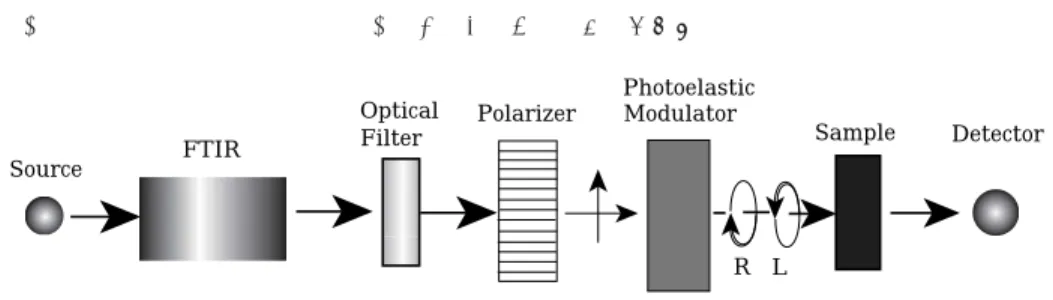
Fig4ῑ shows a block diagram of VCD apparatus. The monochromatic infrared radiation by a dispersive spectrometer or modulated infrared radiation by a Fourier transform spectrometer is introduced into a system of creation and modulation of circularly polarized light. The creation and selective detection of LCL and RCL is carried out with the combination of a polarizer and a quarter-
Table4῍ Comparison of ECD and VCD
Electronic Circular Dichroism Vibrational Circular Dichroism wavelength region ultraviolet & visible infrared
transition electronic vibrational
electronic state ground & excited ground
observable chromophore many vibrational modes
sample molecules with chromophores not restricted
information poor rich
anisotropic factor ῌ῍ῌ῏῎ ῍ῌ῏῏ῌ῍ῌ῏ῐ
analysis difficult rather easy
sensitivity high low
Vibrational Circular Dichroism Spectroscopy +-+
Ey
E Ex
45°
45°
+R
−R (a)
(b) (c)
(d) (e)
R=λ/4
λ/4
−λ/4 0
LINEAR RIGHT LINEAR LINEAR CIRCULAR LEFT
CIRCULAR R L
Sample Detector
Source FTIR
Optical Filter
Polarizer
Photoelastic Modulator
wave plate which is modulated by an electric circuit at the frequency between ῎ῌ and ῍ῌῌkHz. The polarized infrared radiation is illuminated onto the sample, and the transmitted IR is focused onto the high-sensitive IR detector, usually a liquid N῎ cooled MCT ῌHgCdTe῍ or InSb detector.
Fig4ῐ Retardation effects of compression and extension Fig4῏ Block diagram of VCD spectrometer
῏ ῒ ῌ ΐ ῐ῎ῑ +-,
῎-ῌ4 Principle of Photoelastic Modulator
One of the most important module in VCD spectrometer should be a photoelas- tic modulator, PEM. PEM is a device that consists of a rectangular bar of birefringence ῌdouble refraction῍ material transparent for infrared radiation at- tached to a piezoelectric transducer. By applying the alternating current to the piezoelectric transducer, the birefringence crystal starts oscillate with its reso- nant frequency ῌwm῍, which in turn produce the oscillating anisotropy of the refractive index.
The effect of the modulator on a linear polarized light wave is shown in Fig4 ῐῐ῍. The plane polarization is declined by ῎῏degrees to the modulator axis before passing through the modulator. If the optical element is relaxed the light passes through with the polarization unchanged ῌFig4ῐῌa῍῍. If the optical element is compressed, the polarization component parallel to the modulator axis travels slightly faster than the vertical component. The horizontal component then
“leads” the vertical component after light passes through the modulator ῌFig4ῐ ῌb῍῍. If the optical element is stretched, the horizontal component “lags” behind the vertical component ῌFig4ῐῌc῍῍.
The phase difference between the components at any instant of time is called the retardation. The peak retardation is the amplitude of the sinusoidal retarda- tion as a function of time. The retardation ῌin length units῍ is given by
Aῌt῍ῑz῎nxῌt῍ῐnyῌt῍῏, ῏-῍῍
where z is the thickness of the optical element and nxῌt῍ and nyῌt῍ are the instantaneous values of refractive index along the x- and y- axes, respectively.
An important condition occurs when the peak retardation reaches exactly one-fourth of the wavelength of light. When this happens, the PEM acts as a quarter-wave plate for an instant and causes a ῐῌ-degree phase shift between two orthogonal polarization components. Fig4ῐῌd῍shows this condition at the instant retardation is at its maximum.
The polarization vector traces a right-handed spiral about the optic axis. Such light is called “right circularly polarized.” For an entire modulator cycle, Fig4ῐῌe῍ shows the retardation vs. time and polarization states at several points in time.
The polarization oscillates between right and left circular, with linear ῌand elliptical῍ polarization states in between.
῎-῍4 Treatment of Circularly Polarized Light
The phase difference for the polarized lights along the x- and y-axes after passing through the PEM of the length of d is
Vibrational Circular Dichroism Spectroscopy +--
ddxdy῎pd
lnxny῎pd
lDndῌsinwmt. ῑ-῎
The electric vector of the linearly polarized light which incidents at ῐῑ degrees declined against the principal x-axis should change to
Em Eῌ
῎῎excoswnx
c t
eycosw ny
c t Eῌexey
῎῎ cosd
῎ cosw
nd c ῍
E ῑ-῏ Eῌexey
῎῎ sind
῎ sinw
nd c ῍
E Eῌ
῎῎ cosd
῎ sin
d
῎
eR῍iexpiw nd
c t
c. c ER Eῌ
῎῎ cosd
῎ sin
d
῎
eL῍iexpiw nd
c t
c. c EL.
ῑ-ῐ
when the light passed through PEM῍ῌ. Here, E and E is the amplitudes of the electric vector components, parallel and perpendicular to the polarizer, and ER
and ELare the amplitudes of the right and left polarized lights. The power of the light is proportional to the amplitude. Therefore, we obtain
ERL῎Eῌ῎
῎
cos d
῎ sin
d
῎
῎Eῌ῎
῎ ῍sind, ῑ-ῑ
and the strength of light which has passed through passed the PEM is ImIRIL
Iῌ
῎ ῍sindῌsinwmt IR. ῑ-ῒ
Iῌ
῎ ῍sindῌsinwmt IL
The function sind can be expanded with a Fourier series by the Bessel functions as
cosdcosdῌsinwmtJῌdῌ῎
n῍
S
J῎ndῌcos῎nwmt. ῑ-ΐsindsindῌsinwmt῎
nῌ
S
J῎n῍dῌsin῎n῍wmt. ῑ- By ignoring the high frequency components, we can understand that the linearly polarized lights are modulated by twice the frequency of the driving frequency of the modulator, whereas the circularly polarized lights are modu- lated by the same frequency of the modulator. Therefore, we can measure the linearly and circularly polarized lights by lock-in amplified by the frequencies of῎wm andwm.
+-.
CH2
*
The intensity of the light, which is focused onto the detector after passing through the chiral sample, will be described as follows,
Iΐῌ
῍Iῌ
῎῎
῏῍ῌῒaR῏῍ῑ῎J῍῍dῌ῎sinwmtῑῌῐ ῍IR῎ ῑῌ
῍Iῌ
῎῎
῏῍ῌῒaL῏῍ῑ῎J῍῍dῌ῎sinwmtῑῌῐ ῍IL῎ ΐῌ
῍Iῌ
῎῎
῏῍ῌῒa῏῍῍ῌ῍῍/῎῎Daῑ῍ῌῒ῍῍/῎῎Da῎ ῍IDC῎
, ῑ-῎
ῑ῍῍ῌ῍῍/῎῎Daῒ῍ῌῒ῍῍/῎῎Da῎῎J῍῍dῌ῎sinwmtῐ ῍IAC῎
where Da is the difference of the absorbance for LCL and RCL, that is
DaΐaLῒaR. ῑ-῍ῌ῎
The ratio of alternating current and direct current of the frequency of wm is IAC
IDCΐ῎J῍῍dῌ῎ ῍῍ῌ῍῍/῎῎Daῒ῍ῌῒ῍῍/῎῎Da῎
῍῍ῌ῍῍/῎῎Daῑ῍ῌῒ῍῍/῎῎Da῎G῍˜n῎
ΐG῍˜n῎῎J῍῍dῌ῎tanh῍ln῍ῌDa/῎῎ , ῑ-῍῍῎
ῐG῍˜n῎J῍῍dῌ῎ῒ῎.῏ῌ῏Da
where G῍˜n῎ includes the gain of electric circuit, and is a constant intrinsic to the instrument.
ῌ4 Example of Observed VCD Spectra
The ordinary infrared absorption spectrum and VCD spectrum of b-pinene have been measured by using a Fourier transform spectrometer, Model Chiralir constructed by Bomem Inc. The measurement conditions are the followings;
spectral region: ῎ῌῌῌ to ΐῌῌ cmῒ῍, resolution: ῐ cmῒ῍. The optical path length of liquid cell was adjusted between ῍ῑ to ῒῑ mm so that the absorbance of infrared band to be around ῌ.ῐ, which is of practical importance to obtain a good VCD signal. We used a liquid nitrogen cooled MCT detector. The accumulation time
Fig4῍ῌ Molecular structure of῍S῎-b-pinene The symbolῑdenotes the chiral center.
Vibrational Circular Dichroism Spectroscopy +-/
1800 1600 1400 1200 1000 800 (Wavenumber/cm−1)
observed (neat)
(a)
(b)
(c)
(d)
for VCD measurement was ῒ hours ῐῌ scans/min.
Raman spectrum was also measured by using a laser Raman spectrometer, Dilor XY. The excitation wavelength was set to ῐ῍῏.ῐ nm of Ar ion laser.
The ab initio theoretical calculations were carried out by using a program package, Gaussian ΐῒ῍῍. A few combinations of the wavefunctions and basis sets were examined. We chose Hartree-Fock wavefunction or a method depending on the density functional theory DFT, particularly the B῎LYP method. Also exam- ined were a medium size basis set, ῏-῎῍G, and a rather large basis set up to ῑ-῎῍
G῍῍. First, molecular geometry was optimized and then normal vibration and its IR, Raman, and VCD strength were calculated.
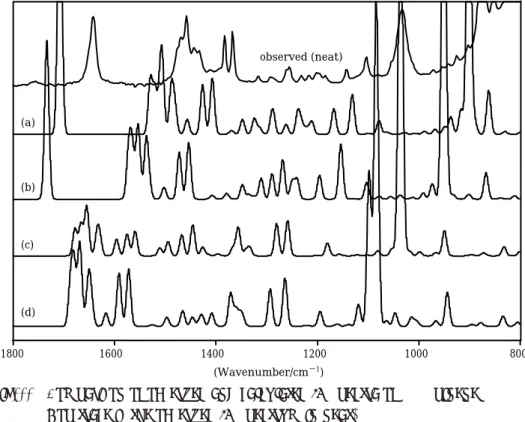
Fig4῍ῌ shows the molecular structure of S-b-pinene. Figures ῍῍ to ῍῎ show the parts of the observed spectra of IR, Raman, and VCD. In each figure, the observed spectrum is compared with calculated spectra by the ab initio method.
The top trace is the observed spectrum, and the next two traces a and b
Fig4῍῍ Comparison of observed and calculated IR spectra ofS-b-pinene Top trace is the observed IR spectrum in neat.
aCalculated spectrum by B῎LYP/ῑ-῎῍G῍῍, bCalculated spectrum by B῎LYP/῏-῎῍G, cCalculated spectrum by HF/ῑ-῎῍G῍, dCalculated spectrum by HF/῏-῎῍G.
ῌ +-0
1600
1800 1400 1200 1000 800
(Wavenumber/cm−1) observed (neat)
(a)
(b)
(c)
(d)
Fig4ῌ῍ Comparison of observed and calculated Raman spectra ofῌS῍-b-pinene Top trace is the observed Raman spectrum in neat.
ῌa῍Calculated spectrum by B῎LYP/ῐ-῎ῌ῎Gῌῌ, ῌb῍Calculated spectrum by B῎LYP/῏-῎ῌG, ῌc῍Calculated spectrum by HF/ῐ-῎ῌGῌ, ῌd῍Calculated spectrum by HF/῏-῎ῌG.
Vibrational Circular Dichroism Spectroscopy +-1