STUDIES ON p-HYDROXYPHENYL- AND
SYRINGYL LIGNINS
Toru YAMASAKI
Contents
1. Preface .,, , , , ,".,
.,
., ,," ,, ,, , ,,,....
" , ,,,,,, ,, , ,,.
, , , .. , , , , , , , , , .,, , , , ,,, , , , , ,,, ,..
,,,,, , , , ,, , , ., , , .,,,,, , , .,, , ,,".
, ..,, , , , ,...
111. , p - ~ ~ dunit of grass lignin ~ ~ ~ ~,,. ,,
...
.,,, ~.. ,,.. ... h,.. ,,, , , , ~,, , , , ,. .
~, ,,...
.., , ~,. .. , l, , ,, , ,.
~2 ~ ~ ~ ~ ~ ~1. Introduction , , , , , , , , , , , , , , , , , , , . , , . , , , , , , , , . , , , , , , , , , , , , , . , , , , , , . , . . .
..
. . . , , , , , , , , , . . . , . , , , , , .....
... . ....
2 2. Enzymic dehydrogenation polymer of' ,p-coumaryl alcohol (p-DHP) , , , , , , , , , , , , , , , , . , 33. ,P-Hydroxyphenyl component of grass lignin , ~ ~ , ~ ~ ~ , , ~ ~ . . . ~ ~ ~ ,,,,
.
. .
,, ,, , ,,.
114.
occurrence
of diphenyl ether structure in lignin ,,,,, , , . , ,..., , , , , , , . , . ..,... , ..,...
.. . 14 111. Occurrence of syringyl lignin in hardwood, , , , , , , . , . , , , , , . , , . , , , , , , , , , , . , , . . , ,, , , , , , . . . , , , , , , . , " . I 51. ~ ~ t ~
...
~....
..,...
d ~ ~ t i ~..
~, , , , , , . .....
., , . ,, . .....
.
., , , , , , , , , ,...
. , , , ,,, ,.
.15 2. Enzymic dehydrogenation polymer of sinapyl alcohol (s-DHP) + . . , , , , , , , , , , ,,, ..,.,, -17A. Formation of s-DHP.,, . , , ,
..
,, , , ,,,.. , ,,, , ,,, ,,.,, , , , , , ,. .,,...
,,....
, , , , , , , , ,,.
, ,,,,, , , ..,., , , . ,...
. , ,,. ,,,.....
17 B. constitutional model of s - ~ ~ p . ,,, , ., ,,,. .,. .
,,,,. ,. ,,,,, .. , . ., ,,. ,,,,,,,,, ,,, ,,,.
.,,...
, .,,., , ,...
,..
,,, ., ,, ,,. 19 3. syringyl lignin of hardwood ,, , . , .. ,..,,, , .,, . , ,....
...
....
..
... . ,
. , , ,,...., , , ,,.. . ,...
..
..,, , ..,...
29 A. Separation of s-DHP from a mixture of c- and s-DHPs by mercuration ,..29B. Syringyl unit-rich lignin of hardwood , , , , , ,,....,,,...,,,,,,,.,,,..,,...,,,,,,,,.,,,..,,..,, ",,,,,,,,,.. 34 1V. Concluding remarks ,,,,,, . , .. . . .
..
,....
, , , . ,, , ,...,,..
, , , ,..,,,..,
.,, ,..,,,..., , ,, ,,,,,, ,, ,,,, , ,,...,
, ,,,,., ,.. ,,,., , , ,., ,38Acknowledgments References
I. Preface
Lignin occurs widely in the tissues of terrestrial vascular plants in great amounts equal to starch and next to cellulose. I t is a natural high molecular compound produced by peroxidase-catalyzed dehydrogenative polymerization of conifer yl, sinapyl, and 9-coumar yl alcohols. Lower terrestrial plant (club mosses and ferns)- and gymnosperm lignins a r e mostly composed of guaiacylpropane units, whereas angiosperm lignin is composed of guaiacylpropane and syringylpropane units, and grass and bamboo lignins, the both units and p-hydroxyphenylpropane units. No lignin has been found in bacteria, fungi, algae, lichens, and br yophytes.
Knowledge of lignins has been developed by numerous scientific workers, especially, by P. Klason, K. Freudenberg, H. Erdtman, H. Hibbert, and E. Adler in relation to the pulp and paper industry. Freudenberg': confirmed that lignin i s a dehydrogenation polymer of coniferyl alcohol or its related alcohols a s suggested by Klason and Erdtman2), and established the chemical scheme of spruce lignin over almost 30 years of his life. Neish and other plant biochemists have been trying to elucidate the biosynthesis of lignin mono- mers in higher plants.
However the systematic investigation of angiosperm lignins is in rather slow progress. T h i s may be due to the following two reasons t h a t the pulp and paper industry was in need of softwoods in former, and that hardwood lignin is a complex dehydrogenation copolymer of conifer yl and sinapyl alcohols.
T h e present investigation comprises the following subjects.
1. Chemical properties of dehydrogenation polymer of p-coumaryl alcohol
2. Characterization of 9-hydroxyphenyl component in the polymeric system of grass and bamboo lignins
3. Dehydrogenation polymer of sinapyl alcohol by peroxidase and hydrogen peroxide 4. Possible occurrence of syringyl lignin in nature
T h e amount of p-coumaric acid esterified to alcoholic hydroxyl groups of the side chain of grass and bamboo lignins is estimated to be 5 to 10% of these lignins3). On the other hand p-hydroxyphenylglycerol-fl-aryl ether moiety of these lignins is found to be quite minor4). Therefore i t is conceivable that various condensed P-hydroxyphenyl components in the polymeric system of the lignins probably occur in a considerable amount. However t h e condensed #-hydroxyphenyl moieties of grass and bamboo lignins have not yet been investi- gated. In the present investigation a considerable amount of a biphenyl and two diphenyl ether carboxylic acids composed of p-hydroxyphenyl and guaiacyl units, which could not be found from soft- and hardwoods lignins, were detected in the permanganate degradation products by gas-liquid chromatography. And a peculiar structural feature of grass and bamboo lignins is discussed in relation to chemical properties of dehydrogenation polymer of p-coumaryl alcohol (p-DHP).
I t has been known t h a t angiosperm lignins show the variation of the ratio of syringyl unit to guaiacyl within the same species, by tissue and cell wall5). I t is conceivable t h a t
the variation is due to the modes of biosynthesis of sinapyl alcohol and coupling of the radicals of the lignin monomers, especially sinapyl alcohol. For the former problems roles of S-adenosylmethionine-catechol 0-methyltransferase6)>') and ferulic acid 5-hydroxylase8) is being actively studied. For the latter Sarkaneng) has proposed the view t h a t the nature of lignins (end-wise- and bulk polymers) is effected by the stationary concentration of monomer radicals, on the basis of difference between the two dehydrogenation procedures (Zutr opf- and Zulauf methods) by Fr eudenbergl0).
T h e latter half of the present investigation has been performed to establish the occurrence of syringyl lignin in angiosperm tissues. Firstly formation of dehydrogenation polymer from sinapyl alcohol alone (s-DEIP) was confirmed. Secondly a distinct difference of the solubility in acetic acid between mercurated s-DHP and dehydrogenation polymer of coniferyl alcohol (c-DHP) could be found, and s-DHP was separated from a mercurated mixture of
s- and c-DHPs. Finally syringyl unit-rich lignin could be isolated and characterized from beech and Yamamomo woods by the application of mercuration.
11. p-Hydroxyphenylpropane u n i t of grass lignin 1. Introduction
As early a s 1943 Hachihama and Jodai") isolated and identified 1-propyl-4-hydroxybenzene in addition to 1-propyl-3-methoxy-4-hydroxybenzene and 1-propyl-3,5-dimethoxy-4-hydroxy- benzene from hydrogenolysis products of bagasse hydrochloric acid lignin, and proposed the view that $-hydroxyphenylpropane unit is one of main building units of grass lignin. At the same time Creighton and Ilibbert'2) obtained $-hydroxybenzaldehyde from products of alkaline nitrobenzene oxidation of corn stalks, and proposed the similar view. p-Hydroxy- benzaldehyde was also detected in the oxidation products of gymnosperms and angiosperins by Nord
et
aZ.13), Leopold et aZ.14) and Bland15). On the other hand G ~ l d s c h m i d ' ~ ) and Higuchi") found a small amount of $-hydroxycinnamaldehyde in aqueous hydrolysis products of western hemlock and bamboo, respectively. Furthermore Rratzl and Schweers18) obtained a small amount of p-hydroxyphenylpropanones from ethanolysis products of beech cuproxam lignin and p-DHP. Thus $-hydroxyphenylpropane unit has been confirmed to be one of the building units of all higher plants.I t has been shown a s a characteristic feature of grass and bamboo lignins that they contain 5 to 10% of ester of p-coumaric acid accompanied by ferulic acid in small amounts3). Occurrence of the ester of $-hydroxybenzoic acid in aspen lignin was first demonstrated by Smithlg) who indicated that the acid is linked to aliphatic hydroxyl group. Vanillic and syringic acids have been also known to occur a s an ester with lignins20). T h e occurrence of the esters is widely distributed over softwoods, hardwoods, and tropical woods21). Nakano
et
al.22) presumed that a part of 9-hydroxybenzoic acid is esterified to alcoholic hydroxyl group a t a-position of the side chain of aspen lignin molecule. Okabe and K r a t ~ l ~ ~ ) proposed a possibility that $-hydroxybenzoic acid might be linked to the a-position on the basis of the nucleophilic attack by the acid on a-carbon atom of intermediate quinonemethide during dehydrogenation of coniferyl alcohol. On the other hand Pew and con nor^^^) suggestedanother possible esterification to phenolic hydroxyl group during intramolecular rearrange- ment of the side chain on the ground that new types of a dimer and a trimer containing an ester were obtained on dehydrogenation of p-hydroxypropiophenone by peroxidase and hydrogen peroxide. Shimada e t U Z . ~ ~ ) and Nakamura e t u Z . ~ ~ ) confirmed, on the basis of spectral and analytical data obtained by methanolysis, thioglycolation, hydrogenation and acidolysis using models and MWLs, that the majority of $-coumaric and 9-hydroxybenzoic acids are linked to the alcoholic hydroxyl groups a t r-carbon atoms of the side chains of lignin molecules, and that the formation of the esters may be biochemically controlled, i.e., by the mediation of an acylating enzyme. Kratzl and Claus2') obtained a small amount of 1-(4-hydroxypheny1)-propane-l,2-dione from ethanolysis oil of bamboo and rye plants, and they confirmed that a part of p-hydroxyphenyl component of grass lignin is composed of 8-hydroxyphenylglycerol-B-aryl ether structure. Higuchi and Kawamura4) showed that the $-hydroxyphenylglycerol-B-aryl ether moiety is not specific to grass lignin but occurs in various plant lignins, and the amount of the moiety between conifers and grasses is almost equal and a little less in dicotyledonous trees. Furthermore Adlerz8) obtained a small amount of 3-hydroxy-1-(4-hydroxypheny1)-propane-Zone from acidolysis oil of spruce lignin, and they confirmed the occurrence of 9-hydroxyphenylglycerol-8-aryl ether moiety in conifer lignin.
Aromatic carboxylic acids produced by permanganate oxidation of methylated lignin were first obtained by Freudenberg et al.29)"31) to investigate the condensed C-C linked aromatic moieties of lignin. Veratric, isohemipinic and 5,5'-dehydrodiveratric acids were obtained from spruce lignin, and trimethylgallic acid in addition to the acids from beech. Further- more numerous aromatic compounds of anisole, veratrole and tr imethoxybenzene series were isolated and identified by Richtzenhain3'), Freudenberg e t U Z . ~ ~ ) ' ~ ~ ) , and Larsson e t al.36).
2. Enzymic dehydrogenation polymer of p-coumaryl alcohol (p-DHP)37)
Grass and bamboo lignins are believed to be a polymer composed of $-hydroxyphenyl, guaiacyl and syringyl units. While, several worker^^^)'^^) have proposed the view t h a t Sphagnum cell walls contain a low methoxyl lignin which is basically a highly condensed polymer by double condensations a t 3- and 5-positions of $-hydroxyphenyl nuclei.
In the present investigation enzymic dehydrogenation polymers (DHPs) prepared from p-cournaryl, coniferyl, and sinapyl alcohols by the Zulauf method were subjected to nitro- benzene and permanganate oxidation, and acidolysis, and their chemical properties, especial- ly the degree and pattern of nucleus substitution of $-hydroxyphenyl component of grass and bamboo lignins were studied. P-DHP was first prepared by Freudenberg e t However little infor mation is available concerning chemical proper ties of the p-DHP, except an ethanolysis experiment by Kratzl ef a l l 8 ) .
Results and discussion
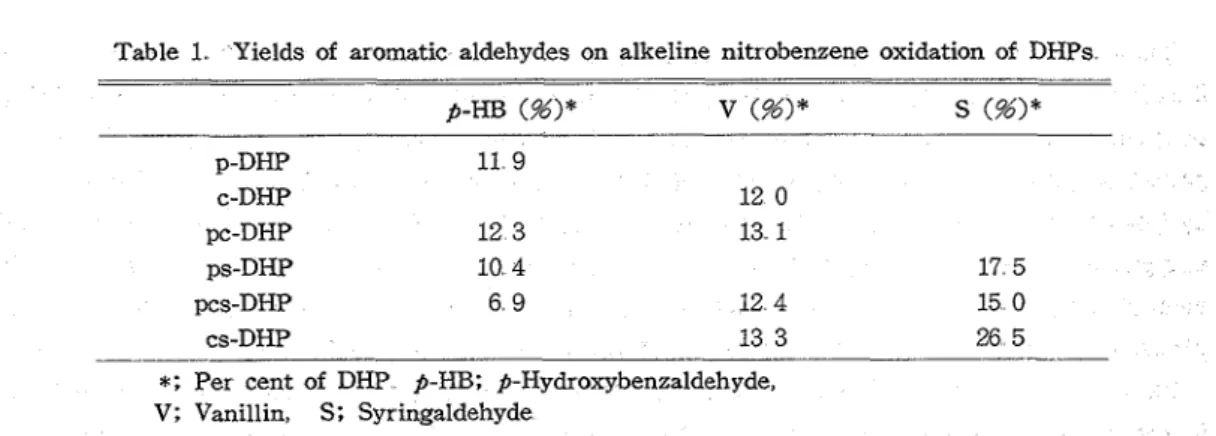
Yield of each aromatic aldehyde produced by alkaline nitrobenzene oxidation of the DHPs is shown in Table 1. The amount of 9-hydroxybenzaldehyde from p-DHP was approximately equal to t h a t of vanillin from c-DHP, and molar ratio of $-hydroxybenzaldehyde to vanillin for DHP of a 1 : 1 mixture of $-coumar yl alcohol and conifer yl alcohol (pc-DHP) was
Table 1 Yields of aromatic aldehydes on alkeline nitrobenzene oxidation of DHPs
P-HB (%I* V
(%I*
S (%I*p-DHP 11 9 C-DHP 12 0 pc-DHP 12 3 13 1 ps-DHP 10 4 17 5 pcs-DHP 6 9 12 4 15 0 --cs-DHP 13 3 26
---
5*;
Per cent of DHP p-HB; p-Hydroxybenzaldehyde, V; Vanillin, S; Syr ingaldehydesomewhat higher than one. T h e molar ratio for DHP of a 1 : 1 : 1 mixture of 9-coumaryl, coniferyl and sinapyl alcohols (pcs-DHP), on the other hand, was about 2/3 of that for the pc-DHP, while the yield of p-hydroxybenzaldehyde from DHP of a 1 : 1 mixture of $-coumaryl and sinapyl alcohols (ps-DHP) was similar to that from the p-.DHP and pc-DHP,
although the reason is still unknown. Thus it may be considered that free radicals of
p-
coumaryl and sinapyl alcohols do not effect an apparent condensation pattern of coniferyl alcohol, and that the condensation pattern of 9-coumaryl alcohol is very similar to that of coniferyl alcohol except the case of copolymerization of the three alcohols.
Table 2 Yields of acidolysis products of DHPs
-- - -- - Products (%)* p-DHP c-DHP pc-DHP ps-DHP pcs-DHP cs-DHP - R-CHO 0 4 0.5 0 3 0 3 R-CHzCOCH3** tt 0 7 1.0 0 2 R-COCOCH3 St ti 0 3 it R-COOH t t ti ti R-CHOHCOCH3** St ti 0 3 ti R -COCHOHCH3** 0 4 0 3 0 5 0 4 R-CHLCOCHZOH it 0 3 0 3 0 7
*;
Per cent of DHP**;
These components were identified by gas chromatography-mass spectrometry using a Shimadzu LKB-9000 R-; p-Hydroxyphenyl group, R1-; Guaiacyl group, R"-; Syringyl group, St; Small,+,; Trace
Table 2. shows yields of acidolysis products of the DHPs. A considerable amount of 2-hydroxy-1-(4-hydroxypheny1)-propane-1-one and a small amount of 1-(4-hydroxypheny1)- propane-Zone, 1-(4-hydroxypheny1)-propane-l,2-dione, 1-hydroxy-1-(4-hydroxypheny1)-pro- pane-2-one and 3-hydroxy-1-(4-hydroxypheny1)-propane-2-one, suggesting participation of $-
hydroxyphenylglycerol-m-hydroxyphenyl ether structure, a s well a s $-hydroxybenzaldehyde and $-hydroxybenzoic acid were detected in the acidolysis products of the DHP of p-coumaryl alcohol alone. These $-hydroxyphenylpropanones which a r e ascribed to $-hydroxyphenyl- glycerol-B-aryl ether structure were also found from pc-, ps-, and pcs-DHPs.
Faix and S c h w e e r ~ ~ ~ ) have recent1 y reported that no 9-hydroxybenzaldehyde was found in the products of alkaline nitrobenzene axidation of various DHPs prepared from mixtures of p-coumaryl, coniferyl, and sinapyl alcohols in various ratios by laccase obtained from Psallzota campestrzs, and presumed that p c o u m a r y alcohol gives a highly condensed C-C linked moieties during the formation of DHP. Their findings a r e in sharp contrast to the results in the present work. I t is probably due to autoxidation of their DHPs by oxygen molecule, since radicals are formed by laccase much slower than by peroxidase*.
Total yield of guaiacylpropanones, such a s 1-(4-hydroxy-3-rnethoxyphenyl)-propane-2-one, 1-(4-hydroxy-3-methoxyphenyl)-propane-1,2-dione, 1-hydroxy-1-(4-hydroxy-3-methoxypheny1)- propane-Zone, 2-hydroxy-l-(4-hydroxy-3-methoxyphenyl)-propane-l-one, and 3-hydroxy-144- hydroxy-3-methoxypheny1)-propane-2-one, from the c-DHP was several times higher than that of 9-hydroxyphenylpropanones from the p-DHP. The results suggest whether the occurrence of P-0-4 coupling of radicals derived from $-coumaryl alcohol by peroxidase and hydrogen peroxide is rather deficient a s compared to that of radicals from coniferyl alcohol or $-hydroxyphenylglycerol moiety of P-0-4 structure is subsequently condensed with other lignin units. Kratzl e t al.18)147) also reported similar results with ethanolysis of p- and c-DHPs prepared by mushroom laccase.
However the yield of $-hydroxyphenylpropanones increased considerably in the case of the DHP in which $-couniaryl alcohol was copolymerized with coniferyl alcohol or sinapyl alcohol, indicating that dehydrogenation copolymers of $-coumaryl alcohol and other lignin monomers a r e sufficient in $-hydroxyphenylglycerol-P-aryl ether structure a s compared to p-DHP.
T h e yields of guaiacylpropanones from the pc-DHP and DHP of a 1 : 1 mixture of coniferyl and sinapyl alcohols (cs-DHP) were also much higher than that from the c-DHP, whereas the difference in the yield between p-hydroxyphenylpropanones and guaiacylpropanones seems to lessen in the pcs-DHP. Kratzl and Buchtela") reported that DHP prepared from 3 g of coniferyl alcohol and 1.5 g of sinapyl al~ohol-(3-'~C) by the Zulauf method using crude - -- . - - . . . . -. .. . .- . . . - - - - - . . - -. - - - - - - - - . . . -. . . . . . . . - - . -. . -. . -. . - . -. -
*
Peroxidase is widely distributed in plants, whereas the occurrence of laccqse in higher plants is limited Higuchi e t a2 4 3 ) , 4 4 ) found that radish peroxidase catalyzes the formation of DHP from coniferylalcohol, and proposed that peroxidase plays a more important role than laccase in lignin biosynthesis Nakamura4=) demonstrated that plant laccase purified is incapable of catalyzing the formation of DHP
from lignin monomers Harkin and O b ~ t ' ~ ) have recently confirmed that peroxidase is unequivocally responsible for dehydrogenative polymerization of lignin monomers in plants From these results is strongly supported a view that peroxidase principally participates in the formation of lignin in higher plants
laccase obtained from mushroom, gave a considerable amount of 1-(4-hydroxy-3,5-dime.. thoxypheny1)-propane-1, 2-dione-(3-14C) a s well a s 1-(4-hydroxy-3-methoxypheny1)-propane- 1,2-dione by ethanolysis. In the present investigation, however, the yields of syringyl- propanones from the ps-DHP, cs-DHP and pcs-DHP were quite small, indicating that, in the DHP prepared by the Zulauf method, a participation of syringylglycerol-P-aryl ether structure is of minor importance a s compared to t h a t in hardwood MWL.
Studies on the enzymic dehydrogenation of sinapyl alcohol by Zutropf method should be still performed with reference to the Zulauf method.
Yields of methylesters of aromatic carboxylic acids in the potassium permanganate and hydrogen peroxide oxidation products of methylated DHPs a r e shown in Table 3. Yield
Table 3 Yields of methylesters of aromatic carboxylic acids in permanganate and hydrogen peroxide oxidation products of methylated DHPs
-- - -Methylester
(%I*
P-DHP C-DHP pc-DHP ps-DHP pcs-DHP CS-DHP Anisic acid Veratric acid Tr imethylgallic acid 4- Methoxyisophthalic acid 4-Methoxy-o-phthalic acid Isohemipinic acid Metahemipinic acid Methoxytr imesic acid 2-Methoxydiphenyl ether-
5,4'-dicar boxylic acid 3,3'-Dehydrodianisic acid 2,3 Dimethoxydiphenyl ether
-
5,4'-dicar box jrlic acid 2,8-Dimethoxydiphenyl ether -
5,4'-dicarboxylic acid 2,3,8-Trimethoxybiphenyl-
5,5'-dicar boxylic acid
2,3,8-Tr imethoxydiphenyl ether
-
5,4'-dicarboxylic acid5,5'-Dehydrodiver atr ic acid 2,3,2', 6'-Tetramethoxydiphenyl
ether -5,4'-dicarboxylic acid
*;
Per cent of methylated DHP tt; Small, f ; Trace.of anisic acid from the DHP of p-coumaryl alcohol alone was 2.9695, that of Cmethoxy- isophthalic acid was 1.05%, and that of 3,3'-dehydrodianisic acid was 2.4396, respectively. I n addition a small amount of 4-methoxy-o-phthalic and 2-methoxydiphenyl ether-5,4'- dicarboxylic acids were found. However methoxytrimesic acid was scarcely detected in the degradation products of the DHP from $-coumaryl alcohol alone. On the other hand a considerable amount of veratric, isohemipinic and 5,5'-dehydrodiveratric acids, and a small amount of metahemipinic and 2,3,2'-trimethoxydiphenyl ether-5,4'-dicarboxylic acids were found from the DHP of coniferyl alcohol. These findings make i t reasonable to believe that $-coumaryl alcohol, of which carbon atoms a t 3- and 5-positions in the aromatic nucleus
a r e unsubstituted for methoxyl groups, polymerizes in a similar manner with coniferyl alcohol, and a participation of a considerable amount of dehydrodi-9-coumaryl alcohol, 9-coumarylresinol, and dehydrobis-p-coumaryl alcohol, and of a small amount of dehydrodi- #-coumaryl ether involving diphenyl ether a r e suggested in t h e DHP of 9-coumaryl alcohol. In fact these dimers were isolated and identified from the dehydrogenation products of p-coumar y alcohol49).
Molar ratio, calculated on the yield shown in Table 3, of each methylester of the main acids of anisole and veratrole series to methyl anisate and methyl veratrate, respectively is shown in Table 4. T h e molar ratio of dimethyl 4-methoxyisophthalate to methyl anisate
Table 4 Molar ratios of methylesters of main acids of anisole and veratrole series to methyl anisate and methyl veratrate
Methylester A p-DHP C-DHP V A pc-DHP V A pcs-DHP V
4-Methoxyisophthalic acid 0 26 0 13 0 11
3,3'-dehydrodianisic acid 0 41 0 18 0 11
Isohemipinic acid 0 27 0 10 0 10
5,s'-Dehydrodiver atr ic acid 0 41 0 20 0 12
A; To methyl anisate, V; To methyl veratrate
is very similar to t h a t of dimethyl isohemipinate to methyl veratrate. T h e same thing is recognized for the molar ratio of dimethyl 3,3'-dehydrodianisate to methyl anisate and for t h a t of dimethyl 5,s'-dehydrodiveratrate to methyl veratrate.
The above findings in the present investigation suggest that no difference of condensation pattern between p-coumaryl alcohol and coniferyl alcohol substantially occurs in their DHPs formation by the Zulauf method.
Experimental
P r e p a r a t i o n o,f enzymtc deh,ydrogenatzon poZymers (DHPs)
D H P of 9-coumaryl alcohol (9-DHP): T o a solution containing 3 g of p-coumar yl alcohol in 3 liters of 1/15 M sodium phosphate buffer solution (pH 6.0) were added 0.45 m g of
crude horseradish peroxidase
(RZ;
approximately 0.3, Sigma) and 40.8 ml of 0.1% hydrogen peroxide ten times a t intervals of 12 min. On stirring t h e mixture solution a t room tempar- ature, i t became milky within about 30min, and amorphous precipitates were found to be formed gradually. T h e same amounts of peroxidase and 0.1% hydrogen peroxide were added every day by t h e same procedure, and the mixture was stirred for another 5 days. The reaction solution was evaporated to 500 ml under nitrogen a t 35-40°C, and the precipi- tates were collected by centrifugation, washed with water, and dried iiz vacuo over calcium chloride. T h e crude p-DHP was dissolved in a small amount of a mixture solution of dichloroethane/ethanol (2 : I ) , filtered to remove a trace of insoluble material, and pre- cipitated into ether wit11 stirring. Yield of the purified p-DHP was 1 . 8 g (60%).D H P of coniferyl alcohol (c-DHP) : T o a solution containing 1.8 g of coniferyl alcohol in 1.8 liters of 1/15 M sodium phosphate buffer solution (pH 6.0) were added a total 17 m g
formed were purified by the same procedure. Yield of the c-DHP was 1.2 g (67%).
D H P o,f P-coumaryl alchol and coniferyl alcohol ( 1 : 1 ) (PC-DHP): T o a solution con-
taining 0.6 g of $-coumaryl alcohol and 0.72 g of coniferyl alcohol in 1.5 liters of 1/15 M
sodium phosphate buffer solution (pH 6.0) were added a total 9 m g of the peroxidase and 408 ml of 0.1% hydrogen peroxide for 5 days, and precipitates formed were purified by
the same procedure. Yield of the pc-DHP was 0.99 g (75%).
D H P o f 9-coumaryl alcohol and sinapyl alcohol ( 1 : 1) ( 9 s - D H P ) : T o a solution con-
tainig 0.6 g of $-coumar yl alcohol and 0.84 g of sinapyl alcohol in 2.5 liters of 1/15 M sodium phosphate buffer solution (pH 6.0) were added a total 9 mg of the peroxidase and 408 ml
of 0.1% hydrogen peroxide for 5 days, and precipitates formed were purified by the same
procedure. Yield of the ps-.DHP was 0.87 g (60%).
D H P of p-coumar.yl alcohol, coniferyl alcohol and sinap.yl alcohol ( 1 : 1 : 1 ) (pcs-DHP) :
To a solution containing 0.6 g of $-coumaryl alcohol, 0.72 g of conifer yl alcohol, and 0.84 g
of sinapyl alcohol in 3.5 liters of 1/15 M sodium phosphate buffer solution (pH 6.0) were
added a total 13.65 m g of the peroxidase and 612 ml of 0.1% hydrogen peroxide for 5 days,
and precipitates formed were purified by the same procedure. Yield of the pcs-DHP was
1.55 g (72%).
D H P o f conzferyl alcohol and sinapyl alcohol ( 1 : 1 ) ( c s - D H P ) : To a solution containing
0.9 g of coniferyl alcohol and 1.05 g of sinapyl alcohol in 4 liters of 1/15 M sodium phosphate
buffer solution (pH 6.0) were added a total 11.25 mg of the peroxidase and 510 ml of 0.1%
hydrogen peroxide for 5 days, and precipitates formed were purified by the same procedure.
Yield of the cs-DHP was 1.36 g (70%). Nitrobenzene oxidatzon
DHPs were subjected to alkaline nitrobenzene oxidation for 2 hr a t 170°C. T h e reaction
solution was diluted with water, washed with ether, and adjusted to pH 2-3. Aromatic aldehydes produced were extracted with ether, and the ether solution was dried over anhydrous sodium sulfate. After evaporating the solvent, the residue was dissolved in
0.1 ml of pyridine, and 0.1 ml of hexamethyldisilazane and 0.05 ml of trimethylchlorosilane
were added. The reaction mixture was shaken, and, after 5 min, analyzed by gas-liquid
chromatography. A flame ionization detector was used for analyses of the trimethylsilyl ethers of the products: Stainless steel column ( 1 m, 3 mm ID) packed with 5% SE-30 on Chromosorb W(AW). Column temperature; 175°C. Injector temperature; 250°C. Carrier
gas; nitrogen, 0.8 kg/cm2. Acidolyszs
Ten m g of DHP was dissolved in 1 ml of a mixture solution of dioxane and water (9 : 1 )
containing 0.2 N hydrogen chloride in a glass tube and the solution was sealed and heated a t 120°C for 4 hr. The solution was added dropwise into 10 ml of water under stirring,
and adjusted to pH 3-4 with 0.4 N sodium bicarbonate. Precipitates were centrifuged off and the acidolysis products in a supernatant solution were extracted with chloroform, and the chloroform solution was dried over anhydrous sodium sulfate. After evaporating the chloroform, the residue was dissolved in 0.1 ml of pyridine, and 0.1 ml of hexamethyl- disilazane and 0.05 ml of trimethylchlorosilane were added. T h e reaction mixture was
shaken, and, after 5 min, dried i n vacuo over phosphorous pentoxide. T h e trimethylsilyl derivatives of the acidolysis products were dissolved in 1 ml of n-hexane and analyzed by gas-liquid chromatography. A flame ionization detector was used for analyses: Stainless steel column (2 m, 3 m ID) packed with 3% 92-52 on Chromosorb W: Column temperature; 195°C. Injector temperature; 240°C. Carrier gas; helium, 0.9 kg/cm2.
Perrnangnate und hydrogen peroxzde oxidation
Methylated DHPs were hydrolyzed and subjected to permanganate and hydrogen peroxide oxidation successively according to the procedure described by Larsson e t aL50): Each 0.5 g of DHPs was methylated twice with dimethyl sulfate and sodium hydroxide in dioxane/water (5 : 3) a t 65°C under nitrogen gas, and the methylated DHP was hydrolyzed with 1 N sodium hydroxide for 3 hr a t 168-170°C, and followed by remethylation in the same procedure. T h e methylated DHP thus obtained was oxidized with 5% potassium permanganate a t pH 11-12, 90-100°C, and the ether soluble-acid fraction of the permanganate oxidation products was then treated with 30% hydrogen peroxide a t pH 9-10. A mixture of aromatic carboxylic acids thus obtained was methylated with diazomethane in methanol, and analyzed by gas- liquid chromatography. A flame ionization detector was used for analyses a t following conditions: Stainless steel column ( I m, 3 mm ID) packed with 5% SE-30 on Chromosorb G (AW, DMCS). Column temperature; 165-265°C. 7.5"C or 4"C/min up, then isotherm. Injector temperature; 310°C. Carrier gas; nitrogen, 30 ml/min.
Syntheses
p-Coumaryl akohol: Acetate of ethyl p-coumarate was reduced with lithium aluminum hydride in absolute ether a t -20°C4'), and the crude alcohol obtained was recrystallized from ethyl acetate. Mp 122-124°C.
Conifeyl alcohol: T h e alcohol was synthesized from ethyl ferulate by lithium aluminum hydride reduction5'), and recrystallized from dichloromethane. Mp 74°C.
Sinapyl alcohol: Acetate of ethyl sinapinate was reduced with lithium aluminum hydride5'), and the crude alcohol obtained was recrystallized from ether/petroleum ether. Mp 65-67OC.
3-Hydroxy-l-(4-hydroxy$henyl)-propane-2-0ne: The ketol was synthesized from p-acetoxy-
phenylacetic acid according to the procedure described by LundquistS2). Mp 71-72OC. Anal. Calcd. for C~HIOOJ: C, 65.03; H, 6.07. Found: C, 64.81; H, 5.99.
3-Hydroxy-l-(4-hydroxy-3-methoxyphenyl)-propane-2-one: The ketol was prepared from
acetyl homovanillic acid according to the procedure by Fischer e t Mp 81-82°C. Anal. Calcd. for CloH1204: C, 61.20; H, 6.17. Found: C, 61.08; H, 6.17.
3-~ydroxy-I-(4-hydroxy-3, 5-dinzethoxyphenyl)-propane-Pone: The ketol was synthesized
from acetyl homosyringic acid by the procedure described by Fischer e t aLS3) for the synthesis of 3-hydroxy-l-(4-hydroxy-3-methoxyphenyl)-propane-2-one. Mp 104-105°C. Anal. Calcd. for C11Hlr05: C, 58.40; H, 6.24. Found: C, 57.92; H, 6.14.
Trzmethylgall~c acrd: Gallic acid was methylated with dimethyl sulfate and sodium hydroxide5'). Mp 167OC.
4-Methoxyisophthalic aczd: as. m-Xylenol was methylated with dimethyl sulfate and sodium hydroxide, and then oxidized with potassium permanganateS5) to the acid. Mp 245°C.
4-Methoxy-o-phthalic acid: o-Xylenol was methylated with dimethyl sulfate and sodium hydroxide, and then oxidized with potassium permanganate. Mp 162-163°C.
Isohemipinic acid: 5-Allylacet~vanillone~~) was methylated with dimethyl sulfate and sodium hydroxide, and then oxidized with potassium permanganate. Mp 261-262OC.
Metahemipinic acid: 4, 5-Dimethoxy-2-methylbenzaldehyde5') was oxidized with potassium permanganate to the acid. Mp 202-204°C.
Methoxytrimesic acid: T h e acid was synthesized from $ - c r e ~ o l ~ ~ ) . Mp 248°C.
Dimethyl 3,3'-dehydrodzanisate, Dimethyl 2,3,2'-trimethoxybiphenyl-5,5'-dicarboxylate,
a n d Dimeth,yl 5,s'-dehydrodiveratrate: T h e esters were synthesized according to the pro- cedure described by Larsson e t aL3'). A mixture of methyl 3 - i o d o a n i ~ a t e ~ ~ ) (3.54 g), methyl 5-iodoveratrate60) (3.87 g) and copper powder (15 g) was heated a t 220-230°C for 30 min, and the reaction products were extracted with ethyl acetate. T h e solvent was evaporated and the residue was fractionated by vacuum distillation. Dimethyl 5,5'-dehydrodiveratrate crystallized first from the distillate a t 130-190°C (0.01 mmHg). The crude crystals were recrystallized from ethyl acetate. Mp 129-130°C. Anal. Calcd. for CzoHzzOs: C, 61.52; H, 5.69. Found: C, 61.78; H, 5.77.
Dimethyl 3,3'-dehydrodianisate crystallized by concentration of the mother liquor. T h e ester was recrystallized from ethyl acetate. Mp 173-174°C. Anal. Calcd. for C18H1806: C, 65.44; H, 5.50. Found: C, 65.27; H, 5.28.
Dimethyl 2,3,Zf-tr imethoxybiphenyl-5,5'-dicarboxylate crystallized finally by addition of n-hexane to the mother liquor. T h e ester was recrystallized from ethyl acetateln-hexane. Mp 106-107°C. Anal. Calcd. for C l ~ H z 0 0 ~ : C, 63.32; H, 5.61. Found: C, 63.54; H, 5.70. 2-Methoxydzphenyl ether-5,B'-dzcarboxylzc aczd: To a solution of potassium metal (0.34 g) in 16 ml of absolute methanol, a solution of methyl p-hydroxybenzoate (1.24 g) in 4 ml of absolute methanol was added. After evaporating the solvent, methyl 3-bromo-4-metho~y- benzoateG1) (2 g), copper powder (0.2 g ) and anhydrous cupric acetate (0.2 g) were added and heated a t 195-205°C for 4.5 hr. The reaction products were extracted with ether, and the ether extract was washed with 1% sodium hydroxide and water, and separated by a preparative TLC using benzene/methanol (40 : 0.3) a s solvent. The oily substance giving the Rf value of 0.38 was isolated and subjected to saponification with 1 N methanolic
potassium hydroxide. After evaporating the solvent, the residue was dissolved in water and washed with ether. The aqueous solution was acidified to pH 2, and then extracted with ether. The free acid thus obtained was recrystallized from methanol. Mp 311.5 to 312.5"C. Anal. Calcd. for CI5Hl2OG: C, 62.49; H, 4.20. Found: C, 62.52; H, 4.45.
2,3-Dimetlzoxydzphenyl ether-5,4'-dzcarboxylzc acid: A mixture of potassium salt of methyl p-hydroxybenzoate (2.16 g), methyl 5 - b r o m o ~ e r a t r a t e ~ ~ ) (3 g), copper powder (0.3 g), and anhydrous cupric acetate (0.3 g) was heated a t 195-205°C for 4.5 hr. The reaction products were extracted with ether and the ether solution was washed with 1% sodium hydroxide and water, and after evaporating the solvent, the residue was fractionated by column chromatography (celite 545, AW, DMCS, 2.4 X30 cm) using methanol/water (500 ml of 60% then 1000 ml of 70% methanol). The oily substance from fractions 85-89 (each 8 ml) was subjected to saponification with 1 N methanolic potassium hydroxide. The free acid thus
obtained was recrystallized from methanol. Mp 215-217OC. Anal. Calcd. for C16H1407: C, 60.37; H, 4.44. Found: C, 60.49; H, 4.76.
Dimethyl 2,2'-dzmethoxydiphenyl ether-54'-dicarboxylate: A mixture of potassium salt of methyl 4-hydroxy-3-methoxybenzoate (0.91 g), methyl 3-bromo-4-methoxybenzoate (1 g), copper powder (0.1 g), and anhydrous cupric acetate (0.1 g) was heated a t 195-200°C for 4.5 hr. T h e reaction mixture was extracted with ether, and the ether solution was washed with 1% sodium hydroxide and water, and after evaporating the solvent, the residue was separated by preparative TLC using benzene/methanol (20 : 0.3). T h e substance giving the Rf value of 0.33 was isolated and recrystallized from methanol. Mp 96-96.5"C. Anal. Calcd. for C18H1807: C, 62.41; H, 5.25. Found: C, 62.45; H, 5.04.
Dzmethyl 2,3,2'-trimethoxydiphenyl ether-5,4'-dicarbox.ylate: A mixture of potassium salt of methyl 4-hydroxy-3-methoxybenzoate (2.49 g ) , methyl 5-bromoveratrate (3 g), copper powder (0.3 g), and anhydrous cupric acetate (0.3 g) was heated a t 195-200°C for 4.5 hr. T h e reaction products were extracted with ether, and the ether solution was washed with 1% sodium hydroxide and water, and after evaporating the solvent, the residue was fractionated by vacuum distillation. T h e distillate a t 165-185°C (0.01 mmHg) was recrystallized from methanol. Mp 117-118OC. Anal. Calcd. for ClgHzoOs: C, 60.63; H, 5.37. Found : C, 60.91 ; H, 5.53.
Dzmethyl2,3,2', 6'-tetramethoxydiphenyl ether-54'-dicarboxylate: T h e ester was synthe- sized according to the procedure described by Inubushi e t ~ 1 . ~ ~ ) . Mp 10I°C. Anal. Calcd. for CzoHzz09 : C, 59.10; H, 5.46. Found: C, 59.42; H, 5.65.
3. p-Hydroxyphenyl component of g r a s s 1ignine4)
Studies on condensed p-hydroxyphenyl components of grass and bamboo lignins have not yet been performed, although the uncondensed structures have been investigated by hy- drogenolysis, alkaline hydrolysis, nitrobenzene oxidation, ethanolysis, and acidolysis a s described previously. According to a recent study6'), polymeric system of the bamboo lignin is probably composed of about 10 : 68 : 22 of p-coumaryl, coniferyl, and sinapyl alcohols, and p-coumaric acid esterified to the lignin is estimated to be 0.07/C6-C$. Then for the bamboo lignin is finally given a possible composition of 20 : 60 : 20 of p-hydroxyphenyl, guaiacyl, and syr ingyl propane units. While Bland e t u Z . " ' ~ ~ ~ ) reported that the artificial lignin prepared from p-coumaric acid and Sphagnum "MWL" a r e highly condensed polymers containing double condensations a t 3- and 5-positions in $-hydroxyphenyl nuclei.
However the data obtained with the DHP of 9-coumaryl alcohol in the present investi- gation have shown that no difference of condensation pattern between p-coumaryl and coni- fer yl alcohols occurs substantially in the for mation of DHP.
The present investigation was undertaken to establish the structural feature of p-hydroxy- phenyl component in the polymeric system of grass and bamboo lignins.
Results and discussion
Gas chromatograms and yields of methylesters of aromatic carboxylic acids in the per- manganate and hydrogen peroxide oxidation products of various MWLs and of saponified bamboo MWL a r e shown in Fig. 1 and Table 5, respectively. Both Jyuzudama and bamboo
MWLs gave apparently very similar chroma- tographic feature, except t h a t the amount of anisic acid ( I ) from the former lignin was much higher than t h a t of the latter. I t has been shown t h a t Jyuzudama lignin con- tains almost twice amounts of p-coumaric acid esterified to t h e lignin a s compared to t h a t of bamboo lignin3). T h e higher yield of anisic acid from Jyuzudama lignin may be ascribed to t h e higher amount of
p-
coumaric acid of t h a t lignin. Hachihama et
~ 1 . ~ ~ 1 reported t h a t no anisic acid was found
in the permanganate oxidation products of methylated beech powder. Small amounts of anisic acid, however, was detected from
beech a s well a s Japanese red pine lignins. 7 5'C/min up
Yield of veratric acid (11) from the grass and bamboo lignins is 5 to 6% of the lignins and is higher than t h a t from beech lignin, whereas yield of trimethylgallc acid (111) is 2.5 to 3% of the lignins and much lower than t h a t from beech lig~iin. MWL of Jap- anese red pine, which was used for com- parison, gave 8.8% of veratr ic acid a s well a s a small amount of trimethylgallic acid. T h e yield of anisic acid from t h e bamboo MWL w a s quite high (7%), and even in t h e MWL, in which $-coumaric acid esterified w a s previously removed by saponification with alkali, still gave about 1/4 of the a - mount of the acid from the untreated MWL, and the result was comparable to t h a t of p-hydroxybenzaldehyde on alkaline nitro-
Bamboo
7 5'C/min up
10 20 30 40 50 min benzene oxidation of the saponified MWL. Fig 1 Gas chromatograms of methylesters of As the structure producing anisic acid from aromatic carboxylic acids in permanganate
and hydrogen peroxide oxidation products the saponified bamboo MWL, dehydrodi-p- of methylated MWL
coumar yl alcohol, $-coumar ylr esinol, and
the similar compounds composed of $-coumaryl and coniferyl alcohols or $-coumaryl and sinapyl alcohols a r e suggested. T h e possibility of t h e participation of p-hydroxyphenylgl- ycerol-a-aryl ether structure is, however, minor a s shown by Higuchi et al.'). Isohemipinic (V), metahemipinic (VI) and 4-methoxyisophthalic (IV) acids which a r e produced from the condensed units of guaiacyl and $-hydroxyphenyl groups in lignin were obtained from
Table 5. Yields of methylesters of aromatic carboxylic acids in permanganate and hydrogen peroxide oxidation products of methylated MWLs
Bamboo Grass
Bamboo MWL, NaOH ( C o i x Red Beech treated l a c y yma) pine
Anisic acid (I) Veratric acid (11) Tr imethylgallic acid (III) 4-Methoxyisophthalic acid (IV) Isohemipinic acid (V)
Metahemipinic acid (VI) Methoxytr imesic acid (VII) 2-Methoxydiphenyl ether-5,4'-
dicarboxylic acid (WI) 3,3'-Dehydrodianisic acid (1x1 2,3-Dimethoxydiphenyl ether -5,4'-
dicar boxylic acid (X) 2,T-Dimethoxydiphenyl ether-
5,4'-dicarboxylic acid (XI) 2,3,2'-Trimethoxybiphenyl-5,5'-
dicar boxylic acid (XII) 2,3,2'-Tr imethoxydiphenyl ether -
5,4'-dicar boxy lic acid (XIII) 5,5'-.Dehydrodiveratr ic acid (XIV)
2,3,Z, 6'-Tetramethoxydiphenyl ether-5,4'-dicarboxylic acid (XV)
*;
Based on lignin weight f ; Trace.all t h e MWL. T h e yield of 4-methoxyisophthalic acid was highest in beech MWL, being in agreement with the data obtained by Hachihama et aL6'). Bland et al.40)966) reported t h a t a n artificial lignin prepared from 9-coumaric acid on potato parenchyma and Sphagnum "MWLn gave hydroxytrimesic acid a s well a s 4-hydroxyisophthalic acid on permanganate oxidation, and they proposed a view t h a t t h e artificial lignin and S p h a g n u m "MWLn a r e basically highly condensed C-C linked polymer of 9-hydroxyphenyl unit through double condensations a t 3- and 5-positions in aromatic nuclei.
However in the present investigation methoxytrimesic acid was scarcely detected in t h e degradation products of grass and bamboo lignins, and the possibility of double conden- sations a t the 3- and 5- positions of t h e p-hydroxyphenyl nuclei was quite small.
2,3,2'-Tr imethoxydiphenyl ether-5,4'-dicarboxylic acid ( X I I I ) and 5,5'-dehydrodiveratric (XIV) acids were found in all t h e MWLs tested in the present investigation, whereas 2,3,2', 6'-tetramethoxydiphenyl ether-5,4'-dicarboxylic acid (XV), which originated from a structural moiety composed of a guaiacyl and a syringyl groups, was found in grass, bamboo, and beech MWLs except Japanese red pine. Furthermore 2,3,2'-trimethoxybiphenyl-5,5'- dicarboxylic (XII), 2,3-(X) and 2, 2'-dimethoxydiphenyl ether-5,4'-dicar boxylic (XI) acids, which a r e a biphenyl and diphenyl ether composed of a guaiacyl and a 3-hydroxyphenyl ether groups, were found only in the degradation products of grass and bamboo lignins, indicating a peculiar structural feature of the grass and bamboo lignins.
such a s 2-methoxydiphenyl ether-5,4'-dicarboxylic (VIII) and 3,s'-dehydrodianisic (IX) acids could not be detected in any MWL, suggesting a difficult condensation between two 9-hydroxyphenyl groups. Any dimeric acid composed of a p-hydroxyphenyl and a syringyl
groups was not detected.
In view of t h e above experimental results, it is concluded that the grass and bamboo lignins a r e qualitatively but not quantitatively similar to hardwood lignin in the occurrence of the structural moieties composed of p-hydroxyphenyl and guaiacyl, of two guaiacyl, and of guaiacyl and syringyl units through phenylcoumaran ring, diphenyl ether and biphenyl, and that the structural moieties composed of two 9-hydroxyphenyl units through diphenyl ether and biphenyl may not participate.
Experimental
P r e p a r a t i o n of milled wood l i g n i n (MWL)
T h e following plant s t e m s ; bamboo (Phyllostachys heterocycla Matsum. var. ptzbescens Ohwi), Jyuzudama (Coix lacryma-jobi Linn. ), Japanese red pine (Pinus densiflora Sieb. e t Zucc.), and beech ( F a g u s c r e n a t a Blume) were used in the present experiment. Ten grams of the extractive-free powder of the plant stems were milled for 48 hr by using a vibratory ball mill (Hinodekoki, Gifu). T h e resulting fine powder was extracted with acetone/water (8 : 2), and t h e extracted crude lignin was purified according to t h e standard method of Bjor kmanG8).
Saponification of bamboo M W L
T w o grams of a bamboo MWL dissolved in 20 ml of 1 N sodium hydroxide and the solution was kept for 24 hr a t room temperature. T h e saponified lignin was separated by acidifing to pH 2 with hydrochloric acid, and purified by dropping a solution of the lignin in dichloroethane/ethanol (2 : 1) into ether with stirring.
P e r m a n g a n a t e and hydrogen peroxide oxidation
T h e MWLs and t h e saponified bamboo MWL were methylated, hydrolyzed, and remethy- lated, and then subjected to permanganate and hydrogen peroxide oxidation successively by the procedure a s described previously. A mixture of aromatic carboxylic acids thus produced was methylated with diazomethane in methanol, and analyzed by gas-liquid chromatography.
4. Occurrence of diphenyl e t h e r s t r u c t u r e i n l i g ~ ~ i n ~ ~ ) ? ~ ~ )
Diphenyl ethers composed of 9-hydroxyphenyl and guaiacyl groups such a s 2,3- and 2,2'- dimethoxydiphenyl ether-5,4'-dicar boxylic acids, and those of two guaiacyl groups s u c h a s 2,3,2'-trimethoxydiphenyl ether-5,4'-dicar boxylic acid which were detected in t h e permanga- nate and hydrogen peroxide oxidation products of the c-DHP and cs-DHP could not be detected in the pc-DHP and ~ c s - D H P ~ ~ ) .
As described previonsIy6'), molar ratio of dimethyl 2,3,2'-trimethoxydiphenyl ether-5,4'- dicarboxylate to methyl 5,5'-dehydrodiveratrate was 0.66, 0.17, 0.77, and 0.55 in the degradation products of methylated MWLs of Japanese red pine, beech, bamboo, and Jyuzudama (Cozx lacryma-jobi), respectively, whereas the molar ratio for t h e both methyl- esters from the c-DHP and cs-DHP was 0.21 and 0.22, respectively.
Furthermore t h e yield of 2,3,2', 6'-tetramethoxydiphenyl ether-5,4'-dicarboxylic acid from bamboo, Jyuzudama, and beech MWLs tested in t h e present investigation was quite higher than t h a t of 5,5'-dehydrodiveratrate, while the yield of the former acid was lower than t h a t of t h e latter acid in t h e cs-DHP and pcs-DHP.
I t i s concluded from t h e experimental results, that, in t h e DHP, t h e participation of diphenyl ether moiety is of minor importance a s compared with t h a t of biphenyl moiety, indicating a peculiar structural feature of t h e DHP, wherezs t h e participation of t h e diphenyl ether moiety is not less major than that of biphenyl one in all the tested lignin.
Freudenberg e t proposed a view that a t oligolignol stages during lignin formation a predominant amount of biphenyl component occurs, and followed with formation of di- phenyl ether component during lignin for mation. T h e present experimental results seem in harmony with his view.
T h u s i t is confirmed in the present investigation that t h e occurrence of diphenyl ether moiety is characteristic of t h e structure of mature lignin.
I t has been long discussed whether Sphagnum contains a certain lignin, especially a
p-
hydroxyphenyl lignin70). Erickson and M i k ~ c h e " ) ' ~ ~ ) recently found 4-methoxyisophthalic and 3,3'-dehydrodianisic acids in permanganate and hydrogen peroxide oxidation products of methylated sodium hydroxide-sodium monosulfid-soluble fractions of P t z l ~ u m crysta- castrensis and Plagiochila asplenoides, and 4,7,9-trimethoxy-Z-dibenzofuran carboxylic acid from D i c r a n u m bergeri, Leptobryum pyrzforme, Pogonatum urnigerium, Polytricum commune, and S c a p a n i a undulata, and also 3-(4,7,9-tr imethoxy-2-dibenzofrany1)-propionic acid from Pogonatum and Polytrichum, in addition to anisic, ver atr ic, isohemipinic and metahemipinic acids from all tested 8 species of bryophytes.In the present i n ~ e s t i g a t i o n ~ ~ ) > ~ ~ ) , it has been established t h a t permanganate and hydrogen peroxide oxidation of the methylated DHP of $-coumaryl alcohol generally gives anisic, 4-methoxyisophthalic, 4-methoxy-o-phthalic, 3,3'-dehydrodianisic and 2-methoxydiphenyl ether-5,4'-dicarboxylic acids, and that the occurrence of diphenyl ether moiety i s character- istic of t h e structure of mature lignin. Erickson e t al.'j) also confirmed that the occurrence of diphenyl ether structure in lignin i s a n important indicator of the criterion for lignin by the permanganate oxidation method. From t h e absence of the diphenyl ether component in the permanganate oxidation products of all tested species, and also no detection of even 4-methoxyisophthalic and 3,3'-dehydrodianisic acids from S p h a g n u m in spite of detection of a considerable amount of anisic acid, they have proposed a view that any lignin is present in none of bryophytes species.
111. Occurrence of syringyl lignin in hardwood 1. Introduction
Botanists have long known tt.at lignified angiosperm tissues give characteristic red color- ations by Maule, and Cross-Bevan tests. Creighton e t aL7') obtained vanillin on alkaline nitrobenzene oxidation of pteridophytes and gymnosperms (exceptionally syringaldehyde a s well a s vanillin f r o ~ n Podocarpus a m a r u s , P. pedunclatus, Tetraclinzs a r t i c u l a t a , E p h e d r a
trgfurca, Gnetum indicum and Welwitschza mirabzlzs), and syringaldehyde and vanillin in t h e ratio of 1-3 : 1 from angiosperms, resulting in harmony with Maule reaction. Kawa- mura and HiguchiT5) studied comparatively on t h e properties of lignins of plants in various taxonomical positions on t h e basis of t h e Maule tests, methoxyl contents, molar ratios of syringaldehyde to vanillin (S/V) on alkaline nitrobenzene oxidation and patterns of UV and IR spectra, and they classified lignins into various types.
Sarkanen e t al 76) have developed the achievements obtained by Kawamura e t al., and
confirmed that absorptivities of maxima dominated by syringyl nuclei a t 1130, 1235, 1335, 1430, 1470 and 1600 cm-' all show a linear ascending relationship with methoxyl/Cs-Ca values, whereas t h e maximum a t 1275 cm-', typical of guaiacyl nuclei, shows a linear descending relationship with the value. Furthermore many investigations have revealed that ratios of syringyl unit to guaiacyl in lignins differ from tissues to tissue^'^)"^^).
I t has been known that methoxyl contents of Brauns lignins from certain species of angiosperms a r e generally lower than those of MWLs from the same species, being s u g gestive of for the Brauns lignin to be a guaiacyl component-rich ligninX6). T h i s was supported by low syringaldehyde yields on nitrobenzene oxidation of t h e Brauns lignins (1.7% for birch and 4.0% for oak lignins)"). A clear interpretation of these findings is hardly permissible, since t h e Brauns lignins may sometimes be contaminated with certain polyphenolic components and other extractives.
T h e heterogeneity was also found within the lignosulfonic acid from t h e same hardwood. Stonex8) reported that initial lignin derivative fractions obtained with neutral sulphite cooking of aspen chips gave low syringaldehyde yields on nitrobenzene oxidation when compared with the overall yield of t h e aldehyde for the chips. Smilar results were obtained by Mar thXQ) with sulphite-bisulphite cooking of t h e chips. Further more Kyogoku and Hachi- hamag0) found that low molecular weight fractions, obtained by fractional precipitation, of barium lignosulfonate from beech wood powder showed ascending syringaldehyde yields and methoxyl contents. Iwamida e t al.'') reported the similar results with sulphite cooking of the beech chips.
T h e variation of the relative amounts of syringyl units in lignins of species in t h e various taxonomical positions and their tissues is probably due to different substrate specificity of 0-methyltransferase and t h e presence or absence of ferulic acid 5-hydroxylase. And the occurrence of these enzymes may be closely related to polyphylesisQ2) of the angiosperms and diverse differentiation of a primitive tissue.
However any methoxyl-rich lignin corresponding to syringyl lignin has never been iso- lated. FreudenbergQ3) has described that coniferyl and sinapyl alcohols a r e copolymerized to angiosperm lignin by the similar dehydrogenative principle a s conifer lignin i s formed, and t h a t the syringyl units may occur in a random distribution spread within the angiosperm lignin molecule. Many compounds, monomers to tetramers, have been recently isolated and identified by Nimz e t al?4) and Sakakibara et a,??') from the products of hydrolysis and hydrogenolysis of wood powder. These results almost entirely agree with t h e above Fr eudenber g's theory for the for mation of angiosperm lignin. A constitutional scheme f of beech lignin composed of 25 units has been proposed by Nimzg4) on the basis of elementary
analysis, methoxyl content, UV and IR spectra, PMR and CMR spectra, and t h e yields of degradation products.
A finding of syringylglycerol-P-syringylglycerol etherQ6) in hydrolysis products of Fraxinus
mandshurzca wood powder, however, is of interest in relation to a possibility t h a t a differ-
ent scheme from t h e Nimz's may be conceivable in angiosperm lignin.
As early a s 1951 Nord et al9?) described, during t h e course of his'stuhy on Brauns lignins of hardwoods such a s oak and birch, that a possibility of t h e existence of "syringyl lignin" should not be overlooked, and,predicted the possibility t h a t the "syringyl lignin" may be obtained, if f r a c t i 6 n a t i ~ n procedure, e.'g., a continuation of enzymic decay of hardwoods, a r e specific to isdlate t h e "lignin".
2. Enzymic dehydrogenation polymer of sinapyl alcohol ( S - D H P ) ~ ~ ) ~ 99)
A. Formation of s-DMP
Freudenberg and coworkers reported that DL-syringaresinol is easily produced by dehydro- genation of sinapyl a l c o h 0 1 ~ ~ ~ ) ' ~ ~ ~ ) and that continued dehydrogenation of this alcohol does not lead to a lignin-like polymer but instead to 2,6-dimethoxy-l,4-benzoquinone and other degradation p r o d ~ c t s ~ ~ ' ) ~ ' ~ ~ ) . They also reported that a 1 : 1 mixture of coniferyl and sinapyl alcohols is dehydrogenated to a lignin-like polymer51), and t h a t if sinapyl alcohol component predominates in the mixture, t h e excess is not incorporated into the polymer104). From these results Freudenbergg3) has expressed doubts about the existence of syringyl lignin in nature. However Sarkaneng) has suggested a possibility of formation of s-DHP on t h e basis of his theory for end-wise- and bulk polymer formation.
In the present investigation i t has been established t h a t a considerable amount of a lignin-like polymer from sinapyl alcohol alone was formed in peroxidase and hydrogen peroxide system.
Results and discussion
Molecular size distribution of t h e polymer, which was determined by gel filtration on a column of Sephadex G-50 using dioxane/water (1 : 1) as eluent, is shown in Fig. 2. T h e location of the elution peak of vitamin BIZ (Mw=1355) which was used a s a marker is also given in the diagram. Methoxyl content of the polymer was 28.56% indicating almost no demethoxylation or demethylation during dehydrogenation. Phenolic hydroxyl content of the polymer determined by Goldschmid methodlo') was 0.38 per methoxyl group. UV spectrum of the polymer which is shown in Fig. 3 indicated a characteristic feature of "syringyl lignin" and differed from those of sinapyl alcohol and DL-syringaresinol. X z z m"hyl cellosolve nm: 273. IR spectrum also showed characteristics of the "lignin*.
v::;
cm-': 3400, 2920, 2820, 1605, 1510, 1460, 1420, 1365, 1325, 1220, 1135 and 1100 (Fig. 4). T h e signal for guaiacyl nuclei a t 1275 cm-' was missing. Acidolysis of .the polymer gave 16% of Hibbert's monomers which were identified by g a s chromatography-mass spectrometry using authentic Hibber t's monomers a s reference. 3-Hydroxy-1-(4-hydroxy-3,5-
dimethoxypheny1)-propane-2-one; MS(TMS) m l e : 370(Mt), 255(M-15), 239(M-COCH20- TMS), 209 (239-CHz= 01, 103(CH2=0+-TMS), 73 (TMS+). 1-Hydroxy-1-(4-hydroxy-3.5- dimethoxypheny1)-pr opane-2-one; MS (TMS) m/e: 370 (M'), 355 (M-15), 327 (M-COCH3),
Eluate
Fig. 3 W spectra of s-DHP (-),
Fig. 2 Gel filtrations of s-DHP
syringaresinol (
.
..), and (-) and vitamin B I ~ (-1.
sinapyl alcohol(-1.
I I I l l , , I 3000 2000 1500 1000 500 Wave number (cm-') Fig. 4 IR spectrum of s-DHP298 (M-TMS), 73 (TMS+). 2-Hydr oxy-1-(4-hydr oxy-3,5-dimethoxypheny1)-propane-1-one; MS(TMS) m / e : 370(M+), 355(M-151, 257(M-CH3CHOTMS1, 117(CH3C+HOTMS), 73(TMS+). 1-(4-H ydr oxy-3,5-dimethoxypheny1)-propane-2-one; MS(TMS) mle: 282(M+), 267(M-15), 252 (M-0 = CH2), 239(M-COCHs), 209(252-COCH3), 179(209-0 = CHz), 73(TMS+). I-(4-H ydr oxy- 3,5-dimethoxypheny1)-propane-l,2-dione; MS (TMS) m / e : 296 (MC), 281 (M-151, 253 (M- COCHa), 223(253-0=CH2), 73(TMS+). The acidolysis results indicated that t h e polymer contains a considerable amount of P-0-4 linkage which is a most important structural moiety in the growing of lignin polymer. T h e polymer. and its methyl derivative afforded 8-10%
of syringaldehyde and 15-16% of trimethylgallic acid by alkaline nitrobenzene and per- manganate-hydrogen peroxide oxidation, respectively.
T h e data in the present investigation clearly show that radicals formed enzymically coupled not only by
B-B
to form syringaresinol but also by P-0-4 to make growth of syringyl lignin via syringylglycerol-B-sinapyl ether, and a possible occurrence of syringyl lignin in the cell walls of hardwoods.Experimental Preparation o f s- DHP
To a solution containing 10 m g of crude horseradish peroxidase (RZ; approximately 0.3, Sigma) in 1 liter phosphate buffer solution (1/60 M, pH 6.9) were added dropwise a t a n equal rate using a microtube pump 3.4 mmoles of sinapyl alcohol in 2 liters of the same buffer and 3.4 mmoles of hydrogen peroxide in 0.58 liters of the buffer over a period of 30 h r a t 22°C with stirring. After addition of the solutions, the reaction mixture was stirred for another 24 hr, and then evaporated to 0.4-0.5 liters under nitrogen gas a t 40°C. Precipitates formed were collected by centrifugation, washed with water, dried in vacuo over phosphorus pentoxide and sodium hydroxide. The crude s-DHP was dissolved in a mixture of dichloroethane/ethanol (2 : l ) , and the solution was added dropwise into 200 to 300 times volume of ether with stirring. Yield of the purified milky s-DHP powder was 20%.
Nitrobenzene oxidation
S-DHP was subjected to alkaline nitrobenzene oxidation a t 170°C for 3 hr and the yield of syringaldehyde was determined by gas-liquid chromatography a s described previously.
Acidolysis
Ten m g of s-DHP was subjected to acidolysis a s described previously and TMS deriva- tieves of the products were analyzed by means of a Shimadzu LKB-9000 Gas Chromatograph- Mass Spectrometer.
Permanganate and hydrogen peroxide oxidatzon
S-DHP was methylated, hydrolyzed and remethylated, and then subjected to permanganate and hydrogen peroxide oxidation successively by the same procedure a s descrived previously, and the yield of trimethylgallic acid was determined by gas-liquid chromatography.
B.
Constitutional model of s-DWPIn the previous study a considerable amount of DHP was found to be formed from sinapyl alcohol alone by peroxidase and hydrogen peroxide. T h e s-DHP has been confirmed to be a synthetic syringyl lignin on the basis of methoxyl and phenolic hydroxyl group contents, UV and IR spectra, and further the amounts of syringaldehyde, trimethylgallic acid, and Hibbert's monomers produced by alkaline nitrobenzene oxidation, methylation-permanganate oxidation, and acidolysis, respectively.
In the present study a structural feature of s-DHP was studied analytically and spectro- metrically to establish a constitutional model, and discussed in relation to syringyl lignin in nature.
Nitrobenzene oxzdation
Yield of syringaldehyde i n the oxidation prgducts of s-DHP is shown in Fig. 5. Behavior of s-DVP in the oxidafioa was different from that qf MWL, suggesting t h a t molecular \?reight of ,s-DHP is low and that s:DHP may be composed of certain simple structural elements, e. g., ones outstandingly resistant towards the oxidation such a s syr jngaresinol,
and submissive such a s P-0-4.
I 2 3
Reaction time (hr)
Fig 5 Time courses of yields of syringaldehyde by alkaline nitrobenzene oxidation of s-DHP ( 0 - 0 ; at 190°C,
+-a;
at 175OC,0-0;
at 160°C), and syr ingaresinol(0-0;
at 160°C)AcidoZysis and mild acidoZyszs
Ten% of syringaresinol was obtained from acidolysis products of s-DHP, and 3% of that from mild acidolysis. On calculating from recovery yield of authentic compound, syringa- resin01 may be yielded in 26% and in 7 % by the acidolysis and the mild acidolysis, respective1 y.
Estimation of ,functional groups of s-DHP
Content of free phenolic hydroxyl group was Od4/methoxyl which corresponds t o 0.48/Cs-C3. T h e content was a little higher than that (0.40/rnetho~yl)'~~) of a DHP of coniferyl alcohol, and much higher than that ( 0 . 2 8 / m e t h o ~ y l ) ' ~ ~ ) of MWL from wood of Thuja Standishii.
T h e higher phenolic hydroxyl content may be due to lower molecular weight of s-DHP. Content of p-hydroxybenzyl alcohol group was 0.08/methoxyl, being much higher than that (0.06/rnetho~yl)'~~) of the DHP of coniferyl alcohol and that ( 0 . 0 5 / m e t h o ~ y l ) ' ~ ~ ) of the MWL of T. Standishiz. Content of a-carbonyl group was O.O2/methoxyl. Content of $-
alkoxybenzyl alcohol group was O.O7/methoxyl, being a little higher than that (O.lO/meth- o ~ y l ) ' ~ ~ ) of the DHP of coniferyl alcohol and that ( 0 . 0 9 / r n e t h o ~ y l ) ' ~ ~ ) of the MWL. T h e content of P-alkoxybenzyl alcohol group was almost equal to that of p-hydroxybenzyl alcohol
group, suggesting that molecular weight of s-DHP is low. T h e benzyl alcohol group is formed by nucleophilic attack of hydroxyl ion to a 9-quinonemethide intermediate during dehydrogenation of sinapyl alcohol. Therefore the higher content of benzyl alcohol group should indicate a higher content of 0-0-4 and
0-1
linkages in s-DHP. In fact content of 8-0-4 linkage of the s-DHP was estimated to be 0.13/methoxyl, which may be much lower than the true value, since various side reactions are known to occur during acidolysis. T h e content of a - 0 - 4 linkage of the s-DHP was O.OS/methoxyl.Molecular wezght o f s-DHP
Molecular weight (Mn) of s-DHP was 1172 1. 60, being l/2-l/3 of that of MWL and similar to that of c-DHP.
CMR spectrum o f s D H P
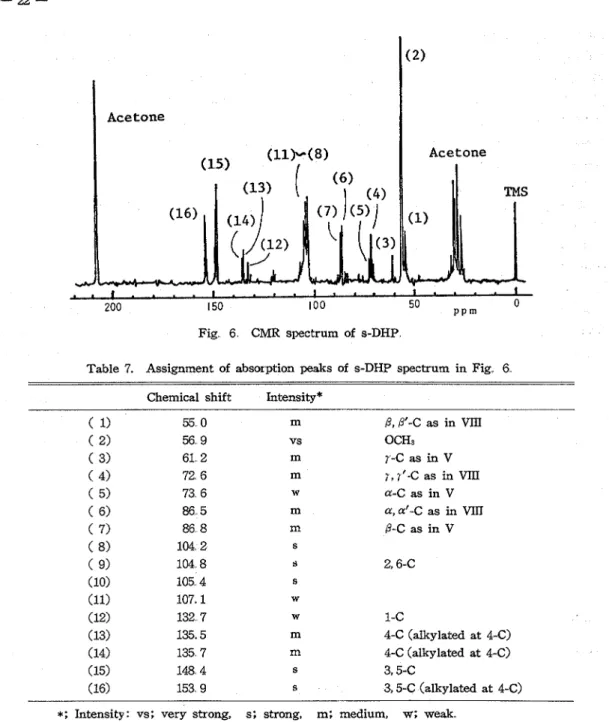
Chemical shifts of threo-l-(4-hydroxy-3,5-dimethoxypheny1)-2-(2', 6'-dimethoxyphenoxy)- propane-1,3-diol (V) and syringaresinol (VIII), a CMR spectrum of s-DHP, and assign- ments of absorption peaks of the s-DHP a r e shown in Table 6, Fig. 6, and Table 7, respectively. The absorption peak$ of the s-DHP could be assigned, expect very weak obscure peaks. The data clearly show that structural moieties of syringylglycerol-6-syringyl ether and syringaresinol are predominant in s-DHP. kiidemann and Nimz107'~108) reported that a chemical shift of 19-C of 1,2-diarylpropane-l,3-diol is 63 to 65 ppm from TMS. T h e peak a t 63 to 65 ppm is missing in the s-DHP, indicating that a possibility of occurrence of 1,2-disyr ingylpropane-1,3-diol during the for mation of s-DHP is quite small. In agree- ment with the fact, stilbene derivative was not detected, by TLC, in the alkali degradation
Table 6 Chemical shifts of carbon atoms of model compounds
(V, VIII) in ppm
Chemical shift Assignment
55 3 P, a'-C in VIII 56 5-57 1 OCHJ 61 2 7-C in V 72 7 7,r1-C in VIII 73 8 a-C in V 87 2 a , a'-C in VIII 88 8 P-C in V 104 8 2,6-C in VIJI 105 1 2,6-C in V 106 5 3', 5'-C in V 125 0 4'-C in V 132 3 l-C in V 133 4 l-C in VIII 135 8 1'-C in V 136 5-136 7 4-C in V and VIII 148 3 3,5-C in V 149 3 3,5-C in VIII 153 7 2', 6'-C in V --
Fig 6 CMR spectrum of s-DHP
Table 7. Assignment of absorption peaks of s-DHP spectrum in Fig. 6
Chemical shift Intensity*
- ( 1) 55 0 m P, Pf-C as in Vm ( 2) 56 9 vs OCH3 ( 3) 61 2 m y-C as in V ( 4) 72 6 m 7.7'-C as in WI ( 5) 73 6 w a-C as in V ( 6) 86 5 m a, a'.-C as in VIII ( 7) 86 8 m P-C as in V ( 8) 104 2 s ( 9) 104 8 s 2,6-C (10) 105 4 s (11) 107.1 w (12) 132 7 w l-C (13) 135.5 m 4-C (alkylated at 4-C) (14) 135 7 m 4-C (alkylated at 4-C) (15) 148 4 s 3,5-C (16) 153 9 s 3,5-C (alkylated at 4-C)
*;
Intensity : vs; very strong, s; strong, m; medium, w; weak.products of s-DHP with 2 N sodium hydroxide a t 100°C for 6 hr, according to the same procedure described by N i m ~ " ~ ) . However a weak absorption peak corresponding to t h a t of a-C or P-C of 1,2-diarylpropane-l,3-diol, or of r-C of cinnamyl alcohol or Ar-CO-CH (-0-C-4')-CHzOH appeared in CMR spectrum of a s-DHP (Ph-OH content, 0. 11/OCH3) which was obtained in 45% yield. T w o 1,2-disyringylpropane elements of 25 phenyl units a r e inserted into a constitutional scheme of beech lignin, which has been recently proposed by Nimzg4). 1, 2-Disyringylpropane-1,3-diol moiety may be formed a t maturation stages during s-DHP formation and lignification.