South East Asian Studies,Vol. 16, No.2, September 1978
Education and Rural Developm.ent
- - A Comparative Study of Thai and Malay
Villages--Yokuo MURATA*
In this paper, the present conditions of education in Thai and Malay villages are analyzed from a comparative standpoint. Considerable differences in education have been discovered within the five Thai and two Malay villages surveyed. This paper covers not only the educational opportunities available for rural people but also the qualitative aspects of rural education based on inquiries concerning the educational consciousness of villagers and rural school teachers. The relationship between educa-tion and rural development is discussed in the final seceduca-tion of this study, considering the economic, social and institutional characteristics of Thai and Malay rural societies.
I Introduction
An integral research survey of rural education was taken in the Thai and Malay villages by a Japanese survey team from July 11 to August 24, 1976. The title of the research survey was "The Role of Education for Rural Development in Southeast Asia". Six members of the team conducted both a villagers' survey and a rural school teachers' survey.l)
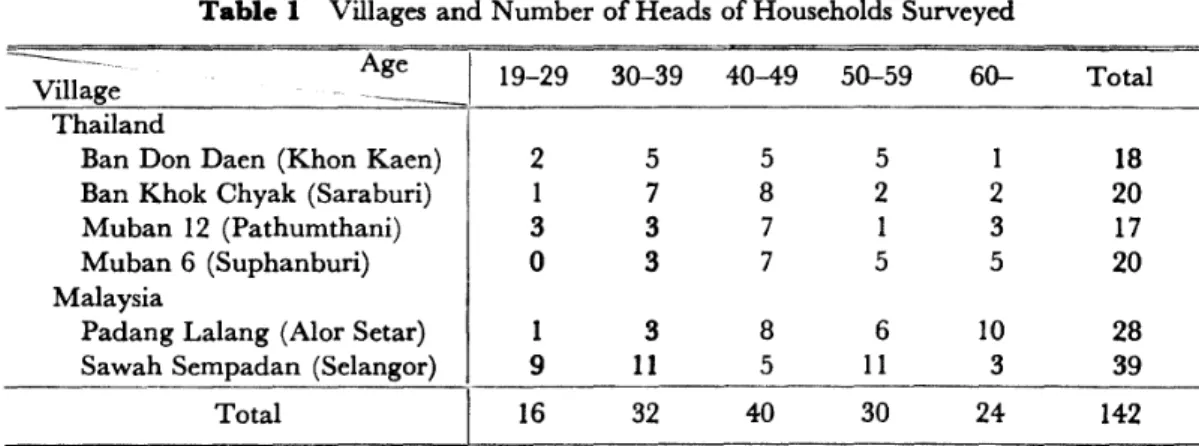
The villagers' survey was done by means of questionnaires and interviews and entailed 142 heads of households in four Thai and two Malay villages, approximately 10% of the heads of households from anyone village. Their ages were primarily be-tween 30-60 years old. 83.6% of the Thai and 94.00/0 of the Malay villagers surveyed were farmers, while the remainder were laborers, retailers, service workers like barbers, owners of small home industry and civil servants. The villages surveyed in Thailand are Ban Don Daeng of the commune of Don Han in the Muang district, Khon Kaen Province; Ban Khok Chyak of the commune of Tan Diaw in the Kaeng Khoi district,
*
t1mJl.::K, Research Associate, National Institute for Educational Research, Tokyo, Japan1) In Malaysia, I observed the rural education in Alor Janggus district of Kedah State. The research data concerning rural education in Malaysia has been offered by Prof. Masuo Kuchiba and Prof. L. J. Fredericks, who were members of the team and undertook the research survey in Alor Janggus and Sawah Sempadan respectively.
In Thailand I am very much indebted for helpful cooperation in the research survey to Mr. Swat Chongkol, Mr. Somkit Keorsarn and Miss Somsri Limsopas of the research division of the Department of Educational Technique, Ministry of Education, Thailand.
Saraburi Province; Muban 12 of the commune of Khuban Luang In the Laad Lum
Kaeo district, Pathumthani Province; and Muban 6 of the commune of Wangyang in the Sriprachang district, Suphanburi Province. Those in Malaysia are Padang Lalang of the Alor Janggus district in Alor Setar, Kedah State; and Sawah Sempadan in the Tanjung Karang district, Selangor State. All of these are rice-growing villages. The villages with the number of heads of households surveyed by age are shown in Table 1.
Table I Villages and Number of Heads of Households Surveyed
--"""-
Village~~e_1
19-29 30-39 40-49 50-59 60- Total ThailandBan Don Daen (Khon Kaen) 2 5 5 5 I 18
Ban Khok Chyak (Saraburi) 1 7 8 2 2 20
Muban 12 (Pathumthani) 3 3 7 I 3 17
Muban6(Suphanburi) 0 3 7 5 5 20
Malaysia
Padang Lalang (Alor Setar) 1 3 8 6 10 28
Sawah Sempadan (Se1angor) 9 11 5 11 3 39
Total 16 32 40 30 24 142
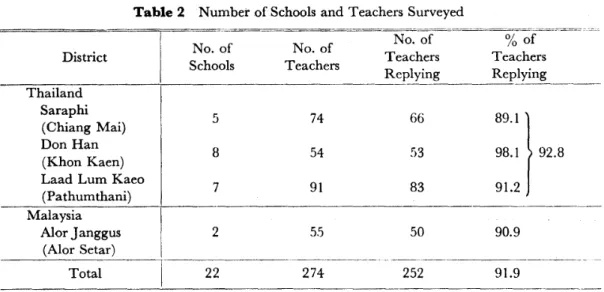
The teachers' survey was conducted in twenty schools in varIOUS rural areas of Thailand and two schools in Malaysia. The rural areas surveyed are the commune of Saraphi of Chiang Mai Province; the commune of Don Han of Khon Kaen Province; the commune of Khuban Luang of Pathumthani Province in Thailand, and the Alor Janggus district of Alor Setar in Malaysia. The twenty Thai schools surveyed are divided into eleven four-year primary schools, seven seven-year primary schools and three lower secondary schools. The two Malaysian schools are one six-year primary school and one lower secondary school. The survey team distributed questionnaires to 274 teachers in all and 252 were subsequently received. The percentage of teachers who replied was 92.8% in Thailand and 90.90/0 in Malaysia, totaling 91.9% in all, as seen in Table 2. Among the 252 teachers, 164 were primary school teachers and 88 were lower secondary school teachers. Male teachers totaled 117 while female teachers totaled 135.
I will now describe briefly the villages surveyed. The villagers in the Thai provinces of Chiang Mai, Khon Kaen and Saraburi are behind in the modernization of agriculture and lead the traditional life of their ancestors, coupled with a strong belief in Buddhism although in the Saraphi district, Chiang Mai, some villagers are Christians. The standard ofliving of the villagers in Khon Kaen and Saraburi Provinces was low, because of water shortage. The average net income per household is US$565 in Ban Don Daeng of Khon Kaen and US$1,213 in Ban Khok Chyak of Saraburi. The farmers in the two villages engage in the traditional type of farming, depending
Table 2 Number of Schools and Teachers Surveyed 74 66 891 ) 54 53 98.1 92.8 91 83 91.2 55 50 90.9 ---~_._--". -._.--_.._--~-- - - , - - - - .__...._-. 274 252 91.9 _ . _ -No. of Teachers 7 2 5 8 No. of Schools District Malaysia AlorJanggus (Alor Setar) No. of %of Teachers Teachers Replying Replying i . -Thailand Saraphi (Chiang Mai) Don Han (Khon Kaen) Laad Lum Kaeo (Pathumthani)
Total
1--2"2---·-primarily animal and human resources. Rice-growing is done by a single cropping. New farming technology is introduced as a supplement to the traditional technology. Some of the farmers use engines to pump up water from natural reservoirs. Chemical fertilizers are widely used for rice-growing and vegetable gardens in Ban Khok Chyak, although in Ban Don Daeng, it is applied only for vegetable gardens. New varieties of rice have not been introduced.
On the other hand, the villages of Pathumthani and Suphanburi, owing to their proximity to Bangkok, are in the process of modernizing their agriculture and intro-ducing farm machines, chemical fertilizers and new varieties of rice. The standard of living is relatively high, amounting to US$1,762 as the net income per household in Muban 12 of Pathumthani and US$1,769 in Muban 6 of Suphanburi. In Muban 6, farmers adopt rice double-cropping. In Muban 12, buffaloes are completely re-placed with hand tractors and petroleum engines, although in Muban 6 some buffaloes are used for threshing paddy.
This pattern of the modernization of agriculture has led the farmers to spend more money and some farmers suffered from indebtedness. Such expenditure per farm is much higher in Muban 12 than in Muban 6. In the two villages, non-agricultural income is also considerably high because near Muban 12 there are two large jute-bag factories which employ quite a number of the villagers of Muban 12 and the Muban 6 villagers work in small-scale trade and other activities.
The two villages in Alor Setar and Tanjung Karang in Malaysia are inhabited by Malays. The villages seem to be prospering as a result of rice double-cropping, which have become possible by improving the irrigation and drainage systems. The villagers are also using new farming technology such as machines, chemical fertilizers and new high-yielding varieties of rice. Their standard of living is also high; especially in Padang Lalang the net income per household is US$2,127 and in Sawah Sempadan
US$I,341. In Padang Lalang, electricity was installed at the end of 1976 and some villagers are planning to use it in their homes. Their life is considerably modernized as evidenced by the building of new homes and the influx of radios. Yet they are all earnest believers of Islam.
In this paper, I will describe the features of rural education found in the villages of Thailand and Malaysia based on the results of the research survey of the villagers and rural school teachers. Some differences in rural education have been found among the villages within each country but the differences have been relllarkable between the Thai and Malay villages. Therefore, rural education in the Thai and Malay villages will be compared.
This paper describes the educational opportunities available for rural people, the difficulties in rural school education and the villagers' views of education. Finally, the relationship between education and rural development will be discussed. The expansion of educational opportunities for rural individuals is certainly important to rural development and it is emphasized in many developing countries. However, I will also pay attention to the qualitative aspects of education.
II Educational Opportunities AvailableCor Rural People
There are primary schools in every school district of the villages surveyed In
Thailand and Malaysia, their and secondary schools are found in some of their villages. But some children in the villages are not enrolled in school even though they are of school age.
In the Thai villages, 59 children (40.4%) were not enrolled or out of school among 146 children of the 7-18 age group, while in the Malay villages, the number of unenroll-ed children was fewer with 24 (21.8%) among 110 children of the 6-18 age group as shown in Table 3. Unenrolled children in Thai villages were not found in the 7-10 age group (lower primary school), but 30.7°!c> were found unenrolled in the 11-13 age group (upper primary school). In the age group of the 14-18 years, the unenrolled children exceeded the enrolled children, reaching 68.3°!c> in the 14-16 age group (lower secondary school) and 73.0% in the 17-18 age group (upper secondary school). For unenrolled children in Malay villages, the percentage was lower than that of enrolled children in every age group, recording less than 100/0 in the 6-11 age group (primary school level), 22.7% in the 12-14 age group (lower secondary school), and 45.2% in the 15-18 age group (upper secondary school). Among these unenrolled children, 54 of the Thai children (91.5%) had received four years of primary education, while 12 of the Malay children (50.0%) had received six years of primary education and 7 (29.1 %) no school education.
The reasons for non-enrollment of children could be divided into two categories, economic and personal reasons. In the economic category, such reasons as "educational
Table 3 Number of Enrolled and Unenrolled Children in Rural Areas
---
--
----'--..-., Race Thai Malay-
-I I
Age group
.---
Enrolled Unenrolled Enrolled Unenrolled Thai - 7-10 yearsNo. 40 0 29 3
Malay- 6- 9 years
% 100.0 0.0 90.7 9.3
(lower primary school) Thai -11-13 years No. 27 12 I 23 2 Malay-1O-11 years % 69.3 30.7 92.0 8.0
(upper primary school) I
Thai -14-16 years
No. 13 28 17 5
Malay-12-14 years
% 31.7 68.3 77.3 22.7
(lower secondary school) Thai -17-18 years
No. 7 19 17 14
Ma1ay-15-18 years
% 27.0 73.0 54.8 45.2
(upper secondary school)
Total 87 59.6 59 40.4 86 78.2 24 21.8
costs are high" and "children have to help their parents at home" were mentioned by many villagers. "Our child lacks ability", "our child does not like to study" and "illness" were the principal personal reasons. At the primary school level, economic and personal reasons were almost of equal importance but at the lower secondary school level, economic reasons gained over the personal ones for both the Thai and Malay villages.
Economic reasons at the primary school level were indicated by a few villagers in every village except for Sawah Sempadan where many parents gave economic reasons. The net income of villagers who cited economic reasons was less than US$250 in the Thai villages, and about US$I,OOO in the Malay ones. At the lower secondary school level, the same economic reasons were found among many villagers, whose net income was also low. It was found to be 90.0% of Ban Khok Chyak villagers, 62.5(% of Ban Don Daeng villagers, 25.0% of Muban 12 villagers, 18.2% of Muban 6 villagers, 22.2% of Sawah Sempadan villagers and 11.1 % Padang Lalang villagers, of those who answered the question. These results show that the percentage is very high among the villagers of Ban Khok Chyak and Ban Don Daeng where the standard of living is low and the way of farming was not modernized. However, I have to pay attention to the fact that in other modernized villages there were several unenrolled children whose parents got considerably high net incomes (over US$I,500). "The school is too far" is also mentioned at the lower secondary school level, particularly by the villagers of Ban Don Daeng, Ban Khok Chyak and Sawah Sempadan.
Regarding the educational opportunities available for adults over 18 years, I first examined their school experience, which is indicated by the length of schooling shown in Table 4. By comparing the Thai and Malay villagers, I notice that most of the
Table 4 Level of Education of Villagers (Over 18 Years Old) I 100.0 1.8 1.8 0.9 9.4 0.9 I 70.5 14.7 % 19-29 3
I
2 51 5 8 29 1 99 >- 30-49 15 3 12 6 0 0 29 65 CIS 50- 14 0 0 1 0 Cii 0 35 50 ~ No. I 32 I 5 63 12 I 8 29 I 65 I 214 % 14.9 2.3 29.5 5.6 3.7 13.6 30.4 100.0~:
No School Primary Education Secondary Education ReligiousEducation 4 Years 6 Years Other Lower Upper Education Total 19-29
Xl
60 1 6 1 3 0 74 '(\1 30-49 77 1 10 1 1 1 97 E5 - - - - -50- 21 0 5 0 0 3 53 33 No. 158 2 21 2 4 4 224Thai villagers (70.5%) had received four years of primary education, but that many of the Malay villagers (59.9%) had received six years of primary education (29.50/0) or religious education in religious schools (30.4%), Religious education in the Malay villages relates mainly to people over 30 years old but the six years of primary education was received by many younger people in the 19-29 age group. Religious schools are defined as traditional temple schools in the Thai case and Koran Schools or Pondok in the Malaysian case. In their temple schools, Thai villagers learn how to read and write the Thai language and learn about the Buddhist religion. The Koran School provides knowledge about Koran in a short course while in the Pondok, the Islamic religion and the Jawi script are taught for about two or three years. Those who did not have any schooling were about 15% of the total of both the Thai and Malay villagers, most of whom were over 30 years old at that time. In the age group of those over 50 years old among Thai villagers, those who had no schooling were more than those who had received four years of primary education. Secondary education had been com-pleted by only 2.7% of the Thai and 17.3% of the Malay villagers, most of whom belonged to the 19-29 age group. No person had received any higher education.
Among the enrolled children, some repeaters of a certain grade were found. In the schools surveyed in the Saraphi, Don Han and Laad Lum Kaeo districts in Thailand, many repeaters were found in the lower grades of primary school, reaching an average of 17.3% for the first grade, 10.80/0 for both the second and third grade pupils. How-ever, for the upper grades of the primary schools and lower secondary schools, repeaters were very few, 2% of the fourth, 2.1 % of the fifth, 0.8% of the sixth, and 2.1 0/0 of the first, 1.8% of the second in the lower secondary schools. In the primary and lower secondary schools surveyed in Alor Janggus district in Malaysia, I found only 2% repeaters among the second grade pupils in the lower secondary schools. Moreover, the primary school teachers in both Thailand and Malaysia informed me that many pupils were inclined to be absent from schools, and that the rate of their absence was
quite high during the busy season, as during transplanting or harvesting paddy. So it is reasonable to expect that the absence from school would be one of important causes of repeating the school year.
In order to study the villagers' opportunities for education other than that offered at the formal schools, we asked them how many times they usually attend meetings, visit any organizations, listen to the radio or read the newspaper. Their replies for the number of times to attend a "religious meeting" or "village meeting" and listen to the radio were usually more affirmative (i.e., often or sometimes) than negative (i.e., rarely or never). Particularly, the number of times to attend a religious meeting was greatest among both the Thai and Malay villagers (Thai 97.4%, Malay 97.0%). Following this, the number of times to attend a village meeting was also markedly high (Thai 61.40/0' Malay 71.6%). This fact shows that many of these villagers still attend traditional-type meetings frequently. In Ban Don Daeng, the village meeting is held at least once a month.
On the other hand, negative answers exceeded affirmative ones for the number of times to read a newspaper, visit an extension farm, an experimental farm, a farmers' association, or to attend an adult school. The number of times to read a newspaper (affirmative percentage, Thai 33.6%, Malay 55.2%) was less than those listening to the radio (Thai 90.5%, Malay 75.80/0)' Thus, both Malay and Thai villagers used the radio more often than the newspaper as a means of mass communication. It seemed to be unpopular especially among the Thai villagers to visit an extension farm (affirmative percentage, Thai 14.6%, Malay 23.8%), an experimental farm (Thai 6.7%, Malay 13.4%), or a farmers' association (Thai 14.80/0' Malay 35.8%), although both the Thai and Malaysian Governments have stressed the diffusion of these types of farms and associations for furthering the modernization of agriculture.
Few villagers had attended adult schools in every village. Among Thai villagers, only two persons had attended "often", five persons "sometimes" and the remaining 67 persons "never". In the Malay villages, nine persons answered "often", five persons "sometimes", eight persons "rarely" and 45 persons "never". This result might be caused by the fact that in most of the villages surveyed, adult schools were not operated. In the Malay villages, I found adult schools were sometimes operating in order to teach the Malay language in village meeting places. But in many Thai villages, adult schools had not been open for more than five years. Therefore, in most of the villages, school buildings, temples and mosques plus literate people such as teachers, monks and religious people had not been utilized for adult education. However, I found other types of adult schools open in some cities of Thailand. For example, in Chiang Mai and Khon Kaen cities, adult schools were open to young men between about 15-25 years who were taught mainly general education. These young men had not had any opportunity to complete primary or lower secondary education. Some of them came from the rural
areas.
In general, Thai and Malay rural people are still lacking opportunities for modern education. Particularly, many Thai rural children are not enrolled in the upper primary and lower secondary schools. For reasons of non-enrollment, economic factors are stressed by many villagers whose net income is low. Among the enrolled children, grade repeaters are found a good many in the level of the lower primary schools. On the other hand, Malay rural children have considerable opportunities for education. However, many adults over 18 years in the Thai villages have not completed seven years of primary education and many Malay adults over 30 years have only religious education. About 15% of the adults in both the Thai and Malay villages have not had any school education. Nevertheless, the opportunities for education other than at a formal school are very limited because of few adult schools functioning in the villages. However, they seem to enjoy attending traditional meetings and listening to the radio.
In
Rural School EducationRural schools are presently playing an important role in rural education in Thailand and Malaysia. How is rural school education carried out and what are the problems found? I will answer these based on the opinions of the rural school teachers surveyed. I asked the rural school teachers whether or not they had any desire to be trans-ferred to urban schools. 47.5°/~ of the Thai and 78.0% of the Malaysian teachers answered that they would rather work at urban schools. Most of them preferred to be transferred to the schools in the main cities of the provinces or states, such as Chiang Mai, Khon Kaen, Pathumthani and Alor Setar. This shows that rural school teachers displayed dissatisfaction with rural schools. Concerning the working conditions for teachers, Thai teachers commented that "the salary is low" (48.8°/) of the teachers), "there are few chances to get a higher teacher qualification" (30.9%), and "rural life is inconvenient" (21.0%). But :Malay teachers rarely complained, except for the fact that "rural life is inconvenient" (16.0%) and "salary is low" (8.0% ),
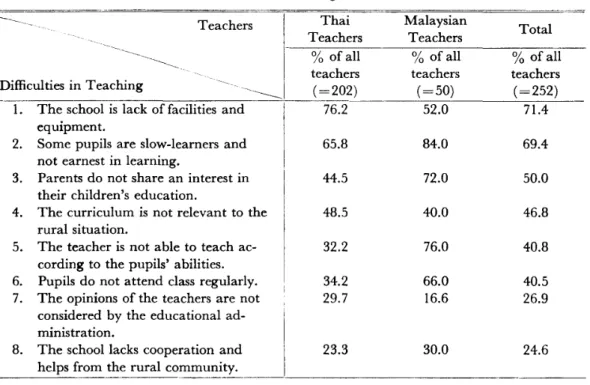
The most difficult problems in teaching were pointed out by the rural school teachers as seen in Table 5. Item 1, "the school is lack of facilities and equipment", was indicated by most of the Thai teachers but not by many Malaysian teachers. Rural schools in Thailand have few school facilities and equipment except for blackboards, desks and chairs. In some small-sized primary schools, pupils lack even textbooks and notebooks. Malay rural schools are larger in size and facilities are rather good.
Item 2, "some pupils are slow-learners and not earnest in learning" and item 3, "parents do not share an interest in their children's education", were stressed by both the Thai and Malaysian teachers. These two problems seem to be closely related with each other, for if parents do not have any interest in their children's education,
Jlm7:;JlVf~ 16~2%
Table 5 Difficulties in Teaching at Rural Schools
-~~~-- - - - - - - _ . ~ ~ ~ ~
---
-----...- Teachers Thai MalaysianTotal Teachers Teachers
---...
%
of all%
of all%
of all--- teachers teachers teachers
Difficulties in Teaching
--::---
(=202) (=50) (=252)1. The school is lack of facilities and 76.2 52.0 71.4
equipment.
2. Some pupils are slow-learners and 65.8 84.0 69.4
not earnest in learning.
3. Parents do not share an interest in 44.5 72.0 50.0
their children's education.
4. The curriculum is not relevant to the 48.5 40.0 46.8
rural situation.
5. The teacher is not able to teach ac- 32.2 76.0 40.8
cording to the pupils' abilities.
6. Pupils do not attend class regularly. 34.2 66.0 40.5 7. The opinions of the teachers are not 29.7 16.6 26.9
considered by the educational ad-ministration.
8. The school lacks cooperation and 23.3 30.0 24.6
helps from the rural community.
the children will not be inclined to be earnest in learning. During interviews, many teachers said that most of the rural parents were indifferent to daily school activities. They cited the following examples: "parents do not come to school for consultation about their children's education or future", or "they do not help their children with their homework". The teachers concluded that "a parent's indifference has a bad influence on the children's attitudes toward learning". In relation to this problem, item 8, "the school lacks cooperation and helps from the rural community", seems to be caused to some extent by such indifference as shown in item 3. As an illustration, teachers also commented that rural parents usually made large donations to temples or mosques but little to schools.
Item 5, "the teacher is not able to teach according to the pupils' abilities", was also emphasized, especially by many Malaysian teachers. As a significant reason for this, item 4, "the curriculum is not relevant to the rural situation", can be considered. Moreover, when we asked teachers how rural schools could be improved, "teaching methods which are relevant to the rural situation" (Thai teachers 75.5%, Malaysian teachers 54.0%) and "modern teaching methods" (Thai teachers 44.5%, Malaysian teachers 70.0%) were pointed out by many teachers.
In item 6, teachers complained that pupils did not attend class regularly. This seems to be a cause for pupils to become repeaters as seen in section 2. Furthermore, in connection with items 2 and 3, parents' indifference to children's education can be considered to be a cause for pupils' non-attendance at school, besides economic reasons. There were several unenrolled children whose parents got rather high net income, and
the complaints about parents' indifference and pupils' absence were found many among the teachers in the districts of Alor Janggus (Alor Setar) and Laad Lum Kaeo (Pathumthani) where the standard of living was rather high.
These teachers' opinions illustrate that, at present, internal conditions of rural schools are such that the curriculum and teaching methods are regarded as just as important as external conditions, such as teachers' salaries, school facilities and equip-ment. The present curricula of Thai and Malaysian rural schools are controlled by their central governments. They have the same contents as those of urban schools and give much importance to teaching academic subjects, such as the national language, mathematics, social studies, and natural science. In the curricula of primary and lower secondary schools, work-oriented education is introduced in both countries to help children develop work values, positive attitudes and rational habits. In the case of the primary schools, "practical arts" is taught from the upper primary level in Thailand and "arts and crafts" from the beginning of primary school in Malaysia. However, such work-oriented education is not quite popular yet in the rural schools which I visited. It seems to me that there are imbalances between general and work-oriented education, because the general education have been too much emphasized. The school teachers pay less attention to work-oriented education since the courses of study in the two countries put stress on academic studies which are connected with the contents of teaching in the higher level of education. Moreover, according to the curricula of the two countries, religious instruction is provided for only one class hour (=45 minutes) in Thailand and three class hours (=120 minutes) in Malaysia per week. Teaching methods are almost the same in any rural schools. One teacher is usually lecturing to a class, stressing memorization without use of dialogic methods of teaching. Rural school teachers seem to want to reform this kind of uniform education into a better one which would fit with the rural situation.
IV Villagers and Rural Education
To examine the educational consciousness of the villagers, I asked them the follow-ing questions.
1. Do you think that school education is good? 2. What vocation do you wish for your children?
3. Up to what level of education do you wish your children to reach? 4. What kind of education do you want your children to receive? In this section, the villagers' answers to these questions will be analyzed.
To the first question, all of the Thai and Malay villagers answered "Yes", except for three Malay villagers who replied, "I do not know anything about education".
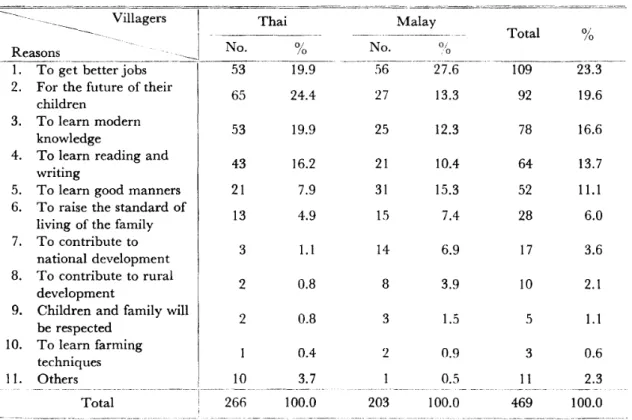
The reasons why they think that school education is good are shown in Table 6. Item 1, "to get better jobs" came at the top among all the Thai and Malay villagers.
*rfl7;)7!Vfj"G 16Jl!l2-5
Table 6 Reasons Why Villagers Feel that School Education is Good
Villagers Thai Malay
- - - _..- .---_._._----._....,--- Total %
Reasons No. % No. 0//0
~ - " - - - _ . _ - ~ . _ - ,.._._-"----_..
,---get 56 27.6 109 23.3
2. For the future of their
65 24.4 27 13.3 92 19.6 children
3. To learn modern
53 19.9 25 12.3 78 16.6 knowledge
4. To learn reading and
43 16.2 21 10.4 64 13.7 writing
5. To learn good manners 21 7.9 31 15.3 52 11.1 6. To raise the standard of
13 4.9 IS 7.4 28 6.0
living of the family 7. To contribute to 3 1.1 14 6.9 17 3.6 national development 8. To contribute to rural 2 0.8 8 3.9 10 2.1 development
9. Children and family will
2 0.8 3 1.5 5 1.1 be respected 10. To learn farming 0.4 2 0.9 3 0.6 techniques 11. Others 10 3.7 I 0.5 11 2.3 Total 266 100.0 203 100.0 469 100.0
Item 2, "for the future of their children" was also mentioned by many villagers. Some Thai and Malay villagers told me in the interview that school education was a means for escaping from the hard work of farming and to get better jobs which would raise the standard of living of the family (item 6) and lead their children to an easier and happier future life. This kind of pragmatic view on school education may well explain the reasons why many villagers selected items I, 2 and 6.
Items 3, 4 and 5, indicated by about 8%-20% of the villagers, show that basic modern education (reading and writing, modern knowledge) and moral education (good manners) were expected to be provided in school education. However, items 7,8 and 9 were indicated by less than 10% of the respondents. Thai villagers, particularly, rarely checked these items. This could mean that school education was not expected to con-tribute very much to national and rural development or to learning farming techniques. In connection with this, I asked Thai farmers in Muban 6 and 12 and Malay farmers in Padang Lalang, who used a high-yielding variety of rice, from where they had received information on the rice. Most of them answered from neighbors, kinsmen and friends (Thai 50.0%, Malay 44.0%) and from an extension services (Thai 41.6°,/0, Malay 28.0%). A few farmers answered that they had received information from a formal school (Thai 0.03%' Malay 0.0°,/0), adult school (Thai 0.0%, Malay 8.00/0) or village leaders (Thai 0.03%, Malay 12.0%). Other information on modern farming, such as chemical fertilizers, farm machines and insecticides also seemed to have come from
the same sources. Thus, schools do not seem to be regarded as effective sources of information on new modern farming.
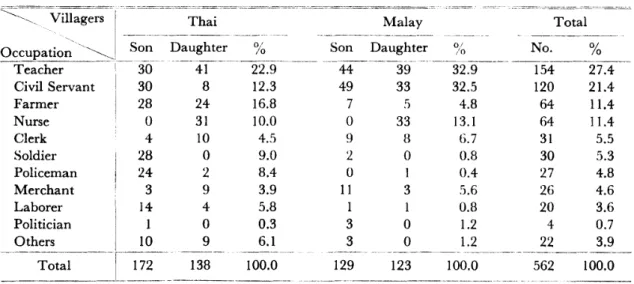
Secondly, concerning the occupation which villagers desire for their children, both the Thai and Malay villagers indicated mostly white-collar occupations as seen in Table 7, such as teacher, civil servant, nurse, clerk, soldier and policeman, most of which are government employees and usually found in the towns. Among these white-collar occupations, teacher, civil servant and nurse were desired the most, and particu-larly Malay villagers preferred teacher (32.9%) and civil servant (32.5<;"0)' On the contrary, the occupation of farming was desired by fewer villagers than I expected, 16.8<;"0 for Thai and only 4.8% for Malay villagers. In Ban Don Daeng with a low standard ofliving, no villagers wanted their children to be farmers, while even in Padang Lalang with a high standard of living, most of villagers did not want their children to become farmers. Judging from this result, rural parents may have a tendency to desert agriculture and prefer regular salaries. It can also be said that the jobs which the villagers wanted most for their children are the white-collar occupations. Between sons and daughters, not very many differences were found, but Thai villagers wanted their sons to be civil servants and their daughters to be teachers. Both the Thai and Malay villagers wanted their daughters to be nurses and the sons to be soldiers.
Villagers Civil Servant Farmer Nurse Clerk Soldier Policeman Merchant Laborer Politician Others Total
Table 7 Desirable Occupations for Children by Villagers
Thai Malay Total
--'-."--_.---'""""-'...
-Daughter 0' Son Daughter 01 No. %
10 /0 -'-'--'--"'''''----''---_.-•..._'---_. •..._-_._-_.._--_.,._.__..._.- ---•...._-_...,----_...
__
.._._-- - - ,.._ -41 22.9 44 39 32.9 154 27.4 30 8 12.3 49 33 32.5 120 21.4 28 24 16.8 7 5 4.8 64 11.4 0 31 10.0 0 33 13.1 64 11.4 4 10 4.5 9 8 6.7 31 5.5 28 0 9.0 2 0 0.8 30 5.3 24 2 8.4 0 I 0.4 27 4.8 3 9 3.9 II 3 5.6 26 4.6 14 4 5.8 1 1 0.8 20 3.6 1 0 0.3 3 0 1.2 4 0.7 10 9 --,-_._--6.1 3 0 1.2 22 3.9 172 138 100.0 129 123 100.0 562 100.0This kind of vocational preference of villagers toward white-collar occupations seems to be related with the social value found extensively in both Thailand and Malaysia. According to the value, people respect a mental occupation like government employees who are usually highly educated, rich and engage in desk work, and under-estimate a labor occupation such as farming and hard labor.2)
2) Paitoon Kreua-Keaw Na Lampoon, The Character of Thai Society (in Thai). (Bangkok: Bopit Chamkat Press, 1975),pp.89-94.
Thirdly, the level of education which the villagers desired for their children can be seen in Table 8. These levels indicate not ideal but actual levels to which villagers aspire for their children. In the case of the Thai villagers, the levels of education ranged from primary education 38.5%, lower secondary education 15.0%' upper secondary education 26.20/0 and to higher education (undergraduate university level) 20.3%. Four years of primary education was also indicated by 19.8% of the Thai villagers. It is quite interesting that, in contrast with this, most of the Malay villagers, 87.3%' desired higher education (undergraduate university level), while only 9.7% of them desired primary education and 3.3% upper secondary education.
Table 8 Aspiration Level of Schooling which Villagers Desire for their Children
~ Level
I
Primary Education Secondary Education Higher
~'"
Education,
,
, Four Seven (or University Total
"'..,
Years Six) Years Lower Upper Under-" Villagers ,~ graduate Thai I No. I 37 35 I 29 49 38 I 188 % I 19.8 18.7 15.0 26.2 20.3 100.0 Malay I No. % 5 4.0 7 5.7 o 0.0 4 3.3 107 87.0 123 100.0 The reasons why some wished only for the primary education level were similar to those given concerning non-enrollment elaborated on previously. Thai villagers gave economic reasons top priority. "Children have to help their parents at home" (32.9%) and "education cost is high" (29.10/0)' Personal reasons followed them such as "our child lacks ability" (8.9%), "our child does not like to study" (7.30/0) and "girls do not need a higher level of education" (7.2%). In Malay villages, no villager in Padang Lalang wished this level but those in Sawah Sempadan indicated "school is located too far" (28.6%) as well as economic (37.1 %) and personal reasons (34.3 % ), On the other hand, the reasons given for desiring a secondary or higher education were similar to those given about why school education is good as shown in Table 6. In this case, pragmatic reasons, such as, "to get better jobs" (Thai 25.5%, Malay 36.1 %), "for the future of our children" (Thai 18.2%, Malay 27.3%) were indicated most often. Following these were economic and personal reasons, "to be able to pay for school costs" (Thai 19.3%, Malay 7.4%), "our child has ability" (Thai 15.7%, Malay 9.7%), "sons and daughters need higher education" (Thai 6.0%' Malay 6.9%), "members of family can feel a sense of honor" (Thai 10.9%, Malay 0.9%), etc.
In relation to household income, there was found a certain inclination among Thai villagers that those with a higher household income desired a higher level of education. Particularly in Muban 6 this trend was seen clearly; two villagers with the net income more than US$2,500 desired their children to receive university education, seven villagers with US$I,500-2,500 income desired secondary or university education, three villagers
with US$500-1,500 income desired primary, secondary and university education, and two villagers with lower than US$500 income desired only primary education. In other Thai villages, the villagers with a lower net income than US$500 preferred their children to receive only primary education (58.3%) or secondary education (41.7%). But many villagers (65.6°1<» getting more than US$500 income inclined to desire sec-ondary or university education for their children although there were some (34.4%) who were satisfied with only primary education.
Besides these features, sex difference was admitted among Thai villagers, for those who had both sons and daughters desired their sons to receive a higher level of education than their daughters. Among 31 villagers, 16 preferred more education for their sons, 13 the same level of education and only two preferred more education for their daughters. In Malay villages, the difference in household income does not have much influence on the aspiration level of education as in Thailand. In Padang Lalang, all the villagers desired their children to receive university education, as the standard of living was improving. In Sawah Sempadan, among 35 villagers, eight villagers wanted primary education for their children, one villager wanted upper secondary education and the other 26 wanted university education. Among nine villagers who wanted primary or upper secondary education, six had a net income per household less than US$I,600, while the others obtained more than that.
For the reasons why so many villagers desired higher levels of education, I, thus, have to think about reasons other than the economic ones, particularly in the Malay case. The other main reason is the social value placing esteem on white-collar occupa-tions; this is found in the two countries as mentioned above. In connection with this, the school system could be considered as another reason. The higher educational institutions, like universities, are organized to produce the manpower who will be engaged in white-collar occupations or high-ranking government positions. In Thailand, it was reported by the ILO team for employment promotion in 1974 that even secondary vocational education was regarded by many students and their parents as a means not to obtain skills but to enter higher educational institutions.3)
For Malay villagers, other reasons for desiring a secondary or higher education include the reason that the Malaysian government has recently increased the number of scholarships available for school children. Federal scholarships have been awarded particularly to Malay school children.4) Moreover, secondary schools with free dormi-3) Asian Regional Team of ILO for Employment Promotion, Training for Employment in Thailand, Chapter
II. (Bangkok, 1974), pp. 21-22.
4) For example, in Kedah State, Federal Minor Scholarships were provided to866 Malay students of the Remove classes and Form I to Form V, and Special Federal Minor Scholarships were provided to 40 Malay students in technical courses of Form IV in 1974. In addition, Pre-University Scholarships were provided for676students of Form VI and State Scholarships for 681 students, of whom237were primary school students,268lower secondary school, and176upper secondary school in the same year.
tory and no fees, such as Fully Residential Science Schools (Form I-IV) and Science Secondary Schools (Form IV-V), have been established, especially for students from rural areas. Now it is no longer a dream but a reality for Malay villagers to have their children reach the university level if their children show ability. The second is that as Prof. Kuchiba explains, in Malay villages egalitarianism is very strong among vil-lagers.5) They believe that it is very weak to discriminate the rich and the poor, leaders and ordinary people, or man and woman. For example, the aspiration level of higher education for children is almost the same between sons and daughters, which is different from the Thai case.
Fourthly, as shown in Table 9, I obtained results concerning the kinds of education villagers wished their children to receive. It is noteworthy that both the traditional type of education, i.e., religious and moral education, and basic modern education, i.e., reading and writing and modern basic knowledge, were considered important by both Thai and Malay villagers. Malay villagers, particularly, put great emphasis on religious and moral education (44.8%). It is also interesting that a considerable number of villagers, particularly Thai, wished their children to have practical education, such as some training for farming, practical education for daily life such as dress-making, cooking, dyeing, bamboo or metal design, £1sh- or animal-rearing, house cleaning, and health education, which are useful in rural life. Rural development, business education and civic education were rated low, 60/0-7%' with the exception of 0.9% for rural development by the Malay villagers. There was not much difference found for the kind of education desired between sons and daughters, but modern knowledge, training for farming and civic education were found to be more desired for sons for both the Thai
Table 9 Kinds of Education Desired by Villagers for their Children
Malay Villagers Total Kind of Education Thai Villagers
Son Daughter 0 /
/0 Son Daughter 0//0 No. %
Religious and Moral Education
Reading and Writing Modern Knowledge Training for Farming Practical Education
for Daily Life Health Education Rural Development Business Education Civic Education Others Total 27 40 26 32 20 12 15 14 14 2 202 23 31 13 16 18 25 9 9 8 1 153 14.1 20.0 11.0 13.5 10.7 10.4 6.8 6.5 6.2 0.8 100.0 53 10 21 5 5 7 1 6 10 2 120 46 14 9 2 9 4 1 9 5 2 101 44.8 10.9 13.6 3.2 6.3 4.9 0.9 6.8 6.8 1.8 100.0 149 25.9 95 16.5 69 11.9 55 9.6 52 9.0 48 8.4 26 6.6 38 6.4 37 4.5 7 1.2 576 100.0
5) Masuo Kuchiba, "Padang Lalang, A Paddy Farming Village Revised - Some Socio-Economic Effects of Double-Cropping -," (1977), A Research Paper of Our Rural Survey, p. 12.
and Malay villagers.
Thus, it is understood that the Thai and Malay villagers see great value in school education primarily from a pragmatic view point, although the Malay villagers have a much stronger inclination in this respect. However, rural school teachers com-plained that parents did not show interest in their children's education and that rural schools lacked cooperation and help from villagers. Such an indifference of parents to education may cause pupils' absence from school, which may have influences on repeating grades and, finally, on the lack of educational opportunities for children.
Therefore, the question remains: why are they still indifferent to schools and school activities? The following reasons can be surmised, based on our research.
a) Parents have not had enough modern education themselves, causing a lack of understanding of modern school education.
b) Rural schools do not seem to conform with the rural parents' assumptions concerning education. For example, school curricula do not devote much time to religious and moral instruction, which villagers regard as practical education and which has a direct influence on their fate according to their Buddhist and Moslem beliefs. In addition, rural schools do not provide villagers with useful information and skills which may be directly practical to rural life. Instead, they are inclined to receive information such as modern farming techniques mainly through transmission by neigh-bors, kinsmen and friends.
c) Both the external and internal aspects of rural schools are administered and supported by the central and local governments. Therefore, parents do not regard rural schools as their own but "someone else's" institution.
For whatever reason, it seems very significant that parents are indifferent to daily school activities though they believe that school education is directly related to their children's future. With this matter in mind, I will now discuss the relationship between education and rural development.
V Education and Rural Development
When I questioned the rural school teachers as to whether or not they felt school education contributed to rural development, I found that their reactions were almost the same for both the Thai and Malaysian teachers. Most of the teachers (74.2% of Thai, 60.0°,10 of Malaysian) considered it desirable for rural children to receive secondary or higher education. More than half of the teachers (Thai 60.4%' Malaysian 56.0%) felt that it was useful to teach reading and writing but few teachers (Thai 25.7%,
Malaysian 40.0%) expected that school education could help to raise the standard of living of the family. Most teachers felt school education was not contributive to rural development in that it does not help children to understand modern farming (Thai 45.5°,10, Malaysian 34.0%) and that, after finishing school, children would not follow in
their parents' footsteps as farmers (Thai 26.7%, Malaysian 48.00
/ 0 ), Furthermore,
many teachers were afraid that after finishing school, children would leave rural areas for urban areas (Thai 40.6%, Malaysian 78.00
/ 0 ) and that school education would not
help to improve ruallife in the long run (Thai 60.9%, Malaysian 36.0%).
From the previous sections, it is understandable that most of the Thai and Malay villagers are indifferent to daily school-going and do not expect school education to con-tribute to rural development, as seen in Tables 5 and 6. However, from the pragmatic viewpoint of education, they wish their children to receive secondary or higher educa-tion in order to obtain better jobs and a brighter future. Nevertheless, as many teachers fear, it might be possible that the present condition of rural education would lead the rural children to leave the rural areas to escape farming and to drain the rural areas of the very young people who would be needed to promote rural development.
The present school system also seems to help rural areas bring about such drain of youths. Since most of the institutions of higher education in the two countries which provide the opportunities to get better jobs are located in the metropolitan region or big cities, young rural people who want to receive higher education are motivated in-evitably to migrate to urban areas. In the case of Thailand, it was reported that almost 50% of the students who came to the Bangkok Metropolitan Area from the other parts of the country to receiving higher education ended up settling down there in 1970. And about 73% of all university graduates were employed in the Bangkok Metropolitan Area.6) I am afraid that this kind of the high percentage of internal brain drain at the higher educational level may eventually have a serious influence on the brain drain from rural areas in the future. A similar situation is also found at the upper secondary school level.
One more factor which will cause the brain drain is that consciousness of the villagers to be villagers is low and their solidarity as a group is weak. Thus, they do not have a strong motivation to stay for a long time in the same village and to contribute to its development. About the case of Padang Lalang in Malaysia, Prof. Kuchiba comments as follows: "in Padang Lalang fairly, high regional mobility is found and among the 28 samples interviewed and 46.4% had a will to leave the village if there is an opportunity to increase their income somewhere else."7)
Until now, it has been generally considered that it is most important for rural development in developing countries to include expansion of educational opportunities to as many rural people as possible. As there were found many children and adults who had not enough educational opportunities, this view could be applied to Thai and Malay villages. But at the same time at the present stage of development in Thailand 6) Thai University Research Associates and the Social Science Association of Thailand, Urbanization in
the Bangkok Central Region. (Bangkok: Kurusapha Ladprao Press, 1976), pp. 256-259.
and Malaysia, I as a researcher, also fear that it will not necessarily contribute to rural development to quantitatively increase the opportunities to receive modern school education. Such opportunities may not arouse the parents' interest in children's education, and to have rural children receive higher levels of education, which may cause rural brain drain. In the rural areas, it will be very important to make a quali-tative improvement in rural education in order to render it relevant to the rural situation and to invoke interest in the parents concerning modern education.
To devise relevant education, the five main characteristics of rural education found in the Thai and Malay villages should be taken into consideration. First, rural school education is not different from that of the urban school in curriculum and teaching methods. Secondly, many villagers, particularly Malay, wish their children to have a religious and moral education as well as reading and writing, and modern basic knowledge. Thirdly, practical education, which is useful to daily rural life, is desired for their children by a considerable number of villagers, particularly the Thai villagers. Fourthly, school education is not expected to contribute to rural development or to learning farming techniques by many villagers. Fifthly, educational facilities available, such as the school buildings, temples or mosques, and literate individuals, such as teachers, monks and religious persons in villages are not effectively utilized for adult education. Many villagers, however, seem to enjoy attending traditional religious and village meetings and listening to the radio.
Nowadays, rural development has been conceived in a broad sense. For example, Philip H. Coombs, when defining rural development in the "New Paths to Learning",8) says that" ... Economic growth per se or, more narrowly, increased agricultural produc-tion, does not in itself constitute successful rural development. Broadly conceived, rural development means rural transformation - change not only of methods of production and of economic institutions but of social and political infrastructures as well, and transformation of human relationship and opportunities." In transitional communities, such as the Thai and Malay villages discussed in this report, this kind of broad con-ception will be necessary when considering education and rural development because rural transformation will involve many aspects of rural community change. From this viewpoint, I have studied rural education in connection with economic, social and institutional facets of the societies, such as the household income of villagers, social values and organizations, and the school system. As a result, I feel that the present modern education in rural areas would not necessarily bring about rural development. Connected with this, two crucial matters will become more important for rural develop-ment in future. One is to put more emphasis on the qualitative aspects of rural educa-tion. The other is to examine the problem of the brain drain of rural young people, 8) Philip H. Coombs with Roy C. Prosser and Manzoor Ahmed, New Paths to Learning. (New York:
which might be increased by the development of the present modern education, in close relation to employment policies at the local and national levels.
Finally, I will point out main three educational problems found to be common in the rural areas of the two countries, although there are some differences. The first is that rural people still lack modern educational opportunities. For the reasons of the lack of educational opportunity, economic reasons are significant but, in addition, inappropriate external and internal conditions of rural education also seems to be a reason affecting parents' indifference to children's education and their absence from school. Accordingly, the second problem is that in both school education and out-of-school education, education which is relevant to the rural situation has not been established. This is seen not only in school curricula and teaching methods but also in the fact that rural public buildings, and literate people have not been fully utilized for adult education. Thirdly, in relation to the second problem, modern education found in the school does not seem to aid in rural development. This arises because the present modern education has an inclination to stimulate villagers to leave rural areas for urban areas in order to get better jobs, in accordance with various economic, social and institutional factors such as the low standard of living in rural areas, the villagers' pragmatic view of education, the social value to underestimate manual labor jobs, the linkage between higher level of education, employment opportunities and
white-collar occupations, and so on.
Conunents
by ABU BAKAR Mahmud
*
Introduction
The intent In this discussion of Mr. Murata's paper on "Education and Rural
Development" is to crystallize the problems and issues highlighted in his paper and to make some pertinent criticisms on the findings of the comparative study in the context of Malaysia's current rural education strategies, objectives and programs. A meaningful discussion of the paper could be done against the backdrop of rural education for development in the context of Malaysia's national development efforts. Rural education in Malaysia, as is the case for many other developing countries is concerned with the education and training of the rural population to transform rural communities through changes in covert and overt behavior patterns - in people's knowledge, skills, attitudes and motivations. Such changes would, besides teaching them how to read and write, predispose the rural people to a better understanding of development efforts, induce them to understand and accept new technologies for the purpose of increasing productivity through improved agriculture and related activities.
In its broadest sense, rural education encompasses the following: (I) pre-school child development; (2) general education in the rural areas for the children, at both the primary and secondary levels; (3) the education and training of farmers and youth through out-of-school extension education ; (4) the training of those serving farmers such as extension field personnel, community development workers, etc.; and (5) "fixmalized" training of farmers, youth and girls.
The paper shall be discussed against this rather broad backdrop of rural education - its aims and objectives, programs efforts, problems and issues.
General Comments on the Study
The study concerns two aspects of rural education, namely, (a) educational op-portunities available for rural people, and (b) the relationship between education and rural development.
The study is essentially a comparative one in that it compares the rural education status and problems in Thailand with the corresponding situation in Malaysia. It is an attitudinal study limiting itself to two primary but, nevertheless, important rural education variables, i.e., the availability of educational opportunities and the inter-relationships between education and rural development. The only weakness in such an attitudinal and comparative study is that it primarily compares variables in cor-responding situations leaving as "spin-offs" and/or inferences the situation that pertain specifically to the each of the situations compared. What would be equally useful, in my opinion, is to incorporate intra-country or in situ investigations, in addition to the inter-country studies so that intra-country variables can be further investigated and the findings related to decision-making or policy-making. This would involve the expansion of the study and entails a complex experimental design.
Nevertheless, Mr. Murata and his research team should be highly commended on their efforts because the comparative study has revealed some significant finding re-garding the problems of rural education as well as people's attitudes toward rural education, and their implications for rural development.
Educational Opportunities for Rural People
Mr. Murata's findings regarding non-enrollment that "at the primary school level, economic and personal reasons were almost of equal importance but at the lower second-ary school level, economic reasons gained over the personal ones for both the Thai and Malay villages" and "at the lower secondary school level, the same economic reasons were found among many villagers, whose net income was also low" can lead to several inferences. One pertains to the cost of secondary education as compared to primary education "as indicated by the reason that "the school is too far". The other relates to the choice that has to be made by the farmer between "the extra pair of hands" and
the education of their children. It would appear that the first choice prevails. In other word, schooling is sacrificed for the "extra pair of hands" so as to augment farm labor resources.
The finding that "many of these villagers still attend traditional-type meetings frequently" is an expected one. This is based on the already accepted fact that in traditional societies simple, semi-literate village folks do not respond well to formalized training or learning experiences. They prefer to attend traditional meetings with their fellow villagers. This finding has implications in organizing training programs for farmers in modern farming methods and techniques in that the non-formal or informal learning experiences should be capitalized. The informal out-of-school extension teaching of farmers as carried out by the Agricultural Extension Service in Malaysia takes full cognizance of farmers' preference for non-formal and traditional learning situations.
On the preference for radio listening as a source of information, this is a readily understandable fact. Reading has never been a farmer's habit, the same with visiting demonstration farms on their own volition.
The literacy level sometimes negates reading as a means of getting information. Visiting demonstration farms organized by government agencies involves time, money and effort on the part of the farmer. Besides, demonstration farms (a result-demonstration method) have never been proven to be the most effective method of convincing farmers regarding new farming methods and techniques. Experience all over the world has borne out one fact: that farmers have to be convinced "on their own home ground", i.e., demonstrations conducted on their own farm plots utilizing the resources and production inputs at their disposal (locally available farm inputs). Farmers, no matter how traditional they are, are rational enough to think that Govern-ment demonstration farms are high-cost and high-input technological innovations which are usually beyond their means.
Status
of
Rural School EducationOn rural school education, the study focusses only on the formal or general school system in the rural areas under investigation. Cast against the backdrop of rural education, it is pertinent to note also that when we speak of rural education in relation to rural development, other educational opportunities also exist or could be made available, namely, pre-school child development programs (Taman Bimbingan Kanak-Kanak), the informal out-of-school extension education of farmers, womenfolk and youth, and the "formalized" training of farmers, youth and girls as carried out at agricultural training centers (e.g., the Rural Agricultural Training Centre in Malaysia).
The findings that the pupils are not earnest in learning, that the parents are indif-ferent to their children's education are, in many instances, foregone conclusions. These
deficiencies in rural school education stem from the nature of teaching content (or curricula) and the methodology used in teaching. More often than not, the content is not relevant to the rural situation. There exist severe imbalances in the curriculum between the general (academic) content and vocation-oriented learning experiences. The conventional and classical teaching method and techniques (constituting what could be termed the indoctrination approach) are often uninspiring. The implication here is that there is an urgent need to closely re-examine the curricula of rural schools so that (a) the learning experiences/activities are not only in line with national edu-cation policy objectives but relevant to rural situations, needs and requirements; (b) the teaching methodology should be developed and used so as to develop interest among the pupils besides the mere inculcation of knowledge. The "doing" aspect should be emphasized in the teaching program.
Villagers Vis-a- Vis Rural Education
Here, again, rural education is narrowly limited to rural school education and, therefore, the findings could be misleading viewed against the broader spectrum of rural education. Of interest here is that positive attitudes to rural education have two dimensions namely, (a) the fulfilment of the academic aspirations of children, and (b) the raising of productivity/family income through learning modern farming tech-niques. Unfortunately, both dimensions appear to be conflicting in the context of rural school education, i.e., one, the fulfilment of academic aspiration and, the other, the enhancement of rural/farm vocations. The finding that school-education is not expected to contribute very much to national and rural development or to learning farming techniques, is a logical one since the very purpose of rural schools is to provide education within the general school system. It is impossible to achieve the twin objectives of general education and vocational training in a rural school system. In Malaysia, there are specific centers/institutes established for teaching modern farming techniques which have direct and immediate bearing on national and rural development. Examples of these are the Rural Agricultural Training Centres to train farmers and youth in practical agriculture, Farm Mechanization Training Centres to train youths in main-tenance and operation of farm machinery and implements, and Agricultural Institutes to train operative-level extension personnel to service farmers.
On therole of the formal rural school as a source of information on farming methods, it is obvious that the school has never been designed to perform this function at all.
It is, therefore, logical that information has to come from other non-formal, external sources. In Malaysia, the formal rural school system has never been used as a channel for transmitting farming information. There are other and more effective ways of doing this, bypassing the formal rural school.
accompli as a result of the value judgments already ingrained In rural society. One
could hardly imagine a farmer in his right mind encouraging his children to be a farmer like himself, or even a better one. It is rational thinking to move away from agriculture and look for jobs that have the so-called "social dignity and status".
As a result of this discussion, I am able to draw out several implications as well as new problems and issues in the following. (I) Should the formal rural school playa direct role in increasing agricultural productivity and bettering rural life? (2) Ifthe rural school system cannot effectively playa role in contributing to rural development (as revealed in the study), then steps should be taken to enhance other rural education alternatives especially those providing the education and training for the community. (3) Rural education should not "drive out" people to the urban areas (other than in pursuit of higher education), leaving a tremendous "energy gap" which adversely affects agricultural production because of labor shortages. (4) Rural education, through the formal schools, should inculcate in its curricula the "dignity of labor" and not ingrain in children the preference for "white-collar" jobs. (5) Ifformal school rural education is at all to playa role in rural development, then the curriculum should be a "proper blend" of both academic content and vocational learning experiences, so as to cater for the academically inclined who will eventually find their way to insti-tutions of higher learning and those with limited academic ability who will eventually find their way back to the land. In devising this proper "mix", it is worthwhile to take head of the five characteristics of rural education as listed on p. 115 of Mr. Murata's paper.
Conclusion
Finally, I wish to state that I am in full agreement with the fact that if rural educa-tion is to contribute substantially and significantly to rural development, planners and policy-makers should ensure that rural education receive the necessary "enhancement" to enable it to subscribe to the broad concept and requirements of rural development as defined by Philip H. Coombs; " ... economic growth per se or, more narrowly, increased agricultural production, does not in itself constitute successful rural develop-ment"; and "broadly conceived, rural development means rural transformation--change not only of methods of production and of economic institutions but of social and political infrastructures as well, and transformation of human relationship and op-portunities." The supportive view point expressed by Mr. Murata to the effect that "in transitional communities, such as the Thai and Malay villages discussed in this report, this kind of broad conception will be necessary when considering education and rural development because rural transformation will involve many aspects of rural community change" has far reaching implications in formulating policies, strategies arid developing programs of rural education for national and rural development.