
Jasmonate-responsive ERF transcription factors regulate steroidal glycoalkaloid biosynthesis in tomato.
65
0
0
全文
(2) supplementary material; Black and white figures; 4 Color figures; 3 Tables; 0 Downloaded from http://pcp.oxfordjournals.org/ at Nara Institute of Science and Technology on April 21, 2016. Supplementary figures; 5 Supplementary tables; 10. 2.
(3) Title and running head; Title; Jasmonate-responsive ERF transcription factors regulate steroidal glycoalkaloid biosynthesis in tomato. Running head; Regulation of SGA biosynthesis in tomato. Chonprakun Thagun1, Shunsuke Imanishi2, Toru Kudo3, Ryo Nakabayashi4, Kiyoshi Ohyama5, Tetsuya Mori4, Koichi Kawamoto6, Yukino Nakamura3, Minami Katayama3, Satoko Nonaka6, Chiaki Matsukura6, Kentaro Yano3, Hiroshi Ezura6, Kazuki Saito4,7, Takashi Hashimoto1, and Tsubasa Shoji1. Authors’ addresses; 1. Graduate School of Biological Sciences, Nara Institute of Science and Technology, Ikoma,. 630-0101, Japan. 2. Institute of Vegetable and Tea Science, National Agriculture and Food Research Organization,. Tsu, 514-2392, Japan. 3. Department of Life Sciences, School of Agriculture, Meiji University, Kawasaki, 214-8571,. Japan. 3. Downloaded from http://pcp.oxfordjournals.org/ at Nara Institute of Science and Technology on April 21, 2016. Authors.
(4) 4. RIKEN Center for Sustainable Resource Science, Yokohama, 230-0045, Japan. 5. Department of Chemistry and Materials Science, Tokyo Institute of Technology, Meguro-ku,. 152-8551, Japan. 6. Graduate School of life and Environmental Sciences, University of Tsukuba, Tsukuba,. 7. Graduate School of Pharmaceutical Sciences, Chiba University, Chiba, 260-8675, Japan. Abbreviations; ACAA, acetyl-CoA C-acetyltransferase; bHLH, basic helix-loop-helix; CaMV, cauliflower mosaic virus; DMPP, dimethylallyl pyrophosphate; D14SR, ∆14-sterol reductase; DWF5, sterol reductase; DWF7, sterol C-5 desaturase; EAR, ERF-associated amphiphilic repression; EMSA, electrophoretic mobility shift assay; ERF, ethylene response factor; GAME, glycoalkaloid metabolism; GC-MS, gas chromatography-mass spectrometry; GFP, green fluorescent protein; GUS, β-glucuronidase; HMGS, hydroxymethylglutaryl-CoA synthase; HMGR,. 3-hydroxy-3-methylglutaryl. 3β-hydroxysteroid-∆8∆7-isomerase;. IDI,. CoA. reductase;. isopentenyl-diphosphate. HYD1,. ∆-isomerase;. IPP,. isopentenyl pyrophosphate; JA, jasmonate; JAZ, jasmonate ZIM-domain protein; JRE, jasmonate-responsive. ERF;. LC-QTOF-MS, 4. liquid. chromatography-quadrupole. Downloaded from http://pcp.oxfordjournals.org/ at Nara Institute of Science and Technology on April 21, 2016. 305-8577, Japan.
(5) time-of-flight-mass. spectrometry;. MeJA,. methyl. jasmonate;. O14DM,. obtsuifoliol. 14α-demethylase; ORCA3, octadecanoid-derivative responsive Catharanthus 3; qRT-PCR, quantitative reverse transcription-PCR; SCDH, sterol-4α-carboxylate 3-dehydrogenase; SGA, steroidal glycoalkaloid; SMO2, sterol 4α-methyl oxidase 2; SQO, squalene monooxygenase; Downloaded from http://pcp.oxfordjournals.org/ at Nara Institute of Science and Technology on April 21, 2016. SSR2, sterol side chain reductase 2.. Footnotes; None. 5.
(6) Abstract Steroidal glycoalkaloids (SGAs) are cholesterol-derived specialized metabolites produced in species of the Solanaceae.. Here, we report that a group of jasmonate-responsive. transcription factors of the ETHYLENE RESPONSE FACTOR family (JREs), are close. SGAs in tomato.. In transgenic tomato, overexpression and dominant suppression of JREs. caused drastic changes in SGA accumulation and in the expression of genes for metabolic enzymes involved in the multistep pathway leading to SGA biosynthesis, including the upstream mevalonate pathway.. Transactivation and DNA-protein binding assays. demonstrate that JRE4 activates the transcription of SGA biosynthetic genes by binding to GCC box-like elements in their promoters.. These JRE-binding elements occur at. significantly higher frequencies in proximal promoter regions of the genes regulated by JREs, supporting the conclusion that JREs mediate transcriptional coordination of a series of metabolic genes involved in SGA biosynthesis.. Keywords jasmonates, steroidal glycoalkaloids, tomato, transcription factors. 6. Downloaded from http://pcp.oxfordjournals.org/ at Nara Institute of Science and Technology on April 21, 2016. homologs of alkaloid regulators in Cathranthus roseus and tobacco and regulate production of.
(7) Text Introduction Plants have evolved multitudes of defense and adaptation mechanisms to survive in fluctuating environments.. To ward off threats imposed by pathogens and pests, plants. and other metabolites with bioactive properties (Bednarek and Osbourn 2009).. Although. these plant-derived chemicals, or phytochemicals, are widely exploited by humans as valuable compounds, they are often unwanted in food crops because of adverse impacts on human health (Betz 1999). Accordingly, elimination or reduction of such phytochemicals is a critical aim in plant breeding.. Complex metabolic pathways, encompassing precursor-supplying. primary pathways and downstream specialized pathways, produce defense compounds. Tight regulation, often involving transcriptional coordination of structural genes, is required to ensure restrained implementation of these costly chemical defenses, which often impose burdens on growth and development in plants (Baldwin 1998). Jasmonates (JAs) play central signaling roles in a wide range of plant resistance and developmental responses (Wasternack and Hause 2013), including the elicitations of defense chemical pathways.. Indeed, methyl jasmonate (MeJA) has been widely used as an elicitor to. induce the production of secondary metabolites in plant culture (Yukimune et al. 1996). Perception of JA signals and the subsequent signal transduction pathway steps, mediated by 7. Downloaded from http://pcp.oxfordjournals.org/ at Nara Institute of Science and Technology on April 21, 2016. produce and accumulate toxic substances, including a diverse array of alkaloids, terpenoids,.
(8) CORONATINE INSENSITIVE 1, JASMONATE ZIM-DOMAIN proteins (JAZs) and JAZ-interacting transcription factors, have been elucidated through molecular and genetic studies and are conserved among plant species (Wasternack and Hause 2013).. However, less. is known about the molecular mechanisms linking JA signaling with downstream A group of JA-inducible ETHYLENE. RESPONSE FACTOR (ERF) transcription factors, categorized into clade 2 of group IXa (Nakano et al. 2006, Shoji et al. 2010, Shoji et al. 2013) have been found to play regulatory roles. in. JA-induced. alkaloid. biosynthesis. in. distinct. species.. For. instance,. OCTADECANOID-DERIVATIVE RESPONSIVE CATHARANTHUS 3 (ORCA3) controls the JA-dependent production of monoterpenoid indole alkaloids, including clinically important compounds, in the medicinal species Catharanthus roseus (van der Fits and Memelink 2000). Similarly, the JA-induced formation of ornithine-derived nicotine is regulated by ERF189 in tobacco (Shoji et al. 2010).. Both ORCA3 and ERF189 mediate the. coordinated transcription of a series of metabolic and transport genes (Shoji et al. 2009) involved in the alkaloid pathways by recognizing specific GCC box-like elements found in promoters of the target genes (van der Fits and Memelink 2001, Shoji et al. 2010, Shoji and Hashomoto 2011a).. The JA-inducible expression of ORCA3 and ERF189 is regulated by a. homologs of the basic helix-loop-helix (bHLH)-family MYC2 transcription factor (Zhang et al. 2011, Shoji and Hashimoto 2011b). MYC2 is a JAZ-interacting factor, involved in the 8. Downloaded from http://pcp.oxfordjournals.org/ at Nara Institute of Science and Technology on April 21, 2016. defense-related metabolism (De Geyter et al. 2012)..
(9) regulation of a wide range of downstream JA responses (Kazan and Manners 2013). Steroidal glycoalkaloids (SGAs), which occur in certain species of Solanaceae and Lilaceae families, are nitrogen-containing compounds with a glycosylated steroidal backbone derived from cholesterol. Based on their cytotoxic properties, SGAs have been proposed to SGAs are. present as toxic and anti-nutritional compounds in inedible parts of solanaceous vegetables, such as immature green fruits of tomato and sprouts and green peels of potato tubers (Friedman 2002, Friedman 2006, Iijima et al. 2013).. In tomato, α-tomatine, derived from its. aglycone tomatidine through elaborate glycosylation steps, is the predominant SGA in green organs, while its less toxic derivatives are found in red ripe fruits (Iijima et al. 2009).. After. early molecular studies on glycosyltransferases involved in the glycosylation (Moehs et al. 1997, Itkin et al. 2011), a series of GLYCOALKALOID METABOLISM (GAME) genes were identified as responsible for enzymatic steps from cholesterol to SGAs in tomato and potato (Itkin et al. 2013).. STEROL SIDE CHAIN REDUCTASE 2 (SSR2) plays a key role. diverting the metabolic flow to cholesterol formation from cycloartenol (Sawai et al 2014). Similar to other metabolic genes that form clusters in plant genomes (Boycheva et al. 2014), GAME genes are clustered in both the tomato and potato genomes (Itkin et al. 2013). Cárdenas et al. (2016) recently identified five tomato ERF genes phylogenetically related to alkaloid-regulating ORCA3 and ERF189, and reported that one of them regulates 9. Downloaded from http://pcp.oxfordjournals.org/ at Nara Institute of Science and Technology on April 21, 2016. function in plant defense against biotic threats (Friedman 2002, Friedman 2006)..
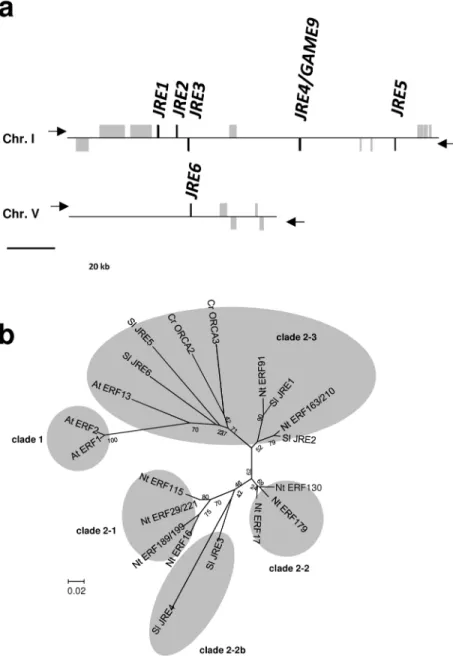
(10) the metabolic genes involved in the biosynthesis of SGAs in tomato and potato (Cárdenas et al. 2016).. Here, we report characterization of these genes, which we term. Jasmonate-Responsive ERF (JRE) genes, as well as of a sixth related JRE in tomato. We performed transcript profiling and metabolite analyses of transgenic tomato lines with altered. pathways leading to SGA formation, from the isoprenoid-supplying mevalonate pathway to GAME-mediated steps after cholesterol.. Transactivation and DNA-protein binding studies. indicated that JRE4 positively controls the biosynthesis genes by recognizing GCC box-like elements in their promoters.. Significant enrichment of putative JRE-binding elements in. proximal 5’-flanking regions of JRE-regulated genes, including those involved in SGA biosynthesis, further support the conclusion of JRE-mediated transcriptional coordination of these genes.. Results Six JRE genes and their expression patterns in tomato In tomato, there is a gene cluster (spanning about 100 kb) with five clade 2 ERF genes of group IXa on chromosome I (Cárdenas et al. 2016); we found that one additional ERF gene of this clade resides as a singleton on chromosome V (Fig. 1a).. Since all six ERF genes were. inducible by jasmonate (see below), we named them Jasmonate-Responsive ERF (JRE) 1 10. Downloaded from http://pcp.oxfordjournals.org/ at Nara Institute of Science and Technology on April 21, 2016. JRE function. We demonstrated that JREs play central roles in the transcriptional regulation of.
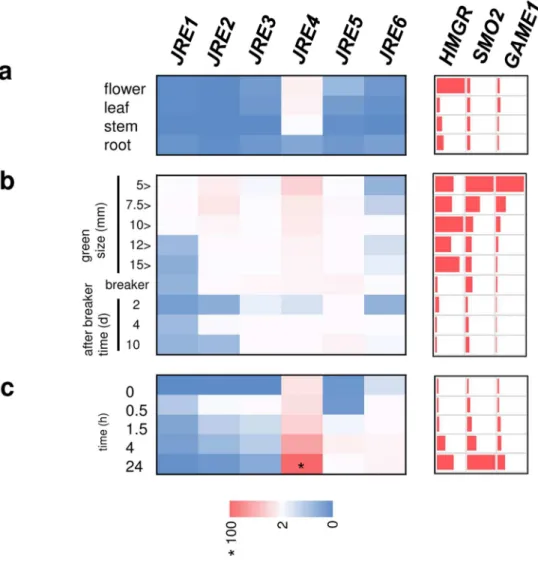
(11) (Solyc01g090300),. JRE2. (Solyc01g090310),. JRE3. (Solyc01g090320),. (Solyc01g090340) JRE5 (Solyc01g090370) and JRE6 (Solyc05g050790).. JRE4. Note that JRE1,. JRE2, JRE3, JRE4, and JRE5 respectively correspond to GAME9-like1, GAME9-like2, GAME9-like3, GAME9, and GAME9-like4 reported in a very recent study (Cárdenas et al.. Based on alignment of amino acid sequences of the conserved DNA-binding domain, a phylogenetic tree including JREs from tomato and related ERF proteins from Arabidopsis, Catharanthus roseus, and tobacco was generated to examine the evolutionary relationships among the members (Fig. 1b).. As defined previously (Shoji et al. 2013), clade 2 is divided. into 4 subgroups. JRE3 and JRE4 were placed in clade 2-2b, and the remaining four JREs were in clade 2-3 (Fig. 1b). We examined the expression patterns of JRE genes along with SGA biosynthetic 3-hydroxy-3-methylglutaryl CoA reductase (HMGR1), sterol 4α-methyl oxidase 2 (SMO2), and GAME1 genes in tomato tissues using quantitative Reverse Transcription (qRT)-PCR (Fig. 2 and numerical values in Supplementary Table S1).. Both JRE genes and SGA. biosynthesis genes were expressed in organs from 7-week-old plants and no apparent organ specificity was observed (Fig. 2a).. JRE4 was the most highly expressed JRE in nearly all. examined tissues, though in roots and fruits at certain stages, the predominance of JRE4 was diminished, mainly due to decreased JRE4 expression in the tissues. 11. The levels of toxic. Downloaded from http://pcp.oxfordjournals.org/ at Nara Institute of Science and Technology on April 21, 2016. 2016)..
(12) SGAs, such as α-tomatine, as well as their production drastically decrease during fruit ripening in parallel with increased catabolism of toxic SGAs to less toxic forms (Iijima et al. 2009).. In accordance with such changes, expression of SGA biosynthesis genes and some. members of JREs, JRE1, JRE2, and JRE4, progressively decreased as fruits matured (Fig. 2b).. the SGA biosynthesis and JRE gene expression were most evident during green fruit stages (Fig. 2b), when fruits were rapidly enlarging, rather than during later color-changing stages. Expression levels of JREs in cultured hairy roots were comparable to or somewhat higher than those in tissues from greenhouse-grown plants, suggesting the usefulness of the cultured material in studies on JREs and SGA biosynthesis.. MeJA coordinately induced SGA. biosynthesis genes in tomato hairy roots (Fig. 2c).. All JREs were induced by MeJA. treatment in tomato hairy roots, but the induction kinetics in terms of magnitude and timing varied among the members (Fig. 2c). JRE4 and JRE6 were gradually induced during the 24-h duration. Acute and strong induction within 30 min followed by a sharp decline was characteristic of JRE1, JRE2, and JRE3. Induction of JRE5 peaked at 4 h after the start of the treatment.. Generation of transgenic tomato lines with altered function of JRE genes To study effect of altered JRE function on gene expression and metabolism in tomato, stable 12. Downloaded from http://pcp.oxfordjournals.org/ at Nara Institute of Science and Technology on April 21, 2016. Except for HMGR1, expression of which declined clearly at the breaker stage, decreases in.
(13) transgenic tomato lines of plants and hairy roots were generated by Agrobacterium-mediated transformation.. Two JRE4 overexpression (JRE4-OX) lines of plants (lines OX1 and OX12). were established by introducing JRE4 cDNA under the control of cauliflower mosaic virus (CaMV) 35S promoter.. JRE4 was chosen as a target gene for overexpression because it is In leaves of the JRE4-OX lines, high. expression of JRE4 transcript was confirmed; this expression did not significantly change with MeJA treatment (Supplementary Fig. S1a). By contrast, MeJA induced the endogenous JRE4 gene in wild-type controls (Supplementary Fig. S1a).. No visible abnormalities were. observed in the JRE4-OX plants (Supplementary Fig. S1b). We chose a dominant suppression strategy to compromise JRE function, since the closely related JRE genes could have overlapping functions.. For this purpose, JRE3, JRE4,. and JRE5 were fused at their C termini with the ERF-associated amphiphilic repression (EAR) motif, which dominantly suppresses expression of genes targeted by transcription factors (Hiratsu et al. 2003).. The JRE-EARs were overexpressed using the CaMV35S. promoter in transgenic tomato hairy roots; two independent lines (lines #1 and #2) for each construct were selected and analyzed.. Overexpression of the introduced JRE genes was. confirmed in JRE-EAR lines using qRT-PCR (Supplementary Fig. S2).. Consistent with. different expression levels of the endogenous JRE genes (Fig. 2), the degrees of overexpression relative to vector controls varied among the lines with different fusion 13. Downloaded from http://pcp.oxfordjournals.org/ at Nara Institute of Science and Technology on April 21, 2016. the main JRE expressed in tomato tissues (Fig. 2)..
(14) constructs.. There was significant reduction of off-target JRE gene expression (e. g. JRE1. and JRE2 in all JRE-EAR lines, JRE6 in JRE3-EAR and JRE5-EAR lines) (Supplementary Fig. S2), suggesting down-regulation of the JREs by the JRE-EAR fusions.. There were. slight variations of growth and morphology among the lines (not shown), but they were. Transcript profiling in overexpression and dominant-suppression lines of JREs To clarify the regulatory function of JRE transcription factors in tomato, we investigated the effects of altered JRE function on the transcriptome to reveal genes targeted by JREs. Comparative. transcript profiling was carried out using the. overexpression and. dominant-suppression transgenic lines with a custom tomato oligoarray representing over 40,000 transcripts (Ruiu et al. 2015). to the array.. Total RNA from each line was labelled and hybridized. As control samples for comparison, wild-type plants for overexpression and. empty-vector control lines for suppression were included.. To examine the profiles in distinct. types of tissues as well as after JA elicitation, leaves of JRE4-OX lines and hairy roots of suppression lines treated with MeJA were used for analysis. Array oligos representing genes up-regulated in JRE4-OX lines and down-regulated in JRE-EAR lines are listed in Supplementary Table S2 and Table S3, respectively; the list of the genes represented is in Supplementary Table S4. 14. A large number metabolic genes. Downloaded from http://pcp.oxfordjournals.org/ at Nara Institute of Science and Technology on April 21, 2016. within the range normally observed for hairy root cultures..
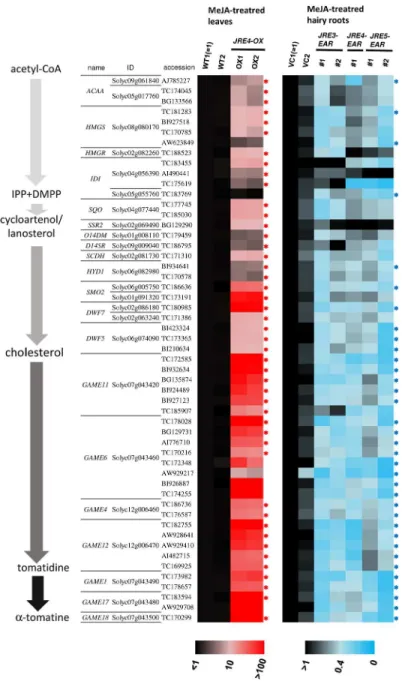
(15) involved in SGA biosynthesis were among the JRE-regulated genes; 24 genes regulated in either JRE4-OX or JRE-EAR lines (Fig. 3 and Supplementary Table S5).. All genes, except. two (Solyc05g055760 for IDI and Solyc02g069490 for SSR2), whether they satisfied both listing criteria (Rox>5.0, Q<0.85) or not, showed trends of signal increases in JRE4-OX lines The JRE-regulated metabolic genes were involved in. nearly all branches of the pathway leading to SGAs from the upstream mevalonate pathway to cholesterol biosynthesis and downstream aglycone formation and glycosylation (Fig. 3). The extent of regulation generally seemed greater for later steps, especially those after cholesterol (Fig. 3); GAME genes were especially responsive to alterations of JRE function (Supplementary Table S2 and Table S3).. All of the biosynthesis genes were similarly. suppressed by JRE3-EAR, JRE4-EAR, and JRE5-EAR; this tendency was corroborated by the unbiased distribution of probes for SGA biosynthesis genes (Supplementary Fig. S3). To validate the results of microarray analyses, transcript levels of SGA biosynthesis genes were analyzed in JRE4-OX and JRE4-EAR lines by qRT-PCR.. Increased expression. of the genes, except acetyl-CoA C-acetyltransferase (ACAA), was observed in leaves of JRE4-OX lines relative to wild-type controls in both MeJA-treated and mock-treated conditions (Fig. 4a).. Consistent with the microarray analysis results, the degree of. up-regulation in JRE4-OX lines was greater for genes involved in later parts of the pathway (Fig. 4a).. We also found clear up-regulation of SMO1 and GAME1 but not HMGR1 of the 15. Downloaded from http://pcp.oxfordjournals.org/ at Nara Institute of Science and Technology on April 21, 2016. as well as decreases in JRE-EAR lines..
(16) mevalonate pathway in roots from JRE4-OX plants (Supplementary Fig. S4).. In transgenic. hairy roots expressing JRE4-EAR, all of the examined SGA biosynthesis genes were suppressed to 28 to 70% levels relative to the controls (Fig. 4b).. To clarify how altered JRE4 function affects SGA-related metabolism in tomato, we examined metabolite levels in leaves from JRE4-OX plants exposed to MeJA vapor (Fig. 5a) and hairy roots of a JRE4-EAR line treated with MeJA (Fig. 5b). predominant. α-tomatine,. were. extracted. and. SGAs, including the. measured. using. liquid. chromatography-quadrupole time-of-flight-mass spectrometry (LC-QTOF-MS), whereas more hydrophilic substances, including pathway intermediates and other sterols and triperpenoids, were analyzed using gas chromatography-mass spectrometry (GC-MS).. In the. JRE4-OX line (line OX1), the level of α-tomatine increased 2.1-fold relative to wild-type controls, while in the JRE4-EAR line (line #1), clear reductions of α-tomatine to 47 % level of controls were observed.. Similar changes were observed for other SGAs (Supplementary. Table S6, Supplementary Figure S5). 1.5-fold in the JRE4-EAR line.. Cholesterol, a sterol precursor of SGAs, increased. The phytosterols campesterol and stigmasterol did not show. any significant changes except for a 32 % decrease of stigmasterol in the JRE4-OX line (Fig. 5).. Cycloartenol and lanosterol, the first tetracyclic triperpenoid intermediates, were 16. Downloaded from http://pcp.oxfordjournals.org/ at Nara Institute of Science and Technology on April 21, 2016. Metabolic impact of altered JRE4 function.
(17) markedly decreased in the JRE4-OX line, to 9 and 15 % of levels in the control, respectively, while a 3.3-fold increase of cycloartenol and a 2.9-fold increase of lanosterol were observed in the JRE4-EAR line.. Triterpenoids, namely α-amyrin, β-amyrin, and lupeol, were. increased 1.3- to 1.5-fold in the JRE4-OX line and decreased to 14 to 80 % of the control Squalene decreased to 48 % of that in the control in the. JRE4-OX line and did not significantly change in the JRE4-EAR line.. JRE4 activates transcription of SGA biosynthesis genes by binding to GCC box-like promoter elements To examine whether JRE4 activates the transcription of SGA biosynthesis genes in vivo through their 5’-flanking regions, transient transactivation assays were performed in tomato fruits using Agrobacterium-mediated infection, or agroinjection, for gene delivery.. For. transient expression, the β-glucuronidase (GUS) reporter was placed downstream of the 5’-flanking region of sterol reductase (DWF5) (-1500 to -1; counted from the first ATG) or GAME4 (-1500 to -1) (Fig. 6a). The individual reporter constructs and a CaMV 35S promoter-driven JRE4 effector were co-delivered into tomato fruits by agroinjection along with a CaMV 35S promoter-driven green fluorescent protein (GFP) reference construct. The expression levels of the GUS reporter genes were analyzed by qRT-PCR and normalized to that of the reference GFP gene (Fig. 6b). 17. DWF5 and GAME4 promoter-driven GUS. Downloaded from http://pcp.oxfordjournals.org/ at Nara Institute of Science and Technology on April 21, 2016. levels in the JRE4-EAR line..
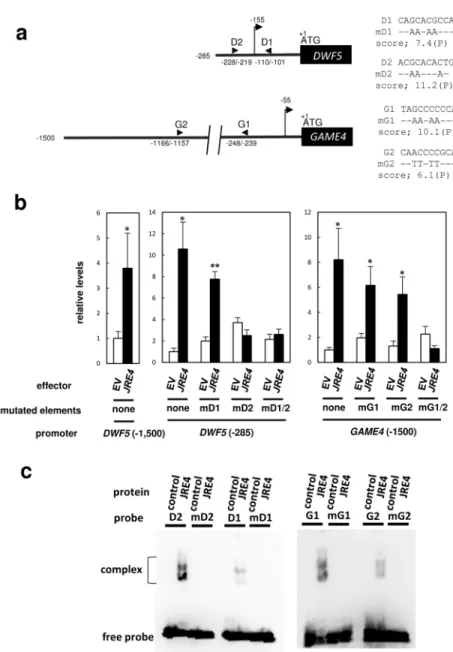
(18) reporter genes were up-regulated 3.8- and 8.2-fold by JRE4 overexpression, respectively, indicating that the JRE4-mediated gene activation was dependent on regions included in the reporter constructs.. The 1,500-bp region of DWF5 could be trimmed to a relatively short. span (-285 to -1) without losing reporter responsiveness (10.6-fold) (Fig. 6b) and basal. JRE4 recognizes two structurally related elements, the GCC box-like P box and the GCC box (Shoji et al. 2013, Supplementary Table S7).. Accordingly, we used in silico. analysis to identify P box and GCC box elements within the 1,500-bp 5’-flanking regions of DWF5 and GAME4. Using a cutoff score of 7.0, two P boxes (named D1 and D2) in DWF5 and one P box (named G1) encompassing a GCC box in GAME4 were predicted, while no GCC box other than the one included in G1, was found. Both D1 and D2 were present within the short functional region (-285 to -1) of DWF5. To clarify the role of the predicted elements in the JRE4-dependent reporter activation, nucleotides within the elements were substituted (Fig. 6a) and the resultant mutant reporters were subjected to transient transactivation assays (Fig. 6b).. For DWF5, mutations. in D1 abolished the JRE4-dependent activation of the reporter driven by the short region (-285 to -11). Mutations in D2, which resides in 5’-untranslated region rather than the promoter, did not have major influences on the induction, indicating the requirement of functional D1 element but not of D2.. GAME4 promoter activation did not change much 18. Downloaded from http://pcp.oxfordjournals.org/ at Nara Institute of Science and Technology on April 21, 2016. activity, indicating the functional importance of this proximal region..
(19) with mutations only in G1, suggesting the presence of additional elements indispensable for the promoter induction.. Based on such assumption, we lowered the cutoff value in the. analysis, and found the G2 element (-1111 to -1102) with score of 6.1 as a predicted P box (Fig. 6a).. Mutations in G2 alone did not change activation, similar to those in G1 (Fig. 6b).. no longer activated by the JRE4 effector, pointing the involvement of functionally redundant G1 and G2 in the GAME4 activation. To validate in vitro binding of the elements to JRE4 proteins, Electrophoretic Mobility Shift Assay (EMSA) was carried out with oligonucleotide probes based on sequences of the elements (Supplementary Table S10).. When incubated with recombinant. fusion proteins of truncated JRE4 (corresponding to 40 to 219 amino acids) tagged with N-terminal thioredoxin and other short tags, DNA-protein complexes were detected as intense shifted triplet bands for D2 and G1 probes (Fig. 6c). Similar patterns of shifted bands were observed for D1 and G2, albeit with lower intensity than those for the other two probes. Interestingly, the intensities of the shifted bands corresponded with the in silico prediction scores for the elements.. The shifted bands were completely abolished when mutated probes. (Fig. 6a) were used, confirming the specificity of binding of the wild-type probes.. Putative JRE-binding elements found in proximal promoter regions of JRE-regulated 19. Downloaded from http://pcp.oxfordjournals.org/ at Nara Institute of Science and Technology on April 21, 2016. However, when the GAME4 promoter construct carried mutations at both G1 and G2, it was.
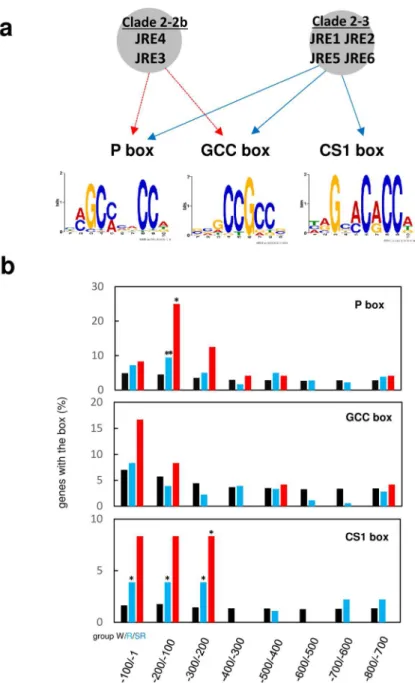
(20) genes The JRE4-binding elements found in proximal promoter regions (Fig. 6), prompted us to examine whether genes with such JRE-binding elements in promoter regions were enriched among JRE-regulated genes.. In addition to the P and GCC boxes targeted by clade 2-2b. All of the examined boxes were represented as weighted matrices (Supplementary Table S7). We computationally searched for P, GCC, and CS1 boxes with a cut-off score of 7.0 in promoter regions (up to -800; counted from first ATG) of JRE-regulated genes (group R) (180 genes in Supplementary Table S4) and of JRE-regulated SGA biosynthesis genes, (group SR) (24 genes in Fig. 3), a subset of group R genes.. The corresponding regions of all. protein-coding genes annotated in a tomato reference genome (group W) (34,725 genes) were analyzed as controls.. The genes with the JRE-binding elements in each group were counted.. The values even for group W were slightly variable among examined regions, possibly reflecting biased GC-contents or other genomic features in promoter regions.. We detected. enrichment of genes with a P box in the -200 to -100 region for both R (2.1-fold) and SR groups (5.8-fold) and of genes with a CS1 box in the -300 to -1 region for group R (2.2- to 2.7-fold) and in the -300 to -200 region for group SR (5.7-fold). To examine whether sequences related to P, GCC, and CS1 boxes could be retrieved in non-targeted analysis, the 5’-flanking sequences (-1500 to -1) of group R and SR genes 20. Downloaded from http://pcp.oxfordjournals.org/ at Nara Institute of Science and Technology on April 21, 2016. JRE4, a related CS1 box, recognized by clade 2-3 JREs (Fig. 7a), was included in the analysis..
(21) were subjected to MEME (Multiple Em for Motif Elicitation) analysis (Bailey et al. 2006), retrieving the sequences shared among the queries.. Multiple sequences with similarity to the. JRE-binding boxes were retrieved (Supplementary Table S8); match scores representing the similarities were calculated using position-specific probability matrices for P, GCC, and CS1. genes (Supplementary Table S7).. Discussion Impacts of altered JRE function on SGA biosynthesis Here, we used transgenic approaches, involving overexpression and dominant suppression, to elucidate the regulatory functions of tomato JRE transcription factors, which are closely related to alkaloid-regulating ORCA3 from C. roseus (van der Fits and Memelink 2001) and ERF189 from tobacco (Shoji et al. 2010).. Based on microarray analyses, we identified a. large number of JRE-regulated metabolic genes involved in SGA biosynthesis, including all clustered GAME genes except GAME2, constituting a core pathway downstream of cholesterol (Itkin et al. 2011, Itkin et al. 2013), genes for cholesterol biosynthesis, including SSR2 (Sawai et al. 2014) and flux-controlling HMGR (Narita and Gruissem 1989), and others involved in the mevalonate pathway (Fig. 2). 21. Our results demonstrate the existence of. Downloaded from http://pcp.oxfordjournals.org/ at Nara Institute of Science and Technology on April 21, 2016. boxes based on sequences retrieved from the 5’-flanking regions (-300 to -1) of group R.
(22) JRE-mediated transcriptional regulation of the entire SGA pathway in tomato.. This. regulation of the upstream pathways, as far up as the isoprenoid-producing branch, may be required to meet the metabolic demands for downstream SGA production without disturbing homeostasis of other metabolites derived from the highly branched terpenoid pathways.. The. 2009) campesterol and stigmasterol in the transgenic lines support this conclusion (Fig. 4). Although the overall pathway to SGA biosynthesis was generally coordinated, expression levels of genes involved in later steps, such as GAMEs, changed much more in the transgenic lines than did the upstream genes (Fig. 3, Fig. 4a, Supplementary Figure S4, Supplementary Table S2, Supplementary Table S3, Supplementary Table S5).. Such. differential regulation between distinct parts of the pathway was corroborated with the changes in the levels of metabolites; changes in SGAs and upstream intermediates, cholesterol, cycloartenol, lanosterol, and squalene, showed opposite trends in both the overexpression and the suppression lines (Fig. 5). This difference in accumulation presumably reflects imbalances between the early and late parts of the pathway.. To understand the. metabolic changes of triterpenoids, α-amyrin, β-amyrin, and lupeol, which showed a trend opposite to that of cycloartenol and lanosterol (Fig. 5), it might be useful to examine the regulation of oxidosqualene cyclase genes, none of which were identified as the regulated genes in our microarray analysis.. Of course, to better understand the metabolic impacts of 22. Downloaded from http://pcp.oxfordjournals.org/ at Nara Institute of Science and Technology on April 21, 2016. relatively small changes in the accumulation of the essential phytosterols (Boutté and Grebe.
(23) JRE4 overexpression, we need to examine not only the expression of the metabolic genes at transcript level but also activities of the involved enzymes and metabolic flux reflecting them. Our microarray-based approach to screening genes involved in a JRE-controlled regulon not only points to known structural genes (Fig. 3) but also helps mine novel In this regard,. it is intriguing that many uncharacterized genes annotated as encoding glucosyltransferases, cytochrome P450 enzymes, and peptide transporters were included in the list of JRE-regulated genes (Supplementary Table S4).. Similar transgenic approaches combined. with transcript profiling in other species producing SGAs are considered useful to elucidate the molecular bases of chemically diverse metabolites of this group (Friedman 2002, Friedman 2006, Iijima et al 2013).. It should be noted that Cárdenas et al. (2016) recently. reported that potato GAME9, an ortholog of tomato GAME9/JRE4, regulates the biosynthetic genes of the SGAs chaconine and solanine (Cárdenas et al. 2016).. Our identification of a. series of JRE-regulated metabolic genes in tomato provides new insights on cholesterol formation, which has been relatively unexplored in plants compared to other organisms (Sawai et al. 2013). To understand this regulation in the context of a greater metabolic network, we will need to address the coordination of the JRE-mediated transcriptional regulation with other mechanisms operating at the transcriptional and post-transcriptional levels (Pollier et al. 2013, 23. Downloaded from http://pcp.oxfordjournals.org/ at Nara Institute of Science and Technology on April 21, 2016. metabolic and transport genes required for complex SGA-related metabolism..
(24) Van Moerkercke et al. 2015, Mertens et al. 2015).. As discussed below, it is still an open. question whether all parts of the pathway are similarly subjected to the transcriptional regulation by JREs.. In addition to structural genes, molecular factors important for the. pathway regulation could be included in the JRE-regulated genes. Notably, among the genes. RING-finger E3 ubiquitin ligase, a homolog of MAKIBISH1 from Medicago truncatula that controls HMGR enzyme activity (Pollier et al. 2013).. Studies of tomato JREs and GAME9. (Cárdenas 2016; this study), along with recent studies on a group of related bHLH transcription factors (Van Moerkercke et al. 2015, Mertens et al. 2015), open a new chapter in the study of the regulation of terpenoid pathways, which had been remained unexplored until recently.. Transcriptional regulation of SGA biosynthesis genes JRE4 directly activates the transcription of DWF5 and GAME4 genes by recognizing the GCC-like elements in their promoter regions (Fig. 6).. Two of the three functional elements. found in DWF5 and GAME4 are present in similarly situated proximal regions (-248 to -219 relative to the ATG) (Fig. 6a).. This finding is consistent with previous reports on ORCA3-. and ERF189-recognizing elements present in similar regions of the targeted genes (van der Fits and Memelink 2000, Shoji et al. 2010, Shoji and Hashimoto 2011a) and also with the 24. Downloaded from http://pcp.oxfordjournals.org/ at Nara Institute of Science and Technology on April 21, 2016. identified as regulated by JREs (Supplementary Table S4) was a gene encoding a.
(25) computational predictions of the elements in the JRE-regulated genes (Fig. 7), suggesting a common mechanistic feature among transcription factors of this group.. Our results for. GAME4, which is present in a two-gene metabolic cluster (Fig. 6), point to a role for promoter-binding transcription factors in the regulation of such clusters, possibly in addition. It remains to be addressed whether all JRE-regulated SGA biosynthesis genes, including clustered GAMEs other than GAME4, are regulated directly by JREs in a similar manner as demonstrated for DWF5 and GAME4.. Considering the large number of regulated. steps and the differential regulation we observed, we cannot exclude the possibility of the involvement of additional mechanisms, such as indirect regulation through other transcription factors or metabolite-mediated feedback regulation.. As demonstrated for regulation of. nicotine biosynthesis genes by ERF189 and the JAZ-interacting bHLH transcription factor MYC2 (Shoji and Hashimoto 2011b), it is also plausible that JREs regulate the downstream genes in cooperation with other transcription factors.. In this regard, it is interesting that both. MYC2 and GAME4/JRE4 were required for transactivation of promoters of SGA biosynthesis genes in tobacco cells (Cárdenas et al. 2016).. Nevertheless, the significant. enrichment among the JRE-regulated genes of those bearing a P or CS1 box in the proximal promoter (Fig. 7) and the complementary results of the MEME analysis (Supplementary Table S8) suggest that JRE4 and possibly other JREs, including clade 2-3 members that can 25. Downloaded from http://pcp.oxfordjournals.org/ at Nara Institute of Science and Technology on April 21, 2016. to their proposed regulation at the chromosomal level (Wegel et al. 2009)..
(26) recognize the CS1 box, participate in the transcriptional regulation of many, but not necessarily all, of the genes by binding to the predicted elements.. The frequent occurrence. of the JRE-binding elements in the regulated genes supports the notion that genes acting downstream are recruited into regulons under the control of transcription factors through. Hashimoto 2011a, Moghe and Last 2015). The results of our promoter-related analyses (Fig. 6, Fig. 7, Supplementary Table S8) point the possible importance of GCC-like P and CS1 boxes rather than the canonical GCC box for JRE-mediated regulation, although all JREs presumably have substantial in vitro binding abilities to GCC box (Fig. 7a, Shoji et al. 2013).. As proposed for tobacco ERF189,. which exclusively targets the P box (Shoji et al. 2013), such preference for the GCC-like box of JREs may allow the JRE-controlled regulon to be free from influence by the large number of GCC box-recognizing ERFs.. Regulatory function of multiple JRE genes Gene clustering is common to JREs (Fig. 1a) and related ERFs (Shoji et al. 2013); in tobacco, ERF189 is clustered with related genes on a nicotine-controlling NIC2 locus and the NIC2-locus cluster was found to be deleted in a low-nicotine mutant (Shoji et al. 2010), while ORCA3 was found to reside on a same genomic contig with a similar gene in C. roseus 26. Downloaded from http://pcp.oxfordjournals.org/ at Nara Institute of Science and Technology on April 21, 2016. acquisition of functional cis-elements in the appropriate promoter regions (Shoji and.
(27) (Kellner et al. 2015).. When overexpressed in a low-nicotine mutant, ERF189 recovered. nicotine accumulation to the wild-type levels, and thus ERF189 has been considered to work most effectively as a regulator of nicotine biosynthesis among the clustered ERFs (Shoji et al. 2010).. Similar to the NIC2-locus cluster in tobacco, the tomato JRE cluster includes Dominant suppression of. clade 2-2b JRE3, 2-2b JRE4, or 2-3 JRE5 similarly repressed the expression of SGA biosynthesis genes (Fig. 3, Supplementary Fig. S3), suggesting overlapping functions of the three JREs. Of course, the effects of ectopic expression of the dominant repressive forms of these proteins should be interpreted carefully. The involvement of clade 2-3 JREs in SGA regulation is also supported by the frequent occurrences of CS1 boxes in promoters of the regulated genes.. In addition to overexpression (Fig. 3, Supplementary Fig. S4,. Supplementary Table S2) and promoter binding (Fig. 6) analyses as performed herein for JRE4, knock-out or knock-down experiments for individual members would be required to confirm the in planta contributions of each JRE to SGA regulation. The gene expression patterns strongly support a role for JRE4 in SGA regulation (Fig. 2).. JRE4 is expressed the most highly among JREs at the transcript level and, as pointed in. Itkin et al. (2013), its expression is clearly coordinated with SGA biosynthesis genes in various samples (Fig. 2).. In fruits, progressive decreases of expression were evident for. JRE4 and SMO1 and GAME1 during the green fruit stages (Fig. 2b), indicating that SGA 27. Downloaded from http://pcp.oxfordjournals.org/ at Nara Institute of Science and Technology on April 21, 2016. members of different clades, namely clades 2-2b and 2-3 (Fig. 1)..
(28) formation mainly declines during the green stages rather than later color-changing stages (Iijima et al. 2009).. In hairy roots, all JREs were clearly induced by MeJA treatment, but. their induction patterns were variable between the members (Fig. 2c).. Again, the gradual. induction of JRE4 paralleled those of SGA biosynthesis genes during the 24-h duration of According to the co-expression analysis and other evidence, we can infer that one. or few select members, such as tomato JRE4, tobacco ERF189, and possibly C. roseus ORCA3, play a predominant role in regulation of targeted metabolic pathways in each species. We need to further understand functional redundancy and divergence among the multiple ERF members to address why these ERF genes are maintained in a form of gene clusters during plant evolution.. SGAs as defense chemicals in tomato Plants usually adapt particular classes of metabolites for chemical defense.. A variety of. compounds, including SGAs, methyl ketones, and sesquiterpenes, are considered to mediate the herbivore resistance in Solanum species (Antonious et al. 2014).. SGAs are a group of. bioactive compounds with abilities to bind to cholesterol, disrupt cellular membranes and inhibit cholinesterases (Friedman 2015).. Based on their toxic and pharmacological. properties, SGAs has been proposed to be involved in plant host resistance against a wide range of biotic agents, such as bacteria, fungi, virus, insects and animals (Friedman 2002, 28. Downloaded from http://pcp.oxfordjournals.org/ at Nara Institute of Science and Technology on April 21, 2016. treatment..
(29) Friedman 2006).. A series of genes encoding biosynthetic enzymes and transcription factors. involved in SGA biosynthesis were induced by MeJA treatment in tomato tissues (Fig. 2c, Fig. 4a, Supplementary Fig. 1S, Supplementary Fig. 4S).. The JA-induced expression of the. genes and involvement of tomato homologs of ORCA3 and ERF189 in their induction. herbivores in tomato, as in the case of nicotine in tobacco (Baldwin 1998, Shoji and Hashimoto 2013).. Although induced significantly after elicitation, SGAs and nicotine are. substantially produced even at basal levels and the amounts of SGA and nicotine accumulation in the tissues seem in a similar range (in orders of mg per g dry weight), indicating the similarities of these two alkaloid groups with analogous regulatory mechanisms. Drastic declines of expression of SGA biosynthetic and regulatory JRE genes during early fruit development in tomato (Fig. 2c) are an example of developmental regulation of defense chemical pathways, which may operate more generally, ensuring the removal of toxic substances from seed-bearing mature fruits to allow seed dispersal assisted by fruit-eating herbivores. One of the main goals in tomato and potato breeding is the removal of toxic and anti-nutritional SGAs, which are not critically required for plant protection during normal cultivation and occasionally cause poisoning.. The removal of SGAs becomes critical when. considering the introduction of desirable genetic traits into cultivated species from wild 29. Downloaded from http://pcp.oxfordjournals.org/ at Nara Institute of Science and Technology on April 21, 2016. underline the committed roles of SGAs and JA signaling in induced chemical defense against.
(30) counterparts that usually produce SGAs at higher levels (Iijima et al. 2013).. Our. identification of the transcriptional regulators of SGA pathway provides a promising molecular tool applicable for the generation of the crops with low-SGA contents.. Plant growth, transformation and treatment Sterilized seeds of tomato, Solanum lycopersicum cv. Micro-Tom, were germinated and grown to seedlings on half-strength Gamborg B5 medium solidified with 0.6% (w/v) agar and supplemented with 2% (w/v) sucrose.. Two-week-old seedlings were transferred onto soil in. pots and grown to maturity in the greenhouse. The coding region of JRE4 was cloned into the BamHI and SacI sites on pBI121 to generate a binary vector p35S::JRE4 for overexpression. introduced. into. Agrobacterium. tumefaciens. strain. The p35S::JRE4 vector was GV2260. by. electroporation.. Agrobacterium-mediated transformation to generate transgenic tomato plants was done according to Sun et al. (2006).. Shoots were selected on solidified Murashige and Skoog. medium containing 100 mg liter-1 kanamycin. generation.. Diploid individuals were screened in T0. Transgenic plants of the T3 generation were analysed.. For gene expression analyses, leaves and roots from 4-week-old plantlets grown in greenhouse were submerged in B5 medium with 100 µM MeJA and incubated for 24 h in the 30. Downloaded from http://pcp.oxfordjournals.org/ at Nara Institute of Science and Technology on April 21, 2016. Materials and Methods.
(31) dark.. Four individual 7-week-old plants were placed in air-tight plastic containers (ca. 81. liters in volume), with a cotton sheet soaked with 5 ml of 100 µM MeJA.. The cotton sheet. was replaced with a newly soaked one every day during the duration of treatment.. Leaves. detached from plants exposed to MeJA vapour for 4 d were used for metabolite analysis.. JRE5 were amplified by PCR with primers including the restriction sites and a sequences for EAR motif (5’-CGGCCGCTTGATTTGGATCTTGAACTCAGACTTGGATTTGCTTA-3’; encoding LDLDLELRLGFA; Hiratsu et al., 2003) and inserted into the XbaI and SacI sites of pBI121.. To generate transgenic hairy roots, tomato hypocotyls from 7-day-old seedlings. were infected with Agrobacterium rhizogenes strain ATCC15834 harboring a binary vector by briefly touching one end of hypocotyl segment (1.5 cm in length) to a bacterial colony and then standing the segments on the same agar medium with the contacted end up.. Hairy roots. emerging from infected sites were excised and subcultured twice every week on solidified B5 medium containing 300 mg liter-1 cefotaxime for disinfection and 50 mg liter-1 kanamycin for drug-resistance selection.. The selected lines were maintained by subculturing every week in. 125-ml glass flasks filled with 25 ml liquid B5 medium supplemented with 2% (w/v) sucrose with shaking at 100 rpm in the dark.. MeJA was directly added to 4-day-old cultures to a. final concentration of 100 µM.. 31. Downloaded from http://pcp.oxfordjournals.org/ at Nara Institute of Science and Technology on April 21, 2016. To generate the dominant-suppression vectors, coding sequences of JRE3, JRE4, and.
(32) cDNA microarray analysis Total RNA was isolated from leaves treated with MeJA for 24 h and hairy roots treated with MeJA for 24 h using an RNeasy kit (Qiagen). 2100 Bioanalyzer (Agilent).. RNA integrity was checked with an Agilent. Total RNA (500 ng) was used to generate Cyanine 3-labelled A tomato custom. oligoarray with 60-mer probes of more 40,000 sequences, designed using transcript sequences of the Tomato Gene Index Version 11 (LeGI v.11; http://www.danafarber.org/), was. hybridized with the labelled samples and scanned, and data were captured and processed as described (Ruiu et al. 2015).. Due to poor labelling, hybridization was cancelled for sample. from JRE4-EAR line #2. Probes with low signal intensity (averages for the two controls <0.2) and intensities variable between lines (differences between the two controls >2.5 folds) were excluded from the analysis.. Values relative to the controls were obtained by pairwise comparisons and. averaged for each construct; values were defined as Rox, Rj3, Rj4, and Rj5 derived from data for JRE4-OX,. JRE3-EAR,. JRE4-EAR,. and JRE5-EAR. lines,. respectively.. For. the. overexpression experiment, probes with Rox>5 are listed in Supplementary Table S2.. For. the suppression experiment, Q was defined as Q2=Rj32+Rj42+Rj52 and probes with Q<0.85 are listed in Supplementary Table S3.. 32. Downloaded from http://pcp.oxfordjournals.org/ at Nara Institute of Science and Technology on April 21, 2016. cRNA probes using a Quick Amp Labeling Kit, One-Color (Agilent)..
(33) qRT-PCR Total RNA was isolated from plant samples that had been ground in liquid nitrogen using RNeasy kit (Qiagen) and then converted to first-strand cDNA using ReverTra Ace qPCR RT Master Mix (Toyobo) with oligo(dT) primer.. The cDNA templates were amplified using a. The primer sequences are given in Supplementary Table S9. used as a reference gene.. EF1α (Solyc05g005060) was. Each assay was repeated at least three times.. Based on. amplifications from equal molar quantities of cloned amplicons, amplifications from different primer pairs were normalized.. Metabolite analysis For measurement of SGAs, freeze-dried samples (2 mg) were extracted with 250 µl (for hairy root samples) or 500 µl (for leaf samples) of 80% (v/v) methanol containing 2.5 µM lidocaine and 2.5 µM 10-camphour sulfonic acid using a mixer mill with zirconia beads for 7 min at 18Hz and 4°C.. After centrifugation for 10 min at 12,000 g, the supernatant was filtered. using an HLB µElution plate (Waters).. The extracts (1 ul) were analyzed using. LC-QTOF-MS (LC, Waters Acquity UPLC system; MS, Waters Xevo G2 Q-Tof).. Positive. ion mode was used and analytical conditions were as follows: LC column, Acquity bridged ethyl hybrid (BEH) C18 (1.7 µm, 2.1 mm × 100 mm, Waters); solvent system, solvent A 33. Downloaded from http://pcp.oxfordjournals.org/ at Nara Institute of Science and Technology on April 21, 2016. LightCycler 96 (Roche) with SYBR Premix Ex Taq (Takara) according to Shoji et al. (2010)..
(34) (water including 0.1% formic acid) and solvent B (acetonitrile including 0.1% formic acid); gradient program, 99.5%A/0.5%B at 0 min, 99.5%A/0.5%B at 0.1 min, 20%A/80%B at 10 min, 0.5%A/99.5%B at 10.1 min, 0.5%A/99.5%B at 12.0 min, 99.5%A/0.5%B at 12.1 min and 99.5%A/0.5%B at 15.0 min; flow rate, 0.3 ml/min at 0 min, 0.3 ml/min at 10 min, 0.4. 40 °C; MS detection: capillary voltage, +3.0 keV, cone voltage, 25.0 V, source temperature, 120 °C, desolvation temperature, 450 °C, cone gas flow, 50 l/h; desolvation gas flow, 800 l/h; collision energy, 6 V; mass range, m/z 50‒1500; scan duration, 0.1 sec; inter-scan delay, 0.014 sec; data acquisition, centroid mode; Lockspray (Leucine enkephalin): scan duration, 1.0 sec; inter-scan delay, 0.1 sec. MS/MS data were acquired in ramp mode using the following analytical conditions: (1) MS: mass range, m/z 50–1500;scan duration, 0.1 sec; inter-scan delay, 0.014 sec; data acquisition, centroid mode; polarity, positive/negative; and (2) MS/MS: mass range, m/z 50–1500; scan duration, 0.02 sec; inter-scan delay, 0.014 sec; data acquisition, centroid mode; polarity, positive/negative collision energy, ramped from 10 to 50 V. In this mode, MS/MS spectra of the top 10 ions (> 1000 counts) in an MS scan were automatically obtained. If the ion intensity was less than 1000, MS/MS data acquisition was not performed and moved to of next top 10 ions.. Chemical assignment of SGAs was performed using the. MS/MS spectra reported in Itkin et al. (2011). All SGA levels were calculated based on a calibration curve of α-tomatine (Tokyo Chemical Industry Co., Ltd., Tokyo), assuming the 34. Downloaded from http://pcp.oxfordjournals.org/ at Nara Institute of Science and Technology on April 21, 2016. ml/min at 10.1 min, 0.4 min/min at 14.4 min and 0.3 ml/min at 14.5 min; column temperature,.
(35) same molar responses of SGAs. For measurement of triterpenes, the extraction of plant tissues with added standards ([25,26,26,26,27,27,27-2H7]cholesterol (98% D, Cambridge Isotope Laboratories, Inc., Andover, MA, USA) or synthesized [3,28,28,28-2H4] β-amyrin, [28,28,28-2H3] α-amyrin, and. described (Tsukagoshi et al, 2016).. Quantification of triterpenes except for lanosterol and. squalene using GC-MS analysis was performed as described previously (for sterols; Choi et al, 2014, for triterpenols; Ohyama et al. 2007).. Lanosterol amounts were calculated using the. peak area ratio of fragment ion (m/z: 393) of trimethylsilylated lanosterol and that (m/z: 336) of the standard (TMS derivative of the labeled cholesterol).. Quantification of squalene was. performed using the standard calibration curve with coefficients of determination, r2 > 0.9996. The curves were constructed using the peak area value of TIC (total ion chromatogram).. Transactivation assay The 5’-flanking regions of DWF5 and GAME5 were amplified by PCR from tomato genomic DNA with primers attached with the restriction sites and cloned into the HindIII and BamHI sites on pBI121 to generate the GUS reporter constructs.. For mutant reporter constructs,. before cloning the fragments into pBI121, PCR-based mutagenesis (Hemsley et al. 1989) was used to substitute the nucleotides in the cloned promoter sequences; nucleotide substitutions 35. Downloaded from http://pcp.oxfordjournals.org/ at Nara Institute of Science and Technology on April 21, 2016. 28,28,28-2H3] lupeol (Ohyama et al. 2007)) was carried out using the method previously.
(36) introduced are shown in Fig. 6a. effector plasmids.. pGBW17 was used as the empty-vector control for the. The binary vectors, p19s for P19 silencing suppressor (Voinnet et al.. 2003) and p35S-GFP for GFP reference gene, were used. Transient gene expression was performed in tomato fruits according to an Briefly, Agrobacteriun tumefaciens strain. EHA105 with a binary vector was grown overnight in YEB medium supplemented with 20 µM acetosyringone and appropriate antibiotics and recovered by centrifugation at 4,000 g for 20 min.. The cells were re-suspended in infiltration buffer (10 mM MES, 10 mM MgCl2, 200. µM acetosyringone, pH 5.7) by adjusting optical density at 600 nm to 0.25, and then incubated for at least 2 h at room temperature in the dark.. The bacterial suspensions for. reporter and effector vectors plus those for p19s and p35S-GFP vectors were combined, and the resultant solution (200 to 300 µl per fruit) was injected into mature green fruits (1 to 1.5 cm in size) using a 1-ml plastic syringe attached to a 27-gauge needle.. Gene expression was. analyzed by qRT-PCR using fruits harvested 3 d after the injection.. EMSA Bacterial expression and purification of recombinant fusion proteins of JRE4, called Sl1g90340 in Shoji et al. (2013), were done as described (Shoji et al. 2013).. In the. pET32b-based expression vector, a portion of JRE4 (corresponding to 40-219 amino acid 36. Downloaded from http://pcp.oxfordjournals.org/ at Nara Institute of Science and Technology on April 21, 2016. agroinjection protocol (Orzaez et al. 2006)..
(37) residues) was placed downstream of a sequence for N-terminal tags, a thioredoxin, an S-tag, and a His-tag (Shoji et al. 2013).. Proteins comprising only with the tag portion from empty. pET32b were purified and used as the controls. Sequences of sense and antisense oligonucleotides used are given in Supplementary Probe preparation, DNA-protein-binding assays, gel separation, and detection of. the reaction products were carried out as described (Shoji et al. 2010).. Computational analysis We used Regulatory Sequence Analysis Tools (RSAT; Turatsinze et al. 2008, http://rsat.ulb.ac.be/rsat/) to search for putative JRE binding elements in the query genomic. sequences by weight matrix scoring.. Weight matrices for the P, GCC, and CS1 boxes (Shoji. et al. 2013) are given in Supplementary Table S7. parameters.. The default setting were used for all. Elements with scores higher than 7.0 were retained for analysis, along with. element G2, which had a score of 6.1 in GAME4. elements in the examined regions were counted.. Genes with putative JRE-binding. Significant differences of the values. compared to those of group W including all tomato protein coding genes was determined by one-sided Fisher’s exact test (α=0.05) using the fisher test function of R (V. 3.2.2). Based on sequences predicted to be the JRE-binding elements by RSAT in the regions (-300 to -1) of group R genes, position-specific probability matrices for P, GCC, and 37. Downloaded from http://pcp.oxfordjournals.org/ at Nara Institute of Science and Technology on April 21, 2016. Table S10..
(38) CS1 boxes (Supplementary Table S7) were generated by MEME software (v. 4. 10. 2.,. Bailey et al. 2006) with option settings; ‘2’ for ‘-nmotif’, ‘10’ for ‘-minw’ and applying ‘-revcomp’.. To retrieve the sequences commonly found in the queries, MEME was used. with option settings; ‘10’ for ‘-nmotif’, ‘7’ for ‘-minw’ and applying ‘-revcomp’.. Match. JRE-binding box (P, GCC, or CS1) were calculated using position-specific probability matrices for the pairs.. When a pair of sequences with lengths of L1 and L2 were aligned. with the overlapping length of L3, the alignment length Le was defined as Le=L1+L2-L3. Differences between 1 and normalized vector distances were summed for overlapping positions and divided by Le to give scores for the alignments.. The alignment scores were. calculated for all possible alignments with no gap in both orientations for a sequence pair, and the highest alignment score was adapted as match score for the pair.. Supplementary data Figure S1 Transgenic JRE4-OX tomato plants. Figure S2 Expression levels of JRE genes in transgenic JRE-EAR hairy root lines. Figure S3 Venn diagram showing the numbers of probes down-regulated (Rj3<0.4 for JRE3-EAR, Rj4<0.4 for JRE4-EAR, Rj5<0.4 for JRE5-EAR) by each JRE-EAR. Figure S4 Gene expression in roots of transgenic JRE4-OX tomato plants. 38. Downloaded from http://pcp.oxfordjournals.org/ at Nara Institute of Science and Technology on April 21, 2016. scores representing the similarities between a pair of the retrieved sequence and the.
(39) Figure S5 Schematic diagram of SGAs in their biosynthetic pathway.. Table S1 Transcript levels of JRE genes and SGA biosynthesis genes in tomato tissues. Table S2 Probes up-regulated in JRE4-OX lines. Table S3 Probes down-regulated in JRE-EAR lines.. Table S5 Signal intensities of probes corresponding to JRE-regulated SGA biosynthesis genes Table S6 SGA levels in transgenic tomato JRE4-OX plant and JRE4-EAR hairy root lines. Table S7 Matrices for P box, GCC box, and CS1 box. Table S8 Top 10 sequences retrieved by MEME analysis. Table S9 Oligonucleotide primers used for qRT-PCR analysis. Table S10 Sense and anti-sense oligonucleotides for probes used in EMSA. Funding This work was supported by a Grant-in-Aid for Scientific Research (C) [grant number 26440144] from the Japan Society for the Promotion of Science to T.S. and Cooperative Research Grant of the Plant Transgenic Design Initiative, Gene Research Center, University of Tsukuba.. Disclosures 39. Downloaded from http://pcp.oxfordjournals.org/ at Nara Institute of Science and Technology on April 21, 2016. Table S4 JRE-regulated genes..
(40) The authors have no conflicts of interest to declare.. Acknowledgements We thank Drs. Tsuyoshi Nakagawa and Yoshinori Yagi for providing pGBW17 and p35S-GFP, This work was supported in part by the RIKEN Plant Transformation Network. and the Japan Advanced Plant Science Network.. References Antonious, G.F., Kamminga, K., Snyder, J.C. (2014) Wild tomato leaf extracts for spider mite and cowpea aphid control. J. Environ. Sci. Health B. 49: 527-531.. Bailey, T.L., Williams, N., Misleh, C. and Li, W.W. (2006) MEME: discovering and analyzing DNA and protein sequence motifs. Nucleic Acids Res. 34: W369-373.. Baldwin, I.T. (1998) Jasmonate-induced responses are costly but benefit plants under attack in native populations. Proc. Natl. Acad. Sci. 95: 8113-8118.. Bednarek, P. and Osbourn, A. (2009) Plant-microbe interactions: chemical diversity in plant 40. Downloaded from http://pcp.oxfordjournals.org/ at Nara Institute of Science and Technology on April 21, 2016. respectively..
(41) defense. Science 324: 746-748.. Betz, J.M. (1999) Plant toxins. J. AOAC Int. 82: 781-784.. Opin. Plant Biol. 12: 705-713.. Boycheva, S., Daviet, L., Wolfender, J.L. and Fitzpatrick, T.B. (2014) The rise of operon-like gene clusters in plants. Trends in Plant Sci. 19: 447-459.. Cárdenas, P.D., Sonawane, P.D., Pollier, J., Bossche, R.V., Dewangan, V., Weithorn, E. et al. (2016) GAME9 regulates the biosynthesis of steroidal alkaloids and upstream isoprenoids in the plant mevalonate pathway. Nat. Comm. 7:10654.. Choi H, Ohyama K, Kim YY, Jin JY, Lee SB, Yamaoka Y. et al. (2014) The role of Arabidopsis ABCG9 and ABCG31 ATP binding cassette transporters in pollen fitness and the deposition of steryl glycosides on the pollen coat. Plant Cell 26:310-24.. Crooks, G.E., Hon, G., Chandonia, J.M. and Brenner, S.E. (2004) WebLogo: a sequence logo 41. Downloaded from http://pcp.oxfordjournals.org/ at Nara Institute of Science and Technology on April 21, 2016. Boutté, Y. and Grebe, M. (2009) Cellular processes replying on sterol function in plants. Curr..
(42) generator. Genome Res. 14: 1188-1190.. De Geyter, N., Gholami, A., Goormachtig, S. and Goossens, A. (2012) Transcriptional machineries in jasmonate-elicited plant secondary metabolism. Trends Plant Sci. 17: 349-359.. Chem. 50: 5751-5780.. Friedman, M. (2006) Potato glycoalkaloids and metabolites: roles in the plant and in the diet. J. Agric. Food Chem. 54: 8655-8681.. Friedman, M. (2015) Chemistry and anticarcinogenic mechanisms of glycoalkaloids produced by eggplants, potatoes, and tomatoes. J. Agric. Food Chem. 63: 3323-3337.. Hemsley, A., Amheim, N., Toney, M.D., Cortpassi, G. and Galas, D.J. (1989) A simple method for site-directed mutagenesis using the polymerase chain reaction. Nucleic Acids Res. 17: 6547-6551.. Hiratsu, K., Mitsuda, N., Matsui, K. and Ohme-Takagi, M. (2003) Dominant repression of 42. Downloaded from http://pcp.oxfordjournals.org/ at Nara Institute of Science and Technology on April 21, 2016. Friedman, M. (2002) Tomato glycoalkaloids: role in the plant and in the diet. J. Agric. Food.
(43) target genes by chimeric repressors that include the EAR motif, a repression domain, in Arabidopsis. Plant J. 34: 733-739.. Iijima, Y., Fujiwara, Y., Tokita, T., Ikeda, T., Nohara, T., Aoki, K. et al. (2009) Involvement of. lycopersicum). J. Agric. Food Chem. 57: 3247-3252.. Iijima, Y., Watanabe, B., Sasaki, R., Takenaka, M., Ono, H., Sakurai, N. et al. (2013) Steroidal glycoalkaloid profiling and structures of glycoalkaloids in wild tomato fruit. Phytochemistry 95: 145-157.. Itkin, M., Heinig, U., Tzfadia, O., Bhide, A.J., Shinde, B., Cardenas, P. et al. (2013) Biosynthesis of antinutritional alkaloids in Solanaceous crops is mediated by clustered genes. Science 341: 175-179.. Itkin, M., Rogachev, I., Alkan, N., Rosenberg, T., Malitsky, S., Masini, L. et al. (2011) GLYCOALKALOID METABOLISM1 is required for steroidal alkaloid glycosylation and prevention of phytotoxicity in tomato. Plant Cell 23: 4507-4525.. 43. Downloaded from http://pcp.oxfordjournals.org/ at Nara Institute of Science and Technology on April 21, 2016. ethylene in the accumulation of esculeoside A during fruit ripening of tomato (Solanum.
(44) Kazan, K. and Manners, J.M. (2013) MYC2: The master in action. Mol. Plant 6: 686-703.. Kellner, F., Kim, J., Clavijo, B.J., Hamilton, J.P., Childs, K.L., Vaillancourt, B. et al. (2015) Genome-guided investigation of plant natural product biosynthesis. Plant J. 82: 680-692.. Goossens, A. (2016) The bHLH transcription factors TSAR1 and TSAR2 regulate triterpene saponin biosynthesis in Medicago truncatula. Plant Physiol. 170: 194-210.. Moehs, C.P., Allen, P.V., Friedman, M. and Belknap, W.R. (1997) Cloning and expression of solanidine UDP-glucose glucosyltransferase from potato. Plant J. 11: 227-236.. Moghe, G.D. and Last, R.L. (2015) Something old, something new: conserved enzymes and the evolution of novelty in plant specialized metabolism. Plant Physiol. 169: 1512-1523.. Nakano, T., Suzuki, K., Fujimura, T. and Shinshi, H. (2006) Genome-wide analysis of the ERF gene family in Arabidopsis and rice. Plant Physiol. 140: 411-432.. Narita, J.O. and Gruissem, W. (1989) Tomato hydroxymethylglutaryl-CoA reduxtase is 44. Downloaded from http://pcp.oxfordjournals.org/ at Nara Institute of Science and Technology on April 21, 2016. Mertens, J., Pollier, J., Vanden Bossche, R., Lopez-Vidriero, I., Franco-Zorrilla, J.M. and.
(45) required early in fruit development but not during ripening. Plant Cell 1: 181-190.. Ohyama K, Suzuki M, Masuda K, Yoshida S, and Muranaka T (2007) Chemical phenotypes of the hmg1 and hmg2 mutants of Arabidopsis demonstrate the in-planta role of HMG-CoA. Orzaez, D., Mirabel, S., Wieland, W.H. and Granell, A. (2006) Agroinjection of tomato fruits. A tool for rapid functional analysis of transgenes directly in friut. Plant Physiol. 140: 3-11.. Pollier, J., Moses, T., González-Guzmán, M., De Geyter, N., Lippens, S., Vanden Bossche, R. et al. (2013) The protein quality control system manage plant defence compound synthesis. Nature 504: 148-152.. Ruiu, F., Picarella, M.E., Imanishi, S. and Mazzucato, A. (2015) A transcriptomic approach to identity regulatory genes involved in fruit set of wild-type and perthenocarpic tomato genotypes. Plant Mol. Biol. 89: 263-278.. Sawai, S, Ohyama, K., Yasumoto, S., Seki, H., Sakuma, T., Yamamoto, T. et al. (2014) Sterol side chain reductase 2 is a key enzyme in the biosynthesis of cholesterol, the common 45. Downloaded from http://pcp.oxfordjournals.org/ at Nara Institute of Science and Technology on April 21, 2016. reductase in triterpene biosynthesis. Chem. Pharm. Bull. 55:1518-1521..
(46) precursor for toxic steroidal glycoalkaloids in potato. Plant Cell 26: 3763-3774.. Shoji, T. and Hashimoto, T. (2011a) Recruitment of a duplicated primary metabolism gene into the nicotine biosynthesis regulon in tobacco. Plant J. 67: 949-959.. biosynthesis genes directly and by way of the NIC2-locus ERF genes. Plant Cell Physiology 52: 1117-1130.. Shoji, T. and Hashimoto, T. (2013) Smoking out the masters: transcriptional regulators for nicotine biosynthesis in tobacco. Plant Biotechnol. 30: 217-224.. Shoji, T., Inai, K., Yazaki, Y., Sato, Y., Takase, H., Shitan, N. et al. (2009) Multidrug and toxic compound extrusion-type transporters implicated in vacuolar sequestration of nicotine in tobacco roots. Plant Physiol. 149; 708-718.. Shoji, T., Kajikawa, M. and Hashimoto, T. (2010) Clustered transcription factor genes regulate nicotine biosynthesis in tobacco. Plant Cell 22: 3390-3409.. 46. Downloaded from http://pcp.oxfordjournals.org/ at Nara Institute of Science and Technology on April 21, 2016. Shoji, T. and Hashimoto, T. (2011b) Tobacco MYC2 regulates jasmonate-inducible nicotine.
(47) Shoji, T., Mishima, M. and Hashimoto, T. (2013) Divergent DNA-binding specificities of a group of ETHYLENE RESPONSE FACTOR transcription factors involved in plant defense. Plant Physiol. 162: 977-990.. protocol for Micro-Tom, a model cultivar for tomato functional genomics. Plant Cell Physiol. 47: 426-431.. Tsukagoshi Y, Suzuki H, Seki H, Muranaka T, Ohyama K, and Fujimoto Y (2016) Ajuga ∆24-sterol reductase catalyzes the direct reductive conversion of 24-methylenecholesterol to campesterol. J. Biol. Chem. in press.. Tamura, K., Stecher, G., Peterson, D., Fillpski, A. and Kumar, S. (2013) MEGA6: molecular evolutionary genetic analysis version 6.0. Mol. Biol. Evol. 30: 2725-2729.. Thompson, J.D., Higgins, D.G. and Gibson, T.J. (1994) CLUSTAL W: improving the sensitivity of progressive multiple sequence alignment through sequence weighting, position-specific gap penalties and weight matrix choice. Nucleic. Acid Res. 22: 4673-4680.. 47. Downloaded from http://pcp.oxfordjournals.org/ at Nara Institute of Science and Technology on April 21, 2016. Sun, H.J., Uchii, S., Watanabe, S. and Ezura, H. (2006) A highly efficient transformation.
(48) Turatsinze, J.V., Thomas-Collier, M., Defrance, M. and van Helden, J. (2008) Using RSAT to scan genome sequences for transcription factor binding sites and cis-regulatory modules. Nat. Proto. 3: 1578-1588.. regulator of plant primary and secondary metabolism. Science 289: 295-297.. Van Moerkercke, A., Steensma, P., Schweizer, F., Pollier, J., Gariboldi, I., Payne, R. et al. (2015) The bHLH transcription factor BIS1 controls the iridoid branch of the monoterpenoid indole alkaloid pathway in Catharanthus roseus. Proc. Natl. Acad. Sci. USA 112: 8130-8135.. Voinnet, O., Rivas, S., Mestre, P. and Baulcombe, D. (2003) An enhanced transient expression system in plants based on suppression of gene silencing by the p19 protein of tomato bushy stunt virus. Plant J. 33: 949-956.. Wasternack, C. and Hause, B. (2013) Jasmonates: biosynthesis, perception, signal transdaction and action in plant stress response, growth and development. An update to the 2007 review in Annals of Botany.. Ann. Bot. 111: 1021-1058.. 48. Downloaded from http://pcp.oxfordjournals.org/ at Nara Institute of Science and Technology on April 21, 2016. Van der Fits, L. and Memelink, J. (2000) ORCA3, a jasmonate-responsive transcriptional.
(49) Wegel, E., Koumproglou, R., Shaw, P. and Osbourn, A. (2009) Cell type-specific chromatin decondensation of a metabolic gene cluster in oats. Plant Cell 21: 3926-3936.. Yukimune, Y., Tabata, H., higashi, Y. and Hara, Y. (1996) Methyl jasmonate-induced. Biotechnol. 14: 1129-1132.. Zhang, H., Hedhili, S., Montiel, G., Zhang, Y., Chatel, G., Pré, M. et al. (2011) The basic helix-loop-helix transcription factor CrMYC2 controls the jasmonate-responsive expression of the ORCA genes that regulate alkaloid biosynthesis in Catharanthus roseus. Plant J. 67: 61-71.. Legends to figures Figure 1 Tomato JRE genes (a) Schematic presentation of the cluster of five JRE genes on chromosome I and JRE6 on chromosome V.. JRE and other genes are represented as black and gray boxes, respectively.. Strands on which each gene resides are indicated with arrowheads.. (b) Phylogenetic tree of. tomato JREs and related ERF proteins from Arabidopsis, Catharanthus roseus, and tobacco. Two clade 1 ERF proteins of group IXa, At ERF1 and At ERF2, were included as an outgroup. 49. Downloaded from http://pcp.oxfordjournals.org/ at Nara Institute of Science and Technology on April 21, 2016. overproduction of paclitaxel and baccatin III in Taxus cell suspension cultures. Nat..
(50) Amino acid sequences of the DNA-binding domain were aligned using ClustalW (Thompson et al. 1994).. An unrooted phylogenetic tree was constructed using the neighbor-joining. algorithm with MEGA6 (Tamura et al. 2013).. Bootstrap values are indicated at branch. nodes, and the scale bar indicates the number of amino acid substitution per site.. Species. Figure 2 Expression patterns of JRE genes in tomato. Tomato flower, leaf, stem, and root (a) and fruits of different ripening stages (b) were examined. 24h (c).. Wild-type tomato hairy roots were treated by 100 µM MeJA for 0. 0.5, 1. 4, and Transcript levels were analyzed by qRT-PCR.. Heat maps were drawn using. average values (Supplementary Table S1) of three biological replicates.. For JREs, values. are calculated relative to those of EF1a, and are shown relative to the value (set to 100, marked with asterisk) of JRE4 in hairy roots treated by MeJA for 24 h.. For HMGR1, SMO1,. and GAME1, levels are shown relative to those in leaf, in fruit at stages with highest expression for each, or in hairy roots at 0 h.. Figure 3 JRE-regulated SGA biosynthesis genes identified by cDNA microarray analysis. Probes corresponding to SGA biosynthesis genes up-regulated by JRE4 overexpression or down-regulated by dominant suppression of JREs are shown. 50. Signal intensities relative to. Downloaded from http://pcp.oxfordjournals.org/ at Nara Institute of Science and Technology on April 21, 2016. names are denoted with prefixes. At, Arabidopsis; Cr, C. roseus; Nt, tobacco; Sl, tomato..
(51) those of one of the controls (WT1 or VC1) are represented as heat maps (values available in Supplementary Table S5). asterisks, respectively.. Probes with Rox>5 and Q<0.85 are marked with red and blue. Schematic view of SGA biosynthesis pathway is on the left. ACAA,. acetyl-CoA C-acetyltransferase; HMGS, hydroxymethylglutaryl-CoA synthase; HMGR,. squalene monooxygenase; SSR2, sterol side chain reductase 2; O14DM, obtsuifoliol 14α-demethylase;. D14SR,. ∆14-sterol. reductase;. SCDH,. sterol-4α-carboxylate. 3-dehydrogenase; HYD1, 3β-hydroxysteroid-∆8∆7-isomerase; SMO2, sterol 4α-methyl oxidase 2; DWF7, sterol C-5 desaturase; DWF5, sterol reductase; GAME, glycoalkaloid metabolism; IPP, isopentenyl pyrophosphate; DMPP, dimethylallyl pyrophosphate.. Figure 4 Expression levels of SGA biosynthesis genes in transgenic tomato JRE4-OX plant and JRE4-EAR hairy root lines. Transcript levels were analyzed by qRT-PCR. biological replicates.. Levels are shown relative to the controls.. abbreviations of gene names. MeJA for 24 h.. The error bars indicate the SD for three See legend of Fig. 3 for. (a) Levels in leaves from JRE4-OX plant lines treated with. (b) Levels in hairy roots of JRE4-EAR (line #1) treated with MeJA for 24 h.. Figure 5 Metabolite levels in transgenic tomato JRE4-OX plant and JRE4-EAR hairy root 51. Downloaded from http://pcp.oxfordjournals.org/ at Nara Institute of Science and Technology on April 21, 2016. 3-hydroxy-3-methylglutaryl CoA reductase: IDI, isopentenyl-diphosphate ∆-isomerase; SQO,.
(52) lines. Metabolite levels were analyzed by LC-QTOF-MS for α-tomatine and by GC-MS for others. The error bars represent SD from four (for a) or five (for b) biological replicates. other SGAs are available in Supplementary Table S6.. (a) Levels in leaves from JRE4-OX. (b) Levels in hairy roots of JRE4-EAR. (line #1) treated with MeJA for 4 d. (c) Metabolites are schematically indicated in SGA biosynthesis pathway.. Figure 6 JRE4-mediated activation of DWF5 and GAME4 is dependent on JRE-binding elements found in the promoter regions. (a) Schematic representation of 5’-flanking regions of DWF5 and GAME4.. The positions of. JRE-binding elements (arrowheads) and transcriptional start sites (arrows with vertical lines) are shown.. On the right, nucleotide sequences of the elements are shown, while only the. substituted nucleotides are indicated in mutated versions. assays in tomato fruits.. (b) Transient transactivation. GUS reporter gene fused with 5’-flanking regions of DWF5 (-1,500. to -1 or -285 to -1; counted from the first ATG) and GAME4 (-1,500 to -1) or their mutated versions, were delivered into tomato fruits by agroinjection with JRE4 effector plasmid or empty vector (EV) and GFP reference plasmid.. Expression levels of GUS reporter gene. were normalized to those of the GFP reference gene, and are shown as relative values against 52. Downloaded from http://pcp.oxfordjournals.org/ at Nara Institute of Science and Technology on April 21, 2016. plants (line OX1) exposed to MeJA vapor for 4 d.. Levels of.
図

+4

関連したドキュメント
To determine whether expression of HPV genes had any influence upon HIF-1α activation or levels in normoxia and hypoxia, we first examined whether HIF-1α levels were induced
Quantitative analysis by real-time Reverse transcription-polymerase chain reaction (RT-PCR) of chronological change in the expression of hepatocyte growth factor (HGF),
We measured blood levels of adiponectin in SeP knockout mice fed a high sucrose, high fat diet to examine whether SeP was related to the development of hypoadiponectinemia induced
ADsZFHzcr:IpurifiedthenitratereductasefromMZgアzeZD叩かiJ肋川川昭肥ZDZZzcZi切川
In the case of the Kac equation, that has the Gaussian distribution as steady state, rates of convergence with respect to Kolmogorov’s uniform metric, weighted χ -metrics of order p ≥
Keywords: continuous time random walk, Brownian motion, collision time, skew Young tableaux, tandem queue.. AMS 2000 Subject Classification: Primary:
The commutative case is treated in chapter I, where we recall the notions of a privileged exponent of a polynomial or a power series with respect to a convenient ordering,
Then it follows immediately from a suitable version of “Hensel’s Lemma” [cf., e.g., the argument of [4], Lemma 2.1] that S may be obtained, as the notation suggests, as the m A
