
近畿大学学術情報リポジトリ
21
0
0
全文
(2) ft* •. 37---5'gV Introduction While English activities have been required for the fifth and sixth grade students. in public elementary. schools in Japan. teaching has repeatedly. (MEXT, 2008a), the issue over the quality of. been one of the obstacles elementary. other words, more than 90% of English classes are taught. schools have faced. In by homeroom. teachers. (MEXT, 2008b) who are not necessarily trained English teachers. Therefore, the level of English teachers in terms of their English ability and teaching skills has been at the center of discussion among researchers. (Butler, 2005; Higuchi, Kanamori, & Kunikata,. 2005). Subsequently, in order to more effectively promote a higher quality in elementary school English education nationwide, training sessions based on a clear set of standards should be offered not only to in-service teachers university teachers. students. in teaching certificate programs. Researchers. at universities. elementary. but also to pre-service teachers, i.e.,. have proposed. school English. syllabi for methodology. teaching pre-service classes on teaching. (Egawa, 2008; Ito, 2010; Izumi, 2007; Koda, 2009; Yoshida,. Kodera, Terada, & Honda, 2006). These syllabi often include both theoretical aspects such as objectives of English activities and methodology on teaching elementary school English, and practical experiencing. aspects such as learning. micro-teaching.. how to teach songs and chants, and. Moreover, some researchers. (Hojo & Matsuzaki, 2010;. Matsumiya, 2010) have suggested appropriate content for methodology classes based on the feedback they have received from their students. According to the feedback, preservice teachers. tend to prefer learning practical skills such as English conversation. skills and game instruction. skills, to learning. syllabi and feedback from pre-service pre-service. teachers. ample practical. theoretical. teachers. suggest. training regarding. elements. These proposed that universities. should offer. English ability and teaching. skills before they go into an actual classroom as a student teacher. Yet, to date, neither extensive research on the actual contents of practical training sessions for pre-service teachers nor empirical studies on the effectiveness of the contents of training sessions have been done. In regards training procedures. to the current. for university. situation,. this study explored. effective. students who plan to become teachers in the future. at a primary or secondary level. More precisely, this study empirically measured. the. effectiveness of a specific training element regarding teaching skills of elementary school English activities, giving game instructions in English.. — 212 —.
(3) PracticalTrainingSessions to PreparePre-Service TeacherstoConductEnglishActivitiesat the Elementary SchoolLevel Research Questions In this study, the participants. were divided into two groups, groups A and B. Both. groups A and B received three, approximately. 30-minute training sessions on giving. game instructions in English. Although the number of sessions and the contents of game activities were the same for both groups, the styles and procedures different. between. demonstrated. the groups.. Regarding. game instructions. group. A's sessions,. as if the participants. school students. On the other hand, the participants. of the sessions were their. instructor. in group A were elementary. in group B had to act out game. instructions themselves as teachers to other classmates. Specifically, this study attempted to answer the following research questions. 1. Are there significant. improvements. instructions. after. demonstrates. game instructions. 2. Are there. significant. instructions. receiving. three. in pre-service training. teachers'. sessions. skills to give game. in which. their. instructor. (group A)?. improvements. in pre-service. teachers'. skills to give game. after receiving three training sessions in which they themselves. act out. game instructions on their own (group B)? 3. Is there a significant difference in the improvement. of pre-service teachers'. skills to. give game instructions between groups A and B? Method Participants The participants in the study were 29 second to fourth-year students at a Japanese university in Osaka who were enrolled in two Methodology of Teaching English I classes taught by two different Japanese. instructors,. one of whom is the author, in the first. semester. in 2011. This methodology class is one of the required classes in an English. teaching. certificate. program. offered to literature,. economics, and law majors at the. university. The students in this program plan to teach at a primary or secondary level in the future. In order to take the methodology class, the students are required to have a minimum TOEIC (the Test of English for International Communication) and the average score of the participants In this study, the 29 participants the other instructor's. score of 400,. in this study was 550, ranging from 405 to 810.. were divided into two groups: 16 students. who took. class as group A, and 13 students who took the author's class as. group B. The ANOVA (one-way analysis of variance). — 213 —. results on the pre-test. scores.
(4) ft*.NAMItl:/37—CV between the two groups indicated that there was no significant difference in the scores of the pre-test between the groups (F(1, 27) = 1.49, p = .23 for game 1, and F(1, 27) = .21, p = .65 for game 2). This suggested that the two groups exhibited a level of skills in giving game instructions. in English similar enough to justify continuing. statistical. analyses on the data.. Materials Test Materials Giving game instructions was chosen as the specific training element for this study because it had been one of the most typical skills required in English classes at the elementary. school level (MEXT, 2009a). The same two games were chosen for both. pre- and post-tests game instructions. in which the participants. were evaluated on their skills in giving. in English as if to elementary. school students. The two games were. chosen from a revised list of games for elementary. school students, which had been. developed by the author and examined for its content validity and level of difficulty (easy, medium, and difficult) by two experts on teacher training for elementary school teachers (Matsunaga, 2009b). The two games in the present study were the secret word game and the can you ---? game (see test cards for the two games in Appendix. A).. These two games were chosen based on their level of difficulty so that the test included both easy (the secret word game) and difficult (the can you ---? game) sets of game instructions.. The can you ---? game was evaluated difficult since the game activity is. more complicated than the other, and its English instructions require a larger variety of English expressions.. Rating scales For the purpose of evaluating teaching skill requirements. for elementary. school. English teachers, the author developed her own level description (rating scale) in order to evaluate a teachers' current level of teaching skills (Matsunaga, 2009a). The rubric was also examined performance. for its content validity by the above experts.. in giving game instructions. The participants'. in English in this study was evaluated based. on this rating scale. In the process. of creating. the level description. of teaching. skills, the rubric. employed three categories introduced in a test, EPTI (the English Proficiency Test for. — 214 —.
(5) Practical Training Sessions to Prepare Pre-Service. Teachers. to Conduct English Activities at the Elementary. School Level. Indonesia), developed by the SEAMEO -RELC, NLLIA LTRC, and IKIPS (The South East Asian Ministers National Language. of Education. and Literacy. Organization,. Institute. Regional Language. of Australia,. Language. Center,. Testing. The. Research. Center, & Institut Keguruan dan Ilmu Pendidikan ) (1997). The EPTI was developed for the purpose of creating an English proficiency test that was relevant to high school teachers of English in Indonesia. Although the main purpose of this test was to measure the English proficiency of teachers, the test was also used to evaluate their teaching skills in English. For instance, the test materials included topics such as gathering and preparing teaching materials, communicating in English in the classroom with students, and participating. in professional. training. and development. activities. Therefore,. the. author found the content of the test relevant to the testing of teaching skills of Japanese elementary school teachers, and referred to the EPTI's evaluation categories on teaching skills when creating her own rubric. The test introduced the following three evaluation categories. for teaching. instructions;. skills:. (a) overall. (b) identification of participants,. task fulfillment. and completeness. and use of instructive. of. language; and (c). fluency. The author reconfigured these three categories into four categories as follows: (a) overall task fulfillment, language,. and (d) fluency.. participants' students,. (b) recognition. The first element,. skills in conducting. using appropriate. of students'. activities. level, (c) use of instructional. overall. task fulfillment,. in a comprehensible. English expressions,. intonation,. manner. evaluates for their. and pronunciation.. second element, recognition of students' level, evaluates participants'. The. skills in adjusting. their level and speed of English to those of their students. The third element, use of instructional language, evaluates participants'. skills in employing appropriate. English. And the last element, fluency, evaluates. participants'. classroom. skills in conducting. activities with a smooth and even tempo. The rating scale employed four levels within the range of 0% to 100%: (a) Level one (0% to 59%), insufficient level to assess; (b) level two (60 to 69%), limited professional competence; (c) level three (70 to 79%), minimum professional competence; and (d) level four (80 to 100%), professional competence, with level three being set as a satisfactory categories. level. In addition, each of the four evaluation. accounted for the following allotment for a total of 100%: (a) overall task. fulfillment, 70%; (b) recognition of students' level, 10%; (c) use of instructional language, 10%; and (d) fluency, 10%. Utilizing this rating scale, the participants'. — 215 —. performance. in.
(6) ft* •. —CV. giving instructions. of game 1 and 2 was separately. the range of 0% to 100%. Furthermore, IKIPS revealed. only the categories. assessed based on the four levels in. since the SEAMEO -RELC, NLLIA LTRC, and. but did not reveal level descriptions,. created her own level descriptions. of the four categories. limitations. of space, only level descriptions. Appendix. B (see Matsunaga,. (Matsunaga,. 2009a). Due to. of overall task fulfillment. 2009a for more information. the author. are shown in. on the rubric of teaching. skills).. Procedures Instructional. materials. Although taught by two different instructors,. the two Methodology of Teaching. English I classes, i.e., groups A and B, shared the same syllabus and were conducted in virtually. identical ways. The only difference between. received. three, approximately. instructions. 30-minute receptive. in English, where their instructor. demonstrations,. while group B received. the classes was that group A. training sessions on giving game. gave the group game instructions. three, approximately. as. 30-minute productive. training sessions, where they themselves had to act out game instructions. These two styles and procedures. of training sessions were chosen in this study since the former. (group A) is one of the typical training sessions for in-service elementary. styles that has been employed. in training. school teachers. The latter (group B), on the other. hand, is a training style that the author considered potentially effective since this style focuses on pre-service teachers' actual practice giving game instructions, in comparison to that of group A. The author wanted to examine the effectiveness of both styles, and also which of the two styles would be more effective in helping pre-service improve their game instruction three. teachers. skills. Even though more practice time, i.e., more than. times, would have obviously. been better. in order to improve. their game. instruction skills, offering the pre-service teachers more than three training sessions was not a feasible option, considering the fact that the instructors had to cover other topics and materials required in the methodology class syllabus. In other words, the practice time for this study was set in a minimal and feasible way so that any instructor future methodology. class could easily incorporate. of a. the training sessions into his/her. syllabus. Both groups received approximately. 30-minute training sessions in three classes. — 216 —.
(7) Practical Training Sessions to Prepare Pre-Service. Teachers. to Conduct English Activities at the Elementary. from weeks seven to nine of the academic semester. School Level. (total of 14 weeks). Three different. games were chosen for each of the three sessions. The three games were selected on a frequency basis from the textbooks, English Notebook 1 and 2 (Eigo nouto 1, 2), which were distributed elementary. by the Ministry (2009a) and have been used regularly at most public. schools. The three games were: (a) a bingo game, (b) a finger pointing. game (Yubisashi-gemu), the participants. procedures,. three practice. textbooks. and sample English instructions. cards, the author referred. (MEXT, 2009b). Then, the instructors. and procedures. After the explanation. the game instructions. school students. The instructor. to the teacher's. of the game. In manuals for the. of both groups explained the contents. of the game to the participants. (about 10 minutes). demonstrated. In each session,. in both groups received a practice card, which included the information:. the name, objectives, creating. and (c) a Japanese card game (Karuta-gemu).. by reading through the practice card. of the game, the instructor. to the participants. not only demonstrated. of group A. as if they were elementary. the instructions. but also carried. out the whole game activity to the end (about 15 minutes). The participants were expected to learn how to properly give game instructions. through experiencing. the activity as students, but they did not have a chance to demonstrate themselves. In addition, the model performances followed the procedures. in group A. the instructions. given to group A by their instructor. that the author had developed for this study. On the other. hand, after the instructor's explanation. (about 10 minutes), the participants. in group B. were given four minutes. to act out the game instructions. in English,. to prepare. referring to the sample English instructions minutes, each participant. on the practice card. Then, after the four. acted out the game instructions. members of a group of three to four people. Each participant. for two minutes. to other. acted out the instructions. but did not carry out the whole activity to the end. After this group practice eight minutes), the instructor. (author) gave feedback to the participants. their instructional. and interaction. language. However, the instructor participants through. did not demonstrate. with students. as a class on. (about three. the game instructions.. (about. minutes).. Therefore,. the. in group B were expected to learn how to properly give game instructions. actually. giving instructions. themselves. instructor.. — 217 —. and receiving. feedback. from the.
(8) ft* •. 37—CV. Pre- and post-tests The participants. in both groups took an interview-style. practical pre-test in the. second or third week of the class. The practical test consisted of the two games and was given individually by an interviewer practical test, a participant. (instructor). was given a test card for each game which included the. information: the name, objectives, procedures, then, after five minutes of preparation game instructions. in his/her office for 15 minutes. In the and Japanese. time, the participant. in English as if to elementary. addition, all practical tests were video-recorded order to evaluate the tests, the interviewer as an interviewer. instructions. of the game;. had to act out giving the. school students. (two minutes).. with permission by the participants. In. (the instructor). of each group served both. and a rater. After the initial practical test, the original interviewer. reviewed the video-recording. and rated it based on the rating scale described in the. above section, Rating scales. Then, on a different day, the other interviewer the same video-recording. through. on the ratings of game 1 and 2 in the pre-test. computing. reviewed. and re-rated it in order to confirm the reliability of the first. rating. In order to confirm the reliability of the first rating, inter-rater two raters. In. Pearson. correlation. reliability of the. was separately. examined. coefficients. The results of the correlational. analyses showed that the correlations on the ratings of both games between the two raters were statistically significant and were greater than .85, r (29) = .86, p < .01 for game 1, and r(29) = .88, p < .01 for game 2. These results indicated that the two raters agreed on the ratings on the pre-test to an extent which confirmed the reliability of the first rating. The participants in both groups took the same interview-style test with the same procedures. practical post-. in the 12th or 13th week of the class. In terms of the. reliability of the first rating on the post-test, it was again confirmed by the results of the correlational analyses (r(29) = .92, p < .01 for game 1, and r(29) = .95, p < .01 for game 2). Furthermore,. the practice schedule in this study was organized in such a way that it. created a one-month period with no practice for the participants. before the post-test.. This was done intentionally because the author planned to examine the lasting effects of offering the participants. training sessions. Persistence. of practice effects is essential. since pre-service teachers in training sessions do not immediately apply the skills they learn in those sessions into actual teaching situations.. — 218 —.
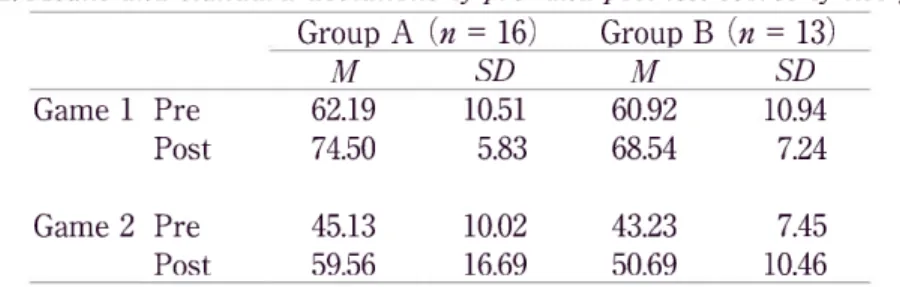
(9) PracticalTrainingSessions to PreparePre-Service TeacherstoConductEnglishActivitiesat the Elementary SchoolLevel Results Research question 1: Improvements. in game instruction skills of group A (instructor's. demonstration group) In order to evaluate the effects and ascertain. whether. pre-service. teachers. in. group A were able to improve their skills to give game instructions, two paired-samples t tests were conducted. For game 1, the results indicated that the mean score for the post-test was significantly greater than the mean score for the pre-test, t(15) = 5.93, p = .00. For game 2, the results also indicated that the mean score for the post-test was significantly greater than the mean score for the pre-test, t(15) = 7.00, p = .00. These results indicated that group A improved their skills in giving game instructions through participating in their instructor's three demonstrations. In addition, the average post-test scores of the group in Table 1 indicated that the group on average reached the satisfactory 74.50). To be more precise, 13 participants. level (level three, 70%) in game 1 (M = (81.25%) out of 16 participants. reached the. satisfactory level in game 1 on the post- test, compared to only one participant. (6.25%). on the pre-test. However, the group on average did not reach the satisfactory level in game 2 (M = 59.56), where they had to act out more complicated game instructions. More precisely, four participants. (25%) out of 16 participants. reached the satisfactory. level in game 2 on the post-test, compared to zero (0%) on the pre-test. These results suggested. that the three training sessions in which the pre-service teachers. their instructor's. demonstrations. helped to improve their game instruction. observed skills to a. certain extent, but did not help to improve their skills to a completely satisfactory level in the study. The means and standard deviations for the pre- and post-test scores of the two groups are presented in Table 1.. Table 1. Means and standard deviations of pre- and post-test scores of two groups Group A (n = 16) Group B (n = 13) Game. 1 Pre Post. Game. 2 Pre Post. M. SD. M. SD. 62.19. 10.51. 60.92. 10.94. 74.50. 5.83. 68.54. 7.24. 45.13. 10.02. 43.23. 7.45. 59.56. 16.69. 50.69. 10.46. — 219 —.
(10) ft* •. ?Alt. 37—CV. Research question 2: Improvements. in game instruction skills of group B (participants'. demonstration group) In order to evaluate the effects and ascertain. whether. pre-service. teachers. in. group B were able to improve their skills to give game instructions, two paired-samples t tests were conducted. For game 1, the results indicated that the mean score for the post-test was significantly greater than the mean score for the pre-test, t(12) = 4.38, p = .01. For game 2, the results also indicated that the mean score for the post-test was significantly greater than the mean score for the pre-test, t(12) = 4.39, p = .01. These results indicated that group B improved their skills in giving game instructions through acting out three sets of game instructions. On the other hand, the average post-test scores of the group in Table 1 indicated that the group on average. did not reach the satisfactory. level (level three, 70%) in. either game 1 (M = 68.54) or 2 (M = 50.69). To be more precise, six participants (46.15%) out of 13 participants compared to one participant. reached the satisfactory level in game 1 on the post-test,. (7.69%) on the pre-test. Regarding game 2, two participants. (15.38%) reached the satisfactory level on the post-test, compared to zero (0%) on the pre-test. In sum, the three training sessions in which the pre-service teachers acted out game instructions. helped to improve their game instruction. skills to a certain extent,. but did not help to improve their skills to the satisfactory level in the study.. Research question 3: Difference in test scores between two groups In order to ascertain whether there is a significant difference in the improvements of pre-service teachers' skills to give game instructions independent. between groups A and B, two. t tests were conducted on the gain scores from the pre- to post-tests on. games 1 and 2. The t tests on both games 1 and 2 were significant, t(27) = 6.04, p = .00, = .57 for game 1, and t(27) = 6.45, p = = .61 for game 2. The participants in group A (M = 11.20, SD = 2.76 for game 1, and M = 13.13, SD = 2.50 for game 2) on average had higher gains than those in group B (M = 5.54, SD = .26 for game 1, and M = 6 .77, SD = .48 for game 2). These results indicated that offering receptive style training sessions (group A), in which the instructor. demonstrated. game instructions,. was more effective in improving the pre-service teachers' skills than offering productive style training sessions (group B), in which the pre-service teachers themselves had to act out game instructions.. — 220 —.
(11) PracticalTrainingSessions to PreparePre-Service TeacherstoConductEnglishActivitiesat the Elementary SchoolLevel Discussion and Conclusion This study examined the effectiveness of receptive and productive. (participants'. giving game instructions. research. questions:. demonstration). 1) whether. in which their instructor. demonstration). styles of practical training sessions on. Specifically, this study attempted the instructor's. significantly improves participants'. demonstration. (instructor's. to answer the following. demonstration. group. (group. A). game instruction skills after three training sessions,. demonstrates. game instructions, 2) whether the participants'. group (group B) significantly. improves participants'. game instruction. skills after three training sessions, in which they themselves act out game instructions, and 3) whether there is a significant difference in the improvements of game instruction skills between groups A and B. The results of statistical receptive. (group. significantly. analyses implied that offering the participants. A) or productive. improve. (group. B) style training. their skills in giving game instructions.. sessions. either. helped. The positive. to. results. obtained from this study suggested that training sessions as part of class contents in a methodology. class would help pre-service teachers. practical. extent,. practical. training. and therefore, sessions. future. improve their teaching skills to a. classes should consider. into their syllabi. The results. incorporating. also implied that offering. receptive style training sessions (group A), in which the instructor demonstrated instructions. and the participants. effective in improving sessions. (group. instructions. the participants'. B), in which. as teachers. improve. the participants. themselves. the instructor's. that actual practice giving instructions. (group. A). However,. analyzed the performances. observing. inexperienced. as students, was more style training. model performance.. This. since the author had. (group B) would help participants participation. more thoroughly. in model. observed. and. of both groups A and B on the post-test, she realized that. observing model game instructions learn how to properly. as the author. game. had to act out game. with the author's original hypothesis. their skills as much as, or even more than mere. performances. through. those instructions. skills than offering productive. without observing. result was not consistent hypothesized. experienced. more. (group A) may have led the pre-service teachers to. give game instructions. a proper. themselves.. model performance. In other words, learning. may be essential. especially. for. teachers, for example, pre-service teachers in this study, since a proper. model can guide them to the right direction in acquiring teaching skills such as game. — 221 —.
(12) ft*. • i-111,11-1t1-. instruction. —CV. skills. On the other hand, experiencing. observing the instructor's teachers. model performance. giving game instructions. without. (group B) may have left the pre-service. uncertain about a proper way of giving game instructions.. The results may. imply that any teaching skill is initially learned through imitating model performances, and therefore,. giving pre-service. teachers. proper model performances. is crucial in. practical training sessions. It is often said that teachers teach the way they were taught as students. The results of this study reconfirmed. the responsibility. of instructors. in. teaching certificate programs to be proper models for pre-service teachers. At the same time, the fact that even group A's average post-test scores of game 2 (59.56) did not reach the required. professional level (level three, 70%) in this study. suggested that it would be necessary to further explore a way for pre-service teachers to reach that level through revising the contents of training sessions. One way may be a combination of the above two styles, receptive and productive styles. In this combined style, pre-service teachers then experience. will first observe their instructor's. giving game instructions. themselves. model performance. based on their observation.. and A. possible problem of this method, however, may be that the method will require more time, but instructors can spend only a limited amount of time on these training sessions in a course. The following limitations should also be considered when interpreting this study. First, this study had only a limited number of participants. the data in. (a total of 29), and. therefore, the data may not be statistically valid. However, the author believes that the data can show an overall tendency of the effectiveness of practical training sessions on giving game instructions in English. Second, this study covered only one typical element regarding teaching skills, giving game instructions, and resulted in restricting. positive. effects of practice only to this area. Finally, testing effects may have influenced the posttest scores of both groups since the same interview-style the pre-test,. and the post-test. practical test was employed on. which was given about 10 weeks after the pre-test.. However, the author considers the testing effects rather unlikely since the majority of the participants. poorly acted out the designated. Results section), resulting. in an incompletion. two games on the pre-test. of the activities. Therefore,. effects may have had a small part in the improvements. (see the. the testing. of the post-test scores, but it is. not logical to assume that the testing effects considerably affected the post-test scores. In addition, it was thought by the author that a 10-week interval between the pre- and post-tests would not allow for participants' recollection of the details of the pre-test. With — 222 —.
(13) Practical Training Sessions to Prepare Pre-Service Teachers to Conduct English Activities at the Elementary School Level. these. limitations,. on effective the. research. In other. however,. training. sessions. method. in this. words,. future. certificate. programs. skills. as classroom. such. teachers.. And. will help. improve. program. this. the. contents. study. can on. examine. English. author. hopes. that. practical. valuable. effective different. school. to different. contents areas. related. areas. in teaching. effective. for. For. offered. to English. of more. research instance,. of training. skills. empirical. certificate. pre-service. sessions.. in teaching. ability. on improving. an accumulation of classes. for future. teachers.. of classes. effectiveness. and. implications. elementary. be applied. for their. development. more. still offers. for pre-service. research. should. the. study. or teaching of pre-service. data. of this. kind. programs,. making. elementary. school. teachers.. Note This study was supported. by a Grant-in-Aid for. Society for the Promotion of Science (# 23720298). Scientific from. from. Research. the. Japan. 2011 to 2012.. References. Butler, Y. G. (2005). English language education in Japanese elementary schools: Analyses and suggestions based on East Asian perspectives. Tokyo: Sanseido. Cohen, J. (1988). Statistical power analysis for the behavioural sciences (2nd edition). NY: Academic Press. Egawa, M. (2008). The development. of university. teacher. training. programs. for. elementary school English teachers. JASTEC Journal, 27, 53-65. Higuchi,. T., Kanamori,. T., & Kunikata,. eigokyoiku riron to jissen. T. (Eds.). [Future. (2005). Korekara. English. education. no shogakko in elementary. schools: Theories and practices]. Tokyo: Kenkyusha. Hojo, R. & Matsuzaki, K. (2010). A survey of university teaching classes conducted. freshmen's. by the university. basis: For the purpose of nurturing. hopes for English. students. student-teachers.. on a voluntary Bulletin of Joetsu. University of Education, 29, 231-240. Ito, M. (2010). Raising awareness. of prospective. secondary. school English teachers. about elementary school English: Toward coherent English education in. — 223 —.
(14) ft* •. :/ 37—CV Japan. Aoyamagakuin. University Kyoikugakai Kiyo Kyoikukenkyu,. 54,. 149-168. Izumi, E. (2007). Kyoikudaigaku. niokeru. genshokukyoinkenshu. shogakkoeigo. no jyujitsu. English education at teachers. eno torikumi. wo mezashite. course. Tokohagakuen. for pre-service. University's. [Elementary. to. school. colleges: Toward better teacher training. for pre- and in-service teachers]. JES Journal, Koda, A. (2009). A model. kyoinyosei. 8, 75-82.. teacher. "Bridge course". training. research. for elementary. on. school. English teacher training. Tokohagakuen University Journal, 25, 65-80. Matsumiya,. N. (2010). Changes in attitudes university effect. students. studying. of a relevant. toward teaching. English on the part of. to be elementary. teaching. methods. school teachers:. course,. Journal. The. of Quality. Education, 3, 111-134. Matsunaga, M. (2009a). A rubric of competence levels of Japanese English teachers in elementary schools. Kinki University English Journal, 3,1-18. Matsunaga, M. (2009b). Tests to measure competencies of Japanese English teachers at the elementary school level. Kinki University English Journal, 4,13-29. Ministry. of Education,. Culture, Sports, Science and Technology.. (2008a). Shogakko. gakushu shido yoryo [A course of study for elementary schools]. Tokyo; Tokyoshoseki. Ministry. of Education,. Culture,. Shogakkoeigokatsudo. Sports,. jishijyokyochosa. nendo [A Report on current elementary. Science. and Technology.. no omona kekkagaiyo heisei 19. situation of English education. schools, 2007]. Retrieved. (2008b).. in public. July 5, 2010, from http://www.. mext.go.jp/ b_menu/ houdou/20/03/08031920/001.htm Ministry of Education, Culture, Sports, Science and Technology. (2009a). Eigo noto 1 & 2 [English notebook 1 & 2]. Tokyo: Kyoikushuppan. Ministry of Education, Culture, Sports, Science and Technology. (2009b). Eigo noto 1 & 2- Shido handobukku I & 2 [English notebook 1 & 2: Teacher's. manuals. 1 & 2]. Tokyo: Kairyudo. Saito, E. & Takeuchi, 0. (Eds.). (2007). Shogakko eigo gakkyutannin no tameno katsudou aidiashuu gorokunensei yo [Teaching English at the elementary level: Example activities for homeroom teachers. — 224 —. school. (fifth & sixth graders)]..
(15) PracticalTrainingSessions to PreparePre-Service TeacherstoConductEnglishActivitiesat the Elementary SchoolLevel Tokyo: Sanseido. SEAMEO Regional Language. Centre, NLLIA Language Testing. IKIPS Semarang Indonesia:. EPTI. Research. Centre, &. and Malang. (1997). The English proficiency test for Manual. Singapore:. SEAMEO. Regional Language. Centre. Yoshida, H., Kodera, S., Terada, H., & Honda, K. (2006). Shogakkoeigokyoiku seikarikyuramukaihatsu elementary. [Developing. school English. a teacher training curriculum. education].. The Bulletin. Society Osaka Kyoiku University, 51, 105-122.. — 225 —. no kyoinyo for. of the English.
(16) ft*. • 1-111,111t1--^. —CV. Appendix. A. Test Cards in Japanese. Secret Word Game ARR.. (_q_VC:11 — —F•Y. fF(41p,_S :. fkr_-oo-cM-c5Z, V-11-UMV—IAW. -c. L. MR - :. (FRM. /144-R5 — 6*tid-to (MNT1-4)E11) 1. il4 L ff,2 1 El. 0 DIAR-A'. 1 A-c.--i-9E-V-zaL. L. CD Mflt;t`-t—. 7 O)V). L. L, rf/—. 'y 1-'7 -. “11-1 L. 5,. 90_, 1t>>. 1-. ff.A. h. 14 11g1--gff'igij. O. g—INMDOWIN—S1=105-1-A74 — 0) to. J l. Vizt1M(D. a)\'DA-15A-4-63freff-T---D-C-Foo. 1-. ). ck-3(::, .9i126zrolip-3--chr—A 9?..2.1St (ilittrg) 1)J,Tor)F;Ilifcco-)MTr. 1=1=1,L,L (ko),M-t—F,. Mt?. — 226 —. *kiflti.-coZM. .14-.
(17) Practical Training Sessions to Prepare Pre-Service. pq ra)4R7T 1. 2.. (tib-rttpT4). Teachers. to Conduct English Activities at the Elementary. School Level. 1. (14k1ht-c-ct,N6-*XVCElltiztAX0-... "Let's play the Secret Word game!" (Y— .A(DrMt'. Z 0). ./7----C14-.'"),1-•LO. 3. 4 . IMgkfr. L. 5 . f,: f± L.. 1-1-Z. Rn'67).'7. 1-. >r 'Y 1- —. "carpenter". 5L-r L. tt,. L. (5-HXHILLTITTA-) 6 . "You get the eraser, and you get one point." (.(70)-') *4. •:/. L. 0). 7 . "You get more points, and you are the winner.". (%ii. Can You ---? Game ARR.. tR. 1#1. — F'). Can you --- ? ---Yes, I can. / No, I can't. /144-tl- 5 — 6. wc-. z. /ft.°. .t3(-J-to. 7 —. — 1-. Y-4ON'74:. CD1 (.1`171Ug9M1A-ctIRARLL-c70).1--) ® LoriMtZUMf-AV=7:0Zo)t,tk7:6VIN-J-Z, 6At,. “T7 - 0 TA--Aqiic:ITI-c4t0),,M.. — 227 —. 5 z.
(18) ft*. • i-111,111t1--^. —CV. 5-. hpT4. 1-0)6Hr z ( ku 6 a) VIAU —^.7`171U. CM). 0)5kill-Lk-sli*C-t—. T LLUtt 1-s _ LLUI to. g—iNax..9a)=0A—..1=105-(ii t)-0"). )0. I- rag PI ff=AiC. CA-Miztnta). ft-D-CNDA'-'4111,-c-Foo 11=1,LI,L. rear. olpfr:. (eb-rttrag). rAti. z. y'7-"C'T7.),11L,. 3.. 7—. 4.. tI. 5.. Can you — ?. m11. 6.. ffliTilktoc. 1:: 6 Are you --- ?. f1. 6--j-Z. Lo. L-CtIlf-niti:a--z-Z. h (IL `MT 7.. 0). ,277c2ilt6:17:Z b=7:Z7)'. gD. A46ri )T. V.T6D FA:16--CMF(Tr. OE,. 2.. 6=6t. 92(zroip. 1. 6iAtfittL-Co6k1-5c-ftfI7l,--(tiALN-A... 1. "Let's play a game!" (—.Z-\. —. tz,. z. t). "You ask fewer questions, and you are the winner." 0). — 228 —. Q)..
(19) PracticalTrainingSessions to PreparePre-Service TeacherstoConductEnglishActivitiesat the Elementary SchoolLevel A Translation of the Test Cards. Secret. Word. Game. Giving instructions for a game (for the interviewee) Game: Secret word game Objectives: Students. (5th or 6th graders). will learn names of occupations, and will be. able to repeat them after the teacher. Style: listening game, conducted in pairs Prepared materials: Picture cards of various jobs, an eraser Procedures: 1. Students work in pairs, sitting face to face. Each pair puts an eraser between them. 2. The teacher says one of the occupation names on the board, and the students repeat it after the teacher. However, when the teacher says the secret word, students should not repeat the word. Instead, they have to pick up the eraser. Those who grab the eraser, earn 1 point.. Test. criteria. instructions. appropriate. for He/. giving she. instructions:. is also. expected. An. interviewee. to effectively. must use. the. include prepared. the. following. materials. and. gestures.. Required instructions:. (the following instructions. are given in Japanese except for 1, 6,. & 7.) 1. Let's play the Secret Word game! 2. Work in pairs. 3. Sit face to face with your partner. Then, put an eraser between the two of you. 4. Repeat the word after me. 5. But, when I say the secret word, "carpenter," eraser! (end of the test) 6. You get the eraser, and you get one point. 7. You get more points, and you are the winner.. — 229 —. do not repeat it. You must pick up the.
(20) ft*. • i-111,11-1t1---./. Can. You---?. Game. Giving instructions for a game (for the interviewee) Game: Can you ---? game Objectives: Students. (5th or 6th graders). using "Can you. will be able to ask and answer questions,. "Yes, I can. / No, I can't.". Style: interview game, conducted in pairs Prepared materials: a worksheet, which details five people and six things each person can/cannot. do. Procedures: 1. Students work in pairs, sitting face to face. Each student chooses who he or she will become from the five people on the worksheet,. but does not tell the partner his or. her choice. 2. The students in pairs ask and answer questions, using "Can you No, I can't." The student. who can guess who his or her partner. "Yes, I can. / is with fewer. questions will be the winner.. Test. criteria. instructions. appropriate. for He/. giving she. instructions:. is also. expected. An. interviewee. to effectively. must use. the. include prepared. the. following. materials. and. gestures.. Required instructions. (the following instructions are given in Japanese, except for 1 & 7.). 1. Let's play the Can You ---? Game! 2. Work in pairs, and sit face to face with your partner. 3. Look at your worksheet. Choose one person you want to be. 4. But, do not tell your partner who you are. 5. Ask and answer questions, using "Can you. "Yes, I can. / No, I can't.". 6. When you know who your partner is, ask your partner. "Are you. (end of the test) 7. Ask fewer questions, and you are the winner.. Note. In the process of creating the above two test cards, the author referred to the game activities introduced in Saito, E. & Takeuchi, 0. (Eds.) (2007) in references.. — 230 —.
(21) PracticalTrainingSessions to PreparePre-Service TeacherstoConductEnglishActivitiesat the Elementary SchoolLevel Appendix B Level Descriptions on Overall Task Fulfillment Teaching. skills:. Overall. task. Levels. Descriptions. 4. Very. fulfillment. competent. a game,. can. gestures, model. in teaching briefly. explain. including dialogue,. English.. all the. can. When. explaining. it, effectively necessary. explain. the. using. information.. situation. well,. how. to perform. picture. prompts. When. performing. effectively. using. or a. picture. prompts or gestures, with appropriate intonation and pronunciation. Competent in teaching English. When explaining how to perform. 3. game,. some. enough. intonation. 1. using. picture. pronunciation competent. a game,. game. missing. some. dialogue,. pausing. situation.. Errors. well. or. hesitation. game,. or hesitation. the. missing. instructions. much. dialogue, explain. the. errors. of the. pausing. and. is evident,. necessary. in intonation. Difficult and. to read. pronunciation.. explaining. explaining game,. a model. explaining. the. in a dialogue. are. how. to perform. a. impossible. to carry. and. how. out the. it is almost. When. is evident,. acceptable. trouble. for students. information.. or hesitation. situation.. and. and. use. performing. pronunciation. enough. can explain. Trouble. model for students. English. When explaining. well. performing. but. to carry. When. is evident,. in intonation be a good in teaching. pausing. is evident.. or. to follow.. When. for students. information.. evident. Cannot Not competent. explain. for students English.. or hesitation. necessary. and. it well. prompts. When. is evident,. gestures,. enough. explain. picture. information.. or. enough. can. using. or hesitation. in teaching. well. but. game,. prompts. pausing. instructions. the. necessary. pausing. and. is evident,. out. of the. some. marginally. to perform the. most. dialogue,. situation,. Only. to carry. including. a model. 2. or hesitation. for students. gestures,. the. pausing. a. out the. performing almost. to game,. a model. impossible. to. a dialogue. aloud,. with. many. Impossible. to be. a model. for. students.. Note.. The. recognition consists. teaching. skills. of students' of four. competence;. levels:. level. rubric level,. Level. 3, minimum. use. consists. of four. of instructional. 1, insufficient. level. professional. categories: language,. and. to assess;. level. competence;. competence.. — 231 —. Overall. and. task. fluency.. Each. 2, limited level. fulfillment, category. professional. 4, professional.
(22)
図
関連したドキュメント
全国の 研究者情報 各大学の.
Background: The aim of this study was to investigate effects of basic life support (BLS) training on willingness of single rescuers to make emergency calls during
Chiang Mai was established as a free state of Lanna Kingdom in 1296 and was annexed to Siam in 1884. The urban area is located between Suthep.. Mountain on the west and
Week 3 Listening Test Part 2, Question-Response (Textbook, Unit 9) Week 4 Listening Test Part 2, Question-Response (Textbook, Unit 9) Week 5 Listening Test Part 5,
4 A Hybrid Learning Algorithm for MLP If the input vectors are mapped onto around the apex of the hypercube through the first hidden layer with a sigmoidal nonlinear function,
In the on-line training, a small number of the train- ing data are given in successively, and the network adjusts the connection weights to minimize the output error for the
東京大学 大学院情報理工学系研究科 数理情報学専攻. [email protected]
情報理工学研究科 情報・通信工学専攻. 2012/7/12
