Discrete
Mittag
-Leffler
function
and
its
applications
離散ミッタークレフラー関数とその応用
永井敦
(
ATSUSHI
NAGAI
)
*大阪大学大学院基礎工学研究科
(Department of Mathematical
Sciences,
Graduate School
of Engineering Science,
Osaka
University)Abstract
Discreteand$q$-discreteanaloguesofMittag-Lefflerfunctionarepre
sented. Their relations to fractional difference are also investigated. Applications of these functions to numerical analysis and integrable
systems are also made.
1Fractional derivative
Fractional derivativegoes back to the Leipniz’s note in his list to $\mathrm{L}$’Hospital
in 1695 and we
now
have many definitions of fractional derivatives $[11, 13]$.
In the last few decades, many authors pointed out that derivatives and integrals of fractional order, especially 1/2-derivative,
are
very suitable for the description of physical phenomena (See ref. [14] for example.).We first define affactional integral operator $I^{a}$ as follows.
Definition 1Let $a$ be a nonnegative real number and $u(t)(0<t)$ be
piece-wise continuous on $(0, \infty)$ and integrable on any subinterval $[0, \infty)$
.
Thenfor
$t>0$, we call$I^{a}u(t)= \int_{0}^{t}K(a;t-s)u(s)\mathrm{d}s$ (1)
$I^{0}u(t)=u(t)$ (2)
the
fmctional
integralof
$u$of
order $a$.
$K(a;t)$ is a monomial given by $K(a;t) \equiv\frac{t^{a-1}}{\Gamma(a)}$ $(t>0, a>0)$. (3)Fractional derivatives oforder$a>0$
are
defined by acombination of normalderivative and ffactional integral in the following two
manners.
$\mathrm{e}$-mail:[email protected]
数理解析研究所講究録 1302 巻 2003 年 1-20
Definition 2Let m be a positive integer such as m $-1<a\leq m$ and$u(t)$
be a given
function
whichsatisfies
the conditions in the previousDefinition
1and is m times continuouslydifferentiate.
Then, itsfractional
derivativeof
order a isdefined
by$D^{a}u(t) \equiv(I^{m-a}D^{m}u)(t)=\int_{0}^{t}K(m-a;t-s)u^{(m)}(s)\mathrm{d}s$ (4)
Definition 3For the
same
$a,m$,$u(t)$ in thepreviousDefinition
2, itsderiva-tive
of
order$a$ isdefined
by$D^{a}u(t) \equiv(D^{m}I^{m-a}u)(t)=(\frac{\mathrm{d}}{\mathrm{d}t})^{m}\int_{0}^{t}K(m-a;t-s)u(s)\mathrm{d}s$
.
(5)These two definitions
are
called Caputo and Riemann-Liouville fractionalderivatives, respectively. We here adopt Caputo’s definition 3.
The Mittag-Leffler function,
$E_{a}(z)$ $= \sum_{j=0}^{\infty}\frac{z^{j}}{\Gamma(aj+1)}$ $(a>0, z \in \mathbb{C})$ (6)
was proposed by Mittag-Leffler [9] in
1903 as an
entirefunction whose ordercan
becalculated exactly. Afterwards, itwas
clarified that theMittag-Lefflerfunction also plays
an
important role in fractional calculus (See refs. $[8, 10]$for example).
The main purpose of this paper is to discretize the Mittag-Leffler
func-tion and to investigate its relafunc-tion to fracfunc-tional difference proposed by Hirota in 1991 [6]. In section 2,
we
elaborate on the property of the Mittag-Leffler function concerning its relation to fractional derivative. Especially,we
re-view Kametaka’s result [7] in which asolution to acertain ffactional
differ-ential equation is given by
means
of the Mittag-Leffler function. Section 3and 4is devoted to discretization and $q$-discretization of the Mittag-Leffer
function. It is also shown that they
are
eigen functions of acertain frac-tional difference and $q$-difference operators, respectively. Two applicationsare
given in the final 2sections. First isan
application to numericalcompu-tation of ffactional differential equations and the second is to integrable sys-tems, in which
anew
typeof discrete nonlinear integrable equation equippedwith ffactional difference is proposed
2
Half-order
differential equation and Mittag-Leffle
function
We start with a fractional difffferential equation,
$\{$ $(D+aD^{1/2}+b)u(t)=\beta K(1/2;t)+f(t)$ $(t>0)$, $u(0)=\alpha$, (7)
or
equivalently $\{_{u(0)=\alpha}u’(t)+a,\int 0K(1/2;t-s)u’(s)\mathrm{d}s+bu(t)=\beta K(1/2;t)+f(t)t$ $(t >0)$, (8) where $p,q$are
positive constants and $\{\alpha,\beta, f(t)\}$are
given data.Equa-tion (7) describes
a
motion ofa
particle ina
fluid and the unknown function$u(t)$ stands for
a
relative velocity ofa
particlewith respecttoits surroundingfluid. It was known from experimental result that $u(t)$ decays to 0 at the
order of$O(1/\sqrt{t})$
.
However its mathematical proofhad not been given.In around 1986, Kametaka [7] gave a mathematical proof on the above fact by considering the following expansion of$u(t)$, $f(t)$
.
$\{u(t)=f(t)=\Sigma^{\infty}f_{j}K(\frac{j+2}{2}\cdot,,t)=f_{0}+f_{1}K(3/2\cdot,t)+f_{2}K(2\cdot,,t)+j=0j=0\Sigma u_{j}K(\infty\frac{j+2}{2}\cdot t)=u_{0}+u_{1}K(3/2t)+u_{2}K(2\cdot t)+.\cdot.\cdot.\cdot$
Substituting the above expression into eq. (7),
we
have$u_{1}K(1/2;t)+ \sum_{j=0}^{\infty}(uj+2+auj+1+h\nu j)K(\frac{j+2}{2};t)$
$= \beta K(1/2;t)+\sum_{j=0}^{\infty}.fjK(\frac{j+2}{2};t)$ (9)
and obtain the following linear difffference equation.
$uj+2+auj+1+buj=fj$, $u0=\alpha$, $u_{1}=\beta$ (10)
Hence, $\mathrm{t}\mathrm{h}\mathrm{e}\mathrm{s}\mathrm{o}\mathrm{l}\mathrm{u}\mathrm{t}\mathrm{i}\mathrm{o}\mathrm{n}\backslash$ to eq. (7) is given by
$u(t)= \frac{-\alpha\lambda_{+}\lambda_{-}}{\lambda_{+}-\lambda_{-}}(\lambda_{+}^{-1}E_{1/2}(\lambda_{+}t^{1/2})-\lambda_{-}^{-1}E_{1/2}(\lambda_{-}t^{1/2}))$
$+ \frac{\beta}{\lambda_{+}-\lambda_{-}}(E_{1/2}(\lambda_{+}t^{1/2})-E_{1/2}(\lambda_{-}t^{1/2}))$
$+ \frac{1}{\lambda_{+}-\lambda_{-}}(\lambda+E_{1/2}(\lambda+t^{1/2})-\lambda_{-}E_{1/2}(\lambda_{-}t^{1/2}))*f(t)$ (11) $\lambda_{\pm}=\frac{-a\pm\sqrt{a^{2}-4b}}{2}$
The function $E_{1/2}(\lambda\pm t^{1/2})$is the Mittag-Lefflfflffler function andis also expressed
as follows.
$E_{1/2}( \lambda_{\pm}t^{1/2})=\sum_{j=0}^{\infty}\lambda_{\pm}^{j}K(j/2+1;t)$, $(z\in \mathbb{C})$ (12)
It isawell-known result that if$0<a<2,a\neq 1$ the Mittag-Lefflfflffler function
possesses the following asymptotic behavior [12].
$E_{a}(z) \sim-\sum_{k=1}^{\infty}\frac{1}{\Gamma(1-ak)}z^{-k}$ $(|z|arrow\infty,$ $\frac{a\pi}{2}<|\arg z|\leq\pi)$ (13)
Noticing ${\rm Re}\lambda\pm<0$, one can conclude that $u(t)$ decays to 0 at the order of
$O(1/\sqrt{t})$
.
It can be confirmed through simple calculations that the Mittag-Leffer function,
$u(t)= \sum_{j=0}^{\infty}\lambda^{j}K(aj+1;t)=E_{a}(\lambda t^{a})$ (14)
is an eigen function ofCaputo’s fractional derivative [8],
$D^{a}u(t)=\lambda u(t)$ $(t\geq 0)$
.
(15)In thenext section, we considerdiscrete analogue of Mittag-Lefflfflffler function, which preserves the property (15).
3
Fractional
difference
and discrete
Mittag-Leffler
function
We here give a defifinition of fractional difffference operator and its eigenfunc-tion. Before going to its defifinition, let
us
introduce fundamental function$M(a;n)$ defined by
$M(a;n)=\epsilon^{a-1}$ $(\begin{array}{l}n+a-2n-1\end{array})=\frac{1}{\Gamma(a)}\epsilon_{\Gamma(n)}^{a-1}\Gamma(n+a-1)$ $(a>0, n\in \mathbb{Z}\geq 1)$,
(16)
$M(a;0)=\{\begin{array}{l}1(a=1)0(a\neq 1)\end{array}$ (17)
where $\epsilon$is an intervallength and $(\begin{array}{l}an\end{array})$ $(a\in \mathbb{R}, n\in \mathbb{Z})$ stands forabinomial
coefflfflfflcient defifined by
$(\begin{array}{l}an\end{array})=\{\begin{array}{l}\frac{a(a-1)\cdots(a-n+1)}{n!}=\frac{\Gamma(a+1)}{\Gamma(a-n+1)\Gamma(n+1)}(n>0)1(n=0)0(n<0)\end{array}$
This function satisfifies the following lemma.
Lemma 1 The following relations hold.
$\Delta_{-n}M(a+1;n)=\epsilon^{-1}(M(a+1;n)-M(a+1;n-1))=M(a;n)$ (a $>0)$
(18) Proof of Lemma 1: This is proved by using the relation $\Gamma(x+1)=x\Gamma(x)$
as follows.
$\epsilon^{-1}(M(a+1;n)-M(a+1;n-1))$
$= \frac{\epsilon^{a-1}}{\Gamma(a+1)}(\frac{(n+a-1)\Gamma(n+a-1)}{\Gamma(n)}-\frac{(n-1)\Gamma(n+a-1)}{\Gamma(n)})$
$= \frac{a\epsilon^{a-1}}{\Gamma(a+1)}\frac{\Gamma(n+a-1)}{\Gamma(n)}=M(a;n)$.
$\blacksquare$
Next we go to the defifinition of fractional difference. Hirota [6] took the
fifirst $n$ terms ofTaylor seriesof$\Delta_{-n}^{\alpha}=\epsilon^{-\alpha}(1-E^{-1})^{\alpha}$ andgave the following
definition
Definition 4 Let $\alpha\in \mathbb{R}$. Then
difference
operatorof
order $\alpha$ isdefifined
by$\Delta_{-n}^{\alpha}u_{n}=\{\begin{array}{l}\epsilon^{-\alpha}\sum_{j=0}^{n-1}(-1)^{j}u_{n-j}\alpha\neq 1,2,\cdots\epsilon^{-m}\sum_{j=0}^{m}(-1)^{j}u_{n-j}\alpha=m\in \mathbb{Z}_{>0}\end{array}$ (19)
It should be noted that Diaz, Osier [4] gave another defifinition of fractional difffference,
$\Delta_{-n}^{\alpha}u(t)=\epsilon^{-\sum_{j=0}^{\infty}}$’ $(\begin{array}{l}\alpha j\end{array})$ $(-1)^{j}u(t+(\alpha-j)\epsilon)$ (20)
We here adopt another difffference oparator $\Delta^{\alpha}*,-n$ by modifying Hirota’s
operator.
Definition 5 Let $\alpha\in \mathbb{R}$ and $m$ be an integer such that $m-1<\alpha\leq m$
.
We
defifine difffeooence
operatorof
order$\alpha$,
$\Delta^{\alpha}*,-n$’ by
$\Delta_{*,-n}^{\alpha}u_{n}\equiv\{\begin{array}{l}\Delta_{-n}^{\alpha-m}\Delta_{-\mathrm{n}}^{m}u_{n}=\epsilon^{m-\alpha}\sum_{j=0}^{n-1}(-\mathrm{l})^{j}\Delta_{-k}^{m}u_{k}|_{k=n-j}u_{n}\Delta_{-n}^{\alpha}u_{n}\end{array}$
$(\alpha=0)(\alpha<0)(\alpha>0)$
(21)
We defifine
a new
function,$F_{p}( \lambda,n)=\sum_{j=0}^{\infty}\lambda^{j}M(pj+1;n)$
.
$= \sum_{j=0}^{\infty}\lambda^{j}\epsilon^{pj}\frac{\Gamma(n+pj)}{\Gamma(pj+1)\Gamma(n)}$ (22)Remark 1 Putting $p=1$ in the above defifinition, we have a discrete $e\varphi \mathit{0}-$
nential
function.
$F_{1}( \lambda, n)=\sum_{j=0}^{\infty}\lambda^{j_{\xi}j_{\frac{\Gamma(n+j)}{\Gamma(j+1)\Gamma(n)}}}$
$= \sum_{j=0}^{\infty}(\lambda\epsilon)^{j}$ $(\begin{array}{ll}n+j -1j \end{array})$
$= \sum_{j=0}^{\infty}(-\lambda\epsilon)^{\dot{\mathrm{J}}}$ $(\begin{array}{l}-nj\end{array})=(1-\lambda\epsilon)^{-n}$
.
(23)Remark 2 In the limit
of
$\epsilonarrow 0$,n $arrow\infty$ with t $=n\epsilon$ fifixed, thefunction
$F_{p}(\lambda,$n) converges to the Mittag-Leffler
function.
$F_{p}( \lambda, n)arrow\sum_{j=0}^{\infty}\frac{\lambda^{j}t^{pj}}{\Gamma(pj+1)}=E_{p}(\lambda t^{p})$
.
(24)The following theorem states that $F_{p}(\lambda;n)$ is an eigen-function of fractional
difffference operator $\Delta_{*,-n}^{p}$
.
Theorem 1
If
p $>0,$.
thefunction
$F_{p}(\lambda,$n)satisfifies
the following relation.$\Delta_{*,-n}^{p}F_{p}(\lambda,n)=\lambda F_{p}(\lambda, n)$ (25)
Proof of Theorem 1: Let $m$ be
an
integer such that $m-1<p\leq m$.
Then
we
have$\Delta_{*,-n}^{p}F_{p}(\lambda, n)=\Delta_{*,-n}^{p}(1+\sum_{j=1}^{\infty}\lambda^{j}M(pj+1;n))$
$= \Delta_{*,-n}^{p}\sum_{j=1}^{\infty}\lambda^{j}M(pj+1;n)$
$= \Delta_{-n}^{p-m}\sum_{j=1}^{\infty}\lambda^{j}\Delta_{-n}^{m}M(pj+1;n)$
$= \sum_{j=1}^{\infty}\lambda^{j}\Delta_{-n}^{p-m}M(pj+1-m;n)$ (26)
Bach summand in the above equation is given by
$\Delta_{-n}^{p-m}M(pj+1-m;n)=\sum_{k=0}^{n-1}$ $(\begin{array}{l}p-mk\end{array})$ $(-1)^{k}M(pj+1-m;n-k)$
$= \sum_{k=0}^{n-1}$ $(\begin{array}{l}p-mk\end{array})$ $(-1)^{k}$ $(\begin{array}{ll}pj-m+n-k -1n-k-1 \end{array})$
$= \sum_{k=0}^{n-1}$ $(\begin{array}{l}p-mk\end{array})$ $(-1)^{n-1}$ $(\begin{array}{l}-pj+m-1n-k-1\end{array})$
$=(-1)^{n-1}$ $(\begin{array}{ll}p-pj -1n-1 \end{array})$
$=(\begin{array}{l}n+pj-p-1n-1\end{array})$ $=M(pj-p+1;n)$, (27)
where we have employed
an
upper nagation rule twice and a Vandermonde convolution rule of binomial coefflfflfflcients. Therefore, substitution ofeq. (27)into eq. (26) gives
$\Delta_{*,-n}^{p}F_{p}(\lambda,n)=\sum_{j=1}^{\infty}\lambda^{j}M(pj-p+1;n)$
$= \sum_{\mathrm{j}=0}^{\infty}\lambda^{j+1}M(pj+1;n)=\lambda F_{p}(\lambda,n)$ (28)
which completes the proof. $\blacksquare$
Remark 3 It should be notedthat the Mittag-Leffler
function
satisfifies
more
abundant$pro\mu\hslash ies$ other that its relation to
fractional
$der\cdot vative$, as can beobserved in
ref.
[12]. However, it is unknown whether thefunction
$F_{p}(\lambda;n)$proposed here also
satisfifies
such properties.4
Fractional
$\mathrm{g}$-difference and g-Mittag-Leffler
func-tion
4.1
Fractional $\mathrm{g}$-differenceIn this section,
we
present fractional $q$-addition and $\mathrm{g}$-difference operatorsand investigate their properties.
Before getting onto the main subject,
we
fifirst give defifinitions of q-number. $q$-binomial coefflfflfflcient and$\mathrm{g}$-difference operator, together with their
properties, which
are
required inthispaper.\dagger
Let $q$be agiven complexnum-$\mathrm{b}\mathrm{e}\mathrm{r}$
.
Throughout this paper, we impose the assumption,$|q|>1$
.
(29)We introduce $q- \mathrm{n}\mathrm{u}\mathrm{m}\mathrm{b}\mathrm{e}\dot{\mathrm{r}}[a]_{q}$ defifined by
$[a]_{q}= \frac{q^{a}-1}{q-1}$, (30)
we here rewrite $[a]_{q}$ as $[a]$ for the sake of simplicity. By making use of the
q-number, $q$-binomial coefflfflfflcient is given
as
follows.$\{\begin{array}{l}xn\end{array}\}=\frac{[x][x-1]\cdots x-n+1]}{[n]}!=\frac{[x][x-1]\cdots[x-n+1]}{[n][n-1]\cdots[1]}$ (31)
$\uparrow \mathrm{F}\mathrm{o}\mathrm{r}$
detailsofq-analysis, seeref. [2] for example
We here list some important properties of $q$-number and $q$-binomial
coefflfflffl-cient used in future.
$[-x]=-q^{-x}[x]$ (32)
$\{\begin{array}{l}-xn\end{array}\}=(-1)^{n}q^{-nx-\frac{1}{2}n(n-1)}$ $\{\begin{array}{l}x+n-1n\end{array}\}$ (33)
$\{\begin{array}{l}xn\end{array}\}-\{\begin{array}{ll}x -1 n\end{array}\}=q^{x-n}$ $\{\begin{array}{ll}x -1n -1\end{array}\}$ (34)
$\{\begin{array}{l}xn\end{array}\}-\{\begin{array}{ll}x -1n -1\end{array}\}=q^{n}$ $\{\begin{array}{ll}x -1 n\end{array}\}$ (35)
$\sum_{k=0}^{n}$ $\{\begin{array}{l}xn-k\end{array}\}\{\begin{array}{l}yk\end{array}\}$ $q^{k^{2}-nk+kx}=$ $\{\begin{array}{l}x+yn\end{array}\}$ (36)
We here adopt backward $\mathrm{g}$-difference operator
$\Delta_{q}$ defifined by
$\Delta_{q}f(x)=\frac{f(x)-f(q^{-1}x)}{(1-q^{-1})x}$ (37)
Through dependent and independent variable transformations
$x=q^{n}$, $f(x)=f(q^{n})=f_{n}$, (38)
the $\mathrm{g}$-difference operator in eq. (37) is rewritten equidently
as
$\Delta_{q}f_{n}=\frac{f_{n}-f_{n-1}}{q^{n}-q^{n-1}}$
.
(39)We next introduce a fractional $q$-addition operator $I_{q}^{\alpha}$ defifined
as
follows.Definition 6 Let$\alpha$ be anon-negative real number and $\{f_{n}\}$ is
a
givencom-plex sequence. Then a $q$-addition opemtor
of
fractional
order $\alpha$for
$\{f_{n}\}$ isdefifined
by$I_{q}^{\alpha}f_{n}=q^{(n-1)\alpha}(q-1)^{\alpha} \sum_{k=0}^{n-1}(-1)^{k}$ $\{\begin{array}{l}-\alpha k\end{array}\}$ $q^{\frac{1}{2}k(k-1)}f_{n-k}$ $(\alpha>0,n\geq 1)$
(40)
$I_{q}^{0}f_{n}=\mathrm{A}$ $(n\geq 1)$
Substitution of $\alpha=1$ into eq. (40) gives
$I_{q}f_{n}=q^{n-1}(q-1) \sum_{k=0}^{n-1}$ $\{\begin{array}{l}-1k\end{array}\}$ $q^{\frac{1}{2}k(k-1)}f_{n-k}$
$=q^{n-1}(q-1) \sum_{k=0}^{n-1}(-1)^{k}(-1)^{k}q^{-\frac{1}{2}k(k+1)}q^{\frac{1}{2}k(k-1)}f_{n-k}$
$=(q-1) \sum_{k=0}^{n-1}q^{n-1-k}f_{n-k}$
$=(q-1) \sum_{k=1}^{n}q^{k-1}f_{k}$,
which is $\mathrm{a}$ fifinite version of Jackson integral. This fractional
$q$-addition
or
erator satisfifies the following lemma.
Lemma 2 Let $\alpha$,$\beta$ be non-negative real numbers, $a$,$b$ be complex numbers
and $\{f_{n}\}$,$\{g_{n}\}$ be given complexsequences. Then$q$-addition operators satisfy
the following $linear\dot{\tau}ty$ and commutation mles.
$I_{q}^{\alpha}(af_{n}+bg_{n})=a(I_{q}^{\alpha}f_{n})+b(I_{q}^{\alpha}g_{n})$ (42) $I_{q}^{\alpha}I_{q}^{\beta}f_{n}=I_{q}^{\beta}I_{q}^{\alpha}f_{n}=I_{q}^{\alpha+\beta}f_{n}$ (43)
Proof of Lemma 2. Equation (42) is obvious. We prove
a
commutation rule (43) by employingsome
properties ofa
$q$-binomial coefflfflfflcient.$I_{q}^{\alpha}I_{q}^{\beta}f_{n}$
$=q^{(n-1)\alpha}(q-1)^{\alpha}. \sum_{k=0}^{n-1}(-1)^{k}$ $\{\begin{array}{l}-\alpha k\end{array}\}$ $q^{k(k-1)/2}q^{(n-k-1)\beta}(q-1)^{\beta}$
$\cross\sum_{j=0}^{n-k-1}(-1)^{j}$ $\{\begin{array}{l}-\beta j\end{array}\}$ .
$\oint^{(j-1)/2}f_{n-k-j}$
$=q^{(n-1)(\alpha+\beta)}(q-1)^{\alpha+\beta} \sum_{k=0}^{n-1}(-1)^{k}$ $\{\begin{array}{l}-\alpha k\end{array}\}$ $q^{k(k-1)/2}q^{-\beta k}$
$\mathrm{x}\sum_{j=0}^{n-k-1}(-1)^{j}[^{-\beta}j]q^{j(j-1)/2}f_{n-k-j}$
$=q^{(n-1)(\alpha+\beta)}(q-1)^{\alpha+\beta} \sum_{k=0}^{n-1}(-1)^{k}$ $\{\begin{array}{l}-\alpha k\end{array}\}$ $q^{k(k-1)/2}q^{-\beta k}$
$\cross\sum_{j=0}^{n-k-1}(-1)^{n-k-1-j}$ $\{\begin{array}{lll} -\sqrt n-j -\mathrm{l}- k\end{array}\}$ $q^{(n-k-1-j)(n-k-2-j)/2}f_{j+1}$
$=q^{(n-1)(\alpha+\beta)}(q-1)^{\alpha+\beta} \sum_{j=0}^{n-1}(-1)^{n-j-1}f_{j+1}$
$\cross\sum_{k=0}^{n-j-1}$ $\{\begin{array}{l}-\alpha k\end{array}\}\{\begin{array}{lll} -\beta n-j -1- k\end{array}\}$ $q^{k(k-1)/2+(n-k-1-j)(n-k-2-j)/2}q^{-\beta k}$
$=q^{(n-1)(\alpha+\beta)}(q-1)^{\alpha+\beta} \sum_{j=0}^{n-1}(-1)^{n-j-1}q^{(n-j-1)(n-j-2)/2}f_{j+1}$
$\cross\sum_{k=0}^{n-j-1}$ $\{\begin{array}{l}-\alpha k\end{array}\}\{\begin{array}{lll} -\sqrt n-j -1- k\end{array}\}$ $q^{k^{2}-k(n-j-1)-\beta k}$
$=q^{(n-1)(\alpha+\beta)}(q-1)^{\alpha+\beta} \sum_{j=0}^{n-1}(-1)^{n-j-1}q^{(n-j-1)(n-j-2)/2}f_{j+1}$ $\{\begin{array}{l}-\alpha-\beta n-j-1\end{array}\}$
$=q^{(n-1)(\alpha+\beta)}(q-1)^{\alpha+\beta} \sum_{j=0}^{n-1}(-1)^{j}q^{j(j-1)/2}f_{n-j}$ $\{\begin{array}{l}-\alpha-\beta j\end{array}\}$
$=I^{\alpha+\beta}f_{n}$,
which completes the proof. $\blacksquare$
Next we present a fractional $q$-difference operator $\Delta_{q}^{\alpha}$, which cm be
regarded as a $q$-discrete version of Caputo’s fractional derivative operator.
Definition 7 Let $\alpha$ be a positive real number and $m$ be a positive integer
which
satisfifies
$m-1<\alpha\leq m$.
Then afractional
$g$-difference
opemtorof
order$\alpha>0$ is given by
$\Delta_{q}^{\alpha}f_{n}=I_{q}^{m-\alpha}\Delta_{q}^{m}f_{n}$
$=q^{-(n-1)(\alpha-m)}(q-1)^{-(\alpha-m)} \sum_{k=0}^{n-1}(-1)^{k}$ $\{\begin{array}{l}\alpha-mk\end{array}\}$ $q^{\frac{1}{2}k(k-1)}\Delta_{q}^{m}f_{n-k}$
(44) Remark 4 Fractional q-diffferenoe operatorwas
fifirst
proposed by$Al$-Salam[1]in
1966.
Let $f(x)$ be a givenfunction
and $\alpha\in \mathrm{R}\backslash \{1,2,3, \cdots\}$.
Then aq-diffference
operator $K_{q}^{\alpha}$ is given by$K_{q}^{\alpha}f(x)=x^{-\alpha}(1-q)^{-\alpha} \sum_{k=0}^{\infty}(-1)^{k}$ $\{\begin{array}{l}\alpha k\end{array}\}$ $q^{k(k-1)/2-\alpha(\alpha-1)/2}f(xq^{\alpha-k})$ (45)
fractional
$g$-difference
operator$\Delta_{q}^{\alpha}$ presented here isa
slightmdifification
of
Al-Salam’s $\mathit{0}\mu mtor$ $K_{q}^{\alpha}$
.
The operator $K_{q}^{\alpha}$satisfies
the commutative rule,$K_{q}^{\alpha}K_{q}^{\beta}=K_{q}^{\beta}K_{q}^{\alpha}=K_{q}^{\alpha+\beta}$ (44)
for
any $\alpha,\beta$, whereas the commutation $mle$for
$\Delta_{q}^{\alpha}$ does not always hold.However, as is mentioned in the next section, the operator $\Delta_{q}^{\alpha}$ possesses
an eigen function, which is regarded as a $q$-discrete analogue
of
theMittag-Leffler function.
4.2
g-Mittag-Lefflerfunction
Thissectionprovides
a
$q$-discrete analogueofthe Mittag-Lefflfflffler functionandits relation with the fractional q-difffference operator $\Delta_{q}^{\alpha}$
.
We fifirst introducea
fundamental function $M_{q}(a;n)$ defifined by$M_{q}(a;n)=(q-1)^{a-1}$ $\{\begin{array}{l}n+a-2n-1\end{array}\}$ $(a>0,n\in \mathbb{Z}\geq 1)$
.
(47)$M_{q}(a;0)=\{\begin{array}{l}1(a=1)0(a\neq 1)\end{array}$ (48)
Remark 5 In the limit$qarrow 1$ and $narrow\infty$ with
$t=(q-1)n>0$
fixed, theabove
function
converges to a monomial,$M_{q}(a;n) arrow K(a;t)=\frac{t^{a-1}}{\Gamma(a)}$
.
(49)It is a well-known
fact
that thisfunction
$K(a;t)$ playsan
essential $mle$ inthe theory $f$ractional $der\cdot vatives$
.
The abovefundamental function$M_{q}(a;n)$ satisfifies the following two lemmas
which states the relation between $M_{q}(a;n)$ and q-difffference (or fractional
q-addition) operator.
Lemma 3
If
$a>0$,we
have$\Delta_{q}M_{q}(a+1;n)=M_{q}(a;n)$ $(n\in \mathbb{Z}\geq 1)$
.
(50)Lemma 4
If
$\alpha\geq 0$ and$a>0$, we have$I_{q}^{\alpha}M_{q}(a;n)=M_{q}(a+\alpha;n)$
.
(50)Proof of Lemma 3. This is proved essentially by using an addition rule of$q$-binomial coefficient given by eq. (35).
$\Delta_{q}M_{q}(a+1;n)=.\frac{M_{q}(a+1,n)-M_{q}(a+1\cdot n-1)}{q^{n}-q^{n-1}}$,
$=(q-1)^{a}($ $\{\begin{array}{l}n+a-1n-1\end{array}\}-\{\begin{array}{l}n+a-2n-2\end{array}\}$$) \frac{1}{q^{n-1}(q-1)}$
$=(q-1)^{a}q^{n-1}$ $\{\begin{array}{l}n+a-2n-1\end{array}\}$ $\frac{1}{q^{n-1}(q-1)}$
$=(q-1)^{a-1}$ $\{\begin{array}{l}n+a-2n-1\end{array}\}$
$=M_{q}(a;n)$
which completes the proof. $\blacksquare$
Proof of Lemma 4. If$\alpha=0$, it is obvious. We suppose $\alpha>0$
.
$I_{q}^{\alpha}M_{q}(a;n)=q^{(n-1)\alpha}(q-1)^{\alpha} \sum_{k=0}^{n-1}(-1)^{k}$ $\{\begin{array}{l}-\alpha k\end{array}\}$ $q^{\frac{1}{2}k(k-1)}M_{q}(a;n-k)$
$=q^{(n-1)\alpha}(q-1)^{a-1+\alpha} \sum_{k=0}^{n-1}(-1)^{k}$ $\{\begin{array}{l}-\alpha k\end{array}\}$ $q^{\frac{1}{2}k(k-1)}$ $\{\begin{array}{l}n-k+a-2n-k-1\end{array}\}$
$=q^{(n-1)\alpha}(q-1)^{a-1+\alpha}$
.
$\sum_{k=0}^{n-1}(-1)^{k}$ $\{\begin{array}{l}-\alpha k\end{array}\}$ $q^{\frac{1}{2}k(k-1)}(-1)^{n-1-k}q^{(n-k-1)a+\frac{1}{2}(n-k-1)(n-k-2)}$ $\{\begin{array}{l}-an-k-1\end{array}\}$
$=q^{(n-1)\alpha}(q-1)^{a-1+\alpha}q^{(n-1)a+\frac{1}{2}(n-1)(n-2)}(-1)^{n-1}$
.
$\sum_{k=0}^{n-1}$ $\{\begin{array}{l}-\alpha k\end{array}\}$ $q^{k^{2}-(n-1)k+k(-a)}$ $\{\begin{array}{l}-an-k-1\end{array}\}$
$=q^{(n-1)\alpha}(q-1)^{a-1+\alpha}q^{(n-1)a+\frac{1}{2}(n-1)(n-2)}(-1)^{n-1}[-(a+\alpha)n-1]$
$=q^{(n-1)\alpha}(q-1)^{a-1+\alpha}q^{(n-1)a+\frac{1}{2}(n-1)(n-2)}q^{-(n-1)(a+\alpha)-\frac{1}{2}(n-1)(n-2)}$ $\{\begin{array}{ll}n+a+\alpha -2n-1 \end{array}\}$
$=(q-1)^{a+\alpha-1}$ $\{\begin{array}{ll}n+a+\alpha -2n-1 \end{array}\}=M_{q}(a+\alpha;n)$,
where we have employed
an
upper negation rule (33) twice and aVander-monde convolution rule (36). This completes the proof. $\blacksquare$
We next introduce
a
$q$-analogue of the Mittag-Lefflfflffler functionDefinition 8 Let a be a positive real number. Then q-Mittag-Leffler
func-tion $F_{a,q}(\lambda;$n) is given by
$F_{a,q}( \lambda;n)=\sum_{j=0}^{\infty}\lambda^{j}M_{q}(aj+1;n)=\sum_{j=0}^{\infty}\lambda^{j}(q-1)^{aj}$ $\{\begin{array}{l}n+aj-1n-1\end{array}\}$ (52)
It
can
be verifified easily from eq. (49) that the above function $F_{a,q}(\lambda;n)$converges to the Mittag-Lefflfflffler function $E_{a}(\lambda t^{a})$ in the limit $qarrow 1$ and
$narrow\infty$ with
$t=(q-1)n$
fifixed. The following main theorem states thatq-Mittag-Lefflfflffler function
serves
as an
eigen function of the fractional q-difffference operator $\Delta_{q}^{a}$.
Theorem 2
If
a
$>0$, we have$\Delta_{q}^{a}F_{a,q}(\lambda;n)=\lambda F_{a,q}(\lambda;n)$ (53)
Proof of Theorem 2. Let $m$ be a positive integer such
as
$m-1<a\leq m$.
Operating $\Delta_{q}^{m}$
on
$F_{a,q}(\lambda;n)$ and noticing $\Delta_{q}M_{q}(1;n)=\Delta_{q}1=0$,we
havefrom Lemma 3
$\Delta_{q}^{m}F_{a,q}(\lambda;n)=\sum_{j=0}^{\infty}\lambda^{j}\Delta_{q}^{m}M_{q}(aj+1;n)$
$= \sum_{j=1}^{\infty}\lambda^{j}M_{q}(aj-m+1;n)$
.
(54)Operating fractional $q$-addition operator $I_{q}^{m-a}$
on
both sides of the aboveequation and employing Lemma 4,
we
fifinally obtain$\Delta_{q}^{a}F_{a,q}(\lambda;n)=I_{q}^{m-a}\Delta_{q}^{m}F_{a,q}(\lambda;n)$
$= \sum_{j=1}^{\infty}\lambda^{j}I^{m-a}M_{q}(aj-m+1;n)$
$= \sum_{j=1}^{\infty}\lambda^{j}M_{q}(aj-a+1;n)$
$= \sum_{j=0}^{\infty}\lambda^{j+1}M_{q}(aj+1;n)=\lambda F_{a,q}(\lambda;n)$, (55)
which completes the proof. $\blacksquare$
5
Numerical analysis of fractional differential
equa-tion
We here introduce an integrable discretization of eq. (7)
$\{_{u_{0}=\alpha}^{(\Delta_{-n}+a\Delta_{*,-n}^{1/2}+b)u_{n}=\beta M(1/2;n)+f_{n}}$ (56)
or
equivalently$\frac{u_{n}-u_{n-1}}{\epsilon}+\frac{a}{\sqrt{\epsilon}}\sum_{j=0}^{n-1}$ $(\begin{array}{l}-\frac{1}{2}j\end{array})$ $(-1)^{j}(u_{n-j}-u_{n-j-1})+bu_{n}$
$=\beta M(1/2;n)+f_{n}$, (57)
The above discretization preserves the solution given by
$u_{n}= \alpha\frac{-\lambda_{+}\lambda_{-}}{\lambda_{+}-\lambda_{-}}(\lambda_{+}^{-1}F_{1/2}(\lambda_{+},n)-\lambda_{-}^{-1}F_{1/2}(\lambda_{-},n))$
$+ \beta\frac{1}{\lambda_{+}-\lambda_{-}}(F_{1/2}(\lambda_{+},n)-F_{1/2}(\lambda_{-},n))$
$+ \frac{\epsilon}{\lambda_{+}-\lambda_{-}}\sum_{k=1}^{n}f_{k}(\lambda\dagger F1/2(\lambda+, n-k+1)-\lambda_{-}\tilde{E}_{1/2}(\lambda_{-},n-k +1))$
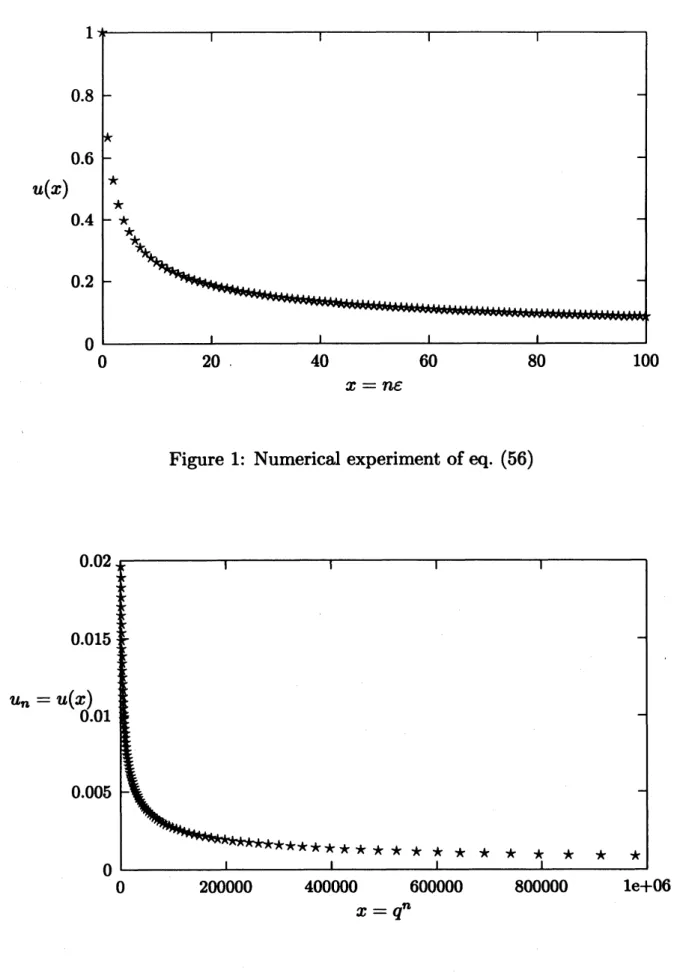
Equation (56) gives an explicit and stable difffference scheme. Its numerical result is illustrated in Figure 1.
In order to investigate $u(t)$ at large $t$, q-difffference scheme,
$\{_{u_{0}=\alpha}^{(\Delta_{q}+a\Delta_{q}^{1/2}+b)u_{n}=\beta M_{q}(1/2;n)+f_{n}}$ (58)
gives
a
more
powerful tool. Its numerical result is given in Figure 2.6
An
integrable
mapping with fractional
difffer-ence
This section provides a new type of integrable mappings equipped with fractional difffference. We fifirst consider the mapping [5]
$\frac{u_{n+1}-u_{n}}{\epsilon}=au_{n}(1-u_{n+1})$ $(a>0)$ (59)
$x=n\epsilon$
Figure 1: Numerical experiment of eq. (56)
$u_{n}=$
$x=q^{n}$
Figure 2: Numerical experiment of eq. (58)
which is a discrete Riccatti equation with constant coefflfflfflcients. It is also regarded as an integrable discretization of the logistic equation
$\frac{d}{dt}u=au(1-u)$ $(a>0)$. (60)
A solution to eq. (59) is given by
$u_{n}= \frac{u_{0}}{u_{0}+(1-u_{0})(1+a\epsilon)^{-n}}$ (61)
In order to ”fractionalize” the mapping (59),
we
start with$u_{n}= \frac{u_{0}}{u_{0}+(1-u_{0})F_{p}(-a\cdot n)}$
,
(62)By making
use
of Theorem 1, $u_{n}$ satisfies the following discrete equation,1
$u_{n}=$
$1+ \frac{1}{1+a\epsilon^{p}}\{\frac{1}{u_{n-1}}-\sum_{j=1}^{n-1}$ $(\begin{array}{l}p-1j\end{array})$ $(-1)^{j}$ $( \frac{1}{u_{n-j}}-\frac{1}{u_{n-j-1}})\}$
.
(63) Putting$p=1$ in eq. (63),
we
have$u_{n}= \frac{(1+a\epsilon)u_{n-1}}{1+(1+a\epsilon)u_{n-1}}$, (64)
which
recovers
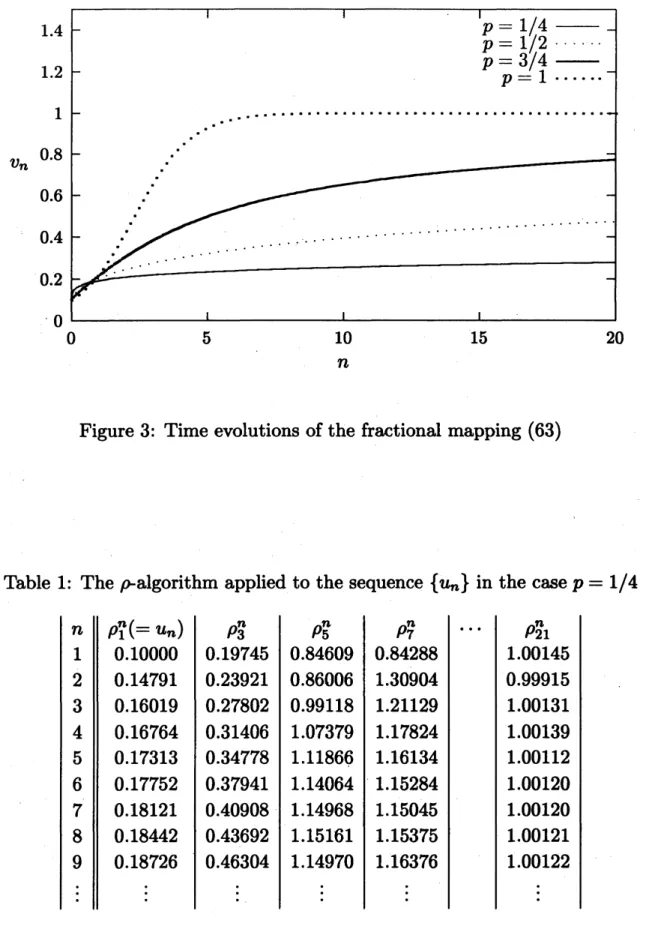
eq. (59). Figure 3 illustrates time evolutions of the fractional mapping with order parameter $p=n/4(n=1,2,3,4)$.
We have put $u_{0}=$$0.1$, $a=1.0$ and $\epsilon=0.1$
.
Considering the fact that the Mittag-Lefflfflffler function has
an
asymptotic behavior [12],$E_{p}( \lambda t^{p})=-\sum_{k=1}^{N-1}\frac{\lambda^{-k}t^{-pk}}{\Gamma(1-pk)}+O(t^{-pN})$, $tarrow\infty$,$\lambda<0$ (65)
and that $u_{n}$ converges to
$u_{n} arrow\frac{u_{0}}{u_{0}+(1-u_{0})E_{p}(-at^{p})}$ (66)
as $narrow\infty,\epsilonarrow 0$ with $t=n\epsilon$ fifixed, we can observe that $u_{n}$ converges to 1
at the order of $O(1/n^{p})$ if
$0<p<1$
.
Table I illustratesa
numerical resultin which we apply a convergence acceleration algorithm, which is called the
$\mu \mathrm{a}\mathrm{l}\mathrm{g}\mathrm{o}\mathrm{r}\mathrm{i}\mathrm{t}\mathrm{h}\mathrm{m}$ $[3]$,
$\rho_{k+1}^{n}=\rho_{k-1}^{n+1}+\frac{(k+n)^{p}-n^{p}}{\rho_{k}^{n+1}-\rho_{k}^{n}}$
$\rho_{0}^{n}=0$, $\rho_{1}^{n}=u_{n}$
to the sequence$\{u_{n}\}$in the
case
$p=1/4$.
Thistable shows that $u_{n}$convergesto the value
near 1.0
at the order $O(1/n^{1/4})$ as $n$ tends $\mathrm{t}\mathrm{o}+\infty$.
1.4 1.2 1 0.8 $v_{n}$ 0.6 0.4 0.2 0 0 5 10 15 20 $n$
Figure 3: Time evolutions of the fractional mapping (63)
Table 1: The $\mathrm{p}$-algorithm applied to the sequence
$\{u_{n}\}$ in the
case
p $=1/4$$|\begin{array}{l}n123456789\vdots\end{array}||\rho_{1}^{n}.\cdot.\cdot.\cdot..(=..\cdot u_{n})0181210177520147910\cdot 18726018442010000017313016019016764$ $|\begin{array}{l}\sqrt{}^{n}30.19745023921027802031406034778037941040908043692046304\vdots\end{array}|$ $086.\cdot.0060.84609099118114064114970115161114968107379111866\rho_{5}^{n}$ $|\begin{array}{l}\sqrt{}^{n}70.842881.309041.211291.178241.161341.152841.150451.153751.16376\vdots\end{array}|$
\ldots
$|0^{\cdot}99.\cdot.915100120100122100145100112100139100131100121100120\rho_{21}^{n}$
7
Concluding
Remarks
We have presented discrete and $q$-discrete analogues of the Mittag-Lefflfflffler
function, togetherwiththeirrelations to fractional difffference andq-difffference. However, the Mittag-Lefflfflffler function possesses more abundant properties other than its relation to fractional derivative and it is not clear whether its discrete analogues preserve such properties.
It is also interesting to fifind new types of integrable systems with frac-tionalderivativeordifffference. Sincefractional difffferentialequationdescribes
a system in which a value at $t=t$ depends not only on its local data but
also
on
its historical data from $t=0$ to $t=t$, it is expected toserve
as $\mathrm{a}$model of some physical phenomenon.
References
[1] W. A. Al-Salam, Some Fractional $q$-Integrals and $q- Der\dot{\mathrm{v}}vatives$
,
Proc.Edinburgh Math. Soc, 15 pp.
135-140.
[2] G. E. Andrews, q-Series: Their Development and Application in Anal-ysis, Number Theory, Combinator.cs, Physics and Computer Algebra,
CBMS Regional Conference Lecture 66, Amer. Math. So c, Providence,
R. I., 1986.
[3] C. Brezinski and M. Redivo Zaglia: Extmpolation Methods. Theory and Pmctice (North Holland, Amsterdam, 1991).
[4] J. B. Diaz and T. J. Osier,
Differences
of
Fractional Order, Math. Comp., 28(1974) pp.185-202.
[5] R. Hirota: J. Phys. Soc. Jpn. 46 (1979) 312.
[6] 広田良吾, 「差分方程式講義」, サイエンス社 (2000), P. 132.
[7] Y. Kametaka, private communication.
[8] K. S. Miller and B. Ross, An Introduction to the Fractional Calculus and Fractional
Differential
Equations, John Wiley andSons, Inc.,1993.
[9] G. M. Mittag-Lefflfflffler, Sur la nouvelle
fonction
$E_{\alpha}(x)$, C. R. Acad. Sci.Paris,
137
(1903) pp.554-558.
[10] I. Podlubny, Fmctional
Differential
Equations, Academic Press,1999.
[11] S. G. Samko, A. A. Kilbas, O. I. Marichev, Fractional Integrals and
Der.vatives, Gordon and Breach Science Publishers, 1993
G. Sansonne and J. Gerretsen, Lectures on the Theory
of
Functionsof
a Complex $Va7\dot{\tau}able$, P. Noordhoffff-Groningen, 1960.杉本信正, 非整数階微分・積分とその応用, ながれ$4(1985)$ pp. 110-120.
P. J. Torvik and R. L. Bagley, On the Appearance
of
the Fractional Der.vative in the Behaviorof
Real Mater.als, J. Appl. Mech., 51(1984)pp.