Japan Advanced Institute of Science and Technology
JAIST Repository
https://dspace.jaist.ac.jp/Title
Efficient Evolutionary Algorithm of
Multi-objective Optimization for High-Confidence Cyber-Physical Systems
Author(s) Lim, Yuto
Citation 科学研究費助成事業研究成果報告書: 1-6
Issue Date 2018-06-01
Type Research Paper
Text version publisher
URL http://hdl.handle.net/10119/15395 Rights Description 基盤研究(C)(一般), 研究期間:2015∼2017, 課題番 号:15K00120, 研究者番号:90435793, 研究分野:情 報学
北陸先端科学技術大学院大学・先端科学技術研究科・准教授
科学研究費助成事業 研究成果報告書
様 式 C−19、F−19−1、Z−19 (共通) 機関番号: 研究種目: 課題番号: 研究課題名(和文) 研究代表者 研究課題名(英文) 交付決定額(研究期間全体):(直接経費) 13302 基盤研究(C)(一般) 2017 ∼ 2015Efficient Evolutionary Algorithm of Multi-objective Optimization for High-Confidence Cyber-Physical Systems
Efficient Evolutionary Algorithm of Multi-objective Optimization for High-Confidence Cyber-Physical Systems
90435793 研究者番号: リム 勇仁(LIM, Yuto) 研究期間: 15K00120 平成 30 年 6 月 1 日現在 円 3,600,000 研究成果の概要(和文):本研究の目的は、制御則設計と実時間計算制約との間のギャップを大規模で分散し効 率的かつリアルタイムに縮むための、高信頼なサイバー物理システム(HiCoCPS)の新しいモデルを提案するこ とです。その成果は、スマートホームおよび他のCPSベースのアプリケーションにおけるHiCoCPSの3つのモデル を設計および提案することを含む。以下の結果も含む:(1)Satisfiability Module Theoriesに基づく新規リ アルタイムスケジューリング方法論フレームワークとタスクモデル、(2)2つのsafe-to-processスキームを用 いた時間遅れモデル、(3)モデル予測制御を用いた最適化モデル。
研究成果の概要(英文):The goal of this project to propose a novel model of high-confidence cyber-physical systems (HiCoCPS) for bridging the gap between control law design and real-time computation constraints in a large-scale, distributed, efficient and real-time manner. The outcomes include designing and proposing three models, i.e., task model, time delay model, and optimization model for the HiCoCPS system in the smart home application and other CPS-based domain applications. In summary, the results are: (1) novel real-time scheduling methodology framework and its task models based on Satisfiability Module Theories; (2) time delay model with two safe-to-process schemes; and (3) optimization model with model predictive control.
研究分野: 情報学
キーワード: Cyber-Physical Systems Real-time System Internet of Things SMT Predictive Control Smart Homes
様 式 C-19、F-19-1、Z-19、CK-19(共通) 1.研究開始当初の背景
The motivation of this project comes from the observation of global transformative forces, i.e., Cyber-Physical Systems (CPS) that is initialized by the National Science Foundation (NSF), United State in late 2006 steers the technological trend to realize the fully automation system of systems in the ultramodern applications. In oversea trends, a high-confidence CPS (HiCoCPS) particularly is a novel research domain, which seeks to integrate computing, communication and storage capabilities with monitoring among connected systems through networks in a dependable, secure, safe, efficient, and real-time fashion. In the HiCoCPS system viewpoint of smart homes, the mountains of raw data from the surrounding sensors and their measurements will be passed into a central computer for processing and spun back out to remotely control the physical actions, e.g., air-conditioner and window. The measurements may not be accurate because of unpredicted change of environments. Some measurements could be incomplete because of occlusion problems due to the wireless nature for example. Furthermore, because of the cheap sensors, inaccurate or faulty measurements are possible. Therefore, the HiCoCPS system is a complex closed-loop control system that makes use of inaccurate or incomplete data from the wireless sensor and actuator networks to make intelligent control decisions to operate the actuators for effective control of physical processes. The design and implementation of the HiCoCPS system in large-scale and distributed manner pose several challenges with respect to the issues such as time-driven and event-driven computation, time-varying delays, and transmission failures. As a result, a new model is required to able to capture the interaction between cyber and physical properties in a composable manner. This project is to ensure the new model of the HiCoCPS system that can meet the key interaction among the properties and eventually provide the requirement level of performance.
2.研究の目的
The purpose of this project is to propose a novel model of HiCoCPS system for bridging the gap between control law
design and real-time computation constraints in a large-scale, distributed, efficient and real-time manner. To achieve it, this project has two main objectives. (1) to propose and develop three models, i.e., task model, time delay model, and optimization model, which should be captured the interaction between cyber and physical properties in a composable manner; and
(2) to implement a HiCoCPS testbed environment for smart home application and other CPS-based domain applications.
3.研究の方法
This project consists of proposing three models, i.e., task model, time delay model, and optimization model in order to bridge the gap between control law design and real-time computation constraints in the HiCoCPS system. This project also implements the HiCoCPS testbed environment using the smart home environment, iHouse.
4.研究成果
In first fiscal year, a task model is proposed to attain an efficiency scheduling algorithm for the HiCoCPS system. To achieve this, a real-time scheduling methodology based on Satisfiability Module Theories (RSMT) framework is designed as illustrated in Figure 1. In RSMT, the task model is breaking down into a task dependency graph, which is used to illustrate the task execution orders before an optimization scheduling algorithm, i.e., the proposed SMT-based scheduling. The scheduling issue is formalized as a form of the constraint satisfaction problem that is using the first-order logic with equality. As a results, the proposed SMT based scheduling can maximize the total number of tasks to meet their deadlines regardless of the system and target constraints. Figure 2 depicts the comparison analysis of success ratio versus task arrival rate. RSMT framework outperforms the baseline algorithms regardless of the input task arrival rate. To show the usage of RSMT framework in the practical applications, a case study on a running car, which is equipped with multiple processors is also studied.
Figure 1: RSMT framework with its task model.
Figure 2: Comparison analysis of success ratio versus task arrival rate
In second fiscal year, a mathematical representation of the time delay model with consideration of network time delay, latencies of sensors and actuators, and clock error for the HiCoCPS system is studied and derived. Figure 3 shows a generic HiCoCPS system with three platforms. The concurrent issue happens at the merge in the platform 3. This concurrent arrival issue of two tasks is formalized as a critical problem of FIFO approach when those two tasks have a dependency of each other. Therefore, the proposed time delay model with a task dependency method is considered. To solve this problem in the HiCoCPS system, two safe-to-process schemes, i.e., the root mean square (RMS) based scheme and the double average (DA) based scheme are proposed.
Figure 3: Generic HiCoCPS system with three platforms.
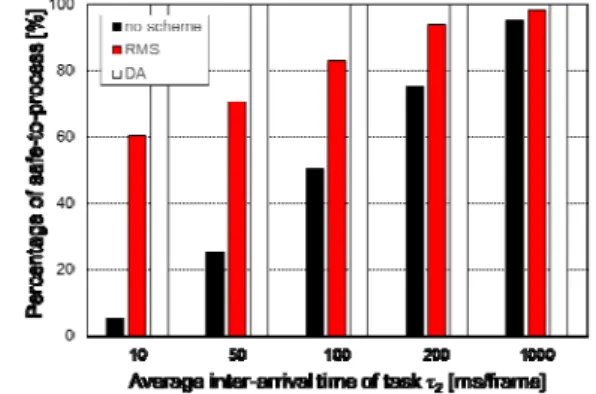
In third fiscal year, the proposed time delay model with the safe-to-process schemes for the HiCoCPS system, which consist of a main controller and two sub-controllers is evaluated. Figure 4 shows the percentage of safe-to-process performance of both RMS-based and DA-based schemes. As shown in Figure 4, the proposed DA-based scheme can guarantee 100% of safe-to-process regardless of any average inter-arrival time of two arrival tasks.
Figure 4: Percentage of safe-to-process performance.
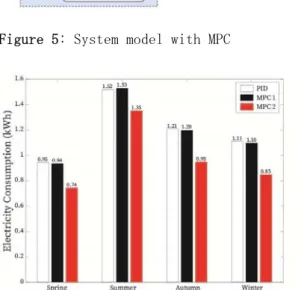
On the other hand, a hybrid predictive control is proposed to optimize real-time control operations of the HiCoCPS system considering the different aspects of the multidimensionality of the HiCoCPS problem. To accomplish this, a model predictive control (MPC) is taken into consideration. The MPC controller is integrated into the existing energy efficient thermal comfort control (EETCC) system, which was developed for the experimental smart home environment as shown in Figure 5. The advantages of MPC is explored in a real time manner for two objectives, i.e., reference tracking and energy minimization scenarios. In this project, the implementation of the MPC is successfully derived, simulated and benchmarked with four different seasons by using an evolutionary algorithm pursues the optimization of a dynamic multiple objective function, i.e., settling time and energy consumption for the EETCC in cyber-physical home system. Figure 6 depicts energy consumption comparison for all seasons. MPC 1 uses single objective (reference tracking), whereas MPC 2 performs two objectives (reference tracking and energy minimization). As a result, MPC 2 is managed to reduce the energy consumption for all seasons. In addition, MPC 2 is extended with the self-adaptive model.
Figure 5: System model with MPC
Figure 6: Energy consumption comparison for all seasons.
In summary, this project reveals many breakthroughs in contributing the research domain of the emergence concept of CPS in the era of Internet of Things. Some improvement and evaluation parts of this project are still needed to be accomplished. Nevertheless, this project leads to long-term research collaborations internationally and domestically although this project has been finished.
5.主な発表論文等 〔雑誌論文〕(計9 件)
(1) Yuto LIM and Yasuo TAN, “Time delay modeling for energy efficient thermal comfort control system in smart home environment,” In: Alfred R., Iida H., Ag. Ibrahim A., Lim Y. (eds) Computational Science and Technology. ICCST 2017. Lecture Notes in Electrical Engineering (LNEE), Springer, Singapore, vol.488, pp.42-52, 2018. DOI: 10.1007/978-981-10-8276-4_5 査読有 (2) Yuto LIM, Sian En OOI, Yoshiki MAKINO,
Tze Kin TEO, Rayner ALFRED, and Yasuo TAN, “Implementation of energy efficient thermal comfort control for
cyber-physical home systems,” Advanced Science Letters, American Scientific Publishers, ICCSE 2016, vol.23, no.11, pp.11530-11534, November 2017. DOI: 10.1166/asl.2017.10322 査読有 (3) Shamsul Faisal MOHD HUSSEIN, Abu
Bakar MOHD Anuar, Yoshiki MAKINO, Hoaison NGUYEN, Shahrum SHAH ABDULLAH, Yuto LIM and Yasuo TAN, “Simplifying the auto regressive and moving average (ARMA) model representing the dynamic thermal behaviour of iHouse based on theoretical knowledge,” In: Mohamed Ali M., Wahid H., Mohd Subha N., Sahlan S., Md. Yunus M., Wahap A. (eds) Modeling, Design and Simulation of Systems. AsiaSim 2017. Communications in Computer and Information Science (CCIS), vol.751, pp.697-711, Springer, Singapore,
2017. DOI:
10.1007/978-981-10-6463-0_59 査読有 (4) Rayner ALFRED, Gabriel Jong CHIYE,
Yuto LIM, Chin Kim ON and Joe Henry OBIT, “A multi-objectives genetic algorithm clustering ensembles based approach to summarize relational data,” In: Berry M., Hj. Mohamed A., Yap B. (eds) Soft Computing in Data Science. SCDS 2016. Communications in Computer and Information Science (CCIS), Springer Singapore, vol.652, pp.113-122, 2016. DOI: 10.1007/978-981-10-2777-2_10 査読有 (5) Shamsul Faisal MOHD HUSSEIN, Hoaison
NGUYEN, Shahrum SHAH ABDULLAH, Yuto LIM and Yasuo TAN, “Black box modeling the thermal behaviour of iHouse using auto regressive and moving average (ARMA) model,” Jurnal Teknologi, Advances on Intelligent Control and Robotic, Penerbit Universiti Teknologi Malaysia (UTM) Press, vol.78, no.6-13, pp.51-58, 2016. DOI: 10.11113/jt.v78.9272 査読 有
(6) Zhuo CHENG, Haitao ZHANG, Yasuo TAN, and Yuto LIM, “A case study: SOFL + model checking for OSEK/VDX application,” In: Liu S., Duan Z. (eds) Structured Object-Oriented Formal Language and Method. SOFL+MSVL 2015. Lecture Notes in Computer Science (LNCS), vol.9559, pp.132-146, Springer, Cham, 2016. DOI:
10.1007/978-3-319-31220-0_10 査読有 (7) Yuto LIM and Yasuo TAN, “Towards a cloud-based platform framework for smart homes,” IEEJ Transaction on Electronics, Information and System (C), Special Issue on Asian Conference on Information Systems 2014/2015, vol.136, no.12, pp.1677-1705, 2016. DOI: 10.1541/ieejeiss.136.1699 査読有 (8) Zhuo CHENG, Haitao ZHANG, Yasuo TAN,
and Yuto LIM, “SMT-based scheduling for overload real-time systems,” IEICE Transactions on Information and Systems, vol.E100.D, no.5, 2017. DOI: 10.1587/transinf.2016EDP7374 査読有 (9) Zhuo CHENG, Yasuo TAN, and Yuto LIM, “Design and evaluation of hybrid temperature control for cyber-physical home systems,” International Journal of Modelling, Identification and Control (IJMIC), vol.26, no.3, 2016. DOI: 10.1504/IJMIC.2016.080295 査読有
〔学会発表〕(計16 件)
(1) Yuan FANG, Sian En OOI, Yuto LIM, and Yasuo TAN, “Time task scheduling for simple and proximate time model in cyber-physical systems,” 5th International Conference on Computational Science and Technology (ICCST), 29-30 August 2018, Kota Kinabalu, Malaysia. 査 読 有 (submitted)
(2) Sian En OOI, Yuan FANG, Yoshiki MAKINO, Yuto LIM, and Yasuo TAN, “Study of adaptive model predictive control for cyber-physical home systems,” 5th International Conference on Computational Science and Technology (ICCST), 29-30 August 2018, Kota Kinabalu, Malaysia. 査 読 有 (submitted)
(3) Sian En OOI, Yoshiki MAKINO, Yuto LIM, and Yasuo TAN, “Predictive thermal comfort control for cyber-physical home systems,” 13th IEEE Annual Conference on System of Systems Engineering (SoSE), 19-22 June 2018, Paris, France. 査読有 (accepted) (4) Yuan FANG, Cheng LI, Yuto LIM, and
Yasuo TAN, “Simple and proximate
time model framework of cyber-physical systems,” IEICE Technical Committee on Ambient intelligence and Sensor Networks (ASN), 30-31 January 2018, Yufu, Japan, vol.117, no.426, ASN2017-102, pp.109-114. 査読無
(5) Cheng LI, Yuan FANG, Yuto LIM, and Yasuo TAN, “Highly available data interpolation (HADI) scheme for automated system in smart home environment,” IEICE Technical Committee on Ambient intelligence and Sensor Networks (ASN), 30-31 January 2018, Yufu, Japan, vol.117, no.426, ASN2017-89, pp.35-40. 査読無
(6) Sian En OOI, Yoshiki MAKINO, Yuan FANG, Yuto LIM, and Yasuo TAN, “Study of predictive thermal comfort control for cyber-physical smart home system,” IEICE Technical Committee on Ambient intelligence and Sensor Networks (ASN), 30-31 January 2018, Yufu, Japan, vol.117, no.426, ASN2017-88, pp.29-34. 査読無
(7) Yuto LIM, Nyiak Tien TANG, Yoshiki MAKINO, Tze Kin TEO, and Yasuo TAN, “Simulation of solar photovoltaic and fuel cell energy system for smart community simulator,” IEICE Technical Committee on Information Networks (IN), 16-17 November 2017, Kitakyushu, Japan, vol.117, no.306, IN2017-39, pp.1-8. 査読無
(8) HoaiSon NGUYEN, Yoshiki MAKINO, Yuto LIM, and Yasuo TAN, “Short-term prediction of energy consumption of air conditioners based on weather forecast,” 4th National Foundation for Science and Technology Development (NAFOSTED) Conference on Information and Computer Science (NICS), 24-25 November 2017, Hanoi,
Vietnam. DOI:
10.1109/NAFOSTED.2017.8108063 査 読 有
(9) Zhuo CHENG, Haitao ZHANG, Yasuo TAN, and Yuto LIM, “Scheduling overload for real-time systems using SMT solver,” 17th IEEE/ACIS International Conference on Software Engineering, Artificial Intelligence, Networking and Parallel/Distributed Computing (SNPD), 30 May-1 June 2016, Shanghai, China, pp. 934-937. DOI:
10.1109/SNPD.2016.7515899 査読有 (10) Zhuo CHENG, Haitao ZHANG, Yasuo TAN,
and Yuto LIM, “SOFL-based dependency graph generation for scheduling,” 11th IEEE System of Systems Engineering Conference (SoSE), 12-16 June 2016, Kongsberg, Norway, pp. 1-6. DOI: 10.1109/SYSOSE.2016.7542958 査 読有
(11) Zhuo CHENG, Haitao ZHANG, Yasuo TAN, and Yuto LIM, “SMT-based scheduling for multiprocessor real-time systems,” 15th IEEE/ACIS International Conference on Computer and Information Science (ICIS), 26-29 June 2016, Okayama, Japan, pp. 1-7. DOI: 10.1109/ICIS.2016.7550822 査読 有
(12) Zhuo CHENG, Haitao ZHANG, Yasuo TAN, and Yuto LIM, “A framework for scheduling real-time systems,” 22nd International Conference on Parallel and Distributed Processing Techniques and Applications (PDPTA), 25-28 July 2016, Las Vegas, USA, pp. 182-187. 査読有
(13) [Invited Talk] Yuto LIM, “A cyber-physical systems approach to smart homes,” 14th International Conference on Computer Applications (ICCA), 25-26 February 2016, Yangon, Myanmar. 査読無
(14) Zhuo CHENG, Yasuo TAN, and Yuto LIM, “rERA: An optimization algorithm of task dependency graph for scheduling,” IEICE General Conference, 15-18 March 2016, Fukuoka, Japan, A-10-16. 査読無
(15) Siew Gin LING, Yasuo TAN, and Yuto LIM, “Design and multiobjective optimization of efficient vehicle management framework for cyber-physical intelligent transportation systems,” IEICE Society Conference, 8-11 September 2015, Sendai, Japan, B-6-22. 査読無 (16) Naushin NOWER, Yasuo TAN, and Yuto
LIM, “Incomplete feedback data recovery scheme with Kalman filter for real-time cyber-physical systems,” 7th International Conference on Ubiquitous and Future Networks (ICUFN), 7-10 July 2015,
Sapporo, Japan, pp. 845-850. DOI: 10.1109/ICUFN.2015.7182663 査読有 〔その他〕 ホームページ: http://www.jaist.ac.jp/is/labs/lim-lab/ 6.研究組織 (1)研究代表者 リム 勇仁 (LIM, Yuto) 北陸先端科学技術大学院大学・先端科学技 術研究科・准教授 研究者番号:90435793 (2)研究分担者 丹 康雄 (TAN, Yasuo) 北陸先端科学技術大学院大学・先端科学技 術研究科・教授 研究者番号:90251967