Spectral Efficiency of Orthogonal Set of Truncated MC‑CDMA Signals Using Discrete Prolate Spheroidal Sequences
著者 Hamamura Masanori, Hyuga Jun journal or
publication title
Wireless Communications and Networking Conference, 2008. WCNC 2008. IEEE
page range 980‑984
year 2008‑03‑31
URL http://hdl.handle.net/10173/628
doi: 10.1109/WCNC.2008.178
Spectral Efficiency of Orthogonal Set of Truncated MC-CDMA Signals Using Discrete Prolate
Spheroidal Sequences
Masanori Hamamura and Jun Hyuga Department of Information Systems Engineering, Kochi University of Technology, Kochi, Japan 782–8502
Abstract— In this paper, we show that a set of multicarrier code-division multiple access (MC-CDMA) signals using a set of discrete prolate spheroidal sequences achieves 95% of the maxi- mum spectral efficiency at the out-of-band energy of 0.1% and the bandwidth-duration product of 45.25 with an orthogonalizing truncation. It is shown that the density ρ of carriers plays an important role in accurately estimating the out-of-band energy of the signals based on the corresponding eigenvalues and in achieving a small out-of-band energy. We also show that ρ should be chosen such that ρ ≥ 4 or ρ ≥ 8. To perform numerically stable eigenanalysis, we employ the technique of singular-value decomposition.
I. I
NTRODUCTIONIn the design of the spectrally efficient signals, it is neces- sary to efficiently pack the signals into a given time-frequency plane. The (sin x)/x-shaped Nyquist pulse has a rectangular spectrum that fully occupies a unit frequency slot and provides the maximum spectral efficiency of 2 symbols/s/Hz, the so- called Nyquist efficiency, without any intersymbol interference (ISI) or out-of-band energy. Although it is highly spectrally efficient, the problem for practical use is that such a pulse has eternal, large sidelobes that result in a large amount of energy being spilled out of a given unit time slot. To reduce the dura- tion of the sidelobes without the occurrence of ISI, pulses that have raised-cosine spectra have been commonly considered at the expense of an excess bandwidth [1]. Recently, a “better than” Nyquist pulse that reduces the magnitudes of the largest two sidelobes of pulses having the raised-cosine spectra was proposed [2]. The wavelets have also been considered for use as efficient pulses, since they inherently have the properties of time-frequency localization [3]. For finite-duration pulses, the prolate spheroidal wave function (PSWF) is known to be an optimum pulse that minimizes the out-of-band energy for a given length of time slot [4]–[7].
Another approach for designing efficient finite-duration signals is to employ a set of signals. Orthogonal frequency- division multiplexing (OFDM) signals [8] are known to be a nearly optimum set of orthogonal signals that can approxi- mately achieve the Nyquist efficiency for a large number of carriers. Each signal in a set of OFDM (pure OFDM) signals has the (sin x)/x-form spectra and hence, has large sidelobes in the frequency domain; however, most of them enter the
frequency slots of other carriers in the set, whereby a small total out-of-band energy can be achieved.
Multicarrier code-division multiple access (MC-CDMA) signals can also be a nearly optimum set of orthogonal signals by appropriately choosing code sequences to achieve a small total out-of-band energy. Discrete prolate spheroidal sequences (DPSSs) [7] have been discussed for use with MC-CDMA [9], [10]. In this paper, we discuss the spectral efficiency for a set of finite-duration MC-CDMA signals using the DPSSs and show that an orthogonalizing truncation provides us with a set of signals that achieve higher spectral efficiency than that of the set of OFDM signals for a given identical value of the bandwidth-duration product.
II. M
ODEL OFT
RUNCATEDMC-CDMA S
IGNALSA. Truncated MC-CDMA Signals
Let us begin with formulating the shapes of finite-duration MC-CDMA signals using L complex carriers (complex ex- ponentials) with frequencies (l −
12)/T
0[Hz] (l = 1, 2, ..., L).
The kth signal c(t; c
k, T ) (k = 1, 2, ..., K) with duration T [s]
(< T
0) is given by
c(t; c
k, T ) = g(t; T ) X
Ll=1
c
k,le
j2πT0(l−12)t, (1) where j = √
− 1, g(t; T ) is a rectangular function for the trun- cation defined as g(t; T) = { 1 (0 < t < T ), 0 (otherwise) } , and c
k(= [c
k,1c
k,2... c
k,L]
T; the superscript
Tdenotes the transpose) is a column vector that contains the code sequence c
k,l(l = 1, 2, ..., L) for the kth signal. The signals c(t; c
k, T ) (k = 1, 2, ..., K ) form a set of size K.
The kth signal, given by (1), is modulated by the complex message symbol b
k, which has two message samples in the real and imaginary parts [1] to be transmitted. Let x
k(t; T ) be the kth modulated signal x
k(t; T) = b
kc(t; c
k, T ). Therefore, a multiplexed signal y(t) can be represented as
y(t) = X
Kk=1
x
k(t; T ) = X
Kk=1
b
kc(t; c
k, T ). (2)
For the following discussions, we define a quantity ρ, called the density of carriers, as the number of complex carriers within a unit bandwidth 1/T , that is,
ρ = T
0/T. (3)
B. Orthogonalization of the Set
To design an orthogonal set of the signals, we first dis- cuss the cross-correlation Φ
T(c
k, c
k0) between the signals c(t; c
k, T ) and c(t; c
k0, T ). Φ
T(c
k, c
k0) is defined as
Φ
T(c
k, c
k0) = Z
T0
c
∗(t; c
k, T )c(t; c
k0, T )dt , (4) where the superscript
∗denotes the complex conjugate.
Substituting (1) into (4) yields Φ
T(c
k, c
k0)
= Z
T0
³ X
Ll=1
c
∗k,le
−j2πT0(l−12)t´³ X
Lm=1
c
k0,me
j2πT0(m−12)t´ dt
= T
0X
Ll=1
X
L m=1c
∗k,lr
l,mc
k0,m, (5) where r
l,mis the cross-correlation between the complex car- riers f
l(t; T ) = g(t; T )
√1T0
exp j
2π(lT−1/2)0
t and f
m(t; T ) = g(t; T )
√1T0
exp j
2π(mT−1/2)0
t, which is given by r
l,m=
Z
T 0f
l∗(t; T )f
m(t; T )dt
=
( 1/ρ (l = m)
1 ρ
sin((l−m)π/ρ)
(l−m)π/ρ
e
−j(l−m)π/ρ(l 6 = m) . (6) Let R
ρbe an L-by-L matrix, whose (l, m)th entry is r
l,m, such that
R
ρ= £ r
l,m¤ . (7)
Since it is obvious from (6) that r
l,m∗= r
m,l, the matrix R
ρis Hermitian; thus, the relation R
Hρ= R
ρholds, where the superscript
Hdenotes the Hermitian transpose (the transpose combined with the complex conjugate).
By using the matrix R
ρand the code sequence c
k, the cross- correlation (5) can be rewritten as
Φ
T(c
k, c
k0) = T
0c
HkR
ρc
k0. (8) The matrix R
ρin (8) can be decomposed into its eigen- values λ
ρ,iand corresponding eigenvectors v
ρ,i, which satisfy R
ρv
ρ,i= λ
ρ,iv
ρ,i(i = 1, 2, ..., K
0; K
0is the rank of the matrix R
ρ, and K
0≤ L), such that
R
ρ=
K0
X
i=1
λ
ρ,iv
ρ,iv
Hρ,i, (9) where the eigenvalues λ
ρ,ihave values 0 ≤ λ
ρ,i≤ 1, and the eigenvectors v
ρ,i(= [v
ρ,i,1v
ρ,i,2... v
ρ,i,L]
T) have a unit norm (i.e., k v
ρ,ik = (v
Hρ,iv
ρ,i)
12= 1) and are orthogonal to each other (i.e., v
ρ,iHv
ρ,i0= { 1 (i =i
0), 0 (i 6 =i
0) } ). To obtain
numerically stable results for the eigenanalysis of the matrix R
ρ, we employ the technique of singular-value decomposition (see Appendix I). Without loss of generality, we assume that the eigenvalues are numbered such that λ
ρ,1≥ λ
ρ,2≥ ... ≥ λ
ρ,K0.
Substituting (9) into (8), we have Φ
T(c
k, c
k0) = T
0c
Hk³ X
K0i=1
λ
ρ,iv
ρ,iv
Hρ,i´
c
k0. (10) Therefore, by choosing the vector c
ρ,k, which is given by
c
ρ,k= 1 p λ
ρ,kv
ρ,k= ⇒ c
k, (11) as the code sequence vector c
kfor the kth signal (k = 1, 2, ..., K ; K ≤ K
0), and by substituting (11) into (10), we have
Φ
T(c
ρ,k, c
ρ,k0)
= T
0p 1
λ
ρ,kv
Hρ,k³ X
K0i=1
λ
ρ,iv
ρ,iv
Hρ,i´ 1 p λ
ρ,k0v
ρ,k0= (
T
0(k =k
0)
0 (k 6 =k
0) . (12)
Expression (12) indicates that the signals c(t; c
ρ,k, T ) (k = 1, 2, ..., K ; K ≤ K
0) are orthogonal for the duration 0 < t <
T . We employ the set of vectors c
ρ,kas the code sequences [10], which is a complex version of the set of DPSSs,
1and discuss the signals transmitted in the duration 0 < t < T . C. Symbol Detection
The message symbol b
kthat modulates the kth signal c(t; c
ρ,k, T ) can easily be detected from the multiplexed signal y(t) using the corresponding correlator (or equivalently, using the matched filter that has the impulse response h
k(τ) = c
∗(T − τ; c
ρ,k, T )).
The kth correlator output z
k(T ) at time t = T is given by z
k(T) =
Z
T 0c
∗(t; c
ρ,k, T ) y(t) dt . (13) Substituting (2) into (13), and using (12), we obtain
z
k(T ) = Z
T0
c
∗(t; c
ρ,k, T )
³ X
Kk0=1
b
k0c(t; c
ρ,k0, T )
´ dt
= X
Kk0=1
b
k0Φ
T(c
ρ,k, c
ρ,k0) = b
kT
0. (14)
1For anL-by-Ldiagonal matrixD= diag{ej(1−12)π/ρ, ej(2−12)π/ρ, ..., ej(L−12)π/ρ}(D−1 =DH), the set of DPSSs is typically defined as the real solution of the set of vectorsdρ,kthat satisfy(D RρDH)dρ,k= λρ,kdρ,k for distinct eigenvaluesλρ,k [7]. It is easily verified thatdρ,k
can be expressed as the formdρ,k=D vρ,k; thus,vρ,k=DHdρ,k. To produce the orthogonal set of signals defined in the duration−T /2< t <
T /2, the vectorsdρ,kcan be employed as the code sequences regardless of the real or complex solutions.
Note that the correlator (or matched filter) provides us with an optimum method of detection that achieves the highest signal-to-noise ratio (SNR) over additive white Gaussian noise (AWGN) channels.
III. S
PECTRALE
FFICIENCYA. Out-of-Band Energy
A reliable value of out-of-band energy is required to accu- rately evaluate the spectral efficiency of the set of truncated MC-CDMA signals. Since the out-of-band energy E
k(out)of the signal x
k(t; T ) can be obtained from the total energy E
k(total)minus the in-band energy E
k(in), we first discuss the in-band energy E
k(in).
Here, we show that approximately 100λ
k[%] of the energy of x
k(t; T ) occupies the bandwidth W = L/T
0, defined in the frequency band B = [0, L/T
0].
Let X
k(f ; T ) (= F [x
k(t; T )]) be the Fourier transform of x
k(t; T ). X
k(f ; T) is given by
X
k(f ; T) = Z
∞−∞
x
k(t; T )e
−j2πf tdt
= b
kZ
T 0c(t; c
ρ,k, T )e
−j2πf tdt
= b
kT
0X
Ll=1
c
ρ,k,lr
∗l(f ), (15) where r
l∗(f) denotes
r
∗l(f ) = 1 T
0Z
T 0e
−j2πf te
j2πT0(l−12)tdt
= 1 ρ
sin ¡
(T
0f − l +
12)π/ρ ¢
(T
0f − l +
12)π/ρ e
−j(T0f−l+12)π/ρ. (16) The in-band energy E
k(in)of x
k(t; T) can be evaluated using (15) as follows:
E
(in)k= Z
B
| X
k(f ; T) |
2df
= | b
k|
2T
02Z
L/T00
¯¯ ¯ X
Ll=1
c
ρ,k,lr
∗l(f ) ¯¯ ¯
2df. (17) Now, we approximate the integral in (17) by a discrete summation of the areas of L rectangles with the frequency interval ∆
f= 1/T
0, that is,
E ˜
k(in)= | b
k|
2T
02X
Lm=1
¯¯ ¯ X
Ll=1
c
ρ,k,lr
l∗(f ) ¯¯
f=m−1/2T
0
¯¯ ¯
2∆
f. (18) Expression (18) can be a good approximation for obtaining the exact values of E
k(in)when ∆
f(= 1/T
0) → 0, or ρ (=
T
0/T ) → ∞ for a certain fixed value of the duration T of the signals, and the approximation is independent of the length L of the code sequence. It will be shown that (18) can be a good approximation only when ρ ≥ 4 or ρ ≥ 8.
We now determine the approximated quantity E ˜
k(in)of the in-band energy.
Note that r
∗l(f ), given by (16), coincides with the complex conjugate r
l,m∗of r
l,m, given by (6), at the frequencies f = (m −
12)/T
0(m = 1, 2, ..., L).
r
∗l(f ) ¯¯
f=m−1/2T
0
= r
∗l,m(19)
Therefore, the following relation holds:
X
L l=1c
ρ,k,lr
∗l(f )¯¯
f=m−1/2T
0
= X
L l=1c
ρ,k,lr
l,m∗= r
Hmc
ρ,k, (20) where r
mdenotes the mth column vector of the Hermitian matrix R
ρ(= [r
1r
2... r
m... r
L]; R
Hρ= R
ρ).
Substituting (20) into (18) yields E ˜
k(in)= | b
k|
2T
02X
L m=1¯¯ ¯ r
Hmc
ρ,k¯¯ ¯
2∆
f= | b
k|
2T
02°° R
Hρc
ρ,k°°
2∆
f, (21) where k · k denotes the norm of the enclosed vector.
Finally, upon substituting (9) for R
ρand (11) for c
ρ,kinto expression (21), we arrive at the desired approximation E ˜
k(in)for the in-band energy of the signal x
k(t; T ).
E ˜
k(in)= | b
k|
2T
02°° ° ³ X
K0i=1
λ
ρ,iv
ρ,iv
Hρ,i´
c
ρ,k°° °
2∆
f= | b
k|
2T
02°° ° q
λ
ρ,kv
ρ,k°° °
2∆
f= | b
k|
2T
0λ
ρ,k(22)
According to Parseval’s theorem, the total energy E
k(total)of X
k(f ; T ) in the frequency domain is identical to that of x
k(t; T) in the time domain, that is,
E
k(total)= Z
∞−∞
| X
k(f ; T ) |
2df
= Z
T0
| x
k(t; T ) |
2dt
= | b
k|
2Z
T0
c
∗(t; c
ρ,k, T ) c(t; c
ρ,k, T )dt
= | b
k|
2Φ
T(c
ρ,k, c
ρ,k). (23) Using (12), we obtain
E
k(total)= | b
k|
2T
0. (24) The out-of-band energy E
(out)kis obtained using (22) and (24) as
E
k(out)= E
k(total)− E
k(in)(25)
≈ E
k(total)− E ˜
k(in)= | b
k|
2T
0(1 − λ
ρ,k). (26) Thus, it is seen from (24) to (26) that approximately 100(1 − λ
ρ,k)[%] of the energy of the signal x
k(t; T) exists outside the given frequency band B.
Figure 1 shows the relationship between the numerically
evaluated exact values of the out-of-band energies and those
0.001 0.01 0.1 1 10
0.001 0.01 0.1 1 10
Out-of-band energy [%]
100(1– ρ,k) [%]
(L | ρ) = (128 | 2)
Eigenvalue approx.
(256 | 4) (512 | 8)
Fig. 1. Relationship between exact value of the out-of-band energy of xk(t;T)and eigenvalue approximation based on (26) (L/ρ= 64(=W T)).
obtained using approximation (26). The solid line shows the approximation based on (26), and dotted lines show the values obtained from (17), (24), and (25).
As can be observed in Fig. 1, the approximation is valid only for ρ ≥ 4 or more precisely, for ρ ≥ 8. In addition, it is important to note that we must choose a large value of density ρ such that ρ ≥ 4 or ρ ≥ 8 to produce the set of signals x
k(t; T ) that achieve a smaller out-of-band energy.
B. Spectral Efficiency
Since each symbol b
ktakes a complex value containing two message samples in its real and imaginary parts, the multi- plexed signal y(t)(= P
Kk=1
x
k(t; T ) = P
Kk=1
b
kc(t; c
ρ,k, T )) of size K conveys 2K samples during T[s] using the band- width W = L/T
0= L/(ρT )[Hz]. Therefore, the spectral efficiency η [samples/s/Hz] of y(t) is given by
η = 2 K
T1W = 2 K
W T
³
= 2K L/ρ
´
. (27)
To determine the size K of the set of the signals, we consider the out-of-band energy for the multiplexed signal y(t). For simplicity, we assume that E[b
∗kb
k0] = {E (k = k
0), 0 (k 6 = k
0) } (E[ · ] denotes the ensemble average). For this case, the average out-of-band energy E
y(out)for the mul- tiplexed signal y(t) can be evaluated using the approximation in (26) as
E
y(out)= E
· X
K k=1E
k(out)¸
= X
Kk=1
E £
E
k(total)− E
k(in)¤
≈ X
K k=1E[ | b
k|
2] T
0(1 − λ
ρ,k)
= K E T
0(1 − λ ¯
ρ), (28) where λ ¯
ρis the average of the eigenvalues λ
ρ,k, defined as
λ ¯
ρ= 1 K
X
Kk=1
λ
ρ,k. (29)
0.0 0.4 0.8 1.2 1.6 2.0
1 10 100
Spectral efficiency, η
Bandwidth-duration product, WT (= L/ρ) 100(1-λ−ρ) < 1.0%
100(1-λ−ρ) < 0.1%
OFDM(W99.0%)
OFDM(W99.9%)
Fig. 2. Spectral efficiencyηvs bandwidth-duration productW T (ρ= 8).
On the other hand, using (24), the total energy E
y(total)of y(t) is
E
y(total)= E
· X
K k=1E
(total)k¸
= X
Kk=1
E[ | b
k|
2] T
0= K E T
0. (30) Thus, from (28) and (30), the out-of-band energy of y(t) is 100 E
y(out)/ E
y(total)≈ 100(1 − λ ¯
ρ)[%]. Note that we can obtain reliable values of the average out-of-band energy E
y(out)by calculating λ ¯
ρ, given by (29), only when we choose a large value of density ρ for the set of signals.
Let K
100pbe the maximum size of K for which y(t) satisfies 100(1 − λ ¯
ρ) < 100p[%], that is,
1 − 1 K
100pK
X
100pk=1
λ
ρ,k< p ≤ 1 − 1 K
100p+1
K100p
X
+1k=1
λ
ρ,k. (31) It should be pointed out that K
100pdepends not only on the value of 100p but also on the values of L and ρ. We employ K
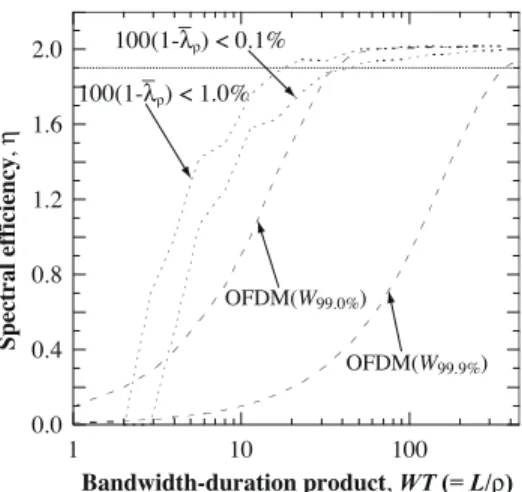
100pas the size K in (27) for the evaluation of the spectral efficiency of y(t). Results are shown in Fig. 2 in comparison with those of OFDM (pure OFDM) signals, for which 99.0% bandwidth (W
99.0%) and 99.9% bandwidth (W
99.9%) are considered.
As can be observed in Fig. 2, the spectral efficiency in- creases with the bandwidth-duration product W T . For the case of 100(1 − ¯ λ
ρ) < 0.1%, the multiplexed signal y(t) achieves η ≈ 1.90, which corresponds to 95% of the maximum spectral efficiency of the Nyquist pulse (sin t)/t, at W T = 45.25;
2whereas the set of OFDM signals requires W T = 373 for the out-of-band energy of 0.1% (the curve for W
99.9%) to achieve η ≈ 1.90.
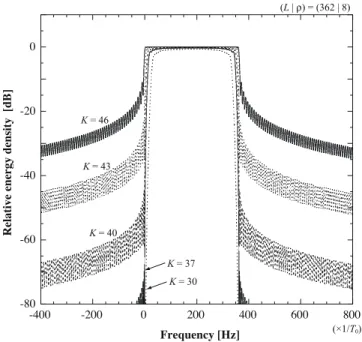
The energy density spectra of y(t) for different sizes of K are shown in Fig. 3 for (L | ρ) = (362 | 8). It is observed that
2K0.1% = 43was obtained at (L|ρ) = (362|8), which corresponds to W T = 45.25. For this case, the approximate value of the average out-of- band energy was100(1−λ¯ρ) = 0.057%, while the numerically evaluated exact value was0.059%. Both of these values are less than the prescribed value of100p= 0.1%.
Relative energy density [dB]
Frequency [Hz] (×1/T0) (L | ρ) = (362 | 8)
K = 46
K = 43
K = 40
K = 37 K = 30 -80
-60 -40 -20 0
-400 -200 0 200 400 600 800
Fig. 3. Energy density spectra ofy(t)for different sizes ofKfor(L|ρ) = (362|8)(i.e.,W T = 45.25).
the out-of-band characteristic of y(t) can be controlled by the size K.
IV. C
ONCLUSIONThe spectral efficiency of an orthogonal set of truncated MC-CDMA signals using DPSSs has been discussed. It has been shown that the set of signals can be more efficiently packed into a limited space of the time-frequency plane than the set of OFDM signals.
A
PPENDIXI
E
IGENANALYSIS OFM
ATRIXR
ρThe purpose of our eigenanalysis is to obtain the eigenvalues λ
ρ,iand corresponding eigenvectors v
ρ,i(i = 1, 2, ..., K
0) such that expression (9) holds.
Let f
ρ,land f
ρ,mbe column vectors f
ρ,l= [f
ρ,l,1f
ρ,l,2... f
ρ,l,MT]
Tf
ρ,m= [f
ρ,m,1f
ρ,m,2... f
ρ,m,MT]
Tthat consist of discrete-time samples f
ρ,l,nand f
ρ,m,n(n = 1, 2, ..., M
T) of the complex carriers f
l(t; T ) and f
m(t; T ), defined as
3f
ρ,l,n= 1
√ ρM
Texp j 2π(l − 1/2)(n − 1)
ρM
T,
f
ρ,m,n= 1
√ ρM
Texp j 2π(m − 1/2)(n − 1) ρM
T. The (l, m)th entry r
l,m, given by (6), of the matrix R
ρcan be represented using f
ρ,land f
ρ,mas r
l,m≈ f
ρ,lHf
ρ,m( , ˆ r
l,m).
Let us define a new matrix F ˆ
ρ= [f
ρ,1f
ρ,2... f
ρ,L]. R
ρcan be represented using F ˆ
ρas R
ρ≈ F ˆ
HρF ˆ
ρ( , R ˆ
ρ).
3We employMT= 4Lfor the numerical discussion throughout the paper.
In accordance with the technique of singular-value decom- position [11], F ˆ
ρis decomposed into
F ˆ
ρ= ˆ U
ρΛ ˆ
ρ12V ˆ
Hρ, (32) where Λ ˆ
1
ρ2
= diag © ˆ λ
1 2
ρ,1
, ˆ λ
1 2
ρ,2
, ... , λ ˆ
1 2
ρ,Kˆ0
ª is a K ˆ
0-by- K ˆ
0diagonal matrix that contains K ˆ
0distinct singular values λ ˆ
1 2
ρ,i
(i = 1, 2, ..., K ˆ
0; K ˆ
0is the rank of F ˆ
ρand rank( ˆ F
ρ) = rank( ˆ R
ρ) ≤ min(L, M
T)), U ˆ
ρ= [ˆ u
ρ,1u ˆ
ρ,2... u ˆ
ρ,Kˆ0] and V ˆ
ρ= [ˆ v
ρ,1v ˆ
ρ,2... v ˆ
ρ,Kˆ0] are an M
T-by- K ˆ
0and an L-by- K ˆ
0matrix, respectively, where u ˆ
Hρ,iu ˆ
ρ,i0= { 1 (i = i
0), 0 (i 6 = i
0) } and v ˆ
ρ,iHˆ v
ρ,i0= { 1 (i = i
0), 0 (i 6 = i
0) } hold.
Using (32) and the relations U ˆ
HρU ˆ
ρ= 1
Kˆ0×Kˆ0( K ˆ
0-by- K ˆ
0identity matrix) and Λ ˆ
1
ρ2
Λ ˆ
1
ρ2
= ˆ Λ
ρ, R ˆ
ρcan be expressed as R ˆ
ρ(= ˆ F
HρF ˆ
ρ) = ( ˆ U
ρΛ ˆ
ρ12V ˆ
Hρ)
H( ˆ U
ρΛ ˆ
ρ12V ˆ
Hρ)
= ˆ V
ρΛ ˆ
ρ12U ˆ
HρU ˆ
ρΛ ˆ
ρ12V ˆ
Hρ= ˆ V
ρΛ ˆ
ρV ˆ
Hρ=
Kˆ0
X
i=1
λ ˆ
ρ,iv ˆ
ρ,iˆ v
Hρ,i. (33) Expression (33) corresponds to the result of the objective eigenanalysis (9). Thus, the eigenvalues λ ˆ
ρ,iand correspond- ing eigenvectors ˆ v
ρ,iof R ˆ
ρcan be obtained by the singular- value decomposition of matrix F ˆ
ρ.
A
CKNOWLEDGMENTThis work was supported in part by a Grant-in-Aid for Young Scientists (B19760271) from the Ministry of Education, Culture, Sports, Science and Technology (MEXT) in Japan.
R
EFERENCES[1] J. G. Proakis,Digital Communications (3rd ed.), McGraw-Hill, New York, 1995.
[2] N. C. Beaulieu,, C. C. Tan, and M. O. Damen, “A “better than” Nyquist pulse,”IEEE Commun. Lett., vol.5, no.9, pp.367-368, Sept. 2001.
[3] P. P. Gandhi, S. S. Rao, and R. S. Pappu, “Wavelets for waveform coding of digital symbols,”IEEE Trans. Signal Processing, vol.45, no.9, pp.2387-2390, Sept. 1997.
[4] J. H. H. Chalk, “The optimum pulse-shape for pulse communication,”
Proc. IEE, Radio and Communication Engineering, vol.87, pp.88-92, 1950.
[5] D. Slepian and H. O. Pollak, “Prolate spheroidal wave functions, Fourier analysis and uncertainty – I,”Bell Syst. Tech. J., vol.40, pp.43-63, Jan.
1961.
[6] H. J. Landau and H. O. Pollak, “Prolate spheroidal wave functions, Fourier analysis and uncertainty – II,”Bell Syst. Tech. J., vol.40, pp.65- 84, Jan. 1961.
[7] D. Slepian, “Prolate spheroidal wave functions, Fourier analysis and uncertainty – V: The discrete case,” Bell Syst. Tech. J., vol.57, no.5, pp.1371-1430, May-June 1978.
[8] R. van Nee and R. Prasad,OFDM for Wireless Multimedia Communi- cations, Artech House, 2000.
[9] I. Raos, S. Zazo, and J. M. Paez-Berrallo, “Reduced interference MC- CDMA system using discrete prolate codes,”IEEE ICASSP ’02, vol.3, pp.2597-2600, May 2002.
[10] I. Raos, S. Zazo, and F. Bader, “Prolate spheroidal functions: A general framework for MC-CDMA waveforms without time redundancy,”IEEE PIMRC 2002, vol.5, pp.2342-2346, Sept. 2002.
[11] S. Haykin,Adaptive Filter Theory (3rd ed.), Prentice Hall, 1996.