Version 1.0 September, 2018
Study plan for the validation trial on multicolor reporter assay using THP-G1b (TGCHAC-A4) (IL-1β Luc assay) as a test evaluating the immunotoxic potential of chemicals
Conducted by:
IL-1β Luc assay Validation Management Team
INDEX
1. Background
2. Objective of the trial
3. Validation Management Team
4. Protocol
5. Chemical
6. Records and archiving
7. Study timeline
1. Background
The use of multicolor reporter assay using THP-G1b (TGCHAC-A4), IL-1β Luc assay is an important for evaluating the immunotoxic potential of chemicals as a part of
Multi-ImmunoTox assay (MITA), because of its technical simplicity, short-term test period and accuracy of test result based on a mechanism of immunotoxicity.
The aim of this trial is to (pre)validate the IL-1β Luc assay method to assess transferability and inter-laboratory variability, in order to incorporate this test for screening the immunotoxic chemicals. The IL-1β Luc assay for the validation trial will be undertaken i) in accordance with the principles and criteria documented in the OECD No. 34 Guidance Document on the Validation and International Acceptance of New or Updated Test Methods for Hazard Assessment [OECD, 2005], ii) according to the Modular Approach to validation [Hartung et al., 2004] ,iii) according to the concept discussed on the validation trials with participation of GLP Test Facilities [Cooper-Hannan et al., 1999] where the whole concept of the validation trials is described in the context of GLP, iv) and in line with the ISO procedure JRC.I.03.GP.01v.01
(http://ihcpnet.jrc.it/quality-safety/quality-documents/unit-03-ivm/doc/JRC.I.03.GP.01v.
01.pdf).
The studies part of a validation trial should ideally be performed in accordance with GLP [OECD, 1998-2007; FDA, 1999; EPA, 1998a&b; JSQA, 2010; SCC, 2010]. As a minimum, but not necessary limited, use of standard operating procedures (SOP), adequate data recording, reporting and record keeping are essential.
A general conceptional framework [Hartung et al., 2004; OECD, 2005] will be used
for documenting all the study to assess the validation status of a test method, called
“modular approach” to validation. In this approach, the information needed to support the validity of the method is organized into modules that provide the following information:
Module 1: Test Definition
Module 2: Within-laboratory repeatability and reproducibility Module 3: Between-laboratory transferability
Module 4: Between-laboratory reproducibility Module 5: Predictive capacity
Module 6: Applicability domain Module 7: Performance standards
The Modular approach as introduced by Hartung et al., allows using datasets from various data sources and studies. This advantage is used in the following proposal to assess the scientific validity of the IL-1β Luc assay. The IL-1β Luc assay for the validation trial has performed under the GLP principle.
2. Objective of the trial
The validation trial will assess the reliability (reproducibility within and between laboratories) and relevance (predictive capacity) of the IL-1 β Luc assay with a challenging set of test substances (test items) for which high quality in vitro and in vivo data are available.
3. Validation Management Team (VMT)
The VMT encompasses collective expertise with the test, in the underlying science and the scientific design, management and evaluation of a validation trial.
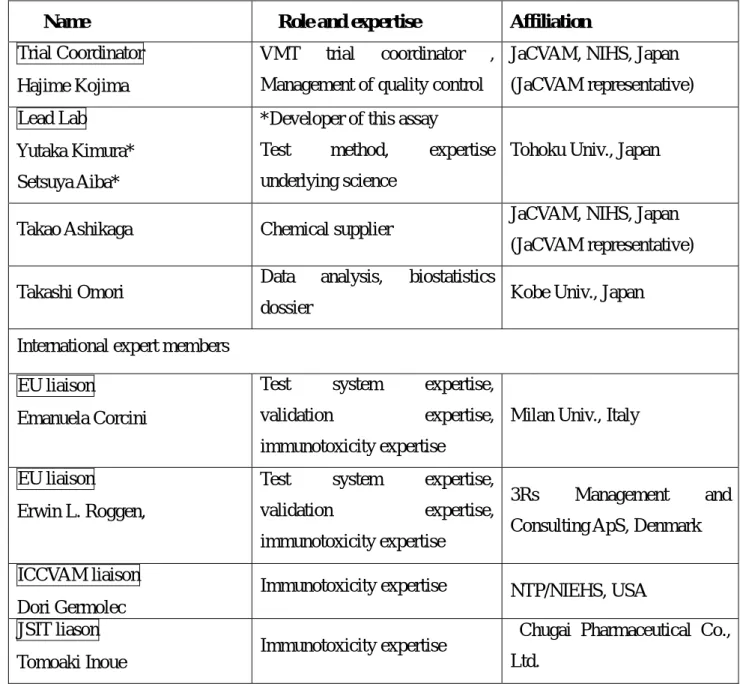
The VMT, which plays a central role overseeing the conduct of the validation trial,
includes:
Table 1. Members for IL-1β Luc assay Validation Management Team
Name Role and expertise Affiliation
Trial Coordinator Hajime Kojima
VMT trial coordinator , Management of quality control
JaCVAM, NIHS, Japan (JaCVAM representative) Lead Lab
Yutaka Kimura*
Setsuya Aiba*
*Developer of this assay
Test method, expertise underlying science
Tohoku Univ., Japan
Takao Ashikaga Chemical supplier JaCVAM, NIHS, Japan
(JaCVAM representative) Takashi Omori Data analysis, biostatistics
dossier Kobe Univ., Japan
International expert members EU liaison
Emanuela Corcini
Test system expertise, validation expertise, immunotoxicity expertise
Milan Univ., Italy
EU liaison
Erwin L. Roggen,
Test system expertise, validation expertise, immunotoxicity expertise
3Rs Management and Consulting ApS, Denmark ICCVAM liaison
Dori Germolec
Immunotoxicity expertise NTP/NIEHS, USA JSIT liason
Tomoaki Inoue
Immunotoxicity expertise Chugai Pharmaceutical Co., Ltd.
3.1 Par ticipating Test Facilities
The laboratories participating in the trial are defined as follow:
Test Facility 1: Hatano Res. Inst., FDSC. Study Director (SD) : Kohji Yamakage
Test Facility 2: AIST, Tsukuba SD : Rie Yasuno
Test Facility 3: AIST, Takamatsu SD : Yoshihiro Nakajima
Information relevant for Modules 1, 2, 3 performed by all laboratories. Data obtained by these laboratories have demonstrated that the IL-1Β Luc assay is transferable and reproducible between experienced laboratories. The all facility will be the laboratory participating in this validation trial acting as unexperienced laboratory to assess between laboratory transferability, reliability and relevance of the IL-1Β Luc assay method under non-GLP conditions (GLP principle).
3.1 Trial management str ucture
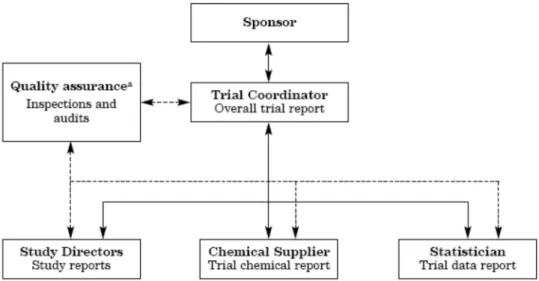
The management structure of the validation trial is shown in Figure 1
Figure 1: Management Structure of the IL-1β Luc assay validation trial
1) Chemical management group
The members of chemical management group are elected by recommendation of
the IL-1β Luc assay VMT. They prepare a tentative list of test chemicals and works with the VMT to make a final decision on the test chemicals to be used in the validation trial. The coded test chemicals listed are distributed by JaCVAM.
2) Data analysis group
The members of data analysis group are elected by recommendation of the IL-1β Luc assay VMT, and check and analyze the data obtained in this validation trial from a third-party standpoint. They also take charge of statistical processing in this validation trial.
3) Quality assurance group
The members of record management group are elected by recommendation of the IL-1β Luc assay VMT. They prepare protocol, test chemical preparation record forms, blank data sheets, etc. and distributes them to the research laboratories
participating in this validation trial. They also collect filled out forms and data sheets after completion of experiments, pointing out omissions or flaws in recording, if any, and requesting correction of such errors.
4) Lead laboratory
The lead laboratory representing the test method is responsible for providing the test method protocol and the eventually necessary data recording or calculation
templates. The Trial Coordinator has to ensure that such data recording or calculation
templates have been validated before distribution to the test facilities involved in the
validation trial. The lead laboratory is also responsible for providing, if necessary, new
versions of the protocols during the entire validation trial. The lead lab and the other
participating test facilities might be contacted by the VMT for technical issues.
3.2 Sponsor
The validation trial for assessing the validity of
IL-1β
Luc assay will be financed by the Ministry of Health, Labour and Welfare (MHLW), Japan.The lead laboratory will support the IL-1β Luc assay validation trial by assuring that reliability is assessed. At the same time, preliminary results of the test method can be evaluated. For this purpose, Lead laboratory will support:
- the financial aspects related to the coordination of a validation trial (e.g.
organization of VMT meetings where also the involved test facilities can be invited for technical clarifications to the VMT, the publication of the validation trial results)
- the test, reference and control item purchase, coding and distribution to the test facility
- the availability of the test systems to the participating laboratories by supporting the Lead laboratory with the logistics for delivering the test system to the facility
- the independent data analysis and statistical support (biostatistician) based on the study reports generated
- the other costs for participating laboratories
3.3 Trial coordination
Dr. Hajime Kojima was appointed as the Trial Coordinator with well-defined roles and responsibilities to coordinate the trial and to establishment of a VMT by supporting of JaCVAM.
The name and location of the Trial Coordinator should be identified in each
individual study plan. For the IL-1β Luc assay validation trial, the Trial Coordinator has direct access to the test item coding.
The Trial Coordinator’s responsibilities include:
a) Establishment of/support to lead laboratory, including meeting organization b) Trial communication and coordination with test facilities
c) Recording of document and data flow between test facilities
d) Assessing and documenting the impact of any amendments and/or deviations from the trial plan and study plans on the quality and integrity of the validation trial e) Ensuring that the individual study reports are forwarded, in a timely manner, for
data and statistical analysis
f) Preparing the trial plan and report, which can be based on the study reports from the lead laboratories and other test facilities involved in the validation trial, and should reflect the overall trial
g) Approval with date and signature of all protocols, Study Plans and Study Reports h) The communication of the results of the trial into the public domain
The role of Trial Coordinator (as the formal representative of the VMT and the
single contact point with the SDs) is of fundamental importance. The Trial
Coordinator is the single critical point of trial control and must ensure clear lines of
communication between the involved test facilities in the trial. The communication
line of the Trial Coordinator is with the SDs of the different test facilities. The SDs are
the single point of contact with the Trial coordinator (unless otherwise communicated
by the participating Test Facilities) to assure a transparent and recorded documentation
flow during the trial. The Trial Coordinator should also ensure that appropriate
arrangements have been made for the supply of the test systems, and test, control and reference items, which meet the requirements of the trial, and that there are appropriate test method protocols (dated signature by the trial coordinator and the Lead Laboratories) and, if appropriate, validated data recording, data analysis, data reporting sheets for the test method.
It is the responsibility of the Trial Coordinator to approve the study plans send for approval by the test facilities, and any amendments to the study plan, by dated signature.
3.4 Training
The lead laboratory will be responsible for issuing a training agenda to the Trial Coordinator for further distribution to the all test facility giving details what training aspects will be covered during the training of the other SDs and Study Personnel at the lead laboratory. Furthermore, after the training, the lead laboratory will issue to the Trial Coordinator a training report and indicating if critical observations are made by the other test facilities regarding the IL-1β Luc assay protocols. In case any critical observations are made a new version of the IL-1 β Luc assay protocols might necessary be issued to the other test facilities before initiating the between-laboratory transferability.
3.5 [Module 3] Between-laboratory transferability
This between-laboratory transferability (Module 3, identical to ICCVAM
proficiency testing phase) is performed in order to assess the successful transfer of the
assay to a test facility unexperienced with that particular test method but having
knowledge of similar test systems and endpoint detection methods.
For the transfer of IL-1β Luc assay to the all test facility, the Phase 0 study using non-coded three chemicals was performed. A few concentrations of each test item will be tested in triplicate in 2 independent runs according to the IL-1β Luc assay protocol describing the details of the experimental design. The results of the between-laboratory transferability will be reviewed before progressing with module 4 on the between laboratory reproducibility. If the transferability data do not meet test acceptance criteria, the Trial Coordinator representing the VMT will try to identify the problems and make corrections where needed.
3.6 [Module 2] Within-laboratory r eproducibility
The within-laboratory reproducibility of the all test facility has been done by an independent biostatistical analysis, under the VMT. The proportion of concordance should be equal or more than 80% as tentative acceptance criteria for phase I validation.
The five test items selected for the phase I study are coded as follows: A, B, C, D, and E. The all facility will prepare a study according to internal GLP principle. This plan will be submitted to the Trial Coordinator and lead laboratory for approval.
At the end of the testing, the test facilities will submit a QC certified copy of whole study dossier to the Trial Coordinator (study plan in GLP principle, raw data, records and data analysis, study report in GLP principle).
3.7 [Module 4] Between-laboratory reproducibility
Ten coded test items have been selected to confirm the between-laboratory
reproducibility in the phase I study. A few concentrations of each test item will be tested
in triplicate according to the IL-1β Luc assay method protocol describing the details of the experimental design.
At the end of the testing, the test facilities will submit a QC certified copy of whole study dossier to the trial coordinator (study plan in GLP principle, raw data, records and data analysis, study report in GLP principle). The proportion of concordance between-laboratory reproducibility should be equal or more than 80% as acceptance criteria,
3.8 [Module 5] Predictive capacity
The necessity for further chemical analysis will be subject to a VMT decision once the data of the between laboratory reproducibility has been assessed. Depending on the statistical analysis the lean design for validation as well as the automatisation of the test leading to an increased dataset will be considered.
4. Protocol
In this validation trial, the protocol (ver. 1E) will be used (attached Document #2).
This protocol will make up a draft by the lead laboratory and be finalized by VMT.
A measurement of bioluminescence intensity induced with chemical treatment will be measured by luminometer (Phelios: ATTO, Cat #:AB-2350) calibrated using stabilized SLG, SLO and SLR enzymes in this validation trial.
5. Chemicals
5.1 Chemicals Selection
Test chemicals have been selected by chemical repository based on published papers on in vivo immunotoxicity
The applied selection criteria were:
information on mode/site of action
coverage of range of relevant chemical classes and product classes quality and quantity of reference data (in vivo and in vitro)
high quality data derived from animals and (if available) also humans
knowledge on interspecies variations (for example: variability with regard to the uptake of chemicals, metabolism, etc.)
coverage of range of toxic effects/potencies
chemicals that do not need metabolic activation
appropriate negative and positive controls
physical and chemical properties (feasibility of use in the experimental set-up as defined by the CAS No.)
single chemical entities or formulations of known high purity
availability
costs
In the first phase of the selection procedure, the Chemical Selection Committee identified and collected several existing lists of potential chemical sensitizing in order to establish a primary database. These chemicals had originally been compiled by international experts for various purposes e.g. as reference compounds for validation studies. An extensive literature research was performed by the Chemical Selection Committee in order to insure that the preselected chemical fulfilled the selection criteria described above.
Emphasis was laid on the fact that different potencies (strong, weak and no activity)
have been chosen. In addition, it was decided that at least 20% of the total substances
to be tested should be negative in order to increase the statistical power of the data analysis.
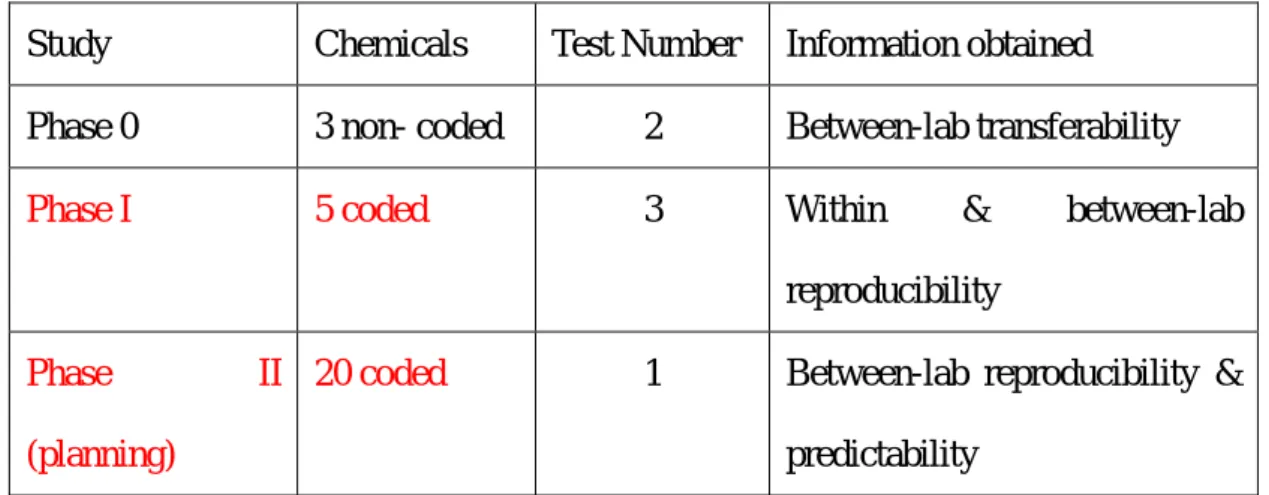
In the first phase IL-1β Luc assay validation trial with data generation at the test facilities, five chemicals will be tested three times in each test chemical for between-laboratory reproducibility and to confirm transferability. After discussion of Phase I results, detailed test planning of the Phase II will be determined. At this moment, twenty chemicals will be planned in the phase II trial for predictive capacity (Table 2).
Table 2. Outline of test planning at each study in the validation trial.
Study Chemicals Test Number Information obtained Phase 0 3 non- coded 2 Between-lab transferability
Phase I 5 coded 3 Within & between-lab
reproducibility
Phase II
(planning)
20 coded 1 Between-lab reproducibility &
predictability
(Planning of Phase II will be determined after discussion of the results of Phase I )
5.2 Chemicals Acquisition, Coding and Distribution
The assessment of within-laboratory reproducibility (Module 2), between
laboratory transferability (Module 3) in the all test facilities have been performed with
coded chemicals. This IL-1β Luc validation trial plan describes the generation of the
missing data sets under coded test item. If the results obtained are not very similar to
the previous obtained sets, the VMT has to assess if coded chemicals need to be tested
in the all test facilities.
The coding will be supervised by the Trial Coordinator, in collaboration with the chemical repository responsible of coding and distribution of test, reference and control items for the validation trial.
5.3 Handling
Each test facility shall receive through the Trial Coordinator essential information about the test chemicals (physical state, weight or volume of sample, specific density for liquid test chemicals, and storage instructions). Moreover, the SD should receive the safety information concerning the hazards identification and exposure controls/personal protection.
6. Records and archiving
At the end of the trial, the IL-1β Luc assay validation trial report is prepared by the Trial Coordinator or the VMT personnel who appointed by the Trial Coordinator. The trial report summarizes the trial goals, procedures, results and conclusions of the
validation trial. This represents the whole validation trial, including archiving and, as
such, will cover several study reports, as well as reports for test item supply, data
management and statistics. The Trial Coordinator oversees the preparation of the trial
report. The Trial Coordinator will be representing the VMT discussions responsible
for preparation of the scientific conclusions. Signatories to the trial report include the
Trial Coordinator, the statistician, and the SDs of the involved test facilities. Although
the SDs may not be involved with the preparation of the trial report, their signatures
confirm that the trial report is an accurate reflection of the management and study
events. The trial report should contain a statement, signed by the Trial Coordinator,
commenting on the accuracy and completeness of the trial report and identifying any
significant issues which could have affected the integrity of the trial, including matters of GLP compliance. A QC statement will be included in the trial report, in order to identify what QC monitoring was done and to confirm whether or not the trial report is an accurate reflection of the validation trial data.
7. Study timeline
An approximate schedule for IL-1β Luc assay validation trial is shown in Table 3.
Duration of this validation trial is around twenty -month from August 2018 to 2020.
Table 3. Schedule of IL-1β Luc assay validation trial
Month Activity
August, 2018
Establish the VMT
Selection of participating research laboratories
Deliberation, decision and read-through of draft study plan Deliberation and decision of protocol
Preparation of a tentative list of test chemicals
Distribution of test chemicals, standard chemicals and positive control chemicals
October,2018
Technical transfer using five known chemicals (non-coded)
Start of technical transfer to know between laboratory transferability Data collection of technical transfer (Phase 0 study)
Phase I study
October, 2018 Coding and distribution of five coded test chemicals November, 2018 Start of Phase I study
March, 2019 End of Phase I study
May, 2019