
Ryoukou Kumabe
aand Hiroshi Nishino
b*
a
Department of Materials and Life Science, Graduate School of Science and Technology, Kumamoto University, Kurokami 2-39-1, Kumamoto 860-8555, Japan
b
Department of Chemistry, Faculty of Science, Kumamoto University, Kurokami 2-39-1, Kumamoto 860-8555, Japan
Abstract
The manganese(III) acetate-catalyzed cycloperoxidation of 4-piperidone-3-carboxylates with 1,1-disubstituted alkenes is described. The 4-piperidone-3-carboxylates reacted with 1,1-disubstituted alkenes in the presence of a catalytic amount of manganese(III) acetate in air at 23 °C to give 1-hydroxy-8-aza-2,3-dioxabicyclo[4.4.0]- decane-6-carboxylates in good to moderate yields. The crystal structure of the azabicyclic peroxides was determined by an X-ray single crystal analysis. The oxidation of the 4-piperidone-3-carboxylates with 1,1- diphenylethene using a stoichiometric amount of manganese(III) acetate gave ethenyl- and ethyl-substituted 4- piperidones and 6-hydroxy-3-aza-7-oxabicyclo[4.3.0]nonane-1-carboxylate which was the same as the product obtained from the hydrogenolysis of the 1-hydroxy-8-aza-2,3-dioxabicyclo[4.4.0]decane-6-carboxylate.
The development of new chemotherapeutic agents to combat malaria type diseases is urgently needed for mankind in order to eradicate malaria all over the world, because malaria parasites have developed a resistance to the conventional antimalarials such as chloroquine (Figure 1).
1Although artemisinin (quighaosu) is a unique antimalarial drug consisting of the 1,2,4-trioxane skeleton,
2the synthesis of N-substituted azaartemisinins, which are more active than artemisinin, was recently reported.
3During the course of our synthetic study of the azabicyclic peroxides,
4we planned the synthesis of an azaartemisinin analogue such as 2,3- dioxabicyclo[4.4.0]decane containing a nitrogen-heteroatom using the 4-piperidone derivative.
Piperidones are also important as intermediates for the synthesis of many alkaloids.
5Therefore, the reaction of the 4-piperidone-3-carboxylates with alkenes in the presence of manganese(III) acetate was first examined. Since it seemed that free 4-piperidones were too sensitive for the oxidant to survive under the oxidation conditions,
6the N-acyl-protected 4- piperidone-3-carboxylates were used.
* Corresponding author. Tel.: +81-96-342-3374; fax: +81-96-342-3374; e-mail: [email protected]
OO
Me
O O
O Me H
Me
H
H N
O
Me
O O
O Me H
Me
H
H R
Artemisinin Azaartemisinins
NMeO
N H H
HO H
Quinine
N Cl
N Me
NEt2 H
Chloroquine
Figure 1. Antimalarial Agents
The 4-piperidone-3-carboxylate derivatives 1 were synthesized by the Dieckmann condensation of the acyl-di(alkoxycarbonylethyl)amines which were prepared by the addition of alkyl acrylates to ammonia followed by N-protection with acyl chlorides.
7Most piperidones 1 were obtained as a mixture of the keto and enol tautomers. At first, in order to investigate the usefulness under our oxidation conditions using manganese(III) acetate, the reaction of 4-piperidone-3-carboxylate 1 (R
1= Ph, R
2= Et) (1 mmol) with an alkene 2 (R
3= R
4= Ph) (2 mmol) was carried out in glacial acetic acid (25 mL) at 23 °C in the presence of manganese(III) acetate (2 mmol) in air. After 30 min, the reaction was quenched by adding 2 M HCl (25 mL) followed by extraction with chloroform and separation by chromatography, which gave an intractable mixture. Although we managed to isolate a cyclic peroxide (35%) from the complex mixture, the 4-piperidone 1 was not recovered (Table 1, Entry 1). It appeared that excessive oxidation occurred and the reaction was complicated. Probably, the N-benzoyl-protected 4-piperidone 1 was still reactive under the oxidation conditions. In fact, the direct oxidation of 1 with manganese(III) acetate led to the decomposition of 1, and benzoic acid was only obtained. In order to find the best reaction conditions, the reaction was scrutinized under various conditions and we found that the desired azabicyclic peroxide 3
Table 1. Manganese(III)-Catalyzed Oxidation of 4-Piperidone-3-carboxylates 1 in the Presence of Alkenes 2
aEntry 1 2 Mn(OAc)
3Time Yield of 3
bR
1R
2R
3R
4mmol h %
1 Ph Et Ph Ph 2 0.5 35
c2 Ph Et Ph Ph 0 3 0
d3 Ph Et Ph Ph 0.3 1.5 20
4 Ph Et Ph Ph 0.1 3 61
5 Ph Et Ph Ph 0.1 8 84
6 Ph Et Ph Ph 0.1 24 70
7 Ph Et 4-ClC
6H
44-ClC
6H
40.1 8 63
8 Ph Et 4-MeC
6H
44-MeC
6H
40.1 8 82
9 Ph Et Et Et 0.1 8 22
10 Ph Et Ph Me 0.1 8 33
11 Ph Et Ph H 0.1 8 35
12 Me Et Ph Ph 0.1 8 48
13 Me Et 4-MeC
6H
44-MeC
6H
40.1 8 69
14 Et Et Ph Ph 0.1 8 64
15 Et Et 4-MeC
6H
44-MeC
6H
40.1 8 82
16 Me Bu Ph Ph 0.1 8 68
17 Et
2N Et Ph Ph 0.1 8 44
a
A mixture of 4-piperidone-3-carboxylate
1 (1 mmol) and the 1,1-disubstituted alkene 2 (2 mmol) was stirred in glacialacetic acid (25 mL) at 23 °C in air in the presence of a catalytic amount of manganese(III) acetate as shown in the table.
bIsolated yield based on the amount of the piperidone 1 used.
cThe piperidone 1 was not recovered, but 1,1-diphenylethene
2 (29% recovered) and a dimer of 1 (4%) were isolated. dThe piperidone
1 (51%) and 1,1-diphenylethene 2 (68%) wererecovered.
N O
O
O R2
R4
R3 N
O O CO2R2
OH
R4 R3
+
cat. Mn(OAc)
3AcOH, air, 23 °C
1 2 3
R1
O O
R1
1 8 6 4
(R
1= R
3= R
4= Ph, R
2= Et), ethyl 8-benzoyl-1-hydroxy-4,4-diphenyl-8-aza-2,3- dioxabicyclo[4.4.0]decane-6-carboxylate, was obtained in an 84% yield using a catalytic amount of manganese(III) acetate (Entry 5).
8The
13C NMR spectrum of the azabicyclic peroxide 3 showed the peaks typical of the 1,2-dioxan-3-ol structure;
4the peaks at d 99.6 and 85.0 ppm were assigned to C-1 and C-4 attached to the oxygen atom, respectively.
9However, since the interconversion of the 8-aza-2,3-dioxabicyclo[4.4.0]decane skeleton seemed to occur on the NMR time scale,
10the three methylene carbons of the piperidine appeared at d 46.2, 36.8, and 32.4 ppm as a broad peak as well as the three methylene carbons of the 4-piperidone 1 (R
1= Ph, R
2= Et). The methylene protons of 3 were also revealed as a broad peak in the
1H NMR spectrum,
9and the stereochemistry of the ring junction could not be defined though the simple PM3 calculation of 3 provided the result that the cis-fused azabicyclic peroxide was ca. 6 kcal/mol more stable than the trans isomer.
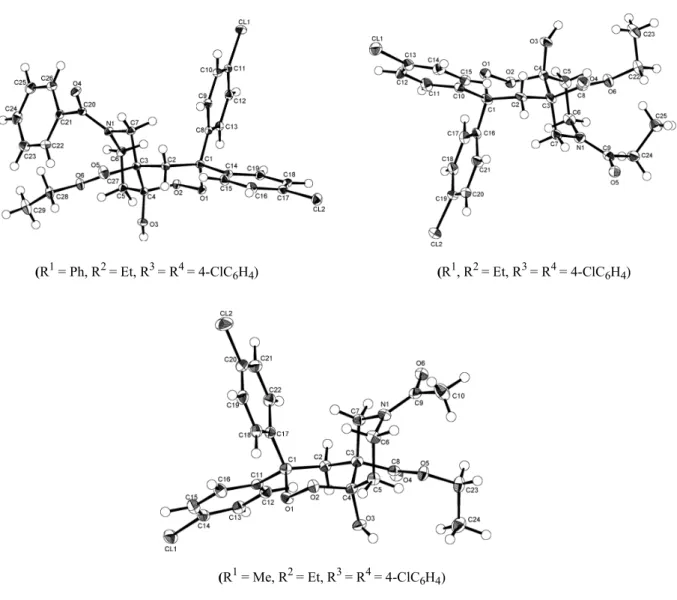
11Therefore, in order to determine the configuration in the crystal state, a single crystal of 3 (R
1= Ph, R
2= Et, R
3= R
4= 4-ClC
6H
4) was successfully grown from ethanol and analyzed by X-ray diffraction.
The crystal structure was solved by direct methods, and the azabicyclic peroxide 3 was found to be the cis-fused bicyclic system shown in Figure 2.
12It was confirmed that the hydroxyl group should be arranged axial due to the 1,3-diaxial interaction between the C-4 phenyl group and C-6 ethoxycarbonyl group, and the molecular modeling study revealed that the
Figure 2. X-Ray Structures of cis-Fused Azabicyclic Peroxide 3
(R
1, R
2= Et, R
3= R
4= 4-ClC
6H
4) (R
1= Ph, R
2= Et, R
3= R
4= 4-ClC
6H
4)
(R
1= Me, R
2= Et, R
3= R
4= 4-ClC
6H
4)
interconversion of the piperidine skeleton would be possible while the cis configuration was retained. A similar catalytic reaction of other piperidones 1 with alkenes 2 yielded the corresponding azabicyclic peroxides 3 that are presented in Table 1 (Entries 7-17). A single crystal of 3 (R
1= Me, R
2= Et, R
3= R
4= 4-ClC
6H
4) and 3 (R
1, R
2= Et, R
3= R
4= 4-ClC
6H
4) was also measured by X-ray diffraction and the cis-fused structure of 3 was again confirmed.
The structures of other 3 were determined by NMR, IR, and MS spectroscopies and elemental analyses.
It is known that the oxidation of pyrrolidinediones with a stoichiometric amount of manganese(III) acetate in the presence of alkenes at reflux temperature gave the corresponding ethenyl- and ethyl-substituted pyrrolidinediones.
4Therefore, we also examined the oxidation of the 4-piperidone-3-carboxylates at high temperature in spite of their instability. Since, in general, the manganese(III)-based oxidation at high temperature is very fast, it seemed that there would be a chance to form substituted products. A mixture of the 4-piperidone 1 (R
1= Ph, R
2= Et) (1 mmol) and the alkene 2 (R
3= R
4= Ph) (2 mmol) oxidized with manganese(III) acetate (2 mmol) in boiling acetic acid (25 mL) gave a mixture of 3-ethenyl-4-piperidone 4 and 3-ethyl-4-piperidone 5. Although the oxidation finished within 1.5 min, the continuous heating of the reaction mixture for 60 min resulted in the production of 6-hydroxy-3-aza-7-oxabicyclo[4.3.0]nonane-1-carboxylate 6 in 35% yield along with a mixture of 4 and 5 (38% combined yield). We recently reported that the palladium-catalyzed hydrogenolysis of azabicyclic peroxides led to the ring reduction of the 1,2-dioxane ring.
13Accordingly, the hydrogenolysis of the azabicyclic peroxide 3 (R
1= R
3= R
4= Ph, R
2= Et) was carried out in 10% methanol-dichloromethane at 40 °C under hydrogen (50 atm) to quantitatively give the same product 6 which consisted of a 1:1 cis and trans mixture.
The manganese(III)-based catalytic cycloperoxidation of 4-piperidone-3-carboxylates is simple and convenient so that many types of substituted 8-aza-2,3-dioxabicyclo[4.4.0]decanes could be synthesized using a combination of 3-alkanoyl- and 3-alkoxycarbonyl-4-piperidones and 1,1-disubstituted alkenes. In addition, it is also useful for the synthesis of functionalized 4-piperidones such as 4 and 5 by choosing the oxidation conditions. Further investigations are now in progress.
Antimalarial testing was performed for the five synthesized 1-hydroxy-8-aza-2,3- dioxabicyclo[4.4.0]decane-6-carboxylates 3.
14Unfortunately, the azabicyclic peroxides 3 did not show the activity, but cytotoxicity toward FM3A (Table 2).
Table 2. Antimalarial Testing of Azabicyclic Peroxides 3
P. falciparum FM3A Entry Azabicyclic peroxide 3
EC
50(M) EC
50(M) 1 R
1= Ph, R
2= Et, R
3= R
4= 4-ClC
6H
47.0 x 10
-62 R
1= Et, R
2= Et, R
3= R
4= 4-ClC
6H
43.1 x 10
-67.8 x 10
-63 R
1= Et
2N, R
2= Et, R
3= R
4= 4-ClC
6H
44.6 x 10
-67.7 x 10
-64 R
1= Cyclohexyl, R
2= Et, R
3= R
4= 4-ClC
6H
42.2 x 10
-59.6 x 10
-75 R
1= Ph, R
2= Et, R
3= Ph, R
4= 4-ClC
6H
41.3 x 10
-57.7 x 10
-61
2
N
O
B z Ph
Ph EtO2C
N
O
B z Ph
Ph EtO2C
OAc
+
NB z CO2Et O
Ph Ph OH
AcOH
reflux Mn(OAc)
3AcOH, reflux
R1 = PhR2 = Et
(R3 = R4 = Ph)



![IPSJ SIG Technical Report Vol.2019-HCI-182 No /3/19 1,a) 2,b) 1. [1] 1 Department of Computer Science, University of Tsukuba 2 Faculty of Engin](data:image/gif;base64,R0lGODlhAQABAIAAAP///wAAACH5BAEAAAAALAAAAAABAAEAAAICRAEAOw==)