Abundance Distribution in Supernova RemnantCas A
Yasuhide Matsuo1、Masa-aki HASHIMOTO1 and Kenzo ARAI 2 1 Department of Physics, Kyushu University, Fukuoka 810-8560 2Department of Physics, Kumamoto University, Kumamoto 860-8555
(Received September 30, 2010)
Two dimensional hydrodynamical simulations of supernova remnant Cas A are performed starting from the onset of explosion to the present phase. Before the explosion, distributions of circumstellar medium is constructed, where the medium is assumed to be ejected from a progenitor. A supernova simulation is carried out by two dimensional hydrodynamical calculation. It is found that the Rayleigh-Taylor instability is advanced from the boundary between hydrogen and helium layers. The instability from silicon and iron layers is not grown enough to induce the observed mixing of materials. It is suggested that mixing before the explosion and/or instability at the boundary of silicon and iron layers due to different distributions of circumstellar medium is needed to explain the observations.
§1. Introduction
It is Cassiopeia A (Cas A) that is the youngest supernova remnant in our Galaxy.
Cas A is the brightest radio source so far.1) Moreover, it has been observed in possible bands of the spectrum: radio,2) infrared,3) visible4) and X-ray.5) The yields of hydrodynamical simulations are compared in detail with the observed properties.
Therefore, Cas A becomes one of the main targets for numerical simulations of supernova explosion.
The observations of X-ray from Cas A indicate6) that the progenitor exploded in A.D. 1671. The distance to Cas A is determined to be 3.4 kpc7) and its size is 2 — 3 pc. Although the type of the supernova for Cas A was inferred to be Ib/c,8) it has been finally identified to be type lib from the observation of light echo,9) which
indicates the explosion of a helium star.
Recent observations have clearly shown there exist a peculiar regions where
irons distribute outside the Si-rich layer.10) Since this observational evidence cannot
be explained in terms of a spherical explosion model, some kinds of mixing between Si- and Fe-rich layers should occur in large scale. Although there are no detailed investigations about the mixing of Cas A, we can infer the mechanism of the mixing
processes: the Rayleigh-Taylor instabilities inside the star,11) interactions between the supernova shock and the circumstellar medium12) and the non-spherical explosion such as jets and/or standing accretion shock instability.13)
In the present paper, we investigate possible mixing between Si- and Fe-layers
due to the Rayleigh-Taylor instability during supernova exploson, using a presu-
pernova model with circumstestellar medium ejected from a progenitor. Two di
mensional hydrodynamical simulations are performed to the present remnant phase
of Cas A by extending the technical method used for the mixing of supernova
1987A.11)'14)
248 Y. Matsuo, M. Hashimoto and K. Arai
§2. Basic equations
Let D/Dt be the Lagrange differentiation, which varies along the fluid particle.
The non-relativistic equations of fluid dynamics relevant for the simulations are
(^i) (2.2)
pDi\p) = ~PVv> (23)
where p, P, e and v are the density, pressure, internal energy density and veloc ity, respectively, of fluid. Mpt is the mass of the point source at the center. Self gravitational potential $ is obtained by solving the following Poisson equation
(2.4) We define the radius i?ph of the photosphere to be
/;
where Kes is the opacity due to the electron scattering: k^ = 0.20(1 + X) cm2 g"1 with the hydrogen mass fraction X.
To solve the above set of equations (2.1)-(2.4), we need an equation of state.
Inside the photosphere, r < iiph, we take radiation and gases composed of electrons and ions:
+ -Pgas>
3 2j
e = 3Prad + -Pga8,
with
Prad = \aT\
PT
where T is the temperature, a is the radiation constant, R is the gas constant and fi is the mean molecular weight.
Outside ilph radiation becomes free, so we set
•* = <Fgas>
10 10
-19 -20
1 10'22
t 10-23
10 -24 10
10 -25 r26
WR:0yr WR:2000yr WR:4000yr WR:6000yr
0.2 0.4 0.6 0.8 1 1.2 1.4 1.6 1.8 2 Radius [pc]
Fig. 1. Evolution of WR and RSG winds. The wind shells are formed around the boundary between the two winds.
For a high temperature region above 5 x 10⁹ K, all materials are in nuclear statistical equilibrium. When T < 5 x 10⁹ K, we take into account 14 species of nuclei: p, 4He, 12C, 16O, 20Ne, 24Mg, 28Si , 32S, 36Ar, 40Ca, 44Ti, 48Cr, 52Fe and 56Ni. The abundance flow (advection) can be followed by solving (2.1) for individual elements k with the mass fraction A*, where Xk = Pk/p-
Once p and T are determined, then the nuclear reaction rates are evaluated.
Consequently, the generated nuclear energies are added to the internal energy.
§3. Initial Models
3.1. Construction of the circumstellar medium
Observations indicate that a progenitor of Cas A had lost most hydrogen-rich
envelope before the explosion.9) We may infer that the progenitor was a Wolf-Rayet
(WR) star: the progenitor experiences three stellar evolutionary stages from the main sequence (MS) stage via the red super giant (RSG) stage finally to the WR
stage.
According to the calculation of stellar evolution,12) the RSG stage continues over 0.6 Myr with a typical wind velocity 10 km s"1. The boundary between the MS and RSG winds locates at about 6 pc, which is much further compared to the forward shock front of 2.5 pc.15) Therefbre, we neglect the effects of the MS wind to the
evolution of stellar wind.
If we assume the RSG wind is spherical and steady,16) then density in the wind
250 Y. Matsuo, M. Hashimoto and K. Arai
6Msun He-core + RSG wind
"(5
6Msun He-core + WR:2000yr
Radius [cm]
Q.
106 108101010121014101610181020
Radius [cm]
Fig. 2. Density distribution of the initial models for Twr = 0 (left panel) and 2000 yr (right panel).
The original presupernova core of 6M© lies inside 1011 cm. The knob around 1018 cm in the right panel corresponds to the WR+RSG shell.
is written from (2.1) as
4?rr2VRSG' (3.1)
where Mrsg is the mass loss rate and vrsg is the velocity of the RSG wind. From the stellar evolution calculations,17) we take Mrsg = 1.54 x lO~5Af0yr""1, vrsg = 4.7 km s"1 and Trsg = 103 K. Under the above condition of the RSG wind, the WR winds are advected18) with Mwr = 9.6 x 10~~6 Moyr"1, vwr = 1.7 x 10³ km s"1 and TWR = 104K.
We calculate the spherical stellar wind from 0.01 to 2 pc with the 2000 equally stretched meshes. The evolution of the winds is shown in Fig. 1. Since the WR wind becomes three orders in magnitude faster than the RSG wind, the WR wind pushes the back of the RSG wind. Consequntly, high density shells (WR+RSG shells) are formed around the boundary between the two winds.
It has been reported19) that the duration *wr of the WR stage could be less
than about 3500 yr. Taking into account the uncertainty in twR, we consider two cases twR = 0 and 2000 yr.
3.2. Observational constraints due to one dimensional simulations
We adopt the presupernova model of a 6M0 He-core.20) Initial models are con
structed by connecting this presupernova model with the WR and RSG winds de scribed in the last subsection. Figure 2 shows the density distribution of the initial models. The left panel indicates the case *wr = 0 and the right one is the case
*wr = 2000 yr. Note that there appears a knob around 1018 cm, which corresponds
to the WR + RSG shell.
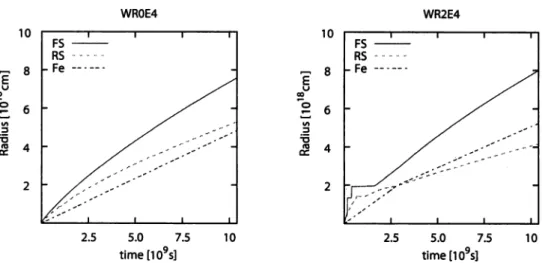
Table I gives the positions jRf8 of the forward shock and i2re of the reverse shock
for models with the input energy of explosion Ein = 2-4x 1051 erg in two cases.
energy of explosion, Rfs and Rrs are the locations of the forward and reverse shocks, respectively.
Models WR0E2 WR0E3 WR0E4 WR2E2 WR2E3 WR2E4
*WR(103yr)
£in(1051erg) -Rfe(pc)
0 0 0 2 2 2
2 3 4 2 3 4
1.8 2.1 2.5 1.9 2.3 2.6
1.3 1.6 1.7 1.0 1.2 1.3
The observed locations15) axe R& = 2.5 ± 0.2 pc and #ra = 1.6 ± 0.2 pc in Cas A.
Therefore, only a model WR0E4 is fitted to the observations of both J?fs and i?re,
which is consistent with the previous study.21) As a consequence, we examine matter
mixing due to the Rayleigh-Taylor instabilities for this model.
§4. Two dimensional hydrodynamical simulations and Rayleigh-Taylor instabilities
We performe two dimensional simulations of supernova explosion for the initial model WR0E4. Our region of calculation is divided into 1000 x 100 meshes in rO plane. When the shock wave passes the boundary between C+O and He-rich layers at t = 3.9 s after the explosion, we specify purturbations in r-component of velocities
as
Svr = eurcos(2O0), (4.1)
where we set e = 0.1. The Rayleigh-Taylor instability is judged from the criterion22)
Vp • VP < 0. (4.2)
This condition is satisfied in most regions of the boundary layers after the shock passes through.
During the propagation of the shock wave, we follow the abundance change using
an a network code23) which contains 13 nuclei from 4He to 56Ni. Furthermore, to evaluate the amount of radio actives nucleosynthesis is calculated in detail for tracer
particles using the post process method with a large network code24) of 464 nuclei.
The produced amounts are found to be 44Ti of 1.3 x 10"4 M0 and 56Ni of 0.123 M0, whose values are consistent with the observed abundances.25)
Figure 3 shows our results of simulations at t = 330 yr after the explosion. The left panel indicates the density contours, where the instability developes at r ~ 0.4 and 1.6 pc. The former region is attributed to the boundary between original O- and Si-rich layers. The latter corresponds to the boundary between H- and He-rich layers. We note that in the deep O-rich layer, both Si and Fe are produced through the explosive O-burning. Most Fe are daughters of radioactive nuclei 56Ni. As seen
from the right panel, no mixing occurs between Si and Fe in our simulations.
252 Y8Mntsmo,MHnshimotoq7DdK、A7nj 3二Z二T鱸o
21[】。]N
?'LT1
]iIllI g琶麺涜彊hmi用?I 「割則喜一(’・砕・別,。’氷’ 、亟垂酔率率刃
R砧
蕊鐵議蕊:
鱸瀞
,j-Z-D生・砂 )α一N TISZ■;二…
二) Ⅱ
 ̄0J
』
、
DFI61 睦:i鞭F鯉ij2・典韓弛鱒-J「鬮劃l「
0.s11.5ZZ-5ヨ
α ロ ̄ ̄● ̄ ̄uUc----ごユ dq511.母ZZ、5ヨ