
• 検索結果がありません。

Teachers' Question in Science Lessons Discussion at Secondary Level of Bangladesh

N/A
N/A
Protected

Academic year: 2021

シェア "Teachers' Question in Science Lessons Discussion at Secondary Level of Bangladesh"

Copied!
13
0
0

読み込み中.... (全文を見る)

全文

(1)

著者 Siddiquee Muhammad Nur‑E‑Alam, Kubota Kenichi journal or

publication title

情報研究 : 関西大学総合情報学部紀要

volume 52

page range 25‑36

year 2021‑01‑30

URL http://hdl.handle.net/10112/00022647

(2)

[email protected], Science Education Specialist, JICA-NCTB (Japan International Corporation Agency- National Curriculum and Textbook Boad)

**
[email protected], Professor Emeritus, Kansai University

Teachers’ Question in Science Lessons Discussion at Secondary Level of Bangladesh

Muhammad Nur-E-Alam SIDDIQUEE

, Kenichi KUBOTA

**

Abstract

Teachers’ question is an essential part of teaching as well as indices of quality teaching. It can scaffold students’ thought process towards meaningful learning. In order to be skillful in asking different types of effective questions to promote thinking, teachers need to know what kind of questions they are currently asked. Therefore, the study aims to explore teachers’ questions at secondary level (Grade VI-X) in various science lesson discussions in Bangladesh context. Video recorded data of fourteen science lessons of thirteen teachers were used as data source of this study. Data were analyzed with coded category. The results revealed that the questions teachers asked while science content area instruction were mainly fall under remembering level category. Understanding, applying, analyzing and evaluating question were asked very infrequently. In this study, there was no question found in the creating level category. Analysis of the results indicated that teaching experiences and in-services trainings were found influential in teachers’ questioning while gender and the subjects taught at graduation level, were not found as influential agent. Implications of the study were also discussed.

Keywords: Secondary Classroom, Teachers’ questions, Science lesson, Bangladesh

Introduction

Teachers’ question is one of the significant aspects of classroom talk and asking question is one of the 10 major dimensions for studying teachers’ behavior in the widely used system for interaction analysis (Flanders, 1970; Ewing & Whittington, 2007). Using questioning technique, for example, Socratic questioning, teacher acts as an interlocutor and a coach who provides scaffolding through asking guiding questions to advance students’ thinking (Chin, 2007). With a similar vein, Aschner (1961) stated that asking question is one of the basic ways by which the teacher stimulates students’

thinking and learning. Effecting learning is the main concern of science education. Effective learning

happens best where social interaction, particularly between learners and more knowledgeable others, is

encouraged. Teaching style, therefore, need to take account of the need for discussion, both between

(3)

pupils and between pupils and teacher (McCormick & Leask, 2005). Cormack, et al., (1998) stated that teachers’ question can be highly influential in shaping classroom discussion so that it aids students’

learning. Kawalkar and Vijapurkar (2011a) asserted that teacher can provide support and guidance to effective learning through effective questioning.

The kind of questions teachers ask and the way in which they are asked can, to a large extent, influence the nature of students’ thinking as they engage in the process of constructing scientific knowledge (Chin, 2007). Teachers questions can become indices of quality teaching (Carlsen, 1991). In the inquiry and conceptual change classroom teaching, the nature of teachers’ question and their purpose differ greatly with the question those asked in traditional teaching (Kawalkar & Vijapurkar, 2011a; Chin, 2007, Yip, 2004). Purpose of question, for example, in traditional teaching is to evaluate what students know and following a particular structure of Initiation-Response-Evaluation (IRE) sequence (Lemke, 1990) whereas, eliciting what students thinking, encourage them to elaborate on their thinking and help them to construct conceptual knowledge development are the purposes of inquiry teaching (Baird & Northfield, 1992).

Developing higher order thinking skills through group and peer discussion is the core of teaching depicted in the teacher education curriculum in Bangladesh (MoE, 2006). Since teachers’ question can support students to involve active discussion and stimulate students thinking, the study attempts to explore teachers’ question in various science lesson discussions at secondary level (Grade VI-X) of Bangladesh. The following questions guided this study: What sort of questions do teachers ask during content area instruction and what are the factors that influence their questioning?

Literature review

The nature of teacher questions and its classification

Teachers questions are frequent, pervasive, and universal phenomena (Roth, 1996) and one of the most prominent features of classroom talk (Wellington & Osborne, 2001; Blosser, 2000) Teachers ask over hundred questions in a class session to encourage students thinking. However, the types of questions teachers ask are more important than the number of the questions they ask in a class session.

Several categories of teachers’ questions have been proposed by many researches. Well known

among these are lower and higher order questions (Bloom et, al., 1956), and open and close-ended

questions (Graesser & Person, 1994). Lower cognitive question corresponding to close-ended question,

are those that invite brief answers and place few cognitive demands on the students while open-ended

or higher cognitive questions invite extended answers, may have several acceptable answers and place

more demands on the learner (Kawalkar & Vijapurkar, 2011a). Wilen (1991) concluded that teachers

use questions to deal with both instructional and managerial tasks. Blosser (2000) identified questions

(4)

as falling into one of four categories: Managerial-type, rhetorical-type, open-type and closed- type.

Managerial questions are those used by the teacher to keep the classroom operating and Rhetorical question are used to reinforce a point or for emphasis (2000, p. 4).

Kawalkar and Vijapurkar (2011a) found five broad categories of teachers’ questions in inquiry classwork: exploring pre-requisites or setting the stage, generating ideas and explanations, providing further, refining conceptions and explanation and guiding the entire class towards the scientific concept.

They reported that traditional teachers ask few open-ended questions. Yip (2004) identified 10 types of questions under four broad categories namely: Lower-order, higher-order, motivational and conceptual- change. He asserted that ‘the conceptual-change’ questions unlike most traditional questions, play a distinctive role in science instructions in that they aim at facilitating students to undergo conceptual change and constructions (2004, p. 78) through eliciting preconceptions or alternative conceptions, challenging students to review and resole inconsistent ideas, extending students idea from existing knowledge and applying the knowledge in novel situation. He reported that lower order questions were frequently asked by the teachers (35.1%), the proportion of higher order questions (25.4%) and conceptual-change questions is also constituted a significantly high percentage (27.4%).

Chin (2007) analyzed teacher’s questions in science classroom. She described four approaches namely Socratic questioning, Verbal jigsaw, Semantic tapestry and Framing and several strategies within these approaches that encourage student responses and thinking.

Previous studies on teacher questioning focused on the recitation or the IRE (Initiation, response, evaluation) pattern of discourse (Mehan, 1979) and the importance of wait time in increasing students’

thoughtfulness (Tobin, 1987). Dillon (1985, 1988b) discussed the lack of student active engagement when teachers asked too many questions based on IRE format. He asserted that prevalence of evaluative questions of the IRE format in classroom talk would be counterproductive to students articulating their thought.

Use of Teachers’ question in inquiry

The purpose of teacher questioning in traditional lesson is to evaluate what students know (Lemke,

1990) in which, teacher asks a closed question that is basically information-seeking, that requires a

predetermined short answer and that is usually pitched at the recall (Goodrum, 2004) or lower-order

cognitive level. However, in inquiry-oriented science classrooms the role of teachers’ questions is to

encourage true dialogue (Lemke, 1990) aiming at conceptual understanding. Such questions are more

open requiring one- or two-sentences answers, and the teacher engages students in higher-order

thinking (Baird & Northfield, 1992). Goodrum (2004) stated that in inquiry teaching the main engine

for facilitating learning is the use of questions and discussion while in traditional lesson the driving

force of teaching is teacher explanation.

(5)

Roth (1996) described a case study where the teacher’s questioning was designed to ‘draw out’

students’ knowledge and scaffold students’ discursive activity to lead to independent accounts and student-centered discussion. Erdogan and Campbell (2008) found that teachers facilitating classrooms with high levels of constructivist teaching practices not only asked a significantly greater of number of questions but also more open-ended questions.

Beccles (2012) studied teacher intensions by using the teacher questions and the purposes of the questions during science lessons in Ghana. He found that the intention of the teachers’ questions was mainly to check students focus in lesson (38%) and students’ prior science content knowledge (42%).

Less emphasis was given on checking students’ procedural knowledge (2%), checking students’

understanding (5%), and eliciting student thinking (8%). To promote meaningful learning that can solve real-life problems, students need to be asked a variety of question (Blosser, 2000).

To develop skills in questioning, teachers need to know what kind of questions they are currently asking. This study, therefore, tried to explore teachers’ questions in various science lesson discussions in secondary level of Bangladesh. As far as the researcher concerns, this study will be the basic one of its kind in the case of Bangladesh. I believe, it would be helpful for science teachers at secondary level to check their current questioning practices. Additionally, the results of the study would be exemplary evidence to the science teachers, teacher educators and future science teachers regarding practical questions in classroom discussion and provide guidelines for teachers to increase their repertoire of questioning skills.

Research Method

An interpretative research framework of Strauss and Corbin (1990) was adapted to conduct this study. It focuses on the in-depth meanings of verbatim lesson transcripts generated from various science lessons. Data were collected from February and March 2012 and February and April 2013.

Participants

Thirteen teachers teaching grade VI to X science from three schools participated in the study. They

were selected purposively. Among the participants four were females. The teaching experiences of the

participants ranging between two to seventeen years, held Bachelor in Education (B.Ed.), have studied

separate subjects of Physics (P) and Chemistry (C) along with either Mathematics (M) or Biology (B)

at graduating level, received Teaching Quality Improvement training (TQI), Subject Based Cluster

training (SBC), Continuing Professional Development (CPD) training, and short term Overseas

Training (OT). Table 1 shows the summary of participants.

(6)

Data Source and Procedure

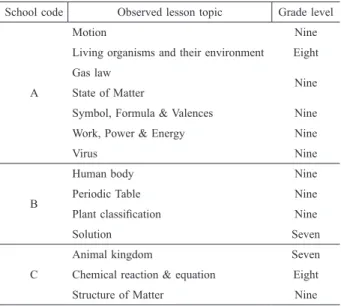
Data of this study was gathered through lesson observation via videotaping. Fourteen science lessons of thirteen teachers from three different schools were observed by the researcher. The observed lessons covered a range of topics (Table 2) included in the science syllabus in secondary levels (Grade VI to X). These include motion; living organism and their environment; gas law; state of matter; symbol,

Table 1. School wise demography of the teachers School

code Teacher Sex

(M/F) Years of Teaching experience Subject

taught

In-service training

B.Ed. SBC TQI CPD OT

A

T1 F 15 P √ √ √

T2 M About 2 B √

T3 M 17 C √ √ √ √ √

T4 F 5 C √

T5 M 9 P √ √

T6 F 14 B √ √ √ √ √

B

T7 M 6 B √ √

T8 M 12 P √ √ √

T9 M 10 B √ √ √

T10 M 11 C √ √ √

C

T11 M 7 B √ √

T12 F 6 C √

T13 M 8 C √ √

Table 2. School wise lesson topic and grade School code Observed lesson topic Grade level

A

Motion Nine

Living organisms and their environment Eight Gas law

State of Matter Nine

Symbol, Formula & Valences Nine

Work, Power & Energy Nine

Virus Nine

B

Human body Nine

Periodic Table Nine

Plant classification Nine

Solution Seven

C

Animal kingdom Seven

Chemical reaction & equation Eight

Structure of Matter Nine

(7)

formula and valences; work, power and energy; virus; human body; periodic table; plant classification;

solution; animal kingdom; chemical reaction and equation; and structure of matter. The average class size was 42 students and average duration of the class was 33 minutes. Due to manpower constraints and the availability of limited video camera for use in class, only classroom discussion in whole-class setting was recorded. The video camera was set up at the middle of the classroom and was directed toward teacher and students. For the video documentation, a high definition (HD) video camera was used, which is sensitive to capture subtle knock of tone, therefore, no extra audio recorder was used.

The video files of the recorded classroom talk were transcribed verbatim and ready for analysis.

Analysis of Data

Data were analyzed through coded category by using revised Bloom’s classification suggested by Anderson and Krathwohl (2001). In order to get a sense of data corpus, the verbatim lesson transcripts of classroom discussion were read through several times. In deciding which utterances were to be considered as questions, the study focused on those that had the grammatical form questions and intonations of an interrogation were taken to be questions. All questions in the lessons were classified under six major categories: remember, understand, apply, analyze, evaluate, create. The emergent categories were refined by adding to, deleting from, or modifying the existing list. This resulted in a number of nineteen codes which were subsumed under six major categories. The codes depicted specific questions while the major categories characterized more holistic questioning groups. For example, the two codes ‘recognizing’ (REC), and ‘Recalling’ (RCL) constitute the major category

‘Remembering’ questions. The codes were developed according to each question cognitive demands and purposes. Beccles (2012) used similar strategy to analyze teachers’ intention for posing questions during classroom discussion.

In order to determine questions’ cognitive demands and purpose, the study taken into consideration the three dimensions of teachers’ questioning suggested by Carlsen (1991): the context of questions, the content of questions and the responses and reactions to questions. Therefore, researcher considered aspects of questioning related to the situational contingencies of the conversations, the development of subject matter knowledge, and the management of turn-taking (Chin, 2007). Table 3 shows an illustrative example of these code and categories along with examples taken from various science lessons.

Researcher along with a rater (PhD researcher at Kansai University, Japan) coded one lesson jointly

to establish a common understanding of the coding regarding questions. The two raters proceeded by

coding all subsequent transcripts independently. Inter-rater reliability was calculated by percent

agreement, which was 82%. Disagreement between the two raters occurred mainly in the classification

(8)

of ‘higher-order’ and ‘conceptual-change’ questions. The discrepancy was settled through discussion and negotiation between the raters. Finally, the frequencies of different questions were computed. The results were explained according to category of the questions.

Table 3. Coding method for teacher’ question in lesson discussion

Category Code Definition Examples for lesson Excerpt

Lower order

Remember

REC Locating knowledge in long-term memory that is consistent with presented material What does virus mean?

RCL Retrieving relevant knowledge from long-term memory Can you name some virus?

Understand

INT Changing from one form of representation to another What do you mean by pollution?

EXA Finding a specific example or illustration of a

concept or principle Can you give an example of

viral diseases?

CLA Determining that something belongs to a category HIV belongs to which group?

SUM Abstracting a general theme or major point(s) What is inside of the cavity of the virus?

INF Drawing a logical conclusion from presented information Can you explain further why diffusion is important?

COM Detecting correspondences between two ideas, objects, and the like Can you compare diffusion and osmosis

EXP Constructing a cause and effect model of a system tell me the diffidence between plant virus and animal virus.

Apply

EXC Applying a procedure to a familiar task How will you stop virus infection?

IMP Applying a procedure to an unfamiliar task Can osmosis and diffusion occur at the same time in a plant?

Higher order

Analyze

DIF Distinguishing relevant from irrelevant parts or important from unimportant parts of presented material

How would compare diffusion and extraction?

ORG Determining how elements fit or function within a

structure How does the valves of heart

work?

ATR Determine a point of view, bias, values, or intent underlying presented material Can osmosis and diffusion occur at the same time in a plant?

Evaluate CHK

Detecting inconsistencies or fallacies within a process or product; determining whether a process or product has internal consistency; detecting the effectiveness of a procedure as it is being implemented

How does fern resemble to Chili plant?

CRT

Detecting inconsistencies between a product and external criteria; determining whether a product has external consistency; detecting the appropriateness of a procedure for a given problem

What is your idea about matter structure?

Create

GEN Coming up with alternative hypotheses based on criteria PLA Devising a procedure for accomplishing some task PRO Inventing a product

Note: The blank rows in the example column of the table indicate that there was no question found in the observed lessons related

to those categories

(9)

Results

Table 4 summarizes the distributions and frequencies of the various types of teachers’ questions.

A total of 364 teachers’ questions in different science lessons were identified under different cognitive subcategories.

The most prevalent type of questions asked during class sessions at secondary level science teaching was the question which checks students’ content knowledge pitched under remembering level with a frequency of 339 (92.88%). Seconded by the understanding question with a frequency of 15 (4.10%).

The questions checking students’ ability to Apply analyze and evaluate of knowledge was with the frequencies of 4 (1.2%), 5 (1.36%) and 2 (0.55%) respectively. There was no question found in the creating category level.

Table 5 shows the frequencies and percentages of the questions under major categories along teachers’ background factors.

Table 5 shows that teachers’ questioning differs in terms of teaching experiences and in-service trainings. The teachers whose teaching experience is ranging between ten to seventeen years, asked variety of questions that include remembering, understanding, applying, analyzing and evaluating. On the other hand, those teaching experience were in between two to nine years, asked basically

Table 4. Frequencies of teachers’ questions in various science lesson Teacher

(T)

Lower-order Higher-order

Total No. (n)

Remember Understand Apply Analyze Evaluate Create

REC RCL INT EXA CLA SUM INF COM EXP EXC IMP DIF ORG ATR CHK CRT GEN PLA PRO

T1 20 6 1 1 1 29

T2 23 23

T3 23 10 1 1 1 1 37

26 2 1 1 1 1 1 33

T4 23 5 28

T5 18 3 1 22

T6 26 1 1 1 29

T7 25 1 1 1 28

T8 21 1 1 23

T9 10 10

T10 23 1 1 1 26

T11 29 1 1 31

T12 17 17

T13 29 29

Total (%) 313 26 2 6 1 4 1 1 3 1 4 1 2

339 (92.88) 15 (4.10) 4 (1.2) 5 (1.36) 2 (0.55) 365

(10)

remembering level questions pitched under lower-order category.

In-service training was found as an influential factor of teachers’ questioning. The teacher of the study showed that who received TQI, CPD and short-term OT asked higher order question. Among the in-service trainings, TQI training was found the most influential regarding teachers’ questioning.

However, teachers who received B.Ed. and SBC asked lower order questions. Gender and subject taught at graduation level did not found as influential factors regarding teachers questioning in this study.

Discussion and Conclusion

The study revealed that the questions teachers asked during science lesson discussion at secondary level were mainly lower order basically for checking students ‘content knowledge’. Applying, analyzing, and evaluating questions were rarely asked. No creating question was found by teachers asked of this study. Analysis of the results indicated that teaching experiences and in-services trainings were found influential in teachers’ questioning while gender and the subjects (physics, chemistry and biology) did not found as influential agent.

Studies of the classroom discussion show that teachers are generally not good for asking high- quality questions. Most teachers’ questions are short-answer questions that require the students to recall

Table 5. Summary of the teachers’ questions along with background factors Teacher Sex M/F

Years of Teaching experience

Subject taught

In-service training Major questioning categories

B.Ed. SBC TQI CPD OT Remember Understand Apply Analyze Evaluate Create Total (n)

T1 F 15 P √ √ √ 26 1 1 1 29

T2 M About 2 B √ 23 23

T3 M 17 C √ √ √ √ √ 33 3 1 37

28 2 1 1 1 33

T4 F 5 C √ 28 28

T5 M 9 P √ √ 21 1 22

T6 F 14 B √ √ √ √ √ 26 2 1 29

T7 M 6 B √ √ 25 2 1 28

T8 M 12 P √ √ √ 21 1 1 23

T9 M 10 B √ √ √ 10 10

T10 M 11 C √ √ √ 23 2 1 26

T11 M 7 B √ √ 29 2 31

T12 F 6 C √ 17 17

T13 M 8 C √ √ 29 29

Total 339 15 4 5 2

% 92.88 4.10 1.2 1.36 0.55 365

(11)

factual knowledge, while only a small percentage of teacher questions demand higher cognitive skills (Graesser and Natalie, 1994). Swift et al., (1988), for example, reported that 85.9% percent of teachers’ questions in middle school science were at recall level. This finding corresponds with presents study results in which 92.88% teachers’ question are at lower cognitive level. Similar results also reported by Yip (2004), and Ewing and Whittington (2007). Yip reported that teacher asked lower- order questions most frequently which constitute one third of the teachers’ questions. Correspondingly, Ewing and Whittington found that professor in their study primarily asked closed questions during class session and they questioned students at the remembering level of cognition. Professor asked evaluating level questions occasionally. Creating level questions were rarely asked.

Learning begins with questioning and it is the first stage in the learning process (Jarvis, 2006). To create a disjunctural situation - a situation when ones’ memories of past experiences and ones’

interpretation of present situation are not in harmony - teachers use questions. It is evident that teachers who are using various questions types during classroom discussions are enabling students to practice a wide range thought process. On the other hand, if teachers use one particular type of questions frequently, students’ thinking may not be challenged at the higher cognitive levels (Blosser, 2004). Thus, the use of multiple types of questions is recommended during class sessions for greater interaction with the courses content.

Blosser (2004) asserted that teachers must be aware of the types of questions they are using during class sessions, the purpose for using the various questions and the amount of time needed for students to process different types of response. When teachers ask, for example, open-type or higher-order questions that require students to formulate answers on their own the amount of time needed for student to think while simple closed-type or lower order questions require little or no processing time.

Each of the question types has implications in students learning. Students who are exposed with management-type questions may become bored. Students who are not given adequate time to truly process a rhetorical question, soon cognitively disengage from content. Students who are frequently asked closed-type questions learn to value the easy recall of facts (Ewing & Whittington, 2007).

If students are to become better problem solvers and discoverer; comprehend that intuitive; every way of explaining the world around them need to be adapted in order to better describe, predict, explain; and control natural phenomena – the need to develop higher order thinking skills (Blosser, 2000). By encouraging true dialogue (Lemke, 1990) through quality question can develop higher order thinking skills and conceptual understanding.

Implications of the study

Questioning is an essential part of good teaching and heart of the inquiry approach of teaching and

(12)

learning. It can scaffold student thought process towards meaningful learning. Since there is no study has been conducted yet regarding questioning at secondary level in Bangladesh, the result of the present study, therefore, would be serve as real classroom scenario for the science teachers to know what kind of questions they are asking currently in teaching science. Teachers might find the results useful to change their questioning pattern from lower-order to higher- order or conceptual-change types of questions to keep pace with the trend of science education of the county, i.e. the use of inquiry lesson.

The results can also be used as a feedback for modifying teachers’ questioning behaviors in the classroom discussion. Future teachers may use the method of the study to reflect on their teaching performance which would help them to improve their teaching skills by employing enhanced questioning skills.

In this study, in-service training was found powerful in shaping teachers’ questioning behavior.

Therefore, science teacher should be exposed more in-service trainings to enhance their questioning skills that enable them to ask different types of questions that enhance students’ involvement in lesson discussion.

References

Anderson, Lorin W. & Krathwohl, David R. (2001). A Taxonomy for Learning, Teaching and Assesses Revision of Bloom’s Taxonomy. New York. Longman Publishing.

Aschner, M. J. (1961). Asking questions to trigger thinking. NEA, Journal, 50, pp. 44-46.

Baird, J. R., & Northfield, J. R.(Eds.). (1992). Learning from the PEEl Experience. Melbourne, Australia: Monash University Printing.

Beccles, C. (2012). Science Teaching, Classroom Discussion and Contexts in Junior High Schools in Ghana.

Unpublished Doctoral Dissertation, Hiroshima University, Japan.

Bloom, B. S., Engelhart, M. D., Furst, E. J., Hill, W. H., & Krathwohl, D. R. (1956). Taxonomy of educational objectives, the classification of educational goals. New York: David, McKay Company.

Blosser, P. E. (2000). How to ask the right questions. Arlington, VA: National Science Teachers Association.

Carlsen, W. S. (1991). Questioning in classrooms: A sociolinguistics perspective. Review of Educational Research, 61, pp. 157-178.

Chin, C. (2007). Teacher questioning in science classrooms: Approaches that stimulate productive thinking.

Journal of Research in Science Teaching. 44(6), 815-843.

Cormack, P., Wingnell, P., Nichols, S., Bills, D., & Lucas, N. (1998). Classroom discourse project: Classroom discourse in the upper primary and early secondary years: What kind of school-based activity allow students to demonstrate achievement of out comes in talking and listening? Canberra, ACT: Department of Employment, Education, Training and Youth Affairs.

Erdogan, I., & Campbell, T. (2008). Teacher questioning and interaction patterns in classrooms facilitated with differing levels of constructivist teaching practices. International Journal of Science Education, 30 (14), pp. 1891-1914.

Ewing, J. C., & Whittington, M. S. (2007). Types and Cognitive Level of Questions asked by Professors during

College of Agriculture Class Sessions. Journal of Agricultural Education, vol. 48(3), pp. 91-99.

(13)

Flanders, Ned A. (1970). Analyzing Teaching Behavior. Addison-Wesley Publishing Company, Inc. Philippines Gall, M. D. (1970). The Use of Questions in Teaching. Review of Educational Research, Vol. 40. No. 5, pp. 707-

721.

Goodrum, D. (2004). Teaching Strategies for Science Classrooms. In Venville, G., & Dawson, V. (Eds.), The Art of Teaching Science (pp. 54-72). CMO Image Printing Enterprise, Singapore.

Graesser, A. C., & Natalie, K. P. (1994). Question asking during tutoring. American Educational Research Journal, 31, pp. 104-137.

Jarvis, P. (2006). The Socratic method. In Jarvis, P. (Eds.), The Theory and Practice of Teaching (pp. 90-97).

London and New York: Routledge.

Kawalkar, A. & Vijapurkar, J. (2011a). Science Talk in the Inquiry Classroom: An Analysis of Teachers’ Questions and Purposes. In S. Chunawala & M. Kharatmal (Eds.) Proceedings of Episteme 4-International Conference to Review Research on Science, Technology and Mathematics Education, pp. 144-149. India: Macmillan.

Lemke, J. L. (1990). Talking Science: Language, learning and values. Norwood, NJ: Ablex.

McCormick, J. & Leask, M. (2005). Teaching Styles. In Susan, C., Leask, M. & Turner, T. (Eds.), Learning to Teach in the secondary School (pp. 276-291). London and New York: Routledge.

Ministry of Education [MOE]. (2006). B.Ed. Curriculum: Secondary Teacher Education. Dhaka, Government of Bangladesh.

Mortimer, E. F., & Scott, P. H. (2003). Meaning Making in Secondary Science Classrooms. Maidenhead, UK: Open University Press.

Roth, W. M. (1996). Teacher questioning in an open-inquiry learning environment: Interactions of context, content, and student responses. Journal of Research in Science Teaching, 33(7), pp. 709-736.

Strauss, A. & Corbin, J. (1990). Basics of Qualitative Research: Grounded Theory Procedures and Techniques.

London, Saga Publication.

Swift, J. N., Gooding, C. T., & Swift, P. R. (1988). Questions and wait time. In J. T. Dillon (Ed.), Questioning and discussion: A multidisciplinary study (pp. 192-211). Norwood, NJ. Ablex.

Wellington, J., & Osborne, J. (2001). Talk of the classroom: Language instructions between teachers and pupils. In J. Wellington & J. Osborne (Eds.), Language and literacy in science education (pp. 24-40). Buckingham, UK:

Open University Press.

Wilen, W. W. (1991). Questioning skills, for teachers. (3

rd

ed.). Washington, D.C.: National Education Association.

Yip, D. Y. (2004). Questioning skills for conceptual change in science instruction, Journal of Biology Education,

38, pp. 76-83.

Table 2. School wise lesson topic and grade  School code Observed lesson topic Grade level
Table 3. Coding method for teacher’ question in lesson discussion
Table 4 summarizes the distributions and frequencies of the various types of teachers’ questions
Table 5. Summary of the teachers’ questions along with background factors Teacher Sex M/F Years of Teaching  experience Subject taught

参照

関連したドキュメント

Discussion: This study suggested that having the opportunity to think about how they would cope at the time of a disaster and to create opportunities to deepen exchanges

[r]

By this method, the determination of uranium from 7.5 p p m down to 1.5 ppb in materials related to semiconductor memory devices was achieved by Riley [6], who showed

In immunostaining of cytokeratin using monoclonal antibodies, the gold particles were scattered in the cytoplasm of the hepatocytes and biliary epithelial cells

The idea is that this series can now be used to define the exponential of large classes of mathematical objects: complex numbers, matrices, power series, operators?. For the

Taking the opportunity of leadership training, we set three project goals: (1) students learn about Japan beyond the realm of textbooks, (2) teachers and students work in

Results indicated three key findings: seventy percent of university students who had an Instagram account were using the account during the study; the level of life satisfaction

When the power on the secondary side starts to diminish, the controller automatically adjusts the duty−cycle then at lower load the controller enters in pulse frequency modulation