日本在住ミャンマー人の民族的アイデンティティと文 化変容方略に関する研究
A Study on Ethnic Identity and Acculturation Strategies of Myanmar Residents in Japan
スムルト ロイ ソム SUMLUT, Roi Sawm
● 国際基督教大学大学院アーツ・サイエンス研究科
Graduate School of Arts and Sciences, International Christian University
磯崎 三喜年 ISOZAKI, Mikitoshi
● 国際基督教大学
International Christian University
文化変容,民族的アイデンティティ,集合的社会的アイデンティティ,生活 満足度,日本在住ミャンマー人
acculturation, ethnic identity, collective social identity, satisfaction with life, Myanmar residents in Japan
ABSTRACT
本論文は,2つの研究,研究1と研究2から成っている。研究1では,日本在住ミャンマー人の民族的 アイデンティティと民族に対する態度を社会心理学的観点から検討した。これまで,社会心理学的視点 から,日本在住ミャンマー人の民族的アイデンティティを調査した研究はなされていない。研究2では,
民族的アイデンティティと集合的社会的アイデンティティが日本在住ミャンマー人の文化的変容戦略, すなわち統合,同化,分離,および排斥に及ぼす影響について検討した。また,彼らが日本社会にどの 程度慣れ親しんでいるかを知るために生活に対する満足度を尋ねた。研究2では,東京周辺のミャンマー コミュニティから102人が調査に参加した。調査結果は,日本で生まれ育った青年は,大人の日本在住ミャ ンマー人に比べ,分離または排斥された状態よりも統合と同化の度合いが高いことが示された。 また,
彼らは,大人に比べて民族的アイデンティティが低いことも示された。民族的アイデンティティと集合 的社会的アイデンティティの効果は,大人群では見られず,青年群で確認された。サンプルサイズとサ
研 究 論 文 RESEARCH ARTICLE
1. Introduction
Over the last few decades, substantial research has been conducted in pluralistic societies, namely, the United States and Canada, from three broad perspectives on the process of acculturation in different sociocultural contexts (a) the acculturation of immigrants, (b) identity formation of adolescents, and (c) acculturation from developmental and clinical psychological perspectives. A majority of studies have indicated that identifying with one’s culture of origin during the acculturation process is positively related to the psychological adaptation and the feelings of life satisfaction (Berry, 2006;
Ward, Bochner, & Furnham 2001; Yoon, Lee, & Goh, 2008). Conversely, the inclination for integration or assimilation predicts better sociocultural adaptation, successful daily life, and contact with the host culture (Ward et al., 2001). Furthermore, it is known that immigrants who reject the host culture or have the feeling of exclusion from the host society are
less satisfied with their lives (Berry, Phinney, Sam,
& Vedder, 2006). A bicultural orientation among Asian Americans in the US has been positively associated with subjective well-being (Chae &
Foley, 2010; Kim, 2009), higher levels of life satisfaction (Ying & Lee, 1999), higher levels of self-esteem and self-concept (Phinney, Chavira, &
Williamson, 1992) compared to those that endorse other acculturation statuses. It was expected that an attitude of integration (adaptation to the host culture and maintenance of ethnic culture) would be positively related to higher satisfaction with life.
Previous studies on ethnic identity and subjective well-being have provided contradictory findings on the relationship between these two psychological constructs. Certain empirical works have supported the positive association between ethnic identity and subjective well-being (Umaña-Taylor & Shin, 2007), self-esteem (Umaña-Taylor, 2004), and high levels of ethnic identity and better adaptation to the mainstream culture (Phinney, 1989). On the ンプリング方法にいくぶんか不十分さはあるものの,調査結果は確かに,民族的アイデンティティ,集 合的社会的アイデンティティ,独自の文化の維持,主流文化との関わり,そして,文化変容戦略などが 相互に関わっていることを示している。
This article is composed of two studies: Study 1 and Study 2. Study 1 aimed to generate ideas and gather in-depth insight into the problem related to ethnic identity and attitudes toward ethnic groups of Myanmar residents in Japan. No previous research has investigated the ethnic identity of Myanmar people in Japan from the social psychological perspective. Study 2 intended to examine the impact of ethnic and collective social identities on the four patterns of the acculturation process: integration, assimilation, separation, and marginalization of Myanmar people living in Japan. Study 2 also inquired about perceived satisfaction with life to further understand how they acculturated to Japanese society. In the second study, a community sample of Myanmar people (n= 102) who lived in and around Tokyo area participated. The findings showed that adolescents born and raised in Japan endorsed integration and assimilation rather than separation and marginalization. Myanmar adolescents scored lower on the ethnic identity scale compared to Myanmar adults who live in Japan. The roles of ethnic identity and collective social identity were confirmed in Myanmar adolescents but not in adult groups. Although the sample size and method of sampling were weak points of the study, the findings indeed provided insight into the complex interplay of ethnic identity, collective social identity, maintenance of one’s own culture, involvement with the mainstream culture, and acculturation strategies of Myanmar people.
contrary, studies have also indicated a significant negative association between ethnic identity and self-esteem (Phinney, 1990) and low life satisfaction (Lee, Yoo, & Roberts, 2004) during social engagements in the mainstream environment.
Most researches were done using the questionnaire method and phenomenon observation (e.g., Berry et al., 2006; Phinney, 2003). Many existing empirical studies of acculturation were conducted in pluralistic societies. However, the empirical findings of Myanmar people in the monocultural and homogeneous Japanese society may contribute to the current findings of international acculturation (Berry, 2005; Sam & Berry, 2006). In this manner, Myanmar residents in Japan may contribute to understanding and the further development of acculturation studies because the national context of Japan, a monocultural homogeneous society, differs widely from pluralistic societies, such as North America and Europe. Furthermore, acculturation and ethnic identity have rarely been investigated among adult immigrants and foreigners in Japan.
Like other foreigners, Myanmar people have come to Japan for various purposes. According to the Japanese government statistics (2019), the number of Myanmar residents in Japan were 32,049 as of Dec 1, 2019. There were only 8,046 registered Myanmar residents in 2012 in Japan, while the number increased to 10,252 in 2014 (Japanese Government Statistics, 2012; 2014). The upward trend in the number of Myanmar residents in Japan can be seen clearly. Although the Myanmar population in Japan is growing, there is hardly any research on Myanmar residents compared to other foreigners, such as Nikkei Brazilians, Chinese, Filipinos, and Koreans. Hence, investigations of the role of ethnic identity and acculturation processes are needed to understand the psychological outcomes of Myanmar people living in Japan because most acculturation theories were generated from research conducted in immigrants receiving
Western societies (Berry, 2005).
2. Theoretical Framework
The current research relied on Berry’s (2003) bi-dimensional model of acculturation. This framework proposed a multidimensional process to explain acculturation strategies. Phinney’s (1990) framework was utilized to understand the ethnic identity of ethnic minority adolescents whose parents are Myanmar nationals living in Japan.
2.1 Acculturation Process
Acculturation is the process by which two cultural groups engage in contacts leading to various cultural changes in both parties (Redfield, Linton, &
Herskovits, 1936). The essential feature of the acculturation process is an individuals’ ability to negotiate with one’s original culture and the host culture (Berry, 2003). According to Berry’s bi- dimensional model, the process of adjusting to another culture, such as acculturation, involves four strategies: integration, assimilation, separation, and marginalization (Berry, 2003). This model allows a person to hold on to the culture of origin and embrace the host culture at the same time. To be specific, the orientation to each culture is unrelated to the other culture. Many recent studies have provided evidence that individuals could preserve their own cultural heritage while adapting to a new culture (Yoon et al., 2013). In addition, Tsai, Ying, and Lee (2000) suggested that engagement levels in both original and host cultures are the source of a person’s cultural orientation. Among those using the four strategies of acculturation, the assimilationists chose to ultimately adopt the norms and values of the host culture as their own and tend to associate with people outside their ethnic group. They are inclined to conform to the majority culture in order to fit in the majority society, often at the cost of losing connections with their ethnic group and their
entire cultural heritage. In contrast, separatists hold closely and firmly to their original heritage and only weakly orient to the host culture. The marginalized people reject both the host and the original culture.
As a result, they are isolated and alienated from both cultures and often experience identity conflicts and crises. The integrated people are those that engage in both original and host cultural spheres. These individuals retain their unique ethnic identity at a high level and also participate well in the host culture. Thus, they embrace the host cultural values and ideals while acknowledging and appreciating their ethnic heritage.
2.2 Social Identity and Identity Formation Tajfel’s social identity theory explains how individuals create and define their place in society as part of the social unit to establish their social identity as individuals with social and individual aspects (Tajfel, 1978). According to his theory, a person’s social identity is based on his or her social experience, family, gender, culture, and ethnicity and delivers a sense of belonging in society. Identity helps individuals define who they are and how they relate to others. Ethnic identity is a form of social identity derived from a sense of shared heritage, history, traditions, values, similar behaviors, area of origin, language and is “a dynamic, multidimensional construct that refers to one’s identity, or sense of self as a member of an ethnic group” (Phinney, 2003, p.
63). Any category of group membership, including one’s ethnic group, defines the group identity.
Therefore, one way of maintaining a sense of identity is to establish oneself based on racial characteristics. Consequently, ethnic identity easily influences a person’s thoughts, beliefs, and behaviors. Moreover, identity is conceptualized as a dynamic element. It results from a process in which different elements come into play by relating to the structure of the society, social interaction, and psychological processes (Giddens, 1995). A person’s
personal and group identity develops from early adolescence through identity formation (Erikson, 1968). Additionally, the development of a group identity seems to be especially critical for people from collectivist cultures and ethnic groups (Markus
& Kitayama, 1991; Phinney, 1990).
2.3 Elements of Ethnic Identity
There are various components of ethnic identity described by Phinney (1990), specifically, self- identification or labeling, a sense of belonging to the group, positive and negative attitudes toward their ethnic group, and ethnic involvement in the social life, including language, friendship, social participation, and cultural practices. In addition, the feeling of belonging, positive and negative evaluation of the group, the group’s values and beliefs, and ethnic group membership’s importance may change gradually due to exploration and social environment (Phinney & Ong, 2007). Phinney’s ethnic identity development model followed the theoretical concepts of Erikson’s identity formation and Marcia’s identity status (Phinney, 1989; 1990).
Thus, the Multigroup Ethnic Identity Measure (MEIM) devised by Phinney (1992) and Revised- MIEM (Phinney & Ong, 2007) captured the concepts of commitment and exploration of ethnic identity and designed to investigate ethnic identity among members of a specific ethnic group and across diverse ethnic groups.
3. Historical Context
Myanmar is an ethnically diverse nation with eight ethnic groups, namely, Kachin, Kayah, Kayin, Chin, Mon, Burman, Rakhine, and Shan. Every group has its own culture, language, and traditions that are inherited from their ancestors. Burman ethnic constitutes 68 percent of the total population, and all other ethnic groups account for the remaining 32 percent (Myanmar Population, 2019). Burman
ethnic is a numerical majority, and the rest are numerical minorities. Therefore, the Myanmar population in Japan is unique and different from other migrant groups because it is composed of multi-ethnic, multilingual, and multicultural groups.
During the late 1980s, many thousands of people fled Myanmar and legally or illegally traveled to foreign countries to avoid punishment following the crackdown on the pro-democracy movement in 1988. Subsequently, some Myanmar people came to Japan. It has been thirty years since the first generation of Myanmar migrants started living in Japan. Most Myanmar migrants that came to Japan at the end of the 1980s have been in Japan for decades, and many of them have settled down in Japan. Among the participants of this study, adolescents were the descendants of Myanmar people that fled their country in the 1980s. Studies conducted on Myanmar people in Japan to date have been based on social and anthropological perspectives, which give no psychological insights into this community. However, these studies do provide inspiring grounds for further investigations from a psychological perspective (e.g., Hitomi, 2012; Kajimura, 2018). Consequently, studying the Myanmar people in Japan and their ethnic identity and acculturation strategies is beneficial from a social psychological perspective. The first research is conducted to generate ideas and acquire a deeper understanding of the problem related to ethnic identity among Myanmar people. The second research is to investigate the effect of collective social identity and ethnic identity of Myanmar residents in Japan on their acculturation strategies.
4. Study 1
4.1 Purpose
Given a lack of research on Myanmar residents in Japan, a qualitative research method was employed to explore and gather in-depth insight into ethnic
identity and related issues. In addition to this, attitude toward ethnocultural groups of Myanmar residents living in Japan was examined.
4.2 Methods
4.2.1 Participants and Procedures
Participants (n = 20) were recruited from two churches, through personal contacts, and by asking participants to refer their friends. Participants were recruited based on the following criteria: (a) Myanmar people born and raised in Tokyo’s urban areas, (b) Myanmar people residing in Tokyo’s urban areas. They were interviewed between August and October of 2016 in a semi-structured format.
The interviews were done by one of the authors in Burmese and Japanese languages. Among the three participants born and raised in Tokyo, one did not speak Burmese, so the interview was conducted in Japanese. The other two adolescents used both Burmese and Japanese during the interview. An informed consent with signature was obtained from each participant at the beginning of the interview. For the three participants born and raised in Tokyo, informed consents from their parents were obtained orally and by phone before the interview appointment. Other ethical points, such as procedural justice, response freedom, and privacy protection, were well established.
Participants’ ages ranged from 17 to 57 years with an average age of M= 32.30, SD= 12.39 years.
Three of them were born and raised in Tokyo. In contrast, the rest of the group consisted of 11 young adults who came to Japan recently and six middle-aged Myanmar adults living in Japan for many years to study and/or work in Tokyo. The participants were from different ethnic groups in Myanmar: five Burman, seven Kachin, five Kayin, and three Chin ethnic individuals (five men and 15 women). In terms of religion, all five Burman ethnics were Buddhists, and all other ethnic groups were Christians. They have been living in Japan for
four months to 28 years.
4.2.2 Materials
Interview questions were developed based on different ethnic identity concepts described by Phinney (1990), and a questionnaire comprised of two sections was administered to the participants.
The first section of the questionnaire consisted of 13 questions designed to obtain information on self-identification using personal information about the respondents. The second section of the questionnaire consisted of five questions related to language proficiency skills. Participants’ abilities to understand, speak, read, and write the relevant ethnic languages, Japanese, and Burmese were inquired. Their use of language in communications was assessed since language is one of acculturation variables to understand the acculturation process.
Then, the respondents were asked to answer interview questions about the strength of ethnic identity, including their sense of pride in belonging to their ethnic group, how often they engaged in their ethnic group’s cultural events, and how they perceived their ethnic group. These questions were designed to identify the attitudes of the participants regarding their ethnic identity. The length of the interviews ranged from approximately 45 to 60 minutes. The interviews were audio-recorded and transcribed.
4.2.3 Data Analysis
The results of the interviews were analyzed qualitatively by the KJ (Kawakita Jiro) method to generate relevant themes related to ethnicity and to discover new ideas. First, transcripts were reviewed by paying attention to the meaning of words and rate of occurrence to obtain a general idea about the responses that were made by each participant. Then, the meanings of each word used were examined, and similar expressions used by the interviewees were identified from segmented text data and grouped.
After that, terms for each category that represented the content of it were developed. Finally, related categories from participants’ responses were extracted and grouped together to develop the final labels.
4.3 Results
The significance of ethnic identity for young and middle-aged adults of ethnic minorities was identified from their self-introductions and self- descriptions. Ten of the 15 members of ethnic minorities mentioned their ethnicity immediately when they introduced themselves, which suggested that ethnic identity played an essential role in ethnic minorities’ lives. Other indications that ethnic identity played a crucial role included maintaining ethnic names, striving to learn the ethnic language, participating in social and cultural activities, as well as practicing traditional values of the ethnic group.
For example, nearly all the members of ethnic minorities except two mixed-race participants have names in their ethnic languages, which is an instance of maintaining and preserving ethnic identity. On top of that, participants expressed pride over belonging to their ethnic group because of their religion, culture, lineage, and people’s characteristics.
All ethnic interviewees responded that they felt good about being a member of their ethnic group because they perceived and believed that their people are patient, tolerant, honest, straightforward, trustworthy, peaceful, and humble, which are appraised as good and valuable. Four ethnic interviewees from Chin, Kachin, and Kayin groups said they are afraid of dealing with ethnic Burman people because they perceived that most Burman people are insincere, arrogant, chauvinistic, and intolerant. Characteristics of in-group and out-group are listed in Table 1.
Young Myanmar adults that have recently come to Japan have come with a specific purpose, such as
Table 1
List of Positive and Negative Traits of Burman Ethnic and Others
Positive attitudes towards in-group of ethnic
minorities Positive attitudes towards in-group of Burman
ethnic majority 1 primacy of religion, religion and ethnicity are glued
together (14*) polite and courteous (10*)
2 dress and accessories (12) behave respectfully to elderly (10*)
3 lineage, ancestry, culture (9*) religious
4 new chosen people of God and knowing the most
righteous God (8*) lucky to be a Buddhist due to Burman ethnicity (10*) 5 patient and tolerate (8*) unique and distinctive, more civilized, rich in cultural
activities (5*)
6 honest (8 *) lineage, ancestry, inheritance of Burman culture (4*)
7 straight forward (7*) being a member of a majority group (1)
8 trustworthy (4*) eloquent and articulate (2)
9 peaceful (4*) good natured and well-bred (1)
10 faithful (3*) 11 humble, gentle (3*) 12 unitive (3*) 13 noble descent (3*) 14 knowing vernacular (3)
15 primacy of religion, religion and ethnicity are glued together (14*)
Negative attitudes towards in-group of ethnic
minorities Negative attitudes towards in-group of Burman
ethnic majority
1 insufficient linguistic competency (5*) less cooperative, easy to split up (instantly), unable to unite (4)
2 weak in education and illiterate (5) unruly (1) 3 low social-economic status (4*) disobedience (1)
4 poor and impoverished (3*) bad manners (1)
5 dishonest and untrustworthy (3*)
Negative attitudes towards out-group of ethnic
minorities Negative attitudes towards out-group of Burman
ethnic majority 1 cunning, two-faced (hypocritical) (4*) rude (2)
2 condescending behaviors (4*) audacious (2)
3 rude (4*) no etiquette (2)
4 chauvinist (2*) no proper manners (2)
5 looking down on non-Burman (4*) inferior but can be improved (2) 6 to gain and profit (1) insufficient linguistic competency (2) 7 take reprisal (3*)
8 no tolerance (3*)
Note. Numbers with an asterisk in the parentheses indicate frequencies of statements;
Numbers alone in the parentheses indicate numbers of people
study or employment. Nine out of the 11 participants were students, one was employed, and another came to Japan with a family member, which meant most participants had specific objectives coming to Japan.
One of their responses indicated that their future objectives were working for the development and welfare of their people when returning to their home country. When asked whether they participated in cultural events related to their ethnic group in Japan, for they were busy with work or study, four young adults responded that they did not have time to participate, whereas the rest answered that they engage once or twice a year. All of them expressed that they actively participated in cultural events when they lived in Myanmar. Therefore, non- participation in ethnic and cultural events might not reflect the strength of ethnic identity or ethnicity appreciation while living in Japan. Similarly, all the middle-aged participants in this study occasionally took part in or organized ethnic and cultural events, emphasizing the importance of social interactions among Myanmar people living in Japan.
The three Myanmar adolescents’ results indicated that their self-categorization was context- dependent and active. It revolved around their contacts with the social and reference groups and interactions with the in-group and the mainstream groups. Myanmar adolescents that have been raised in Japan have attended public or private Japanese schools and learned Japanese culture, customs, traditions, and values in school. All three respondents stated that they are not interested in finding out more about their ethnic background or learning the ethnic traditions, customs, and values that are not priorities in the Japanese context. The three Myanmar adolescents also indicated having difficulty adjusting to the discrepancy between certain Japanese cultural values and those taught at home.
They stated that they encounter problems caused by cultural differences and the generation gap in their daily lives. These problems were arguments with
their parents concerning their parents’ expectations for their future, attitudes towards their future, values in life, and traditional parenting style. They also had experienced discrimination against them in schools because they are foreigners.
In conclusion, the three Myanmar adolescents stated that their ethnic background and being a member of their family were essential aspects of who they were. They expressed that they were not interested in participating in ethnic gatherings; yet, they enjoyed meeting Myanmar adolescents born and raised in Japan.
4.4 Discussion
This interview’s findings provided extensive aspects of ethnic identity and related issues. The findings revealed how positive morality traits were reserved for the positive in-group evaluation of ethnic minorities. Hence, there was a tendency to see the in-group identity positively and the out- group negatively. The results disclosed that one’s religious orientation, perceived similarities, and shared historical experience are critical criteria to define in-group categorization. The results also uncovered the positive and negative sentiments related to being ethnic minorities. For example, those who experienced the violence during the revolutionary war expressed matters such as politics, war, and discrimination.
Although Myanmar people in Japan rarely or occasionally took part in cultural events, they have recognized the importance of their ethnicity and categorized themselves as having an essential and meaningful identity as foreigners living in Japanese society. Similarly, Phinney (1990) had suggested that one can be convinced of one’s ethnicity without keeping up with one’s customs. Their identification as a member of a specific ethnic group, which might be meaningful in the Myanmar context, was meaningless in Japan because the heterogeneity of Myanmar ethnicity is not widely known in Japan.
The above results indicated that the strength of Myanmar residents’ ethnic identity in Japan could be explained neither through their in-depth knowledge of their ethnicity nor by the willingness to explore their ethnicity or participation in cultural events. Nonetheless, the membership in their family and belonging to the community could explain certain aspects of their ethnic identity. The responses of Myanmar adolescents suggested that they took pride in their ethnic group membership and attachment to their community. For Myanmar adolescents, having ethnic Myanmar friends who were also born and raised in Japan was essential because they felt a sense of similarity through shared experiences and a sense of belonging to their community, which made them feel that they were not alone in facing problems. Thus, adolescents’
ways of accepting and embracing their ethnic identity differ from the rest of Myanmar residents in Japan. Extensively, ethnic Myanmar individuals brought up in Japan feel a strong sense of being an ethnic Myanmar. At the same time, they might show an affinity towards the Japanese culture in behaviors and other attitudes. All these experiences explain why they are self-conscious about themselves as foreigners and why they would immerse themselves in Japanese culture, rather than their ethnicity, through their attitudes and behaviors in their daily lives. Simultaneously, they had self-awareness of being a Myanmar national and a member of a specific ethnic group in Myanmar. Hence, the context and contextual changes influence both Myanmar adolescents and adults on how they select social categories to represent themselves and how these might later change to categories that are more relevant and salient to proper context.
The interview findings revealed whether Myanmar adolescents born and raised in Japan would differ from Myanmar adults who live in Japan in terms of ethnic identity and acculturation.
Since Myanmar adolescents communicated the
collective aspects of their community rather than the ethnic aspects during the interview, collective social identity is selected as one independent variable to investigate in the next research. Hence, it would be meaningful to look at the impact of ethnic identity and collective social identity on the cultural adaptation styles and the psychological consequences of Myanmar residents in Japan.
Study 2
4.5 Purpose
The purpose of this study was to investigate the effect of collective social identity and ethnic identity of Myanmar residents (adolescent or adult) in Japan on their acculturation strategies. The following hypotheses were developed based on the understanding gained from the first study data. (a) Acculturation strategies of adolescents will differ from that of adults, i.e., Myanmar adolescents strongly endorse assimilation and integration and do not endorse separation and marginalization. (b) Ethnic identity scores of adolescents will be lower than those of adults. (c) The collective identity of Myanmar adolescents is as essential as the ethnic identity for predicting their acculturation patterns.
4.6 Methods
4.6.1 Participants and Procedures
Altogether, 102 Myanmar people residing in Tokyo’s urban areas were recruited from three churches, through personal contacts, and by asking participants to refer their friends. The first data collection of Myanmar adolescent participants was done between June and August 2017. The survey was administrated on paper, individually to each participant, or in groups of three or four participants.
The second data collection of Myanmar adult participants was carried out between December 2018 and February 2019 by posting on the author’s Facebook account and asking Facebook friends to
share the post. The questionnaire was administrated online by using Google Form. The questionnaire’s cover page mentioned a brief explanation of the research’s purpose and asked for the participant’s agreement. Therefore, participants needed to agree to engage in the study before cooperating in the survey on paper or online. Other ethical points, such as procedural justice, response freedom, and privacy protection, were well established. The questionnaire was in English. It was translated into Japanese and Burmese language and back-translated by two bilingual translators. Translators were familiar with this study so that the language and content of the questionnaire were acceptable and comprehensible to the participants, without losing their contextual meaning. The survey took approximately 30 to 40 minutes to complete.
Participants were 71 women, 28 men, and three others who did not answer their gender when responding to the questionnaire, ranging between the ages of 10 and 61 (M= 25.34 years, SD = 12.76 years). They were a diverse group of Myanmar residents living around Tokyo. As two people did not answer their age, there were 100 participants in total. They were categorized into two major groups:
(a) the first group (n = 55) was composed of middle- aged adults who had been settled for decades and young adults who arrived recently to work or study in Japan, ranging in age from 20 to 61 years (M= 34.75 years, SD = 9.60 years), and (b) the second group was 45 adolescents born and raised in Japan, ranging in age from 10 to 19 years (M= 13.84 years, SD = 2.76 years). The categorization of adolescents is based on the World Health Organization’s (WHO) definition of adolescent, namely, individuals in the 10-19 year of age group (WHO, 2006) and those born and raised in Japan.
4.6.2 Materials
This study employed four standard questionnaires with certain modifications, which will be explained
later to fit Myanmar adolescents’ characteristics in Japan, and a questionnaire inquiring about demographic variables such as gender, age, ethnic group, denomination, and length of stay in Japan. To determine the participants’ ethnic group membership, they were asked, “What is your specific ethnic group?” This question’s response was used to categorize the participants into a specific ethnic group, such as Kachin, Shan, Chin, or Burman.
The Multi-Group Ethnic Identity Measure- Revised (MEIM-R; Phinney, & Ong, 2007) scale consists of six items to assess the extent of adolescents’ affiliation with their ethnic group. The measure consists of two subscales: exploration (e.g.,
“I have spent time trying to find out more about my ethnic group, such as its history, traditions, and customs”) and commitment (e.g., “I have a clear sense of my ethnic background and what it means for me”). Responses to the scale are made on a 5-point Likert-type scale, with the anchors 1 (strongly disagree) and 5 (strongly agree), which yields a minimum of 6 and a maximum of 30 points.
Collective social identity orientation was extracted from Aspects of the Identity Questionnaire (AIQ- IV) (Cheek & Briggs, 2013). This scale is used to assess the relative importance of a participant’s psychological sense of belonging to his or her group (e.g., “My religion,” “My race or ethnic background”, and “My feeling of belonging to my community”). The scale includes eight items.
However, the item “My commitments on political issues or my political activities” was excluded in the present study because the cohort targeted in this study included Myanmar adolescents under 18 years of age who might not have committed themselves to any political group. Consequently, seven items were used to assess the participants’ characteristics.
Each item in this scale describes a different aspect of identity to measure the collective social identity.
Responses are made on a 5-point Likert-type scale that ranges from 1 (not important to my sense of who
I am) to 5 (extremely important to my sense of who I am), providing a minimum seven and a maximum 35 points.
Participants’ acculturation was assessed by utilizing the Acculturation Attitudes Scale (Berry, 2003), which includes four subscales: assimilation (8 items), separation (7 items), integration (5 items), and marginalization (9 items). In this study, one item from the separation dimension, “I would prefer to go out on a date with a Myanmar than with a Japanese,”
was eliminated to fit the participants’ context, i.e., some participants were Myanmar adolescents under 18 years of age, resulting in a total of 28 items.
Responses are made using a 7-point Likert-type scale that ranged from 1 (strongly disagree) and 7 (strongly agree).
Lastly, subjective well-being was evaluated by the adult and child versions of the Satisfaction with Life Scale (SWLS). For children with ages ten and above, the children’s version of SWLS-C is used. It was adapted from the SWLS (Diener, Emmons, Larsen, & Griffin, 1985) by Gadermann, Schonert- Reichl, & Zumbo in 2010. Both adult and child versions include five items assessing global cognitive judgments of respondent’s life as a whole.
Responses to the 5-point Likert-type scale ranges from 1 (disagree a lot) and 5 (agree on a lot),
providing a minimum of 5 and a maximum of 25 points.
4.7 Results
The data analysis was done in SPSS Version 25.
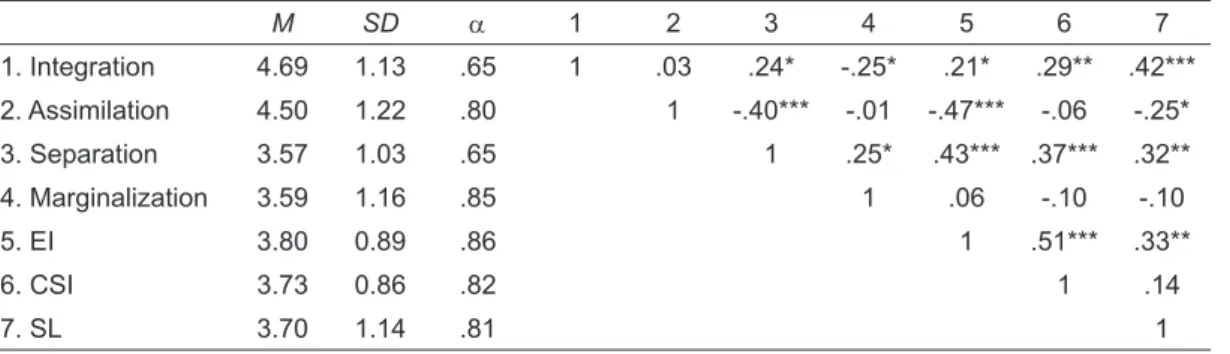
Table 2 provides the means, standard deviations, internal consistencies, and the Pearson correlation of the four Acculturation Attitudes Scale subscales (integration, assimilation, separation, and marginalization), ethnic identity, collective social identity, and satisfaction with life. Individual scale variables were combined to test for the reliability of subscales by computing Cronbach’s alpha. All the subscales recorded an alpha value of .70 or above, demonstrating good internal consistency (Lance, Butts, & Michels, 2006), except for the integration and separation subscales, which recorded an alpha value of .65 and .60, respectively.
The Pearson correlation analysis results indicate the correlations among the study variables, low r = .21 to more than moderate correlations r = .51. No evidence of multi-collinearity was found. A significant but weak negative correlation was found between integration and marginalization r = −.25, p
< .05, whereas no significant correlation was found between integration and assimilation r = .03, n.s.
Apart from these results, significant positive
Table 2
Mean, Standard Deviation, and Cronbach’s alpha, and Pearson Correlations of Acculturation Subscales, Ethnic Identity, Collective Social Identity, and Satisfaction with Life
M SD 1 2 3 4 5 6 7
1. Integration 4.69 1.13 .65 1 .03 .24* -.25* .21* .29** .42***
2. Assimilation 4.50 1.22 .80 1 -.40*** -.01 -.47*** -.06 -.25*
3. Separation 3.57 1.03 .65 1 .25* .43*** .37*** .32**
4. Marginalization 3.59 1.16 .85 1 .06 -.10 -.10
5. EI 3.80 0.89 .86 1 .51*** .33**
6. CSI 3.73 0.86 .82 1 .14
7. SL 3.70 1.14 .81 1
Note. * p<.05, ** p<.01, *** p<.001.
EI: Ethnic Identity; CSI: Collective Social Identity; SL: Satisfaction with Life
correlations were found between integration and all the rest. Separation was significantly and negatively correlated to assimilation r = −.40, p < .001, but positively to all the study variables except integration. Ethnic identity was significantly and negatively correlated to assimilation r = −.47, p <
.001, but positively to all the study variables except marginalization. Furthermore, a significant positive correlation was found between collective social identity and ethnic identity r = .51, p < .001, whereas the correlation with satisfaction with life was not significant r = .14, n.s.
Table 3 shows the results of stepwise multiple regression analysis to predict the four acculturation patterns based on collective social identity and ethnic identity. Regarding the adolescent group, a significant regression equation was found for collective social identity F(1, 43) = 21.11, p < .001;
with an R2 of .33. On the other hand, the ethnic identity equation was found to predict assimilation F(1, 43) = 27.83, p < .001; with an R2 of .40 whereas significant regression equations of collective social identity to predict separation F(1, 43) = 14.41, p <
.01; with an R2 of .25 and marginalization F(1, 43) = 8.47, p < .01; with an R2 of .17 were found.
However, neither the collective social identity nor ethnic identity was a significant predictor of integration, assimilation, and marginalization for the adult group. In adults, only a significant regression equation of ethnic identity to predict separation was found F(1, 55) = 8.17, p < .01; with an R2 of .13.
The stepwise multiple regression analysis was conducted to predict satisfaction of life scores based on collective social identity and ethnic identity. The collective social identity significantly predicted satisfaction of life scores for the adolescent group, β
= .38, t(43) = 2.68, p < .05, and explained a significant proportion of variance in satisfaction of life scores, R2 = .14, F(1, 43) = 7.17, p < .05.
Table 4 showcases the descriptive statistics and summary of the multivariate analysis of variance (MANOVA) comparing the level of ethnic identity of Myanmar adolescents and adults. The four acculturation strategies (integration, assimilation, separation, and marginalization) were subjected to MANOVA to identify the main effects of ethnic identity (low or high), collective social identity (low or high), and group (adolescent or adult) and interaction between them. When the results of
Table 3
Summary of Stepwise Multiple Regression Analysis of Four Acculturation Strategies Scores
Variables Adj. R2 B SE B β t
Adolescent
Integration .38
Collective Social Identity .87 .17 .63*** 5.28
Assimilation .31
Ethnic Identity -.70 .15 -.57*** -4.59
Separation .23
Ethnic Identity .53 .14 .50*** 3.80
Marginalization .15
Collective Social Identity -.59 .20 -.41** -2.91
Adult
Separation .11
Collective Social Identity .41 .142 .36** 2.86
Note. (+ or -) predicted direction, *** p < .001, ** p < .01.
MANOVAs revealed significant interactions, the variables were further investigated using the analysis of variance (ANOVA). The mean score of ethnic identity (M = 3.75) is used as the cutoff point to determine the high and low groups on ethnic identity measures while M = 3.80 is used as the cutoff point to determine the high and low groups on collective social identity measures.
The assumption of Box’s M test of equality of covariance matrices was not met as the significant level for the test statistics was p < .01. Nevertheless, Levene’s test of equality of error variances was not significant. The parameters of effect size for the factorial MANOVAs is decided upon Cohen’s (1988) criteria (small: 0.01–0.059; medium: 0.06–
0.13; large: > 0.14). There was a statistically significant difference in four acculturation strategies based on the ethnic identity, F(4, 95) = 5.82, p <
.001; Wilk’s Λ = 0.80, η2p = .20, group (adolescent or
adult) F(4, 95) = 15.26, p < .001; Wilk’s Λ = 0.61, η2p = .39, and their interaction F(4, 95) = 3.02, p <
.005; Wilk’s Λ = 0. 89, η2p = .11.
The ethnic identity has a statistically significant main effect on integration F(1, 98) = 9.71, p < .01;
η2p = .09, with a medium effect size and assimilation F(1, 98) = 6.56, p < .05; η2p = .06, with a medium effect size. For both integration and assimilation, there were significant interaction effects of ethnic identity and group (adolescent or adult) F(1, 98) = 4.91, p < .05; η2p = .05, with a small effect size, and F(1, 98) = 5.93, p < .05; η2p= .06, with a small effect size, respectively. Additionally, the main effect of ethnic identity can be found on separation F(1, 98) = 7.76, p < .01; η2p = .07, with a medium effect size.
The group (adolescent or adult) has a statistically significant main effect on assimilation F(1, 98) = 55.70, p < .001; η2p = .36, with a large effect size.
However, the interaction effect was not significant.
Table 4
Summary of the Test of Simple Main Effect of Adolescent and Adult Groups in the Level of Ethnic Identity Dependent Variable Ethnic
Identity
Scores Group n M SD SEM F p η2p
Integration Low Adult 17 4.49 1.35 0.26
0.09 .76 .00 Adolescent 33 4.40 0.96 0.19
High Adult 40 4.71 1.05 0.17
7.37 .008 .07
Adolescent 12 5.67 1.06 0.31
Assimilation Low Adult 17 3.79 0.94 0.21
54.26 .001 .36 Adolescent 33 5.69 0.89 0.15
High Adult 40 3.76 0.85 0.138
11.52 .001 .11 Adolescent 12 4.73 0.71 0.25
Separation Low Adult 17 3.61 1.26 0.23
5.56 .02 .05 Adolescent 33 2.95 0.78 0.16
High Adult 40 4.02 0.97 0.15
1.12 .29 .01 Adolescent 12 3.69 0.64 0.27
Marginalization Low Adult 17 3.88 1.48 0.28
0.73 .39 .00 Adolescent 33 3.59 1.16 0.20
High Adult 40 3.67 0.96 0.18
4.34 .04 .04 Adolescent 12 2.88 1.19 0.33
In addition, the group (adolescent or adult) has a statistically significant main effect on separation F(1, 98) = 5.61, p < .05; η2p = .05, with a small effect size and marginalization F(1, 98) = 4.49, p < .05; η2p
= .04), with a small effect size.
The simple main effects of ethnic identity (high and low) within each level combination of the other effects were not significant for adults; thus, only the multivariate simple main effects of ethnic identity (high and low) for adolescents are presented in Table 5.
Table 5
Summary of the Test of Simple Main Effect of Ethnic Identity in Adolescents Dependent Variable Ethnic Identity
Scores M SEM F p η2p
Integration Low 4.40
0.36 12.35 .001 .11
High 5.67
Assimilation Low 5.69
0.29 10.84 .001 .10
High 4.73
Separation Low 2.95
0.32 5.58 .02 .05
High 3.69
Marginalization Low 3.59
0.39 3.36 .07 .03
High 2.88
Note. Low group n = 33; High group n = 12
Table 6
Summary of the Test of Simple Main Effect of Adolescent and Adult Groups in the Level of Collective Social Identity
Dependent Variable
Collective Social Identity Scores
Group M SD SEM n F p η2p
Integration
Low Adult 4.54 1.31 0.25 20
0.40 .53 .00 Adolescent 4.33 1.04 0.23 24
High Adult 4.70 1.05 0.18 37
2.75 .10 .03 Adolescent 5.20 1.07 0.24 21
Assimilation
Low Adult 3.58 0.96 0.20 20
67.80 .001 .41 Adolescent 5.76 0.74 0.18 24
High Adult 3.87 0.82 0.14 37
24.74 .001 .20 Adolescent 5.06 1.02 0.19 21
Separation
Low Adult 3.44 1.18 0.21 20
3.33 .07 .03 Adolescent 2.93 0.83 0.19 24
High Adult 4.14 0.93 0.15 37
8.75 .004 .08 Adolescent 3.40 0.72 0.20 21
Marginalization
Low Adult 3.48 1.42 0.26 20
0.31 .58 .00 Adolescent 3.68 1.16 0.23 24
High Adult 3.87 0.93 0.19 37
6.23 .01 .06 Adolescent 3.09 1.19 0.25 21
Table 6 displays the descriptive statistics and summary of MANOVA comparing the level of collective social identity of Myanmar adolescents and adults. The assumption of Box’s M test of equality of covariance matrices is met as the significant level for the test statistics was p > .01.
There was a statistically significant difference in four acculturation strategies based on the collective social identity, F(4, 95) = 3.16, p < .05; Wilk’s Λ = 0.88, η2p = .12, group (adolescent or adult) F(4, 95)
= 22.62, p < .001; Wilk’s Λ = 0.51, η2p = .49, and their interaction F(4, 95) = 3.70, p < .01; Wilk’s Λ = 0. 86, η2p = .14.
The collective social identity has a statistically significant main effect on integration F(1, 98) = 5.30, p < .05; η2p = .05, with a small effect size and separation F(1, 98) = 9.60, p < .01; η2p = .09, with a medium effect size. The group (adolescent or adult) has a large statistically significant main effect on
assimilation F(1, 98) = 89.21, p < .001; η2p = .48.
The interaction effect was significant F(1, 98) = 7.73, p < .01; η2p = .07, with a medium effect size, and the group (adolescent or adult) has a medium statistically significant main effect on separation F(1, 98) = 11.13, p < .01; η2p = .10. The collective social identity and group have no significant main effect on marginalization but has a small significant interaction effect F(1, 98) = 4.34, p < .05; η2p = .04.
The summary of the test results of simple main effects carried out to explore the interaction of group (adolescent or adult) and collective social identity (high or low) found for adolescents and adults is presented in Table 7.
An analysis of variance showed that the effect of group (adolescent or adult) on life satisfaction scores was significant F(3, 98) = 6.34, p < .05; η2p = .06, with a medium effect size and the effect of ethnic identity on life satisfaction scores was
Table 7
Summary of the Test of Simple Main Effect of Collective Social Identity in Adolescent and Adult Groups Dependent
Variable Group
Collective Social Identity Scores
M SEM F p η2p
Integration
Adult Low 4.54
0.31 0.28 .60 .00
High 4.33
Adolescent Low 4.70
0.33 7.02 .009 .07
High 5.20
Assimilation
Adult Low 3.58
0.24 1.43 .23 .01
High 5.76
Adolescent Low 3.87
0.26 7.20 .009 .07
High 5.06
Separation
Adult Low 3.44
0.26 7.49 .007 .07
High 2.93
Adolescent Low 4.14
0.28 2.85 .01 .03
High 3.40
Marginalization
Adult Low 3.48
0.32 1.44 .23 .02
High 3.68
Adolescent Low 3.87
0.34 2.99 .09 .03
High 3.09
significant F(3, 98) = 6.64, p < .05; η2p = .06, with a medium effect size. The ethnic identity high group (M = 3.97, SE = .17), scored higher than ethnic identity low group (M =3.37, SE = .16) and adult group (M = 3.96, SE = .15), scored higher than adolescent group (M = 3.38, SE = .18). The interaction effect of ethnic identity (high or low) and group (adolescent or adult) was not significant. The main effect of collective social identity on satisfaction with life and the interaction effect of collective social identity (high or low) and group (adolescent or adult) were not significant either.
5. Discussion
The simple main effect of ethnic identity and collective social identity ANOVA results indicated that Myanmar adolescents had scored higher on assimilation than adults. Moreover, adolescents and adults with high ethnic identity scores had higher integration scores than those of low groups, and adolescents with high ethnic identity scores had the highest integration score. Similarly, adolescents and adults with low ethnic identity scores had lower separation scores than those of high groups, and adults with high ethnic identity scores had the highest separation score. Thus, Myanmar adolescents endorsed assimilation while both adolescents and adults with high ethnic identity scores supported integration. This finding reflects the fact that most of the adolescent participants in this study were born and raised in Japan, and their average length of residency is 13.18 years.
Accordingly, the primary hypothesis was supported by assimilation strategy, and it was also partially supported by integration and separation strategies but was not supported by marginalization. The pattern of the significant negative association between integration and marginalization was conceptually consistent with Berry’s model.
Based on the results of stepwise regression, the
role of collective social identity on Myanmar adolescents works similarly to that of ethnic identity on acculturation strategies. Another unique feature of this research is that both ethnic and collective social identities can be regarded as important variables for understanding Myanmar adolescents’
acculturative behavior. To a certain extent, the strategies of Myanmar adolescents’ acculturation process can be explained by the complex interplay between ethnic identity, collective social identity, and acculturation strategies.
The link between ethnic identity and subjective well-being was positively associated with satisfaction with their life and confirmed in this study. Therefore, the results are consistent with the theoretical conception and prior studies which have reported ethnic identity as the construct associated with subjective well-being and outcomes (e.g., Chae
& Foley, 2010; Phinney, 1989; Tsai et al., 2002;
Umaña-Taylor, 2004; Umaña-Taylor & Shin, 2007).
It is suggested that the choice of ethnic identity of adolescents is affected not only by the mainstream culture and ethnicity but also by the social context of the host society as well as their developmental experiences. Therefore, it is important to understand the context of Japan in order to interpret the current findings. In general, Japan is considered as a homogeneous society, and Japanese immigration policy aims to preserve racial homogeneity and Japanese cultural heritage (Asakura & Murata, 2006) due to the underlying concern of the Japanese public regarding the negative impact of different cultures on the homogeneous nature of Japanese society (Green & Kadoya, 2013). The Japanese public display halfhearted sentiment towards immigrants, and foreign children are expected to attend Japanese public schools where they learn Japanese culture, norms, and values to assimilate into mainstream society. Consequently, second- generation children’s acculturation is often consonant with the homogeneous Japanese discourse, even
though it is claimed that the political and educational systems have produced a homogeneous culture in Japan (Lemay, 2018). Seventy-five percent of the Japanese public believe that immigrants desire to assimilate (Stokes & Devlin, 2018). Japanese acculturation expectation towards Asian migrants has mainly been characterized by assimilation by strengthening collectivist values to conform to Japanese social norms (Inoue & Ito, 1993).
The Japanese public education system produces an environment that favors Japanese identity by formally or informally supporting children to spend more time with their peers that are Japanese in majority through extracurricular activities, sports, and social activities (Lemay, 2018), which helps migrant children to assimilate with the Japanese surroundings gradually. Moreover, as Min and Kim (2002) elucidated, Myanmar adolescents raised in Japan speak Japanese fluently, are well acclimated to their culture and traditions through its education system, and generally consider Japanese society more of a cultural home than the country of their parents. Japanese public attitudes, education system, family and peer relationships, developmental- sociocultural experiences, and the national context contribute to Myanmar adolescents’ decision to associate with the more advantageous and context-appropriate mainstream culture. Myanmar adolescents may negotiate and choose the identity that is best suited to the given social environment because they cannot adequately identify themselves with their ethnic group, as it might not be desirable or beneficial to locate themselves strictly within their ethnic group. Instead, they orient themselves toward the society they live in and become a part of the mainstream culture. As a result, it is anticipated that Myanmar adolescents will develop or choose a relevant and corresponding ethnic identity of Myanmar and have a sense of belonging to Japan and Japanese culture. By doing so, they will maintain a more flexible and diverse identity that
fits the local sociocultural context of their young adulthood. It is suggested that future studies should take a longitudinal approach to clarify the reason for the change of acculturative attitudes between early and late Myanmar adolescents.
5.1 Limitations of Research Design and Implications
First, the role of ethnic identity and collective social identity failed to fully explain Berry’s Acculturation Attitudes Scale in the adult samples.
Moreover, this study could not fully explain whether the results were due to the study’s small sample size, or sample’s specific characteristics being ethnic people from Myanmar who have specific purposes to pursue in Japan, or whether it was because the scale is not relevant to adult age group. Future research should consider comparing Myanmar adolescents to another ethnic adolescent group in Japan.
Second, this study could not obtain a gender and race balanced sample due to practical limitations in the participant gathering method; consequently, the sample’s representativeness is questionable. In the beginning, potential participants from the Myanmar community, such as cram schools for Myanmar students, Myanmar stores, and restaurants, were asked randomly to partake in an ethnic survey.
However, the attempt was unsuccessful as most people were reluctant to participate in research because the Myanmar female population in Japan is slightly larger as the male to female ratio of Myanmar people in Japan is 1: 1.14 (Japanese Government Statistics, 2019).
Nevertheless, it is crucial to document the research findings, even if the sample was less than representable with the overrepresented female, Christians, and Kachin ethnics. Because of the importance of the research purpose and the fact that it is difficult to obtain an all-inclusive sample. The means of acquiring the findings were employed by statistical
analysis. Thus, the results are significant to contribute to the research of acculturation and ethnic identity.
Despite being overrepresented with Kachin ethnics, the findings support the argument that being born in Japan and connecting with other Japan-born Myanmar are important to the cultural identity of Myanmar adolescents. Although this study’s results were acquired from Myanmar residents, similar findings may be expected if further researches are done on other Asian immigrants in Japan with similar socio- cultural characteristics. In this study, the focus was on the ethnic identity of Myanmar people but not on a specific ethnic group’s identity. Further research will be needed to focus on one ethnic group with a gender- balanced sample or a more representative sample.
5.2 Limitations of Methodology and Recommendations for Future Research In Study 1, a semi-structured interview method with questions based on different ethnic identity concepts of Phinney (1990) was applied in consideration of validity issues. Despite that, the research methodology seems to be inadequate for validation since the interviews were conducted in different languages, Burmese and Japanese, and the content validity and reliability related to the differences in languages were not investigated.
Hence, future research needs a panel of content experts to evaluate the validity, such as using the Average Congruency Percentage test (Polit & Beck, 2006).
In Study 2, since translated-questionnaire validation was not investigated, future research needs to take steps of translated-questionnaire validation, including content and construct validity. In future research, questionnaires should be examined by a panel of content experts to review each question’s relevance, for instance, using the Content Validity Index (Polit & Beck, 2006). Additionally, the researcher should evaluate whether the translated questionnaire measures a theoretical construct using factor analysis.
6. Conclusion
Both the first and second studies aimed to study the ethnic identity and related social-cultural variables to understand Myanmar residents’ acculturation patterns. The obtained empirical findings of the culture and experiences of Myanmar people may help Japanese and social workers to have a general understanding of this Myanmar diaspora and may later contribute to Myanmar people’s adapting to and living harmonically in the Japanese civil society.
Even though it takes time and requires accumulated knowledge and experiences on the part of Myanmar residents, this research might serve as a stepping- stone to contribute to the field of acculturation research in Japan.
References
Asakura, T., & Murata, A. K. (2006). Demography, immigration background, difficulties with living in Japan, and psychological distress among Japanese Brazilians in Japan. Journal of Immigrant and Minority Health, 8(4), 325-338.
Berry, J. W. (2003). Conceptual approaches to acculturation. In K. Chun, P. Balls-Organista, &
G. Marin (Eds.), Acculturation: Advances in theory, measurement and application (pp. 17- 37). Washington, DC: American Psychological Association.
Berry, J. W. (2005). Acculturation: Living successfully in two cultures. International Journal of Intercultural Relations, 29, 697-712.
Berry, J. W., Phinney, J. S., Sam, D. L., & Vedder, P. (2006).
Immigrant youth: Acculturation, identity, and adaptation. Applied Psychology an International Review, 55(3), 303-332. doi:10.1111/j.1464-0597.
2006.00256.x
Chae, M., & Foley, P. (2010). Relationship of ethnic identity, acculturation, and psychological well- being among Chinese, Japanese, and Korean Americans. Journal of Counseling & Development, 88(4), 466-476. doi:10.1002/j.1556-6678.2010.
tb00047.x
Cheek, J. M., & Briggs, S. R. (2013). Aspects of Identity Questionnaire (AIQ-IV). Measurement Instrument Database for the Social Science. Retrieved from https://www.midss.org/content/aspects-identity- questionnaire-aiq-iv