九州大学学術情報リポジトリ
Kyushu University Institutional Repository
ヒトの嗅覚表現に対する匂い刺激の複雑さの影響
濱川, 昌之
http://hdl.handle.net/2324/2198512
出版情報:Kyushu University, 2018, 博士(システム生命科学), 課程博士 バージョン:
権利関係:
1
Effects of stimulus complexity on human olfactory evaluation and description
Masayuki Hamakawa
Graduate School of Systems Life Sciences Kyushu University
2018
2
3
Preface
Olfaction is remained to be unrevealed greatly compared to vision and audition.
Although past studies have elucidated the basic structure and function of olfactory system, it is unknown in detail how the sense of smell is created from various odorant molecules and how olfaction is related with emotion, memory, and learning.
To clarify human olfactory system, past studies investigated the relationship between olfactory perception and cognitive function. Owing to the studies, it was revealed that human olfaction can be modulated by olfactory experience and learning. For example, sommeliers who have experience in special olfactory training can discriminate and verbalize a lot of odors, but naïve people cannot. On the other hand, the manner that the first order reaction of olfactory neurons influences olfactory recognition is poorly understood. Though functional groups of chemical molecules (e.g., alcohol and ester) can be an index of odorant categorization, a clear regulation between odorant molecular characteristics and the recognition is uncovered. To consider the effect of multiple processing from periphery (i.e., olfactory receptor neurons and olfactory bulb) to center (i.e., olfactory areas such as piriform cortex, amygdala, and orbitofrontal cortex) comprehensively, we investigated the effects of stimulus complexity on olfactory recognition using the complicated olfactory stimuli by conflict of dual emotional evaluations (first experiment) and mixing odorants (second experiment).
We first investigated the relationship between odor-evoked emotion and olfactory recognition. Emotion evoked by odors can be determined or modulated by several factors including odorant-receptor interactions and olfactory experiences.
Because of these factors, some odors can induce an emotional discrepancy such as a
4
conflict between innately determined and experience-based emotions. We examined whether the difference between two subjective ratings, pleasantness and liking, for an odor can be related with the olfactory recognition to explore the effect of the complicated odors evoked by the discrepancy in emotional evaluations. We conducted an olfactory experiment, in which participants were asked to note the difference between pleasantness and liking, whereby the former referred to instinctive and innate feelings and the latter to experience-based and acquired feelings. Ten odorants exhibited no significant difference between pleasantness and liking ratings. Another 11 odorants exhibited a significant relationship between the choice of olfactory perceptual descriptors (e.g., fruity and woody) and intensity; this was not true of the 10 discrepant odorants. We firstly showed that differences in pleasantness and liking ratings can be related with the selection of olfactory descriptors according to odor intensity, though the findings may be preliminary due to the number of participants and odorants.
We next examined whether the recognition of odor mixtures can be changed by structural complexity of odorant molecule. Odor mixtures can evoke smells that differ from those of their individual odor components. Two types of perceptual modes were proposed by past studies, in which a mixture can be perceived as either the original smells of its individual components (elemental) or as a novel smell (configural). We examined whether the structural complexity of an odorant molecule can affect the recognition of odor mixtures. We conducted olfactory experiments, in which different groups of participants were provided olfactory perceptual descriptions of low-, medium-, and high- complexity odor mixtures or components, respectively. Then, the participants’
evaluations were compared between mixtures and components via two types of analyses.
First, we compared each olfactory description following quantification via principal
5
component analysis. Second, we compared data based on seven major olfactory perceptual groups. The analyses suggest that odor mixtures composed of low-complexity odorants were perceived as relatively novel smells than medium- and high-complexity mixtures.
This thesis examined that complicated olfactory stimuli can affect human olfaction. The findings may help to understand how olfactory stimuli is processed from peripheral to central systems to determine the sense of a smell.
6
Table of contents
Preface ... 3
1. General introduction ... 9
1.1. Fundamental knowledge of olfactory system ... 9
1.1.1. Olfactory receptor ... 10
1.1.2. Olfactory bulb ... 11
1.1.3. Olfactory area ... 12
1.2. Olfactory psychophysical studies ... 14
1.2.1. Evaluation axis in olfactory psychophysics... 14
1.2.2. Odor profile determining olfactory recognition ... 16
1.2.3. Major olfactory perceptual group ... 17
1.3. Studies of olfactory neural activity ... 19
1.3.1. Functional magnetic resonance imaging ... 19
1.3.2. Event-related potential ... 21
1.3.3. Electro-olfactogram ... 22
1.4. Aim of the present study ... 23
2. Olfactory perceptual descriptions related with the difference between emotional evaluations ... 27
2.1. Introduction ... 27
2.2. Materials and methods ... 29
2.2.1. Participants ... 29
2.2.2. Olfactory stimuli ... 29
2.2.3. Experimental procedure ... 31
2.2.4. Data analysis ... 32
7
2.2.5. Statistics ... 33
2.3. Results ... 34
2.4. Discussion ... 40
2.5. Limitations ... 44
2.6. Conclusion ... 45
3. The olfactory recognition of an odor mixture varies depending on the molecular complexity of its components ... 46
3.1. Introduction ... 46
3.2. Materials and methods ... 48
3.2.1. Participants ... 48
3.2.2. Olfactory Stimuli ... 48
3.2.3. Experimental procedure ... 53
3.2.4. Data analysis ... 54
3.2.5. Re-analysis of data of mammal olfactory bulb ... 60
3.2.6. Statistics ... 60
3.3. Results ... 61
3.4. Discussion ... 70
3.5. Conclusion and improvement points ... 75
4. General discussion ... 77
4.1. Summary of results and discussions ... 77
4.2. General discussion ... 78
4.3. Future studies ... 82
5. Conclusions ... 84
Acknowledgement ... 86
8
Bibliography ... 88 Appendix A: The raw data of descriptors and intensity scores for the correlation and discrepant groups. ... 102 Appendix B: The raw data of the pleasant and preference score for the correlation and discrepant groups. ... 114 Appendix C: The outline of data analysis. ... 116
9
1. General introduction
Olfaction is known to be as a primitive sense and highly conserved from invertebrate to human1,2. The main role of olfaction would be to detect the beneficial or adverse resources from the volatile chemical substances, which is shown in diverse animals. For example, nematodes show attractive or aversive behavior according to odorants3,4, fruit flies explore foods with the clue of chemicals in the air5, and rodents exhibit fear behavior by substances derived from predators’ body wastes6,7. We empirically know that human also can utilize olfactory cues, such as detection of hazardous materials by smells of rotten foods. Due to the commonality of olfactory system in organisms, basic structure of the system and physiological processes were revealed by past animal and human studies.
In this chapter, I review the knowledge about olfaction. First, I introduce the basic structure of olfactory system and manner of sensing smells. Then, past olfactory studies performing psychophysical experiments and neural activity measurement are mentioned. I finally summarize the aim of the present study.
1.1. Fundamental knowledge of olfactory system
In mammal, olfactory stimuli are broadly processed in the three stages, olfactory receptors in olfactory epithelium, olfactory bulb, and olfactory areas (Fig. 1). The basic structure of the system and manner of the processing are mentioned in this section.
10
Fig. 1. Outline of olfactory system. Basic structure of olfactory system is described, where the olfactory signaling pathway from the receptor to brain is shown.
1.1.1. Olfactory receptor
The process for olfactory sensation is initiated by odorant-receptor interaction in olfactory epithelium. The olfactory receptor, expressed in olfactory receptor neuron, was found by L. Buck and R. Axel8. Mammal shares the olfactory receptor belonging to the class of G protein-coupled receptors with seven-transmembrane domain, and being specifically expressed in olfactory epithelium. It was known that the number of the expressed receptor types was dependent on the species (e.g., mice: about 1000 types, human: 300–500 types)9,10. The correspondence between the receptors and odorants is complicated. One type of receptor can be activated by several types of odorants, and one type of odorant can activate several types of olfactory receptors. Such odorant-receptor interaction resulted in that the activities of olfactory receptor neurons, induced by an odorant, were encoded as population. However, the correspondences between the
11
receptors and odorants were scarcely elucidated. The numerous chemical features of an odorant, such as types of atom components, carbon structure, electrical charge, and so on, may cause difficulty in clarifying the regularity determining the correspondence between the receptors and odorants. Furthermore, it was reported that additional factors can influence the correspondence; according to the concentration of odorants, the activated receptor was switched to another type of receptor4; chemical transformation of odorants by enzymatic metabolism in olfactory mucosa can vary the population of activated receptors11; an odorant can act as agonist or antagonist to olfactory receptors12. Because of the various factors, the comprehensive correspondence between olfactory receptors and odorants still be unknown, although huge researches such as genome analysis and coupling analysis have been conducted4,9,10,13–17.
1.1.2. Olfactory bulb
Next to the activation of olfactory receptors, olfactory bulb receives the odorant- evoked activities. In olfactory bulb, a number of glomeruli are formed, in which synaptic connections between axon of olfactory receptor neuron and dendrite of interneurons such as mitral or tufted cell are observed. The mitral and tufted cells are excitatory neurons, whereas other interneurons including periglomerular and granule cells are inhibitory neurons18,19, enabling the inhibitory modulation termed as lateral inhibition. It should be noted that only one type of olfactory receptors is expressed in an olfactory receptor neuron, and the olfactory receptor neurons with the same type of receptors are projected to the same glomeruli in mammal20. This structure resulted in that an odorant triggers the activation of the definite glomerular group, meaning that olfactory bulb shows spatial activity pattern according to odorants. Indeed, previous studies using various types of
12
odorants demonstrated that rodent olfactory bulb showed odorant-specific spatial activity pattern21–24. Representation of the spatial activity pattern may be underlain by the lateral inhibition which can help to highlight the boundary between the activated and inactivated neurons. The spatial activity pattern in olfactory bulb was important for olfactory perception. When the spatial activity patterns were overlapped by receiving some odorants simultaneously, the mice cannot discriminate the individual odors25. From these studies, olfactory bulb would represent the odorant-specific spatial neural activity to be important for olfactory recognition.
It was also reported that olfactory bulb showed plasticity. MRI studies revealed that human olfactory bulb had plastic structure where the volume of olfactory bulb related to individuals’ olfactory function. In past studies using Sniffin’ Sticks test, which enables to assess olfactory performance26,27, the score of the test was significantly correlated with the volume of olfactory bulb28,29. Although some neurodevelopmental hypotheses suggested that neurogenesis occurring at the level of olfactory epithelium, olfactory bulb, and lateral ventricle may have roles in the plasticity of olfactory bulb, the detailed mechanism remained to be unclear29.
1.1.3. Olfactory area
Several olfactory areas, including olfactory tubercle, piriform cortex, amygdala, and entorhinal cortex, are projected from olfactory bulb. Olfactory tubercle receives monosynaptic input from olfactory bulb, and has a three-layered cortex-like structure30–
32. Due to the presence of olfactory tubercle in ventral striatum, it was argued that olfactory tubercle has a role in olfactory goal-directed behavior31,33. Piriform cortex receives inputs from both olfactory bulb and other olfactory area34. In the piriform cortex,
13
olfactory information such as odor quality was categorized and represented35,36. Piriform cortex also exhibited associative and predictive activity by non-olfactory cue or just imaging a smell37,38. Amygdala has a role in emotional valence evoked by olfactory stimuli. A previous study reported the significant correlation between ensemble pattern activity in the amygdala and rating of subjective valence39. It was also reported that amygdala is involved in emotion-related learning, where amygdala neurons can encode odor cues related with positive or negative taste40,41. Entorhinal cortex receives inputs from olfactory bulb and piriform cortex, and is conceived as the nodal point between hippocampal formation and other cortical areas42,43. Although it can be hypothesized that entorhinal cortex could have a role in olfactory memory due to the connection with hippocampus, the detail functional role of entorhinal cortex still be unknown.
It was shown that these olfactory areas (olfactory tubercle, piriform cortex, amygdala, and entorhinal cortex) cooperate with higher-level regions for olfactory perception or recognition. Orbitofrontal cortex had a role in integration of sensory information and collaborated with amygdala to discriminate component smells from an odor mixture44,45. Anterior temporal lobe, which has connection with olfactory tubercle, piriform cortex, and orbitofrontal cortex, played a role in olfactory semantic- representation and verbalization45,46. Both activations of orbitofrontal cortex and piriform cortex were important for generating the predictive stimulus template with the clue of non-olfactory cue37. On the other hand, it was indicated that other sensory regions can influence the olfactory sensation. For example, olfaction can be affected by modulation from visual cortex, where stimulating the visual cortex by transcranial magnetic stimulation could improve the performance of olfactory discrimination from odor mixture47, and simultaneous reception of gustatory, olfactory and somatosensory stimuli
14
can be an integrated sense, called as flavor48,49. Recognition such as semantic or contextual concordance can also influence olfaction45,46,50. Taken together, it has been suggested that the sense of smell is generated by cooperative processing within various brain region.
Although past animal studies greatly contributed to the understanding of olfactory system, there are clear differences between human and non-human in the system.
Previous studies showed that human has reduced and shortened olfactory system compared to non-human, in terms of the number of olfactory receptors10, the volume of olfactory bub29,51,52, and connections in the central neural circuit31,34,43,53. Therefore, the human research is essential to reveal the human olfaction. In the next sections, I focus on and introduce the human research.
1.2. Olfactory psychophysical studies
Due to the technical difficulties of non-invasive recordings in human olfactory system, psychophysical approach mainly has been conducted to investigate and elucidate how human response to and evaluate smells. The analysis of the subjective ratings can provide olfactory cognitional profiles such as the primal axis of olfactory recognition and manner of semantical output of olfactory stimuli. In this section, I mention the knowledge revealed by past olfactory psychophysical studies.
1.2.1. Evaluation axis in olfactory psychophysics
To measure the sense of a smell as a score, some subjective indexes, such as pleasantness, intensity, familiarity, and edibility, have been used in olfactory psychophysical experiments. The pleasantness is a measurement for hedonic or offensive
15
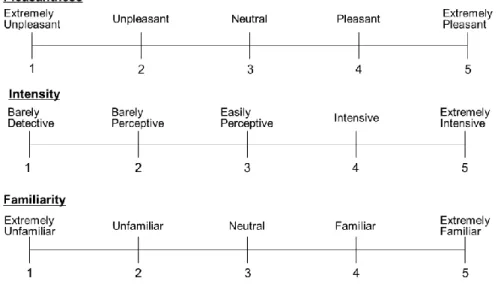
feelings. The intensity is the subjective strength of a smell. The familiarity is used to measure the extent of the memory or experience concerned with the smell. The edibility is the subjective evaluation of being fit to eat or not. Many olfactory studies used these subjective indexes41,54–58 and some studies suggested that the subjective indexes can be the primal axes for olfactory perception59,60. Examples of those olfactory evaluation axis are described in Fig. 2.
In addition to the subjective indexes, olfactory perceptual descriptors such as
“citrus” and “earthy” also have been utilized to express the perceptual profiles of a smell.
Several databases provide the various perceptual descriptors. For example, Atlas of odor character profile (Andrew Dravnieks) provides 146 olfactory descriptors and Sigma Aldrich Ingredients Catalog: Flavors & Fragrances (Sigma Aldrich) does 107 descriptors61. When participants evaluated a smell by the perceptual descriptors, they were often instructed to refer to a descriptor list, otherwise they could provide only few descriptors due to the poor ability of olfactory verbalization45,54. The limited ability of olfactory verbalization may be the reason why those subjective indexes mainly have been used in the olfactory experiments.
16
Fig. 2. Examples of subjective evaluation axis. Examples of pleasantness, intensity, and familiarity axis on 5-point-scale are described. Participants may be instructed to choose each score based on the smell they feel.
1.2.2. Odor profile determining olfactory recognition
Many researchers have aimed to elucidate the odor characteristics determining olfactory perception and recognition. It was reported that the chemical or structural feature of an odorant had a role in the olfactory recognition. Some studies indicated that amino acid sequence of the olfactory receptor binding site was important for the odorant- receptor interaction17,62, and amino acid substitution in the receptor can vary the olfactory perception and recognition63. Other studies showed that the odorant-receptor interaction was affected by molecular volume or carbon structure14,64 and the structural features such
17
as enantiomer and molecular structural complexity was involved in olfactory perception and recognition54,60,65. These studies suggested that peripheral odor coding or processing at the level of odorant-receptor interaction is important for olfactory perception and recognition.
On the other hand, it was also reported that higher-level processing, relating with experience, memory, learning, and so on, is essential for olfactory recognition. A previous report showed that odor mixture perception was modulated by pre-exposure of the components, and argued that olfactory experience can shape the olfactory recognition66. Another study exhibited that mere pre-exposure can vary the pleasant ratings in some odors67. Furthermore, several studies compared olfactory ratings between normal and expert participants, and found the effect of olfactory training or history on olfactory recognition and performance12,68–70. From these studies, olfactory perception and recognition would be determined by olfactory processing at the level of both peripheral and central systems.
1.2.3. Major olfactory perceptual group
In olfaction, the standard unit of stimuli, such as the three primary colors in vision and five basic tastes in gustation, has not been defined. The visual and gustatory sensory neurons have stimuli-type specific receptors. In vison, three types of cone cells in retina individually show light wave-specific responses. In gustation, each type of gustatory receptors in taste buds specifically respond to ligands such as glutamate, glucose, sodium, and so on. Due to the elucidated and simple correspondence between the receptor and stimuli, basic perceptual descriptors, such as “red” or “bitter”, were determined in vison and gustation. On the other hand, as described in the previous section,
18
multi-types of receptors intricately respond to various type of chemicals in olfaction. Such many-to-many correspondence may be the reason why numerous olfactory perceptual descriptors exists61 and there is a difficulty in defining the major olfactory perceptual groups.
Although past physiological studies imply the difficulty in classifying the major olfactory perceptual group, researchers have aimed to define the major perceptual group with psychophysical approach. M. Zarzo and D. T. Stanton applied principle component analysis to calculate the distances between individual olfactory perceptual descriptors using a data of 881 odor samples and 82 perceptual descriptors, and made olfactory perceptual maps71. J. B. Castro, et al. reduced the dimension of olfactory perceptual descriptors by non-negative matrix factorization, and obtained 10 dimensional representation of olfactory perceptual space72. R. Kumar, et al. found 7 major olfactory perceptual group by the modularity maximization algorithm, using a data of several hundred perceptual descriptors and several thousand odor samples61. As these past studies, efforts for defining the major perceptual group have been performed. However, decisive conclusion about the perceptual group is not made. A previous review article indicated that the perception-based classification studies were subjective to 4 factors, individual differences within participants, stimuli characteristics, the manner of data collection, and analytical method73. Indeed, olfactory perception and recognition can be affected by various individual differences such as genetic variation in olfactory receptors, learning, experience, and so on45,63,66. Furthermore, there are a number of types of odorant and perceptual descriptors61. Because of the effects of the various factors on olfactory perception and recognition, comprehensive and careful analysis might be needed to establish the major olfactory perceptual group.
19
1.3. Studies of olfactory neural activity
To reveal the manner how olfactory stimuli is processed to generate the sense of a smell, the analysis of the neural activity is needed. Previous human olfactory studies have used some techniques to record and analyze the activity of olfactory neurons or brain region. In this section, I introduce the techniques and knowledge elucidated by the techniques.
1.3.1. Functional magnetic resonance imaging
Functional magnetic imaging (fMRI) enables to visualize and analyze the brain activity with high spatial resolving power, even if the target brain area is small and placed in deep region. Based on the hemodynamic response function, the brain activity is recorded in individual tiny areas of cubic millimeters (termed as voxel) respectively. A number of the voxels forms the three dimensional data of the brain activity, resulted in the high spatial resolution.
Due to the high resolution, past studies can examine the functional profiles of the small and deep-placed olfactory areas, including piriform cortex and amygdala.
Among researchers using fMRI for human olfaction, Jay A. Gottfried’s research group has contributed to the understanding of the olfactory perception and recognition. The research group combined psychophysical techniques and fMRI, and examined the olfactory neural mechanisms by showing the relationship between the olfactory performance and brain activity. Especially, his group seemed to focused on piriform and orbitofrontal cortices to investigate how brain codes the odor quality and integrates the sensory representations45,46,74–76. To achieve it, the groups often utilized the multivariate techniques in fMRI analysis36. The multivariate techniques enabled to provide pattern-
20
based activity where the data were averaged across space (voxels), time (scans) and participants, whereas the conventional (univariate) techniques potentially included obscuring information at the level of voxels, scans, and participants. Using the multivariate techniques, the group demonstrated the odorant-specific spatial maps in posterior piriform cortex36, predictive stimulus templates triggered by non-olfactory cue in piriform cortex37, and discrimination of odor components from the mixture performed by the connectivity between orbitofrontal cortex and amygdala44. These studies can help to understand how human brain processes the olfactory information and generate the sense of a smell.
However, some limitations should be noted in fMRI analysis. First, the temporal resolution of fMRI is on the level of seconds. This temporal resolution is derived from the fact that fMRI signals are calculated by hemodynamic response function based on the oxygenic consumption in the cerebral blood flow77. The delay of seconds would be critical obstacles in the analysis of olfaction because the sense of smells can be dynamically and momentary changed by the neural adaptation and recovery from the adaptation78,79. When the olfactory brain activity is examined, it must be considered whether the delayed activity data makes a biased conclusion. Second, a positive false error can be easily made in the statistical analysis of fMRI data. When the multiple comparison correction is performed to detect the significant activity among the numerous voxels, the threshold for statistical significance should be statistically and strictly determined. Previous studies alerted the occurring of the false positives by arbitrary threshold, and demonstrated that neural activity can be detected in a dead salmon by the arbitrary threshold80,81. Although fMRI enables to examine the functional activity even in small and deep-placed olfactory areas, those limitations should be considered to avoid
21 biased results.
1.3.2. Event-related potential
Event-related potential (ERP), which can be recorded via electroencephalogram, enables to investigate cognitional functions. It is known that physiological events, such as perception and recognition, trigger the synchronized activation of a million of neurons, resulting in an electrical response in the order of microvolts on the scalp. The ERP components were characterized by the peak amplitude and latency, and the physiological means of the components were established by past visual or auditory studies. For example, the P3 wave is a positive wave component appeared approximate 300 milliseconds after an event and indicated the process of attention82. The N4 wave is a negative component appeared approximate 400 milliseconds after an event and reflected semantical concordance83.
Olfactory ERP studies have been performed mainly by Thomas Hummel’s group.
In an early study, his group showed the different ERP amplitude between normal participants and psychosis-prone subjects, in which pleasant odor (vanillin) induced significant large P1N1 amplitude in the subject group than health participant group84. After the study, the group reported a series of the olfactory ERP studies; using 95 healthy participants and two types of chemosensory stimuli (hydrogen sulfide as olfactory stimuli and carbon dioxide as trigeminal irritant), they showed that behavioral task and N1P2 amplitude exhibited age-related decrease in olfactory and trigeminal functions85; using an odorant which can be sensed as pleasant (sweet smell) or unpleasant (body odor) according to individuals, they demonstrated that the olfactory P3 component was significantly larger when the odorants sensed as unpleasant86; using different cultural
22
participant group (Algerian versus French) and smell of mint, they examined the effect of the experience in which longer P2 latency in response to smell of mint was observed in Algerian group57. From these studies, it can be suggested that subjective valences such as pleasantness and familiarity has important roles in the olfactory ERP responses. In recent studies, the group utilized the ERP as physiological index of olfaction; they investigated the interstimulus intervals whether participants can discriminate the former and later odor or they sensed the smells as one odor87; they found that the olfactory habituation induced by repeated long-term stimulation decreased the ERP amplitude88. Furthermore, the group examined olfactory memory maintenance focusing on N700 components89.
Although several olfactory ERP studies were performed as previous description, the number of the studies are much less compared to the study of other sensory modalities such as vision and audition. The reason of few olfactory ERP study may be derived from some technical problems. First, it is difficult to regulate olfactory stimuli. Unlikely to the light or sound, the quantitative regulation of the amount of chemicals in the air is technically effortful. To avoid this problem, an expensive olfactometer will be necessary.
Second, ERP might have some disadvantages to detect the electronic signals from small and deep-placed olfactory areas. Because most olfactory areas including olfactory tubercle, piriform cortex, and amygdala are relatively small and placed in deep region, ERP might be inconvenient to detect the olfactory first-order response from those areas.
Dual recordings of both ERP and fMRI might be suitable to evade the disadvantage, like as a study performed by Gottfried et al46.
1.3.3. Electro-olfactogram
Electro-olfactogram (EOG) is electric response derived from olfactory sensory
23
neurons, and can be recorded in olfactory epithelium. In the early works, animals such as frogs, rabbits, and dogs were used for the research90,91 and Ottoson firstly used the words of “electro-olfactogram”. The animal studies revealed the biophysical origin of EOG, in which a group of neighboring olfactory receptor neurons was activated by odorants resulting in a small negative voltage transient91.
In human, a few EOG studies performed91 and only Thomas Hummel’s group recently performed the study91–94. In the most recent study, his group examined the profile of olfactory epithelium responses to various odorants95. In the study, the group set an electrode into nasal cavity, and recorded the electronic responses to odorants. They found that human olfactory epithelium showed odorant-specific response according to its zone, and the zone-specific responses were significantly correlated with pleasantness ratings.
From these results, they concluded that human olfactory epithelium would reflect the axis of the olfactory pleasantness.
Although the recording of EOG by Thomas Hummel et al.95 can be a powerful method to investigate the profiles of olfactory response in human, the technical difficulty is remained. Due to the vulnerability of the recordings in nasal cavity, more than 50% of the recorded data were discarded (successful 801 trials from all 1974 trails). Furthermore, the experimenter may be required to have clinical license to put the electrode into the nasal cavity. To avoid these problems, more easy and stable manner to record EOG should be established.
1.4. Aim of the present study
To investigate the profile of human olfaction, factors determining olfactory recognition should be explored. Past human olfactory studies mainly focused on cognitive
24
factors such as experience, memory, learning, culture, and language57,68,69,96–98. The cognitive factors affecting olfactory perception would be caused by neural processing in central nervous system such as piriform cortex, amygdala, and orbitofrontal cortex45,46,50,99–101. On the other hand, recent studies suggested that peripheral neural activity and odorant-receptor interaction also can determine or modulate olfactory perception12,28,54,95,102–104, and animal studies demonstrated that neural activity in receptor neurons and topographic activity pattern of olfactory bulb are important for olfactory perception and odor discrimination12,25,105–108. The interaction or relationship between peripheral and central olfactory processing should be comprehensively investigated to elucidate the factors determining olfactory recognition, though there are technical difficulties in recording and analyzing the peripheral and central processing. To investigate the effect of the olfactory processing from periphery to center, we focused on the complexity of olfactory stimuli. Olfactory information is represented by collective neural activity in olfactory receptor neurons and olfactory bulb, and olfactory perception and recognition are made by several olfactory areas such as piriform cortex, amygdala, and orbitofrontal cortex. Due to such multiple processing of olfactory system, we hypothesized that the complexity of olfactory stimuli can influence olfactory recognition.
To test it, we examined the effect of odor-evoked emotion and odorant molecular feature.
The odor-evoked emotion can be primary axis of olfactory perception59. To investigate the emotion, various types of emotional evaluations (e.g., pleasantness and liking) have been used in past studies. Using dual emotional evaluations, we aimed to investigate whether complicated emotional states can affect olfactory recognition. Molecular features of odorants can directly determine the activity pattern of olfactory receptor neurons54. We focused on the molecular structural complexity and tested whether the molecular
25
complexity can influence odor recognition. Independent experiments of olfactory evaluation investigating the effects of both emotion and odorant feature should be important to clearly show that olfactory recognition is determined or modulated by a complexity of olfactory stimuli. Such approach of both emotion and molecular feature would be a first step to understand how the interaction between peripheral and central processing affects olfactory recognition.
First, from the aspect of emotional feelings, we aimed to examine the effect of the discrepancy of similar but different two emotional evaluations. Previous studies suggested that olfactory emotion can be determined by innate factors such as genetic encoding of olfactory receptors and odorant-receptor interaction54,63,109 and acquired factors such as experience and learning57,68,100. Because few studies assessed the odors showing the difference between the innate and acquired olfactory emotions, odors showing the difference of the emotions failed to be established scientifically. Examination of such odors exhibiting the emotional discrepancy can provide the mechanism how the innate and acquired factors interact each other to determine olfactory recognition. To investigate the relationship between the emotional states and olfactory recognition, we conducted an olfactory experiment where 12 healthy volunteers participated and 36 mono-odorants were used. In the experiment, we asked the participants to note the pleasantness as innate emotion and the liking as the acquired emotion. The participants were instructed to sniff each odor and provide 4 items for odor evaluation; the pleasantness and liking score on 5-point-scale, the olfactory perceptual descriptors (e.g.,
“citrus” and “earthy”) and the intensity score for the individual descriptors on 5-point- scale. We then performed the correlation analysis among the scores.
Second, we investigated whether the recognition of odor mixtures can be
26
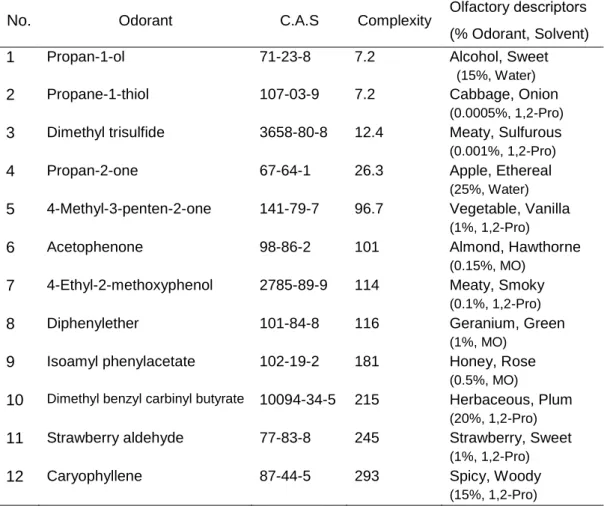
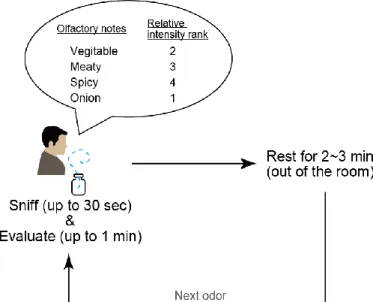
affected by the molecular complexity. The smell of an odor mixture can be changed from the original smell of the odor components according to the combination of the components12. However, the regularity how the recognition of odor mixture is determined was unknown. We thus focused on the odorant molecular structural complexity. It was reported that mono-odorants with the more value of the complexity activated the more number of the olfactory receptors, and induced more variable olfactory perceptual descriptors54. From this previous study, it can be suggested that the molecular complexity has an effect on the odorant-receptor interaction, resulting in the influence on olfactory recognition. We thus hypothesized that the molecular complexity of odor components has a role in the determination of the mixture recognition. To assess it, we prepared 12 odor components and 18 binary odor mixtures, which were divided into three groups according to their molecular complexity scores (low, medium, and high). We then conducted two types of olfactory experiment, where participants were asked to sniff the component or mixture, and evaluate the smell by selecting some olfactory perceptual descriptors from a list and ranking the intensity for the selected descriptors. The selected descriptors and intensity ranks were compared between components and mixtures to examine the difference of the olfactory recognition.
The present thesis is mainly based on the paper of Hamakawa et al. published in Flavor and Fragrance journal. My contributions are designing and conducting the experiments, interpretation of the results, data analysis, and writing the manuscript.
27
2. Olfactory perceptual descriptions related with the difference between emotional evaluations
2.1. Introduction
In the brain, subjective valence is represented according to external sensory stimuli for decision-making or appropriate behavior. Various types of sensory stimuli, such as light, sound, smell, and taste are associated with reward or punishment, and pleasantness and liking are representative examples of this emotional valence in the brain41,110,111.
Among several sensory modalities, olfactory stimuli can elicit emotions directly.
Previous studies showed that olfactory sensory signals were sent to the limbic cortex without being relayed via the thalamus41,45,105, and parts of the cortex associated with olfaction, such as the piriform cortex, were strongly connected to the limbic and paralimbic regions34,45. Indeed, pleasantness has been identified as a primal axis of olfactory perception in humans59, and a number of olfactory studies have used it as an index to evaluate positive or negative emotion evoked by smells39,44,57,59,95,101,112.
Emotions evoked by smell can be modulated or decided by various factors.
Previous studies have indicated that some smells were innately perceived as attractive or aversive. The smells from body wastes of predators were genetically coded to induce fear in prey7. Humans and mice have shown similar hedonic ratings for some odors109, indicating that olfactory hedonic ratings could be predetermined in mammals that share the same types of olfactory G protein-coupled receptors8. On the other hand, experience and learning also have been found to modify olfactory ratings or behavior. Preference for
28
an odor can be altered by reward or punishment conditioning in mice108, and humans have been shown to vary their subjective ratings of odors according to pre-exposure to those odors57,113. These previous studies indicated that olfactory ratings and behavior were affected by innate or acquired factors. However, few studies have focused on differences between the emotions evoked by instinctively and innately determined factors or experience- and learning-based factors.
In the past olfactory studies, individual hedonic dimensions for the emotions may not be defined clearly. In the studies, the ‘pleasantness’ dimension was used most frequently to evaluate the emotional valence induced by smell39,41,44,57,59,95,101,112. Some studies have used pleasantness to examine innate odor-evoked emotion54,59,60, whereas others have used pleasantness to test acquired emotion57,67,113. On the other hand, several studies used the ‘liking’ dimension to evaluate the emotional valence114–116.
In this experiment, to investigate the relationship between the emotional discrepancy and olfactory recognition, we examined whether the significant difference between dual emotional evaluations (pleasantness and liking) is related with olfactory evaluations. We conducted an olfactory experiment with 12 participants and 36 mono- odorants. In the experiment, participants were asked to simultaneously evaluate the pleasantness, liking, olfactory descriptors (e.g., woody), and intensity for an odor. We then analyzed the relationship between the concordance of the emotional evaluations and olfactory descriptors.
29
2.2. Materials and methods 2.2.1. Participants
Twelve healthy volunteers (six women and six men, mean age = 22.0, standard error of the mean = 0.71 years) participated in an olfactory experiment. All participants reported normal olfaction, and none reported a history of psychiatric disorders. All participants’ data were included in the analysis. The ethics committee for the Faculty of Arts and Science at Kyushu University approved the experimental stimuli, protocols, and procedures (201510R2). Written informed consent was obtained from all participants. All methods of this research were performed in accordance with the approved guidelines.
2.2.2. Olfactory stimuli
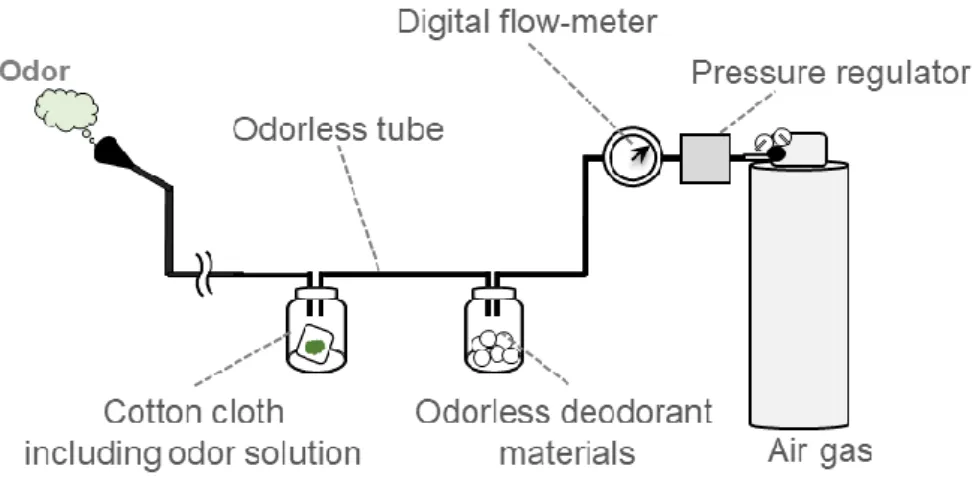
A total of 36 odorants were used in the study (Table 1). The concentration of each odorant was determined based on a previous study examining human olfactory discrimination117. Each odorant was presented to participants using a simple olfactometer constructed by the researchers, as follows. A total of 10.0 μL of each odor solution was pipetted onto a cotton cloth (2 cm x 2 cm), and the cloth was placed into a sealed 50-ml vial at room temperature (set to 25°C using an air-conditioner). The vial containing the gaseous odorant was connected to the olfactometer, which consisted of a tank of pressurized air, a pressure-regulator (GF2-2506-RX-V, Yutaka Engineering Corporation), a digital flow meter (MF-FP10NH06-050-AI-ANV, Horiba STEC Co. Ltd.), odorless deodorant material (Muko-Kukan Nioi-Gui, Kobayashi Pharmaceutical Co. Ltd.), and an odorless tube (Fig. 3). Each odorant was presented to participants at a pressure of 2.0 L/min. The value of airflow pressure was decided by previous studies36,39.
30 Table 1. List of 36 odorants used in this study.
Odorant C.A.S. % odorant Solvent
(-)-α-Pinene 7785-26-4 15 Mineral oil
1,8-Cineol 470-82-6 2 Mineral oil
1-Octen-3-ol 3391-86-4 0.04 Mineral oil
2,4-Trans-trans-decadienal 25152-84-5 0.5 Mineral oil
2-Ethylpyrazine 13925-00-
3
0.4 Mineral oil
4-Nonanolide 104-61-0 0.5 Mineral oil
Acetophenone 98-86-2 0.15 Mineral oil
Benzaldehyde 100-52-7 0.25 Mineral oil
Decanal 112-31-2 1 Mineral oil
Diphenylether 101-84-8 1 Mineral oil
Ethyl propionate 105-37-3 0.25 Mineral oil
Heptanal 111-71-7 0.04 Mineral oil
Hydroxy citronellal 107-75-5 50 Mineral oil
Isoamyl acetate 123-92-2 0.1 Mineral oil
Isoamyl phenylacetate 102-19-2 0.5 Mineral oil
Isophorone 78-59-1 3 Mineral oil
Isovaleric acid 503-74-2 0.01 Mineral oil
Limonene 5989-27-5 5 Mineral oil
γ-Undecalactone 104-67-6 10 Mineral oil
2,3-Dimethylpyrazine 5910-89-4 0.2 1,2-Propanediol 4-Ethyl-2-methoxyphenol 2785-89-9 0.1 1,2-Propanediol 4-Methyl-3-penten-2-one 141-79-7 1 1,2-Propanediol
Butyl acetate 123-86-4 1 1,2-Propanediol
Caryophyllene 87-44-5 15 1,2-Propanediol
Dimethyl benzyl carbinyl butyrate 10094-34-5 20 1,2-Propanediol Dimethyl trisulfide 3658-80-8 0.001 1,2-Propanediol
Ethyl acetate 141-78-6 0.5 1,2-Propanediol
Indole 120-72-9 0.5 1,2-Propanediol
Methyl heptanoate 106-73-0 10 1,2-Propanediol
Pentyl butyrate 540-18-1 1 1,2-Propanediol
Propane-1-thiol 107-03-9 0.0005 1,2-Propanediol
Strawberry aldehyde 77-83-8 1 1,2-Propanediol
Acetone 67-64-1 25 Water
Butanoic acid 107-92-6 1 Water
Propan-1-ol 71-23-8 15 Water
Trimethyl amine 75-50-3 0.025 Water
C.A.S. is Chemical Abstracts Service Number.
31
Fig. 3. The olfactometer constructed by the researchers. The olfactometer was used to present the odors (2.0 L/min).
2.2.3. Experimental procedure
The experiment was conducted in a well-ventilated room. The order in which the 36 odorants were presented was randomized (via computer-generated randomization) for each participant. During the evaluation of each odorant, participants were instructed to hold the tube 1 cm beneath one nostril, sniff the content, and evaluate the odor’s smell and pleasantness and indicate their liking for the odor. Participants evaluated odor pleasantness and liking using five-point scales (1 = very unpleasant/disliked, 2 = unpleasant/disliked, 3 = neutral, 4 = pleasant/liked, 5 = very pleasant/liked). Participants were also asked to note differences between pleasantness and liking, with pleasantness defined as an instinctive and innate emotion, and liking defined as emotion resulting from individual experiences or circumstances (e.g., the smell of a cigarette could be unpleasant
32
and liked, because it could be perceived as offensive and noxious but most smokers would like the smell). Participants then selected olfactory descriptor(s), such as “citrus” and
“minty,” from a list and evaluate their intensity. The list was generated based on the Atlas of Odor Character Profiles (Andre Dravnieks) and included 146 olfactory descriptors.
Participants evaluated the intensity of the descriptors using a five-point scale (1 = very weak, 2 = weak, 3 = easily detectable, 4 = strong, 5 = very strong) for each olfactory descriptor selected.
Participants were allowed 15 s to sniff each odorant, and 1 min to complete the sniffing/evaluation process. After each evaluation, participants rested outside the experimental room for 2 min to eliminate the effects of residual odors. In total, the experiment lasted approximately 2 h per participant.
2.2.4. Data analysis
We analyzed the correlation between olfactory pleasantness and liking for the 36 odorants using Spearman’s rank correlation coefficients (rho) and calculated p values for each odorant using JMP 12 (SAS Institute Inc., NC, USA). The rho and p values were calculated for 12 pairs (i.e., the number of participants) of pleasantness and liking scores.
We identified 10 odorants for which pleasantness was not significantly correlated with liking. We assigned the odors showing no significant difference between the emotional evaluations to the discrepant group (Table 2, D1–D10, p > 0.05). Subsequently, the hierarchical cluster analysis using Ward method was performed using JMP 12 (SAS Institute Inc., NC, USA).
We then examined the characteristics of olfactory recognition in the discrepant and correlation groups. We performed Spearman’s rank correlation analysis to examine the
33
relationships between the numbers and intensity of the olfactory descriptors selected using JMP 12 (SAS Institute Inc., NC, USA).
To examine the reproducibility of the selected olfactory descriptors among participants, we regarded descriptors chosen by only one participant as temporally and transiently selected (defined as transient descriptors, which are the non-colored descriptors in Appendix A). The proportion of transient descriptors (TDIntensity,Odor) was calculated within each intensity score (Intensity: from 1 to 5), for each odorant (Odor: an odorant classified into discrepant or correlation group) as follows:
TDIntensity,Odor = (number of descriptors selected by only one participant for Odor) / (number of descriptors scored as Intensity for Odor).
The score of TD can range from 0 (all descriptors were selected by more than two participants) to 1 (all descriptors were selected by only one participant). For example, in Appendix A, the 6 perceptual descriptors scored as 1 in terms of intensity for acetophenone were “chemical,” “perfumery,” “peach (fruit),” “varnish,” “kerosene,” and
“hay.” Of the 6 perceptual descriptors, the 3 descriptors “peach (fruit),” “kerosene,” and
“hay” were provided by only one participant for the acetophenone, so TD1,Acetophenone was calculated as 3/6 = 0.5.
2.2.5. Statistics
Because the experimental data were not normally distributed, we used nonparametric tests in the statistical analyses. The Wilcoxon signed-rank test (α = .05) was performed to compare the correlation and discrepant groups using JMP 12 (SAS Institute Inc., NC, USA).
34
2.3. Results
We examined whether the discrepancy between the pleasantness and liking influences the olfactory recognition. Here, the pleasantness was defined as instinctive and innate feelings and the liking was done as individual experience-based ones. Using 36 odorants for olfactory stimuli (Table 1), we performed an experiment in which 12 volunteers participated. Each odorant was presented by a simple self-made olfactometer (Fig. 3). Participants were asked to score the pleasantness (from 1: unpleasant to 5:
pleasant) and liking (from 1: disliked to 5: liked) for each odorant, and selected olfactory descriptor(s) from a list generated based on the Atlas of odor character profiles (Andre Dravnieks). They were also asked to evaluate the intensity for each olfactory descriptor they selected (from 1: weak to 5: strong).
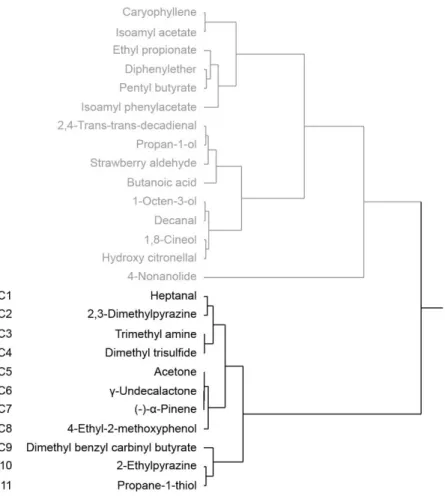
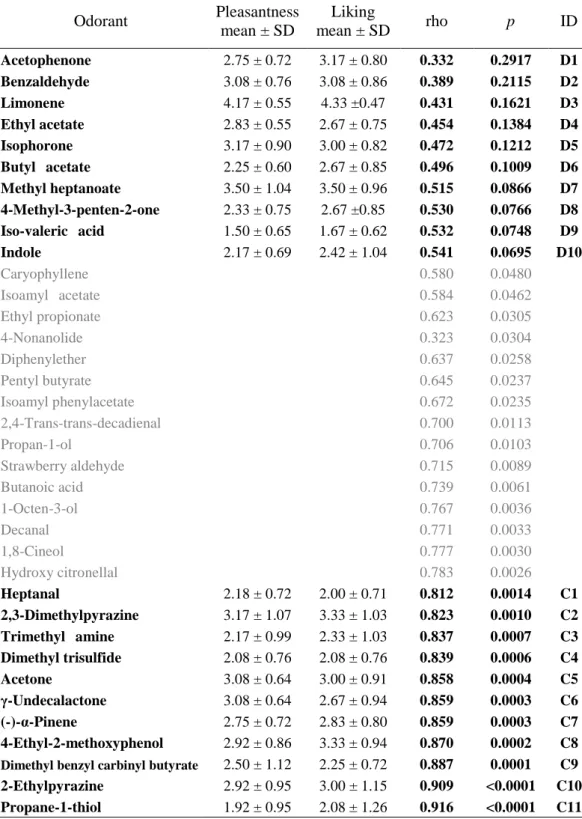
To examine the relationship between pleasantness and liking scores in each odor, we conducted Spearman’s rank correlation analysis using the score of the pleasantness and liking. We obtained 10 odorants showing no significance in the correlation between the pleasantness and liking. The 10 odorants were classified into discrepant group (discrepant group; Table 2, D1–D10, p > 0.05). We then performed a cluster analysis among the other 26 odorants and classified 11 odorants for which the correlation was positive and highly significant into the correlation group (Fig. 4, Table 2, C1–C11).
35
Fig. 4. The Cluster analysis for classification of the correlation group. Among the 26 odorants (except for discrepant group odorants) showing the significance between pleasantness and liking scores, the 11 odorants (C1–C11) was assigned to the correlation group.
36
Table 2. Correlations between pleasantness and liking for the 36 odorants
Odorant Pleasantness
mean ± SD
Liking
mean ± SD rho p ID
Acetophenone 2.75 ± 0.72 3.17 ± 0.80 0.332 0.2917 D1 Benzaldehyde 3.08 ± 0.76 3.08 ± 0.86 0.389 0.2115 D2
Limonene 4.17 ± 0.55 4.33 ±0.47 0.431 0.1621 D3
Ethyl acetate 2.83 ± 0.55 2.67 ± 0.75 0.454 0.1384 D4
Isophorone 3.17 ± 0.90 3.00 ± 0.82 0.472 0.1212 D5
Butyl acetate 2.25 ± 0.60 2.67 ± 0.85 0.496 0.1009 D6 Methyl heptanoate 3.50 ± 1.04 3.50 ± 0.96 0.515 0.0866 D7 4-Methyl-3-penten-2-one 2.33 ± 0.75 2.67 ±0.85 0.530 0.0766 D8 Iso-valeric acid 1.50 ± 0.65 1.67 ± 0.62 0.532 0.0748 D9
Indole 2.17 ± 0.69 2.42 ± 1.04 0.541 0.0695 D10
Caryophyllene 0.580 0.0480
Isoamyl acetate 0.584 0.0462
Ethyl propionate 0.623 0.0305
4-Nonanolide 0.323 0.0304
Diphenylether 0.637 0.0258
Pentyl butyrate 0.645 0.0237
Isoamyl phenylacetate 0.672 0.0235
2,4-Trans-trans-decadienal 0.700 0.0113
Propan-1-ol 0.706 0.0103
Strawberry aldehyde 0.715 0.0089
Butanoic acid 0.739 0.0061
1-Octen-3-ol 0.767 0.0036
Decanal 0.771 0.0033
1,8-Cineol 0.777 0.0030
Hydroxy citronellal 0.783 0.0026
Heptanal 2.18 ± 0.72 2.00 ± 0.71 0.812 0.0014 C1
2,3-Dimethylpyrazine 3.17 ± 1.07 3.33 ± 1.03 0.823 0.0010 C2 Trimethyl amine 2.17 ± 0.99 2.33 ± 1.03 0.837 0.0007 C3 Dimethyl trisulfide 2.08 ± 0.76 2.08 ± 0.76 0.839 0.0006 C4
Acetone 3.08 ± 0.64 3.00 ± 0.91 0.858 0.0004 C5
γ-Undecalactone 3.08 ± 0.64 2.67 ± 0.94 0.859 0.0003 C6 (-)-α-Pinene 2.75 ± 0.72 2.83 ± 0.80 0.859 0.0003 C7 4-Ethyl-2-methoxyphenol 2.92 ± 0.86 3.33 ± 0.94 0.870 0.0002 C8 Dimethyl benzyl carbinyl butyrate 2.50 ± 1.12 2.25 ± 0.72 0.887 0.0001 C9 2-Ethylpyrazine 2.92 ± 0.95 3.00 ± 1.15 0.909 <0.0001 C10 Propane-1-thiol 1.92 ± 0.95 2.08 ± 1.26 0.916 <0.0001 C11
We performed Spearman’s rank correlation analysis to determine the discrepant (upper bold odorants) and correlation (bottom bold odorants) groups.
37
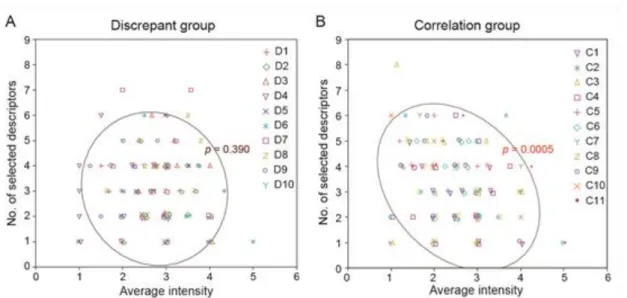
We next investigated the characteristics of olfactory recognition in the discrepant and correlation groups respectively. Previous studies suggested that the sense of smells such as odor qualities (e.g., “citrus”, “woody”, and so on) can be varied according to the intensity12,118. We therefore performed Spearman’s rank correlation analysis on the relationship between the intensity and olfactory descriptors. The results of the correlation analysis of the relationship between the number and intensity of olfactory descriptors showed that the number of olfactory descriptors selected was not significantly correlated with the mean intensity score in the discrepant group (Spearman’s rank correlation analysis, rho = −0.08, p = 0.39, Fig. 5A). In contrast, the number of descriptors selected was significantly correlated with the mean intensity score in the correlation group (Spearman’s rank correlation analysis, rho = −0.29, p = 0.002, Fig. 5B). The raw data for the selected descriptors and intensity scores are shown in Appendix A and pleasantness and liking scores in Appendix B.
38
Fig. 5. The effect of the difference between pleasantness and liking on the choice of olfactory descriptors according to intensity. Spearman’s rank correlation analysis revealed that the number of olfactory descriptors selected was not correlated with mean intensity scores in the discrepant group (A) but was significantly correlated with mean intensity scores in the correlation group (B). C1–C11 and D1–D10 represent the odorants in each group.
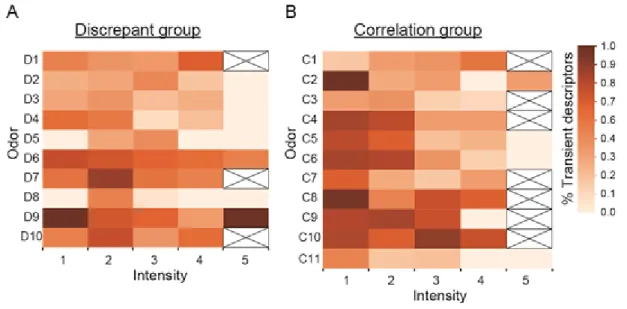
Based on the relationship between the number of descriptors and average intensity in the discrepant and correlation groups (Fig. 5), we then hypothesized that the choice of olfactory descriptors by participants was almost random, regardless to intensity, in discrepant groups, whereas the choice of descriptors was converged to a few descriptors when the participants sensed the smell strongly and clearly in the correlation group. To test the hypothesis, we focused on the reproducibility of the selected olfactory descriptors between participants. We regarded descriptors chosen by only one participant as temporally and transiently selected ones (defined as transient descriptors), and examined
39
Fig. 6. Distribution of the ratio of transient descriptors within each intensity score for each odor. In the discrepant group (A), there was no trend in the distribution of intensity and the ratio of transient descriptors. In the correlation group (B), most odors showed high ratios for low-intensity scores and low ratios for high-intensity scores. C1–C11 and D1–D10 indicate the odorants in each group. The crosses in the white cells indicate that no participants rated the intensity of the odor; “% Transient descriptors” represents the ratio of transient descriptors within the intensity score for each odor.
the ratio of the transient descriptors in each intensity score of each odorant (see 2.2.4.
Data analysis for detail). The results of the comparison of the reproducibility of the selected olfactory descriptors between groups showed that the discrepant group seemed to show no trend, and descriptor intensity was not associated with the ratio of transient descriptors (Fig. 6A). In addition, high and low ratios of transient descriptors were observed for odors with low and high intensity scores, respectively, in the correlation group (Fig. 6B).
40
2.4. Discussion
In this section, we discuss whether no significant difference between pleasantness and liking was related with olfactory recognition. We analyzed the correlation between odor pleasantness and liking to determine two groups, a discrepant group, which showed no significant correlations between these factors, and a correlation group, which showed significant correlations between these factors. The number of olfactory descriptors selected was not significantly correlated with mean intensity scores in the discrepant group, but it was significantly negatively correlated with mean intensity scores in the correlation group. In addition, reproducibility of the choice of olfactory descriptors according to intensity differed between the discrepant and correlation groups. Therefore, the findings suggested that the discrepancy between pleasantness and liking had relation with the choice of olfactory perceptual descriptors according to intensity.
We identified odorants that induced no significant difference between emotional evaluations, pleasantness and liking; however, the factors that caused this no significant difference remain unknown. We cannot exclude a possibility that ambiguity of smells may cause the no significant difference between pleasantness and liking because there seemed to be no clear differences between average scores of the evaluations (Table 2). Although we aimed to strictly control the intensity of the 36 odors by using the conditions based on a previous study and equivalent air-pressure from the self-made olfactometer, each intensity of the odors might not be uniform between participants. Preliminary test could be needed to survey the odor intensity and manner of odor presentation to regulate the ambiguity of smells. Otherwise, we can propose another possibility that chemical features of the odorants may induce the odors of the discrepant groups. For example, four types
41
of odorants, isovaleric acid, indole, trimethylamine, and propane-1-thiol, could reflect the effects of these factors on olfactory emotion. In general, the smells of these four odorants were malodorous, and the participants in the experiment evaluated as them as unpleasant (Appendix B). However, these odorants were grouped differently, as the former two odorants were in the discrepant group, and the latter two odorants were in the correlation group. The reason for the difference in grouping could have depended on the potential for conversion from malodorous to pleasant smells. The smell of isovaleric acid can become fruity via esterification, and the smell of indole can be perceived as floral in very low concentrations. In addition, this finding could have occurred because these two types of odorant can be bound to classes of olfactory receptors that signal pleasantness or unpleasantness. Furthermore, isovaleric acid could evoke fermentation odors, such as that of cheese, based on the Sigma Aldrich Ingredients Catalog: Flavors & Fragrances (http://www.sigmaaldrich.com)
and The Good Scents (http://www.thegoodscentscompany.com/), and emotional evaluation of isovaleric acid could depend on individual participants’ diet histories. A large and comprehensive survey, including genetic variation in olfactory receptors, individual olfactory history, and the chemical properties of odorants, is required to elucidate the odorant-receptor interaction and experience factors involved in emotional discrepancy. Although our findings identified odors that could evoke emotional gaps, further research is required to examine the factors that cause these gaps.
The results for the correlation group could have occurred because of limited ability in olfactory verbalization. Previous studies reported that it was more difficult to verbalize olfactory stimuli, relative to other sensory modalities such as vision45. In the visual system, the occipital, parietal, temporal, and frontal cortices are strongly and