Miscommunication factors in Japanese‑US trade relationship
著者(英) Naoki Kameda
journal or
publication title
Doshisha University world wide business review
volume 5
number 2
page range 11‑26
year 2004‑02‑16
権利(英) Research Center for World Wide Business, Doshisha University
URL http://doi.org/10.14988/re.2017.0000015874
Miscommunication Factors in Japanese-US Trade Relationship
Naoki Kameda
Professor
(
Doshisha UniversityFaculty of Commerce)
Introduction
The US has been Japan’s best customer taking nearly 30% of its whole exports totaling ¥14.86 trillion last year (28.5%). The US also has been the largest supplier to Japan for many years, although China surpassed the US in 2002 (¥7.73 trillion : ¥7.22 trillion or 18.3% : 17.1
1
%). Nevertheless, Ja- pan and the US have the largest trade interaction ever seen across an ocean. In other words, the US usually has been the largest trade partner of Japan, and Japan has been the largest trade partner of the US outside of Canada and Mexico.
In the postwar era it was often said that, “If New York sneezes, Tokyo will soon catch a cold.”
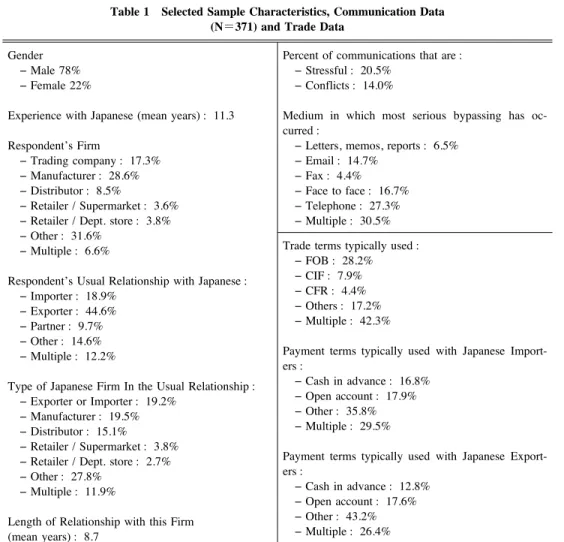
It seems it still holds true as far as the statistics are concerned. But we have seen one big change in the US-Japan trade relationship during recent decades. The players of the international trading “ball game” have changed, as can be seen in Table 1 where many new types of firms have appeared.
For quite a long time, say for about 30 to 40 years in the postwar period, the major players in Japan’s international trade were trading firms represented by so calledJudai Shosha, the big ten inte- grated trading firms, and their affiliates. They exported to and imported from overseas around 60 to 70%, or at a time even over 80%, of the products from airplanes to sausages. However, the domi- nance of Judai Shosha changed in 1988, when manufacturers’ direct export first exceeded that of trading companies. Ever since, manufacturers and even retailers have played the leading role in Ja- pan’s international trade.
What does this change mean? It means that the interface between sellers and buyers, suppliers and customers, and so on, has become more widely enlarged than ever before, and that the direct con- tacts between Japanese business people and foreigners have increased to a level never experienced be- fore. This also means international trade and contact with foreign counterparts is not done just by the professional international traders working for the Japanese trading companies, but increasingly by amateur traders having less empirical knowledge or language required for trade practices. Under such
circumstances, misunderstanding or bypassing miscommunication are apt to take place between these groups of amateurs trade across the Pacific Ocean.
I would like to discuss the problem of bypassing : what it is, why it exists, how it can be solved, and so on, in this paper with a hope that this study will contribute to the betterment of these two countries’ trade relationship. The topics I will discuss are : (1) Definition of bypassing, exam- ples, and possible consequences, (2) Japanese-US trade bypassing ; culture, language, customs and practices, (3) Research on problems in communication between Japanese and American managers, (4) Results from content analysis of the research, and (5) Ways and suggestions to reduce or avoid by- passing.
Definition of bypassing, examples, possible consequences
What is bypassing? Bypassing is the name for the miscommunication pattern that occurs when the sender (speaker, writer, and so on) and the receiver (listener, reader, and so forth)miss each other with their meanin
2
gs. Here are some of actual samples I have collected from American managers dur- ing our recent research.
Cultural bypassing :
1. When asking a question and the Japanese agree or nod in an agreeable fashion, and then I found out that they didn’t fully understand but were being polite.
2. “We will study the proposal.” I thought the proposal was still under review, when in fact the proposal was shelved or rejected. It actually meant “No!”
3. Soon or possible often means “no.”
4. Frequent use of the expression “we will take that into consideration” by Japanese managers.
Americans think “great”, but Japanese mean “Sorry, but we have no interest.”
5. Japanese people tend to avoid making negative statements. They will say “I will consider”
which actually means “No way!” Americans need to guess what they mean by it.
Translation problems :
1. The meaning of “yes” in answer to specific questions−often meant “no” or “maybe” or “I don’t know” or “I want to think about it.”
2. In English, “maybe” means yes (positive). In Japanese, “maybe” means no (negative). So when Japanese say “maybe” it means they really want to say no, but not so bluntly.
3. An understanding of Japanese use of English language is really helpful, such as when a Japa-
nese businessman says something is “very difficult.” What he means is there is no chance, whereas an American assumes there is room to negotiate.
4. I made an appointment with a representative of Softbank, Tokyo. He asked me to meet at
“fronto-no tokoro.” I assumed that it meant in front of the hotel. But it actually referred to the front-desk.
5. I used the phrase “I suspect what Mr. K means is. . . .” Later it became clear that my Japa- nese subordinate interpreted this to mean I was “suspicious” of Mr. K, whereas I only meant
“I think.” Clarifying my intended meaning immediately reduced tension that had been build- ing.
As can be seen from the above, and, the words in these examples do not mean the same to the two parties. Later, I will introduce the result of our extensive study on this bypassing question. The purpose of the study is to understand whether or not this bypassing between Japanese and American managers occurs frequently and, when it does occur, if it is seriously hampering their business activi- ties. But, before that, let us see some more interesting examples as follows :
Time bypassing :
1. Term : soon−to my customer means I will respond within a day or two. His response to soon may mean several days or a week.
2. The distributor demanded that my office send him a piece of information and I replied with a
“soon.” I was bombarded with telephone calls from Japan for sending the info three hours later.
The word “soon” seems to cause a lot of problems or misunderstanding between the two coun- tries’ managers. Why does this happen? It’s simple. “Words do not mean anything, but people mean.
Meanings are in people, but not in words themselves,” as general semanticists such as S. I. Hayakawa claim.
Once an American colleague asked each of the managers in a local public accounting firm in Se- attle to tell him the maximum amount of time he or she attaches to each of several words. Responses are listed in the following tab
3
le.
Notice that “soon” means anywhere from ‘24 hours’ to ‘one year’ in this firm, with ‘one week’
as the most frequent response. When the ‘24 hours’ boss tells the ‘one week’ subordinate to get pro- ject X finished ‘soon,’ the subordinate will salute and finish it up by the end of that week.
Potential problems can be avoided if both parties are less casual about their interaction and rec- ognize that most adjectives and adverbs are quite vague. Just because words are short and frequently used does not mean that a communication using the words is going to be easy. Imagine the interac- tions that occur when the seven managers who define soon as anytime up to a year sit down with the managers who see it as within 24 hours.
We should remember the same word may mean different things to people from other countries or cultural spheres. Some words may have different meanings in other languages. For example, as often said, “The English word ‘problem’ has a negative connotation that is not present in mondai, which means simply, ‘something that will need further study.’ Before registering a negative emotional reaction to words and phrases, Westerners should consult their interpreter for help in understanding the words’ connotatio
4
ns.”
Here is another good example of the fact that meanings are in people, but not in words them- selves. “The 500 most commonly used words in the English language have 14,070 dictionary mean- ings. That’s an average of more than 28 meanings per word. Thewordset for example, has 194 dif- ferent meanings. Words themselves don’t contain the meaning−people supply the meanings depending on past experienc
5
es.”
Japanese-US bypassing ; culture, language, customs and practices
As we have observed in the above translation problems, the word ‘difficult’ still causes a lot of misunderstanding. This word or term has been labeled as one of the most notorious culprits during the past half century of trans-Pacific ocean communication. I was fascinated to find that exactly the same statements were given in response to my questionnaires as those I encountered many years ago in a book, which goes as follows :
Immediately Soon
Right now One hour Two-six hours End of day Twenty-four hours 1.5−3 days End of week One week Two-three weeks One month Two-six months One year
3 7 4 16 3 2 2 4
2 3 10 4 4 5 7
“If one American executive responds to another American’s proposal by saying, ‘That’s diffi- cult,’ the response, interpreted against American culture and business practice, probably means that the door is still open for further discussion, that perhaps the other side should sweeten its offer. In any event, the fact that the proposal is ‘difficult’ is not taken to mean that it is impossible. Coming from a ‘can-do’ culture, the American presses the proposal, perhaps changing it somewhat in hopes of gaining acceptance. In some other cultures, particularly those in Asia, persons are reluctant to say a direct and emphatic no, even when they mean it. So, when a Japanese negotiator, in response to a proposal, says, ‘That’s difficult,’ he is clearly indicating that the proposal is unacceptable. ‘It is diffi- cult’ means ‘no’ to the Japanese, but to the American it means ‘maybe.’ American persistence in pressing a proposal in this situation would be viewed by the Japanese as overly aggressive and even hostile behavi
6
or.”
Why does this type of bypassing occur? I think it partly stems from the peculiar Japanese style of communication. Jack Seward, a prominent Japanologist, once remarked, “The thought process of the Japanese, and therefore the structures of their language, are radically different from those of the West, where pride is taken in clarity, directness, eloquence, and what is called ‘honesty,’ whereas the Japanese value vagueness and avoid statements that are too direct, clear, and unequivocal. They are fond of incomplete sentences and often end even simple declarative sentences with the word ‘but,’
thereby suggesting that other reasonable points of view are possible and avoiding the arrogance of in- sisting on their own. They prefer suggestion to statement, implication to specification. To Westerners words are thetool of communication ; to the Japanese they area tool.
“In fact, Japanese society is characterized by its noticeable lack of emphasis on language as a means of communication. Verbalization is held in low esteem, and it is considered poor policy to use words to persuade. Language is a ritual not necessarily to be taken at face value. The homogeneous Japanese people, from centuries of living in close quarters and sharing the same life-styles, have de- veloped a degree of intuitive feeling for each other that renders much talk superfluo
7
us.”
Rochelle Kopp, a well known cultural counselor in America, managing principal of Japan Inter- cultural Consulting, replied to a question as follows during The Nikkei Weekly’s interview as to what the main source of non-Japanese managers’ frustrations is when working with Japanese : “They often get frustrated at the amount of time it takes to get things done, with the seeming lack of urgency.
They’re looking for quicker decision-making, more decisiveness.” She further commented on the dif- ferences in communication style between the U.S. and Japan as follows : “In some cases, Americans start to wonder if their Japanese colleagues are being secretive. . . .Due to their struggles using the English language, Japanese often get exhausted trying to express themselves, and give up before they have communicated all the necessary information. Another key factor creating the impression of se-
crecy is the “hear one, understand ten” (tacit) communication style that Japanese have. To non- Japanese who are used to having everything on a silver platter, this communication style can easily be misinterpreted as withholding informati
8
on.”
Interestingly again, these comments of hers are clearly reflected in the actual answers from the American managers in the questionnaires. See the following major negative characteristic of Japanese managers in the following content analysis. The second and the third places therein clearly indicate the Kopp’s remarks are on the mark.
Major negative characteristic of the Japanese managers (N=61)
1. Stubborn, not flexible, very assertive, demanding, etc. 21.31%
2. Takes very long to make a decision, hate changes, etc. 19.67%
3. Lack of information disclosure, don’t tell us what the problems are, etc. 11.48%
4. Communication, language, feel inferior due to speech, etc. 9.84%
5. Not straightforward enough, try to be too nice, etc. 8.20%
As to tacit communication style that Japanese have, here is an interesting comment on Japanese communication style given by a local Japanese manager stationed somewhere in the United States of America. “The Japanese probably never will become gabby. We’re a homogeneous people and don’t have to speak as much as you do here. When we say one word, we understand 10, but here you have to say 10 to understand o
9
ne.”
We can further say that Japanese are inclined to skip over the minor premise in a syllogism with a belief that their counterpart in the dialogue must be familiar with that part. This is likely due to a communication style that developed in a homogeneous culture in which it is reasonable to assume that you share a large amount of common knowledge with your counterpart. Here are typical exam- ples of Japanese business English sentences that many Japanese managers are apt to wri
10
te :
!Because of the law in Korea against exporting white granite, I will go to Australia.
!Our office has moved to Kawasaki. I’m going to buy a Honda.
It’s funny, but Japanese people can easily bridge the gap between major premise and conclusion.
Or, you might say, they have a special and mysterious talent to figure out the unsaid part or ‘warrant’
when only the ‘claim’ and ‘data’ are given in the triangle logic, and connect these claim and data.
However, they will have to give the minor premise or the warrant to have their American coun- terparts understand what you want to say as follows :
!Because of the law in Korea against exporting white granite, I will have to check other suppliers.
I have heard that Australia has an abundant source and, therefore, will go there.
!Our office has moved to Kawasaki. It’s too far from the station to walk, so I’ll have to buy a car. I’m thinking of getting a Honda.
Research on problems in communication between Japanese and American managers
Research Design
Sample
During 2001 and 2002, native English-speaking American managers doing business with Japa- nese managers were contacted by telephone, email, and face to face visit by the students of my American colleague. They were asked to fill out an 8-page survey developed by the author. Most re- spondents (N=371) were from Washington State and the US West Coast, and most were male (see Table 1). The sample appears to represent the wide range of US businesses doing business with Japan and the equally broad range of Japanese firms with which business is done. Most of the respondents had had extensive experience doing business with Japanese firms. To check for longitudinal consis- tency in the sample and reliability of results, we compared responses collected in 2001 to those col- lected in 2002. No differences were found.
Measures
Our dependent measures were two Likert-type 5-point scales measuring the frequency of bypass- ing encounters and the seriousness of the problems generally evoked by the bypassing. As a check of the face validity of our frequency measure, we added a third measure of the frequency of serious en- counters with communication problems due to the misinterpretation of words like “soon,” “likely,”
“possible,” and “immediately.” This measure was strongly and significantly correlated with our de- pendent measures. We fostered face validity by defining bypassing for respondents and giving them a non-business example on the survey just prior to asking them for their responses on the dependent and validity check measures.
Our independent measures (in addition to those listed in Table 1) covered a range of factors likely to be associated with bypassing.
Japanese Use of English (10 items). On 5-point disagree-agree scales we asked respondents to characterize Japanese managers in terms of :
!Command of English
!Practice of separating facts from opinions
!Avoidance of difficult words
!Use of clarity
!Avoidance of jargons
!Tendency to state reasons for a decision before the decision
!Avoidance of long sentences
!Avoidance of assertive tone
!Avoidance of passive voice
!Helpful use of non-verbal communication
Respondent’s Communication Style (3 items). On disagree-agree scales we asked respondents to react to statements affirming the use of communication in business that : hurts the feelings of others, forcefully imposes one’s beliefs and positions on others, accepts the need to encounter negative or un- pleasant statements from others.
Table 1 Selected Sample Characteristics, Communication Data (N=371) and Trade Data
Gender
−Male 78%
−Female 22%
Experience with Japanese (mean years) : 11.3 Respondent’s Firm
−Trading company : 17.3%
−Manufacturer : 28.6%
−Distributor : 8.5%
−Retailer / Supermarket : 3.6%
−Retailer / Dept. store : 3.8%
−Other : 31.6%
−Multiple : 6.6%
Respondent’s Usual Relationship with Japanese :
−Importer : 18.9%
−Exporter : 44.6%
−Partner : 9.7%
−Other : 14.6%
−Multiple : 12.2%
Type of Japanese Firm In the Usual Relationship :
−Exporter or Importer : 19.2%
−Manufacturer : 19.5%
−Distributor : 15.1%
−Retailer / Supermarket : 3.8%
−Retailer / Dept. store : 2.7%
−Other : 27.8%
−Multiple : 11.9%
Length of Relationship with this Firm (mean years) : 8.7
Percent of communications that are :
−Stressful : 20.5%
−Conflicts : 14.0%
Medium in which most serious bypassing has oc- curred :
−Letters, memos, reports : 6.5%
−Email : 14.7%
−Fax : 4.4%
−Face to face : 16.7%
−Telephone : 27.3%
−Multiple : 30.5%
Trade terms typically used :
−FOB : 28.2%
−CIF : 7.9%
−CFR : 4.4%
−Others : 17.2%
−Multiple : 42.3%
Payment terms typically used with Japanese Import- ers :
−Cash in advance : 16.8%
−Open account : 17.9%
−Other : 35.8%
−Multiple : 29.5%
Payment terms typically used with Japanese Export- ers :
−Cash in advance : 12.8%
−Open account : 17.6%
−Other : 43.2%
−Multiple : 26.4%
Attitudes towards Japan and Japanese (2 items). On 5-point scales we asked about the respon- dent’s attitude to Japan (Unfavorable-Favorable) and his/her level of satisfaction with current business dealings with Japanese (Unsatisfied-Satisfied).
Communications Environment. As noted in Table 1, we asked respondents about the percent of total communications with Japanese that were stressful or conflict-ridden. We also asked about the medium in which bypassing occurred (with multiple checks scored as “multiple”).
Trade Environment. For respondents engaged in trade with Japan, we asked questions on trade terms commonly used, use of and familiarity with INCOTERMS (a set of commonly used terms), common payment terms used, and common transport documents used (Bill of Lading, Sea Waybill, Air Waybill).
Analysis and Results
Analysis and Results
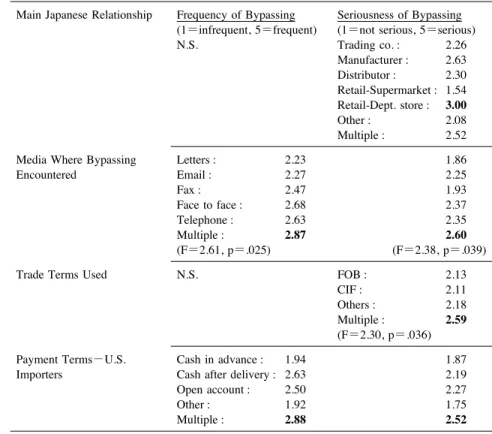
Table 2 reports the significant results of one-way analyses of variance with bypassing frequency and seriousness as dependent measures. The first point to make is that bypassing is neither a frequent nor a serious problem in general. In no case did mean responses go above 3.0, the mid-point on the infrequent/frequent and not serious/serious scales. This was true for all independent measures in the research, suggesting that bypassing does not frequently occur and is not a serious problem when it does occur. However, several hundred written comments from our respondents, discussed below, sug- gest that when it occurs, bypassing is not cost free. Table 2 results suggest that communication by- passing between U.S. managers and managers at Japanese department stores can be serious, probably because of the lack of familiarity of department store managers with international practices. In a simi- lar vein, the results suggest that bypassing is more of a problem when it is encountered in multiple media and when multiple trade terms and payment terms are used. Clearly the complexity of Japanese -American business relationships can evoke bypassing.
Table 3 reports the results of regressing the dependent variables on the remaining variables. In this analysis, bypassing frequency is associated with Japanese use of English, especially in trade ne- gotiations. Unclear statements foster bypassing, as does a tendency to bury decisions within state- ments rather than stating them at the beginning. Interestingly, the use of short sentences fosters by- passing, a sign of Japanese inability to match complex English to complex communication needs. We have a symbolic saying in Japan : Ishin-Denshin. This expression is defined in this way : “What the mind thinks, the heart transmits.” However, it won’t work well when you communicate with non- Japanese managers, as this research suggests.
As for bypassing seriousness, it is associated with the communication situation as well as lan-
guage usage. Bypassing is more serious when U.S. managers are dissatisfied with their Japanese counterparts and engage in conflicts with them.
In sum, bypassing appears to be associated with complex trade-related situations in which Japa- nese managers’ English usage skills are weak. The seriousness of these bypassing incidents is related to the nature of the relationship between the parties as well as to its complexity and Japanese use of
Table 2 Significant Results of Analysis of Variance Tests Main Japanese Relationship Frequency of Bypassing
(1=infrequent, 5=frequent) N.S.
Seriousness of Bypassing (1=not serious, 5=serious) Trading co. : 2.26 Manufacturer : 2.63 Distributor : 2.30 Retail-Supermarket : 1.54 Retail-Dept. store : 3.00
Other : 2.08
Multiple : 2.52
Media Where Bypassing Encountered
Letters : 2.23
Email : 2.27
Fax : 2.47
Face to face : 2.68 Telephone : 2.63
Multiple : 2.87
(F=2.61, p=.025)
1.86 2.25 1.93 2.37 2.35 2.60 (F=2.38, p=.039)
Trade Terms Used N.S. FOB : 2.13
CIF : 2.11
Others : 2.18
Multiple : 2.59
(F=2.30, p=.036) Payment Terms−U.S.
Importers
Cash in advance : 1.94 Cash after delivery : 2.63 Open account : 2.50
Other : 1.92
Multiple : 2.88
1.87 2.19 2.27 1.75 2.52
Table 3 Significant Results of Regression Analyses (stepwise, N=371)
Frequency of Bypassing Seriousness of Bypassing Adj. R2
F P
Frequency of trade term bypassing Clarity of Japanese statements
Tendency to state reasons before decisions Tendency to avoid long sentences
Level of satisfaction with current Japanese relationship Percent of total communications that are conflicts Good command of English
.278 16.53
.000 .215 (3.51)
−.194 (3.12) .150 (2.49) .138 (2.28)
N.S.
N.S.
N.S.
.172 9.44 .000 .149 (2.31)
−.185 (2.77) N.S.
N.S.
−.197 (2.97) .153 (2.36)
−.142 (2.18) (Note : Beta scores reported for variables with t-statistic in parenthesis)
English.
Results from content analysis of the research
In the questionnaire we asked the respondents to answer these questions :
Part 1−3 d. What is a major positive characteristic of the Japanese managers you deal with?
Part 1−3 e. What is a major negative characteristic of the Japanese managers you deal with?
Part 1−3 f. What is the most important factor needed to maintain a good relationship with your Japanese clients, suppliers, and partners?
Part 2−10. Please try to recall a specific instance of American-Japanese bypassing in which you were involved. What happened?
What were the consequences? Briefly describe it below.
Part 2−11 a. In your relationships with Japanese, what is the best way to reduce or avoid bypass- ing problems?
Of all the 371 respondents, 59 fully answered all the three questions and 304 answered either one or two questions. There were about 180 replies, about 50% of all those who answered, to the above Part 2−10 question. However, the answers that satisfied our request for concrete examples of bypassing were only 61. All the others were a bit too abstract, many of them claiming that they have actually experienced bypassing but without providing concrete examples.
So, I have classified these 61 bypassing cases into several categories such as (1) Cultural bypass- ing, (2) Word definition bypassing, (3) Business practices and customs, (4) Translation problems, (5) Time bypassing, (6) Oral vs. written bypassing (the limitation of e-mail as a means of communica- tion), and (6) Other bypassing. At the same time, I have also picked up the 61 questionnaires answer- ing the other two questions at random just to make the number of samples as many as the bypassing samples.
As can be seen in the following answers, the Japanese managers seem to be on one hand re- spected by their American counterparts, who regard the Japanese managers professional and very effi- cient, hardworking and very exact, polite and concerned, respectful, and punctual with deadlines.
Content Analysis of 3 d.
(1) Major positive characteristic of the Japanese managers
1. Professionalism, highly organized, very efficient, etc. 24.60%
2. Hardworking, very serious, very exact, detailed, etc. 16.40%
3. Polite, courteous, polite and concerned, etc. 13.12%
4. Respectful, dependable, high degree of trust, etc. 9.84%
5. On-time, punctual with deadlines, quick response, etc. 8.20%
Others such as loyalty, friendly, straight forward, etc.
On the other hand, however, what about the negative characteristics of the Japanese managers the Americans deal with? See the following answers :
Content Analysis of 3 e.
(2) Major negative characteristic of the Japanese managers
1. Stubborn, not flexible, very assertive, demanding, etc. 21.31%
2. Takes very long to make a decision, hate changes, etc. 19.67%
3. Lack of information disclosure, don’t tell us what the problems are, etc. 11.48%
4. Communication, language, feel inferior due to speech, etc. 9.84%
5. Not straight forward enough, try to be too nice, etc. 8.20%
Others such as impatient, decision making by committee, etc.
Extra comments from female managers :
a. They still are unsure of working with a woman b. Look at women as a lower class than men, and c. Lack of respect for women managers or employees
In sum, some Japanese managers are : stubborn, demanding, taking too long time to make a de- cision, lacking in information disclosure, having communication difficulty, and not straightforward.
Moreover, Japanese managers don’t seem to enjoy good standing among some American female workers.
Many managers, about one third of them, identified communication as the most important factor needed to maintain a good relationship with their Japanese counterparts. See the following answers :
Content Analysis of 3 f.
(3) Most important factor needed to maintain a good relationship with Japanese clients, suppliers, and partners
1. (Clear, open, proper, effective, high quality, etc.) Communication 31.15%
2. Honesty, fairness, integrity, honorable attitude, etc. 13.12%
3. Cross-cultural awareness, understand each other’s culture, etc. 11.48%
4. Respect, trust over time, mutually respectful relationship, etc. 8.20%
5. Trust and patience, assure you’re communicating properly and fully understanding each other,
etc. 8.20%
The item such as ‘cross-cultural awareness’ or ‘understanding each other’s culture” is in third place. This means many American managers believe that good cross-cultural business communication is the most important factor to maintain a good relationship with Japanese managers.
Ways to reduce or avoid bypassing problems
The third content analysis, the ways to reduce or avoid bypassing problems, give us good hints for the improvement of the two parties’ relationship. I have classified all the answers to this question
“how to reduce or avoid bypassing problems” into the following four categories with some represen- tative answers and suggestions from the American respondents :
! Focus on the medium or use of multiple media (39.35%)
1. Communicate important issues in multiple mediums (typically communication bypassing oc- curs during initial communication. For important issues, I find it necessary to communicate the point multiple times in various forms such as verbal and email)
2. Follow-up all written communication with face to face or at least telephone contact.
3. Meet face to face and write down (especially use numbers, which are more widely under- stood).
" Focus on content length, delivery, arrangement, specificity, and target (34.43%)
1. Keep each issue separate. Discuss a single issue until completion before going to the next. The same applies to all written communications. Focus on only one issue with each communica- tion and keep the communication as concise as possible. In face-to-face meeting always take detailed notes and get mutual agreement on the meeting notes when complete.
2. Be very specific. Verify they understand. Know the problem exists and be sensitive.
3. Precise/concise meeting minutes and project tracking.
# Verification through repetition (13.11%)
1. I always try to verify two or more times, using different terminology.
2. Verify communication by saying the same thing with different words.
3. Phrasing things in several different ways.
! Seeking feedback (13.11%)
1. Explain, ask for feedback, explain in other words using real life examples whenever possible.
2. On important issues always recheck understanding by asking back-up questions to insure cor- rect meaning transferred.
3. Confirm things a million times.
The results from the data analysis have suggested that bypassing is more of a problem when it is encountered in multiple media and when multiple trade terms and payment terms are used. But to solve a bypassing problem, American managers have listed using a variety of multiple media to re- duce or avoid bypassing, and suggested communicating the point multiple times in various forms such as verbal and email. Thus, use of multiple media is both a source of bypassing but also a way to solve the problem. Clearly, multiple media must be used with care.
Conclusion
To conclude this paper let me examine some basic rules to avoid bypassing problems we have so far observed as follows :
1. Paraphrase
Managers should encourage each other to check definitions by asking “May I sum up our discus- sion as follows?” or “By May end delivery do you mean you want us to ship the goods from Kobe in the end of May?” Although this practice can be tedious, it will uncover most bypassing. He must sig- nal to others that the communication channel to him is open, wide, and deep so the timid and reticent, as well as the assertive, can get through to do their checking.
2. Use Multiple Channels
Bypassing that occurs during a meeting may be quickly discovered in a follow-up phone call. It is quite fitting that the phone, which is the medium in which much dangerous bypassing occurs, should be used to undo it. Exchanges of memos and e-mails after meetings are always a good idea.
As one manager suggested in his reply to our questionnaire, “For important matters, make sure to clarify your intentions through a combination of e-mails, phone calls, and even face-to-face visits.”
3. Manage Bypassing in Cross-cultural Communication
While much needs to be learned, we can offer a number of practices that should reduce bypass- ing problems in cross-cultural negotiations.
Assume the worst. Bypassing is all but inevitable, even under the best conditions, when people
from different cultures communicate. When problems come up, don’t immediately blame faulty knowledge of English. While everyone is alert to syntax, grammar, and using the right technical terms, bypassing over simple words like “soon” may creep in.
Discuss basic concepts. Ask each party to exchange a written list of their understandings of key concepts. Then use the first negotiating session to do nothing but build rapport through discussion of the key meanings. For those who do international trade the word “delivery” refers to the shipment of the goods on board a vessel as clearly prescribed in the long cherished law for international business such as the Sale of Goods Act and the Incoterms as well. However, not everyone who does interna- tional business knows this definition.
Get it all in writing. It may be wise to respect the American practice of this rule, a procedure that will force common meanings to be established. In many contract forms used for international business, the first few articles or provisions are for interpretations of the terms such as Product, Ex- clusivity, Territory, etc. Managers should enlarge this part of the contract as much as possible and in- clude some other terms and words both parties will use in their daily business communications. Seri- ous problems could be resolved with this method of trade term definitio
11
ns.
To make communication with their foreign counterparts successful, global managers must under- stand that becoming familiar with a foreign language and learning the skills of communication are two entirely different things. A language is naturally an important factor of communication but not a sufficient one.
According to Mehrabian, an American psychologist, the role language plays in interpersonal communication is 7%, the features of voice or diction 38%, and facial expression is 55
12
%. This data suggests the limits of written communication such as email, fax, letter, etc. as a major tool for busi- ness communication. This is also the reason why many American managers listed face-to-face meet- ings as important to avoid and reduce bypassing. With beautiful smiles on their face, both the Japa- nese and American managers can make their deal a successful one.
Notes
1 Source : Japan Foreign Trade Council, Inc.
2 W. V. Haney,Communication and Interpersonal Relations, Homewood, IL, Richard D. Irwin, Inc., 1979, p. 285.
3 J. Sullivan, N. Kameda & T. Nobu, Bypassing in Managerial Communication,Business Horizons, Vol. 34, No. 1, 1991, p. 76.
4 C. Engholm,When Business East Meets Business West : The Guide to Practice and Protocol in the Pacific Rim, NY, John Wiley & Sons, Inc., 1991, p. 121.
5 Source : Clear Communication, Volume蠢, Issue 2, Fall 1993, p. 3 by D. B. Roebuck,Improving Busi- ness Communication Skills, NJ, Prentice Hall, Inc., 1998, p. 5.
6 J. W. Salacuse,Making global deals : negotiating in the international marketplace, Boston, Houghton Mifflin Company, 1991, pp. 46−47.
7 J. Seward, The Fine Art of Interpreting,WINDS, August 1979, Tokyo, Japan Airlines Co., Ltd., pp. 17−18.
8 The Nikkei Weekly, April 22, 2002.
9 F. E. Jandt,Intercultural Communication, Thousand Oaks, CA ; , Sage Publications, Inc., 1995, p. 118.
10 B. Hard,A Western Look at Japanese Business Writing Problems, Tokyo, Yohan Publishing Co., Ltd., 1992, pp. 49−50.
11 N. Kameda,Business Communication toward Transnationalism, Tokyo, Kindai Bungeisha, 1996, pp. 116−
119.
12 A. Mehrabian, Communication without words,Psychology Today,蠡(Sept., 1968), pp. 53−55.