1 The equalities
We start with the knot P(-2,3,7) in Fig. 1. It is called the pretzel knot of type (-2,3,7). It is the most famous knot in Dehn surgery as a starting example of lens surgery: 18-(and 19- also) surgery along P(- 2,3,7) is a lens space ([14]). By ∆P(t), we denote the Alexander polynomial of P(-2,3,7):
∆P(t) = t10 -t9+ t7- t6+ t5- t4+ t3- t+ 1.
Note that ∆P(-t) is Lehmer polynomial in number theory ([32]). We point out the following two equalities on ∆P(t), related to two lens surgeries of P(-2,3,7):
Theorem 1.1
(1) 18-surgery along P(-2,3,7) is the lens space L(18,5) = L(18,11).
∆P(t)∆P(t5)∆P(t11)= t13 inZ[t]/(t18- 1)
(2)19-surgery along P(-2,3,7) is the lens space -L(19,7) = -L(19,11).
∆P(t)∆P(t7)∆P(t11)=1 inZ[t]/(t19- 1)
These assertions are easily obtained by using the computer programs and we omit the detail.
Such equalities in Theorem 1.1 are extended: Let p be an integer with p 2. By (Z/pZ)*, we denote the group, with respect to the multiplication, of invertible elements in the ring (Z/pZ). It contains {1} as a subgroup. The equalities will be extended as a necessary condition for the Alexander polynomial of a knot to yield a lens space:
Theorem 1.2(Announcement) If p/q-surgery along a knot K in S3is a lens space(p 2), then there exists a subgroup G in (Z/pZ)*/{1} with respect to the multiplication, such that the Alexander polynomial ∆K(t) of K satisfiles
Two equalities on the Alexander polynomial of the pretzel knot of type (-2,3,7)
Yuichi YAMADA
Abstract
The pretzel knot of type (-2,3,7) is very well known as a starting example of the lens surgery (i.e. hyperbolic knots yielding lens spaces by Dehn surgery), and its Alexander polynomial also has been studied well in the theory of algebraic integers. In this paper, the author studies two equalities concerning the Alexander polynomials of this knot and he also explains his recent research concerning this knot.
Received on October 20, 2005
Department of Systems Engineering, The University of Electro- Communications 1-5-1, Chofu-gaoka, Chofu, Tokyo 182-8585, Japan
02000 Mathematics Subject Classification: Primary 57M25, Secondary 57M27. Keywords: Alexander polynomial, Dehn surgery, Lens space,
1This work was partially supported by Grant-in-Aid for Scientific Research No.15740034, Japan Society for the Promotion of Science.
Figure 1: P (-2,3,7)
∆K(ti)1 inZ[t,t-1]/(tp-1).
Recently, Dr. Teruhisa Kadokami, the co-author of the preprint [30], suggests that the above result can be proved by using V. G. Turaev’s formula [44, 45] on the relationship between Alexander polynomial and Reidemeister torsion, which was pointed out by J.
Milnor [36]. Furthermore, by the sharpend version of the concept 3-manifolds of lens type, which was originally defined by T. Kadokami in [29] (see also [30]), the theorem will be extended for “lens type”
surgery along knots in arbitrary integral homology spheres. On other recent researches on the Alexander polynomials of lens surgery, see [25, 29, 30, 31, 35, 37].
Now, we refer to the interest on the knot P(-2,3,7) more: Since the discovery in [14] by R. Fintushel and R. Stern that 18-surgery (and 19-surgery also) along the pretzel knot P(-2,3,7) is a lens space, research of hyperbolic knots yielding lens spaces by Dehn surgery has grown up as a researching area “lens surgery” , see [11, 12, 18, 33, 35, 46, 47], recent works [4, 5, 6, 7, 8, 9, 10, 19, 38, 39], and also [48].
Its Alexander polynomial ∆P(t), or Lehmer’s polynomial ∆P(-t), is studied also in the theory of algebraic integers, see [15,23,40]. Let α(=1.17628...) be the unique real solution of the equation ∆P(-t)=0 greater than 1 (thus α is an algebraic integer). It is conjectured that α is the smallest “Mahler measure”
among those of all monic palindromic polynomials.
P(-2,3,7) is also studied from the view point of
braid dynamics. The dilatation minimizing braids of index 3, 4 and 5 are all related to P(-2,3,7), see [20, 41, 42, 40] and Section 3. There are some research on P(-2,3,7) from other view points ([24, 26, 27] and so on).
2 P(-2,3,7) as A’Campo’s divide knot
Here we summarize the author’s recent research about lens surgery along A’Campo’s divide knots ([1, 2, 3]).
Conjecture 1. Every knot of lens surgery is A’Campo’s divide knot, up to mirror image.
The theory of divide knots, defined by N. A’Campo, is deeply related to algebraic geometry and the theory of the singularity of the complex curves. We do not recall the precise definition here, but is summarized as follows: Each generic plane curve C represents a link L(C) in S3. On the process from the divide C to the link L(C), M. Hirasawa,in [22], developed a geometric and knot theoretic method. In our restricted cases, the method by O. Couture and B.Perron in [13] is helpful. The typical examples of the divide knots are torus knots:
Fact 1. ([16]) A rectangle-shaped billiard curve of type B(a,b) represents the torus knot T(a,b), where a, b is a pair of coprime positive integers.
The billiard curve B(a,b) is isotopic to the Lissajous curve (cos at,cos bt) in R2, where t[0,] is the parameter, see Fig.2 (in the case(a,b)=(6,5)). A
Π
iGFigure 2: Billiard curve = Lissajous curve represents a torus knot
torus knot T(a,b) is the link of the singularity of the curve zb - wa=0 in C2. Then the Lissajous curve is the real part of the representation (ebit,eait) in C2 of T(a,b), where t R/2Zis the parameter.
The divide knots satisfy the followings:
Proposition 1. ([1, 2, 3])
(i) L(C) is a knot(i.e., connented) iff C consists of an immersed arc.
(ii) If a divide knot K:= L(C) represented by C, then the unknotting number, the minimal genus, and 4-genus of K all equal to the number of double points of C.
(iii) If C1 and C2 is related to each other by ∆- move, denoted by C1〜C2, then L(C1)= L(C2).
Now, we go back to the knot P(-2,3,7). M.
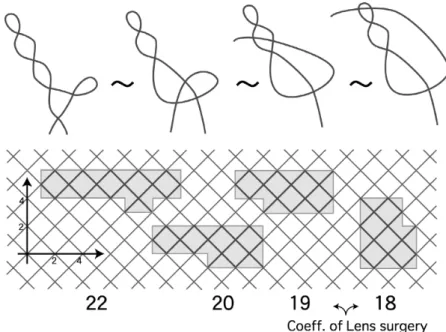
Hirasawa pointed out to the author that P(-2,3,7) is a divide knot and is represented by the first plane curve (as a divde) in Fig.3. We can deform it by ∆- moves as in Fig. 3. Each curve is obtained as the intersection X of the 45° lattice X in the palne and a region which is the union of overlapped rectangles.
Note that, during the ∆-moves in Fig.3, the
number of double points is unchanged from 5 (equals to the unknotting number), but the area of the region decrease to 19, 18, which are the surgery- coefficients of lens surgery along P(-2,3,7). The author’s advanced conjecture is:
Conjecture 2.(continued after Conjecture 1) ..., and the corresponding divide is of L-shaped like as the third and fourth examples in Fig. 3.
Furthermore, the surgery coefficient equals (or differs by only one) to the area of the L-shaped region.
The author checks more examples in [50] on J.
Berge’s list of “doubly primitive knots”defined in [9, 10]. On the other hand, the converse of Conjecture 2 is not true: There exists a family of L-shaped divide knots whose Dehn surgery with the area coefficient is a Seifert 3-manifold or a graph-manifold, see [49].
3
P(-2,3,7) as dilatation minimizing pseudo-Anosov braids
As another piece of the story on the knot P(-2,3,7), we refer to the fact, which is pointed out by D. Silver- S. William’s paper ([40, Example 6.3]), that P(-2,3,7) appears as the closure of some dilatation minimizing pseudo-Anosov braids in small braid indexes. Let bi (i=3,4,5) be the braids:
Figure 3: P(-2,3,7) is represented by these curves as a divide knot
b3= 12-1, b4= 321–1, b5= 123412
of index 3,4, and 5, respectively, see Fig. 4. In [20, 34, 41, 42], it has been proved that they are dilatation minimizing pseudo-Anosov braids in each braid index. The closures of them (or its mirror image b5
−
in the case b5) with 2, 1, and 1 full twist, respectively, are same to the knot P(-2,3,7) ([40]).
Furthermore, we have:
Fact 2. The closures of these braids b3,b4 and b5
with any full twistings still admit lens surgeries.
They are included Berge’s list of the “doubly primitive knots” of lens surgery ([9, 10]), see also [35]. This phenomena is a contrast to Baker’s result in [7]. Braid positivity (thus fiberedness also) of doubly primitive knots is proved by M. Teragaito ([43], [21, §5.7]) and P. Hill- K. Murasugi ([21]).
Acknowledgement. The author is partially supported by Grant-in-Aid for Scientific Research No.15740034, Japan Society for the promotion of Science.
The author would like to thank Dr. Teruhisa Kadokami for the agreement that the author cut these results from the old version of [30] and publish it here. The author would like to thank to Dr. Mikami Hirasawa, Dr. Tomomi Kawamura, Dr. William Gibson, Dr. Masaharu Ishikawa and Professor Norbert A’Campo for informing him on A’Campo’s divide knot thoery. The author would like to thank to Professor Eriko Hironaka, Dr. Eiko Kin and Dr. Won Taek Song for informing him on braid dynamics. The author also
would like to thank to Professor Masakazu Teragaito, Professor Kimihiko Motegi, Professor Hiroshi Goda, Dr. Toshio Saito, Dr. Kenneth Baker, Dr. Arnaud Deruelle, Dr. Hiroshi Matsuda, and Prof. John Berge for helpful suggestion on lens surgery.
References
[1] N. A’Campo, Le groupe de monodromie du de,ploie-ment des singularite, isole,es de coubes planes I, Math. Ann., 213(1975), 1-32.
[2] N. A’Campo, Generic immersion of curves, knots, monodromy and gordian number, Inst.Hautes Etudes Sci. Publ.Math. 88(1998), 151-169.
[3] N. A’Campo, Real deformations and complex topology of plane curve singularities, Ann. de la Faculte des Sciences de Toulouse 8(1999), 5-23.
[4] A. Deruelle and D. Matignon, Thin presentation of knots and lens spaces, preprint.
[5] A. Deruelle and D. Matignon, Spinal knots in lens space, preprint.
[6] K. Baker, Knots on once-punctured torus fibers, (dissertation, The university of Texas Austin (2004).) [7] K. Baker, Surgery descriptions and volumes of Berge knots I: Large volume Berge knots, preprint arXiv:math.GT/0509054.
[8] K. Baker, Surgery descriptions and volumes of Berge knots II: Description on the minimally twisted five chain link, preprint arXiv:math.GT/0509055.
[9] J. Berge, The knots in D2S1 which have nontrivial Dehn surgeries that yield D2S1, Topology Appl. 38(1991), no. 1, 1-19.
[10] J. Berge, Some knots with surgeries yielding lens spaces, (Unpublished manuscript, 1990).
[11] S. Bleiler and R. Litherland, Lens spaces and Figure 4: Braids representing P(-2,3,7)
Dehn surgery, Proc. Amer. Math. Sco., 107(1989), 1127-1131.
[12] M. Culler, M. Gordon, J. Luecke and P. Shalen, Dehn surgery on knots, Ann. Math., 125(1987), 237- 300.
[13] O. Couture and B. Perron, Representative braids for links associated to plane immersed curves, J.
Knot Theory Ramifications 9(2000), 1-30.
[14] R. Fintushel and R. J. Stern, Constructing lens spaces by surgery on knots, Math. Z., 175(1) (1980), 33-51.
[15] E. Ghate and E. Hironaka, The arithmetic and geometry of salem numbers, Bull. of Amer. Math. Soc.
(New Series), 38(3) (2001), 293-314.
[16] H. Goda, M. Hirasawa and Y. Yamada, Lissajous curves as A’Campo divides, torus knots and their fiber surfaces, Tokyo J. Math. 25 No.2 (2002), 485- 491.
[17] C. McA. Gordon, Dehn surgery on knots, In Proceedings of the International Congress of Mathematicians(Math. Soc. Japan, 1991), 631-642.
[18] C. McA. Gordon, Dehn filling: a survey, In Knot theory(Banach Center Publ., 1998), 129-144.
[19] H. Goda and M. Teragaito, Dehn surgeries on knots which yield lens spaces and genera of knots, Math. Cambridge Philos. Soc., 129no.3 (2000), 505- 515.
[20] J. Ham and W. T. Song, The minimum dilatation of pseudo-anosov 5-braids, preprint
arXiv:math.GT/0506295.
[21] P. Hill and K. Murasugi, On double-torus knots (II), J. Knot Theory Ramifications 9no.5 (2000), 617- 667.
[22] M. Hirasawa, Visualization of A’Campo’s fibered links and unknotting operations, Topology and its Appl., 121(2002), 287-304.
[23] E. Hironaka, The Lehmer polynomial and pretzel links, Canad. Math. Bull., 44no.4 (2001), 440- 451.
[24] K. Ichihara, M. Ohtouge and M. Teragaito, Boundary slopes of non-orientable Seifert surfaces for knots, Topology Appl. 122no.3 (2002), no. 3, 467- 478.
[25] K. Ichihara, T. Saito and M. Teragaito, Alexander polynomials of doubly primitive knots, preprint arXiv:math.GT/0506157.
[26] H. Ishigami and M. Teragaito, The simplest hyperbolic knots with non-integral toroidal surgery, J. Knot Theory Ramifications. 12 no.8 (2003), 1023-1039.
[27] J. Jinha (-2,3,7)-pretzel knot and Reebless foliation, Topology Appl. 145(2004), no. 1-3, 209-232.
[28] T. Kadokami, On2-component links with trivial components, The 5th Korea-Japan School of Knots and Links, Proceedings of Applied MathematicsWorkshop, 8 (1997), 71-93.
[29] T. Kadokami, Reidemeister torsion and lens surgeries on knots in homology 3-spheres I, preprint.
[30] T. Kadokami and Y. Yamada, Reidemeister torsion and lens surgeries on(-2,m,n)-pretzel knots, preprint.
[31] T. Kadokami and Y. Yamada, A deformation of the Alexander polynomials of knots yielding lens spaces, in preparation.
[32] D. Lehmer, Factorization of certain cyclotomic functions, Ann. of Math. (2) 34(1933), no. 3, 461-479.
[33] J. Luecke, Dehn surgery on knots in the three sphere, In Proceedings of the International Congress of Mathematicians, Zurich(Birkhauser Verlag, 1995), 585-594.
[34] T. Matsuoka, Braids of periodic points and a 2- dimensional analogue of Sharkovskii’s ordering, Su-rikaisekikenkyu-sho Ko-kyu-roku (Japanese), 574
“Dynamical systems and nonlinear oscillation phenomena” (1985), 241-255
[35] N. Maruyama, On Dehn surgery along a certain family of knots, J. of Tsuda College, 19(1987), 261- 280.
[36] J. W. Milnor, A duality theorem for Reidemeister torsion, Ann. of Math. (2), 76(1962), 137-147.
[37] P. Ozsva,th and Z. Szabo,, On knot Floer homology and lens space surgeries, Topology 44 (6) (2005), 1281-1300.
[38] T. Saito, Dehn surgery and (1,1)-knots in lens space, preprint.
[39] T. Saito, The dual knots of doubly primitive knots, preprint.
[40] D. Silver and S. Williams, Mahler measure of Alexander polynomials, J. London Math. Soc.(2), 69 no.3 (2004), 767-782.
[41] W. T. Song, K. H. Ko and J. Los, Entropies of braidsKnots 2000 Korea, Vol. 2 (Yongpyong). J. Knot Theory Ramifications 11 (2002), no. 4, 647-666 [42] W. T. Song, Upper and lower bounds for the minimal positive entropy of pure braids, Bull.
London Math. Soc., 37(2005), no. 2, 224-229.
[43] M. Teragaito, Dehn surgery on knots yielding lens spaces, The 7-th Japan-Korea school of knots and links, Kobe, February (1999).
[44] V. G. Turaev, Reidemeister torsion in knot theory, Russian Math. Surveys, 41-1(1986), 119-182.
[45] V. G. Turaev, Introduction to Combinatorial Torsions, Notes taken by Felix Schlenk, Lectures in Mathematics ETH Zurich., Birkhauser Verlag, Basel, (2001).
[46] S. C. Wang, Cyclic surgery on knots, Proc. Amer.
Math. Soc. 107(1989), no. 4, 1091-1094.
[47] Y. Q. Wu, Cyclic surgery and satellite knots, Topology Appl. 36(1990), no. 3, 205-208.
[48] Y. Yamada, Berge’s knots in the fiber surfaces of genus one, lens spaces and framed links, J. Knot Theory and its Ramifications. 14no.2 (2005), 177–188.
[49] Y. Yamada, A family of knots yielding graph manifolds by Dehn surgery, to appear in Michigan Math. J.
[50] Y. Yamada, Berge’s lens surgery as A’Campo’s divide knots, in preparation.