Introduction Known Facts Results (2-bridge knots) Results (New Example)
Cosmetic surgery on knots
Kazuhiro Ichihara
Nihon University
College of Humanities and Sciences
Joint works with
Toshio Saito
(Joetsu Univ. of Edu.)
In Dae Jong(Kinki Univ.)
Introduction Known Facts Results (2-bridge knots) Results (New Example)
Complement determines the knot type
Knot Complement Conjecture
A pair of knots in S
3have homeomorphic complements if and only if they are equivalent.
(i.e.,
∃h : S
3 →S
3, homeo. which takes one knot to the other) This was conjectured by Tietze (1908),
They actually showed the following. (The KCC is a corollary to it) Theorem (Gordon-Luecke, 1989)
On a nontrivial knot in S
3, nontrivial Dehn surgery never yields S
3.
Introduction Known Facts Results (2-bridge knots) Results (New Example)
Complement determines the knot type
Knot Complement Conjecture
A pair of knots in S
3have homeomorphic complements if and only if they are equivalent.
(i.e.,
∃h : S
3 →S
3, homeo. which takes one knot to the other) This was conjectured by Tietze (1908),
and was proved by Gordon-Luecke (1989).
They actually showed the following. (The KCC is a corollary to it)
Dehn surgery
E(K): the exterior of a
knot K in a 3-mfd M
(i.e., M
−(open tubular nbd of K)) Glue solid torus to E(K) along slope γ;
γ m
f
We denote the obtained mfd by
K(γ).Introduction Known Facts Results (2-bridge knots) Results (New Example)
Generalization
The Knot Complement Conjecture can be generalized as follows.
Oriented Knot Complement Conjecture (Bleiler (Kirby’s list Problem 1.81(D)))
Let K
1and K
2be knots in a closed, oriented 3-manifold M. If the complements of K
1and K
2are homeomorphic
via an orientation-preserving homeomorphism,
then there exists an orientation-preserving homeomorphism of M
taking K
1to K
2.
Generalization
The Knot Complement Conjecture can be generalized as follows.
Oriented Knot Complement Conjecture (Bleiler (Kirby’s list Problem 1.81(D)))
Let K
1and K
2be knots in a closed, oriented 3-manifold M . If the complements of K
1and K
2are homeomorphic
via an orientation-preserving homeomorphism,
then there exists an orientation-preserving homeomorphism of M
taking K
1to K
2.
Introduction Known Facts Results (2-bridge knots) Results (New Example)
Cosmetic surgery
The OKCC follows from
Cosmetic Surgery Conjecture
(Bleiler (Kirby’s list Problem 1.81(A)))
Two surgeries on inequivalent slopes are never purely cosmetic. i.e., if K(r
1)
∼= K(r
2) for inequivalent slopes r
1, r
2,
then the homeomorphism is orientation reversing.
•
Two slopes are equivalent if there exists
a homeo. of E(K) taking one slope to the other.
•
Two surgeries on K along slopes r
1, r
2are purely cosmetic
if there exists an ori.-pres. homeo. between K(r
1) & K(r
2),
and chirally cosmetic if the homeo. is orientation-reversing.
Cosmetic surgery
The OKCC follows from Cosmetic Surgery Conjecture
(Bleiler (Kirby’s list Problem 1.81(A)))
Two surgeries on inequivalent slopes are never purely cosmetic.
i.e., if K(r
1)
∼= K(r
2) for inequivalent slopes r
1, r
2, then the homeomorphism is orientation reversing.
•
Two slopes are equivalent if there exists
a homeo. of E(K ) taking one slope to the other.
•
Two surgeries on K along slopes r
1, r
2are purely cosmetic
if there exists an ori.-pres. homeo. between K(r
1) & K (r
2),
and chirally cosmetic if the homeo. is orientation-reversing.
Introduction Known Facts Results (2-bridge knots) Results (New Example)
Remark
Remark: (Mathieu, 1992)
For “Orientation reversing” case, there exist examples.
Actually (18k + 9)/(3k + 1)- and (18k + 9)/(3k + 2)-surgeries on the trefoil knot T
2,3in S
3yield
orientation-reversingly homeomorphic pairs for any k
≥0.
Known facts (Examples)
Rong (1995)
Seifert knots in closed 3-manifolds (except lens spaces) admitting cosmetic surgeries are classified.
Matignion (2010)
Non-hyperbolic knots in lens spaces admitting cosmetic surgeries are classified.
The surgeries are all chirally cosmetic.
Introduction Known Facts Results (2-bridge knots) Results (New Example)
Known facts (Examples)
Theorem [Bleiler-Hodgson-Weeks (1999)]
There exists a hyperbolic knot which admits a pair of surgeries along inequivalent slopes yielding oppositely oriented lens spaces.
The lens spaces are: L(49,
−19)
↔L(49,
−18) (mirror image)
It was announced by Matignion that there are infinite family
of such examples extended above.
Known facts (Examples)
Theorem [Bleiler-Hodgson-Weeks (1999)]
There exists a hyperbolic knot which admits a pair of surgeries along inequivalent slopes yielding oppositely oriented lens spaces.
The lens spaces are: L(49,
−19)
↔L(49,
−18) (mirror image)
It was announced by Matignion that there are infinite family
of such examples extended above.
Introduction Known Facts Results (2-bridge knots) Results (New Example)
Known facts (Criteria)
Let
∆K(t)denote the Alexander polynomial of a knot K in S
3normalized to be symmetric and satisfy ∆
K(1) = 1.
Boyer-Lines (1990)
A knot K satisfying
∆00K(1)6= 0has no cosmetic surgeries.
They use the (original) Casson invariant
(i.e., defined by using SU (2)-representations).
Recent Progress
Theorem [Ni-Wu (2011)]
Suppose K is a nontrivial knot in S
3& r
1, r
2are distinct slopes such that K(r
1)
∼= K(r
2) as oriented manifolds.
Then r
1, r
2satisfy that (a) r
1=
−r
2(b) suppose r
1= p/q, then q
2 ≡ −1 (mod p)
(c)
τ(K) = 0, whereτ is the invariant defined by Ozsv´ ath-Szab´ o.
based on Heegaard Floer Homology (d-invariant and τ -invariant).
Introduction Known Facts Results (2-bridge knots) Results (New Example)
2-bridge knots with at most 9 crossings
Proposition.
All the two-bridge knots of at most 9 crossings other than 9
27admits no cosmetic surgery pairs.
9
27= S(49, 18) = C[2, 2,
−2, 2, 2,
−2]
[I., 2013]
For K = 9
27, K(10/3)
6∼= K(
−10/3).
(Tohoku Knot Semi 2011@Sendai)
2-bridge knots with at most 9 crossings
Proposition.
All the two-bridge knots of at most 9 crossings other than 9
27admits no cosmetic surgery pairs.
9
27= S(49, 18) = C[2, 2,
−2, 2, 2,
−2]
[I., 2013]
For K = 9
27, K(10/3)
6∼= K(
−10/3).
(Tohoku Knot Semi 2011@Sendai)
Introduction Known Facts Results (2-bridge knots) Results (New Example)
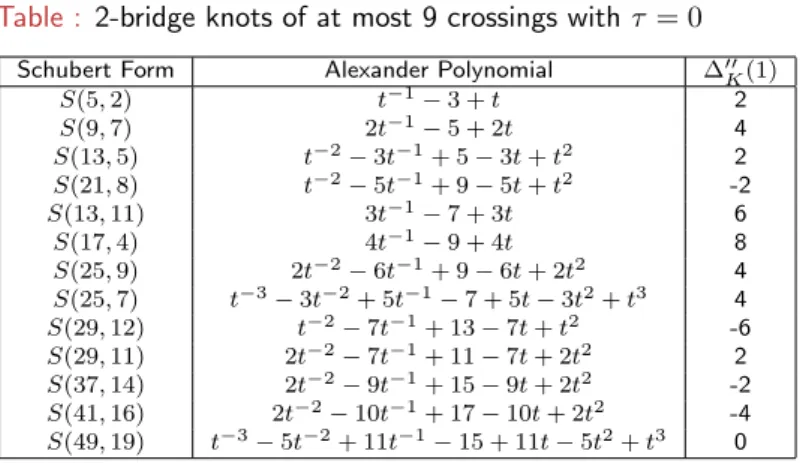
Table : 2-bridge knots of at most 9 crossings withτ = 0
Name Schubert Form Alexander Polynomial ∆00K(1)
41 S(5,2) t−1−3 +t 2
61 S(9,7) 2t−1−5 + 2t 4
63 S(13,5) t−2−3t−1+ 5−3t+t2 2
77 S(21,8) t−2−5t−1+ 9−5t+t2 -2
81 S(13,11) 3t−1−7 + 3t 6
83 S(17,4) 4t−1−9 + 4t 8
88 S(25,9) 2t−2−6t−1+ 9−6t+ 2t2 4
89 S(25,7) t−3−3t−2+ 5t−1−7 + 5t−3t2+t3 4
812 S(29,12) t−2−7t−1+ 13−7t+t2 -6
813 S(29,11) 2t−2−7t−1+ 11−7t+ 2t2 2 914 S(37,14) 2t−2−9t−1+ 15−9t+ 2t2 -2 919 S(41,16) 2t−2−10t−1+ 17−10t+ 2t2 -4 927 S(49,19) t−3−5t−2+ 11t−1−15 + 11t−5t2+t3 0
A family including 9
27Theorem [I.-Saito].
Let K
xbe a 2-bridge knot C[2x, 2,
−2x, 2x, 2,
−2x] with x
≥1.
Then K
xadmits no cosmetic surgery pairs yielding homology 3-spheres.
i.e., any
n1- and
m1-surgeries are not purely cosmetic for K
x.
Remark:
For K
x, ∆
00Kx
(1) = 0 and τ (K
x) = 0 hold. In particular, K
1= 9
27.
Introduction Known Facts Results (2-bridge knots) Results (New Example)
Key Ingredients
C. L. Curtis, An intersection theory count of the SL2(C)- representations of the fundamental group of a 3-manifold, Topology 40(2001), no. 4, 773–787.
H. U. Boden and C. L. Curtis,TheSL(2,C)Casson invariantfor Dehn surgeries on two-bridge knots, Algebr. Geom. Topol. 12 (2012), no. 4, 2095–2126.
T. Ohtsuki, Ideal points and incompressible surfaces in two-bridge knot complements, J. Math. Soc. Japan46(1994), no. 1, 51–87.
Montesinos trick & Banding
Montesinos trick [Montesinos, 1975]
Let M be a 3-mfd with a double br.cover M ¯ along a link L
⊂M.
For a knot K in M, which is strongly invertible w.r.t. the axis ¯ L, ¯ and for a slope r
∈Z, the surgered mfd.K(r) is homeomorphic to the double br.cover along the link obtained from L by a banding.
q ] q ] q ]
]
2q−4±1
Kq±
··· ··· ···
· · ·
Introduction Known Facts Results (2-bridge knots) Results (New Example)
Bleiler-Hodgson-Weeks’s Example
Bleiler-Hodgson-Weeks’s example (1999);
yieldingL(49,−19).
↓
(Cosmetic banding on the knot 9
27)
Bleiler-Hodgson-Weeks’s Example
Bleiler-Hodgson-Weeks’s example (1999);
yieldingL(49,−19).
↓
(Cosmetic banding on the knot 9
27)
Introduction Known Facts Results (2-bridge knots) Results (New Example)
Bleiler-Hodgson-Weeks’s Example
mirroring
& 2π/3-rot.
banding of slope 0
Introduction Known Facts Results (2-bridge knots) Results (New Example)
New Example
a (chirally)
cosmetic banding.•
The double branched cover M along K is hyperbolic.
•
The knot K ¯ in M corresponding to the banding is hyperbolic.
•
The knot K ¯ is not
amphicheiral.This gives a counter-example to: Conjecture (BHW)
Cusped hyperbolic manifolds admit no
cosmetic fillings, true or reflective,
yielding hyperbolic manifolds.
Introduction Known Facts Results (2-bridge knots) Results (New Example)
New Example
•
This knot K admits
a (chirally)
cosmetic banding.•
The double branched cover M along K is hyperbolic.
•
The knot K ¯ in M corresponding to the banding is hyperbolic.
•
The knot K ¯ is not
amphicheiral.This gives a counter-example to: Conjecture (BHW)
Cusped hyperbolic manifolds admit no
cosmetic fillings, true or reflective,
yielding hyperbolic manifolds.
New Example
•
This knot K admits
a (chirally)
cosmetic banding.•
The double branched cover M along K is hyperbolic.
•
The knot K ¯ in M corresponding to the banding is hyperbolic.
•
The knot K ¯ is not
amphicheiral.This gives a counter-example to:
Conjecture (BHW)
Cusped hyperbolic manifolds admit no
cosmetic fillings, true or reflective,
yielding hyperbolic manifolds.
Introduction Known Facts Results (2-bridge knots) Results (New Example)
How to check?
Theorem [I.-Jong].
The knot K ¯ admits a pair of chirally cosmetic surgeries yielding hyperbolic manifolds.
•
The double branched cover M along K is hyperbolic.
•
The knot K ¯ in M corresponding to the banding is hyperbolic.
by HIKMOT [To appear in Exper.Math., arXiv:1310.3410.]
•