Nano‑ and micro‑structural control of WO3
photoelectrode films through aqueous synthesis of WO3・H2O and (NH4)0.33WO3 precursors
著者 Uchiyama Hiroaki, Nagayasu Yuki journal or
publication title
RSC Advances
volume 10
number 19
page range 11444‑11449
year 2020‑03‑20
権利 (C) The Royal Society of Chemistry 2020 URL http://hdl.handle.net/10112/00023744
doi: 10.1039/D0RA01321H
Nano- and micro-structural control of WO
3photoelectrode fi lms through aqueous synthesis of WO
3$ H
2O and (NH
4)
0.33WO
3precursors †
Hiroaki Uchiyama *aand Yuki Nagayasub
Nano- and micro-structured tungsten trioxide (WO3) photoelectrodefilms were prepared through an aqueous solution route. WO3 precursor layers were deposited on glass substrates through heterogeneous nucleation from (NH4)10W12O41aqueous solutions at 50–60C. The crystal phase of the precursors changed from WO3$H2O to (NH4)0.33WO3with increasing (NH4)10W12O41 concentration (x), which involved a morphological change from micron-scale plates to nano-scale fine particles. The WO3$H2O and (NH4)0.33WO3layers were thermally converted to the monoclinic WO3phase. Thefine- particle WO3films obtained from (NH4)0.33WO3layers showed a better photoanodic performance in the UV range below 350 nm, which was attributed to the larger surface area arising from the porous structure. On the other hand, platy-particle WO3 films were obtained from WO3$H2O layers, which exhibited strong light scattering in the visible range, and resulted in an enhanced photoanodic response at wavelengths above 375 nm.
Introduction
Tungsten oxide (WO3) lm materials have been receiving attention as visible-light-responsive photoanode materials owing to their relatively small band gap (2.5–2.8 eV) and pho- toelectrochemical stability in aqueous solutions.1–5In a photo- electrochemical system, the nano- and micro-structures of electrode materials signicantly affect the device performance.
Nanostructures (such as nanoparticles, nanowires, and nano- rods) provide a larger surface area, that is, a larger number of active sites for photoelectrochemical reactions, which results in a more effective photo-energy conversion.2,6–8 In addition, submicron- and micron-scale porous structures are reported to work as light-scattering layers, where the path length of the incident light in the lm materials increases, which leads to more effective light absorption.9–13Thus, the fabrication tech- niques of nano- and micro-structures are widely investigated for the practical application of WO3materials.
The solution route is an effective synthetic method for nano- and micro-structured inorganic materials, where the size, morphology, crystal phase, and crystallinity of the products are inuenced by processing parameters such as the concentration and temperatures of the precursor solutions. Many works have
attempted to prepare novel WO3materials using hydrothermal and solvothermal approaches.5,7,14–18Honget al.reported that WO3 nanocrystals could be synthesized by a hydrothermal reaction followed by additional calcination, and the products showed good photocatalytic and photoelectrochemical activi- ties.14 Zhang et al. prepared WO3 nanotree lms by hydro- thermal oxidation of W substrates, which exhibited a high coloration efficiency as electrochromic materials.16Zhenget al.
synthesized thin lms consisting of WO3 nanoplates with an exposed (002) plane, where orthorhombic WO3$H2O nanoplates were prepared as precursors by a hydrothermal method and then converted to monoclinic WO3by calcination.17Wanget al.
suggested a 2-step hydrothermal method for making WO3 nanoplate array lms with (002) oriented facets on uorine- doped tin oxide (FTO) glass substrates, where the WO3 lms exhibited a high electrochemical performance for water split- ting.5Liuet al.prepared a WO3–CuS nanosheet heterojunction with enhanced photocatalytic performance by a simple on-step solvothermal method.18 These studies suggest that solution routes are promising for the fabrication of nanostructured WO3
materials with enhanced device properties.
Tungsten species are reported to exist as monomeric tung- state ions (WO42) or paratungstate ions (HW6O215, H2W12O4210, and so forth) in an aqueous media,19–23and such tungstate ions can deposit as various types of hydrous tungsten oxides (WO3$xH2O) and tungstates (H2WO4, H4WO5 and so forth).6,8,24,25 Previously, we have reported the preparation of nanostructured WO3 particle materials, where WO3$H2O layered platy particles wererst obtained as precursors through an aqueous solution process and then thermally converted to
aDepartment of Chemistry and Materials Engineering, Kansai University, 3-3-35 Yamate-cho, Suita, 564-8680, Japan. E-mail: [email protected]; Tel:
+81-6-6368-1121 ext. 6131
bKansai University, Japan
†Electronic supplementary information (ESI) available. See DOI:
10.1039/d0ra01321h
Cite this:RSC Adv., 2020,10, 11444
Received 11th February 2020 Accepted 14th March 2020 DOI: 10.1039/d0ra01321h rsc.li/rsc-advances
RSC Advances
PAPER
monoclinic WO3.26In this case, the macroscopic layered struc- tures of the precursors remained even aer the thermal conversion to WO3. Such synthetic routes through morphology- controlled precursors have also been reported by several groups.6,17,24A variation in the chemical composition and crystal phase of WO3 precursors would allow us to control the nano- and micro-structures of the resultant WO3materials.
In this work, we address the nano- and micro-structural control of WO3 lm materials through the control of the crystal phase of the precursor tungsten species by the aqueous solution route. Here, the reaction temperature for the nucle- ation and growth of tungsten species was set to 50–60C, which is milder than hydrothermal techniques, because such mild conditions are considered to be preferable for the phase control of WO3 precursors containing metastable phases. First, WO3
precursor layers were deposited on glass substrates through heterogeneous nucleation from (NH4)10W12O41 aqueous solu- tions under mild conditions below 60C, and then thermally converted to monoclinic WO3materials. Moreover, we evaluate the photoelectrochemical properties of the WO3 heat-treated
lms, and investigate the effect of the nano- and micro- structures on the photoanodic performances.
Experimental
HCl aqueous solutions at pH 1.0 were prepared by diluting approximately 36.0 mass% hydrochloric acid (Wako Pure Chemical Industries, Osaka, Japan) with puried water. (NH4)10- W12O41$5H2O (0.010–0.50 g, Wako Pure Chemical Industries) was added and dissolved in 20 cm3of the HCl solutions under stirring at 80C for 3 min ([(NH4)10W12O41$5H2O] (x)¼0.17–8.5 mM).
Soda-lime glass (20 mm 40 mm 1.0 mm), silica glass (20 mm40 mm1.0 mm), anduorine-doped tin oxide (FTO) glass substrates (20 mm40 mm1.0 mm) were dipped in the (NH4)10W12O41solutions, and then the solutions were aged at 50 or 60 C for 1–3 days. Aer the aging, precursor layers were deposited on glass substrates. The precursor layers were washed with puried water and dried at 60 C for 1 day. The WO3 precursorlms thus obtained were heated at 600C for 1 day in air for the thermal conversion to WO3, where heat treatment was performed at a heating rate of 5C min1.
The crystalline phases of the precursor and heat-treated
lms were identied by X-ray diffraction (XRD) measurements in the ordinary 2q/qmode using an X-ray diffractometer (Model Rint 2550V, Rigaku, Tokyo, Japan) with CuKaradiation oper- ated at 40 kV and 300 mA. The morphologies of thelm samples were observed usingeld emission scanning electron micros- copy (FE-SEM) (Model JSM-6500F, JEOL, Tokyo, Japan). Optical transmission spectra were measured on the samples using an optical spectrometer (V-570, JASCO, Tokyo, Japan), where a FTO glass substrate was used as the reference.
The photoanodic properties of the WO3lms were evaluated in a three-electrode cell using a potentiostat (HZ-7000, Hokuto Denko, Osaka, Japan) consisting of thelm electrode sample, a platinized Pt electrode, and a saturated calomel electrode (SCE) as the working, counter, and reference electrodes, respectively, and of a buffer solution of pH 7, which was an
aqueous solution of 0.2 M Na2B4O7, 0.14 M H2SO4, and 0.3 M Na2SO4, as the supporting electrolyte.
Action spectra of thelms were measured at 1.0 VversusSCE, where a xenon lamp light was monochromatized using a monochromator (SPG-100s, Shimadzu, Kyoto, Japan). The intensity of the monochromatized light was measured using a power meter (NOVA, PD300-UV, Ophir Japan, Saitama, Japan), and was approximately 23mW at a wavelength of 500 nm. For this measurement, thelm wasrst illuminated for 10 s, and then the light was turned off. The difference in current before and aer turning offthe light was taken as the photocurrent.
Quantum efficiency, that is, the incident photon-to-current efficiency (IPCE), was calculated from the photocurrent and incident light intensity.
Results and discussion
Preparation of WO3precursorlms
WO3 precursor layers were deposited on soda-lime glass substrates from the (NH4)10W12O41 solutions of [(NH4)10- W12O41$5H2O] (x)¼0.17–8.5 mM by aging at 60C for 1 day.
Fig. 1 shows the appearance of the WO3precursor layers on the soda-lime glass substrates. Yellowish layers formed on the substrates at x ¼ 0.17–1.7 mM, where the amount of the precursors increased with increasingx(Fig. 1a and b). The color of the precursor layers changed to white at a higher xabove 4.3 mM (Fig. 1c), where partial cracking was oen observed on the surface.
Fig. 2 shows the XRD patterns of the WO3precursor layers prepared at x ¼ 0.17–8.5 mM. The yellowish precursors ob- tained below x ¼ 1.7 mM were identied as the WO3$H2O phase. On the other hand, the increase in the (NH4)10- W12O41$5H2O concentration (i.e., the increase in the amount of NH4+ ions in the solutions) resulted in the formation of the ammonium tungstate phase. The diffraction peaks of the
Fig. 1 Optical micrographs of the WO3precursor layers on soda-lime glass substrates prepared atx¼0.17 (a), 1.7 (b), and 8.5 (c) mM.
Paper RSC Advances
(NH4)0.33WO3 phase appeared over x ¼ 4.3 mM, and single- phase (NH4)0.33WO3 products were obtained at x¼ 8.5 mM.
The paratungstate ion, W12O4210, changes to monomeric tungstate ions (e.g., WO42and HWO4) or other paratungstate species (e.g., HW6O215and H2W12O4210) in aqueous solutions depending on the pH value, concentrations, and coexisting ions in the solutions.19–23 Here, W12O4210 ions were thought to change to WO42 ions under acidic conditions, and then deposit as the WO3$H2O phase at lower NH4+contents and as the (NH4)0.33WO3phase at higher NH4+contents.
Fig. 3 shows the SEM images of the WO3 precursor layers prepared atx¼0.17–8.5 mM by aging at 60C for 1 day. The morphologies of the precursors drastically varied with the changing crystal phase. Aggregates of platy particles were observed for the yellowish WO3$H2O layers obtained at x¼0.17–1.7 mM (Fig. 3a–f), where the number of platy particles on the substrates increased with increasingx(Fig. 3a, c and e).
Moreover, the size of platy units became larger from approxi- mately 1mm to 7–10mm with increasingxfrom 0.17 to 1.7 mM (Fig. 3b, d and f). The white (NH4)0.33WO3layers prepared atx¼ 8.5 mM were found to consist ofne particles below 50 nm in size (Fig. 3g and h).
Preparation WO3heat-treatedlms and their photoanodic properties
We attempted to make WO3 photoelectrode lms from WO3$H2O layers consisting of platy particles (x¼1.7 mM) and (NH4)0.33WO3layers consisting ofne particles (x¼8.5 mM). In the previous section, the precursor layers were obtained by aging at 60C for 1 day, where the WO3$H2O and (NH4)0.33WO3 products each had problems concerning the exposure of the glass substrates, which was undesirable for the electrochemical evaluations. In the case of the WO3$H2O layers ofx¼1.7 mM, the amount of precursor was not sufficient to cover the glass
substrates, and thus the substrate was partially exposed (Fig. 3a, c and e). The substrate exposure was solved by increasing the aging time to 3 days (x¼1.7 mM, aged at 60C) (ESI, Fig. S1a and b†). On the other hand, the (NH4)0.33WO3 layers ofx ¼ 8.5 mM were oen cracked and delaminated owing to the larger amounts of precursors. Low-temperature aging at 50 C (x¼ 8.5 mM, aged for 1 day) reduced the deposition amount of the (NH4)0.33WO3precursor, which resulted in the suppression of cracking (ESI, Fig. S1c and d†). These WO3$H2O and (NH4)0.33WO3layers with no substrate exposure were used to make the WO3heat-treatedlms.
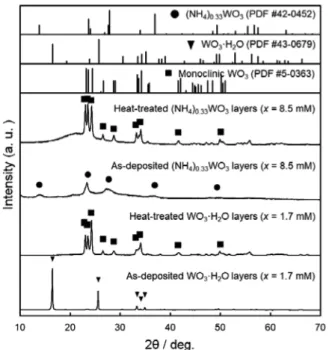
WO3 heat-treated lms were prepared from the WO3$H2O layers consisting of platy particles (x¼1.7 mM, aged at 60C for 3 days) and the (NH4)0.33WO3layers consisting ofne particles (x ¼ 8.5 mM, aged at 50C for 1 day). The precursors were deposited on silica glass substrates, and then thermally con- verted to WO3lms by heating at 600C for 1 day. Fig. 4 shows the XRD patterns of the WO3precursors and heat-treatedlms on silica glass substrates. The diffraction patterns attributed to the monoclinic WO3phase were detected for the heat-treated products.
Fig. 5 shows the micrographs and SEM images of the WO3
heat-treated lms on silica glass substrates. The heat-treated
lms were cloudy and thelm color became light yellow aer the heat treatment (Fig. 5a and c). Crack-freelms were ob- tained from the WO3$H2O layers (Fig. 5a), while cracking and delamination were occasionally observed for the (NH4)0.33WO3
layers aer heating (Fig. 5c). The nano- and micro-structures of the precursors remained even aer the thermal conversion to Fig. 2 XRD patterns of the WO3precursor layers on soda-lime glass
substrates prepared atx¼0.17–8.5 mM.
Fig. 3 SEM images of the WO3precursor layers on soda-lime glass substrates prepared atx¼0.17 (a and b), 0.85 (c and d), 1.7 (e and f), and 8.5 (g and h) mM.
the monoclinic WO3 phase (Fig. 5b and d). Platy particles of approximately 10mm were observed for the WO3 heat-treated
lms prepared from the WO3$H2O layers (Fig. 5b). Previously, we have reported the topotactic transformation of WO3$H2O plates to WO3platy particles by heating, where theat face of WO3plates was the (001) plane of monoclinic WO3.26Thus, in the present work, theat face of the platy particles observed on the substrates was deduced to be the (001) plane of monoclinic WO3, as well as the previous one. On the other hand, porous
lms consisting of ne particles were obtained from the (NH4)0.33WO3layers (Fig. 5d). The cross-section SEM images of the WO3heat-treatedlms are shown in Fig. 6. The thickness of the heat-treated lms obtained from the WO3$H2O and
(NH4)0.33WO3 layers was approximately 4.3 (Fig. 6a) and approximately 2.6mm (Fig. 6b), respectively.
The photoanodic properties were evaluated for the WO3
heat-treatedlms obtained from WO3$H2O (platy particles) and (NH4)0.33WO3layers (ne particles), where the heat-treatedlms were prepared on FTO glass substrates. We checked that the change of substrates from silica glass to FTO glass didn't affect the crystal phases and morphologies of the products. Fig. 7 shows the optical transmission spectra of the WO3heat-treated
lms on FTO glass substrates. As shown in Fig. 5, the WO3heat- treatedlms were cloudy (Fig. 5a and c), which was attributed to the light scattering by the submicron- and micron-scale parti- cles and aggregates in thelm layers. From the optical trans- mittance analysis, the heat-treatedlms actually exhibited a low transparency in the visible range of 300–800 nm, even though WO3materials absorb UV and visible light at wavelengths below 470 nm. Especially, a very low transmittance (almost 0%) was detected in the entire visible range for the platy-particle WO3
lms obtained from WO3$H2O layers. On the other hand, in the case of thene-particle WO3lms obtained from (NH4)0.33WO3
layers, the transmittance slightly increased with increasing wavelength from 350 nm. The low transparency of the platy- particlelms was thought to result from the enhanced light Fig. 4 XRD patterns of the WO3precursor layers and heat-treated
films prepared on silica glass substrates atx¼0.17 mM (aged at 60C for 3 days) and 8.5 mM (aged at 50C for 1 day).
Fig. 5 Optical micrographs (a and c) and SEM images (b and d) of the WO3 heat-treated films obtained from WO3$H2O (a and b) and (NH4)0.33WO3(c and d) precursor layers on silica glass substrates.
Fig. 6 Cross-section SEM images of the WO3heat-treatedfilms ob- tained from WO3$H2O (a) and (NH4)0.33WO3(b) precursor layers on silica glass substrates.
Fig. 7 Optical transmission spectra of the WO3heat-treated films obtained from WO3$H2O and (NH4)0.33WO3precursor layers on FTO glass substrates.
Paper RSC Advances
scattering owing to the larger micron-scale platy particles. Fig. 8 shows the action spectra of the WO3heat-treatedlms, which were measured at a working electrode potential of 1.0 Vversus SCE. The photocurrent under monochromatized light was detected at wavelengths below 450 nm, which agreed with the photoabsorption of WO3materials (band gap energy of WO3is 2.5–2.8 eV). In the UV range below 350 nm, the IPCE value of the
ne-particle lms was higher than that of the platy-particle
lms. Because the photoelectrochemical reactions occur on the surface of the electrode materials, the larger surface area, arising from the porous structure consisting ofne particles, would result in a more efficient energy conversion. On the other hand, at wavelengths over 375 nm, the platy-particle lms exhibited higher IPCE than thene-particlelms. As shown in Fig. 7, the platy-particlelms showed strong light scattering in the visible range. Such light scattering has been reported to elongate the light path length inlm layers, which enhances the light utilization efficiency.9–13 Here, the micron-scale platy particles obtained from WO3$H2O layers could act as a light- scattering layer, which results in the more effective photo- energy conversion in the visible range.
Conclusions
We achieved the morphological control of WO3lm materials by an aqueous solution process. WO3$H2O and (NH4)0.33WO3
layers were prepared on glass substrates through heterogeneous nucleation from (NH4)10W12O41 aqueous solutions, and then thermally converted to monoclinic WO3lms. The variation in the crystal phase of the precursors led to the morphological change of the resultant WO3lms. Micron-scale platy-particle
lms were obtained from WO3$H2O layers, while (NH4)0.33WO3layers provided nano-scalene-particlelms. The larger surface area of thene-particlelms resulted in a better photoanodic response in the UV range below 350 nm. On the other hand, the micron-scale platy particles exhibited strong light scattering in the visible range, which elongated the light path length in thelm layers, leading to the improvement of the
light utilization efficiency at wavelengths over 375 nm. We propose that the morphological control techniques of WO3lm materials through the aqueous solution route and the photo- electrochemical properties depending on the nano- and micro- structures are useful for the development of high-efficiency solar cell devices.
Con fl icts of interest
There are no conicts to declare.
Acknowledgements
This work was supported by KAKENHI, Grant-in-Aid for Scien- tic Research (C), Grant Number JP19K05660, the Kazuchika Okura Memorial Foundation (49th Research Grant), and the Kansai University Fund for Supporting Young Scholars, 2019.
We thank Edanz Group (www.edanzediting.com/ac) for editing a draof this manuscript.
References
1 S. H. Baeck, K. S. Choi, T. F. Jaramillo, G. D. Stucky and E. W. McFarland,Adv. Mater., 2003,15, 1269–1273.
2 W. J. Li, P. M. Da, Y. Y. Zhang, Y. C. Wang, X. Lin, X. G. Gong and G. F. Zheng,ACS Nano, 2014,8, 11770–11777.
3 C. Santato, M. Odziemkowski, M. Ulmann and J. Augustynski,J. Am. Chem. Soc., 2001,123, 10639–10649.
4 H. L. Wang, T. Lindgren, J. J. He, A. Hagfeldt and S. E. Lindquist,J. Phys. Chem. B, 2000,104, 5686–5696.
5 S. C. Wang, H. J. Chen, G. P. Gao, T. Butburee, M. Q. Lyu, S. Thaweesak, J. H. Yun, A. J. Du, G. Liu and L. Z. Wang, Nano Energy, 2016,24, 94–102.
6 D. L. Chen, L. Gao, A. Yasumori, K. Kuroda and Y. Sugahara, Small, 2008,4, 1813–1822.
7 D. Y. Ma, G. Y. Shi, H. Z. Wang, Q. H. Zhang and Y. G. Li,J.
Mater. Chem. A, 2013,1, 684–691.
8 L. Wang, M. Q. Huang, Z. X. Chen, Z. H. Yang, M. Q. Qiu, K. Wang and W. X. Zhang, Crystengcomm, 2016,18, 8688–
8695.
9 C. T. Dinh, H. Yen, F. Kleitz and T. O. Do,Angew. Chem., Int.
Ed., 2014,53, 6618–6623.
10 X. W. Shi, Z. Z. Lou, P. Zhang, M. R. Fujitsuka and T. Majima, ACS Appl. Mater. Interfaces, 2016,8, 31738–31745.
11 F. Sordello, C. Duca, V. Maurino and C. Minero, Chem.
Commun., 2011,47, 6147–6149.
12 C. L. Wang, J. Y. Liao, Y. B. Zhao and A. Manthiram,Chem.
Commun., 2015,51, 2848–2850.
13 M. Xiao, Z. L. Wang, M. Q. Lyu, B. Luo, S. C. Wang, G. Liu, H. M. Cheng and L. Z. Wang,Adv. Mater., 2019,31, 1801369.
14 S. J. Hong, H. Jun, P. H. Borse and J. S. Lee,Int. J. Hydrogen Energy, 2009,34, 3234–3242.
15 Z. H. Jiao, X. W. Sun, J. M. Wang, L. Ke and H. V. Demir,J.
Phys. D: Appl. Phys., 2010,43, 285501.
16 J. Zhang, X. L. Wang, X. H. Xia, C. D. Gu and J. P. Tu,Sol.
Energy Mater. Sol. Cells, 2011,95, 2107–2112.
Fig. 8 Action spectra of the WO3heat-treatedfilms obtained from WO3$H2O and (NH4)0.33WO3precursor layers on FTO glass substrates.
17 J. Y. Zheng, G. Song, J. S. Hong, T. K. Van, A. U. Pawar, D. Y. Kim, C. W. Kim, Z. Haider and Y. S. Kang, Cryst.
Growth Des., 2014,14, 6057–6066.
18 Y. T. Liu, M. Li, Q. Y. Zhang, P. C. Qin, X. D. Wang, G. N. He and L. Li,J. Chem. Technol. Biotechnol., 2020,95, 665–674.
19 J. B. Jensen and J. S. R. Buch,Acta Chem. Scand., Ser. A, 1980, 34(2), 99–107.
20 R. Arnek,Acta Chem. Scand., 1969,23(6), 1986–1992.
21 R. Arnek and Y. Sasaki, Acta Chem. Scand., Ser. A, 1974, A28(1), 20–22.
22 J. Aveston,Inorg. Chem., 1964,3(7), 981–986.
23 Y. Sasaki,Acta Chem. Scand., 1961,15(1), 175–189.
24 M. Elnouby, K. Kuruma, E. Nakamura, H. Abe, Y. Suzuki and M. Naito,J. Ceram. Soc. Jpn., 2013,121, 907–911.
25 H. Suzuki, O. Tomita, M. Higashi and R. Abe,J. Mater. Chem.
A, 2017,5, 10280–10288.
26 H. Uchiyama, S. Mizuguchi and S. Hirano,R. Soc. Open Sci., 2019,6, 182137.
Paper RSC Advances