九州大学学術情報リポジトリ
Kyushu University Institutional Repository
Rhizoctonia solani K?hnに関する菌学的・植物病理 学的研究
諸見里, 善一
https://doi.org/10.11501/3063822
出版情報:Kyushu University, 1992, 博士(農学), 論文博士 バージョン:
権利関係:
Mycological and Phytopathological Studies on �izoctonia solani Ktihn
by
Zenichi MOROMIZATO
1992
College of Agriculture, University of the Ryukyus
Okinawa, Japan
CONTENTS
I. INTRODUC1'ION · · · · · · · · · · · · · · · · · · · · · · · · · · · · · · · · · · · · · · · · · · · · · · · · · · · · · · · · · · · · · · 1
II. Grouping Rbizoctonia solani Ktihn with nonspecific esterase zymogram ······ · 12
Materials and Methods · · · · · · · · · · · · · · · · · · · · · · · · · · · · · · · · · · · · · · · · · · · · · · · · · · · · · 12
Results · · · · · · · · · · · · · · · · · · · · · · · · · · · · · · · · · · · · · · · · · · · · · · · · · · · · · · · · · · · · · · · · · · · 16
Dis cuss ion · · · · · · · · · · · · · · · · · · · · · · · · · · · · · · · · · · · · · · · · · · · · · · · · · · · · · · · · · · · · · · · · 21
III. Morphology of sclerotia of Rbizoctonia solani ···· ······ ··········· ····· ··· 24
Materials and Methods · · · · · · · · · · · · · · · · · · · · · · · · · · · · · · · · · · · · · · · · · · · · · · · · · · · · · 24
Results · · · · · · · · · · · · · · · · · · · · · · · · · · · · · · · · · · · · · · · · · · · · · · · · · · · · · · · · · · · · · · · · · · · 25
Discussion · · · · · · · · · · · · · · · · · · · · · · · · · · · · · · · · · · · · · · · · · · · · · · · · · · · · · · · · · · · · · · · · 27
IV. Effects of sev eral physical factors on sclerotium longevity of Rhizoctonia solani · · · · · · · · · · · · · · · · · · · · · · · · · · · · · · · · · · · · · · · · · · · · · · · · · · · · · · · · 30
Materials and Methods · · · · · · · · · · · · · · · · · · · · · · · · · · · · · · · · · · · · · · · · · · · · · · · · · · · · · 31
Results · · · · · · · · · · · · · · · · · · · · · · · · · · · · · · · · · · · · · · · · · · · · · · · · · · · · · · · · · · · · · · · · · · · 32
Dis cuss ion · · · · · · · · · · · · · · · · · · · · · · · · · · · · · · · · · · · · · · · · · · · · · · · · · · · · · · · · · · · · · · · · 38
V. Enzymatic study on th e sclerotium formation in Rhizoctonia solani · ······ ·· 40
Mat erials and Methods · · · · · · · · · · · · · · · · · · · · · · · · · · · · · · · · · · · · · · · · · · · · · · · · · · · · · 41
Results · · · · · · · · · · · · · · · · · · · · · · · · · · · · · · · · · · · · · · · · · · · · · · · · · · · · · · · · · · · · · · · · · · · 42
Discussion · · · · · · · · · · · · · · · · · · · · · · · · · · · · · · · · · · · · · · · · · · · · · · · · · · · · · · · · · · · · · · · · 45
VI. The longevity of sclerotium forming fungi in soil ······ ····· ······ ······· · 47
Materials a nd Methods · · · · · · · · · · · · · · · · · · · · · · · · · · · · · · · · · · · · · · · · · · · · · · · · · · · · · 49
Results · · · · · · · · · · · · · · · · · · · · · · · · · · · · · · · · · · · · · · · · · · · · · · · · · · · · · · · · · · · · · · · · · · · 53
Dis cuss ion · · · · · · · · · · · · · · · · · · · · · · · · · · · · · · · · · · · · · · · · · · · · · · · · · · · · · · · · · · · · · · · · 65
VII. Effects of nutrients on sclerotium formation of Rhizoctonia solani ······ ·· 69
Exp. 1 · · · · · · · · · · · · · · · · · · · · · · · · · · · · · · · · · · · · · · · · · · · · · · · · · · · · · · · · · · · · · · · · · · · · 70
Materials and Methods · · · · · · · · · · · · · · · · · · · · · · · · · · · · · · · · · · · · · · · · · · · · · · · · · · · · · 70
Results · · · · · · · · · · · · · · · · · · · · · · · · · · · · · · · · · · · · · · · · · · · · · · · · · · · · · · · · · · · · · · · · · · · 71
Discussion · · · · · · · · · · · · · · · · · · · · · · · · · · · · · · · · · · · · · · · · · · · · · · · · · · · · · · · · · · · · · · · · 78
Exp. 2 · · · · · · · · · · · · · · · · · · · · · · · · · · · · · · · · · · · · · · · · · · · · · · · · · · · · · · · · · · · · · · · · · · · · 81
Materia 1 s a nd Methods · · · · · · · · · · · · · · · · · · · · · · · · · · · · · · · · · · · · · · · · · · · · · · · · · · · · · 81
Results · · · · · · · · · · · · · · · · · · · · · · · · · · · · · · · · · · · · · · · · · · · · · · · · · · · · · · · · · · · · · · · · · · · 85
Dis cuss ion · · · · · · · · · · · · · · · · · · · · · · · · · · · · · · · · · · · · · · · · · · · · · · · · · · · · · · · · · · · · · · · · 96
VIII. Effects of a mino acids on sclerotium formation of Rhizoctonia solani Part 1. Inhibition of sclerotium formation by various amino acids ·· ······· 101
Materials a nd Methods · · · · · · · · · · · · · · · · · · · · · · · · · · · · · · · · · · · · · · · · · · · · · · · · · · · · · 101
Results a nd Dis cuss ion · · · · · · · · · · · · · · · · · · · · · · · · · · · · · · · · · · · · · · · · · · · · · · · · · · · · 103
Part 2. Developmental process of sclerotium formation and its inhibition by several amino acids · · · · · · · · · · · · · · · · · · · · · · · · · · · · · · · · · · · · · · · · · · · · · · · · · · · · 110
Materials and Methods · · · · · · · · · · · · · · · · · · · · · · · · · · · · · · · · · · · · · · · · · · · · · · · · · · · · · 110
Results and Dis cuss ion · · · · · · · · · · · · · · · · · · · · · · · · · · · · · · · · · · · · · · · · · · · · · · · · · · · · 113
I� Effects of lights on sclerotium formation of Rhizoctonia solani ··· ······ ·· 120
Materials and Methods · · · · · · · · · · · · · · · · · · · · · · · · · · · · · · · · · · · · · · · · · · · · · · · · · · · · · 121
Results · · · · · · · · · · · · · · · · · · · · · · · · · · · · · · · · · · · · · · · · · · · · · · · · · · · · · · · · · · · · · · · · · · · 123
Dis cuss ion · · · · · · · · · · · · · · · · · · · · · · · · · · · · · · · · · · · · · · · · · · · · · · · · · · · · · · · · · · · · · · · · 133
� CONCLUSIONS · · · · · · · · · · · · · · · · · · · · · · · · · • · · · • · · · · · · · · · · · · · · · · · · · · · · · · · · • · · · · · · 136
XI. Acknowle<igJDents · · · · · · · · · · · · · · · · · · · · · · · · · · · · · · · · · · · · · · · · · · · · · · · · · · · · · · · · · · · 146
XII. Literature cited · · · · · · · · · · · · · · · · · · · · · · · · · · · · · · · · · · · · · · · · · · · · · · · · · · · · · · · · · · 147
I. INTRODUCTION
The genus Rhizoctonia was newly established by Candolle in
1815
andRhizoctonia solani was first described by Ktihn in
1858
as a causal agent of potato black scurf (Kuroazabyo)67>. The fungus is distributed widely in the fields, paddy fields, meadows and forests of the world and is a parasite on over250
plants: crops, vegetables, flowering plants, grasses etc. having varioussymptoms such as sheath blight, web-blight, damping-off, root rot etc. (Table 1, Plate
1).
Furthermore, R solani is not only parasitic on living plants butalso lives on decaying plant residue and, s ymbiotically, on orchid plants117' 123-125.127, 130)
Rhizoctonia species 1s classified in the family Agonomycetaceae (Sterile mycelia), Agonomycetales (Mycelia Sterilla), Hyphomycetes (Fungi imperfecti).
The fungus is identified by:
1)
the number of nuclei 1n nutrient hyphae,2)
thepresence of dolipore_septum,
3)
the branching manner of the hyphae,4)
the color of the hyphae,5)
the formation of moniloid cell,6)
the formation of sclerotia,7)
the hyphal size and8)
the hyphal growth rate, because it does not produceconidia100>. The perfect stage of this fungus had been unknown for a long time because of the difficulty of formation of sexual spore. Even after the perfect stage (basidiospore) was clarified by various techniques, the classification had
-1-
been continuously discussed and the genus name was changed 1n Hypochnus, Cor ticium, Pellicula ria, Bot rybasidium and Ceratobasidi� At present, the
name Thanatephorus is strongly supported. Parmeter et al. 100' 101>
have named � cucumeris (Japanese name:Kumonosukouyakutake) as the perfect stage of R. solani.
They also explained that there are 3 types known as "praticola," "sasakii" and
"solani" of T. cucumeris and that it is difficult to distinguish them as
different species by the morphology of the perfect stage101>. On the other
hand, it is well-known that R. solani involves morphologically, physiologically and pathologically different groups. Watanabe and Matsuda130> examined 220
isolates of R. solani from 59 different field crops from various places 1n Japan
and classified their ecological characters by cultural type, pathogenicity and
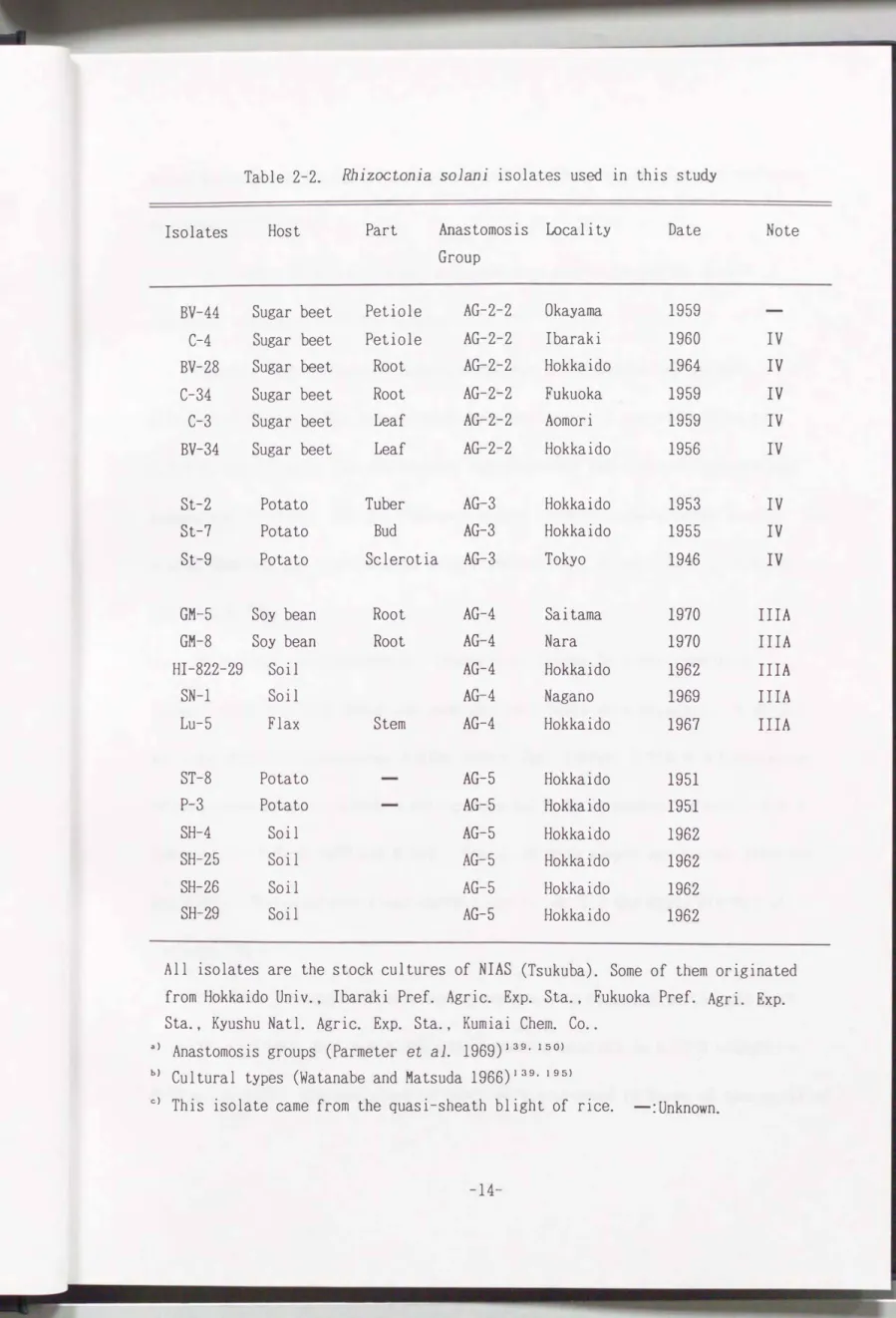
saprophytic activity. Ogoshi 92-95> had classified R. solani by anastomosis which occurred in the same or related isolates and reported that anastomosis groups coincided well with pathogenetic or other classifications. The primary
infection source of the diseases by R. solani is mostly by sclerotium (pl.
sclerotia) 121. 125. 1 26>. Fungal sclerotia are asexual, multicellular, firm
resting structures which become interwoven and aggregate. They are rich in stored nutrients so that they can persist for longer periods than the vegetative
hyphae in adverse soi 1 environments 2 9 • 1 19 • 1 3 s> • Sclerotia are classified according to the modes of germination into three types: 1) the myceliogenic
type, in which individual hyphae or hyphal aggregates are d eveloped directly, such as in Helicobasidium purpureum, Macrophomina phaseoli, Mycosherella
ligulicol� Phymatotrichum omnivoru� Rhizoctonia solani, Sclerotinia gladioli, S. delphinii, S. rolfsii and Verticillium dah liae (as V. albo-atrum
)
,2)
thesporogenic type, in which conidiophores and conidia are produced, such as
Botrytis convolut� B. tulipae, Colletotrichum coccod es, Gloeocercospora sorghi and Helminthosp orium oryzae, and
3)
the carporoge nic type, in which fruit bodies such as ascocarps or basidiocarps are generated, such as Claviceps microcephala,� purpurea, Sclerotinia mino� S. polyblastis, S. sclerotiorum, � trifoliorum, Typhula idahoensis and T. incarnata29>. These modes correlate with the
sclerotia! size because of the necessity of a food-base for the germination. In
general, the size of the myceliogenic sclerotia tends to be small, whereas the
carpogenic sclerotia are correspondingly larger because of the larger amounts of nutrients required for the formation of fruit bodies37>. Furthermore, root and
foliage infecting fungi are myceliogenic and carpogenic, respectively 37>.
Sclerotia! initials originate by hyphal branching, interweaving and aggregation.
These then developed to white immature sclerotia with an increase in size by repeated branching, aggregation and granulation, and matured with
pigmentation22' 119>. The manner of initial formation is different 1n different
fungal species. Townsend and Willetts119> divided the sclerotium forming fungi
-3-
into 3 types: the terminal type, the strand type and the loose type. Mature sclerotia vary 1n layer structure from those without a differentiated rind to those with several well differentiated layers from rind to medulla. Sclerotium
rolfsii produces sclerotia of most complex structure with 4 distinct layers: a)
fairly thick skin or cuticle, b) a rind, two to four cells thick, made of broad and tangentially flattened cells, c) a thin-wall cortex with densely stained
cytoplasm, and d) a medulla of loose filamentous hyphae also with dense
contents29>.
The sclerotium produced by R. solani belongs to the myceliogenic type with regard to the manner of germination, and to the loose type with regard to the
forming of the initials, thus the simplest of all fungi29' 103>. Although there
is no definite pattern of organ ization of the hyphae in the initials, the sclerotia! initial is originated by an irregular branching of the ordinary
mycelium with production of much more numerous septa. The mature sclerotia are
much less tightly interwoven than those of other fungi and there is no obvious differentiation into a rind and a medulla119>. Although there are certain
differences in morphology of sclerotia of R. solani, in general, they become dark pigmented and have spherical , irregular or flat shapes from 0.2 mm to 6 mm
1 n size 1 2 s> •
In recent years, with changing cultivation practices, damage caused by the
fungus has been increasing annually. In this thesis the author describes the application of the zymogram analysis to clarify the relationships among the
anastomosis groups of R. solani, and compares the structural changes during the morphogenesis, and survival of this fungus in var1ous physical and microbiologi
cal environments,- with those of another sclerotium forming fungi of different
morphology. Also, an enzymatic study was undertaken to elucidate the process of sc lerotium formation, the induci ng and inhibiting factors were investigated
as part of a fundamental research into methods for controlling the disease
caused by R. ·solani.
-5-
Table 1-1. Rhizoctonia diseases in Japan
Host plants Disease name
Food crops and special crops
1. Rice Sheath blight
2. Rice Borded sheath spot
3. Rice Brown sheath blight
4. Barley Sheath blight
5. Foxtail millet 6. Sorghum
7. Maize
8. Common millet 9. Barnyard millet 10. Potato
11. Potato 12. Sweet potato 13. Soybean 14. Adzuki bean 15. Adzuki bean 16. Kidney bean 17. Kidney bean 18. Cowpea 19. Pea
20. Broad bean 21. Tobacco 22. Tea
23. Sugar beet 24. Sugar beet 25. Sugar beet 26. Sugar beet 27. Sugar cane 28. Mat rush 29. Cotton
Sheath blight
Sheath blight Leaf-sheath blight Sheath blight Sheath blight Foliage blight Black scurf Charcoal rot Rhizoctonia rot Rhizoctonia rot Charcoal rot Rhizoctonia rot Charcoal rot Charcoal rot
Rhizoctonia stem rot Rhizoctonia rot
Sore shin, Damping-off Web-blight
Leaf blight
Seedling damping-off Root rot
Damping-off
Banded sclerotia! disease Stem rot
Sore shin
Fungus
R. solani R. oryzae R. solani R. solani R. solani R. solani R. solani R. solani R. solani R. solani R. solani R. bataticola R. solani R. solani R. bataticola R. solani R. bataticola R. bataticola R. solani R. solani R. solani R. solani R. solani R. solani R. solani R. candida R. solani R. solani R. solani
Note
AG-2-2, IIIB AG-1, IA AG-1, IA AG-1, IA AG-1, IA AG-1, IA AG-1, IA
AG-3, IV
AG-2-1, II AG-2-1, II
AG-2-1, II
AG-2-2 AG-2-1, II AG-4, IliA AG-1, IB AG-2-2, IV AG-4, IliA AG-2-2, IIIB
AG-1, IA AG-2-2, IIIB AG-4, IliA