Japan’s New Direction for Global Health Cooperation in the Era of the Sustainable Development Goals
Holistic learning process through multi-stakeholder approach to nurture social transformation toward achieving Universal Health
Coverage and Global Well-being Group 5
Team Troika
Tomohiko Sugishita, JICA (Lead)
1, Hidechika Akashi, NCGM (Lead)
2, Toshiro Kumakawa, NIPH (Lead)
3Abstract
While the Sustainable Development Goals (SDGs) were ratified at the United Nations Summit for the Adoption of the Post-2015 Development Agenda in September 2015, it is high time that Japan should contribute to realizing the SDGs in practice. In the era of the SDGs, we are facing planetary boundaries, power fragmentation, systemic complexity, and much uncertainty. Thus, Japan’s Official Development Assistance (ODA) must pay more attention to the aspect of “transformation”
by strengthening learning processes and stakeholder engagement. To foster resilience and integrity in our societies, the people must be in the driving seat and ODA can play a catalytic role in social transformation by providing evidence, opportunities, and networking. This article proposes that a Holistic Learning Process should be at the center of global health cooperation and supported by a transformational platform and multi-stakeholder approach. Active learning resources as to Japan’s experiences with overcoming issues in health, security, and disaster response can provide lively aspirations to those proactive learners. This seamless and dynamic process articulates the frontier of our efforts in promoting institutional development, systems transformation, and smart governance towards enhancing resilient societies, global well-being, and a sustainable future of our planet.
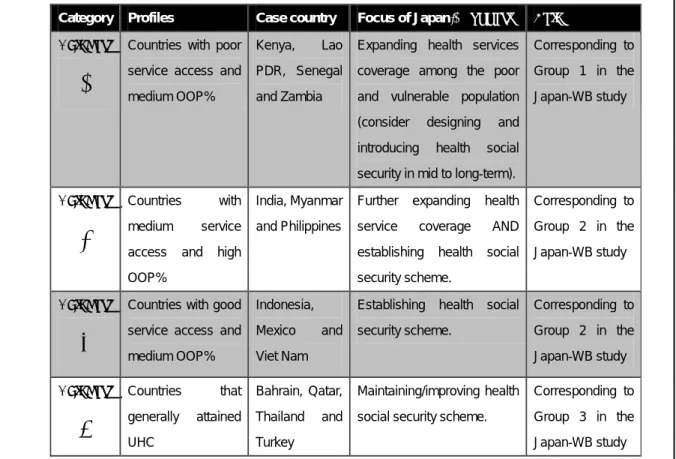
Column (1) UHC profiling and spectrum matrix Column (2) Synergies with other global partners
1. Introduction
On September 25, 2015, the 193 countries of the United Nations Sustainable Development Summit adopted the Sustainable Development Goals, also known as the Global Goals for Sustainable Development, with 17 Goals and 169 targets. The Agenda 2030 entitled
“transforming our world” declared that “[t]his Agenda is a plan of action for people, planet and prosperity. We are determined to take the bold and transformative steps which are urgently needed to shift the world onto a sustainable and resilient path. As we embark on this collective journey, we pledge that no one will be left behind.”4
The MDGs have contributed an enormous impact on improving essential health service
provision, reducing child and maternal mortality, and combating HIV, malaria, tuberculosis, and other diseases. However, they failed to articulate the root causes of inequities in health;
interactions between health, poverty, and other social determinants; and the holistic nature of social, economic, and environmental development. Moreover, interrelated predicaments today cannot be addressed by a single set of government or other decision-makers but require cooperation between many different actors and stakeholders. It is plausible that the SDGs will be incapable of successful resolution unless all parties are fully involved from the very outset.
In the health sector, at least 400 million people do not have access to one or more essential health services and 6% of people in low- and middle-income countries are tipped into or pushed further into extreme poverty because of increasing out-of-pocket health spending5. This is striking evidence that efforts on improving health status themselves can boost poverty and socioeconomic disparities due to incremental costs of medicines and services. Moreover, the most recent Ebola outbreak caused catastrophe in West Africa and even far away in the United States and Europe. The global community comprehends that local risks have international repercussions and the outbreak was not just a matter of contagious diseases, but of financial crisis, climate change, and human security, as well.
In the era of the SDGs, conspicuous concerns on equity, solidarity, and resilience emerged as learning aspects of social systems. In facing planetary boundaries, all life on earth depends on our proactive and creative mindsets. This is why that the word “transformation” becomes significant, in which our transitional efforts determine the state of the planet for generations to come. Each of us plays a crucial role in changing lifestyles in the pursuit of health and
well-being. In terms of social transformation, Japan has enormous experience in facing demographic and economic challenges over past few decades. Notably, the achievement of Universal Health Coverage in 1961 followed by rapid population aging, and the rebuilding of society after the Great Hanshin earthquake (1995) and the Great East Japan earthquake (2011) are vivid examples how the people have overcome unexpected calamity and rebuilt society through full stakeholder engagement.
At this juncture, this article urges that it is high time for the Government of Japan to contribute to turning the SDGs into a reality. In the era of the SDGs, the role of the Japan’s Official
Development Assistance (ODA) must be to pay more attention on the aspect of “transformation”
in development cooperation by strengthening learning processes and stakeholder engagement.
This paper will examine and articulate Japan’s new direction for global Health cooperation in the era of the SDGs, in which a holistic learning process for institutional development, systems transformation, and smart governance is proposed to nurture resilient societies, global
well-being, and a sustainable future for our planet.
2. Japan’s Experience as Active Learning Resource
In the era of the SGDs, institutional development and systems transformation needs to be enhanced by new perspectives inspired through interactive processes. As there is much knowledge accumulated in Japanese society, actual visiting programs to Japan can enhance creative thinking that can be obtained in no other way. In this sense, Japan is one of few countries that can contribute to providing full-content learning packages from a vast range of active resources. While many countries strive for transformative processes of designing and formulating health systems, they demand more specific and practical learning modules from Japan’s experiences with policy innovations.
For an example of an active learning resource, the impact of population ageing in many countries demands crucial preparation to elaborate strategies that can transform social systems according to the resulting economic, demographic, and epidemiological transitions.
The expansion of comprehensive long-term care should consider entitlements to all those who need them, including income transfers from the well-off to lower income, coming from a shrinking share of the economically productive population, to protect against
impoverishing costs. While Japan has shown the most dramatic increase of its elderly population ratio among OECD countries and at the highest speed (Figure 3), long-term care programs in Japan are grounded in health expenditure profiles throughout the life cycle.
Since the attainment of three dimensions of insurance coverage (population coverage:
informal sector involvement by the National Health Insurance Act in 1961, financial coverage: financial protection by the Catastrophic Medical Expense Coverage Policy in 1973, service coverage: the introduction of the Specified Mixed Medical Care Coverage System in 1984), universal health insurance coverage in Japan has continued successive policy innovations to cover medical and non-medical costs for the elderly in an effective and efficient manner (Figure 4).
Figure 3: Project
Figure 4: Policy innovation in Japan responding to demographic transition Figure 3: Project
Figure 4: Policy innovation in Japan responding to demographic transition Figure 3: Projection of elderly population ratios
Figure 4: Policy innovation in Japan responding to demographic transition ion of elderly population ratios
Figure 4: Policy innovation in Japan responding to demographic transition ion of elderly population ratios
Figure 4: Policy innovation in Japan responding to demographic transition Figure 4: Policy innovation in Japan responding to demographic transition Figure 4: Policy innovation in Japan responding to demographic transition Figure 4: Policy innovation in Japan responding to demographic transition
Responses to ageing populations are complicated by the fact that ageing is not just about older people, but is multi
the design of social security systems, the provision of health and social services from “womb to tomb,” and other aspects of public policy. It can be highlighted by a well
policy inno
Japan (Table 1). Their response covered pensions and social security, labor and savings, macroeconomic impacts, as well as health service provision and long
on-going efforts in maintaining universal health coverage are “active learning resources” to those critical learners, especially in the areas of political will, evidence
systems design, flexible policy amendment, and multi
Table 1: Policy innovations to cope with social transition
Regarding the transformative nature of the learning process, Japan can provide successive references as a
community health policies in Japan, the themes and topics have been changing over time and the learner can enrich the practical implications for policy innovations through enhanced understanding of historical and social contexts (Table 2).
Responses to ageing populations are complicated by the fact that ageing is not just about older people, but is multi
the design of social security systems, the provision of health and social services from “womb to tomb,” and other aspects of public policy. It can be highlighted by a well
policy innovations in accordance with social transitions as undertaken by the Government of Japan (Table 1). Their response covered pensions and social security, labor and savings, macroeconomic impacts, as well as health service provision and long
going efforts in maintaining universal health coverage are “active learning resources” to those critical learners, especially in the areas of political will, evidence
systems design, flexible policy amendment, and multi
Table 1: Policy innovations to cope with social transition
Regarding the transformative nature of the learning process, Japan can provide successive references as a dynamic and longitudinal process. For instance with learning programs for community health policies in Japan, the themes and topics have been changing over time and the learner can enrich the practical implications for policy innovations through enhanced
nderstanding of historical and social contexts (Table 2).
Responses to ageing populations are complicated by the fact that ageing is not just about older people, but is multi-dimensional and multi
the design of social security systems, the provision of health and social services from “womb to tomb,” and other aspects of public policy. It can be highlighted by a well
vations in accordance with social transitions as undertaken by the Government of Japan (Table 1). Their response covered pensions and social security, labor and savings, macroeconomic impacts, as well as health service provision and long
going efforts in maintaining universal health coverage are “active learning resources” to those critical learners, especially in the areas of political will, evidence
systems design, flexible policy amendment, and multi
Table 1: Policy innovations to cope with social transition
Regarding the transformative nature of the learning process, Japan can provide successive dynamic and longitudinal process. For instance with learning programs for community health policies in Japan, the themes and topics have been changing over time and the learner can enrich the practical implications for policy innovations through enhanced
nderstanding of historical and social contexts (Table 2).
Responses to ageing populations are complicated by the fact that ageing is not just about older dimensional and multi
the design of social security systems, the provision of health and social services from “womb to tomb,” and other aspects of public policy. It can be highlighted by a well
vations in accordance with social transitions as undertaken by the Government of Japan (Table 1). Their response covered pensions and social security, labor and savings, macroeconomic impacts, as well as health service provision and long
going efforts in maintaining universal health coverage are “active learning resources” to those critical learners, especially in the areas of political will, evidence
systems design, flexible policy amendment, and multi
Table 1: Policy innovations to cope with social transition
Data were quoted from journal of health and welfare 2014/2015 Regarding the transformative nature of the learning process, Japan can provide successive
dynamic and longitudinal process. For instance with learning programs for community health policies in Japan, the themes and topics have been changing over time and the learner can enrich the practical implications for policy innovations through enhanced
nderstanding of historical and social contexts (Table 2).
Responses to ageing populations are complicated by the fact that ageing is not just about older dimensional and multi-generational. It has implications for taxation policy, the design of social security systems, the provision of health and social services from “womb to tomb,” and other aspects of public policy. It can be highlighted by a well
vations in accordance with social transitions as undertaken by the Government of Japan (Table 1). Their response covered pensions and social security, labor and savings, macroeconomic impacts, as well as health service provision and long
going efforts in maintaining universal health coverage are “active learning resources” to those critical learners, especially in the areas of political will, evidence
systems design, flexible policy amendment, and multi-
Table 1: Policy innovations to cope with social transition
Data were quoted from journal of health and welfare 2014/2015 Regarding the transformative nature of the learning process, Japan can provide successive
dynamic and longitudinal process. For instance with learning programs for community health policies in Japan, the themes and topics have been changing over time and the learner can enrich the practical implications for policy innovations through enhanced
nderstanding of historical and social contexts (Table 2).
Responses to ageing populations are complicated by the fact that ageing is not just about older rational. It has implications for taxation policy, the design of social security systems, the provision of health and social services from “womb to tomb,” and other aspects of public policy. It can be highlighted by a well
vations in accordance with social transitions as undertaken by the Government of Japan (Table 1). Their response covered pensions and social security, labor and savings, macroeconomic impacts, as well as health service provision and long
going efforts in maintaining universal health coverage are “active learning resources” to those critical learners, especially in the areas of political will, evidence
-stakeholder engagement.
Table 1: Policy innovations to cope with social transition
Data were quoted from journal of health and welfare 2014/2015 Regarding the transformative nature of the learning process, Japan can provide successive
dynamic and longitudinal process. For instance with learning programs for community health policies in Japan, the themes and topics have been changing over time and the learner can enrich the practical implications for policy innovations through enhanced
nderstanding of historical and social contexts (Table 2).
Responses to ageing populations are complicated by the fact that ageing is not just about older rational. It has implications for taxation policy, the design of social security systems, the provision of health and social services from “womb to tomb,” and other aspects of public policy. It can be highlighted by a well-elaborated process of
vations in accordance with social transitions as undertaken by the Government of Japan (Table 1). Their response covered pensions and social security, labor and savings, macroeconomic impacts, as well as health service provision and long-term care. Indeed,
going efforts in maintaining universal health coverage are “active learning resources” to those critical learners, especially in the areas of political will, evidence-based forecasting,
holder engagement.
Data were quoted from journal of health and welfare 2014/2015 Regarding the transformative nature of the learning process, Japan can provide successive
dynamic and longitudinal process. For instance with learning programs for community health policies in Japan, the themes and topics have been changing over time and the learner can enrich the practical implications for policy innovations through enhanced Responses to ageing populations are complicated by the fact that ageing is not just about older
rational. It has implications for taxation policy, the design of social security systems, the provision of health and social services from “womb to
elaborated process of vations in accordance with social transitions as undertaken by the Government of Japan (Table 1). Their response covered pensions and social security, labor and savings,
term care. Indeed, Japan’s going efforts in maintaining universal health coverage are “active learning resources” to
based forecasting, holder engagement.
Data were quoted from journal of health and welfare 2014/2015 Regarding the transformative nature of the learning process, Japan can provide successive
dynamic and longitudinal process. For instance with learning programs for community health policies in Japan, the themes and topics have been changing over time and the learner can enrich the practical implications for policy innovations through enhanced Responses to ageing populations are complicated by the fact that ageing is not just about older
rational. It has implications for taxation policy, the design of social security systems, the provision of health and social services from “womb to
elaborated process of vations in accordance with social transitions as undertaken by the Government of
Japan’s going efforts in maintaining universal health coverage are “active learning resources” to
Data were quoted from journal of health and welfare 2014/2015
dynamic and longitudinal process. For instance with learning programs for community health policies in Japan, the themes and topics have been changing over time and
Table 2: Trends and training topic modifications
3. Challenges in Japan’s Technical Cooperation for its Health Sector
The Government of Japan uses an array of development assistance schemes to meet the diverse needs of developing countries around the world. Japan’s bilateral assistance through the Japan International Cooperation Agency (JICA) to developing countries has
such as technical cooperation, grant aid, ODA loans, volunteer programs, emergency and disaster relief program etc. In terms of technical cooperation projects in the health sector, JICA conducts an annual average of 93 projects (F
billion since 2000. The most popular cooperation area is health systems strengthening, followed by maternal and child health and infectious disease control.
Table 2: Trends and training topic modifications
Challenges in Japan’s Technical Cooperation for its Health Sector
The Government of Japan uses an array of development assistance schemes to meet the diverse needs of developing countries around the world. Japan’s bilateral assistance through the Japan International Cooperation Agency (JICA) to developing countries has
such as technical cooperation, grant aid, ODA loans, volunteer programs, emergency and disaster relief program etc. In terms of technical cooperation projects in the health sector, JICA conducts an annual average of 93 projects (F
billion since 2000. The most popular cooperation area is health systems strengthening, followed by maternal and child health and infectious disease control.
Table 2: Trends and training topic modifications
Edited from annual report of National Institute of Public Health 1938
Challenges in Japan’s Technical Cooperation for its Health Sector
The Government of Japan uses an array of development assistance schemes to meet the diverse needs of developing countries around the world. Japan’s bilateral assistance through the Japan International Cooperation Agency (JICA) to developing countries has
such as technical cooperation, grant aid, ODA loans, volunteer programs, emergency and disaster relief program etc. In terms of technical cooperation projects in the health sector, JICA conducts an annual average of 93 projects (F
billion since 2000. The most popular cooperation area is health systems strengthening, followed by maternal and child health and infectious disease control.
Table 2: Trends and training topic modifications
Edited from annual report of National Institute of Public Health 1938
Challenges in Japan’s Technical Cooperation for its Health Sector
The Government of Japan uses an array of development assistance schemes to meet the diverse needs of developing countries around the world. Japan’s bilateral assistance through the Japan International Cooperation Agency (JICA) to developing countries has
such as technical cooperation, grant aid, ODA loans, volunteer programs, emergency and disaster relief program etc. In terms of technical cooperation projects in the health sector, JICA conducts an annual average of 93 projects (F
billion since 2000. The most popular cooperation area is health systems strengthening, followed by maternal and child health and infectious disease control.
Table 2: Trends and training topic modifications
Edited from annual report of National Institute of Public Health 1938
Challenges in Japan’s Technical Cooperation for its Health Sector
The Government of Japan uses an array of development assistance schemes to meet the diverse needs of developing countries around the world. Japan’s bilateral assistance through the Japan International Cooperation Agency (JICA) to developing countries has
such as technical cooperation, grant aid, ODA loans, volunteer programs, emergency and disaster relief program etc. In terms of technical cooperation projects in the health sector, JICA conducts an annual average of 93 projects (Figure 1), which have amounted to a total $ 23 billion since 2000. The most popular cooperation area is health systems strengthening, followed by maternal and child health and infectious disease control.
Edited from annual report of National Institute of Public Health 1938
Challenges in Japan’s Technical Cooperation for its Health Sector
The Government of Japan uses an array of development assistance schemes to meet the diverse needs of developing countries around the world. Japan’s bilateral assistance through the Japan International Cooperation Agency (JICA) to developing countries has
such as technical cooperation, grant aid, ODA loans, volunteer programs, emergency and disaster relief program etc. In terms of technical cooperation projects in the health sector, JICA
igure 1), which have amounted to a total $ 23 billion since 2000. The most popular cooperation area is health systems strengthening, followed by maternal and child health and infectious disease control.
Edited from annual report of National Institute of Public Health 1938
Challenges in Japan’s Technical Cooperation for its Health Sector
The Government of Japan uses an array of development assistance schemes to meet the diverse needs of developing countries around the world. Japan’s bilateral assistance through the Japan International Cooperation Agency (JICA) to developing countries has several major components such as technical cooperation, grant aid, ODA loans, volunteer programs, emergency and disaster relief program etc. In terms of technical cooperation projects in the health sector, JICA
igure 1), which have amounted to a total $ 23 billion since 2000. The most popular cooperation area is health systems strengthening, followed
Edited from annual report of National Institute of Public Health 1938
Challenges in Japan’s Technical Cooperation for its Health Sector
The Government of Japan uses an array of development assistance schemes to meet the diverse needs of developing countries around the world. Japan’s bilateral assistance through the Japan
several major components such as technical cooperation, grant aid, ODA loans, volunteer programs, emergency and disaster relief program etc. In terms of technical cooperation projects in the health sector, JICA
igure 1), which have amounted to a total $ 23 billion since 2000. The most popular cooperation area is health systems strengthening, followed
Edited from annual report of National Institute of Public Health 1938-2015
Challenges in Japan’s Technical Cooperation for its Health Sector
The Government of Japan uses an array of development assistance schemes to meet the diverse needs of developing countries around the world. Japan’s bilateral assistance through the Japan
several major components disaster relief program etc. In terms of technical cooperation projects in the health sector, JICA
igure 1), which have amounted to a total $ 23 billion since 2000. The most popular cooperation area is health systems strengthening, followed
Figure 1: Number of technical cooperation projects o
Modified from
Technical training programs in Japan are another major form of health sector, an annual average of 251 short
trainees amounted to a total of 15,104 trainees since 2000 (Figure 2). The most popular training course is “health systems strengthening”
of total programs in the health sector. While the training content focused more on service provision and medical intervention, emerging contents such as health financing, aging society and strategic mana
Consequently, special training courses targeting health insurance and active aging societies were developed and implemented (3 courses, 46 trainees in 2014).
Figure 2: Number of
Figure 1: Number of technical cooperation projects o
Modified from http://www.jica.go.jp/english/publications/reports/annual/index.html Technical training programs in Japan are another major form of
health sector, an annual average of 251 short
trainees amounted to a total of 15,104 trainees since 2000 (Figure 2). The most popular training course is “health systems strengthening”
of total programs in the health sector. While the training content focused more on service provision and medical intervention, emerging contents such as health financing, aging society and strategic mana
Consequently, special training courses targeting health insurance and active aging societies were developed and implemented (3 courses, 46 trainees in 2014).
Figure 2: Number of
Figure 1: Number of technical cooperation projects o
http://www.jica.go.jp/english/publications/reports/annual/index.html Technical training programs in Japan are another major form of
health sector, an annual average of 251 short
trainees amounted to a total of 15,104 trainees since 2000 (Figure 2). The most popular training course is “health systems strengthening”
of total programs in the health sector. While the training content focused more on service provision and medical intervention, emerging contents such as health financing, aging society and strategic management have gained serious attention at the request of the trainees
Consequently, special training courses targeting health insurance and active aging societies were developed and implemented (3 courses, 46 trainees in 2014).
Figure 2: Number of courses and trainees in the health sector Figure 1: Number of technical cooperation projects o
http://www.jica.go.jp/english/publications/reports/annual/index.html Technical training programs in Japan are another major form of
health sector, an annual average of 251 short
trainees amounted to a total of 15,104 trainees since 2000 (Figure 2). The most popular training course is “health systems strengthening” (44 courses, 404 trainees in 2013) amounting to 45%
of total programs in the health sector. While the training content focused more on service provision and medical intervention, emerging contents such as health financing, aging society
gement have gained serious attention at the request of the trainees
Consequently, special training courses targeting health insurance and active aging societies were developed and implemented (3 courses, 46 trainees in 2014).
courses and trainees in the health sector Figure 1: Number of technical cooperation projects o
http://www.jica.go.jp/english/publications/reports/annual/index.html Technical training programs in Japan are another major form of
health sector, an annual average of 251 short-term training courses (2
trainees amounted to a total of 15,104 trainees since 2000 (Figure 2). The most popular training (44 courses, 404 trainees in 2013) amounting to 45%
of total programs in the health sector. While the training content focused more on service provision and medical intervention, emerging contents such as health financing, aging society
gement have gained serious attention at the request of the trainees
Consequently, special training courses targeting health insurance and active aging societies were developed and implemented (3 courses, 46 trainees in 2014).
courses and trainees in the health sector Figure 1: Number of technical cooperation projects on health sector
http://www.jica.go.jp/english/publications/reports/annual/index.html
Technical training programs in Japan are another major form of technical cooperation. In the term training courses (2
trainees amounted to a total of 15,104 trainees since 2000 (Figure 2). The most popular training (44 courses, 404 trainees in 2013) amounting to 45%
of total programs in the health sector. While the training content focused more on service provision and medical intervention, emerging contents such as health financing, aging society
gement have gained serious attention at the request of the trainees
Consequently, special training courses targeting health insurance and active aging societies were developed and implemented (3 courses, 46 trainees in 2014).
courses and trainees in the health sector
n health sector
http://www.jica.go.jp/english/publications/reports/annual/index.html
technical cooperation. In the term training courses (2-8 weeks) and 1018 trainees amounted to a total of 15,104 trainees since 2000 (Figure 2). The most popular training
(44 courses, 404 trainees in 2013) amounting to 45%
of total programs in the health sector. While the training content focused more on service provision and medical intervention, emerging contents such as health financing, aging society
gement have gained serious attention at the request of the trainees
Consequently, special training courses targeting health insurance and active aging societies were
courses and trainees in the health sector
http://www.jica.go.jp/english/publications/reports/annual/index.html
technical cooperation. In the 8 weeks) and 1018 trainees amounted to a total of 15,104 trainees since 2000 (Figure 2). The most popular training
(44 courses, 404 trainees in 2013) amounting to 45%
of total programs in the health sector. While the training content focused more on service provision and medical intervention, emerging contents such as health financing, aging society
gement have gained serious attention at the request of the trainees6.
Consequently, special training courses targeting health insurance and active aging societies were technical cooperation. In the trainees amounted to a total of 15,104 trainees since 2000 (Figure 2). The most popular training
(44 courses, 404 trainees in 2013) amounting to 45%
provision and medical intervention, emerging contents such as health financing, aging society Consequently, special training courses targeting health insurance and active aging societies were
Although the introduction of history and lessons
universal health coverage are currently incorporated in many other training programs, those contents tend to be theor
provided by other agencies around the world, those training programs focus only on individual knowledge development and therefore performance after induction is limited and diluted due a lack of continuous technical and financial support toward organizational development and systems transformation. This is primarily caused by bureaucracy and earmarked budget systems, which hinder competency
support knowledge
4. Holistic Learning Process
Since the technical training program in Japan became standalone without a seamless cooperation process, dynamic performance and
efforts have been limited. Japan’s new ODA direction for global health cooperation is truly in demand to articulate transformational and learning aspects in its implementation, which enables policy innovation
their societies. While the training program in Japan still maintains a significant position within Japan’s overall development assistance, new training programs can be incorporat
broader whole learning process to enhance active learning resources that inspire proactive and creative thinking among stakeholders for sustainable systems development.
Under these circumstances, this article proposes a “ for Japan’s ODA. It consists of a
and is also enhanced by
Figure 5: Holistic learning process
The process evolved in accordance with the theory of adult education reform agenda
present systems becomes the means by which the government can deal criti
articulate how the people can participate in the transformational process of the entire world Although the introduction of history and lessons
universal health coverage are currently incorporated in many other training programs, those contents tend to be theor
provided by other agencies around the world, those training programs focus only on individual knowledge development and therefore performance after induction is limited and diluted due a lack of continuous technical and financial support toward organizational development and systems transformation. This is primarily caused by bureaucracy and earmarked budget systems, which hinder competency
support knowledge
Holistic Learning Process
Since the technical training program in Japan became standalone without a seamless cooperation process, dynamic performance and
efforts have been limited. Japan’s new ODA direction for global health cooperation is truly in demand to articulate transformational and learning aspects in its implementation, which enables policy innovation
their societies. While the training program in Japan still maintains a significant position within Japan’s overall development assistance, new training programs can be incorporat
broader whole learning process to enhance active learning resources that inspire proactive and creative thinking among stakeholders for sustainable systems development.
Under these circumstances, this article proposes a “ for Japan’s ODA. It consists of a
and is also enhanced by
Figure 5: Holistic learning process
process evolved in accordance with the theory of adult education
reform agenda9. The learning process here to facilitate the integration and transformation of present systems becomes the means by which the government can deal criti
articulate how the people can participate in the transformational process of the entire world Although the introduction of history and lessons
universal health coverage are currently incorporated in many other training programs, those contents tend to be theoretical and merely introductory. Moreover, like other training programs provided by other agencies around the world, those training programs focus only on individual knowledge development and therefore performance after induction is limited and diluted due a lack of continuous technical and financial support toward organizational development and systems transformation. This is primarily caused by bureaucracy and earmarked budget systems, which hinder competency-based approaches to adult learning processes
support knowledge-based approaches to child teaching processes (pedagogy)
Holistic Learning Process
Since the technical training program in Japan became standalone without a seamless cooperation process, dynamic performance and
efforts have been limited. Japan’s new ODA direction for global health cooperation is truly in demand to articulate transformational and learning aspects in its implementation, which enables policy innovations in recipient countries toward the realization of the SDGs and well
their societies. While the training program in Japan still maintains a significant position within Japan’s overall development assistance, new training programs can be incorporat
broader whole learning process to enhance active learning resources that inspire proactive and creative thinking among stakeholders for sustainable systems development.
Under these circumstances, this article proposes a “ for Japan’s ODA. It consists of a
and is also enhanced by synergetic efforts by other development partners
Figure 5: Holistic learning process
process evolved in accordance with the theory of adult education
. The learning process here to facilitate the integration and transformation of present systems becomes the means by which the government can deal criti
articulate how the people can participate in the transformational process of the entire world Although the introduction of history and lessons
universal health coverage are currently incorporated in many other training programs, those etical and merely introductory. Moreover, like other training programs provided by other agencies around the world, those training programs focus only on individual knowledge development and therefore performance after induction is limited and diluted due a lack of continuous technical and financial support toward organizational development and systems transformation. This is primarily caused by bureaucracy and earmarked budget systems,
based approaches to adult learning processes based approaches to child teaching processes (pedagogy)
Holistic Learning Process
Since the technical training program in Japan became standalone without a seamless cooperation process, dynamic performance and
efforts have been limited. Japan’s new ODA direction for global health cooperation is truly in demand to articulate transformational and learning aspects in its implementation, which enables
s in recipient countries toward the realization of the SDGs and well
their societies. While the training program in Japan still maintains a significant position within Japan’s overall development assistance, new training programs can be incorporat
broader whole learning process to enhance active learning resources that inspire proactive and creative thinking among stakeholders for sustainable systems development.
Under these circumstances, this article proposes a “
for Japan’s ODA. It consists of a transformational platform
synergetic efforts by other development partners
Figure 5: Holistic learning process
process evolved in accordance with the theory of adult education
. The learning process here to facilitate the integration and transformation of present systems becomes the means by which the government can deal criti
articulate how the people can participate in the transformational process of the entire world Although the introduction of history and lessons-learned from Japan’s experience on achieving universal health coverage are currently incorporated in many other training programs, those
etical and merely introductory. Moreover, like other training programs provided by other agencies around the world, those training programs focus only on individual knowledge development and therefore performance after induction is limited and diluted due a lack of continuous technical and financial support toward organizational development and systems transformation. This is primarily caused by bureaucracy and earmarked budget systems,
based approaches to adult learning processes based approaches to child teaching processes (pedagogy)
Since the technical training program in Japan became standalone without a seamless
cooperation process, dynamic performance and transformative impact with other developmental efforts have been limited. Japan’s new ODA direction for global health cooperation is truly in demand to articulate transformational and learning aspects in its implementation, which enables
s in recipient countries toward the realization of the SDGs and well
their societies. While the training program in Japan still maintains a significant position within Japan’s overall development assistance, new training programs can be incorporat
broader whole learning process to enhance active learning resources that inspire proactive and creative thinking among stakeholders for sustainable systems development.
Under these circumstances, this article proposes a “holistic learnin transformational platform
synergetic efforts by other development partners
process evolved in accordance with the theory of adult education
. The learning process here to facilitate the integration and transformation of present systems becomes the means by which the government can deal criti
articulate how the people can participate in the transformational process of the entire world learned from Japan’s experience on achieving universal health coverage are currently incorporated in many other training programs, those
etical and merely introductory. Moreover, like other training programs provided by other agencies around the world, those training programs focus only on individual knowledge development and therefore performance after induction is limited and diluted due a lack of continuous technical and financial support toward organizational development and systems transformation. This is primarily caused by bureaucracy and earmarked budget systems,
based approaches to adult learning processes based approaches to child teaching processes (pedagogy)
Since the technical training program in Japan became standalone without a seamless
transformative impact with other developmental efforts have been limited. Japan’s new ODA direction for global health cooperation is truly in demand to articulate transformational and learning aspects in its implementation, which enables
s in recipient countries toward the realization of the SDGs and well
their societies. While the training program in Japan still maintains a significant position within Japan’s overall development assistance, new training programs can be incorporat
broader whole learning process to enhance active learning resources that inspire proactive and creative thinking among stakeholders for sustainable systems development.
holistic learnin transformational platform and multi synergetic efforts by other development partners
process evolved in accordance with the theory of adult education
. The learning process here to facilitate the integration and transformation of present systems becomes the means by which the government can deal criti
articulate how the people can participate in the transformational process of the entire world learned from Japan’s experience on achieving universal health coverage are currently incorporated in many other training programs, those
etical and merely introductory. Moreover, like other training programs provided by other agencies around the world, those training programs focus only on individual knowledge development and therefore performance after induction is limited and diluted due a lack of continuous technical and financial support toward organizational development and systems transformation. This is primarily caused by bureaucracy and earmarked budget systems,
based approaches to adult learning processes (andragogy) and fail to based approaches to child teaching processes (pedagogy)7.
Since the technical training program in Japan became standalone without a seamless
transformative impact with other developmental efforts have been limited. Japan’s new ODA direction for global health cooperation is truly in demand to articulate transformational and learning aspects in its implementation, which enables
s in recipient countries toward the realization of the SDGs and well
their societies. While the training program in Japan still maintains a significant position within Japan’s overall development assistance, new training programs can be incorporat
broader whole learning process to enhance active learning resources that inspire proactive and creative thinking among stakeholders for sustainable systems development.
holistic learning process” as a new direction multi-stakeholder approach, synergetic efforts by other development partners (Figure 5).
process evolved in accordance with the theory of adult education8 and related educational . The learning process here to facilitate the integration and transformation of present systems becomes the means by which the government can deal critically with reality and articulate how the people can participate in the transformational process of the entire world
learned from Japan’s experience on achieving universal health coverage are currently incorporated in many other training programs, those
etical and merely introductory. Moreover, like other training programs provided by other agencies around the world, those training programs focus only on individual knowledge development and therefore performance after induction is limited and diluted due a lack of continuous technical and financial support toward organizational development and systems transformation. This is primarily caused by bureaucracy and earmarked budget systems,
(andragogy) and fail to .
Since the technical training program in Japan became standalone without a seamless
transformative impact with other developmental efforts have been limited. Japan’s new ODA direction for global health cooperation is truly in demand to articulate transformational and learning aspects in its implementation, which enables
s in recipient countries toward the realization of the SDGs and well-being in their societies. While the training program in Japan still maintains a significant position within Japan’s overall development assistance, new training programs can be incorporated as part of a broader whole learning process to enhance active learning resources that inspire proactive and
” as a new direction stakeholder approach,
(Figure 5).
and related educational . The learning process here to facilitate the integration and transformation of
cally with reality and articulate how the people can participate in the transformational process of the entire world
learned from Japan’s experience on achieving universal health coverage are currently incorporated in many other training programs, those
etical and merely introductory. Moreover, like other training programs provided by other agencies around the world, those training programs focus only on individual knowledge development and therefore performance after induction is limited and diluted due to a lack of continuous technical and financial support toward organizational development and systems transformation. This is primarily caused by bureaucracy and earmarked budget systems,
(andragogy) and fail to
transformative impact with other developmental efforts have been limited. Japan’s new ODA direction for global health cooperation is truly in demand to articulate transformational and learning aspects in its implementation, which enables
being in their societies. While the training program in Japan still maintains a significant position within
ed as part of a broader whole learning process to enhance active learning resources that inspire proactive and
” as a new direction stakeholder approach,
and related educational . The learning process here to facilitate the integration and transformation of
cally with reality and articulate how the people can participate in the transformational process of the entire world10.
Because Japan’s achievement of universal health coverage in 1961 was partly fueled by a popular movement motivated by concerns about nat
Japan
government and civil society in promoting social movements toward realizing human security.
Organizational Development The focus on
equitable healthcare provision and resilient health systems at the local as well as the national levels. This approach for organizational development is contextually influence
dynamism, and ultimately by the people who operate the organization. One of the empirical lessons here is that internal leadership is essential, as they know the working mechanisms better than external consultants. Thus, the development process
and collaborate with national and local managers until they are able to drive the organizational design and development process. Besides providing solutions and manpower, this collaborative team can engage with manag
options that enhance the effectiveness of the organization. Based on gap analyses, the holistic learning process determines the criteria for success by designing goals that reference the organiz
team can explore the pros and cons of various models and approaches, whose concrete implications can be seen in actual cases and experiences in their own countries, in Ja
elsewhere. National and local managers equipped with strategic management and interactive communication skills can begin to influence the steps in their design processes and influence implementation aiming at achieving universal health coverage (F
Figure 6: Organizational development
Transformational Platform
The holistic learning process is a comprehensive and successive logic process for institutional development and systems transformation. The process is enhanced by two essential pillars, transformational platforms
Because Japan’s achievement of universal health coverage in 1961 was partly fueled by a popular movement motivated by concerns about nat
Japan-US Security Treaty in 1960), the process provides a learning platform for both
government and civil society in promoting social movements toward realizing human security.
Organizational Development
The focus on the holistic learning process is to enhance organizational capacities to ensure equitable healthcare provision and resilient health systems at the local as well as the national levels. This approach for organizational development is contextually influence
dynamism, and ultimately by the people who operate the organization. One of the empirical lessons here is that internal leadership is essential, as they know the working mechanisms better than external consultants. Thus, the development process
and collaborate with national and local managers until they are able to drive the organizational design and development process. Besides providing solutions and manpower, this collaborative team can engage with manag
options that enhance the effectiveness of the organization. Based on gap analyses, the holistic learning process determines the criteria for success by designing goals that reference the organization’s vision and mission. Following organizational vision
team can explore the pros and cons of various models and approaches, whose concrete implications can be seen in actual cases and experiences in their own countries, in Ja
elsewhere. National and local managers equipped with strategic management and interactive communication skills can begin to influence the steps in their design processes and influence implementation aiming at achieving universal health coverage (F
Figure 6: Organizational development
Transformational Platform
The holistic learning process is a comprehensive and successive logic process for institutional development and systems transformation. The process is enhanced by two essential pillars, transformational platforms
Because Japan’s achievement of universal health coverage in 1961 was partly fueled by a popular movement motivated by concerns about nat
US Security Treaty in 1960), the process provides a learning platform for both
government and civil society in promoting social movements toward realizing human security.
Organizational Development
the holistic learning process is to enhance organizational capacities to ensure equitable healthcare provision and resilient health systems at the local as well as the national levels. This approach for organizational development is contextually influence
dynamism, and ultimately by the people who operate the organization. One of the empirical lessons here is that internal leadership is essential, as they know the working mechanisms better than external consultants. Thus, the development process
and collaborate with national and local managers until they are able to drive the organizational design and development process. Besides providing solutions and manpower, this collaborative team can engage with managers as supportive catalysts to develop choices and innovative options that enhance the effectiveness of the organization. Based on gap analyses, the holistic learning process determines the criteria for success by designing goals that reference the
ation’s vision and mission. Following organizational vision
team can explore the pros and cons of various models and approaches, whose concrete implications can be seen in actual cases and experiences in their own countries, in Ja
elsewhere. National and local managers equipped with strategic management and interactive communication skills can begin to influence the steps in their design processes and influence implementation aiming at achieving universal health coverage (F
Figure 6: Organizational development
Transformational Platform
The holistic learning process is a comprehensive and successive logic process for institutional development and systems transformation. The process is enhanced by two essential pillars, transformational platforms and
Because Japan’s achievement of universal health coverage in 1961 was partly fueled by a popular movement motivated by concerns about nat
US Security Treaty in 1960), the process provides a learning platform for both
government and civil society in promoting social movements toward realizing human security.
Organizational Development
the holistic learning process is to enhance organizational capacities to ensure equitable healthcare provision and resilient health systems at the local as well as the national levels. This approach for organizational development is contextually influence
dynamism, and ultimately by the people who operate the organization. One of the empirical lessons here is that internal leadership is essential, as they know the working mechanisms better than external consultants. Thus, the development process
and collaborate with national and local managers until they are able to drive the organizational design and development process. Besides providing solutions and manpower, this collaborative
ers as supportive catalysts to develop choices and innovative options that enhance the effectiveness of the organization. Based on gap analyses, the holistic learning process determines the criteria for success by designing goals that reference the
ation’s vision and mission. Following organizational vision
team can explore the pros and cons of various models and approaches, whose concrete implications can be seen in actual cases and experiences in their own countries, in Ja
elsewhere. National and local managers equipped with strategic management and interactive communication skills can begin to influence the steps in their design processes and influence implementation aiming at achieving universal health coverage (F
Figure 6: Organizational development
Transformational Platform
The holistic learning process is a comprehensive and successive logic process for institutional development and systems transformation. The process is enhanced by two essential pillars,
and multi-stakeholder processes
Because Japan’s achievement of universal health coverage in 1961 was partly fueled by a popular movement motivated by concerns about national security (campaign against the
US Security Treaty in 1960), the process provides a learning platform for both
government and civil society in promoting social movements toward realizing human security.
the holistic learning process is to enhance organizational capacities to ensure equitable healthcare provision and resilient health systems at the local as well as the national levels. This approach for organizational development is contextually influence
dynamism, and ultimately by the people who operate the organization. One of the empirical lessons here is that internal leadership is essential, as they know the working mechanisms better than external consultants. Thus, the development process
and collaborate with national and local managers until they are able to drive the organizational design and development process. Besides providing solutions and manpower, this collaborative
ers as supportive catalysts to develop choices and innovative options that enhance the effectiveness of the organization. Based on gap analyses, the holistic learning process determines the criteria for success by designing goals that reference the
ation’s vision and mission. Following organizational vision
team can explore the pros and cons of various models and approaches, whose concrete implications can be seen in actual cases and experiences in their own countries, in Ja
elsewhere. National and local managers equipped with strategic management and interactive communication skills can begin to influence the steps in their design processes and influence implementation aiming at achieving universal health coverage (F
Figure 6: Organizational development
The holistic learning process is a comprehensive and successive logic process for institutional development and systems transformation. The process is enhanced by two essential pillars,
stakeholder processes
Because Japan’s achievement of universal health coverage in 1961 was partly fueled by a ional security (campaign against the US Security Treaty in 1960), the process provides a learning platform for both
government and civil society in promoting social movements toward realizing human security.
the holistic learning process is to enhance organizational capacities to ensure equitable healthcare provision and resilient health systems at the local as well as the national levels. This approach for organizational development is contextually influence
dynamism, and ultimately by the people who operate the organization. One of the empirical lessons here is that internal leadership is essential, as they know the working mechanisms better than external consultants. Thus, the development process should be articulated to guide, coach, and collaborate with national and local managers until they are able to drive the organizational design and development process. Besides providing solutions and manpower, this collaborative
ers as supportive catalysts to develop choices and innovative options that enhance the effectiveness of the organization. Based on gap analyses, the holistic learning process determines the criteria for success by designing goals that reference the
ation’s vision and mission. Following organizational vision
team can explore the pros and cons of various models and approaches, whose concrete implications can be seen in actual cases and experiences in their own countries, in Ja
elsewhere. National and local managers equipped with strategic management and interactive communication skills can begin to influence the steps in their design processes and influence implementation aiming at achieving universal health coverage (Figure 6).
The holistic learning process is a comprehensive and successive logic process for institutional development and systems transformation. The process is enhanced by two essential pillars,
stakeholder processes. (Figure 7)
Because Japan’s achievement of universal health coverage in 1961 was partly fueled by a ional security (campaign against the US Security Treaty in 1960), the process provides a learning platform for both
government and civil society in promoting social movements toward realizing human security.
the holistic learning process is to enhance organizational capacities to ensure equitable healthcare provision and resilient health systems at the local as well as the national levels. This approach for organizational development is contextually influence
dynamism, and ultimately by the people who operate the organization. One of the empirical lessons here is that internal leadership is essential, as they know the working mechanisms better
should be articulated to guide, coach, and collaborate with national and local managers until they are able to drive the organizational design and development process. Besides providing solutions and manpower, this collaborative
ers as supportive catalysts to develop choices and innovative options that enhance the effectiveness of the organization. Based on gap analyses, the holistic learning process determines the criteria for success by designing goals that reference the
ation’s vision and mission. Following organizational vision-making, the collaborative team can explore the pros and cons of various models and approaches, whose concrete implications can be seen in actual cases and experiences in their own countries, in Ja
elsewhere. National and local managers equipped with strategic management and interactive communication skills can begin to influence the steps in their design processes and influence
igure 6).
The holistic learning process is a comprehensive and successive logic process for institutional development and systems transformation. The process is enhanced by two essential pillars,
(Figure 7)
Because Japan’s achievement of universal health coverage in 1961 was partly fueled by a ional security (campaign against the US Security Treaty in 1960), the process provides a learning platform for both
government and civil society in promoting social movements toward realizing human security.
the holistic learning process is to enhance organizational capacities to ensure equitable healthcare provision and resilient health systems at the local as well as the national levels. This approach for organizational development is contextually influenced by social dynamism, and ultimately by the people who operate the organization. One of the empirical lessons here is that internal leadership is essential, as they know the working mechanisms better
should be articulated to guide, coach, and collaborate with national and local managers until they are able to drive the organizational design and development process. Besides providing solutions and manpower, this collaborative
ers as supportive catalysts to develop choices and innovative options that enhance the effectiveness of the organization. Based on gap analyses, the holistic learning process determines the criteria for success by designing goals that reference the
making, the collaborative team can explore the pros and cons of various models and approaches, whose concrete implications can be seen in actual cases and experiences in their own countries, in Japan, and elsewhere. National and local managers equipped with strategic management and interactive communication skills can begin to influence the steps in their design processes and influence
The holistic learning process is a comprehensive and successive logic process for institutional development and systems transformation. The process is enhanced by two essential pillars, government and civil society in promoting social movements toward realizing human security.
the holistic learning process is to enhance organizational capacities to ensure equitable healthcare provision and resilient health systems at the local as well as the national dynamism, and ultimately by the people who operate the organization. One of the empirical lessons here is that internal leadership is essential, as they know the working mechanisms better
should be articulated to guide, coach, and collaborate with national and local managers until they are able to drive the organizational design and development process. Besides providing solutions and manpower, this collaborative options that enhance the effectiveness of the organization. Based on gap analyses, the holistic
making, the collaborative pan, and elsewhere. National and local managers equipped with strategic management and interactive communication skills can begin to influence the steps in their design processes and influence
The holistic learning process is a comprehensive and successive logic process for institutional development and systems transformation. The process is enhanced by two essential pillars,