Effectiveness of Short-term Overseas English Study Abroad Programs
Michiaki Matsumoto
1. Introduction
Due to the recent economic depression in Japan, the number of Japanese studying abroad has decreased since 20041. In addition to the economic depression all over the world, as well as in Japan, there are many reasons why recent Japanese, especially Japanese college students, do not want to study abroad. One of the reasons may be attributed to the early start of job hunting for college students. Japanese college students, who want to find jobs before graduation, seem not to have enough time and money to study abroad. Another reason for the decline of the number of Japanese college students studying abroad would be attributed to an inward-intention of recent young Japanese. Benton (2012) points out that recent young Japanese do not have a longing for the West, compared to the young Japanese just after the Second World War. Japanese Economic development after the Second World War has made young Japanese less motivated to study abroad, where they have to face a new lifestyle that may be uncomfortable for recent young Japanese.
However, with the recent trend of globalization, more and more Japanese companies are opening overseas branches, and dispatch their employees to foreign countries. Koike et al. (2010) discuss that the number of overseas Japanese affiliated companies has increased over the last 30 years. In 1979, there were less than 4000 overseas affiliated companies that Japanese companies established. In 2007, there were approximately 17,000 companies in foreign countries. This trend will continue, if the current high value of the Japanese yen persists. Thus, it is an urgent matter for Japanese society to cultivate young Japanese who have a global perspective. In addition to enhancing a global mind, communicating with people in English is an indispensable skill for current Japanese people. The recent enthusiastic trend for English study is represented in the rapid growth in the number of examinees for the Test of English for International Communication (TOEIC)2. This implies that Japanese people are aware of the importance of mastering English.
In spite of the trend of globalization surrounding Japan, recent Japanese people, especially the younger generation, are not willing to study abroad in order to study English.
This present study discusses why recent Japanese college students do not want to study abroad.
Then, I examine what kind of English skills Japanese college students expect to improve when they study abroad. After I discuss studies on actual improvement of English skills
in short-term English study abroad programs. Finally I examine the effectiveness of English learning in studying abroad.
2. Japanese, Korean, and Chinese Students studying abroad
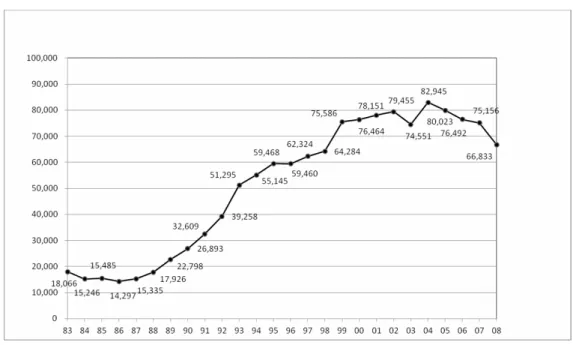
According to the survey conducted by the Organisation for Economic Co-operation and Development (OECD), which was released by the Japanese Ministry of Education, Culture, Sports, Science and Technology, the number of Japanese studying abroad in 2008 was 66,833, and it was 11% fewer than that of in 2007. Figure 1 shows the changes of the number of Japanese studying abroad.
Adapted from /
http://www.mext.go.jp/b_menu/houdou/22/12/__icsFiles/afieldfile/2010/12/22/1300642 _1.pdf
Figure 1. Changes of the number of Japanese studying abroad
The number of Japanese studying abroad increased every year from 1986 until 2002. In 2004, More than 82,000 Japanese studied abroad. However, the number of Japanese studying abroad has been decreasing since 2004. Regarding the countries in which they studied abroad, more than 40% of them chose the United States as their study abroad country in 2008, followed by China, the United Kingdom, and Australia3. Kobayashi (2011) examined the correlation between the decline of Japanese studying in the United States and the population of eighteen year-olds in Japan. The number of Japanese who studied in the United States in 1992-1993 was 37,432, but it declined to 24,842 in 2009. The population of 18 year-olds in 1992 was
about two million fifty thousand and it also decreased to one million twenty-two thousand in 2010. Thus, there seems to be a correlation between the decline of Japanese studying in the United States and the decline of the population of 18 year-olds in Japan. Kobayashi (2011) further compared the total number of Japanese who studied abroad with the number of Japanese who studied in the United States from 2004 to 2008. As shown in figure 1, the total number of Japanese who studied abroad in 2004 was 82,945, and it decreased to 66,833 in 2008. The decline rate was negative 15%. However, the decline rate of Japanese who studied abroad in the United States was negative 31% from 2004 to 2008.
As discussed, the total number of Japanese studying abroad has been decreasing since 2004.
However, Kobayashi (2011) points out that the number of Japanese who participated in study abroad program coordinated by Japanese schools increased in the last few years. Many Japanese schools have established relationships with institutions in the US, Canada, the UK, Australia, China, Korea and other countries, and have sent students to study programs.
According to Kobayashi (2011), the total number of Japanese students who participated in school coordinated study abroad programs in 2008 was 24,508, which was 31.9% more than that of in 2004. However, the ratio of Japanese students who participated in study abroad program in the United States decreased slightly from 29.0% to 26.1%. Thus, Kobayashi (2011) discusses that the decline of Japanese studying in the United States would be a main factor to explain the recent drastic decline of Japanese studying abroad.
Unlike the current situation in Japan, more and more Korean and Chinese have been studying abroad in recent years. Nagashima (2011) examines the statistics released by the Korean Ministry of Education, Science and Technology, and reports that the number of Korean college level students studying abroad has been increasing rapidly since 2003. The number of Koreans studying abroad who were older than 18 years was 251,887 in 2010, which were 100,000 more than that of in 2003. Similar to Japanese, the most popular study abroad country for Koreans is the United States. Nagashima (2011) reports that 29.8% of all Korean studying abroad chose the United States, followed by China, Japan, and Australia. Chinese studying abroad are also increasing in the United States. According to the Open Doors report, the number of Chinese students studying at colleges and universities in the United States increased by 23% in total and by 43% at the undergraduate level in 2010-20114.
The increasing number of Korean and Chinese students studying in the United States might be attributed to the demands of society of college graduates who have high proficiency in English skills. With the recent trend of globalization, more and more Asian companies open overseas branches, and dispatch their employees to foreign countries. And the common language to communicate with local employees is English. Therefore, a high proficiency in English has become an indispensable skill for current business persons working abroad.
Thus, necessity of high English proficiency might motivate more and more Korean and Chinese students to study abroad for the purpose of studying English. In the following section, the English proficiency of Japanese will be compared with those of Korean and Chinese.
3. English proficiency of Japanese, Korean and Chinese
As discussed in the previous section, in recent years, more and more Korean and Chinese study abroad to study English. While many Japanese are aware of the importance of mastering English in the recent globalization trend, the number of Japanese who study abroad to study English is becoming fewer and fewer. This section examines the present state of English proficiency of Japanese, Korean and Chinese in order to discuss whether studying abroad might contribute to the improvement of English proficiency.
The recent trend of globalization has a strong influence on Japanese people’s attitude toward English study. The number of people who took the TOEIC Test is increasing rapidly.
According to TOEIC Test Data and Analysis 2010, one million, seven hundred eighty thousand Japanese took the TOEIC Test in 2010. This indicates that many Japanese are aware of the importance of studying English. However, English proficiency of Japanese has not improved by much. Koike et al. (2010) compare TOEFL scores of Japanese with those of Korean and Chinese.
Table 1. 2008 TOEFL mean scores of Japanese, Korean, and Chinese
Japanese 66 iBT (539 PBT)
Korean 78 iBT (536 PBT)
Chinese 76 iBT (552 PBT)
Adapted from Koike et al. (2010, p21)
The mean TOEFL Internet –based test (iBT) score of Japanese in 2008 was 66 points, and it was more than 10 points lower than those of Korean and Chinese. The result indicates that the English proficiency of Japanese, measured by TOEFL iBT, is inferior to those of Korean and Chinese. Another research that investigated English proficiency of college students also reconfirms this result. Miyahara et al. (1997) examined the mean score of the common English test conducted to Japanese, Korean and Chinese college students.
Table 2. Mean scores of common English test for Japanese, Korean and Chinese college students Japanese students Korean students Chinese students
listening score 73.86 89.72 105.76
grammar score 98.77 117.64 152.09
vocabulary score 69.21 91.23 87.05
reading score 48.95 76.87 87.41
mean score 72.94 93.87 108.07
Adapted from Miyahara et al. (1997, p45)
All the mean scores of Japanese college students were lower than those of Korean and Chinese college students. The result, together with the TOEFL iBT result in Koike et al.
(2010), indicates that the English proficiency of Japanese is not as high as those of Korean and Chinese, even if many Japanese notice that they need to improve English proficiency.
Regarding the English proficiency of Japanese people working with using English, Koike et al. (2010) conducted an extensive survey, and examined the English proficiency measured by the TOEIC scores.
Table 3. TOEIC scores of Japanese working with using English TOEIC scores the number of people valid percentile
above 900 754 11.3%
850-900 659 9.9%
800-850 726 10.9%
750-800 786 11.8%
700-750 763 11.5%
650-700 700 10.5%
600-650 618 9.3%
550-600 560 8.4%
500-550 433 6.5%
450-500 327 4.9%
400-450 325 4.9%
sum of valid answers 6,651 100.0%
Adapted from Koike et al. (2010, p39)
Koike et al. (2010) statistically analyze the TOEIC scores of 6,651 Japanese who regularly worked with using English. As shown in Table 3, 11.3% of them scored more than 900 points, and the median of the scores ranges from 700 to 750 points. The score is much higher than that of the TOEIC mean score of average Japanese working at Japanese companies4. Thus, Koike et al. (2010) conclude that Japanese business persons working with English in daily work hold a considerable higher English proficiency. Koike et al. (2010) further conducted a questionnaire survey to 7,354 Japanese working with English, and investigated the ideally expected English proficiency in business. Nearly 70% of them answered that the expected TOEIC score is more than 800 points. This result implies that the English proficiency of Japanese, especially Japanese college students, does not meet that expectation, when they work with using English in the current globalized society.
4. Effectiveness of Overseas English Study Abroad Program
As discussed in section 1, the number of Japanese studying abroad has decreased over the last few years, even if those who participate in study abroad program coordinated by Japanese schools increased slightly. There are various reasons why Japanese do not want to study abroad, such as the Japanese economic depression, early start of job hunting for college students, and an inward-intention of recent young Japanese. In addition to these reasons, the effectiveness of study abroad programs seems not to be well understood by Japanese college students. Thus, Japanese college students might hesitate to study abroad, which involves expensive costs and uncomfortable new environments. This section examines the previous studies on the actual improvements of English skills in short-term English study abroad programs. Then, I examine what kind of English skills Japanese college students expect to improve before they participate in short-term English study abroad programs.
Regarding participants’ psychological aspects in study abroad programs, various studies have revealed that short-term English study abroad programs might contribute participants’
motivations for English study and cultural awareness (Tanaka and Ellis 2003, Takeda 1998, Kitao 1993, Kobayashi 1999). Kobayashi (1999) investigated the motivational changes of college students who participated in three-week or four-week English programs in the US, Canada, and the UK. Statistically significant differences were found for participants’
positive attitudes towards foreign people and study abroad. Kobayashi (1999) discussed that their positive experiences in English study abroad programs enhanced “integrated motivation” toward English study.
Regarding actual improvement of English skills in short-term English study abroad programs, several studies have revealed that all English skills do not develop equally in the limited duration of the programs (Hashimoto 1992, Tanaka & Ellis 2003, Nakayama &
Yoshimura 2006). For example, Nakayama & Yoshimura (2006) conducted two different kinds of tests on the participants of three-week summer English study program implemented at a US university from 2004 to 2006. The first test was the Michigan Test of English Language Proficiency (MTELP) of the Institutional Michigan English Language Assessment Battery, and the second was the Institutional Test of Written English (ITWE). The test scores of MTELP revealed that the average scores between the first and second MTELP improved slightly: 1.77 points. This improvement was not statistically significant. Nakayama & Yoshimura (2006) discussed that the insignificant improvement could be accounted for by the facts that the duration of the program was not long enough to improve test scores, and that the curriculum was not designed to improve test scores. Regarding ITWE scores, the average score of every year improved significantly in the second ITWE. Furthermore, Nakayama & Yoshimura (2006) examined the participants’ essays, and found that participants developed the ability to organize the essays with the typical English essay structure, introduction, body, and conclusion. Nakayama & Yoshimura (2006) conclude that the oral presentation training that the participants had during the program might contribute to the improvement of writing
skills, even though the program was short.
Then, what kind(s) of English skill(s) do Japanese college students expect to improve in short-term English study abroad programs. I conducted a questionnaire to Japanese college students. Forty-four freshman and sophomore students at a Japanese university answered the questionnaire on what English skill(s) they want to improve in short-term English study abroad programs. The following pie charts show the results:
Students’ expectations of English skills improvement in short-term English study abroad programs
Figure 2
As Figure 1 shows, more than half of them expect to improve listening and speaking skills, 20% of them expect to improve speaking, and 14% of them want to improve their listening skills. This result indicates that almost 90% of Japanese college students expect to improve English communication skills in short-term overseas English study abroad programs.
Regarding listening skills’ improvement in short-term English study abroad programs, some studies reported that participants’ listening skills, which were measured by the TOEFL test, improved significantly. However, other studies pointed out that it did not improve significantly. Taura et al. (2009) investigated English skills’ improvement of college students who participated in three-week overseas English program implemented at a university in New Zealand in 2008, and reported that participants’ average score of the listening section of TOEFL improved: 2.9 points. And this improvement was statistically significant. However, Tanaka and Ellis (2003) report that the average score of the TOEFL listening section improved only 1.15 points, while the average score of the vocabulary-grammar section improved the most: 2.48 points. This implies that it is not easy for Japanese college students to improve English listening skills in the limited duration of short-term overseas English study abroad programs.
listening &
speaking 52%
speaking 20%
listening 14%
all 4 skills 14%
Another study also examined listening skills’ improvement in short-term English study abroad program. Matsumoto (2010) investigated listening skill’s improvement of the Japanese college students who participated in a four-week English study abroad program implemented at a university in the United States from 2005 to 2009. The actual improvement of listening skill was measured by the scores of the listening section of The Secondary Level English Proficiency Test (SLEP), which were conducted in the ESL classes at the beginning and the end of the program. The average score of 27 program participants improved from 17.7 to 19.0, and the standard deviation decreased from 3.40 to 3.16. Statistical analysis revealed that the improvement was significant (t(26)=-2.481, p=.02). Matsumoto (2010) attributed the significant improvement of the listening skill not only to the total amount of English input that the participants were exposed to during the program, but also to the small size of the program groups. Since the number of the participants of each year was very small, three to eight participants, they might have been required to communicate using English during the program.
Matsumoto (2010) also discusses that having studied English in the appropriate levels of the ESL classes and having interactions in English outside of the ESL classes would have contributed to the improvement of their English proficiency, including listening skills.
The fact that the significant improvement was observed in the short-term English study program is consistent with the studies on listening skill’s improvement of Japanese college students in the study abroad programs (e.g., Kobayashi 1999, Taura et al. 2009). However, it is inconsistent with the result that reported slight improvement of the listening skill in Tanaka and Ellis (2003). This may be due to the possibility that SLEP Test has higher reliability in measuring listening skill’s improvement than other English tests, such as TOEFL.
Conclusion
This study examined the reasons why recent Japanese, especially Japanese college students, do not want to study abroad. As discussed in various studies, there are a lot of reasons why fewer and fewer Japanese study abroad, such as Japanese economic depression, early start of job hunting for college students, and an inward-intention of recent young Japanese.
While the number of Japanese studying abroad is decreasing, the number of Korean and Chinese people studying abroad in English speaking countries increases rapidly. This may be due to the fact that younger Korean and Chinese understand well the importance of high English proficiency in the recent globalization trend. Japanese college students are also aware of the importance of acquiring high English proficiency, even if the English proficiency of Japanese students is lower than those of Korean and Chinese people. However, little is well understood by Japanese college students how studying abroad in English speaking countries would contribute to the actual improvements of English skills. Thus, the present
study conducted a questionnaire survey to Japanese college students to explore what sorts of English proficiency Japanese students expect to improve in short-term overseas English study programs. The results showed that more than 90% of them expect to improve oral English skills, such as speaking and listening skills, if they participate in short-term English study abroad programs. Then, I examined previous studies on listening skills improvements in short-term overseas English study programs. Even if the number of studies that have investigated participants’ actual English improvement in short-term overseas English study programs is few, some studies revealed participants’ English skills that were measured by various tests improved significantly, when the programs were organized appropriately.
Thus, it would be important to accumulate more studies on the actual effectiveness of overseas English study programs, and to make more effort to inform Japanese college students of the importance and effectiveness of overseas English study programs. Then, we may expect more and more Japanese college students to study abroad.
Notes
1.http://www.mext.go.jp/b_menu/houdou/22/12/__icsFiles/afieldfile/2010/12/22/1300642_1.pdf 2.http://www.toeic.or.jp/toeic/pdf/data/DAA2010.pdf
3.According to the statistics of Open Doors Report 2009, the number of Japanese students studying in US colleges or universities was 29,264 in 2009.
4.Koike et al (2010) discuss that the mean score of average Japanese working in society can be estimated as 465 points in 2006.
References
Benton, C. (2012). Ima naze wakamono wa kaigai e ikanaku nattanoka. Guroobaru jinzai wo sodateru.
Touyoukanshuppansha.
ETS. (2008). The SLEP test manual. English Testing Service.
Hashimoto, M. (1992). Pre-TOEFL no kekka o tooshite mita Kanagawa daigakusei no tanki eigo kenshuu no seika.
Kokusai Keiei Forum 4, 114-120, Kanagawa Daigaku.
Kimura, Y., Nakata, Y., and Okumura, T., (2001). Language learning motivation of EFL learners in Japan—a cross-sectional analysis of various learning milieus. JALT Journal, 23, No.1. 47-68.
Kitao, S. K. (1993). Preparation for and results of a short-term overseas program in the United States.
Bulletin of the Institute for Interdisciplinary Studies of Culture, 10, 107-118. Doshisha Women’s College.
Kobayashi, A. (2011).Nihonjin ryuugakusei no kaigairyuugaku sogaiyouin to kongo no taisaku. Uebbu Magajin Ryuugaku Kouryuu, May, vol. 2.
Kobayashi, T. (1999). Kaigai gogaku tanki kenshuu de eigoryoku wa donokurai nobiru monoka. Jinbunkenkyuu.
97, 83-100. Otaru Shooka Daigaku.
Koike, I. et al. (2010). Kigyou ga motomeru eigoryoku. Asahishuppansha.
Matsumoto, M. (2010). English Listening Skill’s Improvement In the Short-Term Overseas Program. Annual Review of English Learning and Teaching, No. 15 The JACET Kyushu- Okinawa Chapter.
Miyahara, F. et al (1997). Konomama de yoika daigaku eigo Kyouiku. Shohakusha.
Nagashima, M. (2011). Kankoku no ryuugakusei seisaku to sono hensen. Uebbu Magajin Ryuugaku Kouryuu, April, vol. 1.
Nakayama, M. and N. Yoshimura. (2006). Skill development in a short-term English study abroad program. The Proceedings of AFR 2006, LSHK, on March 5, 2007.
Nihonjin no kaigai ryuugakusha suu ni tuite. Retrieved May 15th, 2012, from
http://www.mext.go.jp/b_menu/houdou/22/12/__icsFiles/afieldfile/2010/12/22/1300642_1.pdf
Open Doors Reports 2009. (2009). Record Numbers of International Students in U.S. Higher Education. Retrieved May 10th, 2012, from
http://opendoors.iienetwork.org/?p=150649
Takeda, A. (1998). Kaigai eigo kenshu ni okeru gakushuu sutorateji ni kansuru ichikousatsu. Mukogawa Joshidai Kiyoo, 46, 11-18.
Tanaka, K. and R. Ellis. (2003). Study abroad, language proficiency, and learner beliefs about language earning. JALT Journal, 25. 1, 63-85.
Taura, H. et al. (2009). Nyuujiirando tanki eigo kenshuu no kooka ni kansuru ichikousatsu. Journal of Language and Culture, 4,1-22 Department of Language and Culture School of Humanities and Social Science Osaka Prefecture University.
TOEIC Test Data and Analysis 2010. Retrieved May 15th, 2012, from http://www.toeic.or.jp/toeic/pdf/data/DAA2010.pdf