Programs on Japanese University Students'
English Communication
著者
藤尾 美佐
著者別名
Misa Fujio
雑誌名
経営論集
号
82
ページ
13-27
発行年
2013-11
URL
http://id.nii.ac.jp/1060/00006341/
Creative Commons : 表示 - 非営利 - 改変禁止 http://creativecommons.org/licenses/by-nc-nd/3.0/deed.jaPositive Effects of Short-Term Overseas Programs on
Japanese University Students’ English Communication
Misa Fujio
Abstract
This article reports the first part of a longitudinal study that investigated the English communicative competence of two Japanese university students before and after their short-term study abroad. This first part focuses on their changes in 1) participation in conversation (turn-taking), 2) language competence, and 3) strategic competence, based on interviews conducted before and after their study in Canada. The analysis revealed a remarkable improvement in the number of words spoken, turn-taking style, fluency, syntactic structure, and the use of communicative strategies.
1 Introduction
In this age of globalisation, improving English oral communication skills is essential for Japanese university students. In Japan, however, there are very few opportunities to use English outside the classroom. Studying abroad therefore offers a promising opportunity to improve not only language ability but also communicative ability. In fact, the effects of overseas study programs have been studied and reported from various aspects: awareness of cross-cultural communication (e.g., Iwai 1992, Hayashi 2013), pragmatic competence (e.g., Iwai & Yamada 1994), or strategic competence (e.g., Fujio 2011).
This study is the first part of a longitudinal study that investigated how the communicative competence of two university students changed after a one-month study visit to Canada and how their competence changed after one year of normal life in Japan.
This first part focused on their changes in turn-taking style, language ability and strategic competence through their study abroad, based on interviews conducted before and after their study. (The latter part focusing on the attrition of the same participants after one year will be reported separately.)
In the next section, the components of communicative competence will be reviewed and the selection of the above three elements will be discussed. In Section 3 and Section 4, the analytical methods and results will be presented, respectively. In the following section, Section 5, the future challenges observed from the analysis will be discussed.
2 Literature Review
2.1 Communicative competence
Canale and Swain (1980) regarded communicative competence as an ability consisting of three major sub-competences (grammatical, sociolinguistic, and strategic competences), which were further sub-divided into four—grammatical, sociolinguistic, discourse, and strategic competences—by Canale (1983). Grammatical competence was regarded as one roughly equivalent to language ability, sociolinguistic competence as one related to sociocultural rules of language use, and discourse competence as one related to how to combine utterances. Strategic competence was referred to as a competence made up of communication strategies, which will be further reviewed in Section 2.3.
Communicative competence was also extensively discussed by Bachman (1990), using a different term, Communicative Language Ability (CLA). CLA consists of three sub-components: language competence, strategic competence and psychophysiological mechanisms. Language competence, consisting of organisational and pragmatic competences, is roughly equivalent to the combination of grammatical, sociolinguistic and discourse competence in the Canale’s model (1983). On the other hand, strategic competence was regarded as a more crucial competence that relates language competence to the language user’s knowledge structures and to the context of the situation.
This study mainly discusses language competence (especially grammatical competence) and strategic competence, because, considering the length of the study was only one month, it was anticipated that few improvements in the participants’ sociolinguistic and discourse competences would be observed in this timeframe.
2.2 Measurement of language competence
When we think of language competence, we must consider how it can be measured. Skehan (1998) discussed three elements to measure language ability: fluency, accuracy, and complexity.
Accuracy was excluded from the measurement due to the nature of the data in this study—interviews with the participants—because spoken language is not accuracy-oriented by nature, but is co-constructed by both participants through their interaction.
There have been many discussions regarding the measurement of fluency which is considered the most important element in conversation. Some studies claimed speech rate and pauses (e.g., Riggenbach 1991) while others claimed the mean length of run (e.g., Towell, Hawkins, & Brazergui 1991) as the most predictable indicators of fluency. However, as Fujii and Tomoda (2005) reported, in the case of second language learners, the mean length of run may become too small and
difficult to compare. Therefore, in this study, speech rate and pauses longer than one second (Lennon 1990) are used to discuss the fluency of the participants.
Lastly, complexity can also be measured in several different ways, including t-unit, c-unit or syntactic structure. In this study, syntactic structure was used, following Iwai and Yamada (1994), and the occurrence ratios of sentence types, such as simple, compound, and complex sentences, were calculated.
2.3 Categorisation of communication strategies
As touched upon in Section 2.1, strategic competence has been regarded as competence manipulating communication strategies (CSs), and two main functions were presented by Canale: “to compensate for breakdowns in communication” and “to enhance the effectiveness of communication” (1983: 11).
The empirical studies about communication strategies, however, originated from the notion of interlanguage (or how the learner try to fill in the gaps between her communicative goals and linguistic resources) (Selinker 1972) and focused on problem-solving strategies. The research has developed with two different approaches: psycholinguistic and interactional. The psycholinguistic approach has investigated the learner’s psycholinguistic mechanism by controlling variables to lexical problems. On the other hand, the interactional approach has observed the strategies used by both the learner and the interlocutor (native speaker) (Yule & Tarone 1997). Since this study used interview data, an interactional approach is taken to analyse the data.
With regard to categorisation of CSs, a basic but very important idea was presented by Corder (1983). There are basically two types of adjustment employed by the learner: adjustment of meaning or form. When the learner adjusts her message to her available resources, she tries to reduce her message according to her resources. On the other hand, she can also attempt to increase her resources to meet her communicative goals. The former was called “message adjustment strategies” and the latter as “resource expansion strategies” by Corder (1983: 17). Tarone (1983) presented a categorisation which became the basis of later categorisations, consisting of three big groups: paraphrase, borrowing, and avoidance. Paraphrase was further sub-divided into approximation, word coinage, and circumlocution. Borrowing consisted of literal translation and language switch, appeal for assistance, and mime. Lastly, avoidance comprised of topic avoidance and message abandonment (1983: 62-63). In this study, a lot of language switch and message abandonment were observed in the interviews prior to studying abroad.
Since the 1990’s, research into communication strategies has developed in several different ways. One of these studies is Fujio (2011), which presented a new categorisation from an interactional point of view: problem-solving, information
adjustment, and interpersonal strategies. In this study, several strategies regarding information adjustment (ones to adjust the amount of information according to the interlocutor’s background knowledge) were observed in the interviews after returning from overseas study.
2.4 Turn-taking
With regard to turn-taking analysis, a basic division between a collaborating topic (“a topic that matches exactly that of the immediately preceding utterance”) and an incorporating discourse topic (“a topic that uses the preceding utterance in a new discourse topic”) was made by Keenan and Schieffelin (1976). The former includes an answer to the previous question or an episode directly related to the previous utterance while the latter includes presenting a different but related question.
Long (1981) further developed their ideas in the field of second language acquisition, and compared native speaker–native speaker (NS-NS) discourse and native speaker–non-native speaker (NS-NNS) discourse patterns. He reported that, in NS-NNS interaction, 1) the mean number of topic-continuing moves per topic initiation was significantly lower, 2) the proportion of topic-initiating moves utilising a question is significantly higher, and 3) the proportion of questions per t-unit is significantly higher. The results imply that NS-NNS discourse tends to be initiated by the NS’s question and followed by the learner’s answer.
Fujio (2011) investigated the longitudinal change in the turn-taking style of Japanese graduate students who studied in the UK, combining the above categorisation with the form of question and statement. She reported that the turn-taking style changed from the sequence of the NS’s incorporating question and the NNS’s collaborating statement to the sequence of incorporating statement by both speakers in the later stage. In this study, the same categorisation as Fujio (2011) is used, as will be further explained in Section 4.1.
3 Methodology
3.1 Data Collection
Interviews were conducted with the two students who participated in a short-term overseas study program in the summer of 2012. Both students (hereafter called Student A and Student B) had taken the author’s GBC (Global Business Communication) seminar since it began in April 2011. The GBC seminar is an English course aimed at improving both English skills and knowledge of business, therefore, the course includes reading materials in English, group discussions, presentations and so on. The students are always encouraged to speak English in the classroom; however, Japanese is also used when necessary, since banning Japanese totally is likely to decrease their willingness to speak out.
Therefore, they are allowed to use Japanese if they cannot think of English expressions, which are later taught by the instructor (author) and they can learn the English expressions in the classroom.
The interviews were conducted before and after their one-month stay in Canada in 2012 when they were third year students. The interviews were conducted separately, with Student A on July 24 and October 5 and with Student B on July 26 and October 5.
Both participants found their programs via the Centre for Global Education and Exchange of the university and independently joined the programs. In the programs, they had opportunities to speak with exchange students from different countries, but conversations with native speakers of Canadian English were limited (except with the host family), because the courses comprised of only exchange students.
In the interviews, the author played the role of interviewer because they were likely to be very nervous if the interviewer was a native speaker. Nearly identical questions were asked for both students. The questions before the study included “When exactly are you leaving for Canada?” “Why did you choose Canada for your study?” “Where did you find the program?” “What are you going to study in the program?” “How many classes do you have a day?” “What do you want to do in Canada other than study?” On the other hand, those after the study covered, “How was your study in Canada?” “How many hours did you study every day?” “What did you do in your communication class?” “How about the exchange students from other countries?” and so on. Hereafter, the interviews before their study will be termed first interviews and ones after their study as second interviews. The first interview with Student A lasted for 11 minutes 21 seconds, and the second interview 18 minutes 43 seconds. With Student B, the first interview lasted for 10 minutes 27 seconds and the second 21 minutes 33 seconds.
3.2 Research Questions
As for specific research questions, the following three were formulated in relation to turn-taking, language competence, and strategic competence, respectively.
1) Will the participants use more incorporating turns in the second interviews? 2) Will their speech rate increase and their language include more compound
sentences?
3) Will they use more achievement strategies?
If they use more incorporating turns, it means that they initiate new topics more in the second interviews. A higher speech rate and greater use of compound
sentences prove improvement in language competence. Lastly if they use more achievement strategies, instead of message abandonment, it means they are more actively engaged in the interviews.
4 Analysis
4.1 Overall structure of the interviews
Before analysing each research question, the overall structure of the interviews will be shown, measured by the number of words spoken by both the interviewer and interviewee. It turned out that both students showed very similar tendencies.
As Figures 1 and 3 indicate, both students accounted for only a quarter of the total number of words spoken in the first interviews before their study. However, after their study, they accounted for nearly half as shown in Figures 2 and 4.
Figures 1 & 2 Number of words before and after the study (Student A)
Figures 3 & 4 Number of words before and after the study (Student B)
As shown by the above figures, the number of words spoken by both participants increased significantly; Student A increased from 135 to 622 words and Student B from 157 to 655 words. This owes to the fact that they answered the interviewer’s questions more actively, adding some episodes, as will be reported in the next section. There might be an additional reason that talking about what actually happened (the major topics in the second interviews) is easier by nature than talking about future events (the major ones in the first interviews). Even taking this into consideration, all the four figures indicate that both students spoke much more and were more actively involved in the second interviews.
Also, the number of words per turn increased remarkably; in the case of Student A, it increased from 5 to 11.11 words and Student B from 3.65 to 9.69 words. These numbers also indicate more active participation in the interviews.
4.2 Turn-taking style
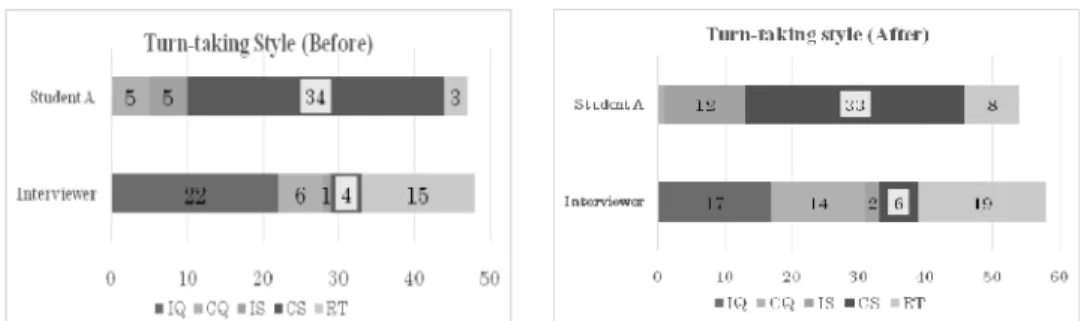
Then, how specifically did their turn-taking style change? As touched upon in Section 2.4, the turn-taking sequence was analysed by categorising turns into five different types: incorporating question (IQ), incorporating statement (IS), collaborating question (CQ), collaborating statement (CS), and acceptance or reactive tokens (RT). The incorporating turn is one to initiate a new topic and the collaborative turn is to basically answer or confirm the immediate turn by the interlocutor. The acceptance is one to only accept the immediate turn, using reactive tokens1 (Clancy, et al. 1996) such as “Yeah” or “That’s true.” The
interviewer used acceptance frequently in order to confirm what the interviewees said and to increase rapport with them. The categorisation can be clarified by the following example.
<Example 1> (From the second interview with Student A)2
ER: So ((Student name)) how was your study? (IQ)
EE: How? In Canada I study grammar vocabulary [oh]
So but very very easy grammar present past and so on. (CS) ER: So how many hours did you study every day? (IQ) EE: Every day (2.85) maybe so uh (3.71) six six or four hour
one class two hour. (CS)
ER: So did you have three classes per day? (CQ)
Figures 5 and 7 show the number of each turn-taking style in the first interviews. The most noticeable features were the interviewer’s incorporating questions (IQ) and the interviewee’s collaborating statements (CS). Therefore, as reported in Long (1981), the sequence of the interviewer’s question (IQ) and interviewee’s answer (CS) was repeated. On the other hand, in the second interviews (Figures 6 and 8), the student’s incorporating statement (IS) and the interviewer’s collaborating question (CQ) increased. This indicates the tendency that the student provided a new topic by himself and the interviewer confirmed his statement by using a CQ. Although both students were more actively involved in the second interviews by initiating new topics and adding episodes, the interviewer confirmed their statements on several occasions since they were not necessarily accurate (See Example 5).
Figure 5 & 6 Turn-taking structure before & after the study (Student A)
Figure 7 & 8 Turn-taking structure before & after the study (Student B)
4.3 Language ability
The improvement of linguistic ability was observed both in fluency and complexity. As introduced in Section 2.2, the fluency was calculated as the speech rate (unpruned word count per minute) and the total number of filled and unfilled pauses longer than one second. These pauses excluded turn-initial pauses because it was hard to judge if the participant took the pauses for linguistic difficulties or for turn-taking difficulties. So, only pauses (both filled and unfilled) within a turn were measured.
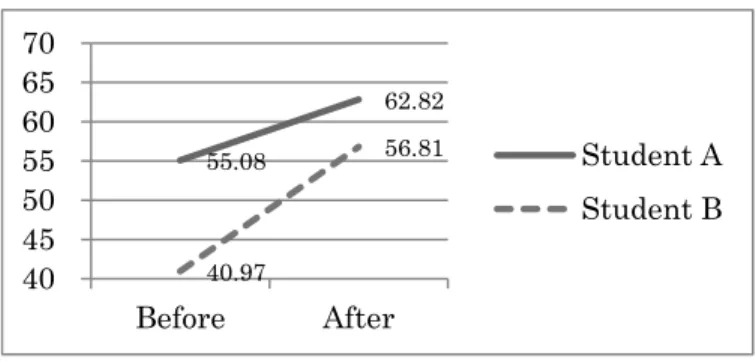
Figure 9 indicates an improvement in the speech rate of both students through their study abroad. The speech rate of Student A increased from 55.08 to 62.82 wpm (words per minute) and Student B from 40.97 to 56.81 wpm. However, they still have a large amount of pauses even in the second interviews; the amount of pauses of Student A totalled 35.38 seconds in the first interview and 54.56 seconds in the second, and that of Student B was 73.12 seconds in the first and 152.1 seconds in the second interview. Both students took longer pauses in the second interviews, which partly stems from the fact that they spoke more in the second interviews, and therefore needed more time to produce longer sentences.
Figure 9 Longitudinal change of speech rate
Next, complexity was measured by the percentage of syntactic structure. In addition to the typical three sentence types—simple, compound, and complex—two other types were added in this study, ‘words only’ (such as “four weeks”) and ‘incomplete sentence’. Figures 10 and 11 show the number of each syntactic structure.
As both figures indicate, the number of sentences produced increased significantly for both participants. Also, they both used more simple sentences in the second interviews instead of words-only. (The percentage of words-only by both participants dropped in the second interviews; Student A from 54% to 40% and Student B from 59% to 25%.) In addition, compound and complex sentences appeared in the second interviews. Most of the complex sentences produced by both participants were When-clause, including sentences such as “So when I arrive in Tronto there is sea in the Tronto.” (by Student A) or “When I went to Seattle, I went I must have to I had to go to the station until 7 am.” (by Student B). As the second example shows, Student B was very attentive to grammatical correctness, which is part of the reasons why Student B had many pauses within a turn.
Figures 10 & 11 Syntactic structure (Student A (Left) and B (Right))
55.08 62.82 40.97 56.81 40 45 50 55 60 65 70 Before After Student A Student B
Thus, both participants showed a remarkable improvement in language competence in terms of fluency and syntactic structure, although they struggled to control tense (they often used present tense for past), articles or pronouns, even in the second interviews.
4.4 Communication Strategies
The most noticeable feature in the first interviews, from a communicative point of view, was that both participants frequently used message reduction strategies; Student A answered in Japanese in 21 turns out of 48 (language switch in the Tarone’s (1983) categorisation) and Student B did not answer and kept silent in 4 turns out of 42 (message abandonment). The following are examples.
<Example 2> (From the first interview with Student A) ER: So why did you choose Canada for your study? EE: Study etto my thinking kangae.
ER: What do you mean? EE: My nanka kangaekata wo kaeru mitaina.
ER: OK. So you want to change your values [values yes] your perspectives. But why Canada not the US? EE: US is uh afraid of drug.
<Example 3> (From the first interview with Student A) ER: So you want to change yourself and you want to change
your views your perspectives but also I guess you want to improve your English skills. Right?
EE: Negaukotonareba.
ER: Yeah hopefully yes.
EE: Last Sunday’s TOEIC. Oh my god. ((Gesture)). Score is maybe low.
As the two examples show, in the first interview Student A code-switched when he could not find good expressions. In both examples, however, the interviewer stuck to using English and presented the English expressions Student A wanted to use. As a result, Student A returned to English in the following turn in both cases. In the following example with Student B, the interviewer paraphrased her question so that Student B could understand easily.
<Example 4> (From the first interview with Student B) ER: You still have four weeks before you leave for Canada. EE: Four weeks.
ER: So what are you going to study? EE: (4.83 )
ER: I think you’re going to study English somehow listening or you know speaking whatever before you’re leaving for Canada.
So what are you going to do during the summer vacation? EE: Summer vacation ((whispering))
ER: Uhm.
EE: Uh Canada ni ikumae? ER: Uhm. Mae.
EE: I study English listening (2.39) study listening.
In this example, Student B might become silent because he could not judge if the interviewer’s question was about his self-study before the overseas program or about the program itself, since her question was rather context-dependent and directly related to her previous turn, “you still have four weeks before you leave for Canada.” Here, the interviewer paraphrased and elaborated her question in the next turn. Student B, however, confirmed it in Japanese, ikumae (before leaving).
Thus, both participants easily code-switched or gave up answering when they faced a problem in the first interviews.
However, in the second interview after the overseas program, Student A did not use Japanese at all except for fillers, such as sono or nandakke. Also, Student B became silent only once in the second interview. Example 5 shows that Student A somehow conveyed his message when he would have used Japanese if it had been the first interview.
<Example 5> (From the second interview with Student A)
They were talking about three classes Student A experienced in Canada: Grammar, Vocabulary and Communication.
ER: So what did you do in your communication class? EE: Communication sono use soft PC soft.
Grammar vocabulary grammar. So one grammar is PC. PC room in PC room.
ER: Wasn’t it a communication class? Or using PC were you chatting something like that?
EE: Sono communication. So maybe uh communication class is no. So (2.12) vocabulary, grammar or PC grammar.
ER: I see. Uh I guess PC grammar is more practical how to use grammar. EE: So very very easy.
In this example, by paraphrasing and specifying information, he somehow conveyed that the communication class he mentioned was not a conversation class but a class for studying (practical) grammar using PC.
In addition, in the second interviews, both participants used several strategies to facilitate conversation. These type of strategies are categorised as information-adjustment strategies by Fujio (2011). She categorised these strategies into Global (those used at the beginning of a turn to make a framework of the turn, such as “From the viewpoint of ~”), Local (those used within a turn, adding or adjusting message according to the interlocutor’s knowledge), and Linguistic (those used to pre-empt a non-understanding, taking into account the interlocutor’s linguistic constraints). Although Global and Linguistic strategies were not observed in this study, both students used several Local strategies, which were not observed in the first interviews at all. The following excerpts are examples of Local strategies, which are frequently used by native speakers of English (Fujio 2011).
<Example 6> (From the second interview with Student A) ER: So how about the exchange students from other countries?
EE: Yeah Chinese Italy Taiwanese Korean Russian Brazilian and so on. <Example 7> (From the second interview with Student B)
EE: But half of the people is Japanese.
ER: Oh OK. So the rest are from other countries.
EE: Yeah Venezuela (2.62) Chinese (1.40) Italy Korean and Brazilian (3.54) and French.
They both exemplified the nationality of exchange students (Exemplifying strategy), instead of answering just “from many countries.”
Student A also used a specifying strategy, which presents general information first and then specify it. In the first part of Example 1, Student A first presented the information, “very very easy grammar”, and then specified it as “present past and so on.”
Another strategy, a following-up strategy was also used by Student B. This is a strategy to add some follow-up information when the speaker infers the interlocutor does not have enough background knowledge.
<Example 8> (From the second interview with Student B) ER: So how were your activities outside the university? EE: I went to Tofino. Tofino is sight-seeing place.
In this example, Student B added information about Tofino, which is not famous for Japanese people and therefore the interviewer might not know. These are strategies that were not observed at all in the first interviews.
Thus, in the second interviews, both students showed noticeable differences in strategy use not only for problem-solving but also for providing more information and facilitating conversation.
4.5 Summary of analysis
Thus, all the research questions presented in Section 3.2 were confirmed. Both participants contributed to the conversation more in the second interviews by providing more words spoken, more topics (incorporating turns) and more information with the use of a wider variety of communication strategies.
5 Discussion
The above results revealed that both participants significantly improved in both language and strategic competences. In this section, what has not improved much and future challenges will be discussed.
Even in the second interviews, both participants could not easily control the tense as well as pronouns and articles. Student A frequently used the present tense to describe a past event while Student B was sometimes aware of the difficulty and sought the right tense, taking a long time as discussed above. In this sense, they have a lot of room to improve their accuracy, which may imply the need for classroom teaching.
In addition, especially in the case of Student B, as his sentences became longer, his pauses also became longer. It seems that producing a longer and complicated sentence requires more cognitive load and so needed more time. However, in spoken language, in which both participants negotiate the meaning and co-construct the discourse, delay cost is especially high (Clark & Brennan 1991). Therefore, a balance between quick response and accuracy should always be made. This point—the basic nature of spoken language and adequate strategies for spoken discourse—should be taught in the classroom.
Finally, it is very meaningful to observe how they can maintain the English level they once attained through normal life in Japan. This topic will be separately reported based on the interview data with the same participants after one year.
6 Conclusion
This study investigated how short-term overseas programs could contribute to improvement of both language and communicative competences, based on two students’ case studies. Both of them showed a remarkable improvement in the number of words spoken, speech rate, syntactic structure, turn-taking style, and
use of communication strategies. This evidence strongly indicates that they contributed to the conversation much more than before their overseas experience. However, they did not show the same level of improvement in accuracy. Future research should therefore clarify what linguistic and communicative elements could be easily improved through overseas studies and what elements should be trained further in the classroom. Also it is very meaningful to observe whether those who improved their English ability through overseas programs could maintain the ability through normal life in Japan. If a lot of attrition is observed, ways to prevent this should be also investigated. This type of longitudinal observation will shed further light on the mechanism of second language acquisition.
Notes:
1 Reactive tokens comprise of several different types (e.g., Clancy et al. 1996). But in this study, because of the space limitation, the details of reactive tokens are not further discussed. 2 As for transcription, the author usually uses the Du Bois system (Du Bois et al. 1993),
which is based on an intonation unit and provides more precise transcription. However, in this data, the interviewees’ intonation did not necessarily follow typical contours such as rising, falling and continuing. Therefore, in the following scripts, question marks are only used for question forms, not rising intonation as used in the Du Bois system. Also, commas are not used to indicate an intonation unit. The brackets [ ] mean backchannels or reactive tokens which did not intervene (when it did result in taking a turn, it was counted as an acceptance turn). The numbers in parentheses show the length of a pause. ER stands for the interviewer and EE for the interviewee.
References:
Bachman, L. F. (1990). Fundamental Considerations in Language Testing. Oxford: Oxford University Press.
Canale, M., & Swain, M. (1980). Theoretical bases of communicative approaches to second language teaching and testing. Applied Linguistics, 1(1), 1-47.
Canale, M. (1983). From communicative competence to communicative language pedagogy. In J. Richards, & R. Schmidt (Eds.), Language and Communication. Harlow, UK: Longman. Clancy, P. M., Thompson, S. A., Suzuki, R. & Tao, H. (1996). The conversational use of reactive
tokens in English, Japanese and Mandarin. Journal of Pragmatics, 26, 355-387. Clark, H.H., & Brennan, S. E. (1991). Grounding in communication. In L. B, Resnick, J. M.
Levine, & S. D. Teasley (Eds.), Perspectives on Socially Shared Cognition. Washington, DC: American Psychological Association.
Corder, S. P. (1983). Strategies of communication. In C. Færch, & G. Kasper (Eds.), Strategies in Interlanguage Communication. London: Longman.
transcription. In J.A. Edwards, & M. D. Lampert (Eds.), Talking Data: Transcription and Coding in Discourse Research. Hillsdale, NJ: Lawrence Erlbaum.
Fujii, A., & Tomoda, M. (2005). Fluency measure for studies of task-based classroom interaction. Bulletin of Foreign Language Teaching Association, The University of Tokyo, 9, 72-90.
Fujio, M. (2011). Commucation Strategies in Action: The Negotiation, Establishment, and Confirmation of Common Ground. Tokyo: Seibido.
Hayashi, C. (2013). Tanki kyotei ryugaku no ibunka tekiou heno kouka [The effects of short-term abroad program on students’ cross-cultural adaptability]. Paper presentation at the JACET Kanto 7th Annual Convention. Tokyo: Aoyama Gakuin University.
Iwai, C. & Yamada, L. (1994). An overseas study program and its influence on EFL learners’ fluency and pragmatic competence. Annual Review of English Language Education in Japan, 5, 41-52.
Iwai, C. (1992). Kaigai bunka eigo kenshu no eigokyouiku ni hatasu yakuwari [The role of overseas programs on English education]. Eigo Eibei Bungaku Ronshu, 17-31.
Keenan, E. O. & Schieffelin, B.B. (1976). Topic as a discourse notion: A study of topic in the conversations of children and adults. In N. L. Charles (Ed.), Subject and Topic. New York: Academic Press.
Lennon, P. (1990). Investigating fluency in EFL: A quantitative approach. Language Learning, 40(3), 387-417.
Long, M. (1981). Questions in foreigner talk discourse. Language Learning, 31(1), 137-157. Riggenbach, H. (1991). Towards an understanding of fluency: A microanalysis of nonnative
speaker conversation. Discourse Processes, 14(3), 423-441.
Selinker, L. (1972). Interlanguage. International Review of Applied Linguistics in Language Teaching, 10, 209-230.
Skehan (1998). A Cognitive Approach to Language Learning. Oxford: Oxford University Press. Tarone, E. (1983). Some thoughts on the notion of “communication strategy.” In C. Færch, & G.
Kasper (Eds.), Strategies in Interlanguage Communication. London: Longman.
Towell, R., Hawkins, R., & Brazergui, N. (1996). The development of fluency in advanced learners of French. Applied Linguistics, 17(1), 84-119.
Yule G., & Tarone, E. (1997). Investigating communication strategies in L2 reference: Pros and cons. In G. Kasper, and E. Kellerman (Eds.) Communication Strategies: Psycholinguistic and Sociolinguistic Perspectives. London: Longman.