Data Analysis of Pre-departure Lessons for
Study-abroad Programs in 2017 and 2018
著者
Fras Polona
雑誌名
樟蔭学園英語教育センターフォーラム
号
9
ページ
47-52
発行年
2020-03
URL
http://id.nii.ac.jp/1072/00004424/
Data Analysis of Pre-departure Lessons for Study-abroad
Programs in 2017 and 2018
Polona Fras International Exchange Programs Desk
Students at Osaka Shoin Women’s University can participate in a number of study-abroad programs to improve their English language skills and learn about other cultures. As part of their preparation for participation in the program, the students must undergo “pre-departure training” consisting of lessons designed to improve both their receptive and productive language skills. This paper briefly outlines these lessons and presents the results of a partial analysis of a questionnaire about the lessons in academic years 2017 and 2018. The aim of this analysis is to help improve the pre-departure training in the coming years.
Introduction
Students at Osaka Shoin Women’s University can choose from a number of short-, medium- or long-term study abroad programs to improve their English language skills and explore other cultures. To sufficiently prepare for the program, the students are required to participate in a number of pre-departure meetings related to such matters as the program application process and crisis management, as well as pre-departure training dedicated to improving their English skills (Osaka Shoin Women’s University, n.d.). In academic years 2017 and 2018, this training was delivered online and consisted of two parts: vocabulary and grammar training (via a learning management system), and English conversation training (via 25-minute video calls with English speakers from the Philippines). In both cases, students used original materials created by a faculty member of Osaka Shoin Women’s University. Students could choose from a variety of topics related to studying abroad, such as personal information, family, education, food and other generic topics. Students participating in short-term programs were required to complete 10 lessons, and students participating in medium- and long-term programs 15 lessons.
Questionnaire analysis
In 2017, the total number of study-abroad program participants was 20. Twelve students participated in short-term and 8 students in medium-term programs. In 2018, the number of participants was significantly lower (only 4 students, all short-term program) 1.
After the conclusion of each program, students were asked to fill out a questionnaire regarding the pre-departure training. In this paper, only questions regarding the satisfaction with the lessons (general satisfaction, number of lessons, topics they had the opportunity to use on-site, improvement of their English skills, increase in their motivation for studying English) have been considered. The response rate was 96%. The majority of questions considered in this analysis were multiple choice questions, while a question regarding topics students used in their daily lives during the program was a multiple response question. There were also 2 open-ended questions to elicit topics that would have been useful, and additional comments. The results are presented in Figures 1-5.
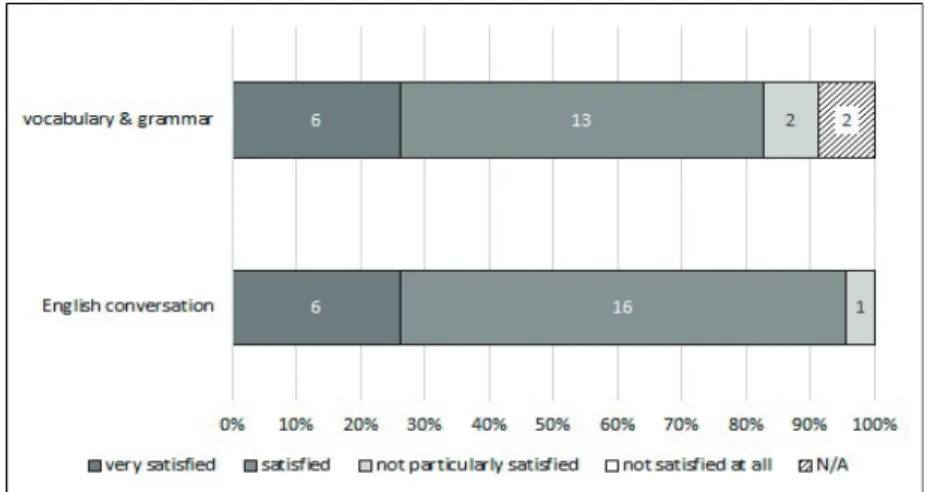
The majority of students were satisfied with both the vocabulary and grammar training (83%) and the English conversation training (96%) as shown in figure 1. Students who were not particularly satisfied with it gave the following reasons: the vocabulary and grammar exercises had glitches (e.g. videos were not playing), the English conversation teachers did not appear for the lessons, the English conversation teachers did not use the provided materials.
1 From academic year 2018, all 2nd year students majoring in English as an International
Language are required to participate in a 4-month study-abroad program. In 2018, the number of these students was 32. However, since this program is a requirement for graduation and not a voluntary one, it was not included in this analysis.
Figure 1. Response: How satisfied are you with the lessons?
Regarding the number of lessons, the majority of students (78% for vocabulary and grammar, 96% for English conversation) answered that it was just right (Figure 2).
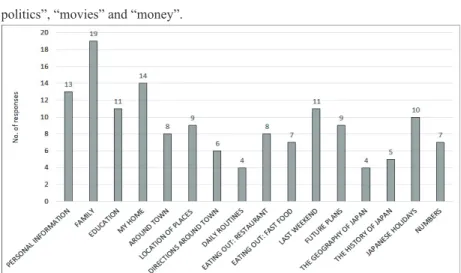
When asked to choose topics they had the opportunity to use in conversation during the program (Figure 3), the most common answers were “family” (83%), “my home” (61%) and “personal information” (57%), while the least common answers were “history of Japan” (22%), “geography of Japan” and “daily routine” (both 17%). In an open-ended question, the students were also asked to suggest other useful topics. Their suggestions were “Japanese culture and customs”, “Japanese politics”, “movies” and “money”.
Figure 3. Response (multiple response question): Which topics did you have the
opportunity to use in conversation during the program?
When asked if they thought their English skills had improved as a result of the pre-departure training, a slight majority (52%) answered affirmatively, 35% said they did not know, and 13% gave a negative answer (Figure 4).
In response to the question regarding the increase of their motivation to study English as a result of the training, 70% of the students answered that their motivation increased, and 30% said that it stayed the same (Figure 5).
Figure 4. Response: Do you think your English skills have improved as a result of
the pre-departure training?
Figure 5. Response: Did your motivation to study English increase as a result of the
Lastly, the students were asked to write any additional comments they might have about the lessons. The majority of the comments were positive (e.g. they were able to actually use the words and expressions they learned in these lessons, they were able to practise their conversation skills beforehand so they were not as nervous when speaking to foreigners on-site), while some students complained about glitches or that it was too time-consuming.
Conclusion
The students seem to be generally satisfied with the pre-departure training. While some complained about the lessons being too time-consuming or did not feel that their English skills had improved or their motivation to study English had increased, the majority seem to think that these lessons are a valuable addition to their study-abroad experience.
While the number and content of the lessons themselves continue to be satisfactory, it was necessary to make some changes in 2019. First, the learning management system had to be changed due to faculty staff changes. While the students can still access some of the materials online, the exercises are now paper-based, which is slightly inconvenient as the students have to check their answers manually against the answer sheet. Also, the materials for the English conversation training had to be changed as per request of the service provider. The students now have more topics to choose from, but some of them have difficulty deciding which ones to pick. Further changes might be necessary in the coming years, but hopefully they will help to improve the pre-departure training.
References
Osaka Shoin Women’s University. (n.d.). International Exchange Programs 2018. [Pamphlet]. Osaka: Osaka Shoin Women’s University.