by Japanese University Students with
Short-Term Overseas Study Experience
著者
藤尾 美佐
著者別名
Fujio Misa
雑誌名
経営論集
号
84
ページ
25-39
発行年
2014-11
URL
http://id.nii.ac.jp/1060/00006877/
Creative Commons : 表示 - 非営利 - 改変禁止 http://creativecommons.org/licenses/by-nc-nd/3.0/deed.jaThe Retention and Attrition of English Ability by Japanese University
Students with Short-Term Overseas Study Experience
Misa Fujio
Abstract
This article, following on from the first part reported in Fujio (2013), reports the second half of a longitudinal study that investigated how two Japanese university students improved their English ability through a short-term overseas study and maintained or lost this English ability over a period of one year of ordinary life in Japan. This second part, based on interviews conducted one year after their study in Canada, focuses on changes after they returned to Japan, in 1) turn-taking style, 2) language competence, and 3) strategic competence. The analysis revealed that, although the students maintained the amount and the complexity of their language production, their turn-taking style, fluency, and the use of communication strategies regressed to nearly the same level as before they studied abroad.
1 Introduction
According to the report by the Ministry of Education, Culture, Sports, Science and Technology, the number of Japanese with overseas study experience declined to 57,500 in 2011, from a peak of 82,945 in 2004(MEXT 2014). On the other hand, the number choosing short-term overseas study experience has levelled off (Column Global Place 2014). Therefore, short-term overseas programmes, particularly their benefits, have started to draw increasing attention, and several previous studies have reported the effects of short-term overseas studies in various aspects: including cross-cultural awareness (e.g., Iwai 1992, Hayashi 2013), fluency (e.g., Fujio 2013, Sato 2014,), pragmatic competence (e.g., Iwai & Yamada 1994, Sato 2014) and strategic competence (e.g., Fujio 2013).
At the same time, it is especially meaningful to track how these students could retain or lose their language and communicative competences when they came back to Japan, returning to ordinary life in Japan in which the use of English is sharply reduced.
In Fujio (2013), the first part of a longitudinal study was reported, which investigated how the language and communicative competences of two university students improved after a one-month study visit to Canada. The study revealed that they improved in almost every aspect except accuracy (See Section 2.3 for a brief summary). The current study reports the second half, that is, how their competences changed over one year upon returning to ordinary life in Japan.
In the next section, first of all, the definition and previous studies about attrition will be summarised. Then, the components of language competence and strategic competence that was investigated in the current study will be reviewed. Lastly, the first part of the study (Fujio 2013) will be briefly summarised so that the later explanation can be easily understood and compared. In Section 3 and Section 4, the analytical methods and results will be presented, respectively. Following the analytical results, in Section 5, the possible reasons of their regression and future instructions in the classroom will be discussed.
2 Literature Review 2.1 Attrition
Several different facets of attrition have been researched: whether it occurs in the mother tongue (L1) or second language (L2); whether it occurs at a high or low level of proficiency; and finally whether it occurs at the individual level or community level (e.g., Anderson 1982; Olshtain 1989).
Anderson (1982) presented four perspectives to investigate attrition: language use, language form, compensatory strategies (to cope with reduced linguistic output) and non-linguistic consequences of linguistic erosion (including lengthened response speed and/ or less expressiveness).
The variables that determine the degree of attrition were categorised into personal, attitudinal, learning style, and intervening (patterns of language use) variables in Lamber and Moore (1986), and into personal, sociolinguistic, input, linguistic, and production variables in Olshtain (1989). These interwoven variables imply that there could be a number of individual variations in attrition and this may not necessarily follow the reversal process of language acquisition.
In Japan, research on attrition has focused on young returnee students with an overseas living experience (e.g., Reets-Kurashige 1999, Tomoda 2009). In the current study, on the other hand, the participants had only a short-term overseas study experience, and the use of the term, attrition, might sound overstated. However, as Reets-Kurashige (1999) described, attrition is “an incremental process, and there is no clear distinction between acquisition and attrition” (p. 24), and the changes regarding the four perspectives presented in Anderson (1982) were more or less observed in both students.
2.2 Components necessary for communicative success
In the current study, as well as the first half reported in Fujio (2013), the components for language use, especially those leading to communicative success, were mainly observed. As the details were discussed in Fujio (2013), only a brief summary of these components will be presented here.
According to Wilkes-Gibbes (1997), communication is regarded as a “grounding process” to discover and extend “the boundaries of common ground” (p. 240), consisting of a presentation phase in which the speaker presents his/her message and an acceptance phase in which both participants negotiate meaning and reach an appropriate understanding. Communication also proceeds based on two principles: the principle of mutual responsibility and the principle of least collaboration effort.
The former principle indicates that successful communication should have balanced contribution, not the case in which only one participant makes full effort to develop the conversation as is often seen in a native speaker and a non-native dyad (Long 1981). Balanced contribution can be measured by the number of words spoken, floor-holding, the manner of presenting topics and turn-taking style. In the current study, the number of words spoken and turn-taking style were analysed.
As for turn-taking analysis, the author used the basic distinction between a collaborating turn which matches exactly “the immediately preceding utterance”, such as an answer to a question, and an incorporating turn that “uses the preceding utterance” for a “new discourse topic” (Keenan & Schieffelin 1976, p.341). In addition, question vs. statement distinction was combined as will be explained in Section 4.2.
The latter principle, the principle of least collaboration effort, can be measured by the occurrence of and recovery from communication breakdowns, since an effective and effortless conversation consists of “flawless presentations and trouble-free acceptances” (Clark & Brennan 1991, p.134). Once a breakdown occurs, more effort is required by the participants to negotiate meaning and recover by using various communication strategies. Therefore, there are two key factors: in the presentation phase, how fewer breakdowns occur (and even if a breakdown happens how quickly they recover from it); and in the acceptance phase, how clearly and effectively the interlocutor can show a sing of understanding to save further unnecessary negotiation of meaning (Fujio 2011). As for the components related to communication breakdowns, both language competence and strategic competence were analysed.
With regard to language competence, fluency and complexity were measured in the current study, and accuracy was only qualitatively observed. Considering the participants’ language ability and the nature of spoken language, accuracy was considered as a less visible and persuasive component to grasp their changes.
To measure fluency, following Lennon (1990), speech rate and pauses longer than one second were used. For complexity, the syntactic structure of each sentence was analysed, following Iwai and Yamada (1994).
Strategic competence was observed through the use of communication strategies (CSs). In the late 1970’s and early 1980’s, many studies presented
various definitions or categorisation of CSs. Among them, a basic but very important idea was presented by Corder (1983): adjustment of meaning or form. When a speaker (in most cases the learner) adjusts her message (meaning) to her available resources, she basically reduces her message and the strategies used were termed “message adjustment strategies”, On the other hand, when she adjusts her form to meaning such as paraphrasing, she expands her resources to meet her communicative goals, and these strategies were called “resource expansion strategies” (p. 17).
Tarone (1983) also categorised CSs into three main groups: paraphrase (such as approximation or circumlocution), borrowing (such as language switch), and avoidance.
Although there are other categorisations including strategies to facilitate and develop conversation (i.e., Fuijo 2011) in addition to the traditional problem-solving strategies, the major CSs observed in the current study were basic and typical ones, such as language switch.
2.3 Summary of the first half of this study (Fujio 2013)
In Fujio (2013), the interview data of two students before and after their 4-week study in Canada were compared (the interviews before the study are called the first interviews and after the study the second interviews). Both participants joined the author’s GBC (Global Business Communication) seminar in April 2011, which aims at improving both English skills and knowledge of business through reading, group discussions or presentations. They both attended an overseas study programme in Canada, respectively, in the summer of 2012.
The analyses of the first study disclosed that they improved in almost every component except accuracy. In the second interviews, the number of words sharply increased and their turn-taking style became more active, in other words, the ratio of incorporating turns increased (see Section 4.2). They also improved their language ability both in fluency and complexity; their speech rates sharply increased and their utterance became more at the sentential level than at the lexical or phrasal level. Lastly, in terms of communication, they used more resource expansion strategies such as paraphrase rather than giving up on their message as in the first interviews.
At the beginning of each section of Analysis, a brief summary of the first and second interviews will be also presented.
3 Methodology
In this section, the methodology of this second half of the study will be explained in terms of data collection and research questions.
3.1 Data collection
The third interviews were conducted one year after the second with the same two students (hereafter called Student A and Student B). The interview was conducted with Student A on July 19 and with Student B on July 23 in 2013. (The first and second interviews with Student A were on July 24 and October 5 in 2012, and those with Student B were on July 26 and October 5 in 2012).
As in the first and second interviews, the author played the role of interviewer for consistency, considering that they might become too nervous if the interviewer were a native speaker. Since they were both in the middle of job-seeking season, nearly identical questions regarding job-seeking were asked in both interviews. The questions included, “How is your job-hunting going?” “How many companies have you applied to?” “What is the most difficult thing in job-hunting?” “What do you appeal the most in job interviews?” “How did you appeal your overseas experience in job interviews?”
The interview with Student A lasted for 17 minutes 58 seconds (the first interview lasted for 11 minutes 21 seconds, and the second one for 18 minutes 43 seconds). With Student B, it lasted for 26 minutes 36 seconds (the first interview lasted for 10 minutes 27 seconds and the second for 21 minutes 33 seconds). Therefore, as far as the length of the interviews was concerned, their patterns were closer to the second interviews, rather than the first ones.
3.2 Research questions
As they had spent one year in Japan living an ordinary life with minimal contact English contact except the GBC class once a week, it was expected that their fluency would significantly decline from the second interviews. The biggest concern was whether or not they could maintain their communicative competence, more specifically, the use of communication strategies (CSs) as well as their turn-taking style. The following specific questions were formulated.
1) Will their contribution show the same tendency in the second interviews, that is, will the participants speak as much as in the second interviews and use as many incorporating turns?
2) Will they retain the same level of fluency and complexity, that is, will they retain the same level of speech rate and the same ratio of sentence structure?
3) Will they show the same tendency in the use of CSs, that is, will they use as many resource expansion strategies as in the second interviews?
If they use the same ratio of incorporating turns, it means that they can still develop the topics as actively as in the second interviews. If their speech rate and
the frequency of compound or complex sentences are retained, it indicates they still maintain the same level of language competence (at least in fluency and complexity). On the other hand, if they clearly decline in these components, it shows some attrition in language competence. Lastly if they use as many resource-expansion strategies as in the second interviews, instead of message adjustment strategies as in the first interviews, it means they still maintain the competence to utilise communication strategies for more active involvement in conversation.
4 Analysis
4.1 Overall structure of the interviews
First of all, the overall structure of all the interviews will be shown, measured by the number of words spoken by both the interviewer and interviewee. As in the first report, very similar tendencies were observed between the students.
As Figures 1 and 2 indicate, the number of words spoken by both students sharply increased after their overseas study (that is, between “before” and “after”). In Student A, it increased from 135 to 622 words and in Student B from 157 to 659 words. Using the percentage as a measure, the increase was also clearly displayed: before the overseas study (the first interview), both students accounted for only a quarter of the total number of words spoken in the interview (Student A 21%; Student B 26%) while after their study (the second interview), they accounted for nearly half (Student A 55%; Student B 49%).
On the other hand, in the interviews after one year, the number of words spoken by Student A slightly dropped to 553 words, accounting for 39%, and Student B remained the same level of 669 words with a slight decline in percentage to 41%. This was due to the slower response of the interviewee (see Sections 4.2, 4.3, and 4.4), prompting the interviewer to speak more to elicit their utterance.
Figures 1&2 Number of words in the three interviews (Student A and Student B)
The number of words per turn did not sharply decline, though. In the case of Student A, it increased from 5 to 11.11 words from the first to second interviews,
669 659 157 952 695 458 0 500 1000 1500 2000 One year After Before Longitudinal Change of Student B (Number of words) Student B Interviewer 553622 135 873 508 498 0 500 1000 1500 One year After Before
Longitudinal Change of Student A (Number of words)
and slightly dropped in the third interview to 9.39. With Student B, it increased from 3.65 to 9.69 words from the first to the second, and remained at the same level of 9.68 words in the third interview.
4.2 Turn-taking style
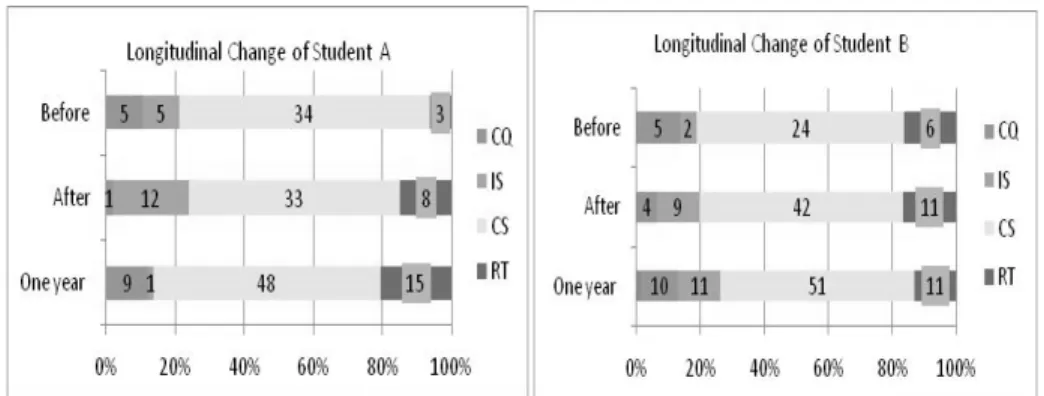
The turn-taking sequence was analysed in the same way as the first half of this study (Fujio 2013). Therefore, turns were categorised into five different types: incorporating question (IQ), incorporating statement (IS), collaborating question (CQ), collaborating statement (CS), and acceptance or reactive tokens (RT). The incorporating turn initiates a new topic and the collaborating turn basically corresponds to the immediate turn by the interlocutor. In the acceptance turn (RT), the speaker only accepts the immediate turn, using reactive tokens(Clancy, et al. 1996) such as “Yeah” or “That’s true.” The categorisation can be clarified by the following example.
<Example 1> (From the second interview with Student A)1
ER: So how about the exchange students from other countries? (IQ) EE: Yeah Chinese Italy Taiwanese Korean Russian Brazilian and so on.
(CS)
ER: I see. (RT) EE: Class is only first week and second week is only Toyo University students. So third week four week it’s so global class. [uhm] My class Italy Chinese Korean Oman Brazilian. (IS)
In this example, the first question by the ER (interviewer) was counted as an IQ since she presented a new topic. Then, the EE (interviewee) answered to the previous utterance, so counted as a CS. On the other hand, the second utterance by the EE expanded the topic voluntarily, changing the topic slightly to the structure of the class. So, it was regarded as an IS.
As Figures 3 and 4 indicate, both students took their turns mainly in the form of collaborating statement (CS), that is, in most cases, an answer to the interviewer’s incorporating question (IQ). Therefore, as indicated in Long (1981) as a typical turn-taking style between a native speaker and a non-native speaker (that can be applied to a dyad with different English levels), the sequence of the interviewer’s question (IQ) and interviewee’s answer (CS) was repeated. Although in the second interviews, they started to use the incorporating statement (IS) by either elaborating or adding an episode, this kind of active involvement in conversation was hardly observed in the third interview with Student A. On the other hand, Student B took some IS turns. The results correspond to their comments as will be revealed in Section 5, Discussion: Student A could not keep his motivation through
daily life focusing on job-hunting while Student B recently started English again after losing motivation for the same reason.
Figures 3 & 4 Turn-taking style in the three interviews (Student A &B)
4.3 Language ability
To analyse changes in linguistic ability, fluency and complexity were measured as in the first and second interviews. As explained in Section 2.2, the fluency was calculated as the speech rate (unpruned word count per minute) and the total number of filled and unfilled pauses longer than one second. Pauses between turns and unfilled turn-initial pauses were excluded because judging precisely if the pause was caused by linguistic difficulties or turn-taking timing was extremely hard. So, as for turn-initial pauses, only filled pauses were measured, in addition to any pauses (both filled and unfilled) within a turn.
Figure 5 Longitudinal change of speech rate in the three interviews
As Figure 5 discloses, the speech rate of both students rapidly increased in the second interviews but dropped sharply in the third interviews. The speech rate of Student A decreased from 62.82 wpm (words per minute) to 52.72 wpm, even lower than 55.08 wpm in the first interview. The values for Student B decreased from 56.81 wpm to 45.65 wpm, showing a sharp decline again, although slightly
55.08 62.82 52.72 40.97 56.81 45.65 30 35 40 45 50 55 60 65
Before After 1-year
Longitudinal Change of Speech Rate
higher than the first interview at 40.97 wpm.
As for pauses longer than one second, the amount of pauses made by Student A totalled 132.58 seconds in the third interview, from the 35.38 in the first and 71.92 seconds2) in the second interviews. Similarly, that of Student B climbed to 307.14
seconds in the third interview from 73.12 in the first and 152.1 in the second interviews.
On the other hand, both participants maintained the same level of complexity in sentence structure as in the second interviews.3)
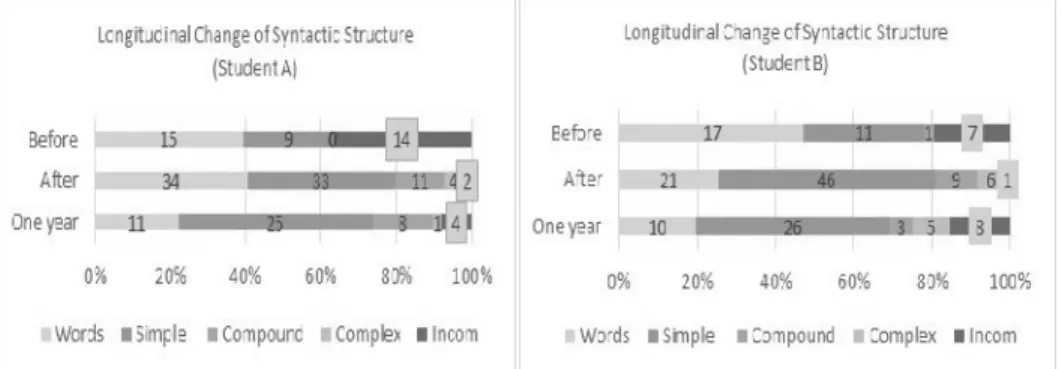
Figure 6 & 7 Longitudinal syntactic structure changes (Student A & B)
As in the first and second interviews, complexity was measured by the percentage of syntactic structure: in addition to simple, compound, and complex sentences, ‘words only’ (such as “last Sunday”) and ‘incomplete sentence’ types were added.
Figures 6 and 7 indicate that both participants showed a similar tendency. In the first interviews they both mostly used phrasal expressions (Words) as well as incomplete sentences such as finishing the sentence by using Japanese. On the other hand, in the second and third interviews, their production became at the sentential level, with the highest percentage of simple sentences. They also started to use some compound and complex sentences in the second interviews, which were hardly observed in the first interviews. The tendency was maintained in the third interviews, although the percentage of these two types (compound and complex sentences) somewhat decreased from the second interviews (from 15% to 9% in Student A and from 15% to 8% in Student B).
The results indicate that in terms of fluency both students regressed nearly to the same level as before they studied abroad. However, they somewhat maintained the complexity in the third interviews. Considering the cognitive burden required to produce the more complicated utterance than the first interviews, mixed with their declining fluency, the total time of pauses in the third interviews seemed to increase.
4.4 Communication strategies
The first half of this study in Fujio (2013) reported that the main communication strategies used by both students clearly changed from the message adjustment strategy in the first interviews to the resource expansion strategy such as paraphrase (Corder 1983) in the second interviews. Especially, in the first interviews, Student A resorted to language switch, using Japanese in 21 out of 48 turns and Student B to message abandonment, keeping silent in 4 out of 42 turns. In the second interviews immediately after their return, message adjustment strategies were not observed at all; instead, they used resource expansion strategies such as paraphrase in order to make themselves understood, and even used strategies to facilitate the interlocutor’s understanding (Fujio 2013). Once again, however, in the third interviews after one year, language switch was occasionally observed in both students.
In the case of Student A, as shown in Figure 6, he could not finish four sentences in English, switching his code to Japanese, such as “Shinboduyosa tte nannte ieba
iinndesuka (What can I say “patience” in English?). Although the percentage of
Japanese usage (4 out of 73 turns or 5%) was much lower than in the first interview (44%), using Japanese itself shows some regression from the second interview in which Japanese was not used at all. Similarly, Student B, who did not use Japanese at all in the second interview, switched to Japanese to complete a sentence in 8 turns out of 84 turns (10%). However, in a way, his attitude in the third interview might be interpreted to have become more active since more effort was made to convey his message to the interlocutor than the first interview, in which he chose to remain silent.
Another feature observed in both students was “latent breakdowns.” Fujio (2011) reported (when investigating longitudinal changes of Japanese graduate students through their 1-year study in the UK) that towards the end of the stay, one of the participants showed more latent breakdowns in which the Japanese participant did not recognise the interlocutor’s question and the interlocutor was forced to expand his presentation. The same phenomenon was observed in both students.
<Example 2> (From the third interview with Student A) ER: Is it the industry you wanted to work for? (4.75) Or the industry or the job you wanted to work?
I mean, at the beginning you wanted to be involved in accounting. EE: No.
<Example 3> (From the third interview with Student B)
I mean, did the experience in Canada change you a lot? EE: Uh (5.74) yes maybe (3.90) more active than (2.74) so far.
In Example 2, the pause lasting for more than four seconds was the first transition relevance place (TRP) in which the interviewee could take a new turn. In fact, the interviewer showed a cue by the long pause and a rising intonation. However, as Student A did not take a turn, the interviewer extended her explanation.
Similarly, in Example 3, Student B overlooked the first TRP, the 1.65 second pause, and the interviewer paraphrased the sentence, using a simpler tense.
These latent breakdowns were observed four times in both interviews but these did not appear in the first and second interviews. There might be several reasons for this. First, the topics in the third conversations focusing on job-hunting might have been more complicated than the first or second interviews regarding their overseas studies. Second, there might be some possibility that their listening comprehension dropped and/or their response slowed down.
In summary, although a lot of improvement was observed in the use of communication strategies from the first to the second interviews, some degeneration was observed in the third interviews, in terms of code-switching and latent breakdowns. Some additional studies are needed, though, to identify if the degeneration was caused for purely linguistic reasons, motivational reasons or some other factors.
4.5 Summary of analyses
In contrast to the second interviews, in which both participants displayed an improvement in almost every component except accuracy, in the third interviews, they showed a sharp decline in fluency and the way of using communication strategies (in terms of using Japanese). On the other hand, they maintained the amount and the complexity of output (the number of words spoken and the sentence structure). Regarding another factor indicating balanced contribution, the turn-taking style, individual differences were observed; although Student B tried to expand his explanation (which was reflected in the ratio of IS turn), Student A became a much more passive interlocutor, just answering the interlocutor’s question (as reflected in the smaller percentage of IS turns and the larger percentage of CS turns).
Thus, the research questions 1 and 2 presented in Section 3.2 were only partially confirmed. Considering Research Question 1, although both students showed the same tendency as in the second interviews in the number of words spoken, Student A did not use as many incorporating turns. For Research Question 2, although they maintained the same level of complexity, the fluency sharply dropped. Lastly, for Research Question 3, they did not use as many resource
expansion strategies as in the second interviews, and their strategy use somewhat returned to the style of the first interviews in that they used Japanese again, although the percentage of the code-switching was much lower than the first interviews.
5 Discussion
The difficulty in maintaining motivation as well as English ability was also reported in Benthien (2014). In her study, the loss of language ability and motivation was observed in many students, which was reflected in both listening comprehension and production skills. However, some participants successfully maintained their language skills and motivation by combining them with their career goals. In this section, the change in motivation of the two participants in a year and how we can maintain students’ motivation in the classroom will be discussed.
In the third interviews, there was a part in which both participants talked about their motivation towards studying English. Because of space limitation, the interviewer’s questions or reactive tokens were omitted.
Actually, I don’t have English skill. Uh when I stayed in Canada, so uh I have I have potential about studying English but, I I don’t have potential, potential, so my part-time job is very busy, so yeah. (Student A)
Maybe fall English skill (3.60) falling. And I don’t don’t study English. The reason is I didn’t study English and (3.72) job activity. But from now recently I I study I start to study English. So my English skill is up by degrees. (Student B)
As the above two examples show, Student A revealed he had lost his motivation to study English (he seems to have meant “motivation” by “potential”) while Student B mentioned he started studying English again. Their differences have been seemingly reflected in the interviews. Student A did not involve actively in the conversation; especially, he did not try to develop conversation as in the second interview, which was reflected in the much smaller ratio of incorporating turns (see Figure 3).
On the other hand, although Student B’s speech rate dropped and pauses increased as Student A, he tried to expand his presentation, as shown by a larger ratio of incorporating turns (see Figure 4).
As described by MacIntyre, Noels and Moore (2010), there are 15 key motivational concepts, and motivation has various facets and approaches to study. Among them, self-confidence (e.g., Clement 1986) and willingness to communicate
(e.g., MacIntrye 2007) seem especially important for typical Japanese learners of English. Considering that they tend to lose chances to use English when return to Japan and to lose their language ability as well as motivation, classroom instructions might need to be more carefully prepared. For example, Reets-Kurashige (1999) suggested designing different classroom tasks based on the participant’s proficiency; for high proficiency students, contextualized speech practice with some time pressure will be productive while for more hesitant speakers, time pressure tasks are not appropriate.
In order to prevent their attrition, some additional works will be needed not only at the individual level, but also at the institutional or even at the national level.
6 Conclusion
This study investigated, based on two case studies, how students who enjoyed improvement through a short-term overseas programme could retain or lose their language ability.Both participants showed a sharp decline in speech rate and way of using communication strategies. On the other hand, they maintained the amount and the complexity of their production, that is, the number of words spoken and syntactic structure. As for turn-taking style or involvement in communication, individual differences were observed and some association with individual motivation was suggested. Future research should therefore clarify what kind of classroom tasks can prevent regression and maintain motivation in order to retain the ability acquired through overseas study.
Notes:
1) As for transcription, since the interviewees’ intonation did not necessarily follow typical contours such as rising, falling and continuing, it does not follow the DuBois system (DuBois et al. 1993), which is based on an intonation unit and provides more precise transcription. The brackets mean backchannels or reactive tokens which did not interrupt the speaker (when it did result in taking a turn, it was counted as an acceptance turn or RT). The numbers in parentheses show the length of a pause.
2) In Fujio (2013), this figure (71.92 seconds) was incorrectly reported as 54.56 seconds, which was simply caused by a mistake in calculation.
3) In Fujio (2013), the analysis of the sentence structure was conducted with only English sentences, and did not include the case in which the participants used Japanese to complete the sentence. However, this time, the compilation included such cases in order to maintain consistency across the analysis of all the three interviews.
References:
Anderson, R. W. (1982). Determining the linguistic attributes of language attrition. In D. Lambert & B. F. Freed (Eds.) , The Loss of Language Skills (pp. 83-118). Rowley: Newbury House.
Benthien, G. (2014). Second language acquisition, study abroad and motivation: A mexed methods study of Japanese university students. Paper presentation at AILA World Congress 2014. Brisbane: Convention and Exhibition Centre.
Clancy, P. M., Thompson, S. A., Suzuki, R. & Tao, H. (1996). The conversational use of reactive tokens in English, Japanese and Mandarin. Journal of Pragmatics, 26, 355-387.
Clark, H.H., & Brennan, S. E. (1991). Grounding in communication. In L. B, Resnick, J. M. Levine, & S. D. Teasley (Eds.), Perspectives on Socially Shared Cognition (pp.127-149). Washington, DC: American Psychological Association.
Clement, R. (1986). Second language proficiency and acculturation: An investigation of the effects of language status and individual characteristics. Journal of Language and Social Psychology, 5, 271-290.
Column Global Place (2014). Kaigai ryugakushasu to wakamono no uchimukido [The number of exchange students and the domestic-oriented youth]. Retrieved August 20, 2014 from http://www.mmjp.or.jp/rmc-jyosai/kokusai/kokusai-column-20120300.html
Corder, S. P. (1983). Strategies of communication. In C. Færch, & G. Kasper (Eds.), Strategies in Interlanguage Communication (pp.15-20). London: Longman. Du Bois, J. W., Schuetze-Cobum, S., Cumming, S., & Paolino D. (1993). Outline of
discourse transcription. In J.A. Edwards, & M. D. Lampert (Eds.), Talking Data: Transcription and Coding in Discourse Research (pp.45-89). Hillsdale, NJ: Lawrence Erlbaum.
Fujio, M. (2011). Commucation Strategies in Action: The Negotiation, Establishment, and Confirmation of Common Ground. Tokyo: Seibido.
Fujio, M. (2013). Positive effects of short-term overseas programs on Japanese university students’ English communication. Keieironshu (Toyo University), 82, 13-27.
Hayashi, C. (2013). Tanki kyotei ryugaku no ibunka tekiou heno kouka [The effects of short-term abroad programs on students’ cross-cultural adaptability]. Paper presentation at the JACET Kanto 7th Annual Convention. Tokyo: Aoyama Gakuin
University.
Iwai, C. & Yamada, L. (1994). An overseas study program and its influence on EFL learners’ fluency and pragmatic competence. Annual Review of English Language Education in Japan, 5, 41-52.
Iwai, C. (1992). Kaigai bunka eigo kenshu no eigokyouiku ni hatasu yakuwari [The role of overseas programs on English education].Eigo Eibei Bungaku Ronshu, 17-31. Keenan, E. O. & Schieffelin, B.B. (1976). Topic as a discourse notion: A study of topic in
the conversations of children and adults. In N. L. Charles (Ed.), Subject and Topic. New York: Academic Press.
Lamber, R. & Moore, R. (1986). Problem areas in the study of language attrition. In B. Weltens, K. De Bot, & T. Van Els (Eds.), Language Attrition in Progress (pp. 177-186). Dordecht: Foris.
Lennon, P. (1990). Investigating fluency in EFL: A quantitative approach. Language Learning, 40(3), 387-417.
Long, M. (1981). Questions in foreigner talk discourse. Language Learning, 31(1), 137-157.
MacIntrey, P. D.,(2007). Willingness to communicate in the second language: Understanding the decision to speak as a volitional press. Modern Language Journal, 91, 564-576.
MacIntrey, P. D., Noels, K. A., & Moore, B. (2010). Perspectives on motivation in second language acquisition: Lessons from the Ryoanji Garden. Selected Proceedings of the 2008 Second Language Research Forum. Retrieved from
www.lingref.com/cpp/sirf/2008/paper2381.pdf
MEXT (2014). Nihonjin no kaigairyugakushasu oyobi gaikokujin ryugakusei zaiseki jyoukyou chousa ni tuite [A survey on the number of Japanese exchange students and exchange students from other countries]. Retrieved August 20, 2014 from http://www.mext.go.jp/a_menu/koutou/ryugaku/1345878.htm
Olshtain, E. (1989). Is second language attrition the reversal of second language acquisition? Studies in Second Language Acquisition, 11(2), 151-165.
Reetz-Kurashige, A. (1999). Japanese returnees’ retention of English speaking skills: Changes in verb usage over time. In L. Hansen (Ed.), Second Language Attrition in Japanese Context (pp.21-49). New York: Oxford University Press.
Sato, Y. (2014) Short-term ESL study abroad: Its linguistic and pragmatic impact. Paper presentation at the AILA World Congress 2014. Brisbane: Convention and Exhibition Centre.
Tarone, E. (1983). Some thoughts on the notion of “communication strategy.” In C. Færch, & G. Kasper (Eds.), Strategies in Interlanguage Communication (pp.61-74). London: Longman.
Tomoda, M. (2009). Kikokushijyo no dainigengo hoji heno torikumi no hensen [The history of institutional support for the retention of Japanese returnees’ second language ability]. In Foreign Language Teaching Association, The University of Tokyo (Ed), Gaikokugo Kyoikugaku Kenkyu no Frontier [On the Frontiers of Foreign Language Education: From Four Skills to Intercultural Communication] (pp. 284-295). Tokyo: Seibido.
Wilkes-Gibbs, D. (1997). Studying language use as collaboration. In G. Kasper & E. Kellerman (Eds.), Communication Strategies: Psycholinguistic and Sociolinguistic Perspectives (pp. 238-274). London: Longman.