• 検索結果がありません。

D-dimer and C-reactive Protein as Potential Biomarkers for Diagnosis of Trousseau’s Syndrome in Patients with Cerebral Embolism

N/A
N/A
Protected

Academic year: 2021

シェア "D-dimer and C-reactive Protein as Potential Biomarkers for Diagnosis of Trousseau’s Syndrome in Patients with Cerebral Embolism"

Copied!
8
0
0

読み込み中.... (全文を見る)

全文

(1)

D-dimer and C-reactive Protein as Potential Biomarkers for Diagnosis of Trousseau ’ s Syndrome in Patients with Cerebral

Embolism

Michiko Tsushima, MD, * Norifumi Metoki, MD, PhD, † Joji Hagii, MD, † Shin Saito, MD, PhD, † Hiroshi Shiroto, MD, PhD, † Minoru Yasujima, MD, PhD,

Tomo Kato, MD, * Natsumi Kudo, MD, * Yuichi Toyama, MD, *

Yoshikazu Yokono, MD, * Masashi Nozaka, MD, * Yosuke Kawamura, MD, * Masamichi Nakata, MD, * and Hirofumi Tomita, MD, PhD * ,

Background: Differentiating stroke due to Trousseau’s syndrome from other types of cerebral embolism is challenging, especially in patients with occult cancer. The cur- rent study aimed to determine predicting factors and biomarkers of stroke due to Trousseau’s syndrome. Methods: This retrospective study comprised 496 consecu- tive patients with acute cerebral embolism, including 19, 85, 310, and, 82 patients with stroke due to Trousseau’s syndrome, artery-to-artery embolism, cardioembolic stroke, and embolic stroke with undetermined source, respectively. All patients were evaluated within 72 hours of onset. The clinical characteristics, laboratory fi ndings, and patterns on diffusion-weighted magnetic resonance imaging (DWI) were compared among the groups. Results: Plasma D-dimer and C-reactive protein (CRP) levels were significantly higher in the Trousseau’s syndrome than in the other causes of cerebral embolism. Multivariate analyses demonstrated that female sex, multiple lesions on DWI, high D-dimer and CRP levels, and low platelet and low brain natriuretic peptide levels were independent predictors that could distin- guish Trousseau’s syndrome from the other causes of cerebral embolism. The cutoff values of D-dimer and CRP to identify stroke due to Trousseau’s syndrome was 2.68 m g/mL fibrinogen equivalent units and .29 mg/dL, respectively.

Conclusions: The elevated D-dimer and CRP levels on admission in addition to spe- cific clinical features may be useful for diagnosis of Trousseau’s syndrome in patients with cerebral embolism.

Key Words: Plasma D-dimer—C-reactive protein—cerebral embolism—

trousseau’s syndrome

© 2019 Elsevier Inc. All rights reserved.

From the *Department of Cardiology and Nephrology, Hirosaki University Graduate School of Medicine, Hirosaki, Japan; †Hirosaki Stroke and Rehabilitation Center, Hirosaki, Japan; and ‡ Department of Stroke and Cerebrovascular Medicine, Hirosaki University Graduate School of Medi- cine, Hirosaki, Japan.

Received October 21, 2019; accepted November 9, 2019.

Grant Support: This study was partially supported by the Japan Agency for Medical Research and Development (AMED) under Grant Number 19ek0210082h0003.

Financial Disclosure: Dr. Tomita received research funding from Boehringer Ingelheim, Bayer, Daiichi-Sankyo, and P fi zer, and Speakers ’ Bureau/Honorarium from Boehringer Ingelheim, Bayer, Daiichi-Sankyo, and Bristol-Myers Squibb. The rest of the authors have no relevant disclosures.

Address correspondence to Hirofumi Tomita, MD, PhD, Department of Cardiology, Hirosaki University Graduate School of Medicine, 5 Zaifu- cho, Hirosaki, 036-8562 Japan. E-mail: [email protected].

1052-3057/$ - see front matter

© 2019 Elsevier Inc. All rights reserved.

https://doi.org/10.1016/j.jstrokecerebrovasdis.2019.104534

Journal of Stroke and Cerebrovascular Diseases, Vol. 29, No. 2 (February), 2020: 104534 1

(2)

Introduction

Trousseau’s syndrome was first described in 1865, by Armand Trousseau, as unexpected or migratory thrombo- phlebitis precedes occult malignancy.

1

Currently, Trousseau’s syndrome is widely applied to cancer-associated thrombosis induced by hypercoagulation conditions.

2

In the field of stroke, the term Trousseau's syndrome is usually used as cerebral embolism that precede the diagnosis of an occult vis- ceral malignancy or appear concomitantly with the tumor.

The mechanisms underlying stroke due to Trousseau’s syn- drome include thromboembolism caused by hypercoagulop- athy, disseminated intravascular coagulation (DIC), nonbacterial thrombotic endocarditis, local compressive effect, and chemotherapeutic therapy.

3 5

The prevalence of cerebrovascular disease in patients with cancer is 15%, and stroke often severely affects the mortality rate and quality of life in these patients.

6

Moreover, previous studies have shown that cerebral embolism due to Trousseau’s syndrome can be the first manifestation of cancer.

7,8

The current approach for the secondary prevention of stroke due to Trousseau’s syn- drome is to control the cancer itself.

1

Therefore, the prompt diagnosis of stroke due to Trousseau’s syndrome is critical.

Plasma D-dimer level has been suggested for its utility as a predictor of cancer-associated stroke.

4,8 12

In the cur- rent study, we aimed to evaluate clinical features and determine predicting factors and biomarkers including D-dimer for stroke due to Trousseau’s syndrome.

Materials and Methods Study Patients

From a 3-year period from April 2016 to March 2019, a total of 1886 patients with acute ischemic stroke were

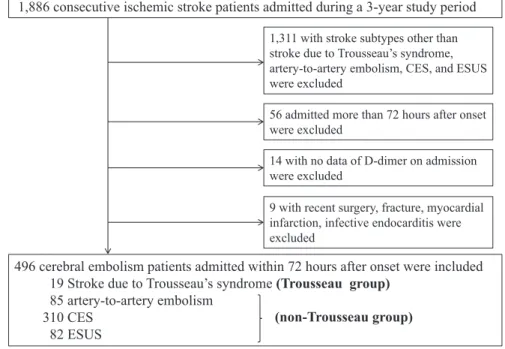
admitted to the Hirosaki Stroke and Rehabilitation Center (HSRC). Of them, 1311 patients with stroke subtypes other than Trousseau’s syndrome, artery-to-artery embo- lism, cardioembolic stroke (CES), and embolic stroke with undetermined source (ESUS), 56 admitted more than 72 hours after stroke onset, 14 without data of plasma D-dimer levels, and 9 with recent surgery, fracture, myo- cardial infarction, and infective endocarditis were excluded in this study (Fig 1). Finally, 496 patients with acute cerebral embolism, 19 Trousseau’s syndrome, 85 artery-to-artery embolism, 310 CES, and 82 ESUS, were retrospectively studied. Stroke due to Trousseau’s syn- drome was defined as cerebral embolism due to the hypercoagulative state associated with active cancer that could not be explained by other embolic sources. Artery- to-artery embolism was defined as cerebral embolism arising from the atherosclerotic plaques of the aortic arch or the carotid or vertebral arteries or from the ulcerated nonstenotic plaques in the cerebral arteries. CES was diagnosed according to the Trial of Org10172 in Acute Stroke Treatment classification.

13

According to the crite- ria proposed by the Cryptogenic Stroke/ESUS Working Group, ESUS was defined as a visualized nonlacunar brain infarct in the absence of (1) extracranial or intracra- nial atherosclerosis causing greater than 50% luminal ste- nosis in arteries supplying the area of ischemia, (2) major- risk cardioembolic sources, and (3) any other specific cause of stroke (arteritis, dissection, migraine/vasospasm, or drug misuse).

14

We retrospectively investigated factors for their utility as diagnostic markers for stroke due to Trousseau’s syndrome, with a focus on plasma D-dimer and other biomarkers on admission. Plasma D-dimer values were expressed as fibrin- ogen equivalent units (FEU) at the HSRC.

Figure 1. Flowchart of the patient selection. CES indicates cardioembolic stroke, ESUS; embolic stroke with undetermined source.

(3)

This study was approved by the ethics committees of the HSRC and Hirosaki University Graduate School of Medicine, and the study subjects were registered in the Hirosaki Stroke Registry (UMIN Clinical Trials Registry:

UMIN000016880).

Diagnosis and Risk Stratification

All patients underwent cranial computed tomography scans on admission, and the patients without intracerebral hemorrhage further underwent brain magnetic resonance imaging including diffusion-weighted imaging, T2-weighted imaging, fluid-attenuated inversion recovery imaging, and magnetic resonance angiography (Signa Excite HD 1.5T; GE Medical Systems, Waukesha, WI). Carotid ultrasonography, chest X-ray, 12-lead electrocardiogram, 24-hour Holter elec- trocardiogram, and standard blood tests were also performed in all patients. As required, some patients were monitored by electrocardiography for 2 weeks during the acute stroke treat- ment phase, and transesophageal echocardiography was also performed. We determined risk factors as follows: congestive heart failure (CHF) (left ventricular ejection fraction < 40% by echocardiography or presence of symptoms for New York Heart Association class II or higher within six months before stroke onset), hypertension (treatment with antihyper- tensive medication or documented systolic/diastolic blood pressure 140/90 mmHg), diabetes mellitus (treatment with insulin or antidiabetic medication or at least 2 determinations of diabetic type on separate days evaluated by 2 h plasma glucose 200 mg/dl with 75 g oral glucose tolerance test, fasting blood glucose 126 mg/dL, casual blood glucose 200 mg/dL, or hemoglobin A1c 6.5%), vascular disease (coronary artery disease, ankle brachial index .9, or aortic plaque), and dyslipidemia (treatment with lipid-lowering medication, low-density lipoprotein cholesterol 140 mg/dL, high-density lipoprotein cholesterol <40 mg/dL, or triglycer- ide 150 mg/dL). The CHADS

2

(CHF, hypertension, age 75 years, diabetes mellitus, stroke, or transient ischemic attack) and CHA

2

DS

2

-VASc (CHF, hypertension, age 75 years, diabetes mellitus, stroke or transient ischemic attack, vascular disease, age between 65 and 74 years, sex cat- egory [female sex]) scores were determined for all patients, as described previously.

15 17

Ischemic stroke subtype was determined by 3 stroke- trained neurologists based on the TOAST classification.

17

The major tumor markers were measured in almost all patients who also underwent chest and abdominal computed tomog- raphy scans to assess unknown malignancies and aortic pla- ques. We evaluated whether patients were taking oral antiplatelet or anticoagulant (OAC) at the time of stroke onset. The stroke severity was assessed using the National Institutes of Health Stroke Scale (NIHSS) on admission.

Statistical Analyses

Data were represented as medians (25th 75th percentiles) or numbers (%). The Kruskal-Wallis followed by the

Steel Dwass multiple comparison test, or Fisher’s exact test was used to compare differences among the 4 groups, as appropriate. The ability of factors to predict stroke due to Trousseau’s syndrome was assessed by multivariate logistic regression analysis with odds ratios (ORs) adjusted for con- founding factors by comparing the data of patients in the Trousseau group versus the data of patients in the remain- ing three groups (non-Trousseau group). Receiver operating characteristic curve analysis was also performed to evaluate the cutoff value, sensitivity, and specificity. All statistical analyses were performed using the statistical software JMP Pro 14 (SAS, Carry, NC). A P value less than .05 was consid- ered to indicate statistical significance.

Results Patient Profiles

During the study period, a total of 19 patients were diagnosed with ischemic stroke due to Trousseau’s syndrome. Among them, 9 (47%) patients had received a diagnosis of active cancer before the stroke presentation whereas the remaining 10 (53%) patients received a new cancer diagnosis during the hospitalization for stroke. In the Trousseau group, the types of primary cancer are pan- creatic cancer in 5 patients, lung cancer in 3, liver cancer in 3, and gastric cancer, gallbladder cancer, colon cancer, ovarian cancer, cervical cancer, prostate cancer, skin can- cer, and suspicious malignant lymphoma (one in each).

Of them, 18 (95%) patients had metastases or advanced cancer. Five patients (26%) developed ischemic stroke during OAC treatment (direct OAC or warfarin) for atrial fibrillation (AF) or DVT.

The clinical characteristics of the study patients are summarized in Table 1. The median ages of the Trous- seau, artery-to-artery embolism, CES, and ESUS groups were 81 (70 87), 77 (70 82), 83 (76 88), and 79 (69 85) years, respectively. The patients in the CES group were significantly older than those in the artery-to-artery embo- lism (P < .0001) and ESUS groups (P = .0003), although those in the Trousseau group were not significant com- pared to the other groups. There were more female patients (74%) in the Trousseau group, whereas more male patients (73%) in the artery-to-artery embolism group. The body mass index was similar among the 4 groups. The median NIHSS scores on admission were 6 (3 18), 3 (1 6), 12 (4 23), and 4 (2 11) in the Trousseau, artery-to-artery embolism, CES, and ESUS groups, respec- tively. The NIHSS scores of patients in the CES group were significantly higher than those in the artery-to-artery embolism (P < .0001) and ESUS group (P < .0001).

Regarding the lesion patterns by DWI, multiple ischemic lesions were found in 17 (89%), 63 (74%), 48 (59%), and 132 (43%) of the patients in the Trousseau, artery-to-artery embolism, ESUS, and CES groups, respectively. There were significant differences in the risk factors among the groups, including CHF, hypertension, dyslipidemia, AF,

D-DIMER FOR DIAGNOSIS OF TROUSSEAU’S SYNDROME 3

(4)

Table 1. Clinical characteristics of the study patients

Variable Total (n = 496) Trousseau (n = 19) A to A (n = 85) CES (n = 310) ESUS (n = 82) P value

Basic characteristics

Age (year) 81 [73-87] 81 [70-87] 77 [70-82] 83 [76-88] 79 [69-85] < .0001

Female sex 254 (51%) 14 (74%) 23 (27%) 176 (57%) 41 (50%) < .0001

BMI (kg/m

2

) 22.6 [19.9-24.6] 22.5 [20.0-24.1] 23.0 [21.2-25.1] 22.5 [19.6-24.6] 22.7 [20.0-24.9] .34

NIHSS 7 [3-19] 6 [3-18] 3 [1-6] 12 [4-23] 4 [2-11] < .0001

Ischemic lesion

Multiple lesion 260 (52%) 17 (89%) 63 (74%) 132 (43%) 48 (59%) < .0001

Treatment

Antiplatelet before onset 90 (18%) 3 (16%) 23 (27%) 45 (15%) 19 (23%) .03

OAC before onset 114 (23%) 5 (26%) 9 (11%) 101 (33%) 0 (0%) <.0001

Active cancer on admission 38 (8%) 19 (100%) 4 (5%) 11 (4%) 4 (5%) < .0001

Risk stratification

Congestive heart failure 103 (21%) 1 (5%) 3 (4%) 93 (30%) 6 (7%) <.0001

Hypertension 404 (81%) 12 (63%) 74 (87%) 260 (84%) 58 (71%) .004

Diabetes mellitus 125 (25%) 9 (47%) 25 (29%) 75 (24%) 16 (20%) .06

Previous stroke or TIA 304 (61%) 8 (42%) 58 (68%) 190 (61%) 48 (59%) .18

Vascular events 135 (27%) 3 (16%) 17 (20%) 97 (31%) 18 (22%) .06

Dyslipidemia 303 (61%) 11 (58%) 65 (76%) 181 (58%) 46 (56%) .02

AF 308 (62%) 4 (21%) 8 (9%) 296 (96%) 0 (0%) <.0001

CHADS

2

score 3 [2-4] 3 [1-4] 3 [2-4] 4 [2-4] 3 [2-4] .003

CHA

2

DS

2

-VASc score 5 [4-6] 5 [2-6] 5 [3-6] 5 [4-6] 4 [3-6] .0004

Blood chemistry

Platelet (£10

4

/ m L) 19.6 [16.0-23.7] 15.9 [12.0-20.5] 20.3 [16.6-24.9] 19.3 [15.7-23.4] 19.8 [16.8-23.7] .04

Albumin (g/dL) 3.9 [3.6-4.1] 3.7 [2.8-4.0] 4.0 [3.8-4.3] 3.8 [3.5-4.1] 4.0 [3.6-4.2] < .0001

CCr (mL/min) 50 [35-68] 48 [29-66] 60 [44-77] 46 [33-65] 54 [39-73] .002

ALT (IU/L) 16 [11-24] 14 [10-23] 16 [12-24] 15 [11-24] 17 [11-24] .82

AST (IU/L) 23 [18-29] 25 [17-63] 21 [18-26] 23 [18-29] 22 [17-28] .10

CRP (mg/dL) .18 [.08-.57] .87 [.42-4.19] .14 [.05-.42] .22 [.09-.65] .12 [.05-.39] <.0001

Total cholesterol (mg/dL) 182 [158-208] 163 [144-199] 185 [163-222] 181 [155-208] 181 [164-203] .09

Triglyceride (mg/dL) 89 [67-124] 90 [71-144] 115 [86-169] 81 [64-110] 96 [69-139] <.0001

HDL-C (mg/dL) 52 [44-65] 40 [29-66] 50 [44-63] 52 [44-64] 55 [45-66] .08

LDL-C (mg/dL) 106 [86-128] 103 [81-130] 110 [91-137] 106 [85-127] 105 [86-125] .24

HbA1c (%) 5.9 [5.6-6.4] 6.2 [5.6-7.0] 5.9 [5.6-6.5] 5.9 [5.6-6.4] 5.8 [5.6-6.2] .13

BNP (pg/mL) 172 [79-341] 103 [71-138] 50 [22-85] 268 [148-440] 86 [39-175] <.0001

APTT (sec) 29.0 [26.4-32.0] 26.7 [26.0-30.1] 29.4 [27.3-32.2] 29.1 [26.5-33.0] 28.1 [26.0-30.6] .02

PT-INR .92 [.86-.99] 1.04 [.95-1.09] .88 [.84-.93] .93 [.88-1.01] .88 [.84-.92] <.0001

Fibrinogen (mg/dL) 421 [361-486] 384 [250-491] 412 [376-480] 426 [365-500] 407 [349-483] .18

Data are shown as median (25th-75th percentiles), or n (%). CCr was estimated by the Cockcroft-Gault equation.

Abbreviations: A to A, artery-to-artery embolism; AF, atrial fibrillation; APTT, activated partial thromboplastin time; BMI, body mass index; CCr, Creatinine clearance; CES, cardioembolic stroke; CRP, C-reactive protein; ESUS, embolic stroke with undetermined source; HbA1c, hemoglobin A1c; HDL-C, high-density lipoprotein cholesterol; LDL-C, low-density lipoprotein cholesterol; NIHSS, National Institutes of Health Stroke Scale; NP, brain natriuretic peptide; OAC, oral anticoagulant; PT-INR, prothrombin time-international normalized ratio; TIA, transient ischemic stroke.

M. TSUSHIMA ET AL.

(5)

and CHADS

2

and CHA

2

DS

2

-VASc scores. The C-reactive protein (CRP) levels in the Trousseau group were the highest, and significantly higher than in the artery-to- artery embolism (P < .0001), CES (P = .007), and ESUS group (P < .0001). The brain natriuretic peptide (BNP) levels were significantly higher in the CES group than in the artery-to-artery embolism (P < .0001), ESUS (P <

.0001), and Trousseau group (P < .0001). Conversely, the platelet levels in the Trousseau group were the lowest, and significantly lower than in the artery-to-artery embo- lism (P = .02). The albumin levels in the Trousseau group were also the lowest, and significantly lower than in the artery-to-artery embolism group (P = .003).

Differences in D-dimer Levels among the Study Groups The D-dimer levels in the Trousseau group were the highest (5.89 [3.75 24.8] m g/mL FEU), and significantly higher than in the artery-to-artery embolism (.92 [.53 1.73], P < .0001), CES (1.79 [1.03 3.45], P < .0001), and ESUS (1.25 [.68 2.62], P < .0001) groups (Fig 2). Four patients in the Trousseau group had AF and one had DVT; the D-dimer levels of these 5 patients, who were on anticoagulation therapy, were comparable to those of the other patients in the Trousseau group. A total of 19 patients among the artery-to-artery embolism, CES, and ESUS groups (other than the Trousseau group) had active cancer on admission. However, the median D-dimer value of all the patients in these 3 groups was significantly lower than that of the Trousseau group (1.49 [1.09 4.11]

versus 5.89 [3.75 24.8] m g/mL FEU, P = .0002).

Univariate and Multivariate Analyses to Determine the Diagnostic Factors for Stroke Due to Trousseau’s Syndrome

Univariate analysis to assess the potential predictive fac- tors for stroke due to Trousseau’s syndrome compared with the other causes of embolic stroke (artery-to-artery

embolism, CES, and ESUS) (non-Trousseau’s group) revealed that, multiple lesions on DWI, hypertension, dia- betes mellitus, AF, platelet, albumin, CRP, high-density lipoprotein cholesterol, BNP, prothrombin time-interna- tional normalized ratio, D-dimer, and fibrinogen were sig- nificant factors (Table 2). Age, sex, and the factors exhibiting significance in univariate analysis were included in the multivariate analysis using stepwise multiple logistic regression. D-dimer (per 1 m g/mL FEU increase; OR 1.16, 95% confidence interval [CI]; 1.07 1.25, P = .0003), CRP (per 1 mg/dL increase; OR 1.69, 95%CI; 1.26 2.27, P = .0005), BNP (per 1 pg/mL increase; OR .99, 95%CI;

.978 .999, P = .03), platelet (per 1 £ 10

4

/ m L increase; OR .85, 95%CI; .75 .97, P = .01), female sex (OR 9.29, 95%CI;

1.98 43.7, P = .005), and multiple lesions on DWI (OR 14.3;

95% CI; 1.62 127.1; P = .02) were independently associated with stroke due to Trousseau’s syndrome (Table 2).

Cutoff Values of D-dimer and CRP for the Diagnosis of Stroke Due to Trousseau’s Syndrome

The receiver operating characteristic curves for D-dimer and CRP are shown in Figure 3. The area under the curve, sensitivity, and specificity for the diagnosis of stroke due to Trousseau’s syndrome were .87, 89%, and 72%, respec- tively, for a cutoff D-dimer value of 2.68 m g/mL FEU (P < .0001) (Fig 3A), and .79, 89%, and 63%, respectively, for a cutoff CRP value of .29 mg/dL (P < .04) (Fig 3B).

Discussion

In the present study, we found that plasma D-dimer and CRP levels on admission were significantly higher in the patients with Trousseau’s syndrome than in those with other causes of cerebral embolism including artery- to-artery embolism, CES, and ESUS. In addition, female sex, presence of multiple lesions on DWI, and low platelet and BNP levels were predictors of stroke due to Trous- seau’s syndrome. Our findings may provide important clinical implication for diagnosis of Trousseau’s syndrome in patients with cerebral embolism.

Cancer is one of the major acquired prothrombotic states associated with an increased stroke risk. The activation of coagulation causes widespread dissemination of micro- thrombi, with subsequent thrombotic occlusion of the small vessels. In patients with cancer, ischemic stroke is generally caused by the hypercoagulability state, DIC, nonbacterial thrombotic endocarditis, and atherosclerosis.

3 5

Several pre- vious studies have shown that ischemic stroke can be the first manifestation of cancer, and .4 to 3.0% of all patients admit- ted for ischemic stroke and up to 5.3% of those with crypto- genic stroke are diagnosed as having an unknown cancer during hospitalization.

7,18,19

In the prospective NORSTROKE study, which followed 1282 patients with stroke for a mean period of 26.9 months, 4.3% of the patients were diagnosed with cancer after stroke, with a mean time of 14 months until diagnosis.

20

Umemura et al. reported that 25.9% of patients Figure 2. Comparison of plasma D-dimer levels on admission among the 4

study groups. Data are presented as median (25th-75th percentiles). Abbre- viations: A to A, artery-to-artery embolism; CES, cardioembolic stroke;

ESUS, embolic stroke with undetermined source.

D-DIMER FOR DIAGNOSIS OF TROUSSEAU’S SYNDROME 5

(6)

with ESUS were diagnosed with cancer-associated stroke.

21

In addition, the most useful therapy for the secondary pre- vention of cancer-associated stroke is controlling the cancer itself. Overall, these findings emphasize that differentiating stroke due to Trousseau’s syndrome from other causes of cerebral embolism, especially ESUS, is important.

D-dimer is a marker of hypercoagulability. Previous studies showed that plasma D-dimer levels were signifi- cantly higher in patients with cancer-associated stroke compared to those suffering from noncancer-associated ischemic stroke.

4,8 12

Similarly, the results of the present study indicated that D-dimer was one of the most useful biomarkers predicting stroke due to Trousseau’s syn- drome. Increased CRP levels are also associated with acute ischemic stroke and cancer.

12,18,22,23

Consistent with this, our results showed that the CRP levels were signifi- cantly elevated in the Trousseau group compared with the other groups. All these findings suggest that elevated

D-dimer and CRP levels on admission may be useful bio- markers for diagnosis of Trousseau’s syndrome in patients with cerebral embolism.

Furthermore, an important finding of the present study is significantly lower platelet levels in the patients with Trousseau’s syndrome. Moreover, the fibrinogen levels also tended to be lower in this group. The platelets appeared to be consumed during the pre-DIC or compen- sated chronic DIC states in patients with Trousseau’s syn- drome. Recent studies have demonstrated that occult cancer should be considered in patients exhibiting multi- ple infarcts on DWI.

4,8,9,12,24,25

In the present study, 89%

of the patients with Trousseau’s syndrome had multiple infarcts on DWI, which was significantly higher than those observed in the artery-to-artery embolism, CES, and ESUS groups. All these findings indicate that evaluation of hypercoagulability and multiple lesions is important for diagnosis of Trousseau’s syndrome.

Table 2. Univariate and multivariate analyses for Trousseau’s syndrome in patients with acute cerebral embolism

Univariate analysis Multivariate analysis

Variable Odds ratio 95% CI p-value Odds ratio 95% CI P value

Basic characteristics

Age (year) .99 .94-1.03 .51

Female sex 2.76 .98-7.80 .05 9.29 1.98-43.7 .005

BMI (kg/m

2

) .99 .87-1.12 .86

NIHSS .98 .94-1.03 .53

Multiple lesion 8.19 1.87-35.8 .005 14.3 1.62-127.1 .02

Risk stratification

Congestive heart failure .20 .03-1.55 .12

Hypertension .37 .14-.97 .04

Diabetes mellitus 2.80 1.11-7.06 .03 2.42 .58-10.1 .22

Previous stroke or TIA .44 .18-1.13 .09

Vascular events .49 .14-1.71 .26

Dyslipidemia .87 .34-2.21 .77

AF .149 .05-.46 .0009 .16 .02-1.02 .053

CHADS

2

score .75 .55-1.02 .07

CHA

2

DS

2

-VASc score .86 .66-1.12 .25

Blood chemistry

Platelet ( £ 10

4

/ m L) .88 .81-.97 .007 .85 .75-.97 .01

Albumin (g/dL) .26 .13-.54 .0002

CCr (mL/min) 1.00 .98-1.02 .94

CRP (mg/dL) 1.14 1.02-1.27 .02 1.69 1.26-2.27 .0005

Total cholesterol (mg/dL) .99 .98-1.00 .18

Triglyceride (mg/dL) 1.00 .997-1.007 .39

HDL-C (mg/dL) .96 .93-.99 .02 .97 .93-1.02 .19

HbA1c (%) 1.06 .94-1.19 .32

BNP (mg/dL) .99 .991-.999 .02 .99 .978-.999 .03

PT-INR 7.41 1.69-32.6 .008 2.78 .14-54.6 .50

D-dimer ( m g/mL FEU) 1.12 1.07-1.17 <.0001 1.16 1.07-1.25 .0003

Fibrinogen (mg/dL) .99 .987-.999 .02 .99 .98-1.00 .08

Multivariate analysis was performed after adjusting for age, sex, and significant factors shown in univariate analysis. CCr was estimated by the Cockcroft-Gault equation.

Abbreviations: AF, atrial fibrillation; BMI, body mass index, BNP, brain natriuretic peptide; CCr, Creatinine clearance; CRP, C-reactive

protein; HbA1c, hemoglobin A1c; HDL-C, high-density lipoprotein cholesterol; NIHSS, National Institutes of Health Stroke Scale; PT-INR,

prothrombin time-international normalized ratio; TIA, transient ischemic stroke.

(7)

BNP, a peptide hormone secreted chiefly by ventricular myocytes, plays a key role in volume homeostasis. BNP lev- els have been reported to be increased in patients with AF, CHF, or renal dysfunction.

26

Therefore, negative association of plasma BNP levels with Trousseau’s syndrome shown in the present study may also help differentiate Trousseau’s syndrome from the other causes of stroke, especially CES.

The present study has several limitations. First, this was a retrospective study performed at a single center. There- fore, the generalization of our results may be limited. Sec- ond, the underlying cancer could not be identified in all cases. All study patients underwent a detailed work-up to determine the cause of cerebral embolism, and the patients with ESUS underwent cancer screening. How- ever, cancer screening was not performed in patients who presented with obvious arteriogenic or cardioembolic source. Moreover, some of the elderly patients could not be examined invasively after the stroke despite the pres- ence of cancer suspicion. In addition, since some patients were not followed up after the hospital discharge, and the percentage of patients with Trousseau’s syndrome in the study cohort might have been underestimated.

Conclusions

Plasma D-dimer and CRP levels may be useful diagnos- tic biomarkers for Trousseau’s syndrome in patients with cerebral embolism. In addition, female sex, multiple lesions on DWI, and low platelet levels may also be useful predictors for stroke due to Trousseau’s syndrome.

Acknowledgment

We are grateful to Mrs. Haruka Tonosaki for her excellent technical support.

Con fl ict of Interest

The authors declare no conflicts of interest associated with this manuscript.

References

1. Varki A. Trousseau's syndrome: multiple de fi nitions and multiple mechanisms. Blood 2007;110:1723-1729.

2. Ikushima S, Ono R, Fukuda K, et al. Trousseau ’ s syn- drome: cancer-associated thrombosis. Jpn J Clin Oncol 2016;46:204-208.

3. Grisold W, Oberndorfer S, Struhal W. Stroke and cancer:

a review. Acta Neurol Scand 2009;119:1-16.

4. Kim SG, Hong JM, Kim HY, et al. Ischemic stroke in can- cer patients with and without conventional mechanisms:

a multicenter study in Korea. Stroke 2010;41:798-801.

5. Seok JM, Kim SG, Kim JW, et al. Coagulopathy and embolic signal in cancer patients with ischemic stroke.

Ann Neurol 2010;68:213-219.

6. Graus F, Rogers LR, Posner JB. Cerebrovascular compli- cations in patients with cancer. Medicine (Baltimore) 1985;64:16-35.

7. Taccone FS, Jeangette SM, Blecic SA. First-ever stroke as initial presentation of systemic cancer. J Stroke Cerebro- vasc Dis 2008;17:169-174.

8. Kim SJ, Park JH, Lee MJ, et al. Clues to occult cancer in patients with ischemic stroke. PLoS One 2012;7:e44959.

9. Bang OY, Seok JM, Kim SG, et al. Ischemic stroke and cancer: stroke severely impacts cancer patients, while Figure 3. Receiver operating characteristic curve analyses for D-dimer (A) and CRP (B) values on admission as a diagnostic marker for ischemic stroke due to Trousseau’s syndrome. Their cutoff values, area under the curve (AUC), sensitivity, and specificity are shown (C).

D-DIMER FOR DIAGNOSIS OF TROUSSEAU’S SYNDROME 7

(8)

cancer increases the number of strokes. J Clin Neurol 2011;7:53-59.

10. Guo YJ, Chang MH, Chen PL, et al. Predictive value of plasma D-dimer levels for cancer-associated stroke: a 3- year retrospective study. J Stroke Cerebrovasc Dis 2014;23:e249-e254.

11. Ito S, Ueda A, Murate K, et al. Differentiation of cancer from atrial fi brillation in patients with acute multifocal stroke. J Neurol Sci 2016;368:344-348.

12. Sorgun MH, Kuzu M, Ozer IS, et al. Risk factors, bio- markers, etiology, outcome and prognosis of ischemic stroke in cancer patients. Asian Pac J Cancer Prev 2018;19:649-653.

13. Adams Jr. HP, Bendixen BH, Kappelle LJ, et al. Classifica- tion of subtype of acute ischemic stroke. Definitions for use in a multicenter clinical trial. TOAST. Trial of Org 10172 in Acute Stroke Treatment. Stroke 1993;24:35-41.

14. Diener HC, Bernstein R, Hart R. Secondary stroke preven- tion in cryptogenic stroke and embolic stroke of undeter- mined source (ESUS). Curr Neurol Neurosci Rep 2017;17:64.

15. Gage BF, Waterman AD, Shannon W, et al. Validation of clinical classification schemes for predicting stroke:

results from the national registry of atrial fibrillation.

JAMA 2001;285:2864-2870.

16. Camm AJ, Kirchhof P, Lip GY, et al. Guidelines for the management of atrial fi brillation: the task force for the management of atrial fi brillation of the European Society of Cardiology (ESC). Europace 2010;12:1360-1420.

17. Okumura K, Inoue H, Atarashi H, et al. Validation of CHS

2

DS

2

-VASc and HAS-BLED scores in Japanese patients with nonvalvular atrial fibrillation. Circ J 2014;78:1593-1599.

18. Cocho D, Gendre J, Boltes A, et al. Predictors of occult cancer in acute ischemic stroke patients. J Stroke Cerebro- vasc Dis 2015;24:1324-1328.

19. Uemura J, Kimura K, Sibazaki K, et al. Acute stroke patients have occult malignancy more often than expected. Eur Neurol 2010;64:140-144.

20. Selvik HA, Thomassen L, Bjerkreim AT, et al. Cancer- associated stroke: the Bergen NORSTROKE study. Cere- brovasc Dis Extra 2015;5:107-113.

21. Umemura T, Nishizawa S, Nakano Y, et al. Importance of finding embolic sources for patients with embolic stroke of undetermined source. J Stroke Cerebrovasc Dis 2019;

28:1810-1815.

22. Liu LB, Li M, Zhuo WY, et al. The role of hs-CRP, D- dimer and fibrinogen in differentiating etiological sub- types of ischemic stroke. PLoS One 2015;10:e0118301.

23. Alvarez-Perez FJ, Castelo-Branco M, Alvarez-Sabin J.

Usefulness of measurement of fibrinogen, D-dimer, D-dimer/fibrinogen ratio, C reactive protein and erythro- cyte sedimentation rate to assess the pathophysiology and mechanism of ischaemic stroke. J Neurol Neurosurg Psychiatry 2011;82:986-992.

24. Kwon HM, Kang BS, Yoon BW. Stroke as the first mani- festation of concealed cancer. J Neurol Sci 2007;258:80-83.

25. Schwarzbach CJ, Schaefer A, Ebert A, et al. Stroke and cancer: the importance of cancer-associated hypercoagu- lation as a possible stroke etiology. Stroke 2012;43:3029- 3034.

26. Shiroto H, Tomita H, Hagii J, et al. Impact of atrial natri-

uretic peptide value for predicting paroxysmal atrial

fibrillation in ischemic stroke patients. J Stroke Cerebro-

vasc Dis 2017;26:772-778.

Figure 1. Flowchart of the patient selection. CES indicates cardioembolic stroke, ESUS; embolic stroke with undetermined source.
Table 1. Clinical characteristics of the study patients
Table 2. Univariate and multivariate analyses for Trousseau’s syndrome in patients with acute cerebral embolism

参照

関連したドキュメント

Background: The purpose of this study was to apply an artificial neural network (ANN) in patients with coronary artery disease (CAD) and to characterize its diagnostic

In conclusion, this study revealed that p16 and ProEx C are useful biomarkers for the diagnosis of cervical intraepithelial neoplasia, and have potential as predictors of

Methods: A total of 32 patients with limited and diffuse type SSc (lSSc, dSSc) were examined based on a structured questionnaire score (QS) of GER symptoms, retention fraction of

Conclusions: Past reported cases of situs inversus and cystic kidney diseases were divided into three groups, i.e., gestational lethal renal dysplasia group, infantile or

Methods: IgG and IgM anti-cardiolipin antibodies (aCL), IgG anti-cardiolipin-β 2 glycoprotein I complex antibody (aCL/β 2 GPI), and IgG anti-phosphatidylserine-prothrombin complex

We measured blood levels of adiponectin in SeP knockout mice fed a high sucrose, high fat diet to examine whether SeP was related to the development of hypoadiponectinemia induced

Effects of age on functional independence measure score gain in stroke patients in kaifukuki rehabilitation ward. Multivariate analysis of improvement and outcome

We find the criteria for the solvability of the operator equation AX − XB = C, where A, B , and C are unbounded operators, and use the result to show existence and regularity