Contents lists available at ScienceDirect
Journal of the Neurological Sciences
journal homepage: www.elsevier.com/locate/jns
Long-term efficacy and safety of eculizumab in Japanese patients with generalized myasthenia gravis: A subgroup analysis of the REGAIN open- label extension study
Hiroyuki Murai a, ⁎ , Akiyuki Uzawa b , Yasushi Suzuki c , Tomihiro Imai d , Hirokazu Shiraishi e , Hidekazu Suzuki f , Meinoshin Okumura g , Fanny O’Brien h , Jing-Jing Wang i , Kenji P. Fujita i , Kimiaki Utsugisawa j , in collaboration with the REGAIN Study Group
a
Department of Neurology, International University of Health and Welfare, Tokyo, Japan
b
Department of Neurology, Graduate School of Medicine, Chiba University, Chiba, Japan
c
Department of Neurology, National Hospital Organization Sendai Medical Center, Sendai, Japan
d
Department of Neurology, Sapporo Medical University Hospital, Sapporo, Japan
e
Department of Neurology, Nagasaki University Hospital, Nagasaki, Japan
f
Department of Neurology, Kindai University Hospital, Osaka, Japan
g
Osaka Toneyama Medical Center, Toyonaka, Japan
h
Alexion Pharmaceuticals, Boston, MA, United States
i
Formerly of Alexion Pharmaceuticals, Boston, MA, United States
j
Department of Neurology, Hanamaki General Hospital, Hanamaki, Japan
A R T I C L E I N F O Keywords:
Eculizumab Myasthenia gravis Japanese patients Open-label extension study MG-ADL
MG-QoL15
A B S T R A C T
The terminal complement inhibitor eculizumab was shown to improve myasthenia gravis-related symptoms in the 26-week, phase 3, randomized, double-blind, placebo-controlled REGAIN study (NCT01997229). In this 52- week sub-analysis of the open-label extension of REGAIN (NCT02301624), eculizumab’s efficacy and safety were assessed in 11 Japanese and 88 Caucasian patients with anti-acetylcholine receptor antibody-positive refractory generalized myasthenia gravis. For patients who had received placebo during REGAIN, treatment with open- label eculizumab resulted in generally similar outcomes in the Japanese and Caucasian populations. Rapid improvements were maintained for 52 weeks, assessed by change in score from open-label extension baseline to week 52 (mean [standard error]) using the following scales (in Japanese and Caucasian patients, respectively):
Myasthenia Gravis Activities of Daily Living (−2.4 [1.34] and − 3.3 [0.65]); Quantitative Myasthenia Gravis (−2.9 [1.98] and − 4.3 [0.79]); Myasthenia Gravis Composite (−4.5 [2.63] and − 4.9 [1.19]); and Myasthenia Gravis Quality of Life 15-item questionnaire (−8.6 [5.68] and − 6.5 [1.93]). Overall, the safety of eculizumab was consistent with its known safety profile. In this interim sub-analysis, the efficacy and safety of eculizumab in Japanese and Caucasian patients were generally similar, and consistent with the overall REGAIN population.
1. Introduction
Anti-acetylcholine receptor antibody-positive (AChR+) generalized myasthenia gravis (gMG) is a rare autoimmune disorder characterized by severe muscle weakness. In patients with this disorder, antibodies to the acetylcholine receptor (AChR) can activate the complement cas- cade, which causes structural damage to the neuromuscular junction (NMJ) [1–3]. These complement-mediated changes lower the efficiency
of neurotransmission at the NMJ resulting in muscle weakness and fa- tigability that are characteristic of myasthenia gravis (MG) [2].
In approximately 10–15% of all patients with MG, the signs and symptoms of MG are inadequately controlled by immunosuppressive therapies (ISTs) [4–6]. In these patients with refractory MG, health-re- lated quality of life and activities of daily living are often significantly impacted, and the risk of experiencing MG crises, exacerbations, hospi- talizations, and emergency room visits remains higher than in patients
https://doi.org/10.1016/j.jns.2019.08.004
Received 8 April 2019; Received in revised form 1 August 2019; Accepted 2 August 2019
⁎
Corresponding author at: Department of Neurology, School of Medicine, International University of Health and Welfare, 1-4-3 Mita, Minato-ku, Tokyo 108-8329, Japan.
E-mail addresses: [email protected] (H. Murai), [email protected] (A. Uzawa), [email protected] (T. Imai), [email protected] (M. Okumura), [email protected] (F. O’Brien), [email protected] (K. Utsugisawa).
Available online 03 August 2019
0022-510X/ © 2019 The Authors. Published by Elsevier B.V. This is an open access article under the CC BY-NC-ND license (http://creativecommons.org/licenses/BY-NC-ND/4.0/).
T
who do respond to ISTs [7,8].
Eculizumab is a humanized monoclonal antibody specifically tar- geted to human terminal complement protein C5 [9]. It is approved in Japan for the treatment of gMG in patients whose symptoms are diffi- cult to control with high-dose intravenous immunoglobulin or plas- mapheresis [10]. Its safety and rapid and sustained efficacy in patients with AChR+ refractory gMG have been reported previously [11,12].
Differences between the clinical characteristics of MG in Japanese patients and in populations that are mainly Caucasian have been de- scribed, particularly with regard to a peak in the incidence of infantile- onset MG, comprising predominantly cases of ocular MG, in Japanese and other Asian populations [13,14]. Furthermore, different human leukocyte antigen alleles have been associated with age of MG onset [15] and have been reported in Japanese and other Asian patients compared with those seen in Caucasian patients with MG [16,17]. It is not known whether such differences in genetic background may influ- ence the response of Japanese patients with MG to eculizumab.
To investigate the efficacy and safety of eculizumab in Japanese patients, we report a sub-analysis of interim data from Japanese and Caucasian participants in the open-label extension of the REGAIN study.
2. Materials and methods
2.1. Study design and study population
Eligible participants entered the open-label study within 2 weeks of completing their REGAIN week 26 visit. Patients from 72 centers in 17 countries were included in the open-label study, which started on 12 November 2014 and was completed in January 2019. This sub-analysis examined the effects of eculizumab in Japanese patients, defined as those of Japanese descent and living in Japan, and compared their outcomes with those of Caucasian participants. To simplify this eva- luation, because the majority of patients in REGAIN were Caucasian [11], all non-Japanese, non-Caucasian patients were excluded. Conse- quently, this sub-analysis reports the efficacy and safety of eculizumab in 11 Japanese and 88 Caucasian patients at the 31 December 2017 data cut-off.
For REGAIN, patients were randomized to receive placebo or ecu- lizumab, with stratification according to Myasthenia Gravis Foundation of America classification at screening; patients were not randomized within countries or centers because the numbers of patients for each location were anticipated to be low [11]. Full REGAIN inclusion and exclusion criteria have been reported [11]. Key inclusion criteria were:
confirmed gMG with a positive serologic test result for anti-AChR an- tibodies; a total score on the Myasthenia Gravis Activities of Daily Living scale (MG-ADL) of 6 or higher; and received and failed treatment with two or more ISTs, or with one or more ISTs and chronic plasma exchange therapy or intravenous immunoglobulin at least four times over the previous 12 months. A history of thymoma or other thymic neoplasms was a key criterion for exclusion. Patients were required to have been vaccinated against Neisseria meningitidis. During REGAIN, patients previously receiving ISTs were required to maintain their pre- study dose and schedule; in the open-label study, adjustment of con- comitant ISTs was permitted at the discretion of the investigator.
However, adjustment of ISTs was not required by the study protocol or requested by the sponsor.
Written informed consent was obtained from all patients before entering the open-label study. The study was conducted in accordance with the Declaration of Helsinki, and the study protocol was approved by the appropriate ethics committee for each study site.
2.2. Dosing and administration of eculizumab
To preserve the blinded nature of REGAIN, open-label study parti- cipants entered a 4-week, double-blind induction phase before the
open-label maintenance phase [12]. Patients from the placebo arm of REGAIN received eculizumab during the open-label study (placebo/
eculizumab group). During the induction phase, these patients received eculizumab 900 mg each week for 4 weeks. Patients from the REGAIN eculizumab arm continued to receive eculizumab (eculizumab/eculi- zumab group), and during the induction phase, they received eculi- zumab 1200 mg on day 1 and at week 2, and matched placebo at week 1 and week 3. During the open-label maintenance phase, all patients received open-label eculizumab 1200 mg every 2 weeks starting at week 4.
2.3. Assessments
This sub-analysis presents open-label study data for the period up to 52 weeks. The same validated MG-specific assessment tools as in REGAIN were used to evaluate activities of daily living (MG-ADL) [18], muscle strength (Quantitative Myasthenia Gravis scale [QMG]) [19], functional ability (Myasthenia Gravis Composite scale [MGC]) [20], and quality of life (Myasthenia Gravis Quality of Life 15-item ques- tionnaire [MG-QoL15]) [21]. MG-ADL, QMG, and MGC were assessed at day 1 and also weekly to week 4; MG-QoL15 was assessed at day 1 and then at week 4. All four assessments were performed at weeks 8, 12, 16, 20, 26, 40, and 52 in year 1, and then every 6 months or at termination if this was before the study ended.
In addition, Myasthenia Gravis Foundation of America (MGFA) post-intervention status was assessed relative to REGAIN baseline at open-label study week 52. Patients who were categorized as improved (having achieved a substantial decrease in clinical manifestations or in MG medications) were also evaluated for minimal manifestations (having no symptoms of functional limitations from MG but having some weakness on examination of some muscles) and pharmacologic remission (having no symptoms or signs of MG [no weakness of any muscle on examination, other than isolated weakness of eyelid closure]
for at least 1 year while receiving some form of therapy for MG other than cholinesterase inhibitors) [22].
Efficacy endpoints included change from open-label study baseline and change from REGAIN baseline in mean MG-ADL, QMG, MGC, and MG-QoL15 total scores, and MGFA post-intervention status (improved, minimal manifestations, pharmacologic remission) [22].
Safety assessments included adverse events and serious adverse events. The incidences of MG exacerbations and hospitalizations were also recorded. For the open-label study, an exacerbation is defined as:
an MG crisis; significant symptomatic worsening (to a score of 3 or a 2- point worsening on any one of the individual MG-ADL items, excluding ocular items); or requirement for rescue therapy.
2.4. Statistical analysis
Efficacy analyses were conducted using data from Japanese and Caucasian patients in the full analysis set, which comprised all patients who received at least one dose of eculizumab in the open-label study and had at least one post-infusion efficacy assessment. Safety analyses were performed using the safety set (all patients who received at least one dose of eculizumab in the open-label study).
Two baselines were used for efficacy analyses. The open-label study baseline was defined as the last available assessment before the first infusion of eculizumab in the open-label study. This was typically the day 1 assessment in the open-label study; if the day 1 data were missing, the most recent assessment from REGAIN was used as the open-label baseline. The REGAIN baseline was the day 1 assessment for REGAIN.
Efficacy analyses were based on separate repeated-measures models
for each of the treatment groups. Assessing the change from the open-
label baseline allows for evaluation of the effect of eculizumab treat-
ment in the placebo/eculizumab arm, and the effect of continuing
treatment in the eculizumab/eculizumab arm. The change from
REGAIN baseline allows for an assessment of all changes over time following continued exposure to eculizumab. Missing data for MG-ADL, QMG, MGC, and MG-QoL15 scores were not imputed. This sub-analysis provides descriptive statistics for Japanese and Caucasian patients in the placebo/eculizumab group; because the number of Japanese pa- tients in the eculizumab/eculizumab group was low, data for this group were not separated by race. Data are reported as means and corre- sponding standard error of the means.
3. Results
3.1. Demographic and disease characteristics
As of 31 December 2017, a total of 117 patients had enrolled into the open-label study and had received at least one dose of eculizumab.
Eighteen patients who were neither Japanese nor Caucasian were ex- cluded from this sub-analysis (eight were Asian but not Japanese, two black, six of other race, one of multiple races, and one of unknown race). A total of 99 patients were included in this sub-analysis: 11 Japanese patients (eight received placebo and three were treated with eculizumab in REGAIN) and 88 Caucasian patients (45.5% [40/88]
from Europe, 43.2% [38/88] from North America and 11.4% [10/88]
from South America; 41 received placebo and 47 received eculizumab during REGAIN). The male/female ratio and age at first study drug dose were similar for Japanese and Caucasian patients, although Japanese patients tended to weigh less than Caucasian patients (Table 1). Disease burden, evaluated by MG-ADL, QMG, MGC, and MG-QoL15 scores and MGFA classification, in each group at open-label baseline is presented in Table 1.
In this interim sub-analysis of the extension study, all eight Japanese patients and 36/41 Caucasian patients (88%) in the placebo/
eculizumab group had received eculizumab for at least 52 weeks. In the eculizumab/eculizumab group, 43/50 patients (86%) had received eculizumab for at least 52 weeks in the open-label study; therefore, the
majority of patients in this group had received eculizumab for at least 78 weeks (including 26 weeks’ treatment in REGAIN).
3.2. Efficacy analyses
3.2.1. Changes from open-label extension study and REGAIN baselines for the Japanese and Caucasian placebo/eculizumab groups
During the 26-week REGAIN study, some degree of placebo re- sponse was observed, and the eight Japanese patients showed a stronger placebo response than the Caucasian patients, especially for changes in mean MG-ADL, MGC, and MG-QoL15 total scores (Fig. 1).
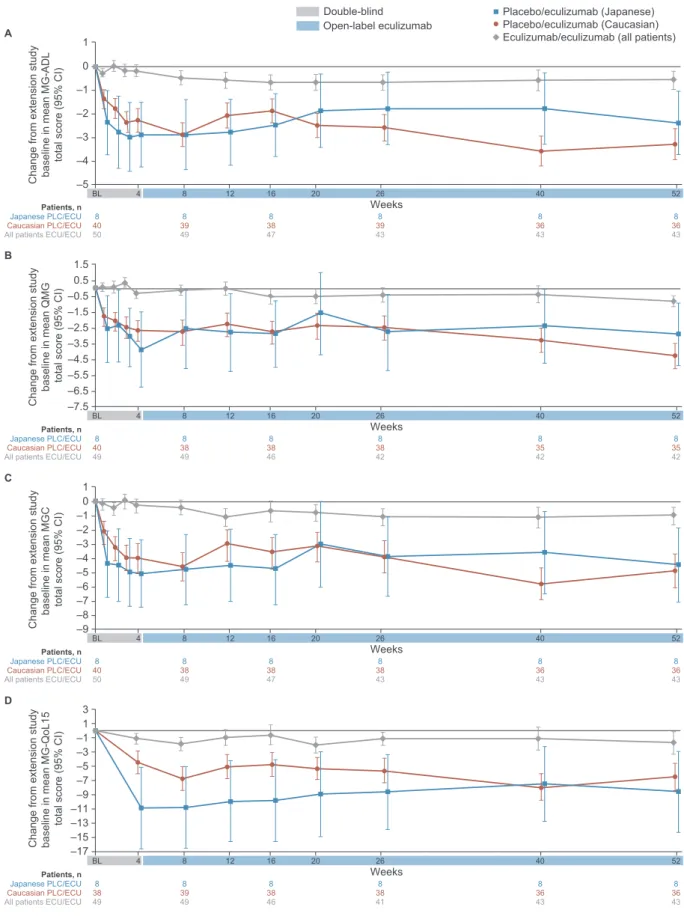
During the open-label study blinded-induction phase, the Japanese patients in the placebo/eculizumab group generally had rapid im- provements in response to eculizumab in mean MG-ADL, QMG, MGC, and MG-QoL15 total scores (Fig. 1, Fig. 2). The placebo/eculizumab- treated Caucasian patients also had rapid responses to eculizumab during the induction phase. While the change from REGAIN baseline was greater in the Japanese patients than in Caucasian patients (Fig. 1), the change from open-label baseline was similar between the two groups (Fig. 2). Improvements in all measures were sustained through 52 weeks. The patterns of improvements with eculizumab in the open- label study observed for these patients in the placebo/eculizumab group were also similar to those observed for eculizumab-treated pa- tients in REGAIN.
After 52 weeks of open-label eculizumab therapy, 62.5% (5/8) of Japanese patients in the placebo/eculizumab group achieved an MGFA post-intervention status of minimal manifestations or pharmacologic remission, compared with 69.4% (25/36) of Caucasian patients.
3.2.2. Changes from open-label extension study and REGAIN baselines for the eculizumab/eculizumab-treated patients
For the eculizumab/eculizumab group (Japanese and Caucasian patients together), the improvements seen during REGAIN were sus- tained through 52 weeks during the open-label study (Fig. 1, Fig. 2). In Table 1
Baseline demographics and disease characteristics of Japanese and Caucasian patients in the open-label extension study.
Treatment group Placebo/eculizumab Eculizumab/eculizumab
Patient group Japanese (n = 8) Caucasian (n = 41) All (N = 49) Japanese (n = 3) Caucasian (n = 47) All (N= 50)
Age at start of open-label study (years), mean (SD) 55.0 (12.9) 49.4 (18.2) 50.3 (17.4) 39.7 (5.7) 49.9 (15.1) 49.3 (14.9) Sex, n (%)
Male 2 (25.0) 16 (39.0) 18 (36.7) 1 (33.3) 17 (36.2) 18 (36.0)
Female 6 (75.0) 25 (61.0) 31 (63.3) 2 (66.7) 30 (63.8) 32 (64.0)
Weight (kg)
n 8 40 48 3 47 50
Mean (SD) 62.2 (19.3) 96.5 (29.4) 90.8 (30.6) 60.7 (8.0) 91.1 (28.6) 89.2 (28.7)
Ethnicity, n (%)
Hispanic or Latino 0 (0.0) 9 (22.0) 9 (18.4) 0 (0.0) 6 (12.8) 6 (12.0)
Not Hispanic or Latino 8 (100.0) 30 (73.2) 38 (77.6) 3 (100.0) 38 (80.9) 41 (82.0)
Not reported/unknown 0 (0.0) 2 (4.9) 2 (4.1) 0 (0.0) 3 (6.4) 3 (6.0)
Region, n (%)
Europe 0 (0.0) 15 (36.6) 15 (30.6) 0 (0.0) 25 (53.2) 25 (50.0)
North America 0 (0.0) 20 (48.8) 20 (40.8) 0 (0.0) 18 (38.3) 18 (36.0)
South America 0 (0.0) 6 (14.6) 6 (12.2) 0 (0.0) 4 (8.5) 4 (8.0)
Japan 8 (100.0) 0 (0.0) 8 (16.3) 3 (100.0) 0 (0.0) 3 (6.0)
MG duration, mean (SD), years
a7.39 (7.166) 9.76 (8.365) 9.37 (8.160) 11.67 (8.038) 10.42 (8.037) 10.49 (7.961)
MG-ADL score, mean (SD) 6.4 (3.16) 7.7 (3.66) 7.4 (3.59) 11.0 (1.73) 5.6 (4.28) 5.9 (4.35)
QMG score, mean (SD) 11.9 (6.27) 14.4 (5.80) 14.0 (5.88) 19.3 (7.02) 12.1 (5.32) 12.5 (5.63)
MGC score, mean (SD) 10.8 (5.85) 13.2 (7.36) 12.8 (7.14) 19.3 (8.08) 10.3 (7.66) 10.8 (7.91)
MG-QoL15 score, mean (SD) 25.0 (15.05) 23.3 (14.14) 23.6 (14.15) 25.3 (8.08) 19.3 (16.26) 19.7 (15.90)
MGFA classification by randomization stratification, n (%)
Class IIa or IIIa 4 (50.0) 21 (51.2) 25 (51.0) 2 (66.7) 21 (44.7) 23 (46.0)
Class IVa 1 (12.5) 0 (0.0) 1 (2.0) 0 (0.0) 3 (6.4) 3 (6.0)
Class IIb or IIIb 3 (37.5) 18 (43.9) 21 (42.9) 1 (33.3) 20 (42.6) 21 (42.0)
Class IVb 0 (0.0) 2 (4.9) 2 (4.1) 0 (0.0) 3 (6.4) 3 (6.0)
MG, myasthenia gravis; MG-ADL, Myasthenia Gravis Activities of Daily Living scale; MGC, Myasthenia Gravis Composite scale; MGFA, Myasthenia Gravis Foundation of America; MG-QoL15, Myasthenia Gravis Quality of Life 15-item questionnaire; QMG, Quantitative Myasthenia Gravis scale; SD, standard deviation.
a
Time from MG diagnosis to first dose date in the REGAIN study.
–10 –6 Change from REGAIN base line in mean MG-ADL to tal sco re (95% CI) –8
–4 –2 A 0
BL 4 8 12 16 20 26 BL 4 8
Caucasian PLC/ECU 40 40 40 40 39 38 38 36 36
All patients ECU/ECU 50 49 50 50 49 47 43 43 43
12 16 20 26 40 52
Weeks
REGAIN Open-label extension
8 8 8 8 8 8 8 8 8
Japanese PLC/ECU Patients, n
Open-label eculizumab Double-blind Double-blind induction
Placebo/eculizumab (Japanese) Placebo/eculizumab (Caucasian) Eculizumab/eculizumab (all patients)
–11 –7 Ch ange from REGAIN basel ine in mean QMG total score (95% CI) –9
–5 –3 –1 B 1
BL 4 8 12 16 20 26 BL 4 8
Caucasian PLC/ECU 40 39 40 40 38 38 38 35 35
All patients ECU/ECU 50 49 50 49 49 46 42 42 42
12 16 20 26 40 52
Weeks
8 8 8 8 8 8 8 8 8
Japanese PLC/ECU Patients, n
–16 –6
–14 –8 –10 –12 Chan ge from REGAI N baselin e in mean MGC total score (95% CI)
–4 –2 C 0
BL 4 8 12 16 20 26 BL 4 8
Caucasian PLC/ECU 40 40 40 40 38 38 38 36 36
All patients ECU/ECU 50 49 50 50 49 47 43 43 43
12 16 20 26 40 52
Weeks
8 8 8 8 8 8 8 8 8
Japanese PLC/ECU Patients, n
–26 –6 –8 –10 –12 –14 –16 –18 –20 –22 –24 C hange from R E GAIN b aseline i n m ean MG-QoL15 total score (9 5% CI)
–4 –2 D 0
BL 4 8 12 16 20 26 BL 4 8
Caucasian PLC/ECU 40 40 40 38 39 38 38 36 36
All patients ECU/ECU 50 48 50 49 49 46 41 43 43
12 16 20 26 40 52
Weeks
8 8 8 8 8 8 8 8 8
Japanese PLC/ECU Patients, n
Fig. 1. Changes from the REGAIN baseline to week 52 in the open-label study in (A) MG-ADL, (B) QMG, (C) MGC, and (D) MG-QoL15 mean total scores. BL, baseline;
ECU, eculizumab; MG-ADL, Myasthenia Gravis Activities of Daily Living scale; MGC, Myasthenia Gravis Composite scale; MG-QoL15, Myasthenia Gravis Quality of
Life 15-item questionnaire; PLC, placebo; QMG, Quantitative Myasthenia Gravis scale; SEM, standard error of the mean. ‘All patients’ is derived from data from all
Japanese and Caucasian patients in the sub-analyses.
–5 –2 –3 –4 Cha nge f rom e xt e nsion study baseli ne in mean MG-ADL total sco re ( 95% CI)
–1 0 A 1
Caucasian PLC/ECU All patients ECU/ECU
BL 4 8
38 36 36
40 39 39
47 43 43
50 49 43
12 16 20 26 40 52
Weeks
8 8 8 8 8 8
BL 4 8
38 35 35
40 38 38
46 42 42
49 49 42
12 16 20 26 40 52
Weeks
8 8 8 8 8 8
BL 4 8
38 36 36
40 38 38
47 43 43
50 49 43
12 16 20 26 40 52
Weeks
8 8 8 8 8 8
BL 4 8
38 36 36
38 39 38
46 43 43
49 49 41
12 16 20 26 40 52
Weeks
8 8 8 8 8 8
Japanese PLC/ECU Patients, n
Open-label eculizumab
Double-blind Placebo/eculizumab (Japanese) Placebo/eculizumab (Caucasian) Eculizumab/eculizumab (all patients)
–7.5 –2.5 –3.5 –4.5 –5.5 –6.5 Chang e f ro m exten sion study basel ine in mean QMG total score (95 % C I)
–1.5 –0.5 0.5 B 1.5
Caucasian PLC/ECU All patients ECU/ECU Japanese PLC/ECU Patients, n
–9 –4
–8 –5 –6 –7 Change from extension s tu dy baseline in mean MGC total score (95% CI)
–3 –2 –1 0 C 1
Caucasian PLC/ECU All patients ECU/ECU Japanese PLC/ECU Patients, n
–3 –5 –7 –9 –11 –13 –15 Chang e f ro m e xt en sion study b aseline in me an M G -QoL1 5 total score (95 % CI) –17
–1 1 D 3
Caucasian PLC/ECU All patients ECU/ECU Japanese PLC/ECU Patients, n
Fig. 2. Changes from open-label study baseline to week 52 in (A) MG-ADL, (B) QMG, (C) MGC, and (D) MG-QoL15 mean total scores. These changes are in mean total scores at each time point during the open-label study from the total scores at open-label study baseline (Fig. 1 shows the same mean total scores during the open-label study as changes from the total scores at REGAIN baseline). BL, baseline; ECU, eculizumab; MG-ADL, Myasthenia Gravis Activities of Daily Living scale; MGC, Myasthenia Gravis Composite scale; MG-QoL15, Myasthenia Gravis Quality of Life 15-item questionnaire; PLC, placebo; QMG, Quantitative Myasthenia Gravis scale;
SEM, standard error of the mean. ‘All patients’ is derived from data from all Japanese and Caucasian patients in the sub-analyses.
this group, 44.2% (19/43) of patients achieved an MGFA post-inter- vention status of minimal manifestations or pharmacologic remission after 52 weeks of open-label eculizumab therapy. Three Japanese pa- tients were randomized to receive eculizumab in REGAIN and con- tinued in the eculizumab/eculizumab arm; however, only one Japanese patient in this group continued in the open-label study after week 26.
3.3. Safety analyses
In total, 99 patients were included in the safety analysis set (Table 2). The most frequently reported adverse events were headache (36.4% of Japanese patients, 37.5% of Caucasian patients) and naso- pharyngitis (100.0% of Japanese patients, 23.9% of Caucasian pa- tients). At the time of this sub-analysis, serious adverse events were experienced by 45.5% of Japanese patients (5/11; four in the placebo/
eculizumab group, and one in the eculizumab/eculizumab group) and 46.6% of Caucasian patients (41/88; 19 in the placebo/eculizumab group and 22 in the eculizumab/eculizumab group; Table 3, and Table A in Supplementary material). No Japanese patients in either group experienced any MG crises, whereas 2.3% of Caucasian patients (2/88;
one in each group) each experienced one event.
At the time of this interim sub-analysis, 22 patients (3 Japanese and 19 Caucasian) had discontinued from the open-label study (placebo/
eculizumab group: 1 Japanese patient and 10 Caucasian patients; ecu- lizumab/eculizumab group: 2 Japanese patients and 9 Caucasian pa- tients; Table 2). One Japanese patient in each treatment group with- drew from the study and one in the eculizumab/eculizumab group was withdrawn by their physician. No Japanese patients discontinued owing to adverse events, and no deaths were reported through week 52.
Eight Caucasian patients elected to withdraw from the study, and four were withdrawn by their physician (placebo/eculizumab group: 6 and
2, respectively; eculizumab/eculizumab group: 2 and 2, respectively).
In addition, three Caucasian patients discontinued owing to serious adverse events: one discontinuation was due to MG clinical deteriora- tion (placebo/eculizumab group), one was due to MG crisis, and one was due to rectal abscess. One additional patient discontinued for a reason recorded as ‘other’ (eculizumab/eculizumab group).
Three Caucasian patients died; all had comorbidities that were likely to have contributed to these outcomes. The first death (in the eculizumab/eculizumab group) occurred in a patient who was receiving concomitant azathioprine, and was attributed to hemophagocytic lymphohistiocytosis associated with cytomegalovirus infection of the liver resulting in hepatic failure and multi-organ failure. This death was considered by the investigator to be probably related to study treat- ment. The second death from pulmonary embolism (placebo/eculi- zumab group) occurred in a hospitalized patient who had a history of pulmonary disease and was recovering from cardiogenic shock sec- ondary to sepsis, which was complicated by a deep vein thrombosis.
The third death (eculizumab/eculizumab group) was attributed to end- stage liver disease in a patient with a history of liver disease including fatty liver and cryptogenic liver cirrhosis. The latter two deaths were considered by the investigators to be unlikely to be related to study treatment.
Exacerbations were experienced by 27.3% of Japanese patients and 18.2% of Caucasian patients. Hospitalization related to worsening of MG was required by 36.4% of Japanese patients and 10.2% of Caucasian patients. No meningococcal infections occurred as of the interim analysis cut-off date; one case occurred after this date in a Caucasian female patient who received antibiotics and recovered.
4. Discussion
Published data suggest that the prevalence of MG in Japan increased between 1987 and 2006 [13], possibly owing to improvements in di- agnostic accuracy and patient follow-up, as well as increased longevity.
Another survey (1999–2000) showed that up to 70% of Japanese pa- tients with MG who had received standard treatment had persistent ocular or generalized weakness that may result in moderate or severe disability [23]. The Japanese guidelines for MG treatment were up- dated in 2014 to emphasize the importance of patients’ quality of life [24–26]. These changes were informed by a large retrospective analysis of Japanese patients with MG that evaluated factors impacting on quality of life, and recommended using early, fast-acting treatment strategies [27]. Such treatment strategies have demonstrated improved outcomes for Japanese patients compared with other approaches using conventional therapies; however, these strategies are not effective for all patients [27], suggesting that new, innovative treatment approaches would be of benefit in these patients.
The safety and rapid and sustained efficacy of the terminal com- plement inhibitor eculizumab have been demonstrated in the phase 3 REGAIN study and its open-label extension in an international popu- lation of patients with AChR+ refractory gMG [11,12]. It is possible that previously described differences in clinical and genetic character- istics between Japanese and Caucasian patients with MG [13,16,17]
may impact the immunopathogenesis of MG and thus influence pa- tients’ responses to therapy. We have therefore investigated the efficacy and safety of eculizumab in Japanese patients with refractory gMG in the REGAIN open-label extension study.
This sub-analysis of interim data from the REGAIN open-label ex- tension study has shown that the rapid and sustained improvements observed during eculizumab treatment in REGAIN [11], and during the open-label study in Caucasian patients who had received placebo during REGAIN, were also seen in the small number of Japanese pa- tients who commenced eculizumab therapy at the start of the open- label study. Notably, over half of both Japanese and Caucasian patients who had refractory gMG at the start of REGAIN achieved minimal manifestations of MG after 52 weeks of open-label eculizumab therapy.
Table 2
Safety information for all Japanese and Caucasian patients in the open-label study.
Patients, n (%) Japanese
(n = 11) Caucasian
(n = 88) All
(N= 99)
Deaths 0 (0.0) 3
a(3.4) 3 (3.0)
Discontinuations 3 (27.3) 19 (21.6) 22 (22.2)
Hospitalizations due to worsening
of myasthenia gravis 4 (36.4) 9 (10.2) 13 (13.2)
Patients with protocol-defined
exacerbation 3 (27.3) 16 (18.2) 19 (19.2)
Patients requiring rescue therapy 3 (27.3) 18 (20.5) 21 (21.2) Most-common adverse events
occurring in ≥10% of total patients
bHeadache 4 (36.4) 33 (37.5) 37 (37.4)
Nasopharyngitis 11 (100.0) 21 (23.9) 32 (32.3)
Diarrhea 1 (9.1) 23 (26.1) 24 (24.2)
Arthralgia 1 (9.1) 18 (20.5) 19 (19.2)
Myasthenia gravis 3 (27.3) 15 (17.0) 18 (18.2)
Pain in extremity 2 (18.2) 15 (17.0) 17 (17.2)
Nausea 1 (9.1) 16 (18.2) 17 (17.2)
Influenza 2 (18.2) 13 (14.8) 15 (15.2)
Bronchitis 1 (9.1) 12 (13.6) 13 (13.1)
Gastroenteritis 1 (9.1) 12 (13.6) 13 (13.1)
Urinary tract infection 1 (9.1) 12 (13.6) 13 (13.1)
Pyrexia 1 (9.1) 11 (12.5) 12 (12.1)
Contusion 2 (18.2) 9 (10.2) 11 (11.1)
Gastroenteritis viral 1 (9.1) 9 (10.2) 10 (10.1)
Seasonal allergy 1 (9.1) 9 (10.2) 10 (10.1)
Back pain 2 (18.2) 8 (9.1) 10 (10.1)
Muscle spasm 2 (18.2) 8 (9.1) 10 (10.1)
a
Causes of death were hepatic failure, chronic hepatic failure, and pul- monary embolism (one patient each).
b
Adverse events with onset on or after the date of the first eculizumab dose
in the open-label study.
The placebo effect observed in the REGAIN study has been discussed previously and could have been influenced by factors such as more frequent follow-up in the study than in usual clinical practice, or the expected variability of MG symptoms over time [11]. Interestingly, the eight Japanese patients who received placebo for 26 weeks in REGAIN exhibited a stronger placebo response than that experienced by Cau- casian patients in the placebo group. The reasons for this difference are not known, but there was more variability in response in the Japanese patients than in the Caucasian patients, probably owing to the small number of Japanese patients overall. On commencement of eculizumab therapy after receiving placebo during REGAIN, improvements during the blinded-induction phase and up to 52 weeks in the maintenance phase of the open-label study were of similar magnitude in Japanese and Caucasian patients.
The safety profiles of eculizumab in Japanese and Caucasian pa- tients during the open-label study were consistent with those reported for eculizumab-treated patients in REGAIN [11] and in studies in aty- pical hemolytic uremic syndrome and paroxysmal nocturnal hemoglo- binuria [28–30]. No new safety concerns were identified in Japanese participants. No meningococcal infections occurred during this interim analysis period; one case occurred after this in a Caucasian patient who recovered [12]. The three patients who died during the open-label ex- tension were Caucasian [12].
A limitation of this sub-analysis is the low number of Japanese patients, who constituted a relatively small proportion (9.4%) of the overall open-label study population. Furthermore, because randomi- zation in REGAIN occurred across all centers, the numbers of patients assigned to eculizumab or placebo could be dissimilar for participating countries. This resulted in the imbalance whereby three Japanese pa- tients received eculizumab in REGAIN while eight received placebo.
Because of this distribution, Japanese and Caucasian patients were compared only in the placebo/eculizumab group, in which most pa- tients received at least 52 weeks’ eculizumab exposure. Some differ- ences that were observed between Japanese and Caucasian patients in this sub-analysis, for example in the rates of MG exacerbations and MG- related hospitalizations, may be due to the small number of Japanese patients included. While the sample size and patient distribution in REGAIN and the open-label extension may limit generalizations about similarities between Japanese and Caucasian patients in terms of re- sponse to eculizumab, this sub-analysis from the open-label extension provides data on the efficacy and safety of eculizumab for at least 52 weeks in Japanese patients with AChR+ refractory gMG that is not adequately treated using other methods, such as chronic intravenous immunoglobulin and/or plasma exchange therapy.
This interim sub-analysis of the REGAIN open-label extension showed that open-label eculizumab was well tolerated and demon- strated similar clinical benefits in both Japanese and Caucasian pa- tients, which were sustained for at least 52 weeks. Eculizumab is
therefore a useful therapeutic option for Japanese patients with diffi- cult-to-control AChR+ gMG. The completion of the open-label study is expected to provide additional long-term efficacy and safety data.
Acknowledgements
This work was supported by Alexion Pharmaceuticals, Boston, MA, USA. We thank the patients who took part and their families, as well as the principal investigators, sub-investigators, and study coordinators (in online Supplementary material). We also thank Dr. Catriona Scott (Oxford PharmaGenesis, Oxford, UK) for medical writing support (funded by Alexion Pharmaceuticals).
Funding
This work was supported by Alexion Pharmaceuticals, Boston, MA, USA.
Declaration of Competing interests
Hiroyuki Murai: personal fees from Alexion Pharmaceuticals during the conduct of the study; fees from the Japan Blood Products Organization, outside of the submitted work.
Akiyuki Uzawa, Yasushi Suzuki, Tomihiro Imai, Hirokazu Shiraishi, Hidekazu Suzuki, Meinoshin Okumura: nothing to disclose.
Fanny O’Brien: is an employee of and owns stock in Alexion Pharmaceuticals.
Jing-Jing Wang: was an employee of Alexion Pharmaceuticals to June 2018, and owns stock in Alexion Pharmaceuticals.
Kenji P Fujita: was an employee of of Alexion Pharmaceuticals to June 2019, and owns stock in Alexion Pharmaceuticals.
Kimiaki Utsugisawa: honoraria for consultancies from Alexion Pharmaceuticals outside of the submitted work.
Appendix A. Supplementary data
Supplementary data to this article can be found online at https://
doi.org/10.1016/j.jns.2019.08.004.
References
[1] J.F. Howard Jr., Myasthenia gravis: the role of complement at the neuromuscular junction, Ann. N. Y. Acad. Sci. 1412 (1) (2018) 113–128, https://doi.org/10.1111/
nyas.13522.
[2] B.M. Conti-Fine, M. Milani, H.J. Kaminski, Myasthenia gravis: past, present, and future, J. Clin. Invest. 116 (11) (2006) 2843–2854, https://doi.org/10.1172/
JCI29894.
[3] E. Tuzun, R. Huda, P. Christadoss, Complement and cytokine based therapeutic strategies in myasthenia gravis, J. Autoimmun. 37 (2) (2011) 136–143, https://doi.
org/10.1016/j.jaut.2011.05.006.
Table 3
Serious adverse events experienced by at least 5% of patients in either group in the open-label study interim analysis.
aNumber of events, n, and patients with events, n (%)
b,cJapanese (n = 11) Caucasian (n = 88) All (N = 99)
Events Patients Events Patients Events Patients
Myasthenia gravis 7 3 (27.3) 18 10 (11.4) 25 13 (13.1)
Colon cancer 1 1 (9.1) 1 1 (1.1) 2 2 (2.0)
Influenza 1 1 (9.1) 1 1 (1.1) 2 2 (2.0)
Hypoglycemia 1 1 (9.1) 0 0 (0.0) 1 1 (1.0)
Large intestine polyp 1 1 (9.1) 0 0 (0.0) 1 1 (1.0)
Pneumonia aspiration 1 1 (9.1) 0 0 (0.0) 1 1 (1.0)
Positional vertigo 1 1 (9.1) 0 0 (0.0) 1 1 (1.0)
a
All serious adverse events are shown in the online Supplementary material.
b
Serious adverse events that occurred on or after the date of the first eculizumab dose in the open-label study.
c