JAIST Repository
https://dspace.jaist.ac.jp/Title Proton-Conductivity Enhancement in Polymer Thin Films
Author(s) Nagao, Yuki
Citation Langmuir, 33(44): 12547-12558 Issue Date 2017-07-28
Type Journal Article
Text version author
URL http://hdl.handle.net/10119/15729
Rights
Yuki Nagao, Langmuir, 2017, 33(44), pp.12547-12558. This document is the unedited author's version of a Submitted Work that was subsequently accepted for publication in Langmuir, copyright (c) American Chemical Society after peer review. To access the final edited and published work, see
http://dx.doi.org/10.1021/acs.langmuir.7b01484 Description
Proton-Conductivity Enhancement in Polymer Thin
Films
Yuki Nagao†*
†School of Materials Science, Japan Advanced Institute of Science and Technology, 1-1
Asahidai, Nomi, Ishikawa 923-1292, Japan
ABSTRACT
Highly proton-conductive polymers have long attracted the attention of researchers for use in energy conversion, sensors, catalysts, and other applications. From the viewpoint of scientific history of creation of highly proton-conductive polymers, one fundamental approach is based on the strategy of phase-segregated structures with strong acid groups. This Feature Article presents a new approach to enhance the proton conductivity of the polymer thin films using an interface that can modify the degrees of freedom for a polymer structure through interaction between the substrate surface and polymers. The author introduces suppressed proton conductivity in Nafion thin films and then specifically examines the enhancement of proton conductivity by the molecular orientation in the polymers. As the last topic, the highly proton-conductive organized
optical domain and degree of the molecular ordering derived from the molecular weight can contribute strongly to the proton transport property.
KEYWORDS: interface, oriented structure, substrate dependence, thickness dependence, organized structure, lyotropic liquid crystal property, molecular ordering, molecular weight dependence
Introduction
Proton transfer in ionic channels of biological proteins has attracted the efforts of many researchers since the 1960s.1 Many have investigated the purple membrane including
bacteriorhodopsin to elucidate its fundamental role in proton transport in biological systems.2-5
Surface proton conduction at the lipid monolayer, including the phenomena of the proton diffusion enhancement at the interface, has also been studied intensively.6, 7 Work in inorganic
research fields indicates that diffusion at the interface or grain boundary plays an important role in the ionic conduction. Liang reported in 1973 approximately 50-times enhancement of Li+ ion
conduction using the non-conductive interface of the Al2O3.8 The sample was simply mixed with
inert Al2O3 ultrafine particles into LiI. In most cases, ionic conductivity enhancement was
observed with non-conductive materials such as SiO2 or Al2O3 as the second phase, which is
nearly insoluble in the host material. To elucidate the enhancement phenomena of ionic conductivities at the interface, widely diverse 2D ion conducting materials have been reported from studies conducted over more than 30 years.9-15 In 2000, Sata et al. demonstrated that ionic
conductivity in solid electrolytes can be improved by introducing interfaces that redistribute ions in space-charge regions.10 These findings gave us the opportunity to improve ionic transport
properties using an interface. In recent years, various thin materials have been reported on the high proton conduction using the interface concept: multilayer thin films by a layer-by-layer,16-18
two-dimensionally confined Langmuir–Blodgett thin films,19, 20 metal–organic framework thin
films,21 and graphene based thin films.22, 23 Today, the proton transport property modulated by
the interface attracts researchers of various research backgrounds.
Many proton conductive polymers have been reported and intensively studied.24, 25 These
designs are based on the phase segregation between the hydrophobic and hydrophilic parts with water uptake. Protons are considered to be transported through the hydrophilic parts. In the recent polymer research fields, taking advantage of the interface extends the molecular design such as the oriented structure and organized structure for the highly proton conductive materials. In this Feature Article, the author proposed the concept of molecular orientation to improve proton conductivity for various proton-conductive polymers using the interface of substrate surfaces.26-33 The interface can modify the degrees of freedom for polymer structures through
interaction for functional groups, wettability, and surface charge between the substrate surface and polymers. Some proton-conductive polymers exhibit an oriented structure by fabrication of thin films. Their oriented thin films show unique proton transport properties compared to those of non-oriented samples. Some polymer thin films exhibited not only higher proton conduction but also thickness-dependence or substrate-dependence for the proton transport property. Understanding the relation between the structure and proton transport property is fundamentally important, but this attempt has often been hampered in many highly proton-conductive polymers because of less structural information derived from amorphous or amorphous-like nature. Recent studies by the author and co-workers have demonstrated the organized polyimide
shows a lamellar structure and exhibits in-plane high proton conductivity with more than 10-1 S
cm-1. The author introduces suppressed proton conductivity in the Nafion thin films, then
specifically examines enhancement of proton conductivity by the molecular orientation and organized structure.
Suppressed Proton Conductivity in Nafion Thin Films
The Nafion membrane has been the most widely investigated polymer electrolyte for use in energy conversion as fuel cells for automotive, portable device and other applications since the 1960s because it exhibits high proton conductivity, good mechanical and chemical stability.24, 34-36 Figure 1 shows the Nafion chemical structure, which comprises a perfluorocarbon backbone
and side chains terminated with sulfonic acid groups. Protons at the sulfonic acid groups of the side chain can be transported through hydrated water channels in hydrophilic pathways, which are separated by phase segregation from the hydrophobic backbone.24, 34-39
Figure 1 Nafion structure with equivalent weight of 1100: x=6-7 and y=1.
In 2008, Siroma et al. demonstrated the proton conductivity drop with decreasing thickness in a Nafion thin film.40 Until now, the interfacial structure,41-67 proton conductivity,40, 50, 52, 53, 64, 65, 68-78 water uptake,54, 60, 64, 76, 79-86 and diffusivity81, 83, 85, 87-89 in the Nafion thin films have been
reported. These structural and physical properties differ from those of the thick Nafion membrane and depend on the thickness and substrate. The Nafion thin films can be prepared
CF
2CF
2CF
2CF
O CF
2CF O
CF
3CF
2CF
2 x ySO
3H
from a commercially available solution using spin casting, drop casting, Langmuir–Blodgett, Langmuir–Schaefer, spray deposition, or self-assembled adsorption on various substrates. One pioneer study for the interfacial structure of the Nafion thin film examined a multilayer lamellar structure between the SiO2 substrate and Nafion thin film using neutron reflectometry (NR).45 On
the other hand, a single hydrated layer appeared at metal interfaces such as at Pt and Au surfaces.44, 45 These results suggest that the interfacial structure of the Nafion thin film depends
on the substrate surface. Kusoglu and Weber summarized recent studies of Nafion thin films conducted up through 2016.36 The degree of micro-phase separation lessened with decreasing
thin film thickness.53 Less micro-phase separation can affect the proton conductivity drop.
In-plane proton conductivity of the Nafion thin film decreases concomitantly with decreasing film thickness as shown in Figures 2a and 2b.40, 50, 52, 53, 65 Commercial Nafion membranes with
thickness of more than several tens of micrometers exhibit good proton conductivity (10-1 S
cm-1). The proton conductivity and activation energy for the proton conduction of the Nafion thin
films depend on substrate surfaces: quartz, MgO, and modified surfaces sputtered by Pt.50, 52, 65, 77
Proton conductivity of the Nafion thin film on the quartz surface shows different thickness dependence from those on the MgO(100) and sputtered Pt surfaces.50, 52, 65 As portrayed in Figure
2c, the activation energy of the Nafion thin film for the proton conduction on the quartz shows a higher value than that on the sputtered Pt surface, especially in the low RH condition.65 These
differences of the proton conductivity can be derived from different interfacial structures of the Nafion thin films and water uptake/diffusion properties.
Figure 2. (a), (b) Thickness dependence of proton conductivity for Nafion thin films at various relative humidity (RH): (a) on SiO2 and (b) on Pt-deposited surface. (c) Activation energy for the
40-nm-thick Nafion thin films on SiO2 and Pt-deposited surface as a function of the RH. Adapted
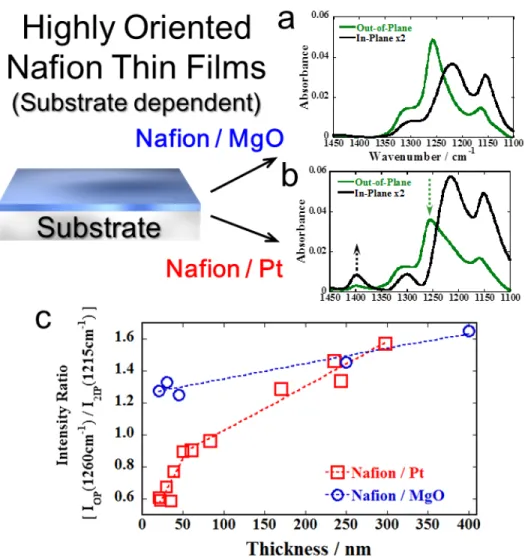
Oriented structures of Nafion thin films also receive attention. Anisotropic IR spectra between the in-plane (IP) and out-of-plane (OP) direction to the MgO (Figure 3a), 50 Si,52 and Pt
deposited65 surfaces (Figure 3b) by p-polarized multiple angle incidence resolution spectrometry
(pMAIRS)90, 91 have been reported. The IR pMAIRS technique can provide opportunities to
investigate pure IP and pure OP molecular vibrations to the substrate surface. The pMAIRS technique can reveal the degree of the molecular orientation quantitatively for each functional group according to the following equation (1) as
, (1) where IIP and IOP are the IP and OP peak absorbance and where ϕ denotes the orientation angle
from the surface normal. For the Nafion thin film, the IP spectrum shows the well-known spectrum of the thick Nafion membrane.92, 93 However, the OP spectrum differs greatly from the
IP spectrum, as shown in Figure 3a. The characteristic absorption band at 1260 cm-1 is observed
only in the OP spectrum. This band cannot be obtained in the IP spectrum. A few reports of the literature describe this peak located at 1260 cm-1 experimentally by polarization modulation
infrared reflection absorption spectroscopy.47, 88 They assigned different attributions of the band
at 1260 cm-1 as ν(CF2)88 and νas (CF3) + δs (COC)47 vibration mode, respectively. Zeng et al.
assigned νas (CF3) vibration mode at the 1269 cm-1 in the Raman spectra.94 Malevich et al. and
Korzeniewski et al. assigned attributions of the band at 1250–1350 cm-1 and 1249–1275 cm-1 as –
SO3- from a deconvoluted IR spectrum.95, 96 Figure 3b shows that this absorbance of the band at
1260 cm-1 in the OP spectrum on the Pt deposited surface changes with decreasing thickness.65
To discuss the absorbance change, the relative intensity ratio is calculated as OP IP I I 2 tan−1 = ϕ
Intensity ratio = 𝐼𝐼𝑂𝑂𝑂𝑂�1260 𝑐𝑐𝑐𝑐−1�
𝐼𝐼2𝐼𝐼𝑂𝑂(1215 𝑐𝑐𝑐𝑐−1), (2)
where IOP and I2IP are derived from peak absorbance of IR p-MAIR spectra. Figure 3c shows that
a threshold is observed around 50–70 nm in the case of the Pt-deposited surface. The ratio changes gradually with decreasing thickness on the MgO substrate surfaces, but no apparent threshold of the ratio is visible. This result suggests that the interfacial oriented structure depends on the substrate surface.
Figure 3 Oriented Nafion thin films. (a) pMAIR spectra on the MgO substrate. (b) pMAIR spectra on the Pt-sputtered surface. (c) Thickness dependence of relative intensity ratios
according to eq. (2). Adapted with permission from ref 65. Copyright 2016 American Chemical Society.
Other reports have described studies of the molecular orientation of the Nafion thin films. Kendrick et al. measured the polarization-modulated IR spectra of Pt-Nafion interfaces. The ordered structure of the SO3- groups on the Pt surface is well supported by their results and DFT
calculations.47 Yagi et al. discussed the orientation of SO
3- groups in the ca. 5 nm region of the
Nafion/Pt interface based on results of vibrational sum frequency generation spectroscopy.59
The adsorbed water also plays an important role in the proton transport property. The number of the adsorbed water and distribution of the water in the Nafion thin film can be investigated using an in-situ quartz crystal microbalance,53, 54, 60, 76, 80, 82, 85 NR,44-46, 54, 61, 81, 84, 86 and
photoluminescence82, 85 measurements. Compared to the thick Nafion membrane, the lower water
uptake and lower effective diffusion coefficient of water in the Nafion thin film were discussed. Their properties were found to be dependent on the film thickness. Less water uptake of the Nafion thin films causes the proton conductivity drop. Water uptake of the 25-nm-thick Nafion thin film on SiO2 shows less amount than that on Pt surface.76 Ogata et al. reported that multi
stepwise hydration was observed through the water uptake kinetics in ca. 50-nm-thick Nafion thin films on silver and quartz substrates by the surface plasmon resonance and NR measurements.84 An NMR study for 10-nm-thick and 160-nm-thick Nafion thin films showed
that the local mobility of the proton within the hydrogen-bonded domain is equivalent and that it is governed by the fast exchange limit in terms of NMR time scales.89
In summary, the Nafion thin film structure is unique and different from the thick Nafion membrane structure. The interfacial structure depends strongly on the thickness and substrate surface. To date, all results have shown that the proton conductivity of the Nafion thin film exhibits a lower value than that of the thick Nafion membrane. The proton conductivity of the Nafion thin film decreases concomitantly with decreasing thickness. Water uptake and diffusion of the Nafion thin film decrease compared to that of the thick Nafion membrane. The property of the Nafion thin film is related with the reaction sites for the polymer electrolyte fuel cells as an ionomer.43, 97 Therefore, understanding the relation between the interfacial structure and proton
transport property is necessary for both fundamental and application studies.
Enhancement of Proton Conductivity in Molecular Oriented Thin Films Oriented Oligomeric Amide Thin Films
The proton conductivity of the Nafion thin films is lower than that of the thick Nafion membrane. Nagao and Naito et al. first reported the observation of anomalous proton conductivity in amide thin films of oligo[(1, 2-propanediamine)-alt-(oxalic acid)] in 2008.98 From the results of 1H
NMR, FT-IR, and MALDI-TOF mass spectra, the synthesized amides are inferred as a mixture of the oligomers with different end groups and low-molecular-weights including the macrocyclic amides, as shown in Figure 4a. The oligomeric amide thin films were prepared by spin coating on the SiO2 substrate with thickness of 60–400 nm. Figure 4b shows that the in-plane proton
conductivity depended on thickness and showed 4.0 × 10⁻³ S cm−1 as a maximum value in the
200-nm-thick at the RH of 80%. For comparison between the thin film and bulk conductivity, the pelletized sample as bulk was processed into pellets of 2.5 mmϕ under pressure of approx. 1 GPa
because of failure of the self-standing membrane. The proton conductivity of the pelletized sample was 3.0 × 10⁻⁴ S cm−1, which is one order of magnitude lower than that of the
200-nm-thick thin film. The activation energies of the 200-nm-200-nm-thick film and pelletized sample were, respectively, 0.69 and 1.0 eV. Figure 4c shows that the substrate dependence of the proton conductivity was observed in the amide thin films.26, 99 The amide thin films showed different
proton conductivity on the SiO2, R-plane sapphire, and MgO(100). The proton conductivity
varied from 4 × 10⁻³ to 1 × 10⁻⁴ S cm-1 under the same condition of the 80% RH and 298 K. This
difference of the proton conductivity is probably attributable to the difference of the interfacial structure. The pMAIRS results show that the spectra of the thin film on the R-plane (1102) sapphire (Figure 4d) differ greatly from those of the MgO substrate (Figure 4e). Both thin films show the anisotropic oriented structure from the IP and OP spectra. The absorption bands at 1680 and 1520 cm-1 in the OP spectrum on MgO substrate can be assigned respectively to the
vibrational modes of Amide I and Amide II. The DFT calculation suggests that the wavenumber of the Amide I band depends on the oligomer–oligomer chain interaction through the hydrogen bonding networks. The difference of the proton conductivity can be derived from the differently oriented structure and hydrogen bonding networks in the thin films. Results obtained for the amide thin films demonstrate that the oriented structure in the thin films contributes to improvement of the proton conductivity. Therefore, preparing an oriented structure by thin films can be proposed as a new method to improve proton transport properties.
Figure 4 (a) Synthetic scheme of the oligomeric amide. (b) RH dependence of the proton conductivity of the amide bulk and thin films with thickness of 60 – 400 nm on SiO2 substrates.
(c) RH dependence of the proton conductivity of the amide thin films on different substrates. (d) pMAIR spectra of the amide thin films on sapphire substrate. (e) IR spectrum of the bulk powder and pMAIR spectra of the amide thin films on the MgO substrate. Figure 4b was adapted with permission from ref 98. Copyright 2009 Elsevier. Figures 4c-e were adapted with permission from ref 26. Copyright 2013 The Chemical Society of Japan.
Oriented Polypeptide Thin Films
An oriented polypeptide also improves the proton conductivity by thin films. Biological molecules and polymers with hydrogen bonding networks often exhibit hierarchical structures for the specific functionality. Proton transport into protein ionic channels has attracted many
researchers since the 1960s.1 Polypeptides are widely acknowledged to take several hierarchical
structures such as α-helix or β-sheets via hydrogen bonding between the amino acids. The poly(aspartic acid) has free carboxylic acid groups at the side chains. The protons at these groups are mobile as proton conduction in the synthetic scheme shown in Figure 5a.27, 29, 100-102 The fully
protonated poly(aspartic acid) thin film shows no oriented structure (Figure 5b),29 although a
partially protonated poly(aspartic acid) (P-Asp) thin film with 60 nm thick exhibits an anisotropic oriented structure between the IP and OP direction to the substrate by pMAIRS results, as depicted in Figure 5c.27 The Amide I band is visible in both IP and OP spectra from
pMAIR spectra at 1670 cm-1. The peak position of the Amide I band is related to the polypeptide
main-chain structure.103, 104 It is plausible that the P-Asp thin film exists in neither regular
secondary structures such as an α-helix or β-sheet nor in an irregular structure because these secondary structures respectively portray the Amide I bands at the range of 1640-1660, 1620-1640, and 1640-1660 cm–1, respectively.103, 104 Figure 5d portrays a proposed non-periodic
α-sheet like model. High proton migration paths were realized through α-α-sheet layers with water uptake, which percolate in-plane, formed by the stacked layer structure in OP direction of the substrate. This model does not necessarily mean that the thin film is composed exclusively of α-sheet layers. For proton conductivity, the fully protonated poly(aspartic acid) thin film shows high surface conductivity. The proton conduction path is dominated on the surface rather than inside the thin film (Figure 5e).29 By contrast, the oriented P-Asp thin film shows that protons
can be transported easily inside the thin film and that they exhibit in-plane proton conductivity of 3 × 10⁻³ S cm-1 on the MgO substrate at 298K, as shown in Figures 5f and 5g.27 It is remarkable
randomly oriented sample is prepared using a pelletized sample.27 The Amide I band appears
correspondingly at ca. 1650 cm-1 in the IR ATR result, which is attributable to the existence of
the irregular structure that produces the band at 1640-1660 cm–1.103, 104 The proton conductivity
of the random oriented P-Asp shows 4 × 10⁻⁴ S cm-1 at 298 K and 70% RH, which is one order
of magnitude lower than that of the oriented P-Asp thin film (Figure 5g). The activation energies for proton conductivity are 0.34 eV for the oriented P-Asp thin film and 0.65 eV for the random oriented P-Asp, as shown in Figure 5h. For comparison, examination using a quartz crystal microbalance is conducted for the water uptake between the oriented and random oriented P-Asp. Both the oriented and random oriented P-Asp show similar isotherm curves; both adsorb two water molecules per chain unit, at most (Figure 5i). Therefore, the results demonstrate that the oriented structure contributes to improvement of the proton transport property.
Figure 5 (a) Synthetic scheme of fully and partially protonated poly(aspartic acid). (b) pMAIR spectra of the fully protonated poly(aspartic acid) thin film. (c) pMAIR spectra of the partially protonated poly(aspartic acid). (d) Proposed structure of P-Asp thin film with non-periodic α-sheet like. Pink atoms surrounded by yellow represent proton carriers of carboxylic acid groups: C gray, N blue, O red, H white. (e) Schematic view of surface proton conduction in the fully protonated poly(aspartic acid) thin film. (f) Schematic view of proton conduction inside P-Asp thin film. (g) RH dependence of proton conductivity by the oriented and random oriented structures. (h) Temperature dependence of proton conductivity by the oriented and random oriented structures. (i) Water isotherm curve between the oriented and random oriented structures. Figures 5b,e,f were adapted with permission from ref 29. Copyright 2014 Elsevier. Figures 5c,d,g-i were adapted with permission from ref 27. Copyright 2013 American Chemical Society.
Results obtained for both amide and polypeptide thin films demonstrate new aspects to enhance proton conductivity by the oriented structure induced by the interface. In the next chapter, a highly proton-conductive organized thin film designed to obtain higher proton conductivity will be demonstrated using not only an oriented structure but also molecular ordering, which can respond reversibly to humidity.
Enhancement of the Proton Conductivity in Highly Molecular Organized Thin Films of Sulfonated Polyimide
Relation between Lyotropic Organized Structure and Proton Conductivity
Sulfonated polyimides (SPIs) are promising candidates for use as polymer electrolytes for fuel cells because of their thermal and chemical stabilities. 106-113 Recently, highly proton-conductive
oriented SPI thin films have been reported as shown in Figure 6a. 30-33 Many highly
proton-conductive polymers are amorphous or amorphous-like. However, this SPI thin film presents an organized structure by water uptake based on the lyotropic liquid crystal property with more than 10-1 S cm-1. This is the first report to demonstrate high proton-conduction by the oriented
organized structure in the solid thin films, which responds reversibly by the humidified atmosphere. The organized structure and liquid crystal property of the SPI thin film on the quartz substrate were confirmed respectively by humidity-controlled in-situ grazing incidence small angle X-ray scattering (GISAXS) measurements and birefringence by polarized optical microscopy (POM) measurements. The SPI thin film shows lyotropic liquid crystalline lamellar behavior. The existence of high relative humidity induces expansion of the lamellar structure in the out-of-plane direction by water uptake, as shown in Figure 6b. Increasing intensity of the OP peak from the GISAXS profile (Figure 6c) by water uptake suggests improvement of the degree of molecular ordering. Along with the improvement of the degree of molecular ordering for the oriented lamellar structure, the in-plane proton conductivity also increases from 10-4 S cm-1 to
10-1 Scm-1 at 25 ºC. Not only because of the oriented lamellar structure but also because of the
large scaled LC ordering and interchain ch-packing114 of SPI thin films, the proton transport
Figure 6 (a) Chemical structure of the sulfonated polyimide. (b) Schematic views of the organized lamellar structure. Molecular ordering improves with water uptake by the lyotropic liquid crystal property. (c) 2D GISAXS patterns at 0% RH and 95% RH, respectively, and humidity-dependent 1D GISAXS profiles in the IP and OP directions of the SPI thin film. Asterisks denote scattering from the Kapton windows. Adapted with permission from ref 32. Copyright 2015 American Chemical Society.
Effects of Molecular Weight to Proton Conductivity
Proton conductive polymers do not usually exhibit a strong effect of the molecular weight for proton conductivity when the molecular weight is greater than some thousands.115, 116 However,
the SPI thin films show strong correlation between the molecular weight and proton conductivity.32 Analyses of the thin films by GISAXS reveal that the HMw (Mw= 2.6 × 10⁵) SPI
film exhibits a higher degree of inherent liquid crystalline-like lamellar ordering than the LMw
(Mw= 1.3 × 10⁴) SPI film does, as shown in Figures 7a and 7b. Such molecular ordering and the
in-plane oriented structure can strongly influence the proton transport characteristics in thin films. The larger ordered domains in the HMw SPI thin film with thickness of approximately 500 nm
show marked proton conductivity enhancement to a value of 2.6 × 10⁻¹ S cm-1 at 25ºC and 95%
RH (Figure 7c), which is more than an order of magnitude higher value than that of the smaller ordered domains in the LMw SPI thin film with less molecular ordering. The larger ordered
domains in the HMw SPI thin film (Figure 7d and 7e) influence the proton conducting
characteristics attributable to the fewer liquid crystalline-like domain boundaries relative to the LMw SPI thin films (Figure 7f and 7g). That influence derives from the smaller ordered domains
in the LMw SPI thin film, which more clearly exhibit large-scaled domain boundaries that can
disrupt the fast ion transportation, as shown in Figure 7h and 7i. Revealing roles of the domain size and domain boundary for the high proton conduction in the SPI thin films is attractive issues to understand the proton conduction mechanism.
Figure 7 (a) RH dependence of 1D GISAXS profiles in the IP direction of both LMw and HMw
SPI thin films. Asterisks denote scattering from the Kapton windows. (b) RH dependence of 1D GISAXS profiles in the OP direction of both LMw and HMw SPI thin films. (c) RH dependence
of the proton conductivity for both LMw and HMw SPI thin films. (d), (e) POM images for larger
domain size of HMw SPI thin films at 0º and 45º, respectively. (f), (g) POM images for smaller
domain size of LMw SPI thin films at 0º and 45º, respectively. (h) Schematic view of the lower
proton conductivity in LMw SPI thin film with less molecular ordering in the out-of-plane
direction and smaller domain. (i) Schematic view of the higher proton conductivity in HMw SPI
thin film with better molecular ordering in the out-of-plane direction and larger domain. Adapted with permission from ref 32. Copyright 2015 American Chemical Society.
Summary
From the viewpoint of the scientific history of the creation of highly proton-conductive polymers, one fundamental approach is based on the strategy of phase-segregated structures with strong acid groups. In this Feature Article, the author demonstrated another method to improve proton conductivity using the interface. The interface can modify the degrees of freedom for a polymer structure by interaction between the substrate surface and polymers. This approach enables us to discuss the relation between the interfacial structure and proton transport property. The Nafion thin film exhibits a thickness-dependent structure at the interface, with proton conductivity decreasing along with decreasing thickness. The oligomeric amide thin films show a substrate-dependent oriented structure. The polypeptide thin films show proton conductivity improvement
in this article, a highly proton-conductive organized polyimide thin film was demonstrated using the lyotropic liquid crystal property. Both molecular ordering and the in-plane oriented structure can enhance proton conductivity in SPI thin films. Moreover, the optical domain and degree of the molecular ordering derived from the molecular weight can contribute strongly to the proton transport property. Other studies have also specifically examined the molecular orientation or organized structure for obtaining the proton condustion.19, 20, 117-120 Some issues still remain
unsolved: roles of the surface wettability, functional groups, surface charge to understand the interfacial interactions. Moreover, a side of the free-surface of the thin films should be considered. An equilibrium structure expected from slow assembly vs kinetically frozen structure from spin coating is also one of the attractive issues. These discoveries are expected not only to encourage further discussion of the relation between the interfacial structure and proton transport properties but also to contribute to the development of Solid State Protonics.
Author Information Corresponding Author *E-mail: [email protected]
Notes
The author declares no competing financial interest. References
(1) Mitchell, P. Coupling of phosphorylation to electron and hydrogen transfer by a chemi-osmotic type of mechanism. Nature 1961, 191, 144-148.
(2) Racker, E.; Stoeckenius, W. Reconstitution of purple membrane vesicles catalyzing light-driven proton uptake and adenosine triphosphate formation. J. Biol. Chem. 1974, 249, 662-663.
(3) Lozier, R. H.; Bogomolni, R. A.; Stoeckenius, W. Bacteriorhodopsin, a light-driven proton pump in Halobacterium halobium. Biophys. J. 1975, 15, 955-962.
(4) Butt, H. J.; Fendler, K.; Bamberg, E.; Tittor, J.; Oesterhelt, D. Aspartic acids 96 and 85 play a central role in the function of bacteriorhodopsin as a proton pump. EMBO J. 1989, 8, 1657-1663.
(5) Trissl, H. W. Photoelectric measurements of purple membranes. Photochem. Photobiol. 1990,
51, 793-818.
(6) Teissie, J.; Prats, M.; Soucaille, P.; Tocanne, J. F. Evidence for conduction of protons along the interface between water and a polar lipid monolayer. Proc. Natl. Acad. Sci. 1985, 82, 3217-3221.
(7) Morgan, H.; Taylor, D. M.; Oliveira, O. N. Proton Transport at the Monolayer-Water Interface. Biochim. Biophys. Acta 1991, 1062, 149-156.
(8) Liang, C. C. Conduction characteristics of the lithium iodide-aluminum oxide solid electrolytes. J. Electrochem. Soc. 1973, 120, 1289-1292.
(9) Schreck, E.; Laeuger, K.; Dransfeld, K. Enhanced ionic conductivity at the interface between sapphire and solid lithium iodide. Z. Phys. B: Condens. Matter 1986, 62, 331-334.
(10) Sata, N.; Eberman, K.; Eberl, K.; Maier, J. Mesoscopic fast ion conduction in nanometre-scale planar heterostructures. Nature 2000, 408, 946-949.
(11) Kosacki, I.; Suzuki, T.; Petrovsky, V.; Anderson, H. U. Electrical conductivity of
nanocrystalline ceria and zirconia thin films. Solid State Ionics 2000, 136-137, 1225-1233. (12) Maier, J. Nanoionics: Ion transport and electrochemical storage in confined systems. Nat.
Mater. 2005, 4, 805-815.
(13) Kosacki, I.; Rouleau, C. M.; Becher, P. F.; Bentley, J.; Lowndes, D. H. Nanoscale effects on the ionic conductivity in highly textured YSZ thin films. Solid State Ionics 2005, 176, 1319-1326.
(14) Peters, A.; Korte, C.; Hesse, D.; Zakharov, N.; Janek, J. Ionic conductivity and activation energy for oxygen ion transport in superlattices - The multilayer system CSZ (ZrO2 +
CaO)/Al2O3. Solid State Ionics 2007, 178, 67-76.
(15) Aoki, Y.; Habazaki, H.; Nagata, S.; Nakao, A.; Kunitake, T.; Yamaguchi, S. Finite Size Effect of Proton-Conductivity of Amorphous Silicate Thin Films Based on Mesoscopic Fluctuation of Glass Network. J. Am. Chem. Soc. 2011, 133, 3471-3479.
(16) Farhat, T. R.; Hammond, P. T. Designing a new generation of proton-exchange membranes using layer-by-layer deposition of polyelectrolytes. Adv. Funct. Mater. 2005, 15, 945-954. (17) Tago, T.; Shibata, H.; Nishide, H. Membrane preparation of polysulfonic acid complexes by
layer-by-layer adsorption. Macromol. Symp. 2006, 235, 19-24.
(18) Daiko, Y.; Katagiri, K.; Shimoike, K.; Sakai, M.; Matsuda, A. Structures and electrical properties of core-shell composite electrolytes with multi-heterointerfaces. Solid State
Ionics 2007, 178, 621-625.
(19) Matsui, J.; Miyata, H.; Hanaoka, Y.; Miyashita, T. Layered Ultrathin Proton Conductive Film Based on Polymer Nanosheet Assembly. ACS Appl. Mater. Inter. 2011, 3, 1394-1397. (20) Sato, T.; Hayasaka, Y.; Mitsuishi, M.; Miyashita, T.; Nagano, S.; Matsui, J. High Proton
Conductivity in the Molecular Interlayer of a Polymer Nanosheet Multilayer Film.
Langmuir 2015, 31, 5174-5180.
(21) Xu, G.; Otsubo, K.; Yamada, T.; Sakaida, S.; Kitagawa, H. Superprotonic Conductivity in a Highly Oriented Crystalline Metal-Organic Framework Nanofilm. J. Am. Chem. Soc. 2013,
135, 7438-7441.
(22) Koinuma, M.; Ogata, C.; Kamei, Y.; Hatakeyama, K.; Tateishi, H.; Watanabe, Y.;
Taniguchi, T.; Gezuhara, K.; Hayami, S.; Funatsu, A.; Sakata, M.; Kuwahara, Y.; Kurihara, S.; Matsumoto, Y. Photochemical Engineering of Graphene Oxide Nanosheets. J. Phys.
Chem. C 2012, 116, 19822-19827.
(23) Hu, S.; Lozada-Hidalgo, M.; Wang, F. C.; Mishchenko, A.; Schedin, F.; Nair, R. R.; Hill, E. W.; Boukhvalov, D. W.; Katsnelson, M. I.; Dryfe, R. A. W.; Grigorieva, I. V.; Wu, H. A.; Geim, A. K. Proton transport through one-atom-thick crystals. Nature 2014, 516, 227-230. (24) Kreuer, K. D. On the development of proton conducting polymer membranes for hydrogen
(25) Hickner, M. A.; Ghassemi, H.; Kim, Y. S.; Einsla, B. R.; McGrath, J. E. Alternative polymer systems for proton exchange membranes (PEMs). Chem. Rev. 2004, 104, 4587-4611.
(26) Nagao, Y. Substrate Dependence of the Proton Transport and Oriented Structure in Oligo (1,2-propanediamine)-alt-(oxalic acid) Thin Films. Chem. Lett. 2013, 42, 468-470. (27) Nagao, Y.; Matsui, J.; Abe, T.; Hiramatsu, H.; Yamamoto, H.; Miyashita, T.; Sata, N.;
Yugami, H. Enhancement of Proton Transport in an Oriented Polypeptide Thin Film.
Langmuir 2013, 29, 6798-6804.
(28) Wang, Z. Q.; Nagao, Y. Effects of Nafion impregnation using inkjet printing for membrane electrode assemblies in polymer electrolyte membrane fuel cells. Electrochim. Acta 2014,
129, 343-347.
(29) Nagao, Y.; Kubo, T. Surface proton transport of fully protonated poly(aspartic acid) thin films on quartz substrates. Appl. Surf. Sci. 2014, 323, 19-24.
(30) Krishnan, K.; Iwatsuki, H.; Hara, M.; Nagano, S.; Nagao, Y. Proton conductivity enhancement in oriented, sulfonated polyimide thin films. J. Mater. Chem. A 2014, 2, 6895-6903.
(31) Krishnan, K.; Yamada, T.; Iwatsuki, H.; Hara, M.; Nagano, S.; Otsubo, K.; Sakata, O.; Fujiwara, A.; Kitagawa, H.; Nagao, Y. Influence of Confined Polymer Structure on Proton Transport Property in Sulfonated Polyimide Thin Films. Electrochemistry 2014, 82, 865-869.
(32) Krishnan, K.; Iwatsuki, H.; Hara, M.; Nagano, S.; Nagao, Y. Influence of Molecular Weight on Molecular Ordering and Proton Transport in Organized Sulfonated Polyimide Thin Films. J. Phys. Chem. C 2015, 119, 21767-21774.
(33) Nagao, Y.; Krishnan, K.; Goto, R.; Hara, M.; Nagano, S. Effect of Casting Solvent on Interfacial Molecular Structure and Proton Transport Characteristics of Sulfonated Polyimide Thin Films. Anal. Sci. 2017, 33, 35-39.
(34) Hsu, W. Y.; Gierke, T. D. Ion transport and clustering in nafion perfluorinated membranes.
J. Membr. Sci. 1983, 13, 307-326.
(36) Kusoglu, A.; Weber, A. Z. New Insights into Perfluorinated Sulfonic-Acid lonomers. Chem.
Rev. 2017, 117, 987-1104.
(37) Gierke, T. D.; Munn, G. E.; Wilson, F. C. The morphology in nafion perfluorinated membrane products, as determined by wide- and small-angle x-ray studies. J. Polym. Sci.
Pol. Phys. 1981, 19, 1687-1704.
(38) Schmidt-Rohr, K.; Chen, Q. Parallel cylindrical water nanochannels in Nafion fuel-cell membranes. Nat. Mater. 2008, 7, 75-83.
(39) Kreuer, K.-D.; Portale, G. A Critical Revision of the Nano-Morphology of Proton
Conducting Ionomers and Polyelectrolytes for Fuel Cell Applications. Adv. Funct. Mater. 2013, 23, 5390-5397.
(40) Siroma, Z.; Kakitsubo, R.; Fujiwara, N.; Ioroi, T.; Yamazaki, S.-i.; Yasuda, K. Depression of proton conductivity in recast Nafion® film measured on flat substrate. J. Power Sources
2009, 189, 994-998.
(41) Kanamura, K.; Morikawa, H.; Umegaki, T. Observation of Interface Between Pt Electrode and Nafion Membrane. J. Electrochem. Soc. 2003, 150, A193-A198.
(42) Hill, T. A.; Carroll, D. L.; Czerw, R.; Martin, C. W.; Perahia, D. Atomic force microscopy studies on the dewetting of perfluorinated ionomer thin films. J. Polym. Sci. Pol. Phys. 2003, 41, 149-158.
(43) More, K.; Borup, R.; Reeves, K. Identifying Contributing Degradation Phenomena in PEM Fuel Cell Membrane Electride Assemblies Via Electron Microscopy. ECS Trans. 2006, 3, 717-733.
(44) Murthi, V. S.; Dura, J.; Satija, S.; Majkrzak, C. Water Uptake and Interfacial Structural Changes of Thin Film Nafion® Membranes Measured by Neutron Reflectivity for PEM Fuel Cells. ECS Trans. 2008, 16, 1471-1485.
(45) Dura, J. A.; Murthi, V. S.; Hartman, M.; Satija, S. K.; Majkrzak, C. F. Multilamellar Interface Structures in Nafion. Macromolecules 2009, 42, 4769-4774.
(46) Wood, D. L.; Chlistunoff, J.; Majewski, J.; Borup, R. L. Nafion Structural Phenomena at Platinum and Carbon Interfaces. J. Am. Chem. Soc. 2009, 131, 18096-18104.
(47) Kendrick, I.; Kumari, D.; Yakaboski, A.; Dimakis, N.; Smotkin, E. S. Elucidating the Ionomer-Electrified Metal Interface. J. Am. Chem. Soc. 2010, 132, 17611-17616.
(48) Bass, M.; Berman, A.; Singh, A.; Konovalov, O.; Freger, V. Surface Structure of Nafion in Vapor and Liquid. J. Phys. Chem. B 2010, 114, 3784-3790.
(49) Bass, M.; Berman, A.; Singh, A.; Konovalov, O.; Freger, V. Surface-Induced Micelle Orientation in Nafion Films. Macromolecules 2011, 44, 2893-2899.
(50) Nagao, Y. Proton Transport Property of Nafion Thin Films on MgO(100) with Anisotropic Molecular Structure. e-J. Surf. Sci. Nanotechnol. 2012, 10, 114-116.
(51) Modestino, M. A.; Kusoglu, A.; Hexemer, A.; Weber, A. Z.; Segalman, R. A. Controlling Nafion Structure and Properties via Wetting Interactions. Macromolecules 2012, 45, 4681-4688.
(52) Nagao, Y. Highly Oriented Sulfonic Acid Groups in a Nafion Thin Film on Si Substrate. J.
Phys. Chem. C 2013, 117, 3294-3297.
(53) Modestino, M. A.; Paul, D. K.; Dishari, S.; Petrina, S. A.; Allen, F. I.; Hickner, M. A.; Karan, K.; Segalman, R. A.; Weber, A. Z. Self-Assembly and Transport Limitations in Confined Nafion Films. Macromolecules 2013, 46, 867-873.
(54) Kim, S.; Dura, J. A.; Page, K. A.; Rowe, B. W.; Yager, K. G.; Lee, H. J.; Soles, C. L. Surface-Induced Nanostructure and Water Transport of Thin Proton-Conducting Polymer Films. Macromolecules 2013, 46, 5630-5637.
(55) Paul, D. K.; Karan, K.; Docoslis, A.; Giorgi, J. B.; Pearce, J. Characteristics of Self-Assembled Ultrathin Nafion Films. Macromolecules 2013, 46, 3461-3475.
(56) Damasceno Borges, D.; Franco, A. A.; Malek, K.; Gebel, G.; Mossa, S. Inhomogeneous Transport in Model Hydrated Polymer Electrolyte Supported Ultrathin Films. ACS Nano 2013, 7, 6767-6773.
(57) Ohira, A.; Kuroda, S.; Mohamed, H. F. M.; Tavernier, B. Effect of interface on surface morphology and proton conduction of polymer electrolyte thin films. Phys. Chem. Chem.
Phys. 2013, 15, 11494-11500.
(58) Mohamed, H. F. M.; Kuroda, S.; Kobayashi, Y.; Oshima, N.; Suzuki, R.; Ohira, A. Possible presence of hydrophilic SO3H nanoclusters on the surface of dry ultrathin Nafion films: a
positron annihilation study. Phys. Chem. Chem. Phys. 2013, 15, 1518-1525. (59) Yagi, I.; Inokuma, K.; Kimijima, K.; Notsu, H. Molecular Structure of Buried
(60) Kusoglu, A.; Kushner, D.; Paul, D. K.; Karan, K.; Hickner, M. A.; Weber, A. Z. Impact of Substrate and Processing on Confinement of Nafion Thin Films. Adv. Funct. Mater. 2014,
24, 4763-4774.
(61) DeCaluwe, S. C.; Kienzle, P. A.; Bhargava, P.; Baker, A. M.; Dura, J. A. Phase segregation of sulfonate groups in Nafion interface lamellae, quantified via neutron reflectometry fitting techniques for multi-layered structures. Soft Matter 2014, 10, 5763-5776.
(62) Page, K. A.; Kusoglu, A.; Stafford, C. M.; Kim, S.; Kline, R. J.; Weber, A. Z. Confinement-Driven Increase in Ionomer Thin-Film Modulus. Nano Lett. 2014, 14, 2299-2304.
(63) Page, K. A.; Shin, J. W.; Eastman, S. A.; Rowe, B. W.; Kim, S.; Kusoglu, A.; Yager, K. G.; Stafford, G. R. In Situ Method for Measuring the Mechanical Properties of Nafion Thin Films during Hydration Cycles. ACS Appl. Mater. Inter. 2015, 7, 17874-17883.
(64) Kusoglu, A.; Dursch, T. J.; Weber, A. Z. Nanostructure/Swelling Relationships of Bulk and Thin-Film PFSA Ionomers. Adv. Funct. Mater. 2016, 26, 4961-4975.
(65) Ono, Y.; Nagao, Y. Interfacial Structure and Proton Conductivity of Nafion at the Pt-Deposited Surface. Langmuir 2016, 32, 352-358.
(66) Ozhukil Kollath, V.; Karan, K. New molecular scale insights into the α-transition of Nafion thin films from variable temperature ATR-FTIR spectroscopy. Phys. Chem. Chem. Phys. 2016, 18, 26144-26150.
(67) Zimudzi, T. J.; Hickner, M. A. Signal Enhanced FTIR Analysis of Alignment in NAFION Thin Films at SiO2 and Au Interfaces. ACS Macro Lett. 2016, 5, 83-87.
(68) Siroma, Z.; Ioroi, T.; Fujiwara, N.; Yasuda, K. Proton conductivity along interface in thin cast film of Nafion®. Electrochem. Commun. 2002, 4, 143-145.
(69) Paul, D. K.; Fraser, A.; Pearce, J.; Karan, K. Understanding the ionomer structure and the proton conduction mechanism in PEFC catalyst layer: adsorbed Nafion on model substrate.
ECS Trans. 2011, 41, 1393-1406.
(70) Paul, D. K.; Fraser, A.; Karan, K. Towards the understanding of proton conduction
mechanism in PEMFC catalyst layer: Conductivity of adsorbed Nafion films. Electrochem.
Commun. 2011, 13, 774-777.
(71) Karan, K. Determination of CL Ionomer Conductivity. ECS Trans. 2013, 50 (2), 395-403. (72) Paul, D. K.; Giorgi, J. B.; Karan, K. Chemical and Ionic Conductivity Degradation of
(73) Paul, D. K.; Karan, K. Conductivity and Wettability Changes of Ultrathin Nafion Films Subjected to Thermal Annealing and Liquid Water Exposure. J. Phys. Chem. C 2014, 118, 1828-1835.
(74) Paul, D. K.; McCreery, R.; Karan, K. Proton Transport Property in Supported Nafion Nanothin Films by Electrochemical Impedance Spectroscopy. J. Electrochem. Soc. 2014,
161, F1395-F1402.
(75) Weber, A. Z.; Kusoglu, A. Unexplained transport resistances for low-loaded fuel-cell catalyst layers. J. Mater. Chem. A 2014, 2, 17207-17211.
(76) Shim, H. K.; Paul, D. K.; Karan, K. Resolving the Contradiction between Anomalously High Water Uptake and Low Conductivity of Nanothin Nafion films on SiO2 Substrate.
Macromolecules 2015, 48, 8394-8397.
(77) Guo, Y. L.; Ono, Y.; Nagao, Y. Modification for Uniform Surface of Nafion Ultrathin Film Deposited by Inkjet Printing. Langmuir 2015, 31, 10137-10144.
(78) Paul, D. K.; Shim, H. K.; Giorgi, J. B.; Karan, K. Thickness Dependence of Thermally Induced Changes in Surface and Bulk Properties of Nafion® Nanofilms. J. Polym. Sci. Pol.
Phys. 2016, 54, 1267-1277.
(79) Noguchi, H.; Taneda, K.; Minowa, H.; Naohara, H.; Uosaki, K. Humidity-Dependent Structure of Surface Water on Perfluorosulfonated Ionomer Thin Film Studied by Sum Frequency Generation Spectroscopy. J. Phys. Chem. C 2010, 114, 3958-3961.
(80) Kongkanand, A. Interfacial Water Transport Measurements in Nafion Thin Films Using a Quartz-Crystal Microbalance. J. Phys. Chem. C 2011, 115, 11318-11325.
(81) Eastman, S. A.; Kim, S.; Page, K. A.; Rowe, B. W.; Kang, S.; DeCaluwe, S. C.; Dura, J. A.; Soles, C. L.; Yager, K. G. Effect of Confinement on Structure, Water Solubility, and Water Transport in Nafion Thin Films. Macromolecules 2012, 45, 7920-7930.
(82) Dishari, S. K.; Hickner, M. A. Antiplasticization and Water Uptake of Nafion Thin Films.
ACS Macro Lett. 2012, 1, 291-295.
(83) Kusoglu, A.; Kwong, A.; Clark, K. T.; Gunterman, H. P.; Weber, A. Z. Water Uptake of Fuel-Cell Catalyst Layers. J. Electrochem. Soc. 2012, 159, F530-F535.
(84) Ogata, Y.; Kawaguchi, D.; Yamada, N. L.; Tanaka, K. Multistep Thickening of Nafion Thin Films in Water. ACS Macro Lett. 2013, 2, 856-859.
(85) Dishari, S. K.; Hickner, M. A. Confinement and Proton Transfer in NAFION Thin Films.
Macromolecules 2013, 46, 413-421.
(86) Kalisvaart, W. P.; Fritzsche, H.; Merida, W. Water Uptake and Swelling Hysteresis in a Nafion Thin Film Measured with Neutron Reflectometry. Langmuir 2015, 31, 5416-5422. (87) Sel, O.; To Thi Kim, L.; Debiemme-Chouvy, C.; Gabrielli, C.; Laberty-Robert, C.; Perrot, H.
Determination of the Diffusion Coefficient of Protons in Nafion Thin Films by ac-Electrogravimetry. Langmuir 2013, 29, 13655-13660.
(88) Davis, E. M.; Stafford, C. M.; Page, K. A. Elucidating Water Transport Mechanisms in Nafion Thin Films. ACS Macro Lett. 2014, 3, 1029-1035.
(89) De Almeida, N. E.; Paul, D. K.; Karan, K.; Goward, G. R. 1H Solid-State NMR Study of
Nanothin Nafion Films. J. Phys. Chem. C 2015, 119, 1280-1285.
(90) Hasegawa, T. A novel measurement technique of pure out-of-plane vibrational modes in thin films on a nonmetallic material with no polarizer. J. Phys. Chem. B 2002, 106, 4112-4115.
(91) Hasegawa, T. Advanced multiple-angle incidence resolution spectrometry for thin-layer analysis on a low-refractive-index substrate. Anal. Chem. 2007, 79, 4385-4389.
(92) Gruger, A.; Regis, A.; Schmatko, T.; Colomban, P. Nanostructure of Nafion membranes at different states of hydration An IR and Raman study. Vib. Spectrosc. 2001, 26, 215-225. (93) Danilczuk, M.; Lin, L.; Schlick, S.; Hamrock, S. J.; Schaberg, M. S. Understanding the
fingerprint region in the infra-red spectra of perfluorinated ionomer membranes and corresponding model compounds: Experiments and theoretical calculations. J. Power
Sources 2011, 196, 8216-8224.
(94) Zeng, J. B.; Jean, D. I.; Ji, C. X.; Zou, S. Z. In Situ Surface-Enhanced Raman Spectroscopic Studies of Nafion Adsorption on Au and Pt Electrodes. Langmuir 2012, 28, 957-964. (95) Malevich, D.; Zamlynny, V.; Sun, S. G.; Lipkowski, J. In situ infrared reflection absorption
spectroscopy studies of the interaction of Nafion® with the Pt electrode surface. Z. Phys.
Chem. 2003, 217, 513-525.
(96) Korzeniewski, C.; Snow, D. E.; Basnayake, R. Transmission infrared spectroscopy as a probe of Nafion film structure: analysis of spectral regions fundamental to understanding hydration effects. Appl. Spectrosc. 2006, 60, 599-604.
(97) Lopez-Haro, M.; Guetaz, L.; Printemps, T.; Morin, A.; Escribano, S.; Jouneau, P. H.; Bayle-Guillemaud, P.; Chandezon, F.; Gebel, G. Three-dimensional analysis of Nafion layers in fuel cell electrodes. Nat. Commun. 2014, 5, 5229.
(98) Nagao, Y.; Naito, N.; Iguchi, F.; Sata, N.; Yugami, H. Synthesis of oligomeric poly (1, 2-propanediamine)-alt-(oxalic acid) and anomalous proton conductivities of the thin films.
Solid State Ionics 2009, 180, 589-591.
(99) Nagao, Y.; Naito, N.; Iguchi, F.; Sata, N.; Yugami, H. Proton Conductivity of Oligomeric Poly (1,2-Propanediamine)-alt-(Oxalic Acid) Thin Films on Al2O3 Substrates. e-J. Surf. Sci.
Nanotechnol. 2009, 7, 530 - 532.
(100) Nagao, Y.; Ando, M.; Maekawa, H.; Chang, C. H.; Iguchi, F.; Sata, N. Synthesis and proton transport property of poly(aspartic acid) thin film on MgO(100) substrate. ECS
Trans. 2009, 16, 401-406.
(101) Nagao, Y.; Iguchi, F.; Sata, N.; Yugami, H. Synthesis and proton transport property of poly(aspartic acid) thin film on SiO2 substrate. Solid State Ionics 2010, 181, 206-209.
(102) Nagao, Y.; Imai, Y.; Matsui, J.; Ogawa, T.; Miyashita, T. Proton transport properties of poly(aspartic acid) with different average molecular weights. J. Chem. Thermodyn. 2011,
43, 613-616.
(103) Krimm, S.; Bandekar, J. Vibrational Spectroscopy and Conformation of Peptides, Polypeptides, and Proteins. Adv. Protein Chem. 1986, 38, 181-364.
(104) Dong, A.; Huang, P.; Caughey, W. S. Protein Secondary Structure in Water from Second-derivative Amide I Infrared Spectra. Biochemistry 1990, 29, 3303-3308.
(105) Liu, B.; Hu, W.; Robertson, G. P.; Guiver, M. D. Poly(aryl ether ketone)s with carboxylic acid groups: synthesis, sulfonation and crosslinking. J. Mater. Chem. 2008, 18, 4675-4682. (106) Vallejo, E.; Pourcelly, G.; Gavach, C.; Mercier, R.; Pineri, M. Sulfonated polyimides as
proton conductor exchange membranes. Physicochemical properties and separation H+/Mz+
by electrodialysis comparison with a perfluorosulfonic membrane. J. Membr. Sci. 1999,
160, 127-137.
(107) Genies, C.; Mercier, R.; Sillion, B.; Cornet, N.; Gebel, G.; Pineri, M. Soluble sulfonated naphthalenic polyimides as materials for proton exchange membranes. Polymer 2001, 42, 359-373.
(108) Fang, J. H.; Guo, X. X.; Harada, S.; Watari, T.; Tanaka, K.; Kita, H.; Okamoto, K. Novel sulfonated polyimides as polyelectrolytes for fuel cell application. 1. Synthesis, proton conductivity, and water stability of polyimides from 4,4'-diaminodiphenyl ether-2,2'-disulfonic acid. Macromolecules 2002, 35, 9022-9028.
(109) Guo, X. X.; Fang, J. H.; Watari, T.; Tanaka, K.; Kita, H.; Okamoto, K. Novel sulfonated polyimides as polyelectrolytes for fuel cell application. 2. Synthesis and proton
conductivity, of polyimides from 9,9-bis(4-aminophenyl)fluorene-2,7-disulfonic acid.
Macromolecules 2002, 35, 6707-6713.
(110) Woo, Y.; Oh, S. Y.; Kang, Y. S.; Jung, B. Synthesis and characterization of sulfonated polyimide membranes for direct methanol fuel cell. J. Membr. Sci. 2003, 220, 31-45. (111) Watari, T.; Fang, J. H.; Tanaka, K.; Kita, H.; Okamoto, K.; Hirano, T. Synthesis, water
stability and proton conductivity of novel sulfonated polyimides from 4,4'-bis(4-aminophenoxy)biphenyl-3,3'-disulfonic acid. J. Membr. Sci. 2004, 230, 111-120. (112) Asano, N.; Aoki, M.; Suzuki, S.; Miyatake, K.; Uchida, H.; Watanabe, M.
Aliphatic/aromatic polyimide lonomers as a proton conductive membrane for fuel cell applications. J. Am. Chem. Soc. 2006, 128, 1762-1769.
(113) Tamura, T.; Kawakami, H. Aligned Electrospun Nanofiber Composite Membranes for Fuel Cell Electrolytes. Nano Lett. 2010, 10, 1324-1328.
(114) Wakita, J.; Jin, S.; Shin, T. J.; Ree, M.; Ando, S. Analysis of Molecular Aggregation Structures of Fully Aromatic and Semialiphatic Polyimide Films with Synchrotron Grazing Incidence Wide-Angle X-ray Scattering. Macromolecules 2010, 43, 1930-1941.
(115) Shi, J.; Vincent, C. A. The effect of Molecular Weight on Cation Mobility in Polymer Electrolytes. Solid State Ionics 1993, 60, 11-17.
(116) Nagao, Y.; Haneda, A.; Naito, N.; Iguchi, F.; Sata, N.; Yugami, H. Synthesis and protonic conductivity of the oligomeric amides with different average molecular weights. Solid
State Ionics 2008, 179, 1142-1145.
(117) Kato, T.; Mizoshita, N.; Kishimoto, K. Functional liquid-crystalline assemblies: Self-organized soft materials. Angew. Chem. Int. Ed. 2006, 45, 38-68.
(118) Every, H. A.; van der Ham, L. V.; Picken, S. J.; Mendes, E. Physical Properties of
Oriented Thin Films Formed by the Electrostatic Complexation of Sulfonated Polyaramid.
(119) Yabu, H.; Matsui, J.; Hara, M.; Nagano, S.; Matsuo, Y.; Nagao, Y. Proton Conductivities of Lamellae-Forming Bioinspired Block Copolymer Thin Films Containing Silver
Nanoparticles. Langmuir 2016, 32, 9484-9491.
(120) Kato, T.; Yoshio, M.; Ichikawa, T.; Soberats, B.; Ohno, H.; Funahashi, M. Transport of ions and electrons in nanostructured liquid crystals. Nat. Rev. Mater. 2017, 2, 17001. Acknowledgments
The author thanks Associate Professor Jun Matsui of Yamagata University, Associate Professor Shusaku Nagano, Dr. Mitsuo Hara, Ms. Hiroko Iwatsuki, and Mr. Ryosuke Goto of Nagoya University, and many collaborators. The author is thankful for the significant experimental efforts and results of Ms. Mie Sasaki, Mr. Nobuhiro Naito, Ms. Emi Urano, Dr. Karthik Krishnan, Dr. Zhuqing Wang, Mr. Takahiro Kubo, Ms. Yanglu Guo, Mr. Yutaro Ono, and many graduate students at Tohoku University, Kyoto University, and Japan Advanced Institute of Science and Technology. This work was supported in part by the Nanotechnology Platform Program (Molecule and Material Synthesis) of the Ministry of Education, Culture, Sports, Science and Technology (MEXT), Japan. This work was financially supported by Program for Improvement of Research Environment for Young Researchers from Special Coordination Funds for Promoting Science and Technology (SCF) commissioned by the Ministry of Education, Culture, Sports, Science and Technology (MEXT) of Japan and the Japan Society for the Promotion of Science (JSPS) through the Funding Program (GR060) for Next Generation World-Leading Researchers (NEXT Program) initiated by the Council for Science and Technology Policy (CSTP). In addition, this work was partially supported research funds of Grant-in-Aid for Scientific Research for Young Scientists from JSPS of Japan (No. 18850005), JST-PRESTO,
Electrotechnology of Chubu (REFEC), Iketani Science and Technology Foundation, The Ogasawara Foundation for the Promotion of Science & Engineering, The Kyoto Technoscience Center, The Foundation Hattori-Hokokai, and The Murata Science Foundation.
TOC
Biography
Yuki Nagao was born in Tokyo, Japan in 1977. He received his B.Sc. in 2001 and M. Sc. in 2003 from University of Tsukuba and Ph.D. in 2006 from Kyushu University under supervision by Prof. Ryuichi Ikeda and Prof. Hiroshi Kitagawa. He was appointed an Assistant Professor of the Department of Mechanical Engineering, Graduate School of Engineering at Tohoku University
in 2006. He also worked as a researcher at PRESTO, JST in 2010, later moving to the Department of Chemistry, Faculty of Science at Kyoto University. Since 2012, he has been an Associate Professor of the School of Materials Science at Japan Advanced Institute of Science and Technology. His current interest is the study of a relation between the interfacial structure and high proton transport property in polymer thin films.