Title
Studies on the Improvement of Jaagaru (Calcareous Heavy
Clay Soil) in Okinawa Island 3 Effects of Niibi Addition on the
Physical Properties of Jaagaru
Author(s)
Oshiro, Kishin
Citation
沖縄農業, 11(1・2): 41-48
Issue Date
1973-03
URL
http://hdl.handle.net/20.500.12001/1144
Studies on the Improvement of Jaagaru (Calcareous
Heavy Clay Soil) of Okinawa Island
III Effects of Niibi Addition on the Physical
Properties of Jaagaru
by
Kishin Oshiro
(Okinawa Pref. Agr. Exp. St.)
1 Introduction
In the previous paper it was pointed out that possibility of the improvement of the
physical properties of surface soil of Jaagaru by Niibi dressing.
The effectes of Niibi dressing on the Physical properties of Jaagaru were investigated before immediate Niibi dressing was carried out. The present paper reports the effects of
Niibi addition on the physical properties of Jaagaru. 2 Materials and Methods
Soil samples, sampling sites of Jaagaru and Niibi samples are same as reort II. Physical Analysis:
a. pF water distribution by sand pole and centrifugal methods.
b. Particle size distribution: The pipette method was used with sodium-hexametaphosphate
as a dispersion agent.
c. Atterberg limit: Air-dried 2-mm soil samples were used to determine liquid limit, plastic
limit, and plastisity range.
d. Three phase distribution: Three phase distribution was determined on 2-mm soil
samples in 100 mililiter core at pF 1.5 by volumetric method.
e. Soil hardness: The soil hardness was determined by Yamanaka soil hardness meter. f. Adhesive force: In the determination of adhesive force of the soils, used were a polyet
hylene pipe which was 2 cm in height, 2cm2 in end inner area, knife-edged at the
bottom and with a string attached to the top, 100 ml core sampler connected with lid,
and lid of the core sampler. Various quantities of water were added to 20 grams of air-dried soil«2 mm) and the soils were kneaded sufficiently. The kneaded sample was packed into the above mentioned polyethylene pipe, and sticked to the center of he lid of core sampler. Then, the string was held with a forefinger to raise the polyethylene pipe packed with the kneaded soil. Wire rings were placed as the weight on the lid of core sampler when the lid was kept in the air by the adhesive force of the kneaded soil for at least 15 seconds. The total weight of the lid and wire rings was expressed as the adhesive force of the soil sample per 2 cm2.
42 (1973)
g. Volume shrinkage: Air-dried soil samples (<2mm) were placed into 100 ml core sampler
and saturated with water for 24 hours. The samples were air dried again at room temperature, and dried at 105°C for 24 hours. The volume of the dried samples was determined measuring the height and diameter of the samples. The voulum shrinkage was obtained by subtracting the volume of dried soil from 100 ml.
h. Permeability by constant-head method.
i. Capillary water rise: Glass tubes, 1.5 cm in diameter and 100cm in height were used to determine the capillary water rise of air-dried soil samples «2mm).
Table 1. Physical Properties of Jaagaru Soil Samples
Particle size distribution % Coarse Sand (2—0.2mm) Fine sand (0.2—0.02mm) Silt (0.02-0.002mm) Clay «0.002mm) Gravel (>2mm) Bulk dencity True special gravity
pF water Vol. % pF 0.0 pF 1.5 pF 2.0 pF 2.7 pF 4.2 Macro pores Available water Unavailable water Shrinkage Vol. %
Maximum adhesvie force g/cm2 Permeability cm/ssc X10-5 Soil hardness kg/cm3 Air dried Oven dried Iju 1.20 19.30 45.30 34.20 0.0 0.94 2.65 64.6 54.5 41.9 36.9 24.8 10.1 29.7 24.8 27.5 210 — 870 9,000 Soil Samples Inamine 1.70 22.20 34.40 41.70 0.0 1.11 2.54 56.4 50.7 40.4 33.7 23.9 5.7 26.8 23.9 31.4 250 9.15 930 12,000
Oshiro : Studies on the Improvement of Jaagaru 43
3 Results and Discussion
(1) Physical Properties of Jaagaru Soil Samples
Physical properties of the Jaagaru soil samples are given in table 1 and Figs. 1 to 3. Both Iju and Inamine soils are fine in texture. Available water content of Iju soil is
29.7%, and that of Inamine soil is 26.8% by volume base, respectively. In the former,
59.3 % of available water and in the latter, 63.4 % of it are low tension water held less
than pF 2.7. Unavailable water contents of the two soils are high.
They are very high in volume shrinkage, in maximum adhesive force, and in soil
hard-naess but very low in water permeability
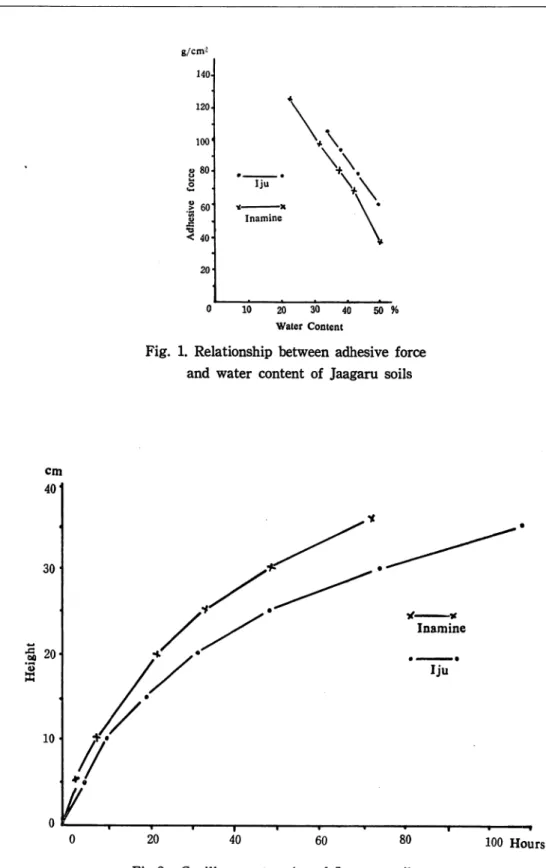
The adhesive force of the samples varies with degrees of thier water contents (Fig.l).
The capillary water rise of the samples is very slow (Fig.2).
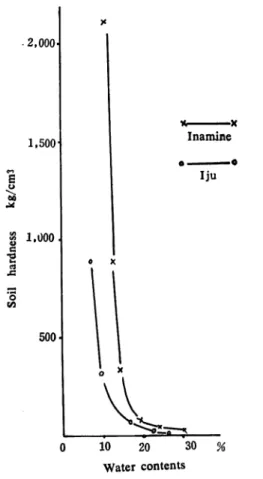
The soil hardness of them varies with levels of water content and it increases
expone-tially with decreasing water content (Fig.3) .
(2) Physical Properties of Niibi Sample
Table 2 and Fig 4 show some of the physical properties of Niibi.
Niibi consists of 94.5 % of sand fractions and 5.5 % of clay fraction. Among the sand fractions, fine sand occupies 85.2 %, silt 8.4 %, and coarse sand 0.9 %, indicating that Niibi is quite uniform in particle size distribution occupied mostly by fine sand fraction.
Table 2. Physical Propertis of Niibi Particle Size Distribution (%)
Coarse sand (2—0.2mm) 0.9 Fine sand (0.2-0.02mm) 85.2 Silt (0.02—0.002mm) 8.4 Clay «0.002mm) 5.5 Gravel (>2mm) % 0.0
Bulk density
1.18
True specific gravity
2.53
pF Water Vol. % pF 0.0 53.2 pF 1.5 41.4 pF 2.0 25.2 pF 2.7 15.6 pF 4.2 8.4
Macro Pores
11.8
Available Water
33.0
Unavailable Water
8.4
Permeability cm/sec X10-3 4.0744 I* 111 (1973) g/cm2 140-120 100' P 80.
I60
< 40 20 Inamine 10 20 30 40 50 % Water ContentFig. 1. Relationship between adhesive force and water content of Jaagaru soils
cm 401 30 00
3
10 20 40 60 80Fig.2. Capillary water rise of Jaagaru soils
Oshiro : Studies on the Improvement of Jaagaru 45 • 2,000-1,500 8} 1.000 O CO 500 Inamine Iju cm 40 30 20 10 0 12 3 4 5 Hours
Fig.4. Capillary water rise of Niibi
0 10 20 30 %
Water contents
Fig.3. Relationship between soil hardness and water content of Jaagaru soils
Available water content is 33.0 % on the basis of voume, and 78 % of it is held by
low tension less than pF 2.7. Non-available water content is very low.
Water permeability of Niibi is very high.
Fig. 4 shows the capillary water rise of Niibi is rapid.
(3) Effects of Niibi Addition on the Physical Properties of Jaagaru Soil Samples
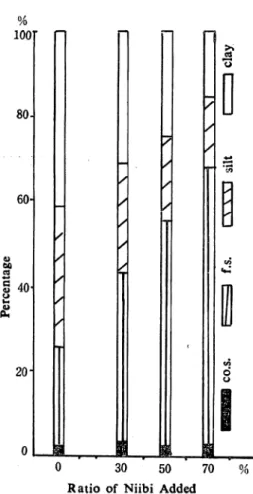
The relationship between particle size distribution and mixing ratio of Niibi to Inamine soil is given in Fig. 5. Fine texture of Inamine soil becomes coarser with increasing ratio of Niibi. This relationship is also observed in Iju soil.
Liquid limit, plastic limit and plastisity range of the samples decrease with increasing ratio of Niibi (Fig.6).
Available water holding capacity of Inamine soil increases with increasing ratio of Niibi,
specifically in low tension water held less than pF 2.7 (Fig. 7).
46 m m ■mi (1973)
Iju soils (Fig.8) .
Fig. 9 shows that the adhesive force of the two soils decrease with increasing ratio of Niibi.
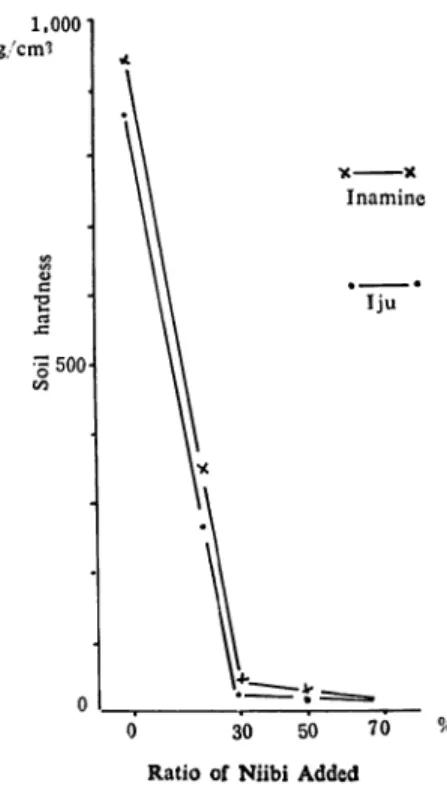
The hardness of air-dried soil samples disappeares with the ratio of 30% Niibi addition
(Fig.10).
The soil hardnss is a measure for resistance to compression. Fig. 10 shows that 30 % Niibi will be the reasonable amount to overcome the large cohesive force of the clay mine rals of Jaagaru when the dressing of Niibi to Jaagaru is made.
100 80- 60-60 B
I40"
20-0 / / / * - _ / / / /0
uUJ
d 0 30 50 70 %Ratio of Niibi Added
Fig.5. Changes in particle size distribution of Inamine soil mixed with varying
amounts of Niibi 60-40 20 L * I L \ >L
T
1 IJU T *[ InanAlnc
?LLH
PL 0 30 50 70 %Ratio of Niibi Added
Fig.6. Changes in Consistency of Jaagaru soils mixed with varying amounts of Niibi
Oshiro : Studies on the Improvement of Jaagaru 47 40 30 20
I 10
0 30 50 70 % Ratio of Niibi AddedFig.7. Changes in available water content of Inamine soil mixed with varying
amounts of Niibi 401 30
I
I
20-10. 0 30 50 70 %Ratio of Niibi Added
Fig.8. Changes in Volume shrinkage of
Jaagaru soils mixed with varying amounts of Niibi 140 g/2cm? 120 6 80 a 60 Inamine 0 30 50 70 %
Ratio of Niibi Added Fig.9. Changes in maximum adhesive
force of Jaagaru soils mixed with varying amouots of Niibi
(1973)
4 Conclusion
Effects of Niibi addition on the physical properties of Jaagaru were investigated.
(1) Particle size distribution of Jaagaru
become scoarser with addition of Niibi.
(2) Adhesive force, volume shrinkage, liquid limit, and plastic limit become lower.
(3) Available water holding capaity becomes higher, and low tension water held less than pF 2.7 increases largely
with addition of Niibi.
(4) Soil hardness of air-dried Jaagaru
disappeares with the ratio of 30 % Niibi addition. 48 # m m 1,0001 kg/cm3
I
I ■
•3 500 x x Inamine Iju 0 30 50 70Ratio of Niibi Added
Fig. 10. Changes in soil hardners of
air-dried Jaagaru soil mixed with varying amounts of Niibi