32
$O(n^{3})$
で認識される文脈自由木言語のサブクラスについて
電気通信大学大学院
電気通信学研究科 川原田 郁雄(Ikuo Kawaharada)
Graduate
School of
Electro-Communications,
University
of Electro-Communications
[email protected]
茨城大学 工学部 情報工学科 藤芳 明生
(Akio Fujiyoshi)
Department of Computer
and Information
Sciences,
Ibaraki
University
[email protected]
AbstractInthispaper,the recognition algorithmfortheclassof tree languages generated by linear, monadic
context-free tree grammars (LM-CFTGs) is proposed. LM-CFTGs define an important class of tree
languages because LM-CFTGsareclosely related to treeadjoininggrammars(TAGs). The algorithm
usesthe CKY algorithmasasubprogram and recognizes whether aninput treecanbederived from
a given LM-CFTG in $O(n^{3})$ time. With this fast recognition algoritm, we think that LM-CFTGs
andspinegrammars (anequivalentformalism) are useful in many applications
1
Introduction
Tree structures
are
used extensively in computer science to represent hierarchical organizations. Forthe purpose offormalizing and classifying tree structures, manykinds of formalisms for treestructures have been proposed. One of the most popular form alisms for tree structures is regular tree grammars
(RTGs)[l].
RTGs
are a generalization ofregulargramm
ars (RGs)from strings to rooted,ordered,labeledtrees. The class of tree languages generated by RTGs coincides with that accepted by deterministic
bottom-up tree automata, and
so
trees generated bya RTG are
recognized in $O(n)$ time, where $n$ isthe number of nodes ofa tree. The class oftree languages generatedby RTG is closelyrelatedto many applications,e.g.,XML documentvalidationand recognition ofderivation treesofcontext-free grammars.
However, for other applications such
as
representation ofRNA
secondary structure and formalisms fornatural languages,
a
larger class oftree structures which includesmore
complicated sorts oftrees needsto be considered. The generalizationof context-free grammars (CFGs) from strings to rooted, ordered,
labeled trees is context-free treegrammars (CFTGs)[7]. Though CFTGs formalize
a
largerclass of treestructures than RTGs, it is thought thatthey
are
too large for application becausethe string languages generated byCFTGsare
exactlyindexed languages, whoseemptiness problem and uniformmembership problem are exponential time complete. However, there exists a restricted version of CFTGs whichgeneratesaninteresting class of tree languages.
In this paper, theclassoftree languages generated by linear,monadic CFTGs (LM-CFTGs)$[2, 4]$ is considered, and the $O(n^{3})$-time recognition algorithm for trees generated by a LM-CFTG is proposed.
LM-CFTGs
are
CFTGs with nonterminals of rank 0 and 1 only and with at mostone occurrence
ofa
variableineveryright-handside of
a
production fora nonterminalofrank1. It is knownthatLM-CFTGs
generate the
same
class ofstring languagesas
tree adjoining grammars (TAGs) 6, ?] anda
strictlylargerclass oftrees thanTAGs. TAGs
are
another formalism for tree structures which havebeen widelystudiedrelatingthem to naturallanguages. It isalsonoteworthythat
LM-CFTGs are
equivalenttospinegrammars (SGs)$[2, 3]$, which
are
alsoa restricted version ofCFTGs
but the restrictions are looser.The recognition algorithm presented in this
paper uses
theCKY
algorithm asa
subprogram andrecognizes whether
an
input treecan be derived from a givenLM-CFTG
in $O(n^{3})$ time. For thepurposeof easier understanding,
an
algorithm which recognizes marked trees will be presented first. A markedtreeisatreewith marks
on some
nodeswhichare
usedto$\mathrm{t}\mathrm{r}\mathrm{a}\mathrm{c}\mathrm{e}$thederivation ofthetreebythealgorithm.BecausetheCKYalgorithm
can
bedirectlyappliedto a marked tree, itcanbe easilyconfirmed whether33
extended
so
that it will try toguess
which nodes shouldhave been marked andrecognizes aninput treewithoutmarks. It is shown that the extended algorithm works correctlyand its run timeisalso$O(n^{3})$
.
2
Preliminaries
In this section, terms, definitions, and former results which will be used in the rest of this paper
are
introduced.
Let $\mathrm{A}’$bethe set of all natural numbers, and let$N_{+}$ bethe set of all positive integers. The
concate-nationoperator is denoted by ‘.’. For
an
alphabet$\Sigma$, the set of stringsover
I isdenotedby $\Sigma^{*}$, and theempty stringis denoted byA.
2.1
Ranked
Alphabets,
Trees,
Substitution
and
Context-Free Grammars
A ranked alphabet is a finite set ofsymbols in which each symbol is associated with a natural number,
called the rankof
a
symbol. Let $\Sigma$bearankedalphabet. For$a\in\Sigma$,therankof$a$is denotedby rank(a).For$n\geq 0$, it isdefinedthat $\Sigma_{n}=\{a\in\Sigma|rank(a)=n\}$.
Aset $D$ is
a
tree domain if$D$is anonemptyfinite subset of$(\lambda^{\Gamma_{+}})^{*}$ satisfyingthe following conditions:.
For any$d\in D$, if$d’$,$d’\in$ $(\Lambda_{+}’)^{*}$ and$d=d^{f}$.
$d’$, then $d’\in D$.
.
For any$d\in D$ and $\mathrm{i},j\in N_{+}$, if$\mathrm{i}\leq j$ and $d\cdot$$j\in D$, then $d\cdot$$\mathrm{i}\in D$.
Let $D$ be atree domain and$d\in D$. Elements in $D$
are
called nodes. A node$d’$ isa
childof
$d$ if thereexists $\mathrm{i}\in N_{+}$ such that $d’=d\cdot \mathrm{i}$
.
A node is called aleaf
ifit hasno
child. The node A iscalled theroot
A
nodethat is neither a leafnor
the root is called an internalnode. Apathis asequence of nodes with the separator $\#$ such thatdo#di#
$\ldots$$\# d_{n}$,$n\geq 0$ where $d_{0}$,$d_{1}$,$\ldots$,$d_{n}\in D$ and for $0\leq \mathrm{i}\leq n-1$,
$d_{i+1}$ is achild of$d_{i}$
.
Let $\Sigma$ be a ranked alphabet. A treeover
$\Sigma$ is afunction $\alpha$ : $Darrow\Sigma$where $D$ is atree domain. The set oftrees
over
$\Sigma$ is denoted by Ts. The domain ofa
tree $\alpha$ is denoted by $D_{\alpha}$.
For$d\in D_{\alpha}$, $\alpha(d)$ is calledthe label of$d$. The subtree of$\alpha$ at$d$is $\alpha/d=\{(d’, a)\in(N+)^{*}\mathrm{x} \Sigma|(d. d’, a)\in\alpha\}$
.
The expressionof
a
treeover Iisdefinedto be astringoverelements of$\Sigma$,parentheses andcommas.
For $\alpha\in T_{\Sigma}$, if$\alpha(\mathrm{d})=b$, $\max\{\mathrm{i}\in N_{+}|\mathrm{i}\in D_{\alpha}\}=n$and for each $1\leq \mathrm{i}\leq n$, the expressionof$\alpha/\mathrm{i}$ is $\alpha_{i}$,
then the expression of$\alpha$ is $b(\alpha_{1}$,$\alpha_{2}$,
. . .
,$\alpha_{\mathrm{n}})$. Note that $n$is the number of the children oftheroot. For$b\in \mathrm{S}\mathrm{o}$, trees are written as $b$instead of$b().\mathrm{W}\mathrm{h}\mathrm{e}\mathrm{n}$the expression of$\alpha$ is $b(\alpha_{1}$,$\alpha_{2}$,. .
.
,$\alpha_{n})$, it is writtenthat$\alpha$$=6(\mathrm{a}\mathrm{i}, \alpha_{2}, \ldots, \alpha_{n})$, i.e.,each tree is identified withits expression.
Let $\Sigma$ bea ranked alphabet, and let I be
a
set that isdisjoint from X. $T_{\mathrm{L}^{\neg}}(I)$ is definedto be $T_{\Sigma\cup I}$where I$\cup I$ is theranked alphabet obtained from I by addingall elements in I
as
symbols of rank 0.Let $X=\{x_{1},x_{2}, \ldots\}$ be thefixed countable set of variables. It is defined that $X_{0}=\emptyset$ and for $n\geq 1$,
$X_{n}=\{x_{1}, x_{2}, \ldots, x_{n}\}$. $x_{1}$ is situationally denoted by $x$. Let $\alpha$,$\beta\in T_{\Sigma}$ and $d\in D_{\alpha}$. It is definedthat $\alpha\langle darrow\beta$
}
$=${
$(\mathrm{d}^{;},\mathrm{a})|(d^{l},$$a)\in$ a and $d$ is nota
prefix ofci’}
$\cup${
$(d\cdot$d’,$b)$$|(d^{\mathit{1}\prime},$$b)\in\beta$},
i.e., the tree$\alpha\langle d\vdash\beta\rangle$ is the result ofreplacing $\mathrm{a}/\mathrm{d}$ by
!.
Let $\alpha\in T_{\Sigma}(X_{n})$, and let $\beta_{1}$,$\beta_{2}$,$\ldots,\beta_{n}\in T_{\Sigma}(X)$. Thenotionofsubstitution is defined. Theresult ofsubstitutingeach$\beta_{i}$ for nodes labeled byvariable$x_{1}$ in$\alpha$,
denoted by$\alpha[\beta_{1}, \beta_{2}, \ldots, \beta_{n}]$, is defined
as
follows..
If$\alpha=a\in\Sigma_{0}$, then $a[\beta_{1}, \beta_{2}, \ldots, \beta_{n}]=a$.
.
If$\alpha$$=x_{i}\in X_{n}$, then$x_{i}[\beta_{1},\beta_{2}, \ldots, \beta_{n}]=\beta_{i}$..
If a $=6(\mathrm{a}\mathrm{i}, \alpha_{2}, \ldots, \alpha_{k})$, $b\in\Sigma_{k}$ and $k\geq 1$, then$\alpha[\beta_{1},\beta_{2}, \ldots, \beta_{n}]=b(\alpha_{1}[\beta_{1},\beta_{2}, \ldots, \beta_{n}], \ldots, \alpha_{k}[\beta_{1},\beta_{2}, \ldots, \beta_{n}])$.
A
context-free
grammar(CFG) isa
$\not\subset$-tuple($;=(N, T, P, \mathit{8})$, where: $N$ and $T$are
disjoint alphabetsof nonterminals and terminals, respectively, $P$ is a finite set of productions of the form $Aarrow\gamma$ where
$\gamma\in$ $(N\cup T)^{*}$, and $S\in N$ is the initial
nonterminal
The language generated by$\mathcal{G}$, denoted by $L(\mathcal{G})$ , is
defined
as
usual.2.2
Context-Free
Tree
Grammars
Thecontext-freetree
grammars
(CFTGs)were
introducedbyW. C. Rounds[7]as
treegeneratingsystems.Definition 1
A
context-free
tree grammar(CFTG) is a4-tuple $\mathcal{G}=(N, \Sigma, P, S)$, where: $N$ and aredisjoint ranked alphabets of nonterminals and $tem\mathrm{i}nalS_{\}}$ respectively, $P$ is afinite set of productions of
theform $A(x_{1}$,$x_{2}$,
. . .
,$x_{n})arrow\alpha$, with $n\geq 0$, AeNn, $\alpha\in TN\cup\Sigma(X_{n})$, and$S\in N_{0}$ is the initid nonterminal.Definition 2 For
a CFTG
($;,$$\Rightarrow \mathcal{G}$istherelation
on
$T_{\Sigma\cup N}\mathrm{x}T_{\Sigma\cup N}$ such that fora tree$\alpha\in T_{\Sigma\cup N}$ andanode
$\mathrm{d}\mathrm{e}\mathrm{D}\mathrm{a}$, ifajd-A(ai,
$\alpha_{2},$ $\ldots,$$\alpha_{n}$) whereAeNn, $\alpha_{1},\ldots,\alpha_{n}\in T_{\Sigma\cup N}$, and$A(x_{1}$,$x_{2}$,
. . .
,$x_{n})arrow\beta$is in$P$, then $\alpha\Rightarrow\alpha\langle d\mathcal{G}arrow\beta[\alpha_{1}, \alpha_{2}, \ldots, \alpha_{n}]\rangle$.
A derivationisa
finite sequence of trees$\alpha_{0}\alpha_{1}\cdots\alpha_{n}$ suchthat$n\geq 0$and
$\alpha_{0}\Rightarrow\alpha_{1}\mathcal{G}\Rightarrow\cdots\Rightarrow \mathcal{G}\mathcal{G}$
$\alpha_{n}$
.
When there existsa
derivation $\alpha_{0}\alpha_{1}\cdots\alpha_{n}$,we
write $\alpha_{0}\Rightarrow^{*}\alpha_{n}\mathcal{G}^{\cdot}$ The subscripta
on
therelations
a
and $\Rightarrow^{*}\mathcal{G}$ may be droppedwhen$\mathcal{G}$ is clearly understood. The tree languagegenerated by $\mathcal{G}$
istheset $\mathrm{L}(\mathrm{Q})=$
{a
ETy $|S\Rightarrow^{*}\alpha$}
$\mathcal{G}^{\cdot}$ The stringlanguagegeneratedby
$\mathcal{G}$is $Ls(\mathcal{G})=$ {yield(a) $|\alpha\in L(G)$
}.
$\mathcal{G}0_{1}$ and $\mathcal{G}_{2}$are
equivalentif$L(\mathcal{G}_{1})=L(\mathcal{G}_{2})$.
$\mathcal{G}_{1}$ and $\mathcal{G}_{2}$are
uteakly equivalentif$Ls(\mathcal{G}_{1})=L_{S}(\mathcal{G}_{2})$.
Linear,monadic
CFTGs
(LM-CFTGs)are
CFTGswith tworestrictions. One is ’linear’ that requires the number ofoccurrences
of every variable inthe right-hand side ofa
production beno
more
than 1, and theotheris ‘monadic’ that requiresthe rank ofnonterminals beeither0or
1.Definition 3 A
CFTG
$\mathcal{G}=(N, \Sigma,P, S)$ is monadicifthe rankof any nonterminalis either 0or
1, i.e.,$N=$ $N_{0}$$\cup N_{1}$ and $N_{n}=\emptyset$ for $n\geq 2$
.
$\mathcal{G}$ is linear if for any production $\mathrm{A}(\mathrm{x}\mathrm{i}, x_{2}, \ldots,x_{n})arrow\alpha$ in $P$,no
variable occurs morethan
once
in$\alpha$.3
Properties
of
LM-CFTGs
In thissection,
we
discussformal propertiesofLM-CFTGs
that giveusintuition about the class oftrees generated by LM-CFTGs.First,
we
introducenormalformofLM-CFTGs, The notionofnormalform ofLM-CFTGs
is analogous to that ofChomsky normal form ofCFGs.
For any LM-CFTG, there exists an equivalent LM-CFTG$\mathcal{G}=(N, \Sigma,P, S)$ that satisfiesthefollowing conditions:
1. Foreach $A\in N_{0}$, if\^A ais in$P$, then eithera-awith$a\in\Sigma_{0}$, or$\alpha=B(C)$ with$B\in N_{1}$ and$C\in N_{0}$
.
2. For each AeNu , if$A(x)arrow\alpha$is in$P$, then either$\alpha=B(C(x))$ with$B$,$C\in N_{1}\mathrm{o}\mathrm{r}\alpha=b(C_{1}$,
$\ldots$,$C_{i-1}$,$x$,
$C_{i+1}$,
.
..,$C_{m}$) with $n\geq 0$, $b\in\Sigma_{n+1}$ and$C_{1}$,$\ldots$,$C_{i-1_{\mathrm{t}}}C_{l+1}$,$\ldots$,$C_{m}\in N_{0}$
.
Ifa LM-CFTGsatisfiesthe aboveconditions,itissaid thatthe grammarisinnormal
form.
Thedefinitionofnormal form is slightly different from the
one
introduced in [2] but it is easy to obtain this normalform in the
same
way asthe construction of theChomskynorm
al form ofcontext-free grammars.For
an LM-CFTG
in normal form, productions which growa
tree horizontallyare
only of theform$A(x)arrow \mathrm{B}(\mathrm{C})\ldots$,$C_{i-1},x,$$C_{i+1}$,$\ldots$,$C_{n}$). Intheright-hand sideoftherules,thei-th childof
$b$isdifferent
from the other children. Thus,
we
introduce modified LM-CFTGs called markingLM-CFTGs
whoseproductionsare with a marker that
can
be used to$\mathrm{t}\mathrm{r}\mathrm{a}\mathrm{c}\mathrm{e}$derivations.Definition 4 For$\mathcal{G}=(N_{7}\Sigma,P, S)$ be
an
LM-CFTG innormalform, themarking $LM$-CFTG associatedwith $\mathcal{G}$, $\mathcal{G}’=$ ($N\cup\overline{N}$,IUZ,$P’$,$S$), is defined
as
follows. $\overline{N}=\{\overline{A}|A\in N\},\overline{\Sigma}=\{\overline{a}|a\in\Sigma\}$, and$P’$ is thesmallestset of productionssafisfingthe following conditions:
1. If$Aarrow a$is in $P$for
some
$A\in N_{0}$ and$a\in\Sigma_{0}$, then $Aarrow a$and $\overline{A}arrow\overline{a}$are
in$P’$.
2. If$Aarrow B(C)$ is in $P$for
some
$A$,$C\in N_{0}$ and $B\in N_{1}$, then$\overline{A}arrow\overline{B}(\overline{C})$ and $A\prec B(\overline{C})$are
in $P’$.
3. If$A(x)arrow B(C(x))$ is in$P$for
some
$A$,$B$,$C\in N_{1}$, then$\overline{A}(x)$ $arrow\overline{B}(\overline{C}(x))$ and $A(x)arrow B\langle\overline{C}(x))$are
in$P’$
.
4. If$A(x)arrow b(C_{1}, \ldots , C_{i-1},x, C_{i+1}, \ldots, C_{m})$ is in $P$for
some
$m\geq 0$,$b\in\Sigma_{m}$ and$C_{1}$,$\ldots$,$C_{i-1}$,$C_{i+1}$,
...,
$C_{m}\in N_{1}$, then $\overline{A}(x)arrow\overline{b}(C_{1,\ldots,-1}C_{l},x, C_{i+1}, \ldots, C_{m})$ and $A(x)arrow b$($C_{1}$,$\ldots$,$C_{i-1}$,$x$,$C_{i+1}$,
.. .
,$C_{m}$)are
in $P’$.
Elements in$\overline{N}\cup$$\overline{\Sigma}$
35
Definition 5 Let $\mathcal{G}$ be a markingLM-CFTG. For
a
tree $\alpha\in L(\mathcal{G}\rangle$ anda
node $d_{0}\in D_{\alpha}$, the markedpath starts from $d_{0}$ is
a
path $d_{0}\# d_{1}\#\cdots\# d_{n}$ such that $n\geq 0$, $d_{n}$ isa
leaf, and for $1\leq \mathrm{i}\leq n$, $\alpha(d_{i})$ ismarked. When $d_{0}$is the root of$\alpha$, the marked pathstarts from $d_{0}$ is calledthe spineof$\alpha$. When$\alpha(d_{0})$
is un-marked, themarked path starts from$d_{0}$ is called a subspineof$\alpha$
.
From the abovedefinitions,the following claim is immediate.
Claim 1 Let $\mathcal{G}$ be
a
markingLM-CFTG.
Forany tree derived by$\overline{\mathcal{G}}$,
.
each node hasexactlyone
marked child if the node is nota
leaf,.
an
un-marked node iseithertherootor a
child ofa marked node,and.
there exists exactlyone
marked pathfor each node.Definition 6 For an LM-CF$\mathrm{T}\mathrm{G}$ $\mathcal{G}=(N, \Sigma, P, S)$, the spine producing CFG associated with $\mathcal{G}$, $\overline{\mathcal{G}}=$
$(N, \Sigma, P’, S)$,is defined
as
follows. $P’$ is thesmallestset ofproductions satisfyingthefollowingconditions:1. If aproduction$Aarrow a$is in $P$for
some
A $\in N_{0}$,$a\in\Sigma_{0)}$ then $Aarrow a$is in $P’$,2. If
a
production $Aarrow B(C)$ is in $P$ forsome
$A$,$C\in N_{0}$,$B\in N_{1}$, then $Aarrow BC$ isin $P’$,3. If
a
production$A(x)arrow B(C(x))$ is in$P$ forsome
$A$,$B$,$C\in N_{1}$, then $Aarrow BC$ is in $P’$, and4. If
a
production $A(x)arrow b$($C_{1}$,$\ldots$,Ci-i,$x$,$C_{i+1}$,$\ldots$,$C_{m}$) is in $P$for
some
$m\geq 0$, $A\in N_{1}$,$b\in\Sigma_{m}$and$C_{1}$,
.
. .
,Ci-i,$C_{i+1}$,$\ldots$,$C_{m}\in N_{0}$, then $Aarrow b$isin $P’$.
Lemma 1 Let$\mathcal{G}=$ ($N\cup\overline{N}$, IUC,$P$,$S$) beamarking LM-CFTG, and let($j=$ $(N\cup\overline{N}, \Sigma\cup\overline{\Sigma}, P^{l}, S)$bethe
spine producing CFGassociated with $\mathcal{G}$
.
For any tree$\alpha\in L(\mathcal{G})$, $d_{0}\# d_{1}\#\cdots\# d_{n}$isa
subspine of$\alpha$if andonly if$\mathrm{a}(\mathrm{d}\mathrm{Q})$ .$\alpha(d_{1})\cdot\cdots\cdot$$\alpha(d_{n})\in L(\overline{\mathcal{G}})$
.
Proof. Fromthe construction of$\overline{\mathcal{G}}$, the lemma clearly holds.
$\square$
4
Recognition Algorithms
4.1
Parsing Algorithms
for
Marking LM-CFTGs
We
assume
thata
markingLM-CF
$\mathrm{T}\mathrm{G}$ $\mathcal{G}=(N\cup\overline{N}, \Sigma\cup\overline{\Sigma}, P, S)$is given and the CFG $\overline{\mathcal{G}}=(N\cup N,$$\Sigma\cup\overline{\Sigma}$,$P’$,$S)$ is constructed from $\mathcal{G}$
.
The algorithm consists ofthree parts: Parse-Tree, Parse and CKY. First,the function Parse Tree takes
an
input and initializes variables. Next, the main procedure Parse isinvoked. Theprocedure Parseisdefinedrecursivelyand checksatree inbottom-upbyusing thefunction
CKY.
Fora
given tree, the procedure Parse storesa
marked path. The function CKY is based on theCKYalgorithm forcontext-freelanguages. The function CKY checkswhethera subspine storedby the
function Parse could be generatedby the
CFG
$\overline{\mathcal{G}}$.The
Function
Parse-Tree
The function ParseTree takes
as
input a tree $\alpha$. This function preparea
variable$\tau_{d}$ anda
set $U_{d}$ foreach node $d$ in $\alpha$
.
The variable $\tau_{d}$ stores a marked path of the node$d$. This string shows the path
with the maxker from
some
leaftothe node $d$. In the 5th line ofthis function, $CKY(\tau_{\lambda}, S)$ is invoked.$CK\mathrm{Y}(\tau_{\lambda}, S)$ checks whether aspine of the root node $\tau_{\lambda}$ could be derived from initial symbol
$S$ by the
CFG
$\overline{\mathcal{G}}$.
Parse-Tree:
Input atree$\alpha$. Output acceptifa $\in L(\mathcal{G})$ otherwise reject.
begin
1 For each node$d$in$D_{\alpha}$,we preparethe set $U_{d}$and
the variable$\mathcal{T}d$ overstrings of nodes with theconcatenation operator
$\#$ .
2 Initialize the variable $\tau_{d}:=$A andtheset $U_{d}:=\emptyset$ for each node$d$in$D_{\alpha}$.
3 For each node$d$in $\alpha$, check that$d$has exactly onemarked child if$d$is notaleaf,
otherwise reject.
4 Parse(a,A)
5 if$CKY(\tau_{\lambda}, S)=true$,thenreturn accept elsereturn reject.
The Procedure Parse
The procedure Parse takes as input
a
tree and a node. The given node shows where the given tree islocatedin thewhole tree, because thisprocedure is definedrecursively. The algorithm works by parsing
in a bottom-up way. This procedure storesa marked pathof the given node. And nonterminals of the
left side symbolof productions which derive theroot nodeand un-markedchildren are stored.
Parse:
Input atree$\alpha$ anda node$d$
.
begin
1 Let$\alpha(\lambda)=b$andrank(b) $=m$
.
2 ifm$=0$,then
3 $\tau_{d}.=d$and $U_{d}:=\{A|Aarrow\alpha\in P\}$
else begin
4for$\mathrm{i}:=1$ to$m$doParse(a/i,$d\cdot \mathrm{i}$)
5 Let the h-th child of the root be marked.
6for each$A(x)arrow b$($C_{1}$,
$\ldots$,child$x,$ $C_{h+1}$,$\ldots$,$C_{m}$) is in$P$forsome
$A\in N_{1}\cup\overline{N}_{1}$,
$C_{1}$,
.
..’$C_{h-1}$,$C_{h+1}$,.
. .
’$C_{m}\in N_{0}$,if$CKY(\tau_{d}Cj)J7=$true,for all$j\in\{1, . . , h-1, h+1, \ldots , m\}$,
then$U_{d}:=U_{d}\cup\{A\}$
7 $\tau_{d}:=d\neq\tau_{dh}$
8 end
end
The
Function
CKY
The extended CKY takes
as an
input a pathwhich is a subspine ofsome node, and checkwhether the given path could be derived by theCFG
(;. This algorithmis the same wayas
well-known recognition algorithmfor context-free languages.CKY:
Input apath$\tau$ andanonterminal$A$. Output trueor
false.
begin
1 The path$\tau$canbewritten as$d_{1}\# d_{2}\#\cdots\# d_{m}$ where$d_{1},d_{2}$,
.
..
,$d_{m}\in D_{\alpha}$ and$m\geq 1$.2 Let $V$be an$m\mathrm{x}$ $m$matrix.
3 fori$:=1$ to m do
4 $V_{\mathrm{i},1}:=U_{d}$
.
5 for$j:=2$to mdo
6 for$\mathrm{i}:=1$ tom- $j+1$ dobegin
7 $V_{i,j}:=\emptyset$
8 for $k:=1$ to$j-1$ do
9 $Vi,i.–V_{\mathrm{z},\mathrm{j}}\mathrm{U}$
{A
$|Aarrow BC\in P’$,$B\in V_{t,k}$,$C\in V_{i+k,j-k}$}
end
10 ifA$\in V_{1,m}$, then return trweelse return
false
end
From above algorithms, we obtain the following results. We leave these proofs of theorems to the
reader
.
Theorem 1 $A\Rightarrow^{*}\alpha\in T_{\Sigma}$ ifand onlyif$CKY(\tau_{\lambda}, A)$$=true$ after applyingParse(a,$\lambda$).
Theorem 2 Ourrecognition algorithm
runs
in0 $(n^{3})$time where$n$ is the numberof nodes of theinputtree.
4.2
Parsing
Algorithms
for
general
LM-CFTGs
In this section,
we
present algorithms for tree languages generated by general LM-CFTGs, In abovesection, LM-CFTGs
are
marked. So,we can
distinguish paths which generated byusing productions oftheform $Aarrow B(C)$ and $A(x)arrow B(C(x))$, and check these paths inthe CKYstyle algorithm. The
new
37
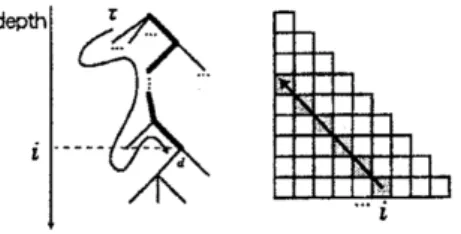
Figure 1: TheCKY algorithm forparsing the tree
Since
there isno
danger of confusion, weuse
thesame
labels for functions and procedures. Thefunction Parse-Tree takes
an
input and initializes variables. For each node $d$ in the input tree, thefunctionprepareaset $U_{d}$. Theset$U_{d}$will besetbythe procedure Parser. Atthenode$d$, if thealgorithm
guess
i-th childto be marked, then nonterminals will beadded to the set $U_{d\cdot i}$.
So, this function prepareanothersetsfor nodes ofleaves.
Parsetree
Input atree$\alpha$. Output acceptifcx $\in \mathrm{L}(\mathrm{Q})$ otherwise reject.
begin
1 For all noded inDa, weprepare the set$U_{d}$$:=\emptyset$ andthetree$\tau_{d}:=$ A.
2 For each leafdin$D_{a}$, we preparetheset $U_{d}’:=\emptyset$.
3 Parse(a,A)
4 if$CKY(\tau_{\lambda}, S)=true$, thenreturn accept else returnreject,
end
The procedure Parse behaves in the
same
way ofabove marked version, but nonterminals is added to the set $U_{di}$, if this procedureguess
i-th child to be marked. If the input tree hasno
child, thennonterminals which derivedthis node
are
stored inthe set $U_{d}’$.
This extension algorithm needs at mostconstant timesofabove version.
Parse:
Input atree$\alpha$ and anode$d$.
begin
1 Let$\mathrm{a}(\mathrm{A})=b$and rank(b)$=m$
.
2 ifm$=0$, then
3 $U_{d}’:=$
{A|A
$arrow\alpha\in P\}$else begin
$45$ for
$\mathrm{i}:=1$ to$m$do Parse(\mbox{\boldmath $\alpha$}/i,$d\cdot \mathrm{i}$)
foreach $A(x)arrow b(C_{1}, \ldots , C_{i-1}, x, C.\cdot+1, \ldots, C_{m})$ is in$P$for some$A\in N_{1}$,
$C_{1}$,.. .,$C_{\mathrm{i}-1}$,$C_{+1}.\cdot$,$\ldots$,$C_{m}\in N_{0}$,and $1\leq \mathrm{i}\leq m$,
if$CKY(\alpha/j, C_{j})=$true, forall$\mathrm{j}\in\{1, \ldots, \mathrm{i}-1,\mathrm{i}+1, \ldots , m\}$
then$U_{d\cdot \mathrm{i}}:=U_{d\cdot i}\mathrm{U}\{A\}$
end end
We extend CKYto parsingthetree structure. The function
CKY
takesasinputa
tree $\tau$ and checkswhether thereexists
a
path from the root toa
leafderivableby CFG $\overline{\mathcal{G}}$.
The following algorithm searchthe input tree inthe depth-first search andconstruct
a
matrix $V$.
This algorithm sets result to set $W$whenever reaching
a
leaf of the tree. And last, CKY checks whether the nonteminal $A$ is in the set$W$. This algorithm
reuse
cells corresponded to prefix path and for each node$d$, sets cells to upperleftneighbor (seeFigure 1). Let$n$be
a
number of nodes ofthe input tree. Foreachnode, thisalgorithm setssells atmost $n$times. Each cell needs to set in $O(n)$ time. This algorithm constructs cells exactly
once
for
same
node,becausethis algorithm visitsnodes indepth-first search. So,the total time complexity is$O(n^{3})$
.
CKY:
Input atree$\tau$and a nonterminal $A$. Output true or
false.
begin
Preparethe$m\mathrm{x}$ $m$matrix $V$andtheset $W$.
2Initialize $W:=\emptyset$
3This algorithm visits eachnode inthe tree$\tau$in thedepth-firstsearch
andsets the matrix$V$in thefollowing way:
4for each node $d$(whosedepth is$i=|d|+1$)
begin
5if$d$hasnochildthen, $V_{i,1}:=U_{d}’$
else
6Let the next visiting node be Z-th child of$d$.
7 $V_{\iota,1}:=U_{d\ell}$
8for$j:=1$ to$i-1$do begin 9 $V_{i-j,j+1}:=\emptyset$
10 for $k:=1$to7 do
li $V_{i-j,i+1}:=V_{i-\mathrm{j},j+1}\cup\{A|Aarrow BC\in P’, B\in V_{i-j_{\mathit{3}}-k+1},, C\in V_{\mathrm{j}-k+1,k}\}$
end
12 if$d$isaleaf, then$W:=W\mathrm{U}\mathrm{V}\mathrm{i},\mathrm{i}$
end
13 if$A\in W$,then returntrue elsereturn
false
end
The complexity does not increasebyextension ofalgorithms. Thus,
we
havethefollowing result.Theorem 3 A recognition oftreelanguages generated by
LM-CFTGs
is in time $O(n^{3})$, where $n$is thenumber ofnodes ofthe inputtree.
5
Conclusion
In this paper,
we
presentan
$O(n^{3})$ time algorithm for recognition tree languages generated byLM-CFTGs. This algorithm arise from properties ofLM-CFTGs such that
a
set ofsubspines and the otherproductionsrewrite a nonterminal onthe pathsis
a
context-freelanuage. Thus, we canapplya
CKY-likealgorithm to these paths.
Our
recognition algorithm might bea
little slow in an actual application. However, we conjecture thata
limitation could be introduced into LM-CFTGsas
in thecase
ofLR-grammars to construct more faster recognition algorithms, i.e., productions which derivesubspines
are
limited to generate
a
‘deterministic’ context-free lanuage. In this paper, we have not be able to presentrecognition algorithms for linear
CFTGs.
The class oftree sets generated by linear CFTGs is closelyrelatedto that of multicomponent TAGs. How order time is necessary for recognition oftree languages
generated bylinear CFTGs? We believe that asolution for these questions willmake the notion of the
tree language recognitionsmoreinteresting.
References
[1] W. S. Brainerd, Ttee generating regular systems, Information
&
Control 14 (2) (1969) 217-231.[2] A. Fujiyoshi, T. Kasai, Spinal-formed context-free tree
grammars,
Theory of Computing Systems 33 (1), 2000,pp.59-83.
[3] A. Fujiyoshi, Epsilon-free grammars andlexicalized grammarsthat generate the classof themildly
context-sensitivelanguages,in: $\mathrm{T}\mathrm{A}\mathrm{G}+7$, Vancouver 2004, pp. 16-23.
[4] A. Fujiyoshi, Linearity and nondeletion on monadic contex-free tree
grammars,
in: InformationProcessing Letters,2004, Pp.
103-107.
[5] A. K. Joshi, L.
S.
Levy, M. Takahashi, Tree adjunctgrammars,
J. Computer&
System Sciences10 (1), 1975, pp. 136-163.
[6] A. K. Joshi, Y. Schabes, Handbook of Formal Languages, Vol. 3, Springer, Berlin, 1996, Ch.
Tree-adjoining grammars,pp. 69-124.
[7] W. C. Rounds, Mapping and grammars on trees, Mathematical Systems Theory 4 (3), 1970, pp.