Tribal culture and religion impacting women
empowerment A study on the Khasis of Meghalaya
著者
MINAKSHI KEENI
学位授与機関
Tohoku University
学位授与番号
11301甲第18938号
Tribal culture & religion impacting women empowerment
A study on the Khasis of Meghalaya
Laboratory: International Development Studies Supervising Professor: Katsuhito Fuyuki Supervising Associate Professor: Nina Takashino
Student ID:
2
TRIBAL CULTURE AND RELIGION AND ITS IMPACT ON WOMEN
EMPOWERMENT
A STUDY ON THE KHASIS OF MEGHALAYA
A DISSERTATION SUBMITTED TO THE GRADUATE SCHOOL OF AGRICULTURAL
SCIENCE, TOHOKU UNIVERSITY IN PARTIAL FULFILMENT
OF
THE REQUIREMENTS THE DEGREE OF
DOCTORAL DISSERTATION (Agricultural Economics)
BY
MINAKSHI KEENI
TABLE OF CONTENTS
Dedication Acknowledgement Abstract Chapter 1: Introduction1.1 Matriliny and Women Empowerment 1.2 Tribal and the Sixth Schedule
1.3 NFHS results- Meghalaya & Kerala Comparison 1.4 Literature Review
1.5 Research Problem, Area and Objective 1.6 Methodology used
1.7 Scope and Limitation of the Study 1.8 Structure of the Study
Chapter 2: Meghalaya: An Overview
2.1 Religion
2,2 Kinship and Marriage 2.3 The Matrilineal Culture
2.4 Political Structure of the Khasi society
2.5 Economic Status of women in the rural society of Meghalaya
Cultural Impact
Chapter 3: NFHS results and comparison of patrilineal and matrilineal societies
3.1 Patriliny and Matriliny 3.2 Cultural Perceptions
3.3 Empowerment Factors affected by perceptions 3.4 Cultural Traditions, perceptions and empowerment
Chapter 4: Impact of Land ownership on women 4.1 Understanding Khasi Traditions
4.2 Social Empowerment and Micro-credit savings 4.3 Methodology and Econometric Model
4.3.1 Determinants of Empowerment Status 4.4Results and Discussion
4.5 Addressing the cultural impact
Religion Impact
Chapter 5: Women empowerment and Contraception use
5.1 Family Planning in the Indian Context 5.2 Conceptual Framework
5.3 Literature Review
5.4 Family Planning amongst the Khasis 5.5 Khasi religion and contraception use 5.6 Contraception prices and usage in India 5.7 Methodology
4
5.7.2 Data Collection 5.7.3 Variables 5.8 Discussions
5.9 Religion impacts Contraception use?
Initiatives
Chapter 6: Role of NGO’s, Government and Village Leader
6.1 Child marriage, domestic violence and family planning
6.2 Meghalaya and the Sixth Schedule 6.3 Role of the Government
6.4 Role of NGOs
6.5 Role of village headman and SHGs 6.6 Difference in views
6.7 Importance of Women Representation
Recommendations
Chapter 7: Impact of women participation in the Dorbar Shnong
7.1 Significance of Women Participation in the political sphere 7.2 Women and Khasi Administration
7.3 Sample Demographics 7.4 Empirical Analysis
7.4.1 Estimation Model 7.4.2 Results and Discussion 7.5 Conclusion
Chapter 8: Conclusion, Discussion and Suggestions
8.1 Recommendations
8.2 Suggestions for Further Studies
Appendix Bibliography
DEDICATION
This dissertation is especially dedicated to my father, who would have been proud of me. It is also dedicated to my family and close friends, for all their support and understanding.
6
ACKNOWLEDGEMENT
The present research work- ‘TRIBAL CULTURE AND RELIGION AND ITS IMPACT ON WOMEN EMPOWERMENT’ is an outcome of a 3-year Ph.D. dissertation. Immeasurable appreciation and deepest gratitude for the help and support are extended to the following persons who in one way or another have contributed in making this study possible.
Professor Katsuhito Fuyuki, who has consistently supported me throughout my study at Tohoku
University. His great patience and dedication, encouragement, critical comments and invaluable suggestions assisted me through this research.
Professor Nina Takashino, who has supported and guided me through conducting every survey
and every conference that I have participated in. Her invaluable discussions, constructive comments and positivity at different stages of my research has taught me a lot as a researcher.
Professor A.K Nongkynrih, Department of Sociology, NEHU, who helped me in organizing,
arranging and acquiring data from the two districts. Without whose help, breaking societal barriers would have been difficult.
Professor Pradip Sharma , Department of Geography, Cotton University, who helped me in
organizing, arranging and acquiring data from Assam.
Longkui Wang, who helped me immensely in analyzing and understanding my data.
Auxillaries Nongsiej and James Nongsiej, my assistants at Meghalaya, who helped me with the
language barrier during research interviews. Their patience and responsibility through the whole research has played a big role in securing data.
Titli Chakraborty, Prashanti Bhattacharya, Sonakshi Goswami, Abira Barman, Bhanita
Talukdar, Akangkhya Patgiri and Bipanchi Das Saikia, my assistants at Assam, who played a
major role in acquiring data from the Karbi tribe. Their patience, diligent work and responsibility gave comfort to the respondents, making data acquisition a smooth process.
Government of Meghalaya, my sincere thanks for their time and patience during the interviews. I
would also like to give my sincere talks to the mission director of Meghalaya Social Welfare Department for helping me in coordinating interviews with NGOs.
NGO’s of Meghalaya, my sincere thanks to the 4 NGO’s that were interviewed for giving me their time and resources.
Village Leaders of the East Khasi Hills District and West Khasi Hills District, without whose
permission, cooperation and understanding, conducting surveys in the villages would have been difficult.
8
ABSTRACT
The 17 Sustainable Development Goals (SDGs) proposed by the UN in September 2015, are directed towards a broad range of development issues including achieving gender equality and empowering all women and girls. Women are often considered to fall under the vulnerable group, but instead, they should be considered as change agents whose participation is key to the advancement of our countries and societies. Hence making women’s empowerment an essential component for economic growth, promotion of social development and the enhancement of business performance. Further investing in women’s empowerment produces the double dividend of benefiting women and children and is pivotal to the health and social development of the family.
Since the 1980s, the Government of India has shown increasing concern for women’s issues through a variety of legislation promoting the education and political participation of women. With approximately 270 million of the population in India living under poverty, the highest proportion of them is women and children. Approximately 43.4% of women suffer from crimes committed by their husbands or family members. As of 2015, the government’s lack of action has positioned India as 125th out of 188 countries on the Human Development Report’s Gender Inequality Index.
While several recent studies focus on the fact that culture and religion do impact women empowerment, this study focuses on how cultural beliefs and traditions of a matrilineal society have an impact on empowerment levels of women. Cultural beliefs and traditions in society play a major role in moulding various decisions of an individual belonging to a particular societal framework. Recognition of these beliefs and traditions is what anchors an individual to his/her society. In central to this, the need for social acceptance is what pushes women to adhere to these norms. This, in turn, results in an impact of empowerment levels on women.
The present research focuses on women issues in the Khasi matrilineal society of Meghalaya. In a state where traditional institutions function based on local customs and conventions that are not codified and yet religiously followed, it is questionable to whether the women are essentially empowered. The study has been designed to understand the core issues behind low empowerment levels of women of the Khasi society. It intends to check the influence of culture and religion on empowerment.
The objective of this research is to check if culture and religion do play a role in the empowerment levels of women of Meghalaya. Followed by evidence of how culture and religion have impacted
the respective empowerment levels in accordance to the National Family Health Survey- 4. Along with this, the research will also look into the various initiatives taken by the various NGO’s, government and village leaders. While many authors have concluded that the underlying issue behind the empowerment levels is the exclusion of women from the political decision making at the village level, this study has also gone on to check the societal perception towards this recommendation.
The first two chapters of the study go on to give an introduction and an overview of the research issue and objectives. Chapter 3 goes on to focus on the first objective, which is checking if culture and religion have an impact on empowerment. Chapter 4 and 5 will focus on the second objective, that is to stress on the evidence of cultural and religion impact on empowerment. Chapter 6 will focus on the third objective which is to look into the various initiatives taken up by the various NGO’s, the government and the village leaders. Chapter 7 will focus on the societal acceptance of the highly recommended suggestion to accept women into the village council. Chapter 8 will conclude this dissertation.
To get a better understanding of whether culture and religion have an impact on empowerment, chapter 3 compares the cultural perceptions of two societies- a patrilineal and matrilineal society. Along with which T-test analysis was used to compare certain empowerment factors of the two societies. It further not only focuses on the productional behaviour of the societies but attempts to understand the impact of tribal cultural traditions on empowerment levels of women as a whole. It also hypothesizes that cultural traditions of the Khasi matrilineal society have led to the prevalence of domestic violence and a high total fertility rate. From this chapter, it can be concluded that culture and religion do play a role in the empowerment levels of women in Khasi society.
With Meghalaya being a matrilineal society, women owning land is considered to be a cultural tradition. Chapter 4, checks the impact of land ownership on the women empowerment levels of the Khasi society and if it gives her decision-making power in the household. Probit regression was then used to analyze the data. The results stated that women who inherited land were more likely to have a savings account and be a part of a socio-economic group. From this, it can be concluded, that women who owned land through lineage were empowered, however, the fact that they still consider their husbands to be the head of the family, makes us consider that there may be a psychological component to it.
10 83.3% of the population in Meghalaya follow Christianity as their religion (2018). With 100% of the respondents following protestant Christianism, the question arises to whether religion has an impact on contraception usage behaviour. The current use rate of contraception to prevent pregnancy in Meghalaya is 4.7 (2.8 for sterilization and 1.9 for temporary methods), which is the lowest in India. Hence, Chapter 5, investigates the possibility of religion impact on the low contraceptive use and participation in family planning programmes. The effects of knowledge about contraception, the extent of urbanization, empowerment and demographic characteristics on contraceptive use and participation in family planning programmes were estimated in a logit regression analysis. Principal component analysis was used to construct a composite measure of women’s empowerment. The results found a rural-urban difference in women’s knowledge of contraceptive use. Women and men’s educational attainments positively related to contraceptive use. Women’s empowerment is positively related to knowledge about contraception. However, employed husbands were less likely to attend family planning programmes, suggesting the importance of providing programmes that do not conflict with work responsibilities.
According to NFHS-4 statistics, the major gender issues that Meghalaya is facing are in the fields of family planning, domestic violence and early marriage. Chapter 6, focuses on providing an overview of the role of the government, the NGO and the village leader in educating women on the repercussions of early marriage, advantages of family planning and combating domestic violence. In this study, four NGOs, the different government departments in the offices of Social Welfare, National Health Mission and the Women’s Special Cell, and 20 village heads, 12 presidents of the female unit and 13 SHGs from each village, have been analysed. From this case study, it was found that while there may be a difference in interpretation of reality between the village head leaders and the government as well as the NGOs when it came to the eradication of social issues, the three agencies were closely connected.
With women in the Khasi society being excluded from political decision-making at local governance institutions, their inclusion has been recommended by several authors. Chapter 7, attempts to understand the view of women on the importance of women representation as decision-makers in society and to examine the determinants of the knowledge and attitude of Khasi women towards women representation. It is hypothesized that facilitating female representation in local governmental structures represents one of many routes towards empowerment. Probit and Logistic regression(reporting odds ratios) were then used to analyse the data. From the results, it could be deduced that women inclusion in the local governance system is of utmost importance. It is also
important that the women realise that their rights are not solely limited to placing a vote but having a say in the decision-making process as well.
With Meghalaya being considered a matrilineal state, it is taken for granted that the women of the state are empowered. While a lot is being done towards the empowerment of women, the exclusion of women from political decision-making at local governance institutions is the underlying issue behind their empowerment status. From the positive willingness of Khasi women to be a part of the village council and the acceptance of female individuals into one village council, it can be deduced that the decision of women inclusion is on the village leaders. It is hence recommended that the Sixth Schedule, which gives these village leaders the authority to enact various legislative and judiciary laws, is revised. Along with this, it is also recommended that the government collaborate with the church towards the implementation of family planning programmes.
12 CHAPTER ONE
INTRODUCTION
1.1 Matriliny and Women Empowerment
Matriliny is an uncommon but recurrent type of social organization found in all regions of the world; in the Standard Cross-Cultural Sample, 31 of 186 societies (17%) are matrilineal (Murdock & White, 1969). Currently, matrilineal societies can be found in the tribes of African countries, in some parts of Southeast Asia and among 3 tribal groups in India.
Most of the anthropologists do not believe in the existence of any true matriarchy. They, however, suggest that there exist three characteristics of matriarchy, viz., descent through the mother (family name through mother), matrilocal residential system (husband lives at the residence of wife after marriage) and inheritance of property by females. Thus, any society, which follows these three norms, is presently called matrilineal society.
By a matrilineal society, we refer to a society where the ancestral descent in a kinship system can be traced through the mother instead of the father. Kapadia (1966) has mentioned that all children of a woman take the family name of their mother.
Matrilineal societies also exhibit an interesting variety of residence patterns, like, ‘a man residing with his wife's matrilineal kin’, ‘a wife residing with her husband's matrilineal kin’ or ‘with his paternal kin’, ‘couples settling down together in a new residence’, or the ‘two living with their respective natal groups following the duolocal pattern’ (Richards, 1950; Dube, 1969). Traditionally, it has been assumed that in those societies where married children live near or with kin, the residence will tend to be patrilocal if males contribute more to the economy and matrilocal if women contribute more (Ember and Ember, 1971; Divale, 1974).
According to the evolutionary theory, it has been theorized that in early human society, due to sexual promiscuity, it was easier to trace the biological relationship of children through their mothers. Thus, resulting in human organizations revolving around the mother rather than the father. From this rose patriarchy, a society where men could assert their superiority. However, these theories have been rejected and it is now theorized that patrilineal and matrilineal societies have developed and flourished independently.
According to Nongbri (2003), approaches in anthropological analyses of matrilineal institutions can be categorized into two predicaments. The first predicts the inevitable demise of matriliny in the face of modernization, urbanization, and colonialism. This deduction is based on the fact that matrilineal institutions are more liable to change than patrilineal ones when confronted with economic differentiation. This theory can be traced to Morgan (1985[1877]) who regarded the matrilineal system as less advanced than the patrilineal system. However, these patrilineal systems, have led towards the subjugation of women, which has given rise to the importance of women empowerment.
As put forth by Wieringa (1994), empowerment-speak refers to a broad range of conceptualizations. It has been interpreted in various ways by politicians, health professionals, educators, social workers, managers, labour organizations as well as marginalized groups. The fact that a centralized definition is absent from the discourse is partially a reflection of these diversities; it also speaks to the salient nature of empowerment to a wide variety of issues (Vissandjee et al, 2005). Issues such as access to education, income and health care- some of the basic building blocks of social infrastructure- are the very issues daily hashed over and determined by local, national and international governing bodies and interests across the world (Lock, 1998).
According to Das (2011), empowerment is probably the totality of the following or similar capabilities:
• Having decision-making power of one’s own.
• Having access to information and resources to make proper decisions.
• Having a range of options from which you can make choices (not just yes/no, either/or). • Ability to exercise assertiveness in collective decision making.
• Having positive thinking about the ability to make a change.
• Ability to learn skills for improving one’s personal or group power. • Ability to change others’ perceptions by democratic means.
Involving in the growth process and changes that are never ending and self-initiated. Increasing one’s positive self-image and overcoming stigma.
Increasing one’s ability in discreet thinking to sort out right and wrong.
Any hindrance to even one of the points mentioned above results in an impact on empowerment levels.
14 In a fast-developing nation like India, the empowerment of women and the reduction of gender inequalities comprise a major part of the development policy. India ranks 141st out of 142 nations and 2062 districts in the world that are categorized as gender critical when it comes to health and survival of women as compared to men. The country ranks 127th on the gender inequality index and 114th on the gender gap in the world (Global gender gap report, 2015). Gender equality is one of the 17 Global Goals of the 2030 Agenda for Sustainable Development of India (UNDP, 2015). Gender inequality is an issue found deep penetrated the Indian society. The pattern of society is predominantly patriarchal. Women in rural areas have been at the receiving end of caste and class divisions coupled with other inherent problems associated exclusively with women and they have been forced to play a subordinate role both within and outside the family.
1.2 Tribal and the Sixth Schedule
According to the Constitution of India, there are 645 tribes in India. They can be found across the country with major concentration being in West Bengal and the Northeastern Regions. There are 145 tribal communities in North-east India of which 78 are large, with a population of over 5000. They constitute around 12 percent of the total tribal population of India. The largest of all the tribes are the Bodos, Khasis, Khynriams and Pnars, Garos, Mizos, Karbis and Mishings.
Tribes have a long and rich cultural past. They are considered to be a society that lacks positive traits of modern society and thus constitute a simple illiterate and backward society (Virginius, 1999). With changes in certain features like education, modern occupation, new technology, etc. In interest of the upliftment of such tribes, the Indian government chalked out several provisions to not only uplift the scheduled castes1 and tribes of the country but to also protect and safeguard their ethnic culture. Along with articles 330,332,335,338 and 342 of the Constitution of India, entire Fifth and Sixth Schedule specify special provisions for the weaker sections of our society (Nath B.K., 2015). Specifically, these articles and schedules are limited to the tribes of Assam, Mizoram, Meghalaya and Tripura.
1 ‘Scheduled caste and tribe’ can be defined as a particular group that: • is geographically isolated from the main stream;
• exhibit ethnic distinctiveness and linguistic differences from the national society; • has a strong sense of ethnic solidarity and an absence of the caste system;
• is minimally involved in the market economy and its subsistence needs guide their production decisions rather than market signals and they have a sustained-yield economic system;
Focusing on the Sixth Schedule of the Indian constitution, it provides the district and the regional council with real power to make laws on various legislative subjects. Along with this, it also provides different autonomous district councils to have a greater role in directing administrative requirements without depending on the Central State structure. Hence, allowing various scheduled tribes to continue administration following their cultural traditions.
1.3 NFHS- Meghalaya& Kerala
Though rare in India, matrilineal societies can be found in Meghalaya and parts of Kerala. Even though tribal, women empowerment levels in Kerala are higher compared to that of Meghalaya even though both the societies have characteristics of matriliny in them. Table 1, displays statistics of women empowerment levels of the two respective areas.
From Table 1, it can be made clear that Kerala stands out as a positive example of women empowerment in India. Female literacy rates here surpass the rest of India (97.3%). Historic reasons are usually given for women’s high status in Kerala, including the now dismantled matrilineal inheritance system practised by many groups in the state, and a tradition of women’s education and work participation (Nayar, 1989).
Table 1: National Family Health Survey: Women Empowerment & Gender Based Violence Women Empowerment and Gender Based Violence Kerala Meghalaya
Women who are literate 97.3% 79.6%
Women with 10 or more years of schooling 70.5% 25.8%
Women age 20-24 years married before age 18 years 7.5% 19.7% Total Fertility Rate (Number of children per mother) 1.6 3.5 Women age 15-19 years who were already mothers or pregnant at
the time of the survey
3.2% 10.1%
Total unmet need for Family Planning 13.2% 21.2%
Usage of any method of contraception 52.9% 22.4%
Currently married women who usually participate in household decisions
92.4% 91.1% Women who worked in the last 12 months who were paid in cash 19.4% 36.7% Ever married women who have experienced spousal violence 14.8% 30.4%
Women owning a house and/or land 38.4% 66.6%
Women having a bank or savings account that they themselves use 70.8% 49.9% Source: NFHS-4, 2017
On contrary to this, in Meghalaya, while the women literacy rates may be higher in comparison to that of women from other Indian states, literacy rates of men are still comparatively higher. Along with this, the percentage of unmet need for Family Planning and the low rates of contraception use
16 in Meghalaya, explains why Meghalaya has the highest fertility rate in the country. In light of this, the question arises to why vast differences exist between Meghalaya and Kerala when the societal frameworks are similar.
1.4 Literature Review
The status of women in society is an outcome of the interpretation of religious texts and the cultural and institutional set-up of religious communities (Klingorová, 2015). The role of religion is, obviously, complex and it varies across time and space. We accept the premise that everyone benefits from gender equality (Verveer, 2011). We consider gender equality and the emancipation of women as important factors for the economic, social, and democratic progress of the world’s regions and for the development of human society. This process is influenced by institutional norms, as well as culture and tradition, which are both largely determined by religion. As the relationship between religion and culture is reciprocal, religious systems are locked in a circle of mutual influence with social norms and patterns of social organisation (Sinclair, 1986). It is apparent that the study of the status of women in religion also reflects the status of women in society as a whole (King, 1995), while considering the cultural, political and geographic factors.
Several studies focus on the impact of culture and religion on gender empowerment. According to Rwafa (2016), culture, religion and gender are problematic terminologies that merit analysis within the context of how these are used in some African communities to justify the oppression of women. The article focuses on how culture and religion are socially constructed and how they define gender roles in the context of Africa.
Socio-economic and institutional perspectives assume that women exhibit deterministic patterns of behaviour in that individual reproductive behaviour is shaped by social and cultural norms and practices; and that improved socio-economic variables such as education, income and labour force participation will result in a decline in fertility and improved health (Pradhan, 2003). According to Salusbury & Foster (2004), ‘to claim culturelessnes is to claim normalcy’, which has implicit renderings of Africa as exotic and cultural. From a biomedical approach many sexual cultural practices associated with these localities (.g. polygamy, ‘dry sex’, ethnic male circumcision), became the centre of research as they were blamed for the high HIV prevalence rates in Africa (Hunter 2010; Venganai, 2012).
However, while the above-mentioned studies focus on Africa, in the Indian context, a study by Gauri Bhattacharya, specializes in the impact of culture and religion on contraception use in the Indian context. Through an analysis of diversification of the selected religions, as part of this assumption, we would like to expand on the study by Seguino (2011), which primarily concerned itself with the influence of religiosity on gender inequality within a set of socioeconomic parameters of the selected states. In this light, the present study aims to not only check the impact of culture and religion on empowerment levels of Indian women, but it also focuses especially on the matrilineal society of India. Along with this, this study will not only focus on contraception use but on the impact of religion and culture on other empowerment factors as well.
1.5 Research Problem, Area & Objective
The non-codification of traditional laws pertaining to the land governance system has been a hindrance to the empowerment process. It has been found that societal issues like domestic violence, early marriages and the lack of family planning are very much prevalent in the matrilineal society of Meghalaya (as per Table 1). To aggravate issues, women are not included in the decision-making processes of the local governance system. (Panchayati Raj institutions).
The present research focuses on women issues in the Khasi matrilineal society of Meghalaya. In a state where traditional institutions function based on local customs and conventions that are not codified and yet religiously followed, it is questionable to whether the women are essentially empowered. The study has been designed to understand the core issues behind low empowerment levels of women of the Khasi society. It intends to check the influence of culture and religion on empowerment.
In respect to this, the following objectives for this research were chosen:
(i) To check if culture and religion do play a role in the empowerment levels of women in India.
(ii) How does tribal culture and religion impact empowerment levels in Meghalaya? (iii) What initiatives are being taken by the NGO’s, government and Village leader?
(iv) To check the views of the society towards the recommendation of women inclusion into the local governance institution.
18 In September 2016, a questionnaire survey was conducted for 28 days in Meghalaya. The research was conducted in two districts, East Khasi Hills and West Khasi Hills.
Mawtawar (Village A) and Nongthliew (Village B) were the two research sites chosen because a majority of the residents were engaged in agricultural activities, similar to other typical rural communities. Mawtawar is a village situated in the district of East Khasi Hills, 15 km from the city centre, with a population of around 980 households, while Nongthliew is a village situated in the district of West Khasi Hills, 38kms from the city centre with a population of around 172 households. The distance between the two villages is around 58kms.
In June 2017, four NGOs, different government departments in the offices of Social Welfare, National Health Mission and the Women’s Special Cell, and 20 village heads, 12 presidents of the female unit and 13 SHGs from each village, were interviewed.
In November 2017, a questionnaire survey was conducted in Meghalaya and Assam for 25 days each respectively. The research was conducted in two districts, East Khasi Hills and West Khasi Hills of Meghalaya and Kamrup and Moregaon of Assam. In total, 301 Khasi respondents from Meghalaya and 272 Karbi respondents from Assam were interviewed.
1.6 Methodology Used
(i) Selection of Study Area
For collecting primary information in regards to matrilineal societies, the two districts were of prime importance- the East Khasi Hills District and the West Khasi Hills district. In the case of patrilineal society, Kamrup and Moregaon were the two districts used to extract primary information.
These two research areas were selected keeping in mind that the research was based on the Khasi and Karbi tribe.
(ii) Primary information
Information was collected by interviewing the residents of the respective research areas. The respondents interviewed had to be married and female. With the help of a translator, each questionnaire was filled on a one-to-one basis. The respondents had to answer a questionnaire which focused on various cultural and religious perspectives that impact gender empowerment.
Along with this 4 NGO’s and the 3 government departments were interviewed focusing on the areas of empowerment that they focused on, their mode of spreading information, their procedures of conducting various projects as well as their views on the issues concerning collaborations between the two bodies.
(iii) Secondary information
Apart from primary information, secondary information was collected from different sources. In particular, the statistical data of the National Family Health Survey was used primarily for highlighting the key issues in empowerment levels of Khasi women. From NGO’s and government, various pamphlets were collected to give an understanding of the various projects and programmes implemented towards women empowerment.
(iv) Selection of NGO’s and Government Department
For the present research studies, the 4 registered NGOs with the government were interviewed. These 4 NGOs are reputed for collaborating the maximum towards women empowerment in Meghalaya. The selection was also based on the volume of activities, coverage and their existence in the study areas.
(v) Analysis of Data
Various empirical tools were then used to analyze the data under STATA.
In chapter 3, T-test analysis was used to check the significance of empowerment factors between the two research societies (Assam & Meghalaya). In chapter 4, Probit analysis was used to check the impact of land ownership on women empowerment. In chapter 5, Principal Component Analysis (PCA) was used to estimate a composite measure for empowerment, after which Logit estimation was used to check the relationship of contraception use in accordance to religious beliefs on empowerment levels. In chapter 6, T-test analysis was used to check the significance of the views of the village head leader and women leadership in the village on specific empowerment factors- family planning, domestic violence and early marriage. In chapter 7, Probit analysis was used to check the significance of the views of women towards women representation in the local governance institution.
20 There is a growing concern towards the increase in total fertility rate amongst the Khasis of Meghalaya. In comparison to India, the number of births per woman is almost double. According to the National Rural Health Mission, special efforts are being taken towards family planning in Meghalaya. Including every month, a lecture being conducted on nutrition and contraception use, where mothers and local leaders are invited to attend. It is hoped that this study can look into the roots of the issue of a high fertility rate.
Along with this, the exclusion of women from local governance institutions is also of concern towards women empowerment levels in the state. This research study also hopes to not only emphasize the root causes behind this but also wishes to suggest a recommendation for the inclusion of women.
Despite the above scope, this study is also limited in the following ways:
(i) The study is only limited to respondents from 3 villages in the East Khasi district out of 988 villages and 2 villages in the West Khasi district out of 1117 villages. Data collected from every village would have helped give a better perspective on the impact of culture and religion in the area
(ii) The study was limited to only females. If the survey would have also interviewed the men on their perspective of women engagement in local governance institutions, a better perspective into their exclusion from the Dorbar Shnong would have been gained.
(iii) Only 4 NGOs who were registered with the government were interviewed. There are several unregistered NGOs who work privately as well towards women empowerment, without government support. The research hence lacks the opinions and understanding of the struggles faced by a non-registered NGO towards the implementation of their programmes.
(iv) With women exclusion from local governance institutions, it is important to do a more precise study into the conditions under which Meghalaya is considered to fall under the Sixth Schedule. Along with this it should also be reconsidered to whether Meghalaya should still be termed as a Sixth Schedule state with its recent advanced developments. The present research does not cover these questions.
1.8 Structure of the Study
The research has been divided into six themes and eight chapters. Some chapters are devoted to the theoretical aspect, while others on empirical studies. Most of the chapters such as third, fourth, fifth, sixth and seventh are a mixture of both empirical and theoretical aspects. The second and eighth chapter covers mostly the theoretical aspects. The first chapter covers the background, literature review, research problem, objectives and methodology, scope and limitation of the study.
The second chapter mainly is an introduction to the Khasi culture. It also stresses on the demographics of Meghalaya. The other areas of the chapter are Kinship, marriage and the political structure of the society.
The third chapter compares the cultural perceptions of two societies- a patrilineal (Karbis) and a matrilineal (Khasi) society. Along with which T-test analysis was used to compare certain empowerment factors of the two societies. It further not only focuses on the productional behaviour of the societies but attempts to understand the impact of tribal cultural traditions on empowerment levels of women as a whole.
With Meghalaya being a matrilineal society, women owning land is considered to be a cultural tradition. Chapter 4, checks the impact of land ownership on the women empowerment levels of the Khasi society and if it gives her decision-making power in the household. Probit regression was then used to analyze the data.
Chapter 5, investigates the possibility of religion impact on the low contraceptive use and participation in family planning programmes. The effects of knowledge about contraception, the extent of urbanization, empowerment and demographic characteristics on contraceptive use and participation in family planning programmes were estimated in a logit regression analysis. Principal Component analysis was used to construct a composite measure of women’s empowerment.
According to NFHS-4 statistics, the major gender issues that Meghalaya is facing are in the fields of family planning, domestic violence and early marriage. Chapter 6, focuses on providing an overview of the role of the government, the NGO and the village leader in educating women on the repercussions of early marriage, advantages of family planning and combating domestic violence. In this study, four NGOs, the different government departments in the offices of Social Welfare,
22 National Health Mission and the Women’s Special Cell, and 20 village heads, 12 presidents of the female unit and 13 SHGs from each village, have been analysed.
With women in the Khasi society being excluded from political decision-making at local governance institutions, their inclusion has been recommended by several authors. Chapter 7, attempts to understand the view of women on the importance of women representation as decision-makers in society and to examine the determinants of the knowledge and attitude of Khasi women towards women representation.
Based on theoretical discussion and empirical studies, the whole thesis is concluded in the eighth chapter. This chapter includes the discussion, conclusion and further recommendations made based on results.
The whole thesis is designedcoherently. The structure of the thesis is figured and presented in figure 1.
Figure 1: Proceedings of the Study Theoretical Empirical Chapter 1: Introduction Chapter 2: Meghalaya:
An Overview Chapter 3: Does culture and religion have an impact on empowerment Chapter 4: Impact of Land Ownership on Women Chapter 5: Women empowerment and Contraception use Chapter 6: Role of NGO’s, Government and
Village Leader
Chapter 7: Impact of Women Participation in the Dorbar Shnong
Chapter 8: Conclusion Research Objective #1 Research Objective #2 Research Objective #3 Research Objective #4
24 CHAPTER 2
KHASIS OF MEGHALAYA: AN OVERVIEW
Meghalaya, literally meaning the dwelling of clouds, is one of the seven states in the northeast region and one of the smallest in India. It is a strip of land surrounded by Bangladesh to the south and part of the west and Assam to the north and the east. It covers an area of 22,429 sq.km. The capital of the State is Shillong, which is situated in the East Khasi District.
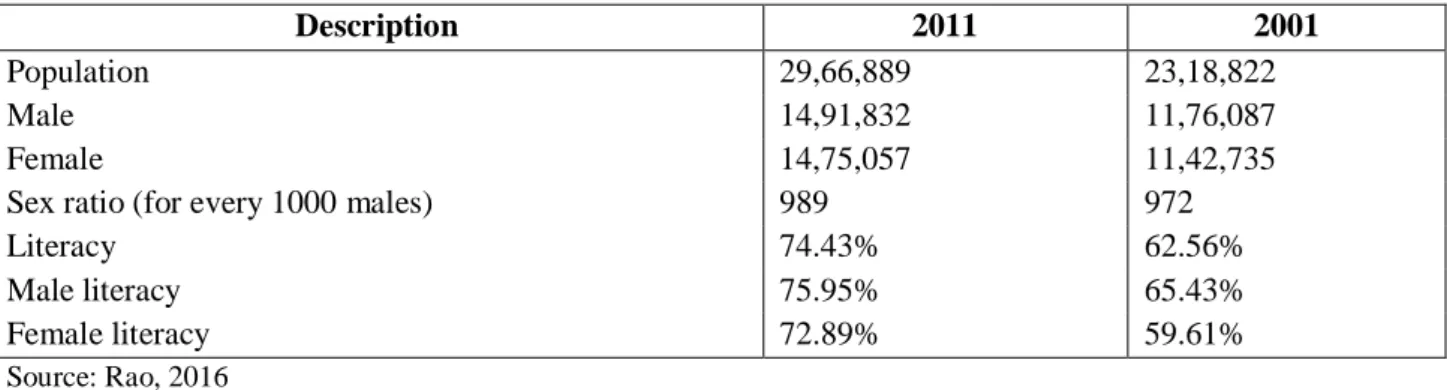
Only about 100 people reside in a km2 of an area in Meghalaya, making it a low-density region. The total population as per 2017 Census is 34,98,708 against 29,66,889 in 2011. While this makes Meghalaya one of the states in India with the lowest population, in spite of which it continues to have rapid population growth. From table 2, the gradual rise in population with a difference of 10 years can be seen. Nearly 81% of the population of the State live in rural areas. With most of its land covered by hills interspersed with gorges and small valleys, the economy is predominantly agrarian with around 75% of its total population being engaged in agricultural activities.
Table 2: Comparative descriptive statistics of Meghalaya
Description 2011 2001
Population 29,66,889 23,18,822
Male 14,91,832 11,76,087
Female 14,75,057 11,42,735
Sex ratio (for every 1000 males) 989 972
Literacy 74.43% 62.56%
Male literacy 75.95% 65.43%
Female literacy 72.89% 59.61%
Source: Rao, 2016
The population of Meghalaya is predominantly tribal, the main tribes are the Khasis, the Jaintias and the Garos besides other plain tribes such as Koch, Rabhas and Bodos. The Khasi people form a major part of the population in the eastern part of Meghalaya and are the state’s largest community.
The females of the Khasi community were mostly engaged in cultivation activities. Cultivation covered activities related to horticulture, agriculture, and growth of forest produce. Horticultural activities were in terms of growing and maintaining orange orchards, banana gardens, jackfruit trees and pineapple plants. In agricultural activities, they were engaged in growing ginger, black pepper, betel leaves and sweet potatoes as cash crops, while arum, millet, certain varieties of nuts and bay
leaves were grown for consumption. Other than this they also maintained kitchen gardens to grow tomatoes, beans, and chillies for self-consumption (Nongkynrih, 2002).
2.1 Khasi Religion
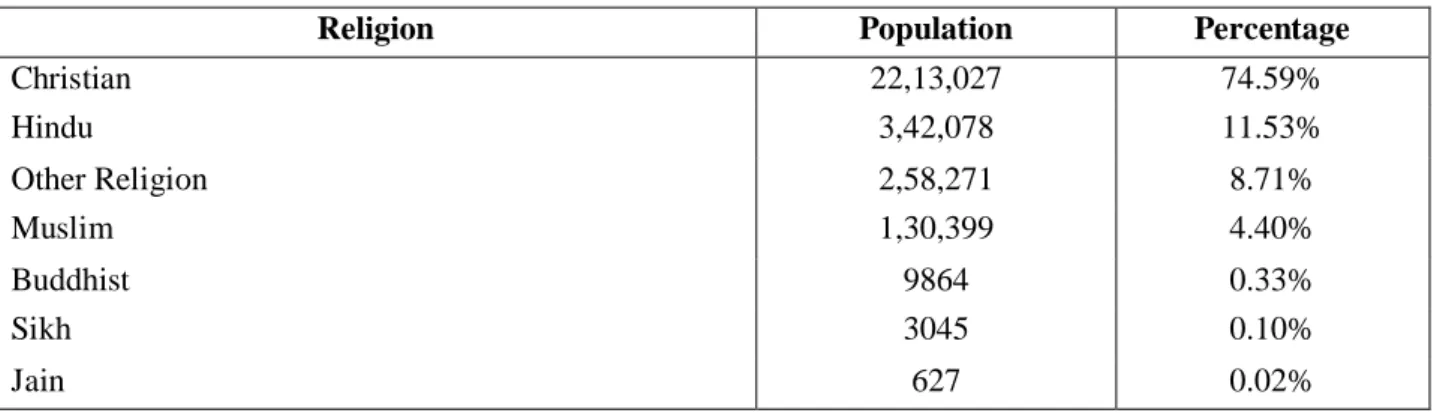
While almost 75% of the population of Meghalaya have embraced Christianity, a minority still follow and practice their old age indigenous religion. After Christianity, Hinduism is the second most popular religion in the State.
Table 3: Religion distribution in the region
Religion Population Percentage
Christian 22,13,027 74.59% Hindu 3,42,078 11.53% Other Religion 2,58,271 8.71% Muslim 1,30,399 4.40% Buddhist 9864 0.33% Sikh 3045 0.10% Jain 627 0.02% Source: Census, 2011
The Khasi Religion cannot be found in shrines, but it can be found in (i) In the rituals, ceremonies and the festivals of the people (ii) In the proverbs, riddles and wise-sayings
(iii) In the customs of the people, especially the different aspects of life (iv) In the different expressions of their beliefs
(v) In the use of religious objects and the expressions of their prayers
(vi) In the manner of worship and the materials they use for making sacrifices and offerings
With no scriptural information of the Khasi religion, it has been considered to be a primal religion by P.R Gurdon. Although the scripts may have been lost, the Khasis continued living with the framework of their culture. Tremendous efforts were made to pass their wisdom based on oral traditions from one generation to another. In the present time, the Khasis, especially the non-Christian Khasis consider their traditional myths and legends as a storehouse of their thoughts, ideas, wisdom and conceptual formation.
In the 19th century, the Roman Catholic Mission began to send some Missionaries to North East India. These missionaries went on to learnt the Khasi language and in due course, they began
26 translating some Catholic religious writings. The growth and development of Christianity among the Khasi people strengthened gradually and steadily. It was towards the end of the 19th century that it gained strong momentum among all sections of the Khasi tribal society.
When Christianity came into Meghalaya, the Khasi family was faced with the question of whether a “Ka Khaduh” could hold the family property if she converted to Christianity. In 1918, the Government ruled that Christian converts should be allowed to inherit the ancestral property, and that property is divorced from religion. Though religion was divorced from the traditional rules, because of the modernisation process, such as, educational development along with the spread of Christianity, that had somehow changed the traditional system in any respect (Roy, 1964)
In marital ceremonies, Christian Khasis got their marriages solemnized in the church, while, non-Christian Khasi (following indigenous Khasi religion) solemnized in the bride’s household in the presence of members from both the sides. In the indigenous Khasi style of wedding, the ceremonies were followed by a public celebration in the form of a big feast. Christian weddings, on the contrary, were simple and devoid of any public pomp or show.
2.2 Kinship and Marriage
One of the most remarkable features of the Khasis that sets them apart from other tribes is that descendants trace their lineage through their mothers and not their fathers. In other words, the Khasi follow a unilineal principle of matrilineal descent (Nongkynrih, 2002). In addition to this, the Khasis follow matrilocal residence, that is the husband lives with the wife’s family.
Being the followers of a unique social system of matriliny, the Khasi women enjoy a special place of status and dignity (Kyndiah, 1990). A Khasi woman (one who has been born and brought up in the Khasi society and who follows the Khasi way of life) after marriage gives birth to a number of children. When her female children get married they are supposed to perpetuate the lineage in turn by producing children.
In Khasi laws and traditions, daughters instead of sons inherit their fathers’ property when they die. Some marriages are arranged, but the practice is uncommon and is not the preferred method of choosing a spouse. Marriages in Khasi society are usually founded on emotions of ‘love’ and the preferences of those entering the union rather than on the parents’ designs for them. Women have complete freedom to choose their husbands, and, unlike India’s patrilineal culture, there are no
societal pressures to marry. A woman also has the right to end a marriage despite her husband’s objection. Women’s remarriages are more common and less disapproved of among the Khasi than in other parts of India, and men, as well as women, are free to remarry as many times as they want.
When a male gets married and shifts residence over to his wife’s mother’s household (i.e. if he marries the youngest daughter) or if he sets up residence in the land given by the village council (i.e. he marries an elder daughter) then he has three options for earning an income:
• to continue working on the field of or in the business run by his maternal family • have an independent source of income
• to work on the field or in the business run by his wife’s maternal family.
In a Khasi family, the mother-in-law of the daughter held a high position of respect because it is she who provides a male to perpetuate the lineage of the daughter. The mother-in-law commanded more authority over the grandchildren than the maternal grandmother of the children.
2.3 The Matrilineal Culture
According to Nongbri (2003), matriliny has been used as evidence that gender relations in Khasi society are egalitarian, that Khasi women are empowered, and even that women have too much power. While this common mindset holds true, the Khasi society can be described as a matrilineal society with elements of patriarchy. In other words, the privileges enjoyed by women are outweighed by those enjoyed by the men of the society. While men still make the decisions, women continue to bear the burden of caring for the extended family.
In addition to this, there are certain limitations to the matriliny privileges enjoyed by women. The youngest daughter does inherit the family property if there is property to inherit, which is very rare in contemporary times. Along with this, even with the property inherited without the permission of male members of the family, the youngest daughter cannot sell it, lease it or use it to run a business.
After marriage, the eldest daughter moves out of her mother’s house along with her husband to set up an independent residence. In such a situation, the ‘Shnong’ or the village administration provide the young couple with land for which there will be no ownership rights. Such a system of acquiring land is known as ‘Ri Raid’, while land acquired through lineage by the youngest daughter in the family is known as ‘Ri Kynti’. However, land received by the Shnong is limited to the receiver’s usage alone.
28 Other than this, other interesting elements of the matrilineal culture that is seen in the Khasi society is the practice of giving the complete day’s earnings to the wife. However, the mutual consensus of women, interviewed in the survey, the head of the household is considered to be the husband. While the father of the family has a definite role to play in the household affairs, his role is, however, limited to the final word of the maternal uncle.
2.4 Political Structure of the Khasi Society
Every Khasi village has its own Dorbar Shnong (village or local council) which plays a pivotal role in the village administration and is prescribed by the Rangbah Shnong (village headman) that is, the village headman, who is elected by adult members of the village. With the village headman having legislative or judiciary powers, the role of the Dorbar Shnong (village level assembly) in women’s issues is important. The village assembly is the lowest level of governance. Each Village unit is headed by a male village headman. He is elected by the village council, which comprises adult male members from every family residing in the village. The village headman is required to maintain peace and harmony in his respective village. He is the judge in all conflicts and quarrels and he can summon ‘defaulters’ and punish them.
The Dorbar Shnong2 is the decision-making body and organises the activities of the village collectively. The female unit and the male unit do not attend the village council meetings but are active participants in village activities. It meets once a month and may meet often as and when the need arises.
The president of the village female unit primarily worked towards the upliftment of women in their village. They attend awareness programmes, arranged by the government, that concern women and intervene in cases of domestic violence in the village. The functions of the president of the female unit involve eradication of gambling and illegal sale of alcohol, maintaining the cleanliness of the village, awarding students at school, looking after the well-being of the society, and eradicating poverty.
2.5 Economic Status of women in the rural society of Meghalaya
2 Along with the village headman, there is the female unit , and the male unit (Seng-Samla) of the village. All together, they form the village administrative structure.
A women’s economic status can be evaluated through their control over economic access and power. In terms of the Khasi society, this can be understood through whether the female household is an earner or dependent, their holding of tangible and intangible assets, nature of inheritance of ancestral property and the nature of job opportunities in which women are involved in comparison to their male counterparts. Along with this, their social position which can be evaluated through their involvement in social functions and duties is also an important content.
According to Utpal Kumar De and Bhola Nath Ghosh, while 16% of all family heads are dependent, 84% are earners. When it came to family heads, through the surveys conducted it was seen that women considered their male counterparts to be the family head even though the land was in their name. This indicates that nowadays the male counterpart who contributes significantly to the family income gain command over their female counterpart. With 80% of women in the Khasi society being earners and the rest being dependents, it can be understood that earning is not a criterion for a female to be the head. With that being said it can also be said that even if they do not earn and depend on the income of either the husband or younger children they can act as the head and thus decision maker. However, the chance of becoming the head of a non-earner female member is relatively more than a non-earning member even in a joint family of the rural Khasi society.
When we talk about inheritance, with the society being matrilineal in nature, it is the youngest girl child that inherits property. The male inherited property either due to the fact that there was no daughter of his parents. However, through the surveys conducted it was seen that most mothers were open to dividing the inheritance amongst their children. However, the overall fact remains that though one of the males inherit parental property, the females had more privilege to inherit property.
The most important economic feature of the Khasi society is that the return in the unverifiable investment in the human capital towards girls is retained within the household, whereas, in other cultures, only the verifiable component of investment can be retained through bride price or dowry. In other words, the Khasi family can choose to raise exactly the daughter they would like to keep in their household, not the daughter most likely to be preferred by other households (Uri Gneezy, Kenneth L.Leonard and John A.List, 2009).
30 CHAPTER 3
DOES CULTURE AND RELIGION HAVE AN IMPACT ON WOMEN
EMPOWERMENT IN INDIA?
3.1 Patriliny and Matriliny
Patrilineal descent refers to a system in which one is a member of a descent group as one has all male links back to the male founding ancestor. Patrilineality is the most common descent system followed by various societies in India. Matrilineal descent refers to a system in which one is a member of a descent group because one has all female links back to the female founding ancestor (Cronk & Gerkey, 2007). Though rare in India, matrilineal societies can be found in Meghalaya and parts of Kerala. The Khasis of Meghalaya were chosen as our research subjects to represent the matrilineal society and the Karbis of Assam were chosen to represent the patrilineal society of India.
Focusing on the statistics of rural women as compiled in the National Family Health Survey (IIPS, 2017), it is interesting to note that even with a strong matrilineal kinship system, the percentage of women in Meghalaya has experienced domestic violence are higher than that of Assam. Along with this, the percentage of unmet need for Family Planning and the low rates of contraception use in Meghalaya, explains why Meghalaya has the highest fertility rate in the country. In addition to this, even though the Indian Constitution states the reservation of seats for women in local government institutions, the non-inclusion of Khasi women in the local governance institutions has been aided by cultural traditions and further by the Sixth Schedule of the Indian Constitution. The customary democratic norms of the Khasis, which have been hailed for years have gone without female representation possibly because it is considered that in a matrilineal society the interests of women are already well protected (Langstieh 2000). Table 4, shows the respective statistics of women empowerment and gender-based violence in Assam and Meghalaya.
It is hence, hypothesized that perceptions of women, influenced by cultural traditions in a matrilineal society, is the reason behind which their empowerment levels are relatively low compared to a patrilineal society. In order to get a better understanding, this case study compares the cultural perceptions of the two societies. Studies by Saikia, Steele and Dasvarma (2001), which also focuses on the Khasis and the Karbis, argue that the perceptions and behaviour related to reproduction are strongly, even predominantly, determined by prevailing cultural and religious
values, which form the basis of socially-sanctioned realities in these communities. This research not only focuses on the reproductional behaviour of the two societies but attempts to understand the impact of tribal cultural traditions on empowerment levels of women as a whole. In order to do so, with special emphasis on the matrilineal society, the study will look into the differences of cultural traditions between a patrilineal society and a matrilineal society, and its respective impacts on women empowerment.
Table 4: National Family Health Survey: Women Empowerment & Gender Based Violence Women Empowerment and Gender Based Violence Assam Meghalaya
Women age 20-24 years married before age 18 years 24.7% 19.7%
Total Fertility Rate (Number of children per mother) 2.3 3.5
Women age 15-19 years who were already mothers or pregnant at the time of the survey
14.4% 10.1%
Total unmet need for Family Planning 14.4% 21.2%
Usage of any method of contraception 52% 22.4%
Currently married women who usually participate in household decisions 86.2% 91.1% Women who worked in the last 12 months who were paid in cash 16.7% 36.7% Ever married women who have experienced spousal violence 26.2% 30.4%
Women owning a house and/or land 53.7% 66.6%
Women having a bank or savings account that they themselves use 42.1% 49.9%
Source: NFHS-4 (2017)
Cultural beliefs and traditions in society play a major role in moulding various decisions of an individual belonging to a particular societal framework. Recognition of these beliefs and traditions is what anchors an individual to his/her society. In central to this, the need for social acceptance is what pushes women to adhere to these norms. This in turn results in an impact of empowerment levels of women.
3.2 Literature Review
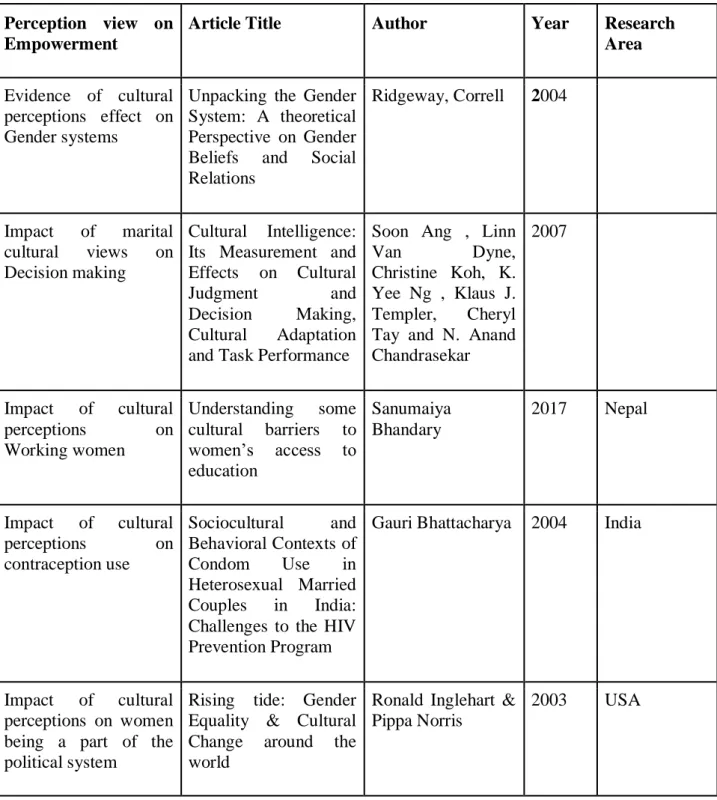
Various studies show evidence that cultural perceptions do tend to impact empowerment levels of a woman. Table 5, displays various studies of authors that show the impact of cultural perceptions on empowerment.
With very little research being done on how cultural perceptions impact empowerment levels of tribal women, this chapter will be covering the above-mentioned objective with special emphasis on the patrilineal culture of the Karbis and the matrilineal culture of the Khasis.
32 Table 5: Literature Review of Perception view on Empowerment Factors
3.2 Cultural Perceptions
In November 2017, a questionnaire survey was conducted in Meghalaya and Assam for 25 days each respectively. The research was conducted in two districts, East Khasi Hills and West Khasi Hills of Meghalaya and Kamrup and Morigaon of Assam. In total, 301 Khasi respondents from Meghalaya and 272 Karbi respondents from Assam were interviewed. The respondents had to be Perception view on
Empowerment
Article Title Author Year Research
Area
Evidence of cultural perceptions effect on Gender systems
Unpacking the Gender System: A theoretical Perspective on Gender Beliefs and Social Relations Ridgeway, Correll 2004 Impact of marital cultural views on Decision making Cultural Intelligence: Its Measurement and Effects on Cultural
Judgment and
Decision Making, Cultural Adaptation and Task Performance
Soon Ang , Linn
Van Dyne,
Christine Koh, K. Yee Ng , Klaus J. Templer, Cheryl Tay and N. Anand Chandrasekar 2007 Impact of cultural perceptions on Working women Understanding some cultural barriers to women’s access to education Sanumaiya Bhandary 2017 Nepal Impact of cultural perceptions on contraception use Sociocultural and Behavioral Contexts of Condom Use in Heterosexual Married Couples in India: Challenges to the HIV Prevention Program
Gauri Bhattacharya 2004 India
Impact of cultural perceptions on women being a part of the political system
Rising tide: Gender Equality & Cultural Change around the world
Ronald Inglehart & Pippa Norris
females married and each questionnaire was filled on a one-to-one basis. The respondents had to answer a questionnaire which focused on various cultural perspectives that impact gender empowerment.
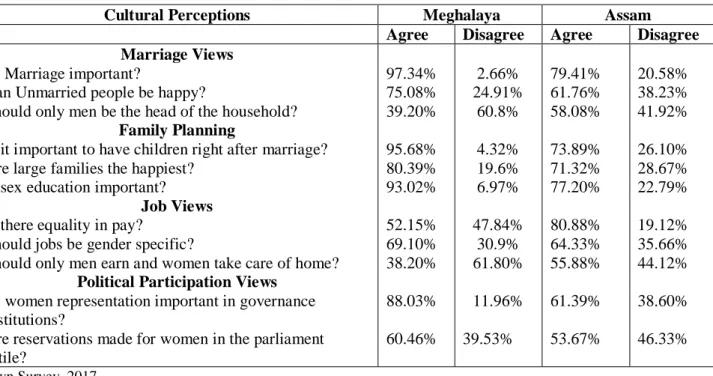
Table 6: Cultural Perceptions of two areas
Cultural Perceptions Meghalaya Assam
Agree Disagree Agree Disagree
Marriage Views
Is Marriage important? 97.34% 2.66% 79.41% 20.58%
Can Unmarried people be happy? 75.08% 24.91% 61.76% 38.23%
Should only men be the head of the household? 39.20% 60.8% 58.08% 41.92%
Family Planning
Is it important to have children right after marriage? 95.68% 4.32% 73.89% 26.10%
Are large families the happiest? 80.39% 19.6% 71.32% 28.67%
Is sex education important? 93.02% 6.97% 77.20% 22.79%
Job Views
Is there equality in pay? 52.15% 47.84% 80.88% 19.12%
Should jobs be gender specific? 69.10% 30.9% 64.33% 35.66%
Should only men earn and women take care of home? 38.20% 61.80% 55.88% 44.12%
Political Participation Views
Is women representation important in governance institutions?
88.03% 11.96% 61.39% 38.60%
Are reservations made for women in the parliament futile?
60.46% 39.53% 53.67% 46.33%
Own Survey, 2017
The Khasi people form a major part of the population in the eastern part of Meghalaya and are the state’s largest community. One of the most remarkable features of the Khasis that sets them apart from other tribes is that descendants trace their lineage through their mothers and not their fathers. In other words, the Khasi follow a unilineal principle of matrilineal descent (Nongkynrih, 2002). According to Khasi laws and traditions, the woman and her youngest daughter inherit property, and not the man. After marriage, the eldest daughter moves out of her mother’s house along with her husband to set up an independent residence. In such a situation, the ‘Shnong’ or the village administration provide the young couple with land for which there will be no ownership rights. Such a system of acquiring land is known as ‘Ri Raid’, while land acquired through lineage by the youngest daughter in the family is known as ‘Ri Kynti’ (Keeni, 2017). However, land received by the Shnong is limited to the receiver’s usage alone.
The Karbis, popularly known as Mikirs, constitute one of the important tribes of Assam.
The Karbi is a patrilineal tribe and descent, inheritance, succession, authority and residence after marriage are traced through male line among them. After marriage, a girl has to leave her family of orientation and live with her husband in the husband’s family of orientation or a neolocal residence.
34 An interesting aspect of the women of the Karbi folk is that she does not change her surname after marriage but instead, her children would have to take her husband’s surname (Zaman, 2008). The Karbi culture has been imbibed with many elements of the cultures of Assamese Hindus and the Khasis.
A compilation of the various questions asked and the views of the various respondents have been presented in Table 6.
From the above-mentioned statistics, it can be understood that Khasi women appear to enjoy a higher status in the field of household decisions as compared to Karbi women, mainly because of the inheritance rules and their comparative freedom in establishing a home (Saikia, Steele & Dasvarma, 2001). Khasi women enjoy a much greater share of liberty in their household decision-making compared to women in other societies of India, this is due to cultural traditions which emphasize the home to be a woman’s domain. Along with this, it is also seen that it is the duty of the husband to provide his wife with his earnings. In this way, Khasi women manage household expenditure, contribute to the family income and make their own decisions, in contrast to Karbi women.
The Khasis believe in big families and hence tend to want more than one child in comparison to Karbi women. This can be deduced from the Total Fertility rate in Table 5. This supports the percentage of Khasi women that feel large families are happier. It is interesting to note, that while a higher percentage of Khasi women believe that sex education is important (Table 6), the percentage of contraception use among Khasi women is lower than that of Karbi women. This may be due to the fact that 100% of Khasi respondents are Protestant Christians, who do not believe in modern methods of contraception. From Genesis IV 29 of the Bible, it can be understood that Christians, especially protestants, condone the use of contraceptives while Catholics forbid its use on the basis of the biblical teaching that, God instructed man to “multiply and fill the earth”.
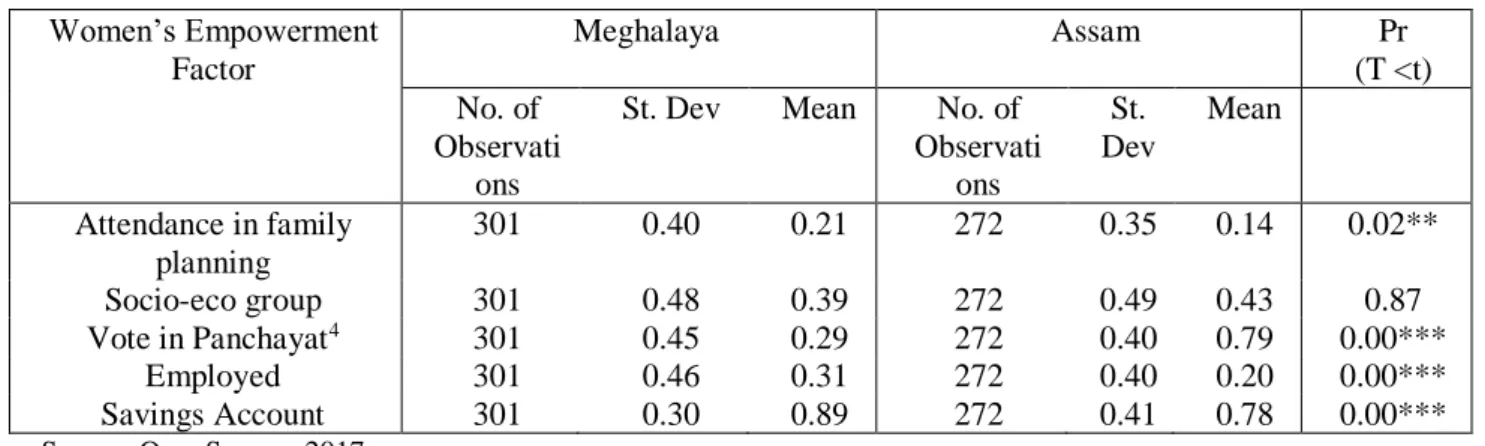
The state government of Meghalaya has made provisions for rural women to earn and support themselves. One such provision is the Job Cart, which is a 100-day labour-intensive work for which women can earn a certain amount of money. Payments are made directly to their respective savings account, which supports the higher percentage of Khasi women having a savings account in comparison to Karbi women (Table 5). This also supports the view of Khasi women where the percentage of women who agree that only men should earn is comparatively less. However, it is interesting to note, that Khasi women don’t feel that equality in pay is important, in fact, they also