THREE DIMENSIONAL COMPUTATION
OF TAYLOR-COUETTE FLOW
Naoki Matsumoto (松本 直樹)
The Institute of Computational Fluid Dynamics, Tokyo, Japan
Susumu
Shirayama (白山 晋)The Institute of Computational Fluid Dynamics, Tokyo, Japan
Kunio Kuwahara (桑原 邦郎)
The Institute of Space and Astronautical Science, Tokyo, Japan
1. Abstract
Three dimensional incompressible
Navier-Stokes
equationsare
solvednu-merically for Taylor-Couette flow with the outer cylinder at rest. The
wave-length of supercritical Taylor vortices created through
an
impulsive startof the inner cylinder is studied. The evolution of Taylor-vortex structure is
visualized and canbe investigated precisely. The results are compared with
2. Introduction
Experiments for flows between concentric cylinders
were
performed byBur-khalter&Koschmieder (1974). They measured the wavelengths of
steady-statevortices that resulted ffom impulsively starting theinner cylinder from
a state of rest with the outer cylinder held fixed. According to these
exper-iments, the wavelength initially decreased up to $R/R_{c}\approx 4(R_{c}$ : Critical
Reynolds number from linear theory). Beyond $R/R_{c}\approx 4$, the wavelength
increased with increasing$R$
.
The objective of the present work istoexaminethis problem. The visualization and the measurements of the 3-dimensional
flow
are
very difficult, and thereseems
to beno
current theory available forsuch strongly nonlinear flows. Therefore it appears that numerical
simula-tion is the only useful tool for our
purpose.
Neitzel (1984) performed theaxisymmetric computation of the incompressible
Navier-Stokes
equationsin finite-length concentric cylinder geometry. But the wavelength did not
increase for $R/R_{c}>4$
.
So we have performed 3-dimensional computationand compared the results with the experiments.
3. Numerical Method
Consider a pair of concentric cylinders of radii $a$ and $b$ and height $h$
.
Weassume
thegap
between the cylinders to be filled with a viscousincom-pressible fluid of kinematic viscosity $\nu$
.
The entire system is assumed tobe in
an
initial state of rest. At time $t=0$, the inner cylinder at radius$r=a$ is impulsively set into rotation with angilar velocity $\Omega$ while the outer
cylinder at $r=b$ is held fixed. The rigid endwalls at $z=0,$$h$ are assumed
to be attached to the inner cylinder and therefore begin to rotate with it at
$t=0.The$ variables
are
made dimensionless using the scales $d\equiv b-a,$$\Omega d$and $\Omega^{-1}$ for length, speed and time respectively.
Numerical method is based
on
the MAC method except treatingpres-sure. The incompressible
Navier-Stokes
equationsare
expressed as follows:$\frac{\partial v}{\partial t}+(v\cdot\nabla)v=-gradp+\frac{1}{R_{e}}\triangle v$ (1)
divv $=0$ (2)
These equations are written in
a
generalized coordinates system and solvedsides of equation (l),we obtain the poisson equations for gradient of
pres-sure:
$\triangle P=-grad\cdot div(v\cdot\nabla)v+gradR+rot\cdot$ rotP $(3a)$
where
$R=-\frac{\partial D}{\partial t}+\frac{1}{R_{e}}D$, $P=gradp$, $D=divv$ $(3b)$
and the formula of vector analysis $grad\cdot divX=\triangle X+rot\cdot$ rotX is used.
The time derivative,$\partial D/\partial t$, is evaluated by forcing $D^{n+1}=0$, i.e.,
$\frac{\partial D}{\partial t}\simeq-\frac{D^{n}}{\triangle t}$
The boundary conditions for (1), (3) are
as
follows(dimensional variables):$u=V$, $v=0$, $w=0$
$P_{r}=\frac{1}{R_{e}}\frac{\partial^{2}u}{\partial r^{2}}+\frac{V^{2}}{a}$, $P_{\theta}=\frac{1}{R_{e}}\frac{1}{a^{2}}\frac{\partial^{2}v}{\partial\theta^{2}}$ $P_{z}=\frac{1}{R_{e}}\frac{\partial^{2}w}{\partial z^{2}}$
at $r=a$
$u=0$, $v=0$, $w=0$
$P_{r}=\frac{1}{R_{e}}\frac{\partial^{2}u}{\partial r^{2}}$ $P_{\theta}=\frac{1}{R_{e}}\frac{1}{b^{2}}\frac{\partial^{2}v}{\partial\theta^{2}}$ $P_{z}=\frac{1}{R_{e}}\frac{\partial^{2}w}{\partial z^{2}}$
at $r=b$
$u=r\Omega$, $v=0$, $w=0$
$P_{r}=\frac{1}{R_{e}}\frac{\partial^{2}u}{\partial r^{2}}+\frac{u^{2}}{r}$, $P_{\theta}=\frac{1}{R_{e}}\frac{1}{r^{2}}\frac{\partial^{2}v}{\partial\theta^{2}}$ $P_{z}=\frac{1}{R_{e}}\frac{\partial^{2}w}{\partial z^{2}}$
at $z=0,h$ $(u, v, w)$ are the velocity components in the directions given by the
cylindrical coordinates $(r, \theta, z)$, and ($P_{r}$,P9,$P_{z}$)
are
the components of $P$in each direction. The Poisson equations for gradient ofpressure
are
solvedby successive
over
relaxation. Dealing with gradient of pressure insteadand the
convergence
becomes good. The Euler semi-implicit scheme is usedfor the time integration of velocity. (All but the convective velocity
are
computed implicitly.) All spatial derivatives except the nonlinear terms
are
approximated by centraldifferences. The nonlinear terms are $app_{f}roximated$
by the third-order upwind scheme:
$(u \frac{\partial u}{\partial x})_{i}=u;\frac{-u_{i+2}+8(u_{i+1}-u_{i-1})+u_{i-2}}{12h}$
$+|u_{i}| \frac{u_{i+2}-4u_{i+1}+6u_{i}-4u_{i-1}+u_{i-2}}{4h}$
We
assume
the flow to be symmetric about the midplane to reduce thesize of the computational domain. This restricts the flow to have an
even
number of vortices, which is the
case
normally observed in the laboratory.A grid system is shown in fig.l. Constant grid spacing is used in each
direction. The computations
were
done on Japanese supercomputerNEC
SX2.
4. Results
There are three nondimensional parameters:
$\eta=b/\grave{a}$ (Radius ratio)
$\gamma=h/d$ (Ratio ofheight and gap)
$R_{e}=\Omega d^{2}/\nu$ (Reynolds number)
$(R_{c}=31.03)$
cf) $Ta= \frac{2\eta^{2}}{1-\eta^{2}}R_{e}^{2}$ (Taylor number)
$\eta$ is fixed at 0.727, and $\gamma$ is fixed at
23.35
to correspondwith the experimentof Burkhalter
&Koschmieder.
The computationsare
performed for fourcases
$R/R_{c}=2,3,4,6$ ($R_{c}:Critica1$ Reynolds number from linear theory).Steady-state
Figure.2 shows instantaneous streamlines in the vertical surface for $R/R_{c}=$
comparison of the experimental and other numerical results. The
wave-length $\lambda$ is defined as follows:
$\lambda=\frac{\gamma-2\epsilon}{N}$
where $\epsilon$is thelength of the endcell,and $N$ isthe number ofvortex-rings$(=1/$
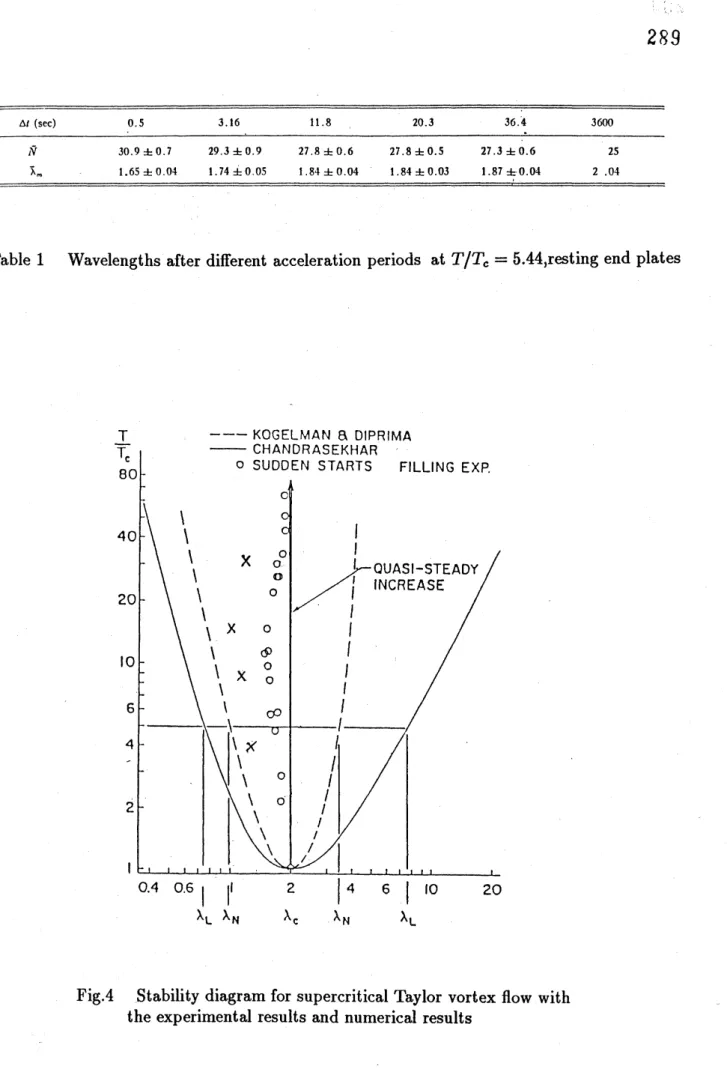
$2$ number of cells) excluding endcells. The agreement is not good
quanti-tatively. Probably the main reason is that the experiment is not a perfect
impulsive start. According to other experiments of them, the wavelength
depends
on
the history of the acceleration.(Table 1) And anotherreason
isfrom the numerical
error
due to the discontinuity in the boundarycondi-tions at the axial end plates. However wavelengths of computational results
are
within the theoretical limit (Fig.4). The quantitative agreement is notgood, but the agreement is good qualitatively. Both wavelengths of the
computational results and the experiments increase for $R/R_{c}>4$
.
Evolution
of
Taylor-vorticesWhy does the wavelength increase for $R/R_{c}>4$ ? We have investigated
the time-evolution of vortices.
(1) $R/R_{c}=3$
At first, avortex develops from the end-boundary by Ekman pumping,
induces next vortex, and propagates up. Finally vortices fill the
gap
between the cylinders and
go
to the steady-state. Flow is axisymmetricduring this procedure. Fig.$5a$ shows the instantaneous streamlines in
the vertical surface. Fig.$5b$ shows the contour of the vorticity normal
to the surface. It is found that the vorticity is supplied from the inner
boundary.
(2) $R/R_{c}=6$
Vortices fill the
gap
between the cylinders by thesame
process withcase(l). However, this is not the steady-state. This state makes
a
transition to the state in which there
are
large Taylorvortices.
Fig.$6a$shows the instantaneous streamlines inthe vertical surface. During the
transition
we
found that wavelengths ofvortices graduallyincrease
byvortex-connection. This feature is not found in the axisymmetric
So
the transitionare
probably due to the non-axisymmetric effects.Fig.$6b$ shows the contour of the vorticity normal to the surface. It is
found that the
vortices
which have thesame
signare
connecting.5. Conclusion
The wavelength of Taylor vortices through an impulsive start increases for
$R/R_{c}>4$ by vortex-connection, and this feature
was
not found byax-isymmetric computation by Neitzel (1984). So this is the non-axisymmetric
effect.
REFERENCES
[1] S.Chandrasekhar : Hydrodynamic and Hydromagnetic Stability
(Ox-ford University Press,Ox(Ox-ford,1961) p.303
[2] S.Kogelman&R.C.DiPrima : Stability of spatially periodic
supercrit-ical flows in hydrodynamics. Phys.Fluids
13
(1970)[3]
J.E.Burkhalter&E.L.Koschmieder
: Steady supercritical Taylorvor-tices after sudden starts. Phys.Fluids 17,1929 (1974)
[4] G.P.Neitzel: Numerical computation of time-dependent Taylor vortex
GRI
$0$ POINT
$S=$ $3\emptyset\star 31\star 1\emptyset 1$qコ 寸 $e\hat{o}$ $N^{\wedge}$ $11$ $\approx^{o}$ $\sim\approx$ 科 $\cup Q)$ $e_{\frac{t\S}{\Xi\infty}}$ 何 . $\cdot$ $\underline{V}$ $\underline{*\partial}$ $Q)\succ$ $o_{\circ}$ $A^{\Phi}rightarrow$ $11$ $\infty$ . 目 $\downarrow$
1
$\sim_{(l1}\partial$ $\frac{\infty}{O}\Phi$ 邸 $\sim g$ $B\mathfrak{X}$ $-\dot{\infty}$ $Pr$ $11$ $\infty$$\wedgerightarrow$ $\frac{\circ}{..arrow_{\frac{N}{z^{Q)}}}Q)}$ $\overline{\Phi\circ}$ $r\circ\succ$ $SA\Phi$ \={o} $A_{(\lrcorner}$ $+_{\dot{6}}-$ $o\infty$ $-$ $\#$ a $\delta$ 科 $\frac{\overline{\star Q)}}{A^{6}}$ $arrow\frac{\underline{o}}{\Phi^{\partial}}$ 七 日 $\overline{v}\approx$ 日 A 家 $\infty b$
$-\underline{a}_{r}\circ\succ$
.
$\frac{rightarrow}{\overline{\Phi tl1}}\cdot\not\in$臼 $=\sim\backslash \prec 0$
$\frac{o}{P\dashv\succ_{6}}*\underline{\mathfrak{B}}-\#\overline{.e\frac{v}{\frac{}{Q)}}}\frac{+^{\infty}}{-}$ $rn6S$ $ $\underline{\infty\approx}arrow\overline{\Phi}\underline{-}\overline{6}$
$\succ q.\xi+_{\overline{Q)}Q)}\underline{v}$
$\neq_{\frac{b:}{\underline\omega}}c\prec\alpha 0_{E^{\aleph^{)}}}$ 陶 $\frac{a}{z}$
$g_{\wedge-\wedge}^{\succ_{6}\ddot{o}X\bullet}Qj\cdot$ . $\triangleleft mo$ $\dot{}^{\frac{b}{\}}ffeo_{\dot{0}}$ く q $q^{v}$ $\underline{\backslash \approx}$ $11$ ト ト
36.4.
$1\overline{v_{m}\overline{\lambda}}$ $30.9\pm 0.7165\pm 0.04$ $29.3\pm 0.91.74\pm 0.05$ $27.8\pm 0.61.84\pm 004$ $27.8\pm 0.51.84\pm 003$ $27.3\pm 0.61.87\pm 004$
2.0425
Table 1 Wavelengths after different acceleration periods at $T/T_{c}=5.44,raeting$end plates
Fig.4 Stability diagram for supercriticalTaylor vortex flow with the experimental results and numerical results
$^{\backslash }0\backslash |\acute{f}_{\vee}\hat{c})\mathbb{Q}_{1}^{\cap^{\prime\sim_{t}}1r_{C}\perp@^{-}t^{\int_{\backslash }\gamma^{\backslash }}}J’:)\acute{(Q\vee}))r_{-}C^{\wedge})\rfloor\prime^{\wedge\bigwedge_{arrow}}\backslash \prime’*_{\vee^{\wedge\sim}}cu)_{1}^{\backslash \}}|\acute{\overline{\subset}}cJ_{c^{--d\wedge}}|$
$\textcircled{0} C_{\vee}^{\backslash _{\backslash }\prime}i_{)},\acute{t}\backslash I(\mathfrak{c}$
$\sigma\infty$
$\circ)$
$C_{J\backslash }^{t)1}’,\bigvee_{arrow J_{\backslash }^{1(\textcircled{0}\overline{C^{\gamma}}J(\ovalbox{\tt\small REJECT}’\cdot \mathfrak{c}}}0^{0}\ovalbox{\tt\small REJECT}_{-\cdot\cdot\prime}^{1}-C_{J_{c}^{(}}^{oJ^{1}}\overline{3}K\hat{C}_{\dot{J}\backslash _{\backslash }}^{)}||\bigcap_{\simarrow}\partial’)C^{0_{\sim’}}.Jffl\prime 1_{\sim^{\theta}}0\ovalbox{\tt\small REJECT}_{\backslash 1\iota^{j_{\sim}}}^{||\overline{O)}C^{c})/((W_{\backslash \backslash }^{c\backslash }}\iota.t^{\backslash }|/\subset C_{arrow’}^{\neg}3)$
$\cup\urcorner$
$\ovalbox{\tt\small REJECT}^{*}\sim l^{\backslash \backslash }\alpha’|\vee’-\backslash ’\backslash \downarrow\int_{-}^{7}\iota.’\prime 1’\iota:l^{*}\iota^{\backslash ^{l_{/}}]_{\vee\iota^{}}’}-t^{(}\Phi^{\backslash }!\dot{t}\ovalbox{\tt\small REJECT}\cdot\backslash (0\gamma_{\overline{\mathbb{Q}}1([\underline{farrow/}}\underline{J}\copyright^{1}|_{\iota}\sim \mathbb{O}\perp C^{cj^{\sim})}|’’(\gamma\}^{(\int(\Supset)}\mathfrak{u}_{\backslash _{\backslash ^{\circ}}’}^{i_{1}}\backslash ^{arrow}$
$r$
$\sigma)$
$\tau\tau$
$\overline{\frac{\ominus}{*}}$ $\ovalbox{\tt\small REJECT}_{\vee}’..\cdot.\sim\prime_{*}\sim.\cdot..\cdot.\cdot\vee...-..\nearrow\wedge/j..$
.
$\backslash ,arrow*.\prime r’arrow tl-((\grave{o}\tau_{\sim^{\overline{\backslash }^{-}},\backslash }./(f_{J^{\backslash }}J_{-\backslash }.(r\overline{3}\llcorner_{\backslash })\}|_{\backslash }\overline{O}T^{:}C^{t.\backslash ,},,)_{1\vee}\backslash _{\backslash }\ulcorner_{\backslash ^{\theta}}7_{\backslash }^{(}’\circ$ $\sigma 0$ $*$ $e$ $\cup$ 俺] $*$ $1U(\lrcorner CC$.
.
$\cdot$:
.
$\cdot$:
.
$\cdot$.
$\cdot$,’ $\backslash ’(\overline{\gamma}^{-}\backslash _{arrow}\sim’!_{\backslash }\backslash \hat{o}T^{_{\sim}}/^{^{1\mathbb{C}^{\grave{o}}}}\cdot\backslash \acute{(}0_{--\backslash }\pi 1_{\iota^{i)}}^{1^{1\otimes^{-\backslash }\overline{[.\backslash _{i}}}}.\mathfrak{c}_{\vee})]_{1^{\int_{t}}(J’}\backslash \cdot.3\overline{C^{c.)1n_{\sim^{t^{-}}}’.\circ}}_{\nearrow\backslash }0\backslash _{\backslash }\neg_{/’}^{\triangleleft}J^{\wedge}$
寸 $L^{1}U^{1}$ $\infty$ ク] 屋] $o$.
. .
. .
. . .
. . .
.
.
.
$\ldots$.
.
$\ldots$$\ell_{\downarrow}^{\backslash }’.\dot{\gamma}\llcorner^{arrow-}\kappa_{\vee}1’J^{\backslash }\ovalbox{\tt\small REJECT}$
フ\supset
.
.
$\cdot$.
$\cdot$.
.
.
.
$\cdot$.
.
.
$\cdot$.
.
$\cdot$.
. . .
.
.
$\cdot$. .
$\cdot:$.
$\backslash ’1\lrcorner,\Gamma^{\wedge}((arrow_{\wedge--}(\Supset\backslash _{=j})^{||}\sim^{-}\cdot$.
$\sim$
$11$
$tU$ $=$
$\Theta$ 屋] $e\circ$ $11$ $\approx^{o}$ $\backslash \approx$ $4\overline{aO}$ $V\Phi$ $* \frac{\hslash}{\overline{\infty\Leftrightarrow}}$ $A^{\Phi}rightarrow$ $\sim^{O}$ $\overline{6}$ $\frac{a}{\underline O}$ $+\succ_{*}$,
.
$\underline{V}$ $\infty-$ $\succ O$ $*\overline{O}$ $O1$ $\overline{O\approx}$ 寸 $0^{\overline{\circ}}\sim$ Il $\underline{tU=}$ $r\dot{\mathbb{E}}^{\frac{b:}{;}}u_{\mathfrak{d}}^{\circ}$ $\iota-$$t$ C 殴 $\triangleright$ 寸 ev $O1$ $\sigma)$ $\Leftrightarrow$ $\sigma)$ O) 欧殴
.
.
. .
.
.
. .
$\cdot$. .
$\cdot$.
.
$\cdot$.
$\cdot$. .
$\cdot$. .
$\cdot$. . .
.
.
$\prime dk_{\iota}^{0^{\backslash }}C_{--}^{\sim}\prime j^{\backslash }$)$\circ 1$ $\sigma$
. .
.
. . . .
.
.
.
.
$\cdot$. .
$\cdot$.
.
$\cdot$.
. .
$\cdot$.
.
$\cdot$.
$:$.
$\backslash \backslash ..\mathcal{K}_{\approx\sim^{P^{\backslash }}}^{y^{\backslash }}(|\overline{a}|.)-’$
.
$arrow$
$11$
$tU$
$-’/\}^{\vee}|$
. $\mathfrak{c}_{\backslash }^{\backslash .\backslash \prime’}(1^{\backslash \prime}\lrcorner(O\backslash c’)k_{arrow r\neg_{\underline{\mathbb{O}}_{/}}}^{\sigma\supseteq}\bigcap_{\sim}C^{1_{I}},-\simeq o_{/^{\backslash ,}\#_{\sim}\cdot\ \perp} O\cdot|\backslash -\sim oC)_{\iota}^{\backslash }r_{0}^{:_{\vee}<,\backslash \underline{o}_{tC^{O]C_{\backslash }^{\sim_{\vee}}}}^{\backslash }}(O^{0})^{-}$
$\Theta\infty$
$O1$
$’(),.’)^{1}t(\subset\gamma,T^{0,}\prime Jf|r_{-}(\grave{o}\tau_{1Q}:C).\prime r_{C)\mathbb{R}^{v}}\sim 0^{\sim}.(C.’\overline{b^{\neg_{)}}}C_{\vee_{-}}^{\vee}j:^{1}\tau_{1}arrow,1t\overline{.c_{\vee}}\{\overline{O}^{1^{\backslash }},- C\circ f_{d^{\backslash }}^{\backslash }$
$\underline{e}$
$\infty\infty$
$O1\Theta$
$c_{i}C|\overline{k_{\sqrt{}’.:^{T_{\frac{\overline-b}{\wedge(\eta\vee}||}}}^{Q_{\backslash \cdot--}}(\neg}Y_{l}^{arrow}c_{\wedge}’)arrow\lambda_{\backslash }O^{\lambda}Bf\int_{\iota}\ovalbox{\tt\small REJECT}_{P^{\backslash }}J^{1}\cdot 03k^{\cap f’}\underline{c^{\backslash }}_{(C_{x^{)(j^{)}\dot{\cap}\prime}}})-\mathbb{Y}^{fo}\cdot/-\sim\zeta;)|^{\prime_{\backslash }}X,\underline{t^{\backslash }}[1’\underline{O}_{\prime}$
, $\iota n^{)}\sigma$ $’\circ\Phi\infty oS\Phi 0$ $\#^{\circ}\geq$ $1$ $\sim_{\S}$ $\sigma\triangleleft^{)}$ $\frac{\infty\overline 0\underline}{\infty}$ $r_{t^{-},\sim^{)_{\wedge 1}\gamma.\backslash (g_{t}}}\backslash ^{\neg}(\sigma_{J\underline{\sim^{Q}}})$ $O^{\partial^{\backslash l}}..\mathbb{Q}^{\iota_{1_{\backslash }^{1b^{\backslash _{r_{\vee-\prime}^{\bigcap,}}}}}}"\backslash r_{\hat{O}}\backslash .\mathcal{F}_{\cap-J^{\backslash }(}\backslash \overline{.((3_{\vee/}}\psi\sim\frac{\overline O-}{\backslash }-1\backslash _{\backslash }i^{-}(.0)[t_{-}^{\overline{arrow}i_{i}^{\backslash ,}T_{\backslash :^{t_{1}}}.\overline{o}}|^{\backslash }|_{1_{\backslash }}0^{1}\copyright_{/}(\eta\iota[|_{\backslash ^{-}}’\underline{\Omega\backslash }]\overline{\uparrow}_{\vee^{\backslash }}^{\wedge},()$
Il 自
$\omega$
$=$
$tD$ $*$ $tu_{r^{\lrcorner}}$ $\cap$ $\lrcorner$ $\triangleleft$ $z$ $g$ $01\Theta$ 箇 $U1\circ$ ) $\succ$ $\vdash$ $t\lrcorner$ $|-$ $\infty$ $\check{\sigma)}c$ $O\supset$ $\uparrow \mathfrak{l}$ 火 $z$ $arrow$