PRODUCTION OF LARGE, VOLUME DISCHARGES IN WATER AND THEIR INDUSTRIAL APPLICATIONS
H. AkiyamaS, S. Katsuki, T. Namihira, *K. Ishibashi and *N. Kiyosaki Kumumoto Universip, Kumumoto, 860-8555, JAPAN
*Nishida T e h Corporation, Kumamoto, 869-0494, JAPAN
' ukiyama(@eecs. hmamoto-u.ac.jp Abstract
Plasmas with a large volume have been produced in low pressure gases using the diffusion and flow of pliamas.
In liquid, arc discharge plasmas have been produced for the basic researches and some applications. The volume of the arc plasma is limited. Here, the production of large volume discharge plasmas in water and their industrial applications are described.
1. INTRODUCTION
Pulsed power has been used to produce nonthermal plasmas in atmospheric pressure gases that generate a high electric field at the tips of streamer discharges and produce high energy electrons, free radicals, ultraviolet rays and ozone. These manifestations of sl.reamer discharges have been used in the treatment of (exhaust gases, removal of volatile and toxic compounds such as dioxin, and the sterilization of microorganisms.
The breakdown phenomena in liquids have been studied for a long time, in particular its relation to electrical insulation. Large volume streamer discharges can he produced not only in atmospheric pressure gases but also in liquids using the recent development in pulsed power technology, These streamer discharges in liquids are able to produce a high electric field, high energy electrons, ozone, chemically active species, ultraviolet rays and shock waves, which readily sterilize microorgankms and decompose molecules and materials
The large volume streamer discharges have many commercial applications, such as
( I ) cleaning of the lakes and marshes,
(2) sewage treatment,
(3) sterilization of bacteria, and (4) chemical decomposition.
First of all the production of large volume streamer discharges is described here. Then, as examples of 'commercial applications using large volume streamer discharges, the cleaning of lakes and marshes and the sewage treatment are described.
11. PRODUCTION OF LARGE VOLUME PLASMAS IN WPdER
A Blumlein line or a Marx generator was used as the pulsed power generator to produce the large volume discharge plasmas in water. A thin wire to plane
electrode, a thin wire to cylindrical electrode and a rod to plane electrode configurations are used. The applied voltage to the electrode is 100 to 400 kV, and the current flowing through the water and discharges is several kA.
The pulse width is about Ips. and the risetime of voltage is about 50 ns. The many streamer discharges begin from the thin wire electrodes, and propagate toward the opposite electrode. The pulse width is controlled to avoid the transition to single'arc discharge,
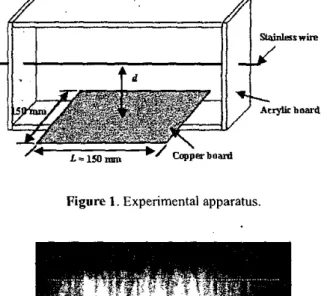
Figure 1 shows the experimental apparatus. A stainless thin wire with 0.5 mm in diameter is used as a positive electrode. A copper plane electrode with 150 x 150 x I mm is used as a ground electrode. The gap separation is adjusted from 45 to 135 mm by the holes of the acrylic hoard, through which the thin wire electrode is sustained.
The electrodes and the support board are set into the water.
qik hoard
Figure 1. Experimental apparatus
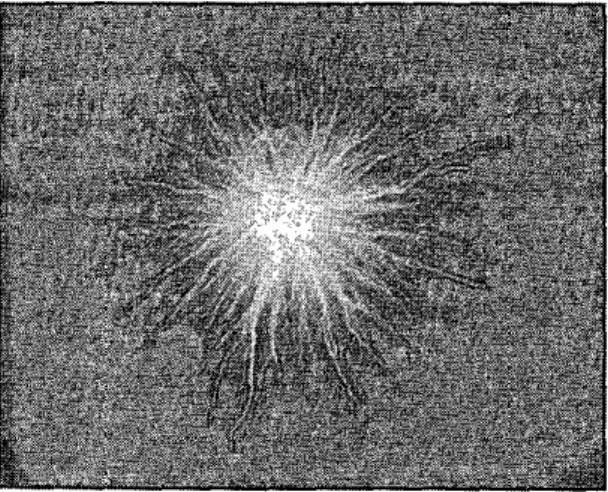
Figure 2. Time-integrated photograph of streamer discharges in tap water.
Figure 2 shows the typical time-integrated photograph 0-7803-7540-8/02/$17.00@2002 IEEE 150
Authorized licensed use limited to: Kumamoto University Trial User. Downloaded on August 6, 2009 at 05:26 from IEEE Xplore. Restrictions apply.
of streamer discharges in tap water with conductivity of 25 mS/m. The applied voltage is 360 kV, and the gap separation is 45 mm. Many streamer discharges are observed. The number of streamem increases with the decreases of water conductivity, and of the diameter of thin wire electrode.
Figure 3 shows the dependence of the number of discharge channels on the electric field intensity at the surface of the thin wire electrode. The electric field intensity is calculated from the diameter of thin wire electrode and the gap separation. The number of the discharge channels is counted, using the radiation of light near the thin wire electrode. The number of discharge channels increases with the electric field strength at the surface ofthe thin wire.
2 S L . . . . , . . . . , . . . . , . . . . ,
Electric field Strength [kV/mm]
Figure 3. Dependence of the number of discharge channels on the electric field intensity at the surface of the thin wire electrode.
111. INDUSTRIAL APPLICATIONS
The large volume discharge plasmas have many commercial applications, such as cleaning of the lakes and marshes, sewage treatment, sterilization of bacteria, and chemical decomposition. Here, the sterilization of algae for cleaning of the lakes and marshes and the sewage treatment are described.
A. Cleaning of Lakes and Marshes
Lakes and marshes have been polluted by the developments of industries and agriculture. Especially, the increase of the use of chemical fertilizer and agricultural chemical has been causing the pollution of lakes and marshes.
The increase of algae is observed in the world. The eutrophication in water causes the multiplication of algae. The nitrogen and phosphor are main causative agents. Some of the algae are poisonous and have an offensive smell. Microcystis is one of the algae, and belongs to the Chroococcales (Cyanopyceae). In
1 5
summer, microcystis floats and covers the surface of lakes and marshes, and makes the surface the green color, since it has the gas vacuole. The enough sun light can not penetrate into the water, and also the oxygen in water is not enough for fishes. In Japan, we call the state of green powder on the water surface “ A O K O and
“Mizunohana”, which mean the green powder and the water bloom, respectively. Figure 4 shows the photograph of “AOKO. Almost all surface of lake is covered by AOKO.
Figure 4. Photograph of “ A O K O ,
The trial to kill the microcystis has been done by using the streamer discharges in water. The microcystis was carried From lake to laboratory. After shaking, the microcystis was poured into the ground stainless vessel with 120 mm in diameter. The depth of water is 100 mm.
Then, the rod electrode was set at the center. The pulsed power with positive polarity was applied to the rod electrode. Figure 5 shows the time-integrated photograph of streamer discharges in tap wafer. The diameter of discharges is a little less than 100 mm.
Figure 5. Time-integrated photograph of streamer il
Authorized licensed use limited to: Kumamoto University Trial User. Downloaded on August 6, 2009 at 05:26 from IEEE Xplore. Restrictions apply.
discharges in tap water.
Figure 6 shows the photographs (a) before shaking, (b) after shaking and (c) after supplying the pulsed power of three shots. The micmcystis floati on the surfice of water. After supplying the pulsed power, it is confirmed that almost all microcystis blooms sink at the bottom. A part of microcystis is collected in the photograph ( c ) .
Figure 6. Photographs (a) before shaking, (b) after shaking and (c) after supplying
the pulsed power of three shots.
152
Figure 7 shows the photomicrographs (a) before supplying the pulsed power, and (h) after supplying the pulsed power. In another words, those show (a) the floating microcystis and (b) the sinking microcystis. The floating microcystis has several gas vacuoles inside the cell. Microcystis sinking after supplying the pulsed power has no gas vacuoles, and the material inside the cell wall becomes more uniform. The microcystis is clearly killed by the streamer discharges, which are produced by pulsed power. The intense electric field, UV light, shock waves and radicals are produced by the streamer discharges in water. The degree of each effect for killing the microcystis is not known till now. We are trying to know what kinds of effects are important for inactivation of the microcystis. Also, we have tried the experiments on the lake in the summer of 2002. I will present these results in another paper
(b)
Figure 7. Photomicrographs (a) before supplying the pulsed power, and @) after supplying pulsed power.
Authorized licensed use limited to: Kumamoto University Trial User. Downloaded on August 6, 2009 at 05:26 from IEEE Xplore. Restrictions apply.
B. Sewage Treatment
Sewage treatment has been done using the streamer discharges in liquid, which are produced by a Marx generator. Generally, the sludge is decomposed into carbon dioxide and methane gases by microorganism.
This principle has been used in the sewage treatment plants. This treatment is called an anaerobic treatment.
However, since it is impossible to treat all components in sludge, the industrial wastes are produced. The organic polymers like protein, lipid and saccharide can not be decomposed.
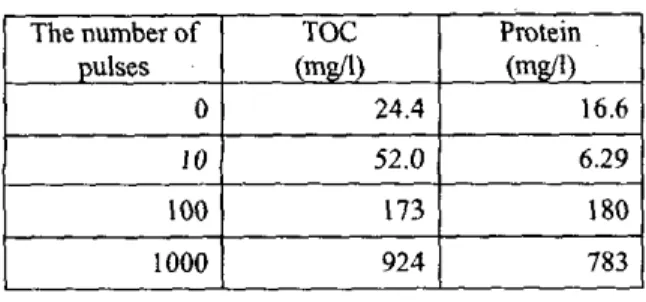
Here, the trial to treat the organic polymers is done. The organic polymer is changed to the lower molecular by the pulsed power produced streamer discharges. The lower molecular is able to be decomposed by the anaerobic treatment. Table I shows the amounts of the TOC (Total Organic Carbon) and Protein depending on the number of pulses, which are produced by the Marx generator.
The number of 0 10 IO0 1000 pulses
Table 1. Amounts of the TOC and Protein depending on the number of pulses.
TOC Protein
(mpil) (mgil)
24.4 16.6
52.0 6.29
173 180
924 783
The TOC means the amount of total organic carbon dissolved in sample. Since the organic polymer is not dissolved, the increase of TOC means the change from the organic polymer to the lower molecular. The protein in table shows the amount of protein in clear liquid after the centrifugal separation. The increase of protein means the destruction of cell wall.
IV. SUMMARY
The large volume streamer discharges in water were produced successfully by using pulsed power. The commercial applications, such as the cleaning of the lakes and marshes, the sewage treatment, the sterilization of bacteria, and the chemical decomposition, have been tried.
As examples of commercial applications, the cleaning of the lakes and marshes and the sewage treatment are described. The microcystis, which is a kind of algae, is killed successfully by streamer discharges. The organic polymer, which is not decomposed by anaerobic treatment, is changed to lower molecule, and then is
treated. 153
V. REFERENCES
[I] I.V. Lisitsyn, H. Nomiyama, S. Katsuki and H.
Akiyama, “Thermal processes in a streamer discharge in water”, IEEE Transactions on Dielectrics and Electrical Insulation, Vo1.6, No.3, pp.351-356, 1999.
121 I.V. Lisitsyn, H. Nomiyama, S . Katsuki and H.
Akiyama, “Streamer discharge reactor for water treatment by pulsed power”, Review of Scientific Instruments, Vo1.70, No.8, pp.3457-3462, 1999.
[3] H. Akiyama, “Streamer discharge in liquids and their applications”, E E E Transactions on Dielectrics and Electrical Insulation, Vo1.7, No.5, pp.646-653,2000.
Authorized licensed use limited to: Kumamoto University Trial User. Downloaded on August 6, 2009 at 05:26 from IEEE Xplore. Restrictions apply.