熊本大学学術リポジトリ
Water purification using pulsed streamer discharges in micro‑bubbled water
journal or
publication title
Digest of Technical Papers‑IEEE International Pulsed Power Conference
volume 2003
page range 1266‑1269
year 2003‑06
URL http://hdl.handle.net/2298/9712
WATER PURIFICATION USING PULSED STREAMER DISCHARGES IN MICRO-BUBBLED WATER
T. Namihira
ξ, D. Wang, T. Takashima, S. Katsuki and H. Akiyama Department of Electrical and Computer Engineering, Kumamoto University,
2-39-1 Kurokami, Kumamoto 860-8555, Japan
ξ email: [email protected]
Abstract
Industrial applications using pulsed power have been developed in many fields. One of them is the water purification using the pulsed streamer discharges. The pulsed streamer discharges in liquids generate intense electric fields at the tip of streamers, as well as high energy electrons, ozone, other chemically radical species, ultraviolet rays and shock waves. All of these may be utilized to decompose molecules and materials and to sterilize microorganism.
In this time, the large-volume streamer discharges in indigo solution with oxygen micro-bubbles were used to decolorization of indigo molecules. The Blumlein type pulse forming network (B-PFN) which has maximum output voltage of 150 kV and pulse duration in the range of 0.6 to 1.2 µs was used as a pulsed power source. The decolorization ratio of indigo solution at fixed pulse repetition rates is higher with oxygen micro-bubbles, and increased with increasing pulse width and increasing the temperature of solution.
I. INTRODUCTION
Several methods have been used to remove chemical molecules from polluted water. The phenomena of streamer discharges in liquids have been investigated for a long time [1-7]. Recently, the pulsed streamer discharges in liquids have been developed to remove dyes [8, 9], organic compounds [10-13], and bacteria [14-17].
The efficient removal of pollutants from wasted water is
of paramount importance world wide.
In this paper, the effects of the pulsed streamer discharges, in micro-bubbled water, on decomposed dyes were investigated. The pulse generator which produces a square voltage pulse in the range of 0.6 -1.2 µs with amplitude of 50 kV was used to generate non-thermal plasma in an indigo solution. The coaxial geometry was employed as the discharge reactor. The effect of bubbling gas, pulse width and solution temperature on dye removal are reported.
II. EXPERIMENTAL SET-UP
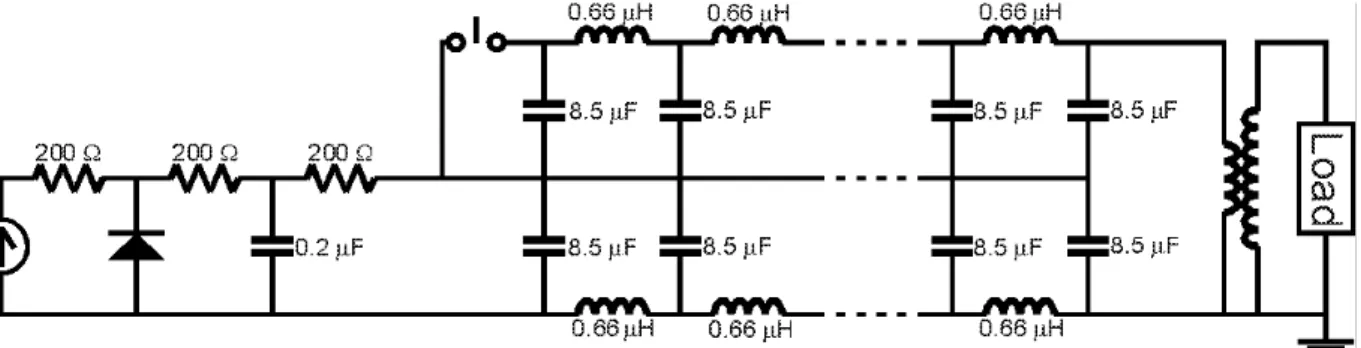
Fig. 1 shows the schematic diagram of a Blumlein type pulse forming network (B-PFN) used in the present work.
Each stage of the generator consists of 8.5 nF capacitor and 0.66 µH inductor. The impedance of each stage of the generator is 17.6 Ω. The number of stages defines the pulse width. In this work, the generator had a pulse width in the range of 0.6-1.2 µs. In order to generate the high voltage, a pulse transformer (2:10) is used in the end of pulse forming network. So, the total impedance of the generator is 440 Ω.
Fig. 2 shows the experimental apparatus for the decolorization of the indigo solution using pulsed streamer discharges. A coaxial cylindrical reactor having a central brass wire, 0.15 mm in diameter, placed concentrically in a stainless steel mesh cylinder, 100 mm in internal diameter, and a length of 200 mm, was employed. The reactor was completely immersed in the indigo solution. A positive voltage polarity was chosen
Figure 1. Schematic diagram of a Blumlein type pulse forming network.
for the central wire of the reactor, since this was more effective to generate non-thermal plasma in solution than the negative polarity [1]. The pulse repetition rate was fixed at 20 pulses per second (pps). The applied voltage from the B-PFN to the reactor was measured using a resistive voltage divider (ratio, 5
×
103), which was connected between the central wire and the ground. The current to the reactor was measured using a Rogowski coil (Pearson current monitor, Model 410, Pearson Electronics, USA), which was located on the return path to the ground. A digital oscilloscope with a maximum band width of 500 MHz and maximum sample rate of 2.0 G samples per second recorded the signals. The oscilloscope was located inside a shielded room (70 dB) to reduce transient interference. The initial concentration of indigo in the solution was 25 mg/L. The solution was circulated with the water pump (Model 20UPD04Z, Nikuni, Japan) during the indigo treatment. The gases were bubbled in the solution separately through the water pump. The typical diameter of a bubble was less than 100 µm. Fig. 3 shows the appearance of micro-bubbles in water. As a result of bubbling, the color of water changes from clear to white, or milky white (Fig. 3b).Figure 2. Experimental set-up.
(a)
(b)
Figure 3. Appearance of micro-bubble in water.
(a)without bubble, (b)with bubble
III. RESULTS AND DISSCUSSIONS
A. Effect of bubbling gas
Fig. 4 shows the experimental result for the removal of indigo using the pulsed streamer discharges in the solution. In order to investigate the effect of bubbling gas, oxygen, nitrogen, or argon was bubbled separately through the water pump. The conductivity, temperature, and pH of the solution were 1.07 mS/m, 295 K, and 6.1, respectively. The applied pulse voltages, having 50 kV peak and 1.2 µs width, to the reactor were kept constant for different bubbling gases.
As shown in Fig. 4, the decolorization ratio was much higher in the case of using oxygen bubbles than using nitrogen or argon bubbles. This means a large number of oxidants such as oxygen atoms and ozone were produced by applying discharges in the oxygen bubbles, therefore the indigo was decolorized by these oxidants. After experiment, the conductivity, temperature, and pH of the solution changed to 1.66 mS/m, 295 K, and 6.2, respectively.
0 20 40 60 80 100
0 10 20 30 40 50 60
O2 bubbles N2 bubbles Ar bubbles
Decolorization ratio, %
Time, min
Figure 4. Effect of bubbling gas on the indigo removal at 50 kV peak voltage and 1.2 µs pulse width.
Ground Electrode
Mesh
Ground Electrode
Mech
1267
B. Effect of pulse width
Fig. 5 shows typical waveforms of the applied voltage to and the discharge current in the coaxial reactor for varying pulse widths with oxygen bubbles in the indigo solution. The peaks of the applied voltages were kept to almost 50 kV for all pulse widths in the range of 0.6 to 1.2 µs.
Fig. 6 shows the dependence of the decolorization ratio after applying pulsed powers for different pulse widths on treatment time. It will be observed from Fig. 6 that the decolorization ratio increased with increasing treatment time. This is because the energy input into the indigo solution increased with increasing treatment time. At a constant treatment time, the decolorization ratio increased with increasing pulse width. This is because the volume of discharge plasma in the solution increased with increasing pulse width. In the case of the longer pulse width, the streamer discharges propagated longer distance from the central wire to outer cylinder of the reactor, since the velocity of the streamer discharges in water is constant during the voltage application [1].
-20 0 20 40 60
0 0.5 1 1.5 2 2.5 3 3.5 4
0.6 µs 1.0 µs 1.2 µs
Voltage, kV
Time, µs (a)
-20 -10 0 10 20 30 40 50
0 0.5 1 1.5 2 2.5 3 3.5 4
0.6 µs 1.0 µs 1.2 µs
Current, A
Time, µs (b)
Figure 5. Typical waveforms of the applied voltage to and the discharge current in the coaxial reactor for the different pulse widths.
0 20 40 60 80 100
0 10 20 30 40 50 60
0.6 µs 1.0 µs 1.2 µs
Decolorization ratio, %
Time, min
Figure 6. Dependence of the decolorization ratio after applying pulsed powers for different pulse widths on treatment time.
C. Effect of temperature of solution
Fig. 7 shows the dependence of the decolorization ratio after applying pulsed powers for different temperatures (295 K and 323 K) of indigo solution on treatment time.
The peaks of the applied pulse voltages, having 50 kV peak and 1.2 µs width, to the reactor were kept constant for both temperatures of indigo solution. Oxygen gas was bubbled in the indigo solution. The conductivity of the solution was 2.2 mS/m in case of 323 K of solution temperature.
In case of 323 K of solution temperature, the conductivity and pH of indigo solution changed to 6.0 mS/m and 3.84 after 40 minutes. The temperature of the indigo was kept 323 K during the application of pulsed power. As shown in Fig. 7, the decolorization ratio was higher in higher temperature of the solution. This is because the channels of the streamer discharges in higher conductivity water are thicker than that in lower conductivity water [1]. The conductivity of the solution gradually increased with decomposing indigo, since the indigo chemically changed to the aldehyde by the oxidants in the discharge plasma [11]. As the result of generating aldehyde (increasing conductivity), the applied voltage to the reactor decreased with increasing the discharge current. So the decolorization ratio gradually saturated with increasing treatment time due to increase the joule heating energy to solution.
IV. CONCULUSIONS
The large-volume streamer discharges generated by Blumlein type pulse forming network in indigo solution with micro-bubbles were used to decolorization of indigo molecules. The following conclusions have been deduced.
1) The decolorization ratio was much higher in case of using oxygen bubbles than using nitrogen and argon bubbles. Since a large number of oxidants were
produced by applying pulsed power in the oxygen bubbles, the indigo was decolorized by these oxidants.
2) In the oxygen bubbles, the decolorization ratio increased with increasing treatment time and increasing pulse width. This is because the energy input into the indigo solution increased with increasing treatment time, and the volume of discharge plasma in the solution increased with increasing pulse width. Moreover, in case of longer pulse width, the streamer discharges propagated longer distance from the central wire to outer cylinder of the reactor.
3) In the oxygen bubbles, the decolorization ratio was higher in higher temperature of the solution, since the conductivity of the solution gradually increased with decomposing indigo. This is because the channels of the streamer discharges in higher conductivity water are thicker than that in lower conductivity water.
0 20 40 60 80 100
0 10 20 30 40 50 60
295 K 323 K
Decolorization ratio, %
Time, min
Figure 7. Dependence of the decolorization ratio after applying pulsed powers for different temperatures of indigo solution on time.
REFERENCES
[1] S. Katsuki, H. Akiyam, A.A. Ghazala and K.H.
Shoenbach, “Paralell streamer discharges between wire and plane electrodes in water, IEEE Transactions on Dielectrics and Electrical Insulation, Vol.9, No. 4, pp.498-506, 2002.
[2] A.Beroual, M. Zahn, A.Badent, K. Kist, A.J. Schwabe, H. Yamashita, K. Yamazawa, M. Danikas, W.G.
Chadband and T. Torshin, “Propagation and structure of streamers in liquid dielectrics”, IEEE Electrical Insulation Magazine, Vol.14, No.2, pp.6-17, 1998.
[3] I.V. Lisitsyn, H. Nomiyama, S. Katsuki and H.
Akiyama, “Streamer discharge reactor for water treatment by pulsed power”, Review of Scientific Instruments, Vol.70, No.8, pp.3457-3462, 1999.
[4] J.C. Devis, S.J. Rzad and R.J. Schwabe,
“Prebreakdown phenomena in sphere-sphere electrode
configurations in dielectric liquids”, Applied Physics Letters, Vol.31, No.5, pp.313-314, 1977.
[5] I.V. Lisitsyn, H. Nomiyama, S.Katsuki and H.
Akiyama, “Thermal processes in streamer discharge in water”, IEEE Transactions on Dielectrics and Electrical Insulation, Vol.6, No.3, pp.351-356, 1999.
[6] H. Akiyama, “Streamer discharges in liquids and their applicatons”, IEEE Transactions on Dielectrics and Electrical Insulation, Vol.7, No.5, pp.646-653, 2000.
[7] A.T. Sugiarto, M. Sato and J.D. Skalny, “Transient regime of pulsed breakdown in low-conductive water solution”, Journal of Physics D: Applied Physics, Vol.34, pp.3400-3406, 2001.
[8] A.T. Sugiarto, T. Ohshima and M. Sato, “Advanced oxidation processes using pulsed streamer corona discharge in water”, Thin Solid Films, Vol.407, pp.174- 178, 2002.
[9] A.T. Sugiarto, S. Ito, T. Ohshima, M. Sato, J.D.
Skalny, “Oxidative decoloration of dyes by pulsed discharge plasma in water”, Journal of Electrostatics, Vol.58, pp.135-145, 2003.
[10] M. Sato, B. Sun, T.Ohshima and Y. Sagi,
“Characteristics of active species and removal of organic compound by a pulsed corona discharge in water, Journal of Advaoced Oxidation Technology, Vol.4, pp.339-342, 1999.
[11] B. Sun, M. Sato and J.S. Clements, Use of a pulsed high-voltage discharge for removal of organic compounds in aqueous solution”, Journal of Physics D: Applied Physics. Vol.32, pp.1908-1915, 1999.
[12] H. Hayashi, W.F.L.M. Hoeben, G. Dooms, E.M.
Veldhuizen, W.R. Rutgers and G.M.W. Kroesen, “LIF diagnostic for pulsed-corona-induced degradation of phenol in aqueous solution”, Journal of Physics D:
Applied Physics, Vol.33, pp.1484-1486, 2000.
[13]A.T. Sugiarto and M. Sato, “Pulsed plasma processing of organic compounds in aqueous solution”, Thin Solid Films, Vol.386, No.2, pp.295-299, 2001.
[14 M. Sato, T. Ohgiyama, J.S. Clements, “Formation of chemical species and their effects on microorganisms using a pulsed high-voltage discharge in water”, Vol.32, No.1, pp.106-112, 1996.
[15] E.J.M. van Heesch, A.J.M. Pemen, P.A.H.J.
Huijbrechts, P.C.T. van der laan, K.J. Ptasinski, G.J.
Zanstra and P. de jong, “A fast pulsed power source applied to treatment of conducting liquids and air”, IEEE Transactions on Plasma Science, Vol.28, No.1, pp.137- 143, 2000.
[16] E.M. Efremov, B.Y. Adamiak, V.I. Blochin, S.J.
Dadashev, K.I. Dmitriev, V.N. Semjonov, V.F. Levashov and V.F. Jusbashev, “Experimental investigation of the action of pulsed electrical discharges in liquids on biological objects”, IEEE Transactions on Plasma Science, Vol.28, No.1, pp.224-229, 2000.
[17]A.A. Ghazala, S. Katsuki, H.H. Schoenbach, F.C.
Dobbs and K.R. Moreira, “Bacterial decontamination of water by means of pulsed-corona discharges”, IEEE Transactions on Plasma Science, Vol.30, No.4, pp.1449- 1453, 2002.
1269