熊本大学学術リポジトリ
Observation of pulsed streamer discharges produced by nano‑second pulsed power in atmospheric air
journal or
publication title
Digest of Technical Papers‑IEEE International Pulsed Power Conference
volume 2005
page range 1001‑1004
year 2005‑06
URL http://hdl.handle.net/2298/9717
doi: 10.1109/PPC.2005.300470
OBSERVATION OF PULSED STREAMER DISCHARGES PRODUCED BY NANO-SECOND PULSED POWER
IN ATMOSPHERIC AIR
D. Wang, S. Yoshida, M. Jikuya, T. Namihira
ξ, S. Katsuki, H. Akiyama
Department of Electrical and Computer Engineering, Kumamoto University 2-39-1 Kurokami, Kumamoto 860-8555, JAPAN
ξ
email: [email protected]
Abstract
Pulsed power technology has been used in many applications such as control of NO
Xand SO
Xfrom exhaust gases, treatment of dioxins, removal of volatile organic compounds, and generation of ozone. Since the pulse width of the applied voltage has a strong influence on the energy efficiency of the removal of pollutants, the development of a short pulse generator is of paramount importance for practical applications. The observation of discharges created by short duration pulsed voltage is an essential aspect for understanding the plasma physics of this growing field.
In the present work, a nano-second pulse generator (NS-PG) that has a pulse duration of less than 10 ns is presented. The NS-PG consists of a high-pressure spark gap switch as a low inductance self-closing switch and a triaxial Blumlein line as a pulse-forming line. The Blumlein line consists of an outer conductor, a middle conductor, and an inner conductor, and is filled up with transformer oil as an insulation medium. The outer conductor is grounded, and the nano-second pulse is generated between the inner and outer conductors. The characteristics of the NS-PG are also reported. The propagation images of the pulsed streamer discharge in a coaxial reactor were taken by a high speed streak camera.
The propagation of the streamers was observed for both positive and negative polarities of the applied voltages to the reactor. From the results, for both polarities, the primary streamer propagated from the inner wire electrode to the outer cylinder electrode, and the maximum propagation velocity of the streamer was in the range 6.0 - 8.0 mm/ns over the voltage 67 - 93 kV of the absolute value of peak applied voltage. The results also showed that the propagation velocity of the streamers was strongly influenced by the voltage rise time and to a lesser extent by the voltage polarity.
I. INTRODUCTION
Pulsed streamer discharges in atmospheric pressure gases have been studied for many years since it is one of
the promising technologies for the removal of the hazardous environmental pollutants [1]. Since the pulse width of the applied voltage has a strong influence on the energy efficiency of the removal of pollutants, the development of a nano-second pulse generator is paramount important for practical applications [2-4].
Besides, the investigation of streamer development is beneficial for the understanding of the mechanisms of the pollution control.
In the present work, a pulse generator that has a pulse duration of less than 10 ns is presented. The pulsed streamer discharges by the developed generator were investigated using a streak camera. The propagation velocity for both positive and negative polarities is reported.
II. EXPERIMENTAL APPARATUS AND PROCEDURE
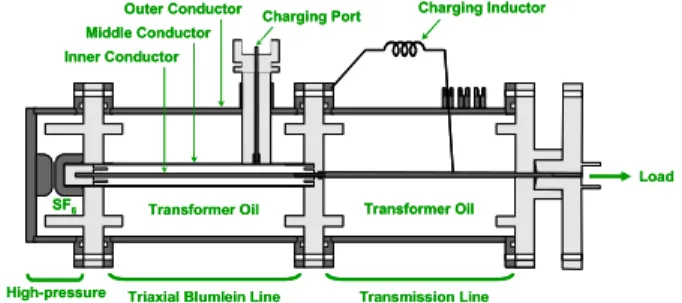
Fig. 1 shows the schematic diagram of the nano-second pulse generator (NS-PG). The NS-PG consists of a high- pressure spark gap switch (SGS) as a low inductance self- closing switch, a triaxial Blumlein line as pulse-forming line, and a voltage transmission line from the Blumlein line to load. The SGS was filled with SF
6gas, and the output voltage of the NS-PG is regulated by varying the pressure of the SF
6. The gap distance of the SGS was fixed at 1 mm. The triaxial Blumlein line consists of an inner rod conductor, a middle cylinder conductor, and an
Charging Port Inner Conductor
Middle Conductor Outer Conductor
High-pressure Spark Gap Switch
Charging Inductor
Triaxial Blumlein Line Transmission Line
Load SF6 Transformer Oil Transformer Oil
Charging Port Inner Conductor
Middle Conductor Outer Conductor
High-pressure Spark Gap Switch
Charging Inductor
Triaxial Blumlein Line Transmission Line
Load SF6 Transformer Oil Transformer Oil
Figure 1. Schematic diagram of the nano-second pulse
generator (NS-PG).
outer cylinder conductor. All the conductors were made of brass. The outer conductor was grounded. The inner, the middle, and the outer conductors of the Blumlein line were placed concentrically. The inner conductor and the outer conductor are connected through an charging inductor. The Blumlein line and the transmission line are filled with transformer oil as insulation and dielectric medium. The middle conductor of the Blumlein line was charged by a charging circuit which consists of a dc source, a charging resistor, a capacitor, a thyratron switch (CX1685, E2V Technologies, Ltd., UK), and a pulse transformer through the charging port. A capacitive voltage divider (1:6700) was mounted on the transmission line to measure the output voltage of the NS-PG. The output voltage polarity of the NS-PG was controlled by the polarity of the charging voltage. The calculated inductance and capacitance of the triaxial Blumlein line were 322 nH/m and 76 pF/m, respectively, which give a characteristic impedance of 130 Ω. The length of the Blumlein line and the transmission line were 500 mm and 200 mm, respectively. The calculated pulse duration of the triaxial Blumlein line was 5 ns.
Fig. 2 shows a schematic diagram for the observation of the streamer discharge images. A concentric coaxial cylindrical reactor was employed as a discharge electrode.
A rod made of tungsten, 0.5 mm in diameter and 50 mm in length, was placed concentrically in a copper cylinder.
The diameter of the outer electrode was 76 mm. A short length of the electrodes was necessary to render clear images of the streamer discharge. The electrode was placed in the open air. The applied voltage to the electrode was varied by regulating the gas pressure of SF
6in the NS-PG from 0.3 to 0.5 MPa. Either positive or negative voltage polarity was applied to the rod electrode and measured by the capacitive voltage divider. The discharge current through the electrode was measured using a current monitor (Pearson current monitor, Model 6585, Pearson Electronics Inc., USA), which was located after the transmission line. A digital oscilloscope (54855A Infiniium, Agelint Technologies, USA) with a maximum bandwidth of 6 GHz and a maximum sample rate of 20 G samples/sec recorded the voltage and current signals. A high dynamic range streak camera (C7700, Hamamatsu Photonics, Japan) with a sensitive MCP (Micro Channel Plate, maximum gain 10,000:1) was used
Nano-Second Pulse Generator
Oscilloscope
Personal Computer
Camera Trigger
Voltage Signal Current Signal
ThyratronTrigger
Thyratron Trigger Monitor Delay Generator
Digital Image Discharge
Electrode
Streak Camera
Inner Rod Outer cylinder
50 µm (Camera slit width)
Reference Image Nano-Second
Pulse Generator
Oscilloscope
Personal Computer
Camera Trigger
Voltage Signal Current Signal
ThyratronTrigger
Thyratron Trigger Monitor Delay Generator
Digital Image Discharge
Electrode
Streak Camera Nano-Second
Pulse Generator
Oscilloscope
Personal Computer
Camera Trigger
Voltage Signal Current Signal
ThyratronTrigger
Thyratron Trigger Monitor Delay Generator
Digital Image Discharge
Electrode
Streak Camera
Inner Rod Outer cylinder
50 µm (Camera slit width)
Reference Image
Figure 2. Schematic diagram for the observation of the streamer discharge images.
to record the images of streamer discharges. The sweep time was fixed at 10 ns for one flame. The slit of the camera was adjusted to focus the central part of the discharge electrode, where the rod electrode was fixed (Fig.2, reference image). The width of the camera slit was fixed at 50 µm. All the delay time of signals were controlled by a digital delay generator (DG535, Stanford Research Systems, Inc., USA).
III. RESULTS AND DISCUSSIONS
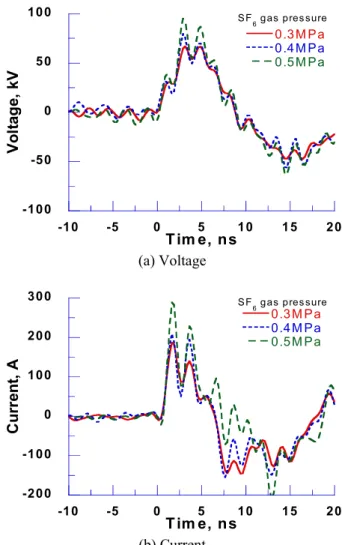
Fig.3(a), (b) and Fig.4(a), (b) show typical applied voltage to and the discharge current in the electrode gap for different SF
6gas pressures in the spark gap switch for both voltage polarities of positive and negative, respectively. It is observed from Fig.3 that the peak applied voltages for 0.3, 0.4, 0.5 MPa are 67, 77, 93 kV, respectively. Likewise, the peak applied voltages for 0.3,
-100 -50 0 50 100
-10 -5 0 5 10 15 20
0.3M Pa 0.4M Pa 0.5M Pa
V o lt ag e, kV
T im e, ns
SF6 gas pres sure
(a) Voltage
-200 -100 0 100 200 300
-10 -5 0 5 10 15 20
0.3M Pa 0.4M Pa 0.5M Pa
Cu rr en t, A
T im e, ns
SF6 gas pres sure
(b) Current
Figure 3. Applied voltage to and the discharge current in the electrode gap for different SF
6gas pressures in the spark gap switch. (Positive polarity)
1002
-100 -50 0 50 100
-10 -5 0 5 10 15 20
0.3M P a 0.4M P a 0.5M P a
V o lt ag e, kV
T im e, ns
SF6 gas pressure
(a) Voltage
-300 -200 -100 0 100 200
-10 -5 0 5 10 15 20
0.3M Pa 0.4M Pa 0.5M Pa
Cu rr ent , A
T im e, ns
SF6 gas pressure
(b) Current
Figure 4. Applied voltage to and the discharge current in the electrode gap for different SF
6gas pressures in the spark gap switch. (Negative polarity)
0.4, 0.5 MPa of SF
6pressure in the SGS are -67, -72, -80 kV, respectively in Fig. 4. The pulse width is approximately 7 ns for both polarities.
Fig.5(a), (b) show the streak images of streamer discharges taken by streak camera for different voltage polarities. In Fig.5, the vertical and horizontal directions display the position of light emission in reactor and the sweep time of the camera, respectively. In the images, the bottom line corresponds to the surface of the inner rod electrode, the position of the light emission corresponds to the position of tip of streamer since high electric field was generated at the tip of streamer [6]. It can be observed that the streamer discharges propagated from the central rod to the outer cylinder electrode.
The propagation velocity of the streamer, v
streamer, is given by
t v
streamerL
∆
= ∆ (1)
where ∆L, ∆t are the distance between rod surface and the tip of streamer, and the time progress for its propagation in Fig.5, respectively.
2 ns 10 mm
2 ns 10 mm
2 ns 10 mm
0.3MPa (67kV)
0.4MPa (77kV)
0.5MPa (93kV) 2 ns 10 mm
2 ns 10 mm
2 ns 10 mm
0.3MPa (67kV)
0.4MPa (77kV)
0.5MPa (93kV)
(a) Positive polarity
2 ns 10 mm
2 ns 10 mm
2 ns 10 mm
0.5MPa (-80kV) 0.4MPa (-72kV) 0.3MPa (-67kV)
2 ns 10 mm
2 ns 10 mm
2 ns 10 mm
0.5MPa (-80kV) 0.4MPa (-72kV) 0.3MPa (-67kV)
(b) Negative polarity
Figure 5. Streak images of streamer discharges for
different voltage polarities.
Table 1. Averaged velocity of streamer heads.
SF6 gas pressure (=Charging voltage) Polarity
0.3 MPa 0.4 MPa 0.5 MPa Positive
(Vapplied-peak)
6.1 mm/ns
(67 kV) 6.5 mm/ns
(77 kV) 7.0 mm/ns (93 kV) Negative
(Vapplied-peak)