Abstract
Care and Welfare association of Japan (JaCCW) sent volunteers to support local care for the kobe earthquake (1995), the mid-niigata earthquake (2004), off-mid-niigata earthquake (2007). in 2008, to provide appropriate care and welfare assistance, will utilize the knowledge gained from these activities, “manual disaster volunteers to support the care and welfare” has begun to create. in this study, compiled by the daily activities of volunteer care support according to interviews and questionnaires in the process of manual. The challenges of the future, even when no disaster is state certified care insurance and caring, will need assistance in certain circumstances. need to be raised to help along this assessment when appropriate. nursing support of the assessment approach is advocated by the Association of Certified Care Workers
“self-reliance support assessment and care planning as viewed from the seven aspects of daily life” using the Care workers support group of volunteers to support the assessment of disaster caring was created by considering the draft (another paper). assessment items and the basic parts of life, thought to be effective in promoting the sharing of information about caring in collaboration with other jobs.
Introduction - background to the research With the July 13 floods and the Mid-Niigata earthquake in 2004, and the off-mid-niigata earthquake in 2007, niigata prefecture has witnessed a string of natural disasters. The Niigata Prefecture Association of Certified Care Workers declares its support for members' volunteer activities in its organizational rules, and the author of this paper was involved in volunteer activities as an association member in these disaster-affected areas. These activities dealt with a wide range of needs, and included in-home environmental maintenance for the elderly, care of the vulnerable in evacuation centers, recreation and supervision aimed towards care prevention, and provision of empathic listening.
Also, the Japan Association of Certified Care Workers (JaCCW) dispatched care work volunteers to areas affected by the kobe earthquake, the mid-niigata earthquake, and the off-mid-niigata earthquake. activities were carried out in cooperation with local care worker associations, and members from each area of the country participated. Research assistance by caregivers who needed disaster relief, Cinii disaster care education in the proposed article search papers (kato, 2008) and was only confirmed, the situation finally being undertaken as a research field
The Reality and Challenges Facing Care Work Volunteers during support of the Vulnerable in Times of disaster
- From an investigation into care work volunteers belonging to the Japan Association of Certified Care Workers -
Fumi okada
key words : disaster, care work volunteers, assessment, support for self reliance,
niigata university of health and Welfare
Research objectives
This research aims to identify clarify the reality of the lives of the cover needed to clarify the issues in the future to do by examining the experiences of certified care workers who have carried out activities as care work volunteers in times of disaster
Research method
Research method was group interview and questionnaire.
Group Interview
group interviews to understand the contents of the interaction of free speech can be found along the desired task.
Questionnaire
Conducted a questionnaire survey was based on the requirements discussed in the group interview.
Outline of group interview Interviewees
Four members of the JaCCW disaster policy Committee were interviewed. The committee members all had proven experience of participating in JaCCW disaster time activities, and have also provided suggestions and furthered
research regarding certified care workers’
volunteer care work in times of disaster after the conclusion of their activities (Table 1).
Investigation Method
in total, three investigations were carried out (Table 2). in the first investigation, a brainstorming session was held after an open discussion among participants. The session covered various aspects of disaster volunteer care support such as location, timing, content, observation, activities of other related professionals and future plans. in the brainstorming session, a stack of cards was prepared in order to record all the key words exchanged during the discussion. The usage of cards was intended to prevent the bias generated by the presentation of a few strong opinions. also the author had raised questions to the facts and opinions for further deepening the contents of
“5W1h (when, where, what, who, how, why)”
in the second investigation, information elicited via brainstorming in the previous session was sorted, and furthermore, chronological details of activities were elicited so the changes that occur with time in the circumstances of disaster afflicted areas and in the lifestyles of the vulnerable, along with changes in details of activities were confirmed.
Table 1 Group Interviewees
association (aCCW) age sex
The hyogo pref., aCCW 50s F
The Fukuoka pref., aCCW 60s F
The osaka aCCW 40s F
The Tokyo aCCW 40s F
Table 2 Schedule of group interviews.
session date (2008) Time place
1 september 9 1:00 pm shinbashi, Tokyo
2 september 23 10:00 am Toranomon, Tokyo
3 october 19 3:00 pm niigata
in the third investigation, interviews based on previous interviews focused on what people had noticed and what kind of support they had been able to provide due to the fact that they were certified care workers.
The results were recorded on tape before being sorted.
Results and discussion of group interviews necessary conditions of life of disaster relief activities and is summarized in the following group interview.
Volunteer activities in Mid-Niigata earthquake.
participated in three group interview, the activities in this earthquake, engaged in promoting the use of equipment for the prevention and care management. equipment is to prevent lower limb muscle weakness “kenpo- kun” device that was developed by public Works.
The equipment was used in kashiwazaki city (genki-kan) and kariha village (kariha community center). niigata pref. was to focus on economy syndrome by earthquake, set up
“kenpo-kun” and ask to maintain niigata aCCW. The primary role of volunteers was also support for caring and welfare assistance and shelter assistance in bathing in bathing facilities established by the sdF. Then, not only visual care, keep communicate with elderly people at the shelter, to find disease and dementia, was effective in preventing the progression to provide information to other professions. also headquarters of health and welfare in kashiwazaki was established by niigata pref., was also engaged needs assessment. For the activity support system for volunteers, reconsider as the Committee care workers. Common opinion of participants, in advance that the contents and status of local volunteer work was the need to hold meetings to report activities. living conditions in shelters are compiled based on the assessment items JaCCWa of the assessment
system is recognized as one of the assessment methods used by the care manager, was adopted by practitioners in care manager training, the state of lives of caring “nuke more ochi, (no missing, no leak, no lose)” has been recognized as a way to know without assessment.
The status of victims (especially the vulnerable) in evacuation centers
lifestyle situations of the vulnerable in evacuation centers are varied. This situation was elicited from interviewees and as a tool to arrange the information, the “self-reliance support assessment and care planning as viewed from the seven aspects of daily life” advocated by JaCCW was applied, and lifestyles in times of disaster were processed as follows.
Clothing
With regard to the clothing aspect of life in evacuations centers, the inability to change clothes appropriately was observed. Communal washing machines and drying areas were available, along with changing rooms provided with privacy in mind. however, amongst the elderly living in evacuation centers those with urine stained clothing who had not changed their urine absorption pads were frequently seen.
also, the clothing situation of a vulnerable person is affected by their relationship with their family. This was magnified especially in situations where individuals experienced a decrease in self-reliance from becoming unable to take care of themselves, or being unable to decide which clothes were best to wear due to the onset of dementia, and other such situations.
Food
meals in evacuation centers revolve around self-defense force provisions prepared with a calorific value of 1,300kcal. There were also evacuation centers where rice balls and pastries were permanently available and laid out on tables
so they could be eaten regularly. drinking water was supplied in peT bottles and hot water in kettles. however, preparations for baby food or care food were not made. single use utensils were disposed of as garbage along with leftover food.
hygiene considerations were also necessary.
Shelter
evacuation centers are established at regional schools and community centers, buildings which were not originally intended to be used as dwellings, and so suffer from a variety of limitations and obstacles. For example, naked flames could not be used for cooking despite the presence of portable gas stoves, toilets were temporary and set up in locations separated from the evacuation center, and due to many families living in a large area, and privacy could not be protected.
mold appeared beneath the bedding of people who left it spread out for the duration of the day.
Physical Health
some people experienced a deterioration of health due to environmental changes. people who had obtained the Certification of Needed Long- term Care under the long-term Care insurance system and usually lived at home were going about their lives in social welfare evacuation centers. However there were also non-certified people in need of care living at home, and in these cases dispatched nurses provided consultations. The role of certified care workers was to provide a link to medical specialists when a bodily irregularity was found on a person during the course of everyday care work.
many elderly people harbored concerns regarding toilet related problems such as constipation caused by the stress of group life, food provisions with few vegetables, and a lack of exercise.
Mental Health
The mental state of a victim changes over the course of time, beginning just after the disaster.
immediately after the disaster, a state of confusion exists where exactly what has happened is not understood and people are left fretting as they are unable to confirm the status of people close to them. There were also cases where victims got together to discuss the shock of the earthquake in an attempt to recover their composure. Roughly one week after the incident, people whose health had deteriorated due to living day and night in an evacuation center were seen, and after two weeks, stress levels approached a peak. after that, evacuees demanded privacy and began to erect cardboard box enclosures, and differences between people began to be seen at around this time.
Family Relationships
While there are instances where hidden family problems are brought to the fore by the disaster, there are also cases where family bonds become stronger. also, it is necessary for those who must suddenly move in with their son or daughter as a result of the catastrophe to change their everyday lifestyle.
Social Relationships
Vulnerable people in evacuation centers suffer an extreme decrease in the number of chances to go outside after a disaster. This is because their families upon whom they relied to take them shopping or to go to see doctors are busy handling problems caused by the disaster, which takes priority over the care of family members. also, people who could barely manage to go out by themselves up to that point experience changes in environment which leads to them being unable to venture out at all.
above, the reality of life, etc. needed disaster relief shelters who studied at the workshop, Association of Certified Care Workers Scheme
assessment items “seven life areas (clothing, food and living healthy body healthy mind family relationships, social relationships) to organize.
Self-care assistance needed
opinion was made at the group interview, is a well-intentioned volunteers, disease prevention and inactive life care [yayoi okawa, 2008]
because there is no learning experience, helping with relief that you can live an independent, independence from the efficiency or The situation is that the holdup was.
To properly support the needs assessment table in a unified opinion, advocated by JACCW “self- reliance support assessment and care planning as viewed from the seven aspects of daily life” a disaster in order to make the participation of the article created by the study (attachment 1).
Outline of questionnaire Recipients
Questionnaires were sent to 82 association members who participated as volunteers in JaCCW disaster time activities. 50 responses were obtained.
Investigation method
at the interview, all the effort were paid to clarify the lives of the actual situation in the disaster area, the changes in needs of victims as well as those in the activities of volunteers involved over time.
The comments and opinions in the interview could be categorized into two domains. in the domain of the volunteers, they included awareness, the environment, preparation, practice activities, the level of support from the professional organizations. With respect to the life of the victims, they were concentrated in three areas, 1) basic material necessities, 2) physical and mental health and 3) the relationship between family and society. most of them agreed with the list, “assessment of the seven areas daily
life”, published by the JaCCW.
a certain numbers of opinions have been cited repeatedly in the process of aggregation. in addition, there were a couple of opinions apparently reflected the behaviors of the professional care workers. These opinions were summarized and adopted as the items in the questionnaires. The questionnaires were sent by mail during a period from december 20, 2008 to January 20,2009.
Questionnaire results and discussion Analysis of respondents
78% of respondents were female, and 22%
male. The most common age group was 50-59, which constituted 40% of respondents (Figure 1).
From these results, many women age 41 or older, mostly male below the age of 40. in addition, the protrusion 50 and women aged participants, experience a rich life experience and care, parenting and women freed from, read and experience a sense of contributing to society. if the organization is required to send in consideration of age and gender.
out of all the volunteer participants, there was an uneven distribution of periods in which people had secured the certified care worker
40
30
20
10
0 <=20 21-30 31-40 41-50 Age
51-60 61+
Figure 1. Age and sex
qualification, and no clear tendency emerged.
The 50 respondents participated as volunteers from ten prefectures. participants from niigata prefecture were the most common at 38 (76%), Toyama, yamagata, gunma, nagano, and Tochigi, prefectures which are geographically close to niigata, all had one participant, as did iwate and Tokyo. ishikawa prefecture was represented by three participants. geographically the furthest prefecture from niigata was Fukuoka, with one participant.
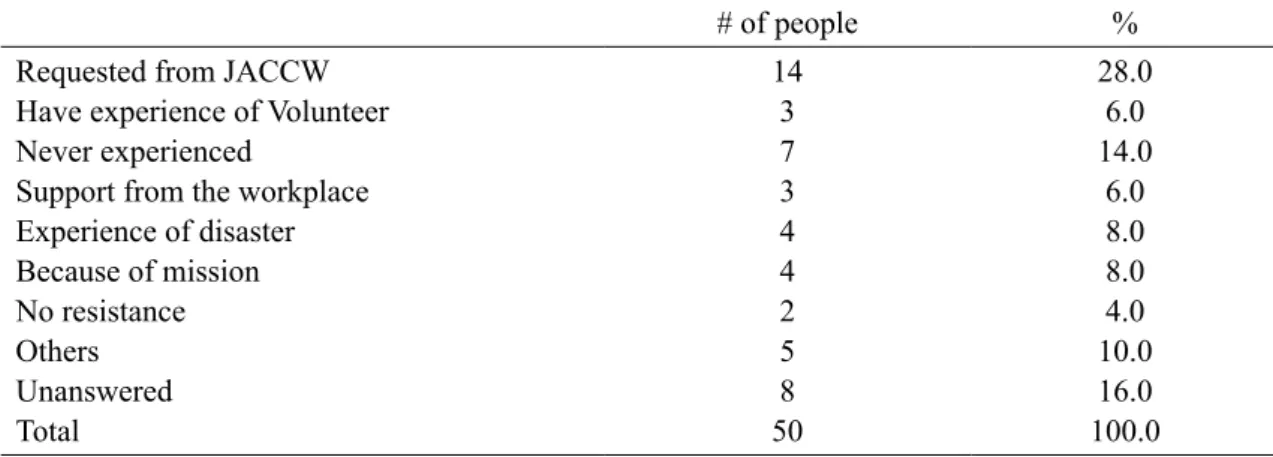
Reasons for participation/Support by workplace Reasons to join the “requested from JaCCW”
with 28%, indicating a higher rate compared to other reasons. presence of groups, maturity embodies the idea of voluntary action can be
induced (Table 1). in addition, participants who had experienced because of that disaster were four respondents.
off-mid niigata earthquake occurred three years after mid-niigata earthquake. The experience of mid-niigata earthquake, awareness of volunteer activities is estimated to be growing, but support from the workplace, “no” respondents who are 43 persons (86%), and the relationship between the corporation and a member of, viewpoints were observed (Figure 2).
Activities as a care work volunteer.
on the activities of volunteers, 44% of people said that the damage was much serious than they
Table 3 Reasons for participation
# of people %
Requested from JaCCW 14 28.0
have experience of Volunteer 3 6.0
never experienced 7 14.0
support from the workplace 3 6.0
experience of disaster 4 8.0
because of mission 4 8.0
no resistance 2 4.0
others 5 10.0
unanswered 8 16.0
Total 50 100.0
Communication from JACCW Wanted to gain experience Felt it was a certificd care worker’s duty Had own exprerience of being a victim Support from workplace Previously experienced volunteer work Had no problems going to afflicted area
Figure 2. Support of corporate and workplace relations belong
imagined (Figure 3). The earthquakes, the situation of the victims in the same region are often different. possible differences between the recognition of a care worker who went to the disaster area.
The main places volunteers worked and activities they carried out were: care work support at general evacuation centers (37%), care work support at social welfare evacuation centers (23%), in house status checks of victims (21%), and care work support in institutions and offices (10%) (figure 4).
The most common response in terms of specific activity details was “disuse syndrome prevention through promoting the use of kenpo-kun (a lower limb exercise device) and massage chairs or
providing guidance and observation for people using these things” (24 respondents). The second most common response was assisted bathing (20 people noting changing clothes, 19 noting guidance, and 16 noting direct assistance). With assisted bathing, support is usually provided for the entire act of bathing from start to finish in an unbroken fashion. however, it was revealed in the interview that there were also cases where it was broken down into steps, so the related question was also broken down as such. The next most common items were “identification of victims needs through communication” (15 people), and “needs evaluation for in-home evacuees” (13 people).
Living circumstances of victims (especially the vulnerable) in evacuation centers
Less serious imaginedthan
16%
Others 4%
Much serious damage than imagined
44%
Same as imagined
36%
Figure 3. Status of disaster area
Others 9%
Care and welfare support in
general shelter 37%
Care and welfare support in
welfare shelter 23%
Care and welfare support in institutions 10%
Confirm the safety of victims of the
home21%
Figure 4. Place of main activities
Questions were set using the “assessment for seven aspects of daily life” classification method applied in the interview. information that came to light in the interviews was used as a basis to create questions of which respondents could check as many as they felt were applicable. There was also space provided for respondents to make free comments when they felt there were no applicable items for their opinions.
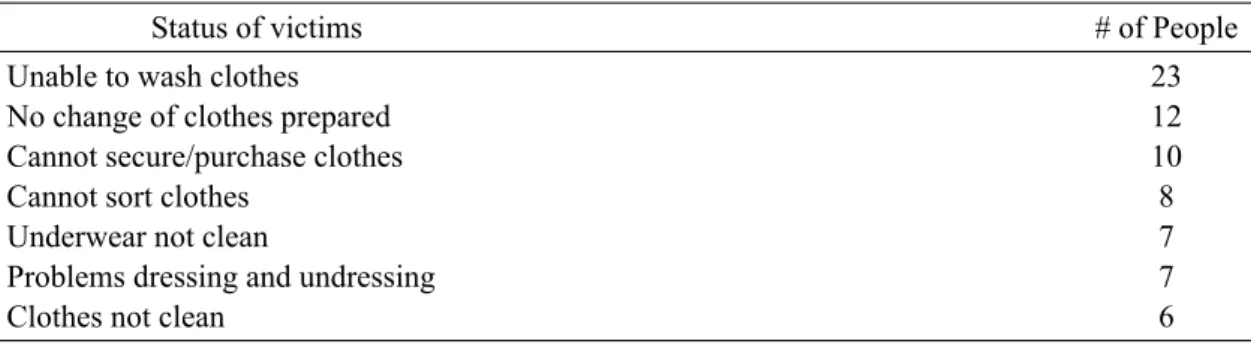
Clothing
There were evacuation centers that provided washing machines and drying areas, but it can be thought that amongst the victims there were those without time to wash clothing in the aftermath of the disaster, and those who were hesitant to use facilities such as washing machines as they were provided for communal use.
Food
For elderly people who need care, meals in
evacuation centers are very oily with lots of calories. in addition to this, improvisation was necessary to handle situations where people with oral or swallowing problems required specialized meals. also, as stressed in the interview there was a need to provide food related hygiene education not only to involved volunteers but also to the victims.
Shelter
due to its occurrence in the middle of summer, the mid-niigata earthquake was a battle against heat. The temperature and humidity level were high, so cooling measures such as ice pillars were improvised. however, the inability to maintain privacy was considered to be more problematic during life in evacuation centers.
Physical health
Difficulty in accepting the reality of the sustained damage, the constrained life in
disuse syndrome prevention through promoting the use of Kenpo kun (a lower…
assisted bathing identification of victims needs through
communication needs evaluation for in home evacuees
Figure 5. Specific activities-Multiple answers
Table 4 Clothing
status of victims # of people
unable to wash clothes 23
no change of clothes prepared 12
Cannot secure/purchase clothes 10
Cannot sort clothes 8
underwear not clean 7
problems dressing and undressing 7
Clothes not clean 6
evacuation centers that follows, and the stress caused by suddenly living in a group can all affect health negatively. also, meals with few vegetables affect toilet routines.
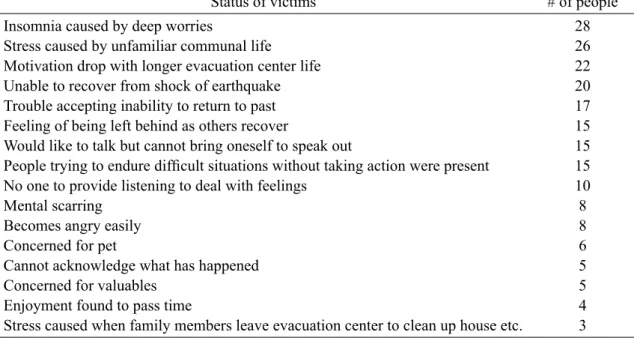
Mental health
The interview saw a large amount of time spent on discussing mental support, and in the questionnaire also, the section related to the mental state of victims received “applicable”
Table 5 Food
status of victims # of people
balanced meals unavailable 19
unable to handle special dietary requirements (salt levels, calories etc) 17
unable to buy/supply food 12
Unable to drink sufficient water 9
unable to handle meals (size, form) 9
inappropriate storage of food 7
no consideration for letting victims lay table/clean up themselves 5
not enough consideration for food hygiene 4
unable to eat 2-3 meals per day 2
unable to eat properly 1
Table 6 Shelter
status of victims # of people
unable to maintain privacy 32
Could not secure enough bedding to maintain health 14
no personal space for victim established 13
problems with temperature and humidity 9
problems with mobility and ambulation 8
unclean, unhygienic living environment 6
hindrances such as steps present 5
unable to carry out every day chores 4
night time too bright, unable to sleep 2
Table 7 Physical health
status of victims # of people
number of chances to move decreased 26
deterioration of physical condition 20
nervousness due to inability to see regular doctor 17
Insufficient bathing 17
Toilet related problems (constipation etc.) 12
Concerns about an existing illness 11
in pain 10
problems with medication 5
Carer in poor physical condition 4
responses to most of the items from the majority of respondents.
Family relationships
in cases where families live separately, and also in cases when they lived together, the support situation for the vulnerable in evacuation centers differed depending on family circumstances.
Respondents added that it became common for people to stop care for family members due to the
disaster, but 16 respondents also noted that family bonds became stronger after the disaster.
Social relationships
in the social relationships section, the “unable to receive regular care service” was checked by the majority of volunteers, and in terms of evacuation center life, items such as “isolated”
and “cannot grasp evacuation center rules (meal times etc.)” were also selected.
Table 8 Mental health
status of victims # of people
insomnia caused by deep worries 28
stress caused by unfamiliar communal life 26
motivation drop with longer evacuation center life 22
unable to recover from shock of earthquake 20
Trouble accepting inability to return to past 17
Feeling of being left behind as others recover 15
Would like to talk but cannot bring oneself to speak out 15
People trying to endure difficult situations without taking action were present 15
no one to provide listening to deal with feelings 10
mental scarring 8
becomes angry easily 8
Concerned for pet 6
Cannot acknowledge what has happened 5
Concerned for valuables 5
enjoyment found to pass time 4
stress caused when family members leave evacuation center to clean up house etc. 3 Table 9 Family relationships
status of victims # of people
Change in family relationship 18
Reluctant to cause problems for family members 17
Family bond strengthen after earthquake 16
increased burden for care 15
Everyday family problems magnified 11
people reluctant to live with family present 9
Weakness of family relationships realized after disaster 8
Friction in relationships after disaster 6
Families attempt to stop caring after disaster 3
Relatives living separately do not get involved 3
Discussion of results and future challenges The objective of this research was to identify both the details of volunteers in times of disaster and what the future challenges are, based on the results of a group interview and survey of JaCCW care work volunteer participants.
during this research, one notable characteristic of participants that became clear through analysis of the attributes was that the number of women in their fifties who volunteer is extremely prominent.
While it is necessary for JaCCW to provide an environment where volunteers can take part without an age imbalance, this research suggests that it is also necessary to provide an environment geared to female participants in their fifties. When considering the age of participants, measures such as developing a manual and checklist that is easy to read despite presbyopia, or an investigation into light weight disaster support equipment can be thought of as future challenges.
Furthermore, it was revealed that the care work volunteers carry out their activities not only in evacuation centers, but across a wide range of areas including in the surrounding region (to conduct needs assessments), in small scale evacuation centers, and in self defense force bathing areas for assisted bathing. This serves to
highlight that future disaster manuals should not only assume a focus on evacuation centers.
Japan’s elderly already constitute 20% of the overall population, and depending on the area there are instances of that rate being more than double. it can be thought that any damage from forthcoming disasters will be damage to an aging society. it is necessary to predict the problems that will be caused by this aging population and advance preparations for damage prevention and victim support. Certified care workers, who are specialists in the field of care, have a large role to play.
dementia suffered by the elderly is clearly an issue. Those able to live a normal life prior to disaster find themselves unable to adapt to the rapid change brought about by living in an evacuation center, and they begin to exhibit confused behavior. Care then becomes necessary, and even though dementia and depression begin to appear in people who suffered no problems before the disaster, there were cases where the people surrounding them were too occupied with their own business to provide care. There were also cases where the surrounding people overreacted to this kind of confused situation, and so collaboration with specialists who understand Table 10 Social relationships
status of victims # of people
unable to receive regular care service 19
loss of family members' job due to employer damage 16
no opportunities to go outside 14
no visits from friends/acquaintances 14
isolated 17
Cannot tolerate the noise made by children in evacuation centers 12
Cannot grasp evacuation center rules (eating times etc.) 8
no support for carer in family 8
no connection to the area 7
becomes unable to indulge interests 4
Regular specialists cease to visit 3
local welfare commissioners do not visit 3
dementia, and mental disorders and disabilities is necessary to smooth over relationships in these kinds of cases.
also, as a measure for care prevention and to ensure the safety of victims, it is necessary to evaluate the afflicted area and evacuations centers in terms of living environment and to produce ideas to secure safe movement. Through the participation of specialists with knowledge, techniques and ability related to support activities, secondary damage and injuries caused by things such as falling in evacuation centers can be prevented.
Furthermore, in terms of food, while nutrition is a natural consideration, ideas for meals for people who experience trouble when eating and the introduction of assistive equipment, along with ideas to provide good tasting meals to ensure people eat correctly are important in times of disaster, just as they are under normal conditions.
Certified care workers constantly consider these things in normal care circumstances. in this case, to cooperate with other professional caregivers, could come up with to maintain stability and promote the life of the victims.
also, as preventive care and safety of victims is also necessary to devise a safe and secure for evaluating the environmental aspects of disaster areas and shelters. Fall in the shelter and participate in activities sponsored by professional technology and practice have knowledge and ability of caregivers to be able to prevent the two following disasters.
in times of disaster, people must use the bathing facilities and temporary toilets provided.
To deal with such cases is to be raised to set up Western-style toilets and toilet seats and shower chairs and simple comfort in the safety precaution care prevention is not only a task in times of disaster. however, in the constricted environments of evacuation centers, how this can be carried out should be the subject of further research, with the aim of developing an effective
recovery and rehabilitation support method.
in the above research, an investigation into the actual characteristics of certified care workers' activities in afflicted areas in times of disaster was conducted, and future tasks were made clear.
The people who rebuild lives destroyed by natural disasters are the victim themselves, and as such it is important to provide effective support while standing aside and watching over people as they rebuild their own lives. Furthering research into care in times of disasters and fulfilling growth as a specialist profession that can provide appropriate support and the establishment of care in times of disaster as part of the everyday training and education of certified care workers to allow this can be thought of as the future challenges.
Reference
yayoi okawa et al., “strategies disuse syndrome prevention in Times of disaster” Care Work Quarterly #62, Center of social Welfare promotion and national examination, 2006 Tadao Takayama et al., “The Theory and Reality
of the group interview method”, kawashima shoten, 1998
The Japan Association of Certified Care Workers:
“self-Reliance assessments Viewed from the seven aspects of daily life and Care plan Creation manual” (Ver.4) (large-size book) Chuohoki publishers, 2008.
The Japan Association of Certified Care Workers:
“manual for Care Work Volunteers in Times of disaster”, 2008
Japan national Council of social Welfare,
“support for the vulnerable in times of disaster, how relationships change, and now - based on experiences of the off-mid- niigata earthquake -” “Welfare monthly”
november 2008