DEVELOPMENT OF GEOMORPHOLOGICAL ZONATION IN FRINGING REEFS: THE RYUKYU ISLANDS, JAPAN
Hironobu KAN*
Abstract The formation process of coral reef zonation was summarized by drilling results and trench observations in several fringing reefs in the central Ryukyu Islands. The prototype of reef zonation emerged when the reef first reached sea level as an offshore barrier in the middle Holocene. Then, reef has expanded seaward by development of reef edge spurs under the almost stable sea level condition in the late Holocene. Contrary to the reef which first reached sea level at offshore, obscure zonal pattern is formed where the initial growth axis lies at the landward end because of no energy related gradient during reef development.
Key words: coral reefs, Holocene development, zonation, fringing reef, Ryukyu Islands
1. Introduction
The zonation of coral reefs is a characteristic feature of reef geomorphology and a foundation of establishment of reef communities because of their energy related gradient (e.g., Hopley 1989). The development of zonation during reef accretion process shows the formation of environmental diversity in coral reefs. In the middle of 1970s, the Holocene reef developments with variety of reef structures and accretion styles are presented by shallow multi-hole drilling results with isochronous curves based on radiocarbon ages (Easton and Olson 1976, Macintyre and Glynn 1976). Later, accretion styles of reefs have been demonstrated by many drilling programs worldwide (see review of Kennedy and Woodroffe 2002, Montaggioni 2005). In the Ryukyu Islands, continuous structure and accretion process of the Holocene reefs were observed using submarine trench walls which have been excavated to construct harbors and associated ship channels across modern fringing reefs (Kan and Hori 1993, Kan et al. 1995, Kan et al. 1997a, b), along with drilling research (e.g., Takahashi et al.
1988, Kan et al. 1991, Kan and Kawana 2006). Reef structure directly observed from trench walls reveals the exact location of sedimentary facies, shape and size of coral colonies and coral clasts in contrast to observations made from reef cores (Kan and Hori 1991).
In this paper, the typical formation processes of geomorphological zonation in the fringing reefs
* Faculty of Education, Okayama University.
are summarized based on the trench observations in Minna, Tonaki and Okinoerabu Islands and the drilling results in Kume Islands in the central Ryukyu Islands. The radiocarbon ages in literatures are converted to calendar age using CALIB 4.3 program (Stuiver et al. 1998) where delta 13C value of 0 ± 2 per mil and the average global ocean reservoir correction of 400 years (delta R = 0 ± 0 years) is adopted for fossil corals.
2. Development of fringing reefs with “crest - lagoon” zonation
The distinct geomorphological zones are developed in many fringing reefs in the central and southern Ryukyu Islands. These zones are arrayed approximately parallel to the reef edge correlating with diminution of wave energy from the surf zone. The reef crest is a characteristic feature of fringing reef zonation which insulate calm shallow lagoon from wave-affected condition of reef edge.
The drilling transects in Kume Island clearly show the crest formation during reef development by radiocarbon isochronous curves for the first time (Takahashi et al. 1988, Kan et al. 1991, 2000). Kan and Hori (1993) demonstrated the development of “crest-lagoon” zonation in the fringing reef flat of Minna Island by the observations from cuttings in the reef and radiocarbon dates. On the basis of these results, the following processes can be proposed for the development of fringing reefs with “crest - lagoon” zonation in the Ryukyu Islands.
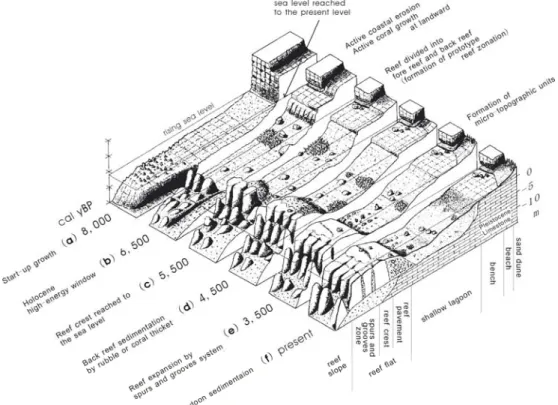
The start-up growth of present reef-flats occurred around 8500 cal yBP from the depth of 20 to 25 m in the southern Ryukyu Islands (Kan and Kawana 2006), around 8300 to 7900 cal yBP from the depth of 10 to 15 m in the central Ryukyu Islands (Fig. 1a, Takahashi et al. 1988, Kan et al. 1991, 1995, 2000, Kawana and Kan 1996, 2002). The start-up growth lagged around 1,000 years behind the inundation of shelves. The earlier start-up growth around 10,000 cal yBP (9030 14C yBP) from 20 m deep is seldom reported from Kikai Island in the central Ryukyu Islands (Konishi et al. 1978, 1983, Webster et al. 1998).
The sea level reached its present position about 7000 cal yBP (Chappell and Polach 1991, Kan and Kawana 2006). However, the wave resistant structure such like the present reef edge has not been formed before the reefs grew to reach sea level (Fig. 1b). The strong wave condition is assumed for coastal zone because of less wave attenuation in reef in this stage. It is called “Holocene high energy window” (Hopley 1984). This condition causes the active coastal erosion to form bench and cliff along the uplifted Pleistocene limestone coasts and also sometime induced the active coral growth at landward.
The reefs grew to reach the sea level around 6500 cal yBP in Sekisei Reef in the southern Ryukyu Islands (Kan and Kawana 2006), 5900 to 5500 cal yBP in Kume, Minna and Okinoerabu Islands in the central Ryukyu Islands (Takahashi et al. 1988, Kan et al. 1991, Kan and Hori 1993, Kan et al. 1995).
The primary growth of reefs usually with tabular corals acted as a breakwater and differentiated the reef into a fore-reef zone and a back-reef zone (Fig. 1c). The reef first reached sea level forming the reef crest
After the crest growth, the back reef, especially seaward of the lagoon, was infilled by thickets of in situ ramose corals and accumulation of coral debris derived from reef edge (Fig. 1d). The vigorous back reef accumulation ended up about 500 to 1000 years after the crest growth (Takahashi et al. 1998, Kan and Hori 1993).
Simultaneously, the area of active reef growth has shifted progressively seaward with the development of reef edge spurs. The microtopographic units along reef margins such as spurs, grooves and reef tunnels were formed in this stage. The pinnacles in front of the established spur and groove system reached sea level and the reef margin migrated seaward (Fig. 1e). This gradual process is called
“reef flat accretion” (Kan and Hori 1993) and has contributed to the build up of expanded reef flat under almost stable sea level condition in the late Holocene.
Fig. 1 Schematic diagram for fringing reef development with “crest - lagoon” zonation.
The base diagram is after Kan (2001). The accretion style and ages are based on the drilling and trench-wall results in Kume and Minna Islands in the central Ryukyus. Ages are converted to calendar age.
3. Reduction of geomorphological zones in fringing reef flat
The width of reef flats narrows with increasing latitude in the Ryukyu Islands. Changes in reef morphology do not occur gradually but are regionally selective, especially in the width of shallow lagoons which disappear as reef flats become narrower. Hori (1980) used the term "reduction" for the decline in zonation and width of reef flats.
In Okinoerabu Island in the central Ryukyu Islands, reef flats are significantly narrower than those in the other islands at similar latitudes where shallow lagoons have not been formed. In the southern coast of Okinoerabu Island, a submarine excavation resulting from the construction of China Harbor cuts through the entire width of a narrow, lagoon-less reef structure which can be compared to the well-developed fringing reef flats with distinct zonation mentioned above.
The cutting reached a depth of 11 m and the full Holocene structure is observed (Kan et al. 1995).
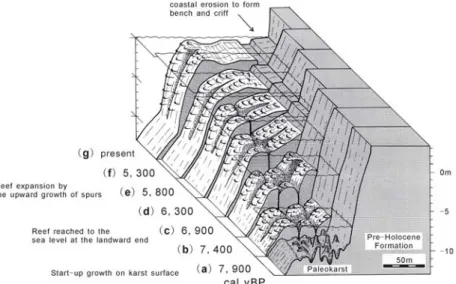
The 90 m seaward of the reef flat (width= 130 m) consists of Holocene reef framework and the 40 m landward consists of Pleistocene limestone. The Holocene reef started to grow around 7900 cal yBP (7050 14C yBP) on the -10 m limestone terrace (Fig. 2a). The vigorous reef growth which reached sea level occurred around 7000 to 6000 cal yBP along the terrace scarp at the landward end (Fig. 2b-d). The reef has been constructed by a uniform facies of in situ tabular corals which shows that the reef has not experienced any cross-reef energy gradient. China Reef was constructed only by “reef flat accretion”
processes in contrast to Minna and Kume Islands where growth was initiated around offshore "barrier"
with later lagoonal infill and some seaward accretion. To a large extent, this explains the variability in width and age structures of these reefs and other fringing reefs of the Ryukyus.
Fig. 2 Schematic diagram for narrow fringing reef development with obscure zonation.
The accretion style and ages are based on the trench-wall result in Okinoerabu Island in the central Ryukyus (Kan et al. 1995). Ages are converted to calendar age.
4. Summary
The Holocene reef histories based on the drillings and trench-wall observations in the Ryukyu Islands show the formation of geomorphological zonation in fringing reefs. The strong zonal patterns emerge when the energy related gradient develops. In the middle Holocene, the reef first reached sea level acting as a breakwater and differentiated the reef into a fore-reef and a back-reef. The fringing reef lagoon might have been formed by a damming process where the growth axis is located some
distance offshore. The initial growth axis forms the reef crest ridge of the present reef and is interpreted as the functional core for reef zonation. In the case of the initial growth axis lay at the landward end, reef experienced no energy gradient during its formation, thus the flat topography with obscure zonation was formed by the following “reef flat accretion” process in the late Holocene. The initial reef growth to reach the sea level lags at least 500 to 1000 years behind sea level rise. Before the reef first reached sea level, coastal erosion might have been active under the “Holocene high energy window” environment.
Acknowledgments
This paper is dedicated to Professor Dr. Nobuyuki Hori on the occasion of his retirement from the Department of Geography, Tokyo Metropolitan University. The author is indebted to many co-researchers in previous studies especially for Professors Tatsuo Takahashi, Motoharu Koba, Yosuke Nakashima, Toshio Kawana, Dr. Atsushi Suzuki and of course Professor Nobuyuki Hori. This study was supported by a Research Grant (No.15300303) from the Ministry of Education, Science and Technology, Japan.
References
Chappell, J., and Polach, H. 1991. Post-glacial sea level rise from a coral record at Huon Peninsula, Papua New Guinea. Nature 349: 147-149.
Easton, W. H., and Olson, E. A. 1976. Radiocarbon profile of Hanauma Reef, Oahu, Hawaii. Geol. Soc.
Am. Bull. 87: 711-719.
Hopley, D. 1984. The Holocene ‘high energy window’ on the Central Great Barrier Reef. In: Coastal geomorphology in Australia, ed. B. G. Thom, 135-150. Academic Press.
Hopley, D. 1989. Coral reefs: zonation, zonality and gradients. Essener. Geogr. Arbeiten. 18: 79-123.
Hori, N. 1980. Nihon no sangosho (Coral reefs of Japan). In Nihon no shizen (Nature of Japan) ed. Y.
Sakaguchi, 149-160. Tokyo: Iwanami Shoten.
Kan, H., and Hori, N. 1991. Methodology and conceptual design for geomorphological surveying of submarine 'road cut' in modern reef-flats. Geographical Sciences (Chiri Kagaku) 46: 208-221.
Kan, H., Takahashi, T., and Koba, M. 1991. Morpho-dynamics on Holocene reef accretion: drilling results from Nishimezaki Reef, Kume Island, the Central Ryukyus. Geographical Review of Japan 64 (Ser.B): 114-131.
Kan, H., and Hori, N. 1993. Topographic formation on the well-developed fringing reef-flat, Minna Island, the central Ryukyus. Transactions Japanese Geomorphological Union (Chikei) 14: 1-16.
Kan, H., Hori, N., Nakashima,Y., and Ichikawa, K. 1995. Narrow reef flat formation in a high-latitude fringing reef. Coral Reefs 14: 123-130.
Kan, H., Hori, N., Kawana, T., Kaigara, T., and Ichikawa, K. 1997a. The evolution of a Holocene fringing reef and island: reefal environmental sequence and sea level change in Tonaki Island, the central Ryukyus. Atoll Res. Bull. 443: 1-20.
Kan, H., Hori, N., and Ichikawa, K. 1997b. Formation of a coral reef-front spur. Coral Reefs 16: 3-4.
Kan, H., Takahashi, T., and Koba, M. 2000. Emerged Holocene coral reef drilling at Nishimezaki, Kume Island, central Ryukyus (5): reef growth observed from radiocarbon dates of fossil corals in Tr-B2 and Tr-B4 core transects. Bull. Fac. Education, Okayama Univ., 114: 37-46.*
Kan, H. 2001. Nansei shotou wo fuchidoru sangosho kaigan (Coral reef coasts along the Southwestern Islands), In Nihon no chikei 1 (Regional Geomorphology of the Japanese Islands) eds. N.
Yonekura et al., 255-258. Tokyo: Univ. Tokyo Press. *
Kan,H., and Kawana, T. 2006. ‘Catch-up’ of a high-latitude barrier reef by back-reef growth during the post-glacial sea-level rise, Southern Ryukyus, Japan. Proc. 10th Int. Coral Reef Symp: 494-503.
Kawana, T., and Kan, H. 1996. Description of the drilling cores through the Holocene coral reefs at the Gushichan Coast in the southern Okinawa Island, the Ryukyus, Japan. Bull. College of Education, Univ. Ryukyus 48: 1-16.
Kawana, T., and Kan, H. 2002. Description of the new drilling cores through the Holocene coral reefs at the Gushichan Coast in the southern Okinawa Island, the Ryukyus, Japan. Bull. Fac. of Education, Univ. Ryukyus 60: 235-244.
Kennedy, D. M., and Woodroffe, C. D. 2002. Fringing reef growth and morphology: a review. Earth Sci. Rev. 57: 255-277.
Konishi, K., Tsuji, Y., Goto, T., and Tanaka, T. 1978. Holocene raised reef drilling at Kikai-jima, central Ryukyus, No.1. Sci. Rept. Kanazawa Univ., 23(2): 129-153.
Konishi, K., Tsuji, Y., Goto, T., Tanaka, T., and Futakuchi, K. 1983. Sangosho no takou-sensou kussaku – Kikaijima ni okeru Kanshin-tou no rei (Multihole shallow drilling on coral reefs: an example of Holocene series at Kikai-jima). Mar. Sci. Monthly (Kaiyo Kagaku) 153: 154-164.*
Macintyre, I. G., and Glynn, P. W. 1976. Evolution of modern Caribbean fringing reef, Galeta Point, Panama. A.A.P.G. Bull., 60: 1054-1072.
Montaggioni, L. F. 2005. History of Indo-Pacific coral reef systems since the last glaciation:
development patterns and controlling factors. Earth Science Reviews 71: 1-75.
Stuiver, M., Reimer, P. J., Bard, E., Beck, J. W., Burr, G. S., Hughen, K. A., Kromer, B., McCormac, F. G., van der Plicht, J., and Spurk, M. 1998. INTCAL98 Radiocarbon Age Calibration, 24,000-0 cal BP. Radiocarbon 40: 1041-1083.
Takahashi, T., Koba, M., and Kan, H. 1988. Relationship between reef growth and sea level on the northwest coast of Kume Island, The Ryukyus: data from drill holes on the Holocene coral reef.
Proc. 6th Int. Coral Reef Symp., 3: 491-496.
Webster,J. M., Davies, P. J., and Konishi, K. 1998. Model of fringing reef development in response to progressive sea level fall over the last 7000 years – (Kikai-jima, Ryukyu Islands, Japan). Coral Reefs, 17: 289-308.