厚生労働行政推進調査事業費補助金(新興・再興感染症及び予防接種政策推進研究事業)
分担研究報告書
HPV ワクチンの安全性・有効性に関する抄訳集の作成
研究分担者 大藤さとこ 大阪市立大学大学院医学研究科公衆衛生学 研究分担者 原 めぐみ 佐賀大学医学部社会医学講座予防医学分野 研究分担者 福島 若葉 大阪市立大学大学院医学研究科公衆衛生学 研究分担者 齋藤 智也 国立保健医療科学院健康危機管理研究部 研究分担者 中島 啓 亀田総合病院呼吸器内科
研究協力者 磯部 充久 さいたま市健康科学研究センター保健科学課代謝免疫係 研究協力者 井手悠一郎 聖マリア学院大学看護学部
研究協力者 出口 昌昭 市立岸和田市民病院産婦人科
研究協力者 加瀬 哲男 大阪市立大学大学院医学研究科公衆衛生学 研究協力者 近藤 亨子 大阪市立大学医学部附属病院運営本部 研究協力者 村端真由美 三重大学医学部看護学科
研究協力者 伊藤 一弥 保健医療経営大学・医療法人相生会臨床疫学研究センター 研究協力者 麦谷 歩 医療法人相生会墨田病院
研究協力者 神谷 元 国立感染症研究所感染症疫学センター 研究協力者 福住 宗久 国立感染症研究所感染症疫学センター 研究協力者 土橋 酉紀 国立感染症研究所感染症疫学センター 研究協力者 八幡裕一郎 国立感染症研究所感染症疫学センター
研究協力者 星 淑玲 筑波大学医学医療系保健医療政策学・医療経済学 共同研究者 田中 孝明 川崎医科大学附属川崎病院小児科
共同研究者 田中 敏博 JA静岡厚生連静岡厚生病院小児科 共同研究者 武知茉莉亜 株式会社電通パブリックリレーションズ 共同研究者 松浦 知香 大阪市立大学大学院医学研究科公衆衛生学 共同研究者 松本 一寛 大阪市立大学大学院医学研究科公衆衛生学 共同研究者 吹田安佐詠 大阪市立大学大学院医学研究科公衆衛生学 共同研究者 迎 恵美子 大阪市立大学大学院医学研究科公衆衛生学 共同研究者 東 泰司 大阪市立大学医学部
共同研究者 田畑 治希 大阪市立大学医学部
研究要旨
HPVワクチンが日本で定期接種化された後、ワクチン接種後の有害事象として報告された持続的 な疼痛をはじめとする多様な症状(当初は複合性局所疼痛症候群等の病名で報告)が社会的な問題 となり、2013年6月に積極的勧奨が差し控えられた。これに伴い、日本における現在のHPVワク チン接種率は1%未満となっている。そこで、HPVワクチンの有用性を検討する基礎資料として、
HPVワクチンの安全性・有効性に関する抄訳集を作成することとなった。日本では、特にHPVワ クチンの安全性に関する懸念が大きいことから、ワクチン市販後の安全性について記載した文献を 中心に系統的レビューを行った。
ワクチンの安全性に関しては、HPVワクチン接種群では、コントロール群と比べて、局所反応の 発生割合が高く、統計学的有意差を認めたが、症状は接種後1週間以内に自然軽快した。全身反応、
重篤な有害事象、慢性疾患の新規発症、自己免疫性疾患の新規発症、妊娠転帰に関しては、HPVワ クチン接種群とコントロ ー ル群で発生割合はほとんど同様であ っ た。 一部の観察研究において、
1 ) 厚生労働省意向による特定研究
A. 研究目的
HPV-16/18は子宮頸がんの約60%、HPV-6/11 は尖圭コンジローマの約90%の原因となっている。
これらの疾患を予防する為に、HPV-16/18に対す る2価ワクチンであるサーバリックスが2006年に 開発され、 日本では2011年に認可された。 また HPV-6/11/16/18に対する4価ワクチンであるガー ダシルが2007年に開発され、日本では2009年に認 可された。その後、2013年に小学校6年生から高 校1年生の女子に対するHPVワクチン接種が定期 接種プログラムに組み込まれたが、ワクチン接種後 の有害事象として報告された持続的な疼痛をはじめ とする多様な症状(当初は複合性局所疼痛症候群等 の病名で報告)が社会的な問題となり、2013年6 月に積極的勧奨が差し控えられた。これに伴い、日 本における現在のHPVワクチン接種率は1%未満 となっている。
そこで、HPVワクチンの有用性を検討する基礎 資料として、HPVワクチンの安全性・有効性に関 する抄訳集を作成することとなった。日本では、特 にHPVワクチンの安全性に関する懸念が大きいこ とから、ワクチン市販後の安全性について記載した 文献を中心に系統的レビューを行った。
B. 研究方法
1)文献の採用基準・除外基準
2019年2月、HPVワクチンの安全性について記 載した刊行論文の抽出を開始した。「安全性」とは HPVワクチン接種後に生じた副反応あるいは有害 事象の評価である。HPVワクチン接種者と非接種 者(他のワクチン接種者や一般集団でも可)で、副 反応あるいは有害事象の発生頻度を比較した研究を 採用することとした。本レビューの目的は、「市販 後の安全性」の評価に重点を置くが、観察研究のみ ならず、無作為化比較対照試験のような臨床試験の
対象者を長期間追跡した研究結果も含むこととした。
文献の採用基準と除外基準は、以下の通りとした。
(採用基準)
・Participants:女性
・Intervention:HPVワクチン( 2 価、 4 価)
・ Comparators:HPVワクチン接種者 vs 非接 種者(HPVワクチン接種者 vs 他のワクチン接 種者や一般集団との比較でも可)
・ Outcome: Primary outcome: ワ ク チ ン 安 全 性・副反応・有害事象
Secondary outcome: 子宮頸がん、
子宮頸部高度異形成、 尖圭コンジ ローマ、HPV感染率に対するワク チン有効性
・ Study design:無作為化比較対照試験、観察研 究(コホート研究、症例対照研究、横断研究)
・Timing:追跡期間は規定しない
・ Language:English OR Japanese
(除外基準)
・ Participants:男性について記載した文献は除 外
・ Intervention:HPVワクチン( 9 価)につい て記載した文献は除外
・ Outcome:上述のPrimary outcomeに関する 記載がない論文は除外
・Study design:会議録、症例報告は除外
・ Setting: 医療経済学的な評価に関する論文、
総説は除外
・ Language:English OR Japanese以外の言語 で記載された文献は除外
2)検索データベースおよび検索式
2019年2月15日 、MEDLINE(PubMed)、
Cochran、医中誌を使用し、以下の検索式で、該当
文献を抽出した:(human papillomavirus vaccine OR HPV vaccine OR gardasil OR cervarix) AND HPVワクチン群で中枢神経系疾患や一部の自己免疫疾患の発生率が高いことを示した研究も認めたが、
研究手法による限界やPublication biasの可能性も考えられる。
ワクチン有効性に関しては、HPVワクチン群で、HPV初感染や持続感染、CINや尖圭コンジロー マの発生割合が下がり、高いワクチン有効率が多くの文献で示されている。
HPVワクチンの有用性を判断する際には、HPVワクチンの安全性と有効性のバランス、すなわ ちワクチンで予防可能な人数と重篤な有害事象の可能性のバランスを評価することが重要である。
本抄訳集がHPVワクチンの安全性と有効性に関する基礎資料として、HPVワクチンの有用性を判 断する際の一助となればと考えている。
(safety OR adverse event OR reactogenicity OR reaction)。
3)文献抽出
2 )に記載した検索式によって抽出された文献 について、2 人の作業者がそれぞれTitle/Abstract をレビューし、 1 )文献の採用基準・除外基準に 従って、文献を選別した(一次スクリーニング)。 文献の選別結果は、各作業者が、3段階で評価した
(〇:採用、×:除外、△:判断不能)。除外または 判断不能と判断した文献については、その理由も記 載した。 2 人の作業者の判断が、両方とも〇の場 合は採用とし、両方とも×の場合は除外した。いず れかが△と判断した文献については、別の作業者が 本文をレビューし、該当の可否を決定した(二次ス クリーニング)。最終的に、140文献1-140)を抄訳集 に付すこととした。文献抽出のフロー図を、図 1 に示す。
4)抄訳集の作成
抽出した140文献について、26人の班員が各 5 編の文献を選択して抄訳した。各文献の抄訳は、事 務局(大阪市立大学大学院医学研究科公衆衛生学)
に提出し、事務局の編集を経て、抄訳集とした。
(倫理面への配慮)
本研究では個人の医療情報等を取り扱わず、倫理 面について特段の配慮を必要としない。
C. 研究結果
140文献のうち、1文献17)は他文献15)と同じ内 容であったため、139文献の概要を、表 1 に示す。
各自の全文抄訳の結果、方法の 1 )に記載した採 用基準に合致しない文献が51件含まれていた(35 件7,9,11,13,19,21,23,25,27,28,34,36,37,38,39,40,44,51,54,59,71,82,85,93,102,103, 107,113,115,117,118,125,128,134,140)は比較対象がなくHPVワ クチン接種者のみを評価、7件42,43,55,56,109127,138)は2 価ワクチンと4価ワクチンを比較、6件24,26,29,95,96,110)
は認可スケジュールと新規スケジュールの比較、1 件78)はロット間の比較、1件98)は他ワクチンと同 時接種した場合の接種順の比較、1件は2価の新規 ワクチンに関する評価2))。88件の内訳は、2価ワ クチンについて記載した文献が39件、4価ワクチ ンについて記載した文献が44件、残りの5文献は 両ワクチンを評価した文献であった。内容に関して、
有効性評価を行った文献は29件であった。安全性 に関しては、局所反応、全身反応、重篤な有害事象、
慢性疾患の新規発症、自己免疫疾患の新規発症、妊 娠転帰、その他の有害事象の評価をした文献がみら れた。研究デザインとしては、無作為化比較試験が 半数を占めた。
1)安全性(ワクチン接種後の有害事象)
局所反応について記載した論文の要約を表 2 に まとめた。これらは総て無作為化比較試験からの結 果である。HPVワクチン群では、接種後に注射部 位の局所反応を報告する者が、コントロール群より も多い。一部の文献では、有意差検定を行っている が、そのほとんどで統計学的有意差を検出している。
局所反応の報告で最も多いのは、注射部位の疼痛で ある。ただし、いずれの報告においても、局所反応 は一過性であり、ほとんどが接種後7日以内に自 然軽快している。
接種後の全身反応に関しても、すべて無作為化比 較試験からの結果である( 表 3 )、HPVワクチン 群とコントロール群で有意差を認めた文献は1件 のみであり、発熱に関してHPVワクチン群で有意 な増加を認めたものであった132)。
重篤な有害事象に関しても、すべて無作為化比較 試験からの結果である( 表 4 )。 各追跡期間中に HPVワクチン群で数%、コントロール群でも数%で、
重篤な有害事象の報告を認めたが、その発生割合は 同様である。一部の文献では、有意差検定を行って いるが、いずれも有意差を認めていない。また、ワ クチン接種と関連した重篤な有害事象は、ほとんど の研究で認めていなかった。
無作為化比較試験では、追跡期間中の慢性疾患の 新規発症についても評価している(表 5 )。各追跡 期間中にHPVワクチン群で数%、コントロール群 でも数%、慢性疾患の新規発症の報告を認めたが、
その発生割合は同様である。
自己免疫疾患の新規発症については、無作為化比 較試験17件、コホート研究2件、症例対照研究2 件で、評価されている(表 6 )。いずれの報告でも、
HPVワクチン群とコントロール群での発生割合は 同様である。一部の有意差検定を行った報告のうち、
2件で有意差を検出しているが、いずれもHPVワ クチン群の方が、コントロール群よりも有意に報告 が少ないという内容であった46,89)。
妊娠中に気づかずにHPVワクチン接種をした者 での妊娠転帰を評価した文献を表 7 にまとめた。
無作為化比較試験15件、コホート研究4件、記述 疫学1件で、評価されているが、自然流産や先天
1 ) 厚生労働省意向による特定研究
異常の発生割合は、HPVワクチン群とコントロー ル群で同様である。有意差検定を行った報告でも、
有意差を検出した報告はない。
その他の有害事象に関しては、アナフィラキシー、
片頭痛、失神、皮膚感染、静脈血栓症、複合性局所 疼痛症候群、ギランバレー症候群、中枢神経系疾患、
視神経炎、多発性硬化症、その他の脱髄疾患、疾患 別の自己免疫疾患、など多岐にわたる報告がある(表 8 )。無作為化比較試験1件、コホート研究15件、
症例対照研究4件、Self-control case series 5件、
記述疫学3件、 その他1件による。 一部の中枢神 経系疾患や一部の自己免疫疾患において、有意差を 認めた報告もあるが、検討手法による違いが影響し ている可能性もある。また、後の分析により、有意 差を検出しなくなった報告もある。詳細は、各抄訳 内容を参照されたい。
2)有効性
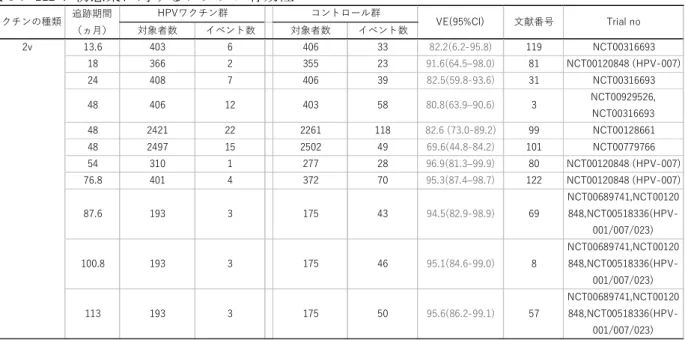
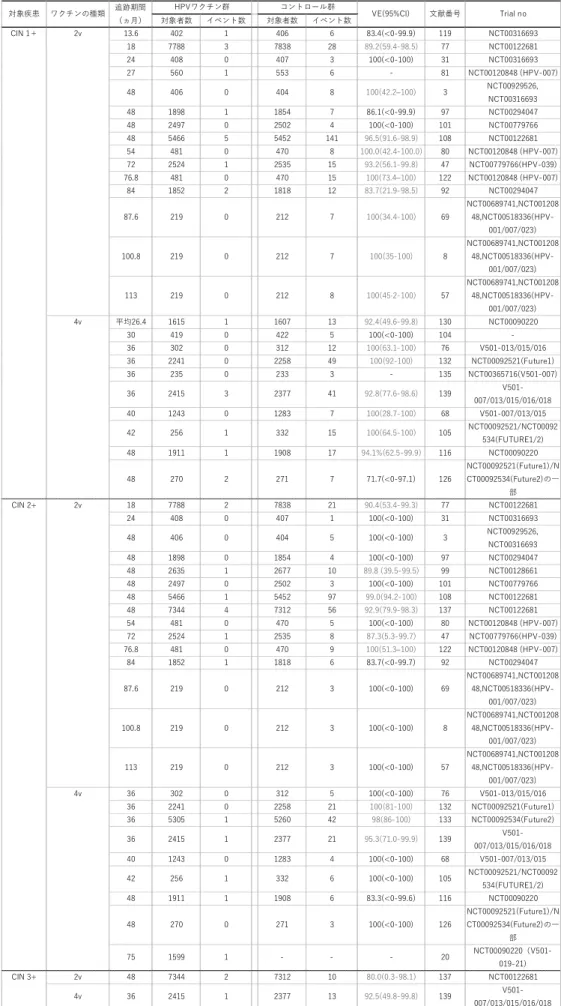
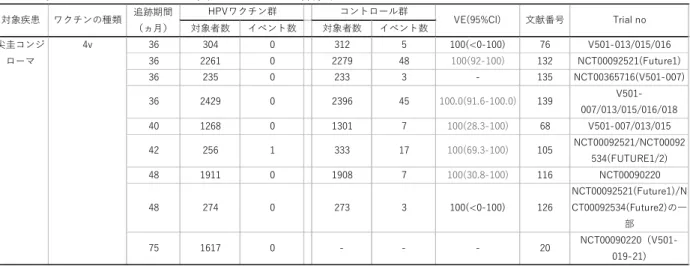
HPV初感染に対する有効性(表 9 )、持続感染 に 対 す る 有 効 性( 表10)、 子 宮 頸 部 上 皮 内 腫 瘍
(CIN)に対する有効性(表11)、尖圭コンジロー マに対する有効性(表12)をまとめた。有効性の 評価はすべて無作為化比較試験による。2価、4価 ワクチンともに、HPV初感染および持続感染に対 する有意な予防効果を全ての研究で検出している(表 9 、表10)。CINに関しては、HPVワクチン群で CINを発症した者が、非常に少ないため、追跡期 間中の発生数が0件の研究では、有効性の算出で 意味のある結果が算出できていない。一方、大規模 研究で、 追跡期間が長期になればなるほど、CIN の予防に対するワクチン有効性は明らかであり、ほ とんどの研究でワクチン有効性は90%以上である
(表11)。尖圭コンジローマに関しての検討は少な いが、HPVワクチン群での発生数は1件のみであっ た(表12)。
D. 考察
HPVワクチンの安全性に関して、無作為化比較 試験の結果からは、ワクチン接種群でコントロール 群よりも発生割合が高くなる事象は、局所反応のみ である。しかし、局所症状はワクチン接種後 1 週 間以内には自然軽快したため、大きな問題とはなら ないと考える。一方、他の研究デザインで検討した 報告で、一部の中枢神経系疾患と一部の自己免疫疾 患が、HPVワクチン接種により有意な増加を認め たものがある。しかし、中枢神経系疾患について有
意 な 増 加 を 報 告 し た 文 献2件53,91)は、 い ず れ も
VAERSのデータベースを利用した研究であり、他
のワクチン接種後の中枢神経系疾患と比較した症例 対照研究による。VAERSのデータベースは、ワク チン接種後の有害事象に関する自発報告システムで あることから、色々な限界点もある53,91)。また、一 部の自己免疫疾患(ベーチェット病63)、炎症性腸 疾 患87)、 レ イ ノ ー 現 象63)、 自 己 免 疫 性 甲 状 腺
炎66,90)、SLE53,91)など)で、HPVワクチン群の方
で発生率が高いことを示した報告もあるが、報告数 は極めて少ない。有意差を認めたもののみが報告さ れているというpublication biasもあることが考え られ、他の多くの研究ではこれらの疾患とHPVワ クチン接種には関連がなかったのかもしれない。ま た、1型糖尿病に関しては、HPVワクチン群の方 で 発 生 率 が 有 意 に 高 い こ と を 示 し た 報 告 も あ る が63)、 有 意 に 低 い こ と を 示 し た 報 告 も あ る た
め66,90)、一貫した関連ではない。
HPVワクチンの有効性の評価では、HPVワクチ ン群で、HPV初感染や持続感染、CINや尖圭コン ジローマの発生割合が下がり、高いワクチン有効率 が多くの文献で示されている。有意差が見られなかっ た文献の多くは、HPVワクチン群でもコントロー ル群でも疾患の発生割合が低かったことにより統計 学的検出力が小さかったためと考える。ただし、こ の系統的レビューでは、文献の抽出方法の採用基準 により、HPVワクチンの有効性のみを評価した文 献が抽出出来ていない。しかし、安全性に着目した 文献検索で該当した文献だけみても、HPVワクチ ンの有効性は明らかである。
現在、日本では1年間に約11,000人の子宮頸が んの新規発症が報告されている。この系統的レビュー から概算されるHPVワクチンの有効性が90%だと すると、毎年9,900人の子宮頸がん患者が予防され ることとなる。一方、ワクチンの安全性に関して、
ワクチン接種により一部の中枢神経系疾患患者が増 加すると仮定した場合、増加する可能性のある中枢 神経系疾患患者は0.08/100,000人年(HPVワクチ ン 群 で5.89/100,000人 年、 コ ン ト ロ ー ル 群 で 5.81/100,000人年 )87)と算出される。 また、 仮に HPVワクチン接種と自己免疫性甲状腺炎に因果関 係 が あ っ た 場 合、 ワ ク チ ン 接 種 に よ り 17.01/100,000人 年(HPV ワ ク チ ン 群 で 23.18/100,000人 年、 コ ン ト ロ ー ル 群 で 6.17/100,000人年)90)の自己免疫性甲状腺炎が増加
する可能性が考えられる。 これらを考慮すると、
HPVワクチン接種によるメリットは、HPVワクチ ン接種によるデメリットをはるかに上回ると考えら れる。もちろん、ワクチン接種によるデメリットは 考慮されるべきである。ワクチン接種と因果関係が あると考えられる有害事象に関しては、接種者への 適切な情報提供を行うとともに、疾患が生じた場合 の補償も考慮する必要があろう。
補足として、日本で当初問題となった持続的な疼 痛をはじめとする多様な症状(当初は複合性局所疼 痛症候群等の病名で報告)を評価した2文献に関 して触れておく。2文献のうち1文献では複合性局 所疼痛症候群とHPVワクチンの有意な関連は認め なかった51)。また、あと1文献では有意差検定は 行われていないが、HPVワクチン群での発生率は 0.28/1,000,000 dosesであった40)。
E. 結論
HPVワクチンの有用性を判断する際には、HPV ワクチンの安全性と有効性のバランス、すなわちワ クチンで予防可能な人数と重篤な有害事象の可能性 のバランスを評価することが重要である。本抄訳集 がHPVワクチンの安全性と有効性に関する基礎資 料として、HPVワクチンの有用性を判断する際の 一助となればと考えている。
参考文献
1) Skufca J, et al. The association of adverse events with bivalent human papilloma virus vaccination: A nationwide register-based cohort study in Finland. Vaccine 2018;
36(39): 5926-33.
2) Trimble CL, et.al. Safety, efficacy, and immunogenicity of VGX-3100, a therapeutic synthetic DNA vaccine targeting human papillomavirus 16 and 18 E6 and E7 proteins for cervical intraepithelial neoplasia 2/3: a randomized, double-blind, placebo-controlled phase 2b trial. Lancet 2015; 386(10008): 2078-88.
3) Konno R, et al. Efficacy of the human papilloma v irus (HP V)- 1 6/1 8 AS0 4 - ad juvanted vaccine against cervical intraepithelial neoplasia and cervical infection in young Japanese women. Hum Vaccin
Immunother. 2014; 10(7): 1781-94.
4) Schurink-Van’t Klooster TM, et al. No evidence found for an increased risk of long- term fatigue following human papillomavirus vaccination of adolescent girls. Vaccine 2018;
36(45): 6796-802.
5) Rodríguez-Galán MA, et al. Adverse reactions to human papillomavirus vaccine in the Valencian Community (2007-2011). An Pediatr (Barc). 2014; 81(5):303-9.
6) Wheeler CM, Safety and immunogenicity of co-administered quadrivalent human papillomavirus (HPV)-6/11/16/18 L1 virus- like particle (VLP) and hepatitis B (HBV) vaccines. Vaccine 2008; 26(5): 686-96.
7) Mok CC, et al. Immunogenicity and safety of a quadrivalent human papillomavirus vaccine in patients with systemic lupus erythematosus: a case-control study. Ann Rheum Dis. 2013;
72(5): 659-64.
8) Roteli-Martins CM, et al. Sustained immunogenicity and efficacy of the HPV- 16/18 AS04-adjuvanted vaccine: up to 8.4 years of follow-up. Hum Vaccin Immunother.
2012; 8(3): 390-7.
9) Esposito S, et al. Immunogenicity, safety and t o l e r a b i l i t y o f a b i v a l e n t h u m a n papillomavirus vaccine in adolescents with juvenile idiopathic arthritis. Expert Rev Vaccines. 2014; 13(11): 1387-93.
10) Sridhar G, et al. Evaluation of optic neuritis following human papillomavirus vaccination.
Hum Vaccin Immunother. 2017; 13(7): 1705- 13.
11) Dhar JP, et al. The safety and immunogenicity of Quadrivalent HPV (qHPV) vaccine in systemic lupus erythematosus. Vaccine 2017;
35(20): 2642-6.
12) Scheller NM, et al. Quadrivalent HPV Vaccination and the Risk of Adverse Pregnancy Outcomes. N Engl J Med. 2017;
376(13): 1223-33.
13) Liu XC, et al. Adverse events following HPV vaccination, Alberta 2006-2014. Vaccine 2016;
34(15): 1800-5.
1 ) 厚生労働省意向による特定研究
14) Mugo N, et al. Evaluation of safety and immunogenicity of a quadrivalent human papillomavirus vaccine in healthy females between 9 and 26 years of age in Sub-Saharan Africa. Hum Vaccin Immunother. 2015;
11(6): 1323-30.
15) Granwehr B. ACP Journal Club: quadrivalent HPV vaccination was not linked to multiple sclerosis or other demyelinating diseases. Ann Intern Med. 2015; 162(8): JC13.
16) Goss MA, et al. Final report on exposure during pregnancy from a pregnancy registry for quadrivalent human papillomavirus vaccine. Vaccine 2015; 33(29): 3422-8.
17) Perkins RB, et.al. The human papillomavirus vaccination is not associated with risk of multiple sclerosis or other demyelinating diseases. Evid Based Med. 2015; 20(3): 116.
18) Angelo MG, et al. Pooled analysis of large and long-term safety data from the human papillomavirus-16/18-AS04-adjuvanted v a c c i n e c l i n i c a l t r i a l p r o g r a m m e . Pharmacoepidemiol Drug Saf. 2014; 23(5): 466-79.
19) Harris T, et al. Adverse events following immunization in Ontario’s female school-based HPV program. Vaccine 2014; 32(9): 1061-6.
20) Luna J, et al. Long-term follow-up observation o f t he sa f e t y , imm u n og en i c i t y , a nd effectiveness of Gardasil.RTM. in adult women. PLoS One. 2013; 8(12): e83431.
21) Moscicki AB, et al. Immune responses elicited by a fourth dose of the HPV-16/18 AS04- adjuvanted vaccine in previously vaccinated adult women. Vaccine 2012; 31(1): 234-41.
22) Klein NP, et al. Safety of quadrivalent human papillomavirus vaccine administered routinely to females. Arch Pediatr Adolesc Med. 2012;
166(12): 1140-8.
23) Gasparini R, et al. Safety and tolerability of bivalent HPV vaccine: an Italian post-licensure study. Hum Vaccin. 2011; 7 Suppl.; 136-46.
24) Neuzil KM, et al. Immunogenicity and reactogenicity of alternative schedules of HPV vaccine in Vietnam: a cluster randomized
noninferiority trial. JAMA 2011; 305(14): 1424-31.
25) Crawford NW, et al. Syncope and seizures following human papillomavirus vaccination: a retrospective case series. Med J Aust. 2011;
194(1): 16-8.
26) Esposito S, et al. Immunogenicity and safety of human papillomav irus- 1 6/1 8 AS0 4 - adjuvanted vaccine administered according to an alternative dosing schedule compared with the standard dosing schedule in healthy women aged 15 to 25 years: results from a randomized study. Pediatr Infect Dis J. 2011;
30(3):e49-55.
27) Borja-Hart NL, et al. Human papillomavirus vaccine safety in pediatric patients: an evaluation of the Vaccine Adverse Event Reporting System. Ann Pharmacother. 2009;
43(2): 356-9.
28) Schwarz TF, et al. Immunogenicity and tolerability of an HPV-16/18 AS04-adjuvanted prophylactic cervical cancer vaccine in women aged 15-55 years. Vaccine 2009; 27(4): 581- 7.
29) ClinicalTrials.gov. Human Papillomavirus (HPV) Vaccine Consistency and Non- inferiority Trial in Young Adult Women.
[https://clinicaltrials.gov/show/nct00337818, 2006]
30) ClinicalTrials.gov. Study to Evaluate the Immune Response and Safety of GSK Biologicals’ HPV Vaccine in Healthy Women Aged 18-35 Years. [https://clinicaltrials.gov/ show/nct00345878, 2006]
31) K o n n o R , e t a l . E f f i c a c y o f h u m a n papillomavirus type 16/18 AS04-adjuvanted vaccine in Japanese women aged 20 to 25 years: final analysis of a phase 2 double-blind, randomized controlled trial. Int J Gynecol Cancer. 2010; 20(5): 847-55.
32) Verstraeten T, et al. Analysis of adverse events of potential autoimmune aetiology in a large integrated safety database of AS04 adjuvanted vaccines. Vaccine 2008; 26(51): 6630-8.
33) Kim SC, et al. Human papillomavirus 16/18 AS04-adjuvanted cervical cancer vaccine:
immunogenicity and safety in 15-25 years old healthy Korean women. J Gynecol Oncol.
2011; 22(2): 67-75.
34) 木村 毅, 他. AS04アジュバント添加子宮頸癌 予防ワクチン ( サーバリックス ) の使用実態下 に お け る 安 全 性 評 価 使 用 成 績 調 査 結 果. Progress in Medicine 2015; 35(5): 921-30.
35) 浜 六郎, 他. HPVワクチン接種後の自己免疫 疾患罹患のリスク分析. 正しい治療と薬の情報 2013; 28(5): 89-99.
36) 森岡 依子, 他. AS04アジュバント添加子宮頸 癌予防ワクチン ( サーバリックス ) の使用成績 調査および被接種者アンケ ー トの中間報告. Progress in Medicine, 2013; 33(1): 105-13.
37) 寺尾さより, 他. 鹿児島市におけるHPVワク チンの動向. 鹿児島産科婦人科学会雑誌 2012;
20: 14-7.
38) 上地秀昭, 他. 当院の子宮頸癌予防ワクチン外 来の現状. 沖縄産科婦人科学会雑誌 2011; 33:
60-4.
39) 神谷 齊, 他. 10~15歳の日本人健康女性を対 象 と し た 子 宮 頸 癌 予 防 ワ ク チ ン Cervarix(HPV-16/18 AS04アジュバントワク チン ) の免疫原性と安全性の評価. 小児科臨床 2009; 62(11): 2451-60.
40) Arana JE, et al. Post-licensure safety m o n i t o r i n g o f q u a d r i v a l e n t h u m a n papillomavirus vaccine in the Vaccine Adverse Event Reporting System (VAERS), 2009- 2015. Vaccine 2018; 36(13): 1781-8.
41) Lin L, et al. Safety and Immunogenicity of the HPV-16/18 AS04-adjuvanted Vaccine in 4-6-year-old Girls: Results to Month 12 From a Randomized Trial. Pediatr Infect Dis J.
2018; 37(4): e93-e102.
42) Leung TF, et al. Comparative immunogenicity and safety of human papillomavirus (HPV)- 16/18 AS04-adjuvanted vaccine and 4vHPV vaccine administered according to two- or three-dose schedules in girls aged 9-14 years:
Results to month 36 from a randomized trial.
Vaccine 2018; 36(1): 98-106.
43) Haskins-Coulter T, et al. Reactogenicity of
Cervarix and Gardasil human papillomavirus (HPV) vaccines in a randomized single blind trial in healthy UK adolescent females. Hum Vaccin Immunother. 2017; 13(6): 1-9.
44) Kim CJ, et al. Six-year multi-centre, observational, post-marketing surveillance of the safety of the HPV-16/18 AS04-adjuvanted vaccine in women aged 10-25 years in Korea.
Pharmacoepidemiol Drug Saf. 2017; 26(7): 837-42.
45) Andrews N, et al. No increased risk of Guillain-Barre syndrome after human papilloma virus vaccine: A self-controlled case- series study in England. Vaccine 2017;
35(13): 1729-32.
46) Grimaldi-Bensouda L, et al. Risk of autoimmune diseases and human papilloma virus (HPV) vaccines: Six years of case- referent surveillance. J Autoimmun. 2017; 79:
84-90.
47) Zhu FC, et al. Efficacy, immunogenicity, and safety of the HPV-16/18 AS04-adjuvanted vaccine in Chinese women aged 18-25 years:
event-triggered analysis of a randomized controlled trial. Cancer Med. 2017; 6(1): 12- 25.
48) Cameron RL, et al. Adverse event monitoring of the human papillomavirus vaccines in Scotland. Intern Med J. 2016; 46(4): 452-7.
49) Yih WK, et al. Evaluation of the risk of venous thromboembolism after quadrivalent human papillomavirus vaccination among US females.
Vaccine 2016; 34(1): 172-8.
50) Naleway AL, et al. Absence of venous thromboembolism risk following quadrivalent human papillomavirus vaccination, Vaccine Safety Datalink, 2008-2011. Vaccine 2016;
34(1): 167-71.
51) Huygen F, et al. Investigating Reports of Complex Regional Pain Syndrome: An Analysis of HPV-16/18-Adjuvanted Vaccine Post-Licensure Data. EBioMedicine. 2015;
2(9): 1114-21.
52) Scheller NM, et al. Quadrivalent HPV vaccination and risk of multiple sclerosis and
1 ) 厚生労働省意向による特定研究
other demyelinating diseases of the central nervous system. JAMA 2015; 313(1): 54-61.
53) Geier DA, et al. A case-control study of quadrivalent human papillomavirus vaccine- associated autoimmune adverse events. Clin Rheumatol. 2015; 34(7): 1225-31.
54) Moro PL, et al. Safety of quadrivalent human papillomavirus vaccine (Gardasil) in pregnancy: adverse events among non- manufacturer reports in the Vaccine Adverse Event Reporting System, 2006-2013. Vaccine 2015; 33(4): 519-22.
55) Einstein MH, et al. Comparison of long-term immunogenicity and safety of human papilloma v irus (HP V)- 1 6/1 8 AS0 4 - adjuvanted vaccine and HPV- 6/11/16/18 vaccine in healthy women aged 18-45 years:
end-of -study analysis of a Phase III randomized trial. Hum Vaccin Immunother.
2014; 10(12): 3435-45.
56) Einstein MH, et al. Comparative humoral and cellular immunogenicity and safety of human papilloma v irus (HP V)- 1 6/1 8 AS0 4 - adjuvanted vaccine and HPV- 6/11/16/18 vaccine in healthy women aged 18-45 years:
follow-up through Month 48 in a Phase III randomized study. Hum Vaccin Immunother.
2014; 10(12): 3455-65.
57) Naud PS, et al . Sustained ef f icacy , immunogenicity, and safety of the HPV-16/18 AS04-adjuvanted vaccine: final analysis of a long-term follow-up study up to 9.4 years post- vaccination. Hum Vaccin Immunother. 2014;
10(8): 2147-62.
58) Zhu F, et al. Immunogenicity and safety of the HPV-16/18 AS04-adjuvanted vaccine in healthy Chinese girls and women aged 9 to 45 years. Hum Vaccin Immunother. 2014; 10(7): 1795-806.
59) Pellegrino P, et al. The epidemiological profile of ASIA syndrome after HPV vaccination: an evaluation based on the Vaccine Adverse Event Reporting Systems. Immunol Res. 2015;
61(1-2): 90-6.
60) Schurink-Van’t Klooster TM, et al. Examining
a possible association between human papilloma virus (HPV) vaccination and migraine: results of a cohort study in the Netherlands. Eur J Pediatr. 2015; 174(5): 641-9.
61) Langer-Gould A, et al. Vaccines and the risk of multiple sclerosis and other central nervous system demyelinating diseases. JAMA Neurol.
2014; 71(12): 1506-13.
62) Grimaldi-Bensouda L, et al. Autoimmune d i s o r d e r s a n d q u a d r i v a l e n t h u m a n papillomavirus vaccination of young female subjects. J Intern Med. 2014; 275(4): 398- 408.
63) Arnheim-Dahlström L, et al. Autoimmune, neurological, and venous thromboembolic adverse events after immunisation of adolescent girls with quadrivalent human papillomavirus vaccine in Denmark and Sweden: cohort study. BMJ. 2013; 347: f5906.
64) Ojha RP, et al. Guillain-Barre syndrome following quadrivalent human papillomavirus vaccination among vaccine-eligible individuals i n t h e U n i t e d S t a t e s . H u m V a c c i n Immunother. 2014; 10(1):232-7.
65) D o n e g a n K , e t a l . B i v a l e n t h u m a n papillomavirus vaccine and the risk of fatigue syndromes in girls in the UK. Vaccine 2013;
31(43): 4961-7.
66) Chao C, et al. Surveillance of autoimmune c o nd i t i o ns f o l l o w i ng r o u t i n e use o f quadrivalent human papillomavirus vaccine. J Intern Med. 2012; 271(2): 193-203.
67) Souayah N, et al. Guillain-Barre syndrome after Gardasil vaccination: data from Vaccine Adverse Event Reporting System 2006-2009.
Vaccine 2011; 29(5): 886-9.
68) Olsson SE, et al. Evaluation of quadrivalent HPV 6/11/16/18 vaccine efficacy against cervical and anogenital disease in subjects with serological evidence of prior vaccine type HPV infection. Hum Vaccin. 2009; 5(10): 696-704.
69) De Carvalho N, et al. Sustained efficacy and immunogenicity of the HPV-16/18 AS04-
adjuvanted vaccine up to 7.3 years in young adult women. Vaccine 2010; 28(38): 6247-55.
70) Kim YJ, et al. Vaccination with a human papilloma v irus (HP V)- 1 6/1 8 AS0 4 - adjuvanted cervical cancer vaccine in Korean girls aged 10-14 years. J Korean Med Sci.
2010; 25(8): 1197-204.
71) Paul-Ebhohimhen V, et al. HPV vaccination:
vaccine acceptance, side effects and screening intentions. Community Pract. 2010; 83(6): 30-3.
72) Ngan HY, et al. Human papillomavirus-16/18 AS04-adjuvanted cervical cancer vaccine:
immunogenicity and safety in healthy Chinese women from Hong Kong. Hong Kong Med J.
2010; 16(3): 171-9.
73) Medina DM, et al. Safety and immunogenicity of the HPV-16/18 AS04-adjuvanted vaccine: a randomized, controlled trial in adolescent girls.
J Adolesc Health. 2010; 46(5): 414-21.
74) Kang S, et al. Safety and immunogenicity of a vaccine targeting human papillomavirus types 6, 11, 16 and 18: a randomized, placebo- controlled trial in 176 Korean subjects. Int J Gynecol Cancer. 2008; 18(5): 1013-9.
75) Brotherton JM, et al. Anaphylaxis following quadrivalent human papillomavirus vaccination. CMAJ. 2008; 179(6): 525-33.
76) Tay EH, et al. Clinical trial experience with prophylactic HPV 6/11/16/18 VLP vaccine in young women from the Asia-Pacific region.
Clinical trial experience with prophylactic HPV 6/11/16/18 VLP vaccine in young women from the Asia-Pacific region. Int J Gynaecol Obstet. 2008; 102(3): 275-83.
77) Paavonen J, et al. Efficacy of a prophylactic adjuvanted bivalent L 1 virus-like-particle vaccine against infection with human papillomavirus types 16 and 18 in young women: an interim analysis of a phase III double-blind, randomised controlled trial.
Lancet 2007; 369(9580): 2161-70.
78) Pedersen C, et al. Immunization of early adolescent females with human papillomavirus type 16 and 18 L1 virus-like particle vaccine
containing AS04 adjuvant. J Adolesc Health.
2007; 40(6): 564-71.
79) Villa LL, et al. Immunologic responses following administration of a vaccine targeting human papillomavirus Types 6, 11, 16, and 18. Vaccine 2006; 24(27-28): 5571-83.
80) Harper DM, et al. Sustained efficacy up to 4.5 years of a bivalent L 1 virus-like particle vaccine against human papillomavirus types 16 and 18: follow-up from a randomised control trial. Lancet 2006; 367(9518): 1247- 55.
81) Harper DM, et al. Efficacy of a bivalent L 1 virus-like particle vaccine in prevention of infection with human papillomavirus types 16 and 18 in young women: a randomised controlled trial. Lancet 2004; 364(9447): 1757-65.
82) Sy LS, et al. Postlicensure safety surveillance of congenital anomaly and miscarriage among pregnancies exposed to quadrivalent human papillomavirus vaccine. Hum Vaccin Immunother. 2018; 14(2): 412-9.
83) Deceuninck G, et al. Absence of association b e t w e e n G u i l l a i n - B a r r e s y n d r o m e hospitalizations and HPV-vaccine. Expert Rev Vaccines. 2018; 17(1): 99-102.
84) Gee J, et al. Risk of Guillain-Barre Syndrome following quadrivalent human papillomavirus vaccine in the Vaccine Safety Datalink.
Vaccine 2017; 35(43): 5756-8.
85) López-Fauqued M, et al. Results on exposure during pregnancy from a pregnancy registry for AS04-HPV-16/18 vaccine. Vaccine 2017;
35(40): 5325-30.
86) Lipkind HS, et al. Maternal and Infant Outcomes After Human Papillomavirus Vaccination in the Periconceptional Period or During Pregnancy. Obstet Gynecol. 2017;
130(3): 599-608.
87) Miranda S, et al. Human papillomavirus vaccination and risk of autoimmune diseases:
A large cohort study of over 2million young girls in France. Vaccine 2017; 35(36): 4761-8.
88) Feiring B, et al. HPV vaccination and risk of
1 ) 厚生労働省意向による特定研究
c h r o n i c f a t i g u e s y n d r o m e/m y a l g i c encephalomyelitis: A nationwide register- based study from Norway. Vaccine 2017;
35(33): 4203-12.
89) Grönlund O, et al. Incidence of new-onset autoimmune disease in girls and women with pre-existing autoimmune disease after quadrivalent human papillomavirus vaccination: a cohort study. J Intern Med.
2016; 280(6): 618-26.
90) Willame C, et al. Risk of new onset autoimmune disease in 9- to 25-year-old w o m e n e x p o s e d t o h u m a n papillomavirus-16/18 AS04-adjuvanted vaccine in the United Kingdom. Hum Vaccin Immunother. 2016; 12(11): 2862-71.
91) Geier DA, et al. Quadrivalent human papillomavirus vaccine and autoimmune adverse events: a case-control assessment of the vaccine adverse event reporting system (VAERS) database. Immunol Res. 2017;
65(1): 46-54.
92) Wheeler CM, et al. Efficacy, safety, and immunogenicity of the human papillomavirus 16/18 AS04-adjuvanted vaccine in women older than 25 years: 7-year follow-up of the phase 3, double-blind, randomised controlled VIVIANE study. Lancet Infect Dis. 2016;
16(10): 1154-68.
93) Šubelj M, et al. Adverse events following school-based vaccination of girls with quadrivalent human papillomavirus vaccine in Slovenia, 2009 to 2013. Euro Surveill. 2016;
21(14).
94) Baril L, et al. Risk of spontaneous abortion and other pregnancy outcomes in 15-25 year o l d w o m e n e x p o s e d t o h u m a n papillomavirus-16/18 AS04-adjuvanted vaccine in the United Kingdom. Vaccine 2015;
33(48): 6884-91.
95) R o m a n o w s k i B , e t a l . S u s t a i n e d immunogenicity of the HPV-16/18 AS04- adjuvanted vaccine administered as a two-dose schedule in adolescent girls: Five-year clinical data and modeling predictions from a
randomized study. Hum Vaccin Immunother.
2016; 12(1): 20-9.
96) Leung TF, et al. Comparative immunogenicity and safety of human papillomavirus (HPV)- 16/18 AS04-adjuvanted vaccine and HPV- 6/11/16/18 vaccine administered according to 2- and 3-dose schedules in girls aged 9-14 years: Results to month 12 from a randomized trial. Hum Vaccin Immunother. 2015; 11(7): 1689-702.
97) Skinner SR, et al. Efficacy, safety, and immunogenicity of the human papillomavirus 16/18 AS04-adjuvanted vaccine in women older than 25 years: 4-year interim follow-up of the phase 3, double-blind, randomised controlled VIVIANE study. Lancet 2014;
384(9961): 2213-27.
98) Walter EB, et al. Pain in adolescent girls receiving human papillomavirus vaccine with concomitantly administered vaccines. Pediatr Infect Dis J. 2015; 34(2): 200-2.
99) Hildesheim A, et al. Efficacy of the HPV-16/18 vaccine: final according to protocol results from the blinded phase of the randomized Costa Rica HPV-16/18 vaccine trial. Vaccine 2014;
32(39): 5087-97.
100) Scheller NM, et al. Quadrivalent human papillomavirus vaccine and the risk of venous thromboembolism. JAMA. 2014;
312(2): 187-8.
101) Zhu FC, et al. Efficacy, immunogenicity and safety of the HPV-16/18 AS04-adjuvanted vaccine in healthy Chinese women aged 18- 25 years: results from a randomized controlled trial. Int J Cancer. 2014;
135(11): 2612-22.
102) Levi M, et al. Evaluation of bivalent human papillomavirus (HPV) vaccine safety and tolerability in a sample of 25 year old Tuscan women. Hum Vaccin Immunother.
2013; 9(7): 1407-12.
103) Jacobson DL, et al. Immunogenicity and tolerability to human papillomavirus-like particle vaccine in girls and young women with inflammatory bowel disease. Inflamm
Bowel Dis. 2013; 19(7): 1441-9.
104) Yoshikawa H, et al. Efficacy of quadrivalent human papillomavirus (types 6, 11, 16 and 18) vaccine (GARDASIL) in Japanese women aged 18-26 years. Cancer Sci. 2013;
104(4): 465-72.
105) Clark LR, et al. Clinical trial experience with prophylactic human papillomavirus 6/11/16/18 vaccine in young black women.
J Adolesc Health. 2013; 52(3): 322-9.
106) Sow PS, et al. Safety and immunogenicity of human papillomavirus-16/18 AS04- adjuvanted vaccine: a randomized trial in 10-25-year-old HIV-Seronegative African girls and young women. J Infect Dis. 2013;
207(11): 1753-63.
107) Jain KM, et al. Monitoring adverse events following immunisation in developing countries: experience f rom human papillomavirus vaccination demonstration projects. Sex Health. 2013; 10(1):57-63.
108) Lehtinen M, et al. Overall efficacy of HPV- 16/18 AS04-adjuvanted vaccine against grade 3 or greater cervical intraepithelial neoplasia: 4-year end-of-study analysis of the randomised, double-blind PATRICIA trial. Lancet Oncol. 2012; 13(1): 89-99.
109) E i n s t e i n M H , e t a l . C o m p a r a t i v e immunogenicity and safety of human papillomavirus (HPV)-16/18 vaccine and HPV- 6/11/16/18 vaccine: follow-up from months 12-24 in a Phase III randomized study of healthy women aged 18-45 years.
Hum Vaccin. 2011; 7(12): 1343-58.
110) Romanowski B, et al. Immunogenicity and safety of the HPV-16/18 AS04-adjuvanted vaccine administered as a 2-dose schedule compared with the licensed 3-dose schedule:
results from a randomized study. Hum Vaccin. 2011; 7(12): 1374-86.
111) Khatun S, et al. Safety and immunogenicity profile of human papillomavirus-16/18 AS04 adjuvant cervical cancer vaccine: a randomized controlled trial in healthy adolescent girls of Bangladesh. Jpn J Clin
Oncol. 2012; 42(1): 36-41.
112) Pedersen C, et al. Randomized trial:
i m m u n o g e n i c i t y a n d s a f e t y o f c o a d m i n i s t e r e d h u m a n papillomavirus-16/18 AS04-adjuvanted vaccine and combined hepatitis A and B vaccine in girls. J Adolesc Health. 2012;
50(1): 38-46.
113) Schwarz TF, et al. Persistence of immune response to HPV-16/18 AS04-adjuvanted cervical cancer vaccine in women aged 15-55 years. Hum Vaccin. 2011; 7(9): 958-65.
114) Gee J, et al. Monitoring the safety of quadrivalent human papillomavirus vaccine:
findings from the Vaccine Safety Datalink.
Vaccine 2011; 29(46): 8279-84.
115) Zhu FC, et al. Safety and immunogenicity of human papillomavirus-16/18 AS04- adjuvanted vaccine in healthy Chinese females aged 15 to 45 years: a phase I trial.
Chin J Cancer. 2011; 30(8): 559-64.
116) Castellsagué X, et al. End-of-study safety, i m m u n o g e n i c i t y , a n d e f f i c a c y o f quadrivalent HPV (types 6, 11, 16, 18) recombinant vaccine in adult women 24-45 years of age. Br J Cancer. 2011; 105(1): 28-37.
117) Labadie J. Postlicensure safety evaluation of human papilloma virus vaccines. Int J Risk Saf Med. 2011; 23(2): 103-12.
118) van Klooster TM, et al. Reported adverse events in girls aged 13-16 years after vaccination with the human papillomavirus (HPV)-16/18 vaccine in the Netherlands.
Vaccine 2011; 29(28): 4601-7.
119) Konno R, et al. Ef f icacy of human papillomavirus 16/18 AS04-adjuvanted vaccine in Japanese women aged 20 to 25 years: interim analysis of a phase 2 double- blind, randomized, controlled trial. Int J Gynecol Cancer. 2010; 20(3): 404-10.
120) Wacholder S, et al. Risk of miscarriage with b i v a l e n t v a c c i n e a g a i n s t h u m a n papillomavirus (HPV) types 16 and 18:
pooled analysis of two randomised controlled
1 ) 厚生労働省意向による特定研究
trials. BMJ. 2010; 340: c712.
121) Bhatla N, et. al. Immunogenicity and safety of human papillomavirus-16/18 AS04- adjuvanted cervical cancer vaccine in healthy Indian women. J Obstet Gynaecol Res. 2010; 36(1): 123-32.
122) GlaxoSmithKline Vaccine HPV-007 Study Group, et al. Sustained efficacy and i m m u n o g e n i c i t y o f t h e h u m a n papillomavirus (HPV)-16/18 AS04- ad ju v a n ted v a cc i ne : a na l ysis o f a randomised placebo-controlled trial up to 6.4 years. Lancet 2009; 374(9706): 1975-85.
123) Garland SM, et al. Pregnancy and infant outcomes in the clinical trials of a human papillomavirus type 6/11/16/18 vaccine: a combined analysis of five randomized controlled trials. Obstet Gynecol. 2009;
114(6): 1179-88.
124) Dana A, et al. Pregnancy outcomes from the p r e g n a n c y r e g i s t r y o f a h u m a n papillomavirus type 6/11/16/18 vaccine.
Obstet Gynecol. 2009; 114(6): 1170-8.
125) Reiter PL, et al. How much will it hurt? HPV vaccine side effects and influence on completion of the three-dose regimen.
Vaccine 2009; 27(49): 6840-4.
126) Lazcano-Ponce E, et al Impact of a quadrivalent HPV 6/11/16/18 vaccine in Mexican women: public health implications for the region. Arch Med Res. 2009; 40(6): 514-24.
127) Einstein MH, et al. Comparison of the immunogenicity and safety of Cervarix and Gardasil human papillomavirus (HPV) cervical cancer vaccines in healthy women aged 18-45 years. Hum Vaccin. 2009;
5(10): 705-19.
128) Slade BA, et al. Postlicensure safety surveillance for quadrivalent human papillomavirus recombinant vaccine. JAMA 2009; 302(7): 750-7.
129) K o n n o R , e t a l . I m m u n o g e n i c i t y , reactogenicity, and safety of human papillomavirus 16/18 AS04-adjuvanted
vaccine in Japanese women: interim analysis of a phase II, double-blind, randomized controlled trial at month 7. Int J Gynecol Cancer. 2009; 19(5): 905-11.
130) Muñoz N, et al. Safety, immunogenicity, and e f f i c a c y o f q u a d r i v a l e n t h u m a n papillomavirus (types 6, 11, 16, 18) recombinant vaccine in women aged 24-45 years: a randomised, double-blind trial.
Lancet 2009; 373(9679): 1949-57.
131) Baxter R, et al. Case-centered Analysis of Optic Neuritis After Vaccines. Clin Infect Dis. 2016; 63(1): 79-81.
132) Garland SM, et al. Quadrivalent vaccine against human papillomavirus to prevent anogenital diseases. N Engl J Med. 2007;
356(19): 1928-43.
133) FUTURE II Study Group. Quadrivalent vaccine against human papillomavirus to prevent high-grade cervical lesions. N Engl J Med. 2007; 356(19): 1915-27.
134) S o y b i l g i c A , e t a l . S a f e t y a n d immunogenicity of the quadrivalent HPV vaccine in f emale Systemic Lupus Erythematosus patients aged 12 to 26 years.
Pediatr Rheumatol Online J. 2013; 11: 29.
135) Villa LL, et al. Prophylactic quadrivalent human papillomavirus (types 6, 11, 16, and 18) L1 virus-like particle vaccine in young women: a randomised double-blind placebo- controlled multicentre phase II efficacy trial.
Lancet Oncol. 2005; 6(5): 271-8.
136) Lim BK, et al. Immunogenicity and Safety o f t h e A S 0 4 - a d j u v a n t e d H u m a n Papillomavirus-16/18 Cervical Cancer Vaccine in Malaysian Women Aged 18-35 years: A Randomized Controlled Trial. Med J Malaysia. 2014; 69(1): 2-8.
137) Paavonen J, et al. Efficacy of human papillomavirus (HPV)-16/18 AS04- adjuvanted vaccine against cervical infection and precancer caused by oncogenic HPV types (PATRICIA): final analysis of a double-blind, randomised study in young women. Lancet 2009; 374(9686): 301-14.
138) Draper E, et al. A randomized, observer- blinded immunogenicity trial of Cervarix(®) and Gardasil(®) Human Papillomavirus vaccines in 12-15 year old girls. PLoS One.
2013; 8(5): e61825.
139) Perez G, et al. Safety, immunogenicity, and e f f i c a c y o f q u a d r i v a l e n t h u m a n papillomavirus (types 6, 11, 16, 18) L 1 virus-like-particle vaccine in Latin American women. Int J Cancer. 2008; 122(6): 1311- 8.
140) Angelo MG, et al. Post-licensure safety surveillance for human papillomavirus- 16/18-AS04-adjuvanted vaccine: more than
4 years of experience. Pharmacoepidemiol Drug Saf. 2014; 23(5): 456-65.
F. 健康危険情報 なし
G. 研究発表 1. 論文発表
なし 2. 学会発表
なし
H. 知的財産権の出願・登録状況 1. 特許取得
なし
2. 実用新案登録 なし
3. その他 なし
1 ) 厚生労働省意向による特定研究
図1.文献抽出のフロー図
Records identified through database searching
(n = 1147 )
Sc re en in g In clu de d
EligibilityId en tif ica tio n
Additional records identified through other sources
(n = 381 )
Records after duplicates removed (n = 1365 )
Records first screened
(n = 326 ) Records excluded
(n = 1039 )
Full-text articles assessed for eligibility
(n = 140 )
199 Full-text articles excluded, because of
No assessment of safety (n=102) Ecologic study or review (n=27)
Male subjects (n=17) Other type of vaccines (n=27)
Case reports (n=14) Other languages (n=2) Replicated studies (n=10) 13 Full-text articles added, because
two articles were published from one registered trial, and because 11
articles were included in meta- analysis or review articles.
Studies included in qualitative synthesis
(n =140 )
Records second screened (n = 127 )
表1.HPVワクチンの安全性に関する系統的レビューによる139文献の概要
記載内容 全抄訳文献
(N=139) n(%)
適格文献(N=88) n(%)
ワクチンの種類 2価ワクチン 62(45%) 39(44%)
4価ワクチン 61(44%) 44(50%)
両ワクチン 16(12%) 5(6%)
有効性 30(22%) 29(33%)
安全性 局所反応 64(46%) 31(35%)
全身反応 62(45%) 31(35%)
重篤な有害事象 76(55%) 46(52%)
慢性疾患の新規発症 30(22%) 23(26%)
自己免疫疾患の新規発症 31(22%) 21(24%)
妊娠転帰 32(23%) 20(23%)
その他 37(27%) 29(33%)
研究デザイン 無作為化比較試験 68(49%) 51(58%)
コホート研究 40(29%) 21(24%)
症例対照研究 6(4%) 6(7%)
Self-control case series 5(4%) 5(6%)
横断研究 4(3%) 0(0%)
記述疫学・症例集積 14(10%) 4(5%)
その他 2(1%) 1(1%)
1 ) 厚生労働省意向による特定研究
表2.ワクチン接種後の局所反応
CI, confidence interval; RD, risk difference.
対象者数 イベント発生割合(95%CI) 対象者数 イベント発生割合(95%CI)
局所反応全体
0.25 74 61.1%~66.2% 74 27.0%~53.5% - 41 NCT01627561
0.25 1298 59.7%(57.0-62.4) 643 43.1%(39.2-47.0) - 106 NCT00481767
1 531 94.0% 538 87.7% P=0.0004 81 580299/007
0.25 2881 85% 2871 67% - 97 NCT00294047
0.25 380 53.7% 376 19.9% - 99 NCT00128661
0.5 463 86.6% 464 82.1% - 6 NCT00092521(Future1)
7 230 70.9% 20 47.4% P=0.11 14 NCT 01245764(V501 046)
40 1233 34.2% 1264 28.7% - 68 V501-007/013/015
0.2 453 69.5% 347 59.1% P=0.002 76 V501-013/015/016
0.5 827 88.1% 275 77.1% - 79 NCT00365716(V501-007)
0.5 480 85.0% 468 72.2% - 104 -
0.5 302 49.0% 385 41.0% - 105 NCT00092521/NCT00092534
(FUTURE1/2)
48 1908 76.7% 1902 64.2% - 116 NCT00090220
0.5 326 82.5% 329 69.1% - 126 NCT00092521(Future1)/NCT
00092534(Future2)の一部
0.5 1908 76.8% 1902 64.3% - 130 NCT00090220
0.13 2673 86.8% 2672 77.4% RD=9.4(7.3-11.5) 132 NCT00092521(Future1)
0.5 448 84.4% 447 77.9% RD=6.5(1.4-11.7) 133 NCT00092534(Future2)
0.5 272 86.0% 274 77.0% - 135 NCT00365716(V501-007)
0.5 1525 84.5% 1239 72.3% - 139 V501-007/013/015/016/018
注射部位の疼痛
0.25 132 91.7% 135 74.8% - 30 NCT00345878
0.25 429 88.8% 210 66.2% - 33 NCT00485732
0.25 980 9~17歳で76.8%,
26~45歳で56.3% 982 9~17歳で55.1%,
26~45歳で27.5% - 58
NCT00996125,NCT01277042, NCT00779766(HPV-
058/069/039)
0.25 474 60.3%(55.8-64.8) 483 30.4%(26.4-34.8) - 70 NCT00290277
1 145 85%(81-88) 145 62%(58-67) - 72 NCT00306241
0.25 3065 70.1%(68.5-71.8) 3058 41.3%(39.5-43.1) - 73 NCT00196924(HPV-013)
0.25 3077 90.5% 3080 78.0% - 77 NCT00122681
0.25 531 93.4% 538 87.2% P=0.0006 81 580299/007
0.25 1298 55.9% 643 38.7% - 106 NCT00481767
0.25 795 79.7%(76.8-82.5) 802 52.2%(48.7-55.7) - 112 NCT00578227
0.25 171 80.1%(73.3-85.8) 174 60.3%(52.7-67.7) - 121 NCT00344032
0.25 512 99.2% 510 42.0% - 129 NCT00316693
0.25 131 76.4% 131 49.4% - 136 NCT00345878
7 230 70.0% 20 47.4% P=0.11 14 NCT 01245764(V501 046)
0.5 827 87.2% 275 76.0% - 79 NCT00365716(V501-007)
0.5 117 72.7% 59 55.9% - 74 -
0.5 453 68.7% 347 57.1% - 76 V501-013/015/016
0.5 302 48.0% 385 40.0% - 105 NCT00092521/NCT00092534
(FUTURE1/2)
0.5 326 81.3% 329 67.9% - 126 NCT00092521(Future1)/NCT
00092534(Future2)の一部
0.13 2673 85.3% 2672 75.4% RD=10.0(7.8-12.1) 132 NCT00092521(Future1)
0.5 448 83.0% 447 75.8% RD=7.2(1.9-12.5) 133 NCT00092534(Future2)
2v
4v 2v
4v
ワクチンの種類 追跡期間
(ヵ月) 相対危険(95%CI) 文献番号 Trial no
またはP値
HPVワクチン群 コントロール群
表3.ワクチン接種後の全身反応
CI, confidence interval; RD, risk difference.
対象者数 イベント発生割合(95%CI) 対象者数 イベント発生割合(95%CI)
全身反応全体
0.25 74 44.6%~47.2% 74 43.2%~47.9% - 41 NCT01627561
1 531 86.3% 538 85.9% P=0.860 81 580299/007
0.25 2881 65% 2871 58% - 97 NCT00294047
0.25 380 90.5% 376 89.1% - 99 NCT00128661
0.25 1298 35.1% 643 35.1% - 106 NCT00481767
0.25 171 38.0% 174 35.1% - 121 NCT00344032
7 230 55.7% 20 57.9% - 14 NCT 01245764(V501 046)
0.5 1233 18.4% 1264 14.8% - 68 V501-007/013/015
0.5 117 31.6% 59 44.1% - 74 -
0.5 453 34.9% 347 33.4% P=0.669 76 V501-013/015/016
0.5 827 68.3% 275 69.1% - 79 NCT00365716(V501-007)
0.5 480 13.8% 468 11.3% - 104 -
0.5 302 35.8% 385 29.1% - 105 NCT00092521/NCT00092534
(FUTURE1/2)
48 1908 39.5% 1902 36.9% - 116 NCT00090220
0.5 326 31.0% 329 29.2% - 126 NCT00092521(Future1)/NCT
00092534(Future2)の一部
0.5 1908 39.4% 1902 36.9% - 130 NCT00090220
0.13 2673 43.4% 2672 40.6% RD=2.8(0.2-5.5) 132 NCT00092521(Future1)
0.5 448 61.0% 447 60.0% RD=1.4( 5.0-7.8) 133 NCT00092534(Future2)
0.5 272 38.0% 274 33.0% - 135 NCT00365716(V501-007)
0.5 1525 46.3% 1239 44.4% - 139 V501-007/013/015/016/018
発熱
0.25 132 14.4% 135 12.6% - 30 NCT00345878
0.25 429 1.6% 210 1.0% - 33 NCT00485732
0.25 474 2.7%(1.5-4.6) 483 1.4%(0.6-3.0) - 70 NCT00290277
0.25 3066 7.8%(6.9-8.8) 3057 6.8%(5.9-7.8) - 73 NCT00196924(HPV-013)
0.25 3076 12.4% 3080 10.9% - 77 NCT00122681
0.25 531 16.6% 538 13.6% P=0.172 81 580299/007
0.25 1298 13.4% 643 13.4% - 106 NCT00481767
0.25 795 3.6%(2.5-5.2) 802 2.0%(1.1-3.2) - 112 NCT00578227
0.25 512 8.0% 510 5.5% - 129 NCT00316693
0.25 131 5.6% 131 4.2% - 136 NCT00345878
0.5 453 15.0% 347 12.8% - 76 V501-013/015/016
0.5 463 20.3% 464 13.4% - 6 NCT00092521
7 230 10.4% 20 26.3% - 14 NCT 01245764(V501 046)
0.5 827 13.1% 275 10.5% - 79 NCT00365716(V501-007)
0.13 2662 14.8% 2666 11.5% RD=3.3(1.6-5.1) 132 NCT00092521(Future1)
発疹
0.25 132 3.0% 135 5.2% - 30 NCT00345878
0.25 429 9.6% 210 3.8% - 33 NCT00485732
0.25 474 4.0%(2.4-6.2) 483 1.9%(0.9-3.5) - 70 NCT00290277
0.25 3066 4.5%(3.8-5.3) 3057 2.6%(2.1-3.2) - 73 NCT00196924(HPV-013)
0.25 3076 10.1% 3080 8.4% - 77 NCT00122681
0.25 531 11.3% 538 10.0% P=0.552 81 580299/007
0.25 1298 0.3% 643 0.5% - 106 NCT00481767
0.25 795 3.1%(2.0-4.6) 802 1.9%(1.1-3.1) - 112 NCT00578227
0.25 512 6.4% 510 4.7% - 129 NCT00316693
0.25 131 1.3% 131 1.7% - 136 NCT00345878
4v 0.5 827 1.0% 275 1.1% - 79 NCT00365716(V501-007)
2v
4v
2v
Trial no
2v
4v
ワクチンの種類 追跡期間
(ヵ月)
相対危険(95%CI)
またはP値 文献番号
HPVワクチン群 コントロール群
1 ) 厚生労働省意向による特定研究