Abbreviations: CA, cholic acid; CDCA, chenodeoxycholic acid; DCA, deoxycholic acid; GCA, glycocholic acid; GLC, gas-liquid chromatography; G- , glycine-conjugated 7 ,12 -dihydroxy-5 -cholanoic acid; HCA, hyocholic acid; HSDH, hydroxysteroid dehydrogenase; LCA, lithocholic acid; -MCA, -muricholic acid; -MCA, -muricholic acid; Me-DMES, methyl ester dimethylethylsilyl ether; MPYG, modified peptone yeast extract glucose; 7=O-DCA, 3 ,12 -dihydroxy-7-oxo-5 -cholanoic acid (7-oxodeoxycholic acid); 7=O-LCA, 3 -hydroxy-7-oxo-5 -cholanoic acid (7-oxolith-ocholic acid); PHP GEL, piperidinohydroxypropyl dextran gel; T- , taurine-conjugated 7 ,12 -dihydroxy-5 -cholanoic
Biotransformation of Bile Acids by Bacteroides sp. Strain
T-40 Isolated from Human Microflora
Yoshio Ogura, Tsuyoshi Takei, Takao Suzuki*, Nobuo Yamaga, Kikuji Itoh†, Kazuo Yamada and Kiyohisa Uchida
Division of Medical Biochemistry, Department of Pathophysiological and Therapeutic Sci-ence, School of Medicine, Tottori University Faculty of Medicine and *Division of Functional Radiation Science, Research Center for BioScience and Technology, Tottori University, Yonago 683-8503, and †Laboratory of Veterinary Public Health, Graduate School of Agricultural and Life Sciences, The University of Tokyo, Tokyo 113-8657 Japan
The effects of Bacteroides sp. strain T-40 isolated from human feces on the biotransfor-mation of bile acids were examined in an anaerobic culture system. Bacteroides sp. T-40 oxidized cholic acid (CA) and chenodeoxycholic acid (CDCA) to 3 ,12 -dihydroxy-7-5 -cholanoic acid and 3 -hydroxy-7--dihydroxy-7-5 -cholanoic acid, and reduced these oxo-bile acids to CA and CDCA, respectively. However, the reduction activities were lower than the oxidation activities. Hyocholic acid was dehydrogenated, but to a lesser extent than CA or CDCA. On the other hand, -muricholic acid, which has a hydroxyl group at the position of 7 , was not dehydrogenated. Glycocholic acid was converted to free 3
,12 -dihydroxy-7-oxo-5 -cholanoic acid but any glycine conjugated 7-oxo product was not detected. These data indicate that Bacteroides sp. T-40 possesses bile acid hydrolase and 7 -hydroxysteroid dehydrogenase, by which conjugated bile acids are initially de-conjugated, and then undergo oxidization of the 7 -hydroxy group.
Key words: Bacteroides; bile acid; biotransformation; dehydrogenase; hydrolase
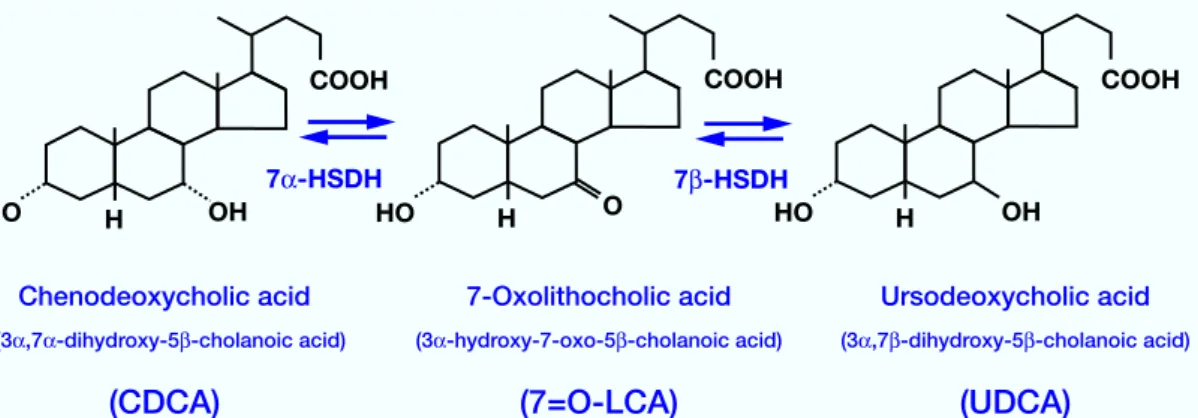
Ursodeoxycholic acid (UDCA), which is present in small amounts in human bile and intestine, is a useful therapeutic agent for dissolution of cho-lesterol gallstones (Sugata and Shimizu, 1974) and for treatment and prevention of hepatic dis-eases (Angulo et al., 1999). It is speculated that UDCA is generated from chenodeoxycholic acid (CDCA) through two-step reaction processes via 3 -hydroxy-7-oxo-5 -cholanoic acid (7=O-LCA) (by microbial biotransformation reactions) in
hu-man intestine as shown in Fig. 1. The first step, oxidation of the 7 -hydroxy group of CDCA, is carried out by 7 -hydroxysteroid dehydrogenase (7 -HSDH), and the second step, reduction of the 7-oxo group of 7=O-LCA, by 7 -hydroxysteroid dehydrogenase (7 -HSDH). In a previous paper, we reported the oxidation/reduction characteris-tics of 7 -hydroxyl bile acids by Eschericha coli, a facultative anaerobe, under aerobic and anaero-bic conditions (Ogura et al., 2005). Meanwhile,
one strain of Bacteroides (Bacteroides sp. strain T-40) was isolated from healthy human feces, in which a relatively high amount of UDCA was detected, and this bacterium was found to have the highest 7 -HSDH activity among bacteria iso-lated from the feces. In the present experiments, we examined the effect of Bacteroides sp. T-40, an obligate anaerobe, on bile acid biotransforma-tion (the first step for producbiotransforma-tion of UDCA) in an anaerobic culture system.
Materials and Methods Chemicals
CA, CDCA, hyocholic acid (HCA), and glyco-cholic acid (GCA) were purchased from Sigma Chemical, St. Louis, MO. -Muricholic acid ( -MCA) and -muricholic acid ( -MCA) were synthesized according to the methods reported by Iida et al. (1989). 3 ,12 -Dihydroxy-7-oxo-5 - cholanoic acid (7=O-DCA) and 7=O-LCA were prepared by the oxidation of CA and CDCA with N-bromosuccinimide (Fieser and Rajagopa-lan, 1949), respectively. 7 ,12 -Dihydroxy-5 - cholanoic acid ( ), glycine-conjugated 7 ,12 - dihydroxy-5 -cholanoic acid (G- ), and taurine-conjugated 7 ,12 -dihydroxy-5 -cholanoic acid (T- ) were synthesized as described previously
(Arimoto et al., 1982; Yamaga et al., 1987), and used as internal standards for analysis of bile ac-ids by capillary gas-liquid chromatography (GLC). These bile acids were estimated to be more than 96% pure so far examined by capillary GLC. Di-methylethylimidazole was purchased from Tokyo Kasei Kogyo, Tokyo, Japan. Piperidinohydroxy-propyl dextran gel (PHP GEL) was purchased from Shimadzu, Kyoto, Japan. The other reagents and solvents of analytical grade were obtained from Wako Pure Chemical Industries, Osaka, Japan. If not otherwise stated, the solvents were distilled once before use.
Bacteroiological procedures
Eighty-four strains (E. coli: 4, Enterococcus: 12, Bacteroidaceae 38, Bifidobacterium: 8, Eubac-terium: 5, Clostridium: 1 and unidentified anaer-obes: 6) were isolated from a human fecal sample using 3 non-selective and 7 selective agar plates (Narushima et al., 2006) and characterized on bases of colony form, Gram stain, morphology, growth in air and spore formation (Mitsuoka et al., 1965). Each strain was cultured anaerobically for 3 days in a modified peptone yeast extract glucose (MPYG) medium (Hirano et al., 1981; Takahashi and Morotomi, 1994) containing CA and the bile acids transformed from CA were ex-amined by thin-layer chromatography (Van den
Fig. 1. Reaction sequences of chenodeoxycholic acid (CDCA), 3 -hydroxy-7-oxo-5 -cholanoic acid (7=O-LCA) and ursodeoxycholic acid (UDCA). 7 -HSDH, 7 -hydroxysteroid dehydrogenase; 7 -HSDH, 7 -hydroxysteroid dehydro-genase.
Ende et al., 1982) and GLC (Ogura et al., 2003). The colony (Bacteroides sp. T-40) which showed the highest production of 7=O-DCA was selected for the present experiment. Strain T-40 was fi-nally identified by approximately 1,500 bp of the 16S rDNA gene according to methods published previously (Miyamoto and Itoh, 2000). Although this sequence suggested strong similarity for the species in Bacteroides cluster, the sequence ho-mology between strain T-40 and type strains in the Bacteroides cluster was less than 95%. E. coli K-12 which possesses 7 -HSDH (Ogura et al., 2003) was obtained from the American Type Culture Collection, Manassas, VA. Both bacteria, the strain T-40 and E. coli K-12, were precultured anaerobically in MPYG medium (Hirano et al., 1981; Takahashi and Morotomi, 1994) at 37˚C for 1 day by the gas-pack method (BBL Gas Pak Anaerobic System; Becton Dikinson, Sparks, MD). Aliquots of the growth of the strain T-40 (8 107/10 µL) and K-12 (3 107/10 µL) were added
to 10 mL of MPYG medium containing 0.5 mM bile acid and cultured anaerobically at 37˚C for 4 days.
Analytical methods
Bile acids were extracted from the medium as previously described (Ogura et al., 2003). A por-tion of the cultured medium, 100 µL, was treated with 8 volumes of ethanol by warming for 10 min and then filtered. The filtrate was evaporated to dryness under a stream of nitrogen and the resi-due was hydrolyzed in alkaline solution. After hydrolysis, the reaction mixture was acidified with diluted hydrochloric acid and bile acids were extracted with diethylether. In the PHP GEL analysis, prior to the analysis of bile acids, , G- and T- as internal standards were added to 100 µL of the culture medium. The analyti-cal sample with the three internal standards was treated with 8 volumes of ethanol by warming for 10 min and then filtered. The filtrate was evapo-rated to dryness under a stream of nitrogen and the residue was subjected to PHP GEL column
chromatography to separate bile acids into free, glycine-conjugate and taurine-conjugate fractions (Yamaga et al., 1987). Glycine-conjugate fraction was hydrolyzed in alkaline solution (Yamaga et al., 1997). The hydrolysate and free fraction were acidified with diluted hydrochloric acid, and the bile acids were extracted with diethylether. The extracted bile acids were converted into methyl ester dimethylethylsilyl ether (Me-DMES) deriva-tives as described previously (Yamaga et al., 1987, 1996). The methyl ester of 7=O-LCA was con-verted to its methoxime derivative as described by Horning et al. (1968), to separately determine this compound and CDCA by GLC.
Capillary GLC
An aliquot of the bile acid derivatives dissolved in n-hexane was injected into a gas chromato-graph (Model G14A; Shimadzu) equipped with a flame ionization detector, a solventless injector, and a computerized data system (Model C-R4A; Shimadzu). A Hicap CBP-1 capillary column (25 m 0.25 mm I.D.; Shimadzu) was used. The column temperature was maintained at 285˚C and helium was used as the carrier gas.
Experiments with cell-free enzyme prepa-ration
Crude 7 -HSDH was prepared from Bacteroides sp. T-40 according to the method of Macdonald et al. (1973). The enzyme activity was assayed for bile acid transformation by a slight modification of the method reported by Macdonald et al. (1974, 1975). The reaction was performed at 37˚C for 10 min with 7 mM NAD+, 0.2 M glycine-NaOH
buffer (pH 9.5), 0–4 mM bile acid and 45 µL of the crude enzyme preparation in final volume of 1 mL. One unit of enzyme activity of 7 -dehydro-genation was defined as the amount of enzyme re-quired to yield 1 nmole of NADH per min under the conditions described above.
Results
The time course of changes in the 7 -de-hydrogenation of cholic acid (CA), cheno-deoxycholic acid (CDCA), hyocholic acid (HCA) and -muricholic acid ( -MCA) by Bacteroides sp. T-40 under anaerobic con-ditions is shown in Fig. 2. CA and CDCA were rapidly oxidized to 3 ,12 -dihydroxy-7-oxo-5 -cholanoic acid (7=O-DCA) and 3 - hydroxy-7-oxo-5 -cholanoic acid (7=O-LCA), about 80% being transformed in 4 days. In the present experiments, CA was oxidized mostly to 7=O-DCA and little or no further transformations were detected so far examined by GLC. HCA was 7 -dehydrogenated, but to a lesser extent than CA or CDCA. -MCA has a 7 -hydroxyl group but not 7 -dehydrogenated. On the other hand, - muricholic acid ( -MCA) and ursodeoxycholic acid (UDCA), possessing a 7 -hydroxy group, were not changed (data not shown). In addition, CA and CDCA were not transformed to
deoxy-Fig. 2. Dehydrogenation of cholic acid (CA), cheno-deoxycholic acid (CDCA), hyocholic acid (HCA) and
-muricholic acid ( -MCA) by Bacteroides sp. T-40 in anaerobic culture system. The strain was precultured anaerobically in modified peptone yeast extract glucose (MPYG) medium at 37˚C for 1 day by use of the gas-pack method. The aliquots (10 µL) was added to 10 mL of MPYG medium containing 0.5 mM bile acid and cultured at 37˚C for 4 days. Bile acids were extracted from the medium, and analyzed by capillary gas liq-uid chromatography. 7=O-DCA, 3 ,12 -dihydroxy-7-oxo-5 -cholanoic acid; 7= O-LCA, 3 -hydroxy-7-oxo-5 -cholanoic acid; 7=O-HDCA, 3 ,6 oxo-5 -cholanoic acid; 7=O-3 6 , 3 ,6 -dihydroxy-7-oxo-5 -cholanoic acid.
Fig. 3. Oxidation of cholic acid (CA) and reduction of 3 ,12 -dihydroxy-7-oxo-5 -cholanoic acid (7=O-DCA) by Bacteroides sp. T-40 and E. coli K-12. The two strains were cultured in anaerobic culture system as described in Fig.2. Bile acids were extracted from the medium, and analyzed by capillary gas-liquid chromatography.
������ ������ ������ ������ ������ ������ ������ ����� ������
Fig. 4. Conversion of glycocholic acid (GCA) to 3 ,12 - dihydroxy-7-oxo-5 -cholanoic acid (7=O-DCA) by
Bac-teroides sp. T-40. The strain was cultured in anaerobic culture system as described in Fig. 2. Bile acids were extracted from the medium without the fractionation by a piperidinohydroxypropyl dextran gel (PHP GEL) column, hydrolyzed and analyzed by capillary gas-liquid chromatography.
Fig. 5. Gas-liquid chromatograms of bile acids in the nonamidate and glycine-conjugate fractions after a piperidi-nohydroxypropyl dextran gel (PHP GEL) column. The medium cultured with 0.5 mM glycocholic acid (GCA) for 4 days was added three internal standard compounds, 7 ,12 -dihydroxy-5 -cholanoic acid ( ), glycine-conjugated 7 ,12 -dihydroxy-5 -cholanoic acid (G- ) and taurine-conjugated 7 ,12 -dihydroxy-5 -cholanoic acid (T- ), and then fractionated by PHP GEL column. Each fraction was hydrolyzed and the bile acids were converted into ME-DMES derivatives. , 7 ,12 -dihydroxy-5 -cholanoic acid; CA, cholic acid; 7=O-DCA, 3 ,12 -dihydroxy-7-cholic acid (DCA) and litho-dihydroxy-7-cholic acid (LCA) in
anaerobic culture.
The transforming activities of Bacteroides sp. T-40 and E. coli K-12 are given in Fig. 3 which shows the time course of changes in the 7 - dehydrogenation of CA, and in the reverse reac-tion, reduction of 7=O-DCA to CA. Although E. coli K-12 oxidized CA to 7=O-DCA about 50% by 4 days, the strain T-40 showed a much higher activity than K-12, oxidizing about 50% in 1 day and about 80% in 4 days. The reduction of 7=O-DCA to CA by these bacteria was slower than the oxidation of CA to 7=O-DCA.
Figure 4 shows the conversion of glycocholic acid (GCA) by the strain T-40. In the present ex-periment, the samples were hydrolyzed at first and then analyzed by GLC. About 30% of GCA was converted to 7=O-DCA in 4 days.
It was not clear from the data of Fig. 4 whether GCA was oxidized to 7=O-DCA with or
without deconjugation. Therefore, the medium cultured with GCA for 4 days was fractionated to taurine-conjugated, glycine-conjugated and
nonamidate bile acid fractions by PHP GEL col-umn chromatography. After that, each fraction was hydrolyzed and subjected to GLC analysis. As shown in Fig. 5, 7 ,12 -dihydroxy-5 -chola-noic acid ( ) and CA were detected only in the glycine-conjugated fraction but 7=O-DCA was detected only in the nonamidate bile acid frac-tions. The bile acids were detected as free bile acids after hydrolysis, but these bile acids found in the glycine-conjugated fraction are shown as G- and GCA in Fig. 5.
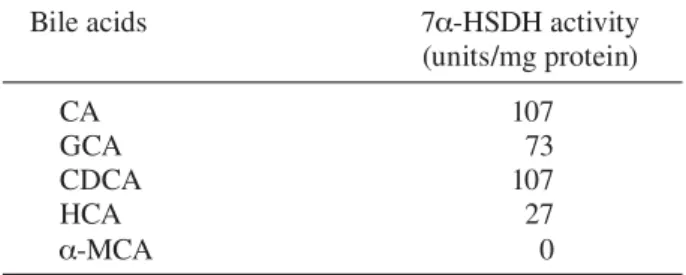
Subsequently, substrate specificity of the cell-free enzyme preparation of the strain T-40 was examined. CA and CDCA showed the highest responses, GCA showed about a 70% response and -MCA, though this bile acid possesses a 7 - hydroxyl group, showed no response (Table 1).
Discussion
The major conversions of bile acids by intestinal bacteria include deconjugation of taurine- or gly-cine-conjugated bile acids, oxidation of hydroxyl groups at C-3, C-7 and C-12, and dehydroxylation of 7 - or 7 -hydroxyl group. In the present study, we examined the characteristics of bile acid con-version by Bacteroides sp. T-40 that possesses high 7 -hydrogenation activity.
7 -HSDH is a widely distributed enzyme among several types of bacteria, and has been par-tially purified from intestinal bacteria including Bacteroides fragile (Hylemon and Sherroed, 1975) and E. coil (Aries and Hill, 1970). Macdonald and Roach (1981) have reported that Clostridium ab-sonus has both 7 - and 7 -HSDH activities. 7 - HSDH is a non-inducible intracellular enzyme with substrate specificity for bile acids (both free and conjugated) having a 7 -hydroxyl group (Haselwood and Haslewood, 1976). In a previ-ous paper (Ogura et al., 2005), we reported that E. coli K-12, a facultative anaerobe, oxidized CA and CDCA to the corresponding 7-oxo-bile acids, which in turn were reduced to CA and CDCA, re-spectively.
In the present experiments, the rate of CA conversion by Bacteroides sp. T-40 was found to be higher than that by E. coli K-12 in anaerobic culture, but -MCA, which has a 7 -hydroxyl group, was not dehydrogenated. UDCA and - muricholic acid ( -MCA), both have a 7 -hydrox-yl group, could not be substrates for this reaction under the same conditions. In addition, the strain T-40 was unable to convert CA to deoxycholic acid (DCA) and CDCA to lithocholic acid (LCA). These data indicate that Bacteroides sp. T-40 has 7 -dehydrogenation activity, but has neither 7 - dehydrogenation nor 7 / -dehydroxylation activ-ity.
The substrate specificity of 7 -HSDH of the strain T-40 was examined using the cell-free crude enzyme preparation. CA, CDCA, GCA and HCA were 7 -dehyrogenated in the order of CA = CDCA > GCA > HCA, but -MCA was not. This nature was the same as that obtained with E. coli K-12 (Ogura et al., 2005), suggesting that 6 -sub-stitution of the CDCA molecule with a hydroxyl group decreases the activity, and 6 -substitution completely blocks the activity.
Table 1. Dehydrogenation of bile acids in vitro by crude 7 -hydroxysteroid dehydrogenase (7 -HSDH) prepared from Bacteroides sp. T-40
Bile acids 7 -HSDH activity
(units/mg protein) CA 107 GCA 73 CDCA 107 HCA 27 -MCA 0
The reaction was performed at 37˚C for 10 min with 7 mM NAD+, 0.2 M glycine-NaOH buffer (pH 9.5), 4 mM
bile acid and 45 mL of the crude enzyme preparation in final volume of 1 mL. One unit of enzyme 7 -dehydro-genation activity was defined as the amount of enzyme required to yield 1 nmole of NADH per min under the conditions described above.
CA, 3 ,7 ,12 -trihydroxy-5 -cholanoic acid; GCA, gly-cine-conjugated 3 ,7 ,12 -trihydroxy-5 -cholanoic acid; CDCA, 3 ,7 -dihydroxy-5 -cholanoic acid; HCA, 3 ,6 , 7 -trihydroxy-5 -cholanoic acid; -MCA, 3 ,6 ,7 - trihydroxy-5 -cholanoic acid.
7 -Dehydroxylation of bile acids by intestinal bacteria is considered to take place after decon-jugation (Aries and Hill, 1970). When GCA was cultured with the strain T-40, 3 ,12 -dihydroxy-7-oxo-5 -cholanoic acid (7=O-DCA) was not de-tected in the glycine-conjugated fraction, but was detected in the nonamidate fraction. These data indicate that GCA is deconjugated at first and then dehydrogenated, suggesting that the strain T-40 possesses both enzymes, hydrolase and 7 - dehydrogenase.
In conclusion, our results have shown that Bacteroides sp. T-40 possesses both deconjuga-tion activity and 7 -dehydrogenadeconjuga-tion activity for bile acids having a 7 -hydroxy group except for - MCA, but possesses neither 7 -dehydrogenation nor 7 / -dehydroxylation activity. These findings indicate that Bacteroides sp. T-40 will be a prom-ising probiotic bacterium for production of UDCA.
Acknowledgments: This work was supported by Grant-in Aid for Scientific Research from the Yakult Bio-Science Foundation (2006).
References
1 Angulo P, Batts KP, Therneau TM et al. Long-term ursodeoxycholic acid delays histological pro-gression in primary biliary cirrhosis. Hepatology 1999;29:644–647.
2 Aries V, Hill MJ. Degradation of steroids by intes-tinal bacteria II Enzymes catalyzing the oxidoreduc-tion of the 3 -, 7 -, and 12 -hydroxyl group in cho-lic acid, and the dehydroxylation of the 7-hydroxyl group. Biochim Biophys Acta 1970;202:535–543. 3 Arimoto K, Adachi K, Yamaga N. 7 ,12
-Dihy-droxy-5 -cholan-24 oic acid as an internal standard for quantitative determination of bile acids by gas chromatography. Steroids 1982;39:631–641.
4 Fieser LF, Rajagopalan S. Selective oxidation with
N-bromosuccinimide. I. Cholic acid. J Am Chem Soc 1949;71:3935–3938.
5 Haslewood ES, Haslewood GAD. The specificity of a 7 -hydroxysteroid dehydrogenase from
Escherich-ia coli. Biochem J 1976;33:59–72.
6 Hirano S, Nakama R, Tamaki M, Masuda N, Oda H. Isolation and characterization of thirteen intestinal microorganisms capable of 7-alpha-dehydroxylating
bile acids. Appl Environ Microbiol 1981;41:737–745. 7 Horning GH, Moss MA, Horning CE. Formation
and gas-liquid chromatographic behavior of isomet-ric steroid ketone methoxime derivatives. Anal Bio-chem 1968;22:284–294.
8 Hylemon PB, Sherrod JA. Multiple form of 7 - hydroxysteroid dehydrogenase in selected strain of
Bacteroides fragilis. J Bacteriol 1975;122:418–424. 9 Iida T, Momose T, Tamura T, Matsumoto T, Chang
FC, Goto J, et al. Potential bile acid metabolites. 14. Hyocholic and muricholic acid stereoisomers. J Lipid Res 1989;30:1266–1279.
10 Macdonald IA, Roach PD. Bile salt induction of 7 - and 7 -hydroxysteroid dehydrogenases in
Clostridi-um absonus. Biochim Biophys Acta 1981;665:262– 269.
11 Macdonald IA, Williams CN, Mahony DE. 7 - Hydroxysteroid dehydrogenase from Escherichia
coli B: preliminary studies. Biochim Biophys Acta 1973;309:243–253.
12 Macdonald IA, Williams CN, Mahony DE. A 3 - and 7 -hydroxysteroid dehydrogenase assay for conjugated dehydroxy-bile acid mixtures. Anal Bio-chem 1974;57:127–136.
13 Macdonald IA, Williams CN, Mahony DE, Christie WM. NAD- and NADP-dependent 7 -hydroxyster-oid dehydrogenases from Bacter-hydroxyster-oides fragilis. Bio-chim Biophys Acta 1975;384:12–24.
14 Mitsuoka T, Sega T, Yamamoto S. Eine verbesserte Methodic der quailtativen und quantitativen Analyse der Darmflora von Menschen und Tieren. Zbl Bak-teriol I Orig 1965;195:455-496.
15 Miyamoto Y, Itoh K. Bacteroides acidifaciens sp. nov., isolated from the caecum of mice. Int J Syst Bacteriol 2000;50:145-148.
16 Narushima S, Itoh K, Miyamoto Y, Park SH, Nagata K, Kuruma K, et al. Deoxycholic acid formation in gnotobiotic mice associated with human intestinal bacteria. Lipids 2006;41:835-843.
17 Ogura Y, Yamaga N, Kido Y, Katayama R, Yamada K, Uchida K. Aerobic and anaerobic biotransforma-tion of bile acids by Escherichia coli (I). Bioscience Microflora 2003;22:133–137.
18 Ogura Y, Yamaga N, Suzuki T, Kimura K, Kido Y, Yamada K, et al. Aerobic and anaerobic biotrans-formation of bile acids by Escherichia coli (II): no conversion of -muricholic acid by 7 -hydroxyster-oid dehydrogenase of E. coli. Bioscience Microflora 2005;24:41–44.
19 Sugata F, Shimizu M. [Retrospective studie on gall-stone disappearance.] Jpn J Gastroenterol 1974; 71:75–80 (in Japanese).
20 Takahashi T, Morotomi M. Absence of cholic acid 7-alpha-dehydroxylase activity in the strains of
Lactobacillus and Bifidobacterium. J Dairy Sci 1994;77:3275–3286.
1982;121:95–109.
22 Yamaga N, Adachi K, Kohara H, Shimizu K. Inter-nal standards for quantitative gas chromatography of individual bile acids after group separation of bile acids in urine. J Chromatogr 1987;422:25–32. 23 Yamaga N, Ikebuchi J, Kohara H, Ogura Y, Yamada
K. Analysis of bile acids in urine specimens from healthy humans: determination of several bile acids
of alkaline hydrolyzing conditions of conjugated bile acids with carbonyl group. Yonago Acta Med 1997;40:73–77.
Received March 19, 2007; accepted June 15, 2007 Corresponding author: Yoshio Ogura, PhD