1Department of Oral Implantology, Osaka Dental University, 1–5–17 Otemae Chuo-ku, Osaka 540– 0008, Japan
2Department of Oral Diagnosis and Interdisciplinary Dentistry, Osaka Dental University Hospital, 1–5–17 Otemae Chuo-ku, Osaka 540–0008, Japan
Improvement of occlusal balance and quality of life in patients by restoration with dental implant
Masaaki HONDA1, Yoichi YAMADA1, Sayaka NAKAMURA-YAMADA1, Tomoya HARA1, Tadasuke TANIOKA2, Kaoru KUSANO1, Shunsuke BABA1
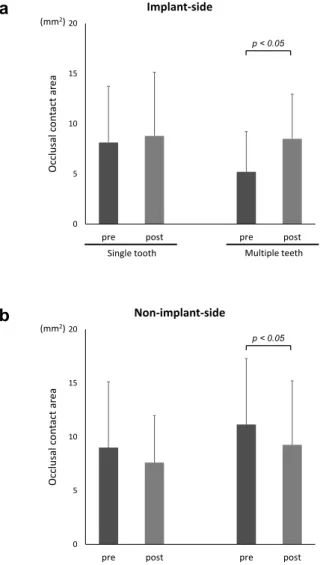
Abstract: Restorations with dental implant have been widely used in missing teeth. However, it has little showed the usability, occlusal efficiency and the patients’ satisfaction (Quality of life) objectively. Occlusal contact area, the bite force and oral health-related quality of life (OHRQoL) using the General Oral Health Assessment Index (GOHAI) questionnaire were measured for partially edentulous patients who received dental implant therapy. The occlusal contact area and the bite force of post-prostheses were significantly higher than that of pre-prostheses at the implant-side (p < 0.05). The contact area and bite force ratio showed no significantly differences between implant-side and non-implant-side after prostheses, indicating that the balance of occlusal distribution was improved. Occlusal contact area in multiple teeth missing cases was significantly increased in post-prostheses at implant-side (p < 0.05), but no statistically significant differences in single tooth missing cases. GOHAI scores was significantly increased after prostheses (p < 0.01) in multiple teeth missing cases, whereas no significantly differences between before and after prostheses in single tooth missing cases. Taken together, implant- retained prostheses improved the occlusal function and balance, and it might be useful for restoration of masticatory function and improvement of OHRQoL, especially in multiple teeth missing cases.
Key words: dental implant, occlusal balance, quality of life (QOL)
原 著
Introduction
Recently, it has gone of super-aged society, improvement of quality of life (QOL) has become essential. Prosthetic treatment for missing teeth is important from QOL point of view. It is related to masticatory efficiency, speaking abilities, sensuousness, nutrition intake, and psychological satisfaction obtained by eating.
Prosthetic patterns have reported to be highest significance to mastication and appearance of their prosthesis1). Most notably, fixed dental
prostheses supported by dental implants are preferred treatment for replacing the missing teeth due to their high predictability, success rate and restoration of the esthetics and function of the tooth2,3). The implants have been used increasingly in prosthodontics.
Occlusion plays an important role in the functional and biological aspects of the implant prosthesis. A stable, well-maintained occlusion can reduce mechanical and biological complications and it leads to the longevity of the prosthesis and the remaining teeth4). The loss of
occlusal support due to missing posterior teeth increases the remaining region’s loading and is difficult to achieve patient satisfaction with functional reconstruction by using the traditional method5). On the other hand, dental implant treatment enables the use of fixed prosthesis that provide a satisfactory result for patients. The masticatory ability is dependent on the number of teeth present1). It has reported that the evaluation of the occlusal contact area, occlusal force, and masticatory efficiency can be useful for assessing masticatory function6). In addition, the maximum bite force that are related to the masticatory performance and efficiency are positively correlated with the occlusal contacts and the occlusal area of natural teeth, and the number of teeth7).
Teeth loss has a negative influence on the Oral Health-Related Quality of Life (OHRQoL)
8). OHRQoL is an integral part of general health that includes a subjective evaluation of the individual’s oral health, functional well-being, emotional well-being, and so on9). To assess OHRQoL, several tools has been reported such as the Oral Health Impact Profile (OHIP) and the Geriatric Oral Health Assessment Index (GOHAI). The GOHAI that was originally introduced in 1990 is one of the most major instrument to measure OHRQoL and translated into different language including Japanese 10,11). Previous reports indicated that implant therapy seems to have a positive effect on OHRQoL12).
There were reports that overdentures with dental implant could improve bite force, and patient’s satisfaction13). However, there were only few studies about the effect of implant- retained fix prostheses on occlusal function and OHRQoL. The aim of the present study was to evaluate alteration and effectiveness of the occlusal contact area, bite force, improvement of QOL and the expediency with the implant treatment in the number of them, single or multiple teeth missing cases.
Materials and methods
Patients
The subjects were partially edentulous patients who received dental implant therapy. Patients with unilateral missing teeth were included in this study. The following patients were excluded:
patients with dental implant overdentures, patients who received immediate loading implants. This study was approved by the Ethics Committee of Osaka Dental University (111046). All participants received verbal and written informed consents prior to participating in the study.
Clinical procedure
All implants (Straumann, Nobel Biocare, Astra Tech Dental, Kyocera, Zimmer Biomet Dental, or Ankylos implants) were installed according to the manual and standard procedures using a two-stage procedure. After a healing period of about 3 to 6 months, the implants were uncovered and healing abutments were connected. The implant-supported fixed prostheses were placed for their edentulous spaces.
Occlusal contact area and occlusal bite force measurements
Occlusal contact area and occlusal bite force were measured with a pressure-sensitive system with a pressure-sensitive foil (Dental Prescale II; Fuji Film, Tokyo, Japan). After recording, the foils were scanned by scanner (EPSON GT- X830; Epson, Tokyo, Japan) and analyzed using biteforce analyzer system (Biteforce analyzer software; Fuji Film) and visualized on the display screen. The measurements were performed three times for each patient and the average of three measurements was used. Occlusal contact area and occlusal bite force were calculated at pre- and post- prostheses, respectively. Occlusal contact area ratio was the percentage of implant-side or non-implant-side occlusal contact area in total occlusal contact area. Occlusal bite Improvement of occlusal balance and quality of life in patients by restoration with dental implant
force ratio was also calculated in the same manner.
Oral health-related quality of life
OHRQoL was evaluated using Japanese version of the GOHAI questionnaire. A total of 12 OHRQoL factors were rated on 5-point scales; 1 = always, 2 = often, 3 = sometimes, 4 = seldom, 5 = never. A higher GOHAI total score (range: 12-60) indicates higher OHRQoL.
Japanese version of GOHAI was used after submitting an application to iHope International (https://www.sf-36.jp/index.html) and receiving approval for its use.
Statistical analysis
The statistical analyses were performed using the SigmaPlot software 12.3. Differences of occlusal contact area and bite force between pre-prostheses and post- prostheses measurements were analyzed by paired t-test. Differences of occlusal contact area ratio and bite force ratio between implant-side and non-implant-side measurements were analyzed by paired t-test.
The Wilcoxon signed rank test was used to compare GOHAI score between pre-prostheses and post- prostheses. The Kruskal-Wallis test was used to compare GOHAI score of pre- prostheses and post- prostheses by number of missing teeth. A p value less than 0.05 was considered to be statistically significant.
Results
In total, 15 patients (5 male and 10 female) were included in this study. The average patients age was 64.4 years (range: 31-80 years). The characteristics of the patients were shown in Table 1. 4 patients received single implant, 8 patients received two implants, and 3 patients received three implants. 6 cases were maxilla and 9 cases were mandible.
The representative visualized images of occlusal measurement were shown in Figure 1a-
b (patient No. 7 and 9). The images showed that occlusal contact of edentulous spaces was recovered after prostheses placement. The occlusal load center that indicated the center of distributer occlusal load balance was biased to non-implant-side before prostheses placement.
After prostheses placement, the occlusal load center shifted to the center of dental arch.
In order to assess the influence of implant- retained prostheses on the occlusal distribution, occlusal contact area and occlusal bite force were analyzed. The comparison analyses showed that the occlusal contact area and occlusal bite force of post-prostheses placement were significantly higher than that of pre-prostheses placement at the implant-side (p < 0.05) (Figure 2a-b). At the non-implant-side, the occlusal contact area and occlusal bite force were significantly decreased after prostheses placement compared to before prostheses placement (p <
0.05). The total occlusal contact area showed no statistically significant differences between pre-prostheses and post-prostheses placement.
The total occlusal bite force was not also significantly different between pre-prostheses
Patient
(No.) Gender Age Region Number of
implants
1 F 70 ┌6 1
2 M 48 ┌6 1
3 M 58 ┌7 1
4 F 31 6┘ 1
5 F 70 6, 5┐ 2
6 M 72 7, 6┐ 2
7 F 75 └5, 6 2
8 F 63 7,6┘ 2
9 M 80 6, 5, 4┘ 2
10 F 74 7, 6, 5┐ 2
11 F 71 6, 5, 4┐ 2
12 F 67 6, 5, 4┘ 2
13 M 59 ┌5, 6, 7 3
14 F 55 ┌5 ,6, 7 3
15 F 73 7,6,5┘ 3
Table 1 Overview of the patients
and post-prostheses.
The balance of occlusal distribution was assessed by occlusal contact area ratio and occlusal bite force ratio. Before prostheses placement, occlusal contact area ratio and occlusal bite force ratio were significantly higher in non-implant-side compared to implant- side that had edentulous spaces. Occlusal contact area ratio and occlusal bite force ratio showed no significantly differences between implant-side and non-implant-side after prostheses placement, indicating that the balance of occlusal distribution was improved (Figure 3a-b).
To evaluate the changes in the occlusal distribution depends on the number of the missing teeth, occlusal contact area was compared.
In multiple teeth missing cases, occlusal contact area was significantly increased in post-
prostheses compared to pre-prostheses at implant-side (p < 0.05) and it was significantly decreased in post-prostheses at non-implant- side (Figure 4a-b). On the other hand, there was no statistically significant differences between pre-prostheses and post-prostheses placement in single tooth missing cases.
The total GOHAI scores was significantly increased after prostheses placement compared to before prostheses placement (p < 0.01) (Figure 5a). In multiple teeth missing cases, GOHAI scores was significantly increased after prostheses placement (p < 0.01), whereas there was no significantly differences between before and after prostheses placement in single tooth missing case (Figure 5b). In addition, GOHAI scores of single tooth missing cases and multiple teeth missing cases before prostheses placement showed significantly differences (p< 0.05).
Improvement of occlusal balance and quality of life in patients by restoration with dental implant
a
b
Pre-prostheses
Pre-prostheses
Post-prostheses
Post-prostheses
Figure 1 Representative images of occlusal measurements (patient No.7 (a) and 9 (b)).
The density of color indicates the degree of applied pressure.
Left; pre-prostheses, Right; post-prostheses, +; occlusal load center.
Improvement of occlusal balance and quality of life in patients by restoration with dental implant
0 5 10 15 20 25 30
pre post pre post pre post
Occlusal contact area
implant-side Non-implant-side Total (mm2)
0 200 400 600 800 1000
pre post pre post pre post
Bite force
implant-side Non-implant-side Total (N)
p < 0.05
p < 0.05
p < 0.05
p < 0.05
a
b
Figure 2 Occlusal contact area (a) and occlusal bite force (b) of pre-prosthesis and post-prostheses.
Occlusal contact area and occlusal bite force were calculated in implant-side, non-implant-side, and total, respectively. Bar: standard deviation. p < 0.05
0.0%
20.0%
40.0%
60.0%
80.0%
100.0%
implant non-implant implant non-implant Occlusal contact area ratio
Post-prostheses Pre-prostheses
p < 0.01
0.0%
20.0%
40.0%
60.0%
80.0%
100.0%
implant non-implant implant non-implant Bite force ratio
Post-prostheses Pre-prostheses
p < 0.01
a
b
Figure 3 Occlusal contact ratio (a) and occlusal bite force ratio (b) of implant-side and non-implant-side.
Occlusal contact area ratio and occlusal bite force ratio were calculated in pre-prosthesis and
post-prostheses, respectively. Bar: standard deviation. p < 0.01
Discussion
The masticatory performance is important factor in case of living energetic life with promising QOL in the present super-aged era.
Its function of edentulous patients is also significantly lost, compared with that of natural dentitions14). Generally, conventional removable dentures have been used for restoration of missing teeth. However, it is difficult to recover fully masticatory efficiency15). Evaluation of masticatory function using pressure detecting
sheet indicated that the biting forces were 35%
and 11% for the removable partial denture and complete denture wearers, respectively, compared with natural dentition16). On the other hand, fixed prostheses by dental implants are a preferred treatment for replacing missing teeth due to the high predictability and success rate
2,3). There may be presumed that implant- retained and/or -supported prostheses would be superior to conventional complete dentures which would represent the standard treatment for edentulous patients in a number of ways15). In
this study, we focused on occlusal condition such as occlusal contact and bite force that are associated with masticatory function and QOL, and assessed implant-retained prostheses. To make quantitative analyses of occlusal contact area and occlusal force in the intercuspal position, Dental Prescale II system was used in this time. The system has been widely performed for healthy dentate subjects, orthodontic patients, removable denture patients and so on17). Our results showed that the occlusal contact area and bite force were significantly
increased in implant-side by using dental implants-retained prostheses (Figure 2). The assessment of occlusal distribution demonstrated that there were significant differences in the ratio of occlusal contact area and bite force between implant-side and non-implant-side before prosthesis indicating that occlusal balance was leaning more towards non-implant-side. However, no significant differences were observed between these sides after prostheses (Figure 3). The results of occlusal load center also indicated that the occlusal balance changed to be toward Improvement of occlusal balance and quality of life in patients by restoration with dental implant
0 5 10 15 20
pre post pre post
Occlusal contact area
Implant-side
Multiple teeth Single tooth
p < 0.05 (mm2)
0 5 10 15 20
pre post pre post
Occlusal contact area
Non-implant-side (mm2)
p < 0.05
F
a
b
Figure 4 Occlusal contact area of pre-prosthesis and post-prostheses at implant-side (a) and at non-implant-side (b) in single tooth and multiple
teeth. Bar: standard deviation. p < 0.05
0 10 20 30 40 50 60 70
Pre-prostheses Post-prostheses
GOHAI total score
P < 0.01
0 10 20 30 40 50 60 70
single
tooth multiple
teeth single
tooth multiple teeth
GOHAI total score
Post-prostheses Pre-prostheses
P < 0.05 P < 0.01
a
b
Figure 5 A box-and-whisker plots comparing changes in GOHAI scores pre-prostheses and post-
prostheses placement (a). A box-and-whisker plots of GOHAI scores based on the number of
missing teeth (b).
the center of dental arch after prostheses placement (Figure 1). Therefore, dental implant prostheses may have a favorable effect on the distribution of implant-side occlusal force and occlusal contact area, and this approach would be able to restore the proper balance of occlusal force and area on the non-implant-side. On the other hand, no significant differences were observed in the total contact area and bite force post-prostheses compared to pre-prostheses.
Subsequently, we also investigated the effect of the dental implants’ numbers. The occlusal contact area at implant and non-implant-side showed no statistically significant differences between pre- and post-prosthesis in single implant cases, but it in multiple implants cases showed statistically significant differences (Figure 4). These results suggest that the use of implant prostheses in multiple implants cases might be effective for restoring the occlusal contact area and decreasing the occlusal load on the non-implant-side of residual natural teeth. It was reported that implant prostheses provide significant increases in the maximum occlusal force, contact area, and masticatory ability in patients treated with one to four implant- supported single crowns18). Other study also reported that the occlusal force and occlusal area on the implant-side significantly increased in 1stand 2ndmolars missing cases but not in only 1st molar missing cases19). Therefore, in multiple teeth cases, the use of an implant prosthesis might have a favorable effect on occlusal contact area, not single tooth case. However, associations between implant prostheses and development of a higher occlusal force and area, and functional improvement remain unknown 19).
Even overdenture cases treated with dental implants to support prosthesis, the masticatory function, satisfaction and QOL was higher than cases treated with conventional dentures20). In multiple teeth missing cases, GOHAI scores of post-prostheses (median: 48; range: 43-59) were higher than that of pre-prostheses (median: 38;
range: 26-52) indicating improvement of OHRQoL. On the other hand, in single tooth missing cases, GOHAI scores of pre-prostheses (median: 52.5; range: 41-59) and post-prostheses (median: 58; range: 56-60) did not show significant differences (Figure 5). The previous study reported that GOHAI scores showed strong relationship with number of remaining teeth11). Our group also indicated that GOHAI scores decreased as the number of occlusal supports decreased21). Since GOHAI scores of pre-prostheses in single tooth missing cases were comparable to that of Japanese national standard, no statistically significant improvement was shown. Therefore, QOL by this fixed dental implant restorations would be related to the number of missing teeth. The effect of implant treatment on OHRQoL might be higher in multiple implants cases.
In this study, dental prescale system was used to evaluate the occlusal distribution. This system is useful to measure occlusal contact area and occlusal bite force in intercuspal position. However, in general, people have their habitual chewing side and masticate at more useful side to crunch. The habitual chewing side might be related to the path of masticatory movement, masticatory rhythm, occlusion, and the dominant hand22). Since it might be difficult to record habitual masticatory movement in this system, further development to assessment occlusal performance is required.
Conclusion
Implant-retained prostheses significantly increased the occlusal contact area and bite force in implant-side and restored the proper balance of occlusal force and area in dental arch. In addition, occlusal area was significantly increased in multiple implants cases but not in single implant cases. Improvement of OHRQoL was also observed in multiple implants cases.
Taken together, implant-retained prostheses
might be useful for restoration of masticatory function, especially in multiple teeth missingcases.
Acknowledgement
We wish to thank Kazushige Tanaka and Ryutaro Konoki at Osaka Dental University, and members of the Department of Oral Implantology, Osaka Dental University for their help, encouragement, and contributions to the completion of this study.
Competing interests
The authors declare that they have no conflict of interests.
References
01)Gotfredsen K, Walls AW. What dentition assures oral function? Clin Oral Implants Res.
2007;18 Suppl 3:34–45.
02)Aglietta M, Siciliano VI, Zwahlen M, Brägger U, Pjetursson BE, Lang NK, et al. A systematic review of the survival and complication rates of implant supported fixed dental prostheses with cantilever extensions after an observation period of at least 5 years. Clin Oral Implants Res. 2009;20:441– 451.
03)Pjetursson BE, Brägger U, Lang NP, Zwahlen M. Comparison of survival and complication rates of tooth-supported fixed dental prostheses (FDPs) and implant-supported FDPs and single crowns (SCs). Clin Oral Implants Res.
2007;18 Suppl 3:97–113.
04)Goodacre CJ, Bernal G, Rungcharassaeng K, Kan JY. Clinical complications with implants and implant prostheses. J Prosthet Dent.
2003;90:121–132.
05)Zembic A, Wismeijer D. Patient-reported outcomes of maxillary implant-supported overdentures compared with conventional dentures. Clin Oral Implants Res. 2014;25:
441–450.
06)Sato S, Ohta M, Sawatari M, Kawamura H, Motegi K. Occlusal contact area, occlusal
pressure, bite force, and masticatory efficiency in patients with anterior disc displacement of the temporomandibular joint.
J Oral Rehabil. 1999;26:906–911.
07)Buschang PH. Masticatory ability and performance. Seminars in Orthodontics.
2006;12:92–101.
08)Steele JG, Sanders AE, Slade GD, Allen PF, Lahti S, Nuttall N, et al. How do age and tooth loss affect oral health impacts and quality of life? A study comparing two national samples. Community Dent Oral Epidemiol.
2004;32:107–114.
09)Sischo L, Broder HL. Oral health-related quality of life: what, why, how, and future implications. J Dent Res, 2011;90:1264-1270.
10)Atchison KA, Dolan TA. Development of the Geriatric Oral Health Assessment Index. J Dent Educ. 1990;54:680–687.
11)Naito M, Suzukamo Y, Nakayama T, Hamajima N, Fukuhara S. Linguistic adaptation and validation of the general oral health assessment index in an elderly Japanese population. J Publ Health Dent. 2006;66:273–275.
12)Nickenig HJ, Wichmann M, Terheyden H, Kreppel M. Oral health-related quality of life and implant therapy: A prospective multicenter study of preoperative, intermediate, and posttreatment assessment. J Craniomaxillofac Surg. 2016;44:753–757.
13)Boven GC, Raghoebar GM, Vissink A, Meijer HJ. Improving masticatory performance, bite force, nutritional state and patient's satisfaction with implant overdentures: a systematic review of the literature. J Oral Rehabil. 2015;42:
220–233.
14)Slagter AP, Bosman F, Van der Bilt A.
Comminution of two artificial test foods by dentate and edentulous subjects. J Oral Rehabil. 1993;20:159–176.
15)Carlsson GE, Omar R. The future of complete dentures in oral rehabilitation. A critical review. J Oral Rehabil. 2010;37:143–156.
16)Miyaura K, Morita M, Matsuka Y, Yamashita A, Watanabe T. Rehabilitation of biting abilities in patients with different types of dental prostheses. J Oral Rehabil. 2000;27:
1073–1076.
Improvement of occlusal balance and quality of life in patients by restoration with dental implant
17)Shiga H, Komino M, Uesugi H, Sano M, Yokoyama M, Nakajima K, Ishikawa A.
Comparison of two dental prescale systems used for the measurement of occlusal force.
Odontology. 2020;108:676–680.
18)Goshima K, Lexner MO, Thomsen CE, Miura H, Gotfredsen K, Bakke M. Functional aspects of treatment with implant-supported single crowns: a quality control study in subjects with tooth agenesis. Clin Oral Implants Res.
2010;21:108–114.
19)Kon K, Shiota M, Sakuyama A, Ozeki M, Kozuma W, Kawakami S, Kasugai S. Evaluation of the Alteration of Occlusal Distribution in Unilateral Free-End and Intermediate Missing Cases. J Oral Implantol. 2017;43:3–7.
20)Bakke M, Holm B, Gotfredsen K. Masticatory function and patient satisfaction with implant- supported mandibular overdentures: a prospective 5-year study. Int J Prosthodont.
2002;15:575–581.
21)Kanehira Y, Arai K, Kanehira T, Nagahisa K, Baba S. Oral health-related quality of life in patients with implant treatment. J Adv Prosthodont. 2017;9:476–481.
22)Takahashi M, Takahashi F, Morita O.
Evaluation of the masticatory part and the habitual chewing side by wax cube and bite force measuring system (dental prescale). Nihon Hotetsu Shika Gakkai Zasshi. 2008;52:513– 520.