Difference in Leaf Area Development of Hand-pruned and Machine-hedged 'Concord' Grapevines Managed by
Conventional and Organic Viticultural Methods
Junko Watanabe 1. 2, Robert M. Poo12 and Kazuo N. Watanabe3•4
Abstract
Modified protocols of the optical method using LAI 2000 Plant Canopy Analyzer were applied to estimate leaf area of Vitis labrusca L. cv. Concord grapevines with different pruning and cultural practices at growing seasons in 1993 and 1994.
Leaf area enlargement of 'Concord' grapevines was sigmodial. Leaf area increased exponentially just after bloom and then the rate of growth decreased for all treatments.
In both years, the difference in leaf area between hand-pruned and machine- hedged vines' was greatest in the early season and the difference became smaller toward the end of season. Smaller leaf area of hand-pruned vines in the early gr"owing seasons was due to: 1) fewer shoots and 2) similar shoot elongation rate of hand-pruned and machine-hedged vines. The difference was compensated at the late season due to larger leaf area per shoot of hand-pruned vines with vigorous lateral shoot growth than machine-hedged vines.
On the. .other hand, conventionally _ managed vines generally maintained significantly larger leaf area than organically managed vines throughout the whole growing season. The organically managed vines had shorter shoots, less lear' number per shoot, smaller individual leaves and less shoot per vines than the conventionally managed vines. The difference of leaf area between two different cultural methods became larger toward the end of the season. :Earlier senescence was also observed in the organic- plots.
Introduction
Since 1990, an interdisciplinary project has been proceeded to determine whole farm impact of converting conventionally managed vineyards in northeastern region of USA to organic management. This has been sponsored by the National Research and Extension Program on Low-Input Sustainable Agriculture (LISA, now SARE: Sustainable Agriculture Research and Extension) (1).
Among several parameters of vine growth and development, leaf area of the canopy combined with crop load, microcliamte and environmental stress has great effects on the fruitfulness of a grape cultivar 'Concord' (2, 3). There must be non destructive, rapid and accurate way to estimate leaf area. To meet with the parameters, we have tested LAI 2000 Plant Canopy Analyzer and elaborated the use of the equipment (4).
1. Department of General Education. Kinki University. Wakayama, 649-6493, Japan
2. Department of Horticultural Sciences. Cornell University. New York Agricultural Experimental Station. Geneva. NY 14456 3. Department of Biotechnological Science. Kinki University. Wakayama. 649-6493, Japan
4. Department of Plant Breeding and Biometry. Cornell University. Ithaca. NY 14853-1902
This study was designed by applying the modified optical technique to vineyards in order to compare leaf area development of hand-pruned with machine-hedged 'Concord' grapevines managed by conventional or organic viticultural methods.
Materials and Methods
Estimation of leaf area and measurement of shoot growth
Twenty-two hand-pruned Vitis labrusca L. cv. Concord vines and 20 machine- hedged ones were randomly selected from the conventionally managed blocks grown in a commercial vineyard in Dresden in N. Y., USA. Twenty-two hand- pruned vines and 20 machine-hedged ones were also selected in the organically managed vineyard sections where vines were. Hand-pruned vines were cane pruned (nodes were retained on several 10-15 nodes canes) with 30 nodes retained per vine. Machine-hedged vines were hedged with vertical cuts made at 7.6 cm from each side of the trellis wire. Row orientation was north-south with 274 cm row spacing. Vines were trained along two wires at 75 cm and 195 cm high, and spaced 244 cm apart. The double trunked, own rooted 'Concord' vines were planted in 1975.
Leaf Area Index (LAI) was estimated using the LAI 2000 Plant Canopy Analyzer (LI-COR, Lincoln, NE) for vines of four different treatments: 1) hand- pruning with conventional management; 2) hand-pruning with organic management; 3) machine-hedging with conventional management; 4) machine- hedging with organic management. In 1993, the readings were taken at five different times during the growing season along the center line of rows at 10 different positions with a 45° view angle. Because this procedure was found to be inappropriate for grapevine canopies (4), LAI was recalculated using only four readings which were found to be highly correlated with directly measured LAI. In 1994, a modified procedure for 'Concord' canopy was applied using a 90° view angle. The measurements were taken weekly from early May to late July biweekly in August and once in September, 1994.
LAI 2000 readings are not only affected by the light interception of leaves but also by other vines and trellis components. Not only the effect of trellis structure, but also impact of shoot, petiole, spur, cane, arm and cordon could be responsible ( 4 ). To account for the impact of over-wintering tissues, the pre-bud burst values of LAI were subtracted from the readings (uncorrected LA!) in 1994 to produce 'corrected LA!' values.
Length of twenty shoots of hand-pruned and forty shoots of machine-hedged vines was measured five times during 1993 growing season. In 1993, two measurements of LAI and shoot length in the organic and hedging treatment were omitted.
Length, leaf number, leaf width of twenty shoots of hand-pruned and of forty shoots of machine-hedged vines with and without clover cover crop were measured in late August in 1994. Total shoot number per vine of every vine was also counted at the same time.
Viticultural method
Soils in the vineyards are Lima silt loams and 36.5 kg nitrogen as ammonIum
nitrate per hectare was applied to the conventional blocks in late April or early May. Pelleted chicken manure (6.5% nitrogen, 5.3% available phosphoric acids, 4.2% potash) was applied at a rate of 1,400 kg/ha to organic blocks in late April or early May. Insect and disease management in the conventional blocks followed New York and Pennsylvania pest management recommendations for grapes (5). Sulfur and lime were used to control fungal disease in the organic blocks with variable frequency of application depending on the incidence and development of fungal disease. Biological controls for powdery mildew cuased by Uncinula necator, eastern grape leaf hopper (Erythroneura elegantula Osborn) and grape berry moth (Polychrosis viteana Clem.) were applied in the organic blocks.
Conventional in-the-row weed control was by a soil active applied herbicide before weed germination and spot treatment with a post-emergence control agent to weeds which later emerged. In the organic blocks, mechanical cultivation was done in early and late season. Propane burners were used in 1993 and mechanical cultivation was applied in 1994 to control weeds which emerged in- the-rows during the growing season; Weeds between rows were killed with glyphosate just before grape bloom in the conventional blocks, while the organic blocks row middles were covered by sod. To test the potential of beneficial effects of having legumes in the between-the-row area of the vineyard, sub-plots of white (alsike) clover, Trifolium hybridum L, were established in 1991.
Results
The elongation of primary shoots among four treatments in 1993
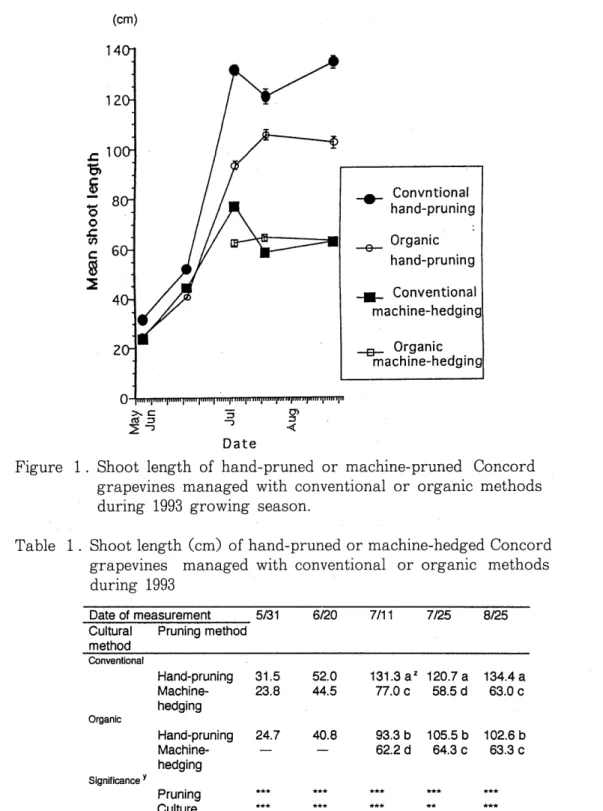
Shoots elongated at similar rates during May and early June (Fig. 1). The largest difference in shoot growth rate was found in the period between mid- June and middle July. Hand-pruned vine shoot in the conventional plots elongated rapidly during this period, while the growth rate of the machine-pruned vine shoot in the conventional plots was low. Shoot elongation essentially ceased after mid-July. Both pruning and culture methods significantly affected final shoot length (Table 1).
The development of canopy area among four different treatments in 1993 growing season
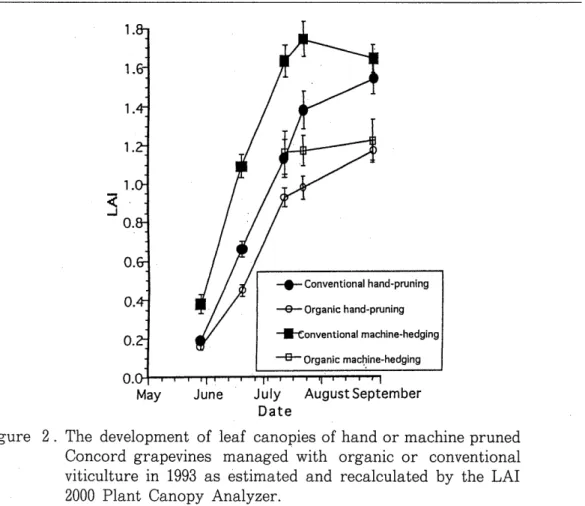
In 1993 there was a linear increase in LAI until mid to late July (Fig. 2).
Canopy growth ceased in mid-July for organic, machine-hedged vines and in late July for conventional, machine-hedged vines. In mid-July canopy growth of organically managed hand-pruned vines slowed and conventionally managed hand- pruned canopy growth slowed in late July.
Canopy size of machine-hedged vines in the 1993 conventional plots was significantly larger than for other vines until August 28 after when there was no significant difference of leaf area between machine-hedged and hand-pruned vines.
(Table 2). This is because conventionally managed machine-hedged vines terminated canopy growth in July, whereas all hand-pruned vines continued growth.
(cm)
.c. 10
'5>
i
'0 8 .c. en 0
c 6 :l ~
4
Date
-e-
Convntional hand-pruning -e- Organichand-pruning
-a- Conventional machine-hedging
-e- Organic machine-hedging
Figure 1. Shoot length of hand-pruned or machine-pruned Concord grapevines managed with conventional or organic methods during 1993 growing season.
Table 1. Shoot length (em) of hand-pruned or machine-hedged Concord grapevInes managed with conventional or organic methods during 1993
Date of measurement 5/31 6/20 7/11 7/25 8/25 Cultural Pruning method
method Conventional
Hand-pruning 31.5 52.0 131.3 aZ 120.7 a 134.4 a
Machine- 23.8 44.5 77.0c 58.5 d 63.0 c
hedging Organic
Hand-pruning 24.7 40.8 93.3 b 105.5 b 102.6 b
Machine- 62.2 d 64.3 c 63.3 c
hedging Significance Y
Pruning Culture PxC
Z Different letters within columns indicate significa'nt difference at 5% level using Fisher's protected LSD.
Y **, *** indicate significant difference at p=0.01 and p=0.001, respectively.
1.
1.
1.
<
1....J
o.
o.
o.
o.
-e-
Conventional hand-pruning-e-Organic hand-pruning -...conventional machine-hedging
o.rJ-...-...,..,..,...,.-~;:::;::::;~;;:::;::;;=r::;r:;---' May June July August September
Date
Figure 2. The development of leaf canopies of hand or machine pruned Concord grapevines managed with organic or conventional viticulture in 1993 as estimated and recalculated by the LAI 2000 Plant Canopy Analyzer.
Table 2. Effect of pruning and cultural methods on the development of leaf canopies (LAD which was estimated using LAI 2000 Plant Canopy Analyzer and recalculated in 1993
Date of measurement 5/28 6/19 7112 7/22
Cultural method Pruning method Conventional
Hand-pruning 0.19 0.66 1.13 1.38 Machine-hedging 0.38 1.09 1.63 1.74 Organic
Hand-pruning 0.16 0.45 0.93 0.98
Machine-hedging 1.16 1.17
Significance Z
Pruning ***
Culture NS
PxC NS NS
Z NS, **, *** indicate nonsignificant, significant at p=0.01 and 0.001, respectively.
8/28
1.54 1.64 1.17 1.22 NS NS
Leaf area development in 1994 growing season
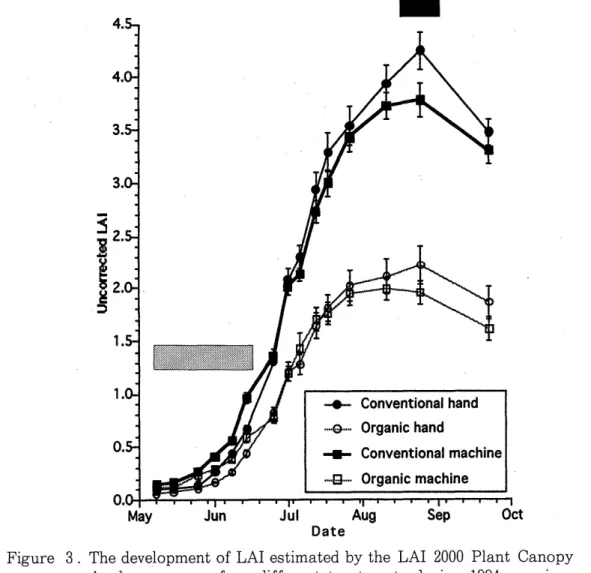
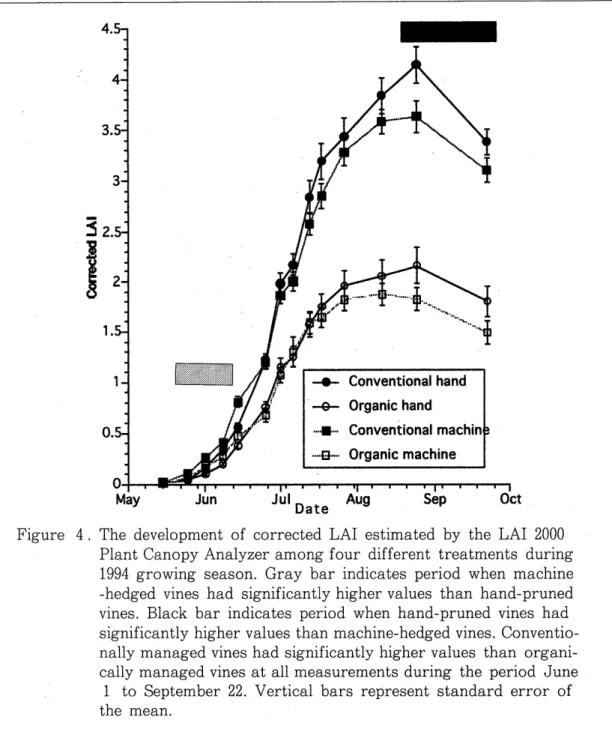
Leaf area index was measured at shorter intervals in 1994 than in 1993. The curves for the uncorrected LAI (Fig. 3) or corrected LAI (Fig. 4) against time
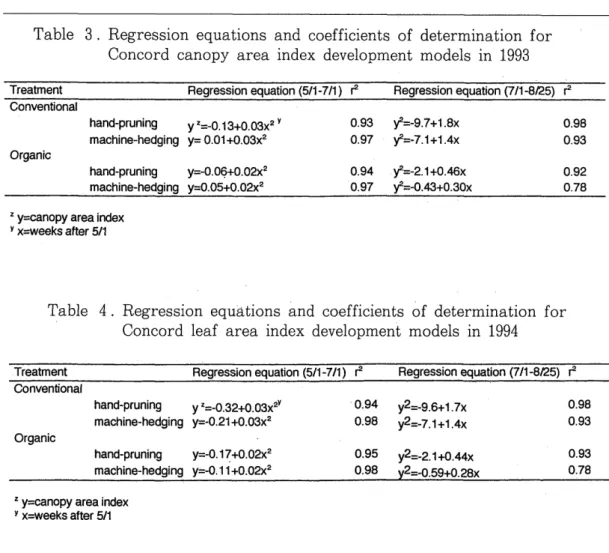
are sigmodial. L.eaf ·area, enlarged exponentially from bud break to the end of June, then the rate of enlargement gradually decreased. Regression equations for the sigmodial curves produced high coefficients of determination (Table 3 and Table 4). These models indicate that leaf area increase in the conventional plots was higher than that in the organic plots throughout the growing season. The rate of increase in the early season for hand-pruned vines was slightly higher than that for machine-hedged vines. In contrast, the rate of increase of hand- pruned vines in July and August was much higher than that of machine-hedged vInes.
3.
3.
o.
-
___ Conventional hand
.... 9.... Organic hand
___ Conventional machine
o.o.l-~~I"T""T""-r--T---r-I~::;::::;:::;;:::;::::;:::;=;::;:;:::;:::;::::;:;
May Jun Jul Aug Sep Oct
Date
Figure 3. The development of LAI estimated by the LAI 2000 Plant Canopy Analyzer among four different treatments during 1994 growing season. Gray bar indicates period when machine-hedged vines had significantly higher values than hand- pruned vines. Black bar indicates period when hand-pruned vines had significantly higher value than machine-hedged vines. Conventionally managed vines had significantly higher values than organically managed vines at all dates except May 25. Vertical bars represent standard error of the mean.
---
Conventional hand--e-
Organic hando. ...
Conventional machin ~.... G· .. · Organic machine
Jun Jul
D ate Aug Sep Oct
Figure 4. The development of corrected LAI estimated by the LAI 2000 Plant Canopy Analyzer among four different treatments during 1994 growing season. Gray bar indicates period when machine -hedged vines had significantly higher values than hand-pruned vines. Black bar indicates period when hand-pruned vines had significantly higher values than machine-hedged vines. Conventio- nally managed vines had significantly higher values than organi- cally managed vines at all measurements during the period June
1 to September 22. Vertical bars represent standard error of the mean.
Table 3. Regression equations and coefficients of determination for Concord canopy area index development models in 1993
Treatment Regression equation (5/1-7/1) f Regression equation (7/1-8/25) f Conventional
hand-pruning y z=-0.13+0.03x2 y 0.93 t=-9. 7+ 1.8x 0.98
machine-hedging y= 0.01 +0.03x2 0.97 i=-7.1+1.4x 0.93
Organic
hand-pruning y=-0.Oq+0.02x2 0.94 i=-2.1 +O.46x 0.92
machine-hedging y=0.05+0.02x2 0.97 i=-0.43+0.30x 0.78
Z y=canopy area index Y x=weeks after 511
Table 4. Regression equations and coefficients of determination for Concord leaf area index development models in 1994
Treatment Regression equation (5/1-7/1) f Regression.equation (711-8/25) f Conventional
hand-pruning y z=-0.32+0.03x2Y ·0.94 y2=-9.6+1.7x 0.98 machine-hedging y=-0.21 +0.03x2 0.98 y2=-7.1 +1.4x 0.93 Organic
hand-pruning y=-0.1~+0.02x2 0.95 y2=-2.1 +0.44x 0.93
machine-hedging y=-0.11 +0.02x2 0.98 y2=-0.59+0.28x 0.78
Z y=canopy area index Y x=weeks after 5/1
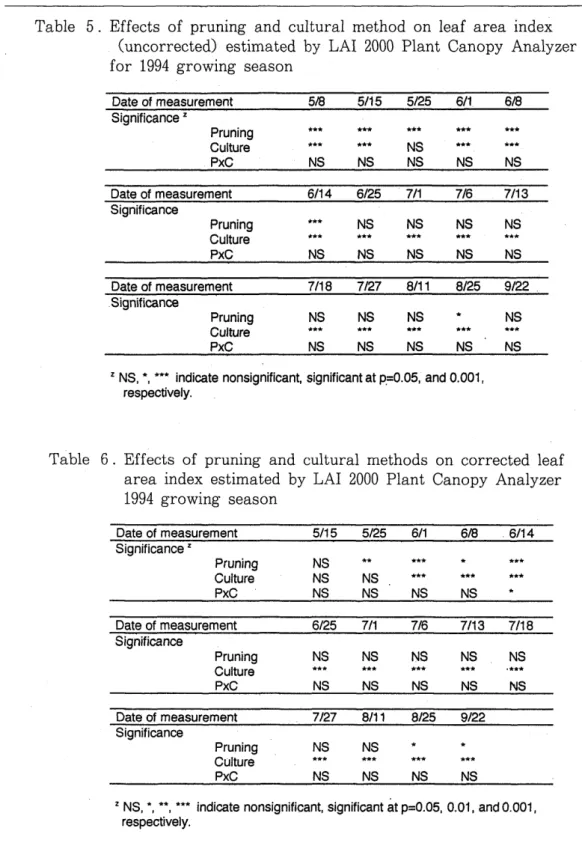
In the early season, machine-hedged vines in the conventional plots had the largest area, while the hand-pruned vines in the organic plots had the smallest leaf area (Table 5 and Fig. 3). At the end of June, there was no significant difference in leaf area of hand-pruned and machine-hedged vines (Table 5 and Table 6). The vines in conventional plots had significantly larger leaf area than those in the organic plots from the end of June toward until season's end.
The corrected LAI values differed from the uncorrected LAI (raw) values only during the first few weeks of the growing season (Fig. 3 and Fig. 4). Most interest in LAI to predict crop capacity is in the middle season when canopies are more fully developed. Thus the correction is only useful when early season values are important.
Table 5. Effects of pruning and cultural method on leaf area index (uncorrected) estimated by LAI 2000 Plant Canopy Analyzer for 1994 growing season
Date of measurement 5/8 5115 5/25 6/1 6/8 Significance Z
Pruning *** *** *** *** ***
Culture *** *** NS
PxC NS NS NS NS NS
Date of measurement 6/14 6/25 7/1 7/6 7/13 Significance
Pruning *** NS NS NS NS
Culture *** ***
PxC NS NS NS NS NS
Date of measurement 7/18 7/27 8/11 8/25 9/22 . Significance
Pruning NS NS NS NS
Culture *** ***
PxC NS NS NS NS NS
Z NS, *, *** indicate nonsignificant, significant at p=0.05, and 0.001, respectively.
Table 6. Effects of pruning and cultural methods on corrected leaf area index estimated by LAI 2000 Plant Canopy Analyzer 1994 growing season
Date of measurement 5/15 5/25 6/1 6/8 .6/14 Significance Z
Pruning NS ***
Culture NS NS *** ***
PxC NS NS NS NS
Date of measurement 6/25 7/1 7/6 7113 7/18 Significance
Pruning NS NS NS NS NS
Culture *** *** ***
PxC NS NS NS NS NS
Date of measurement 7/27 8111 8/25 9/22 Significance
Pruning NS NS
Culture *** *** ***
PxC NS NS NS NS
Z NS, *, **, *** indicate nonsignificant, significant at p=0.05, 0.01, and 0.001, respectively.
The effects of cultural practices and pruning methods on shoot and leaf area development of individual shoots
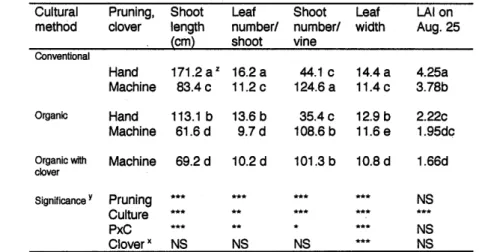
Both pruning and management methods affected shoot development in 1994 (Table 7). Machine-hedged vines had more shoots than hand-pruned vines and conventionally managed vines had more shoots than organically managed vines.
Leaf' number per shoot and leaf width were both greater on conventionally managed vines than on organically managed vines.
Table 7. The effects of cultural practice, pruning method and clover cover crop on shoot growth in late August in 1994
Cultural Pruning, Shoot Leaf Shoot Leaf LAlon method clover length number! number! width Aug. 25
{cm} shoot vine Conventional
Hand 171.2 a Z 16.2 a 44.1 c 14.4 a 4.25a Machine 83.4c 11.2 c 124.6 a 11.4 c 3.78b
Organic Hand 113.1 b 13.6 b 35.4 c 12.9 b 2.22c
Machine 61.6 d 9.7d 108.6 b 11.6 e 1.95dc Organic with Machine 69.2d 10.2 d 101.3 b 10.8 d 1.66d clover
Significance Y Pruning NS
Culture
PxC NS
Clover x NS NS NS NS
Z Different letters within columns indicate significant difference at 5% level using Fisher's protected LSD.
Y NS, *, **, *** indicate nonsognificant, significant at p:0.05, 0.01, and 0.001 respectively.
x NS, *** indicate nonsignificant and significant at p=0.001 using orthogonal contrast.
Hand-pruned vines had longer shoots, more leaves per shoot and greater leaf width than machine-hedged vines in 1994 (Table 7). All of these components were significantly reduced by organic management. Leaf area measured in late August in the conventional plots was twice as large as that in the organic plots in 1994.
Organic management significantly reduced leaf area during the whole 1994 season, except for the corrected LAI measured on May 15 and the uncorrected LAI measurement of May 25 (Table 5 and Table 6). Machine-hedged vines maintained significantly larger leaf area in the early to mid-season in 1994.
However, there was no significant effect of pruning method on leaf area after mid-season. In September, the leaf areas of hand-pruned vines were significantly larger than those of machine-hedged vines in 1994. The same tendency was observed in 1993. The effect of the cultural practices on canopy growth was less in 1993 than in 1994.
Discussion The patterns of leaf area development
Growth of the vegetative parts of 'Concord' was sigmodial for all treatments (Fig. 3). Shoots of 'Concord' elongated exponentially until late June to early July in 1993, when shoot elongation slowed. The same growth pattern for individual shoots was observed on 'Cape Riesling' in South Africa ( 6), 'Thompson Seedless' (7) and 'Sultana' in Australia (8), 'Cabernet Sauvignon' in California ( 9 ). The timing of decrease in shoot elongation rate varied depending on cultivar, environmental conditions and vineyard practices in these studies. Root temperature (9), and topping treatment (6) were reported to affect transition timing. In 1993 we could not determine if pruning method and/ or cultural practice affected the timing of decrease in shoot elongation due to very long interval between measurements.
Leaf area of 'Concord' also increased sigmodially with time (Fig. 4). Total leaf area and vegetative dry weight of 'Thompson Seedless' increased linearly as a function of GDDs (growing degree days) during the time between 150 and 1000 GDDs (7). Mean leaf area per shoot of 'Cape Riesling' exponentially increased until 80 days after bud break, when its growth slowed (6). The decrease in leaf area growth rate was observed between late June and middle July in 1993 (Fig.
2). The decline in leaf area growth was observed during July 1 and July 6 in 1994, around 55 days after bud break and 10 days after bloom. The increase in dry mass of shoots. is almost linear until fruit set, after which the majority of the dry mass production is partitioned to developing bunches (10).
The effect of pruning method on shoot growth
Pruning method had an influence on shoot elongation in early, but not in late season in 1993 (Table 1). The largest difference in LAI between hand-pruned and machine-hedged vines occurred in late May, approximately two weeks after bud break in 1994 when the corrected LAI of hand-pruned vines was 50% of that of machine-hedged vines (Fig. 4). Subsequently the difference became smaller. In 1994 about 1 week before bloom, hand-pruned vines was 73% of that of machine- hedged vines. For uncorrected LAI, the largest differences were observed on 5 /25 in 1994 (Fig. 4) and 5/28 in 1993. Uncorrected LAI of hand-pruned vines was 50% of that of machine-hedged vines in both years during the period of largest difference in canopy area. Uncorrected LAI of hand-pruned vines was 73
% of that of machine-hedged vines approximately 1 week before bud break and a few days after bloom there was no significant differences in 1994. However, there was still a significant difference (p ~ 0.001) between uncorrected LAI of hand-pruned and machine-hedged vines in July of 1993. (Table 1) The reason for different observations in 1993 and in 1994 could be due to different protocols used to estimate LAI or to different environmental conditions. The first year was dry especially in mid-season. Water stress at this time suppresses leaf growth. However, because of a narrower view angle used to estimate canopy area index in 1993 than in 1994, LAI may have been underestimated due to the view field concentrated along the canopy center line.
LAI did not differ between hand-pruned and machine-hedged vines in the same cultural practice at the end of August in 1993 (Table 2). In young apple trees, pruning did not affect total leaf area at full canopy (11, 12). May et al. (13) found that increasing the number of retained nodes on 'Sultana' vines did not increase pruning weights (weight of canes pruned) to a similar extent. The same tendency was observed for 'Concord' grapes in N. Y. (14). The pruning weight of 'Concord' vines with 30
+
10 balanced pruning was not significantly different from that with 60+
10 balanced pruning (15). These results could be either because of greater leaf area per primary shoot of hand-pruned vines or because of the contribution of lateral shoots of hand-pruned vines. These two aspects offset the effect of low shoot number due to hand-pruning on late season leaf area. Hand-pruned vines had significantly larger leaf area per shoot with more nodes Cleaves) per shoot and larger leaf size (Table 7).Hand-pruned vines had more lateral shoot development than did machine-hedged vines in our two year experiments. Cane pruned 'Cabernet Sauvignon' also had a higher proportion of leaf area on lateral shoots than did minimal pruned vines in Australia (Sommer, personal communication). The contribution at 1,000 GDD's of lateral shoots to the entire leaf area of the vines of cane pruned 'Thompson Seedless' averaged 20 % in a three year experiment (7). Pruning stimulated extension of shoot growth after petal fall of young apple trees (11). These results indicate that smaller leaf area of hand-pruned vines in the early season is due to: 1) fewer shoots; and 2) similar shoot elongation rates of shoots of hand-pruned and machine-hedged vines. The difference was compensated at late season due to larger leaf area per shoot of hand-pruned vines than machine- hedged vines with vigorous lateral shoots growth.
A similar pattern in primary shoot elongation was observed from bud break until middle June between hand-pruned and machine-hedged vines in 1993 (Fig.
1 ). Subsequently shoot elongation on hand-pruned vines continued, while that of machine-hedged vines essentially ceased. The study on 'Thompson Seedless' showed that largest leaf area enlargement rate of lateral shoots was observed between 400 and 800 GDDs, whereas that of primary shoots occurred between 150 and 1000 GDD (7). Therefore, it seems that hand-pruned vines would take advantage of the characteristics of vegetative growth during the middle of summer.
Leaf area of hand-pruned vines was significantly greater than that of machine- hedged vines in late August and September in 1994 (Fig. 4). This may be due in part to the influence of vigorous weed growth observed in August for the hand- pruned vines growing in the conventional plots. However, at the measurement in September, most weeds started senescence and some weed growth was eliminated by Weedeater TM, but hand-pruned vines still maintained significantly larger shoot area.
The effect of cultural method on shoot growth
Organic management significantly reduced leaf area development on 'Concord' grapevines. Understanding the factors which limit leaf growth on organically managed vines could make organic viticulture more effective and productive.
As previously discussed, both pruning method and cultural practices had significant effects on shoot growth of 'Concord' grapevines. Pruning method largely influenced early season (before bloom) growth (Table 1 and 6). On the other hand, cultural practices influenced vegetative growth of vines throughout the season (Table 1 and 6). The vines in the organic plots had significantly shorter shoots, less leaf number per shoot and smaller individual leaves than those in the conventional plots in the late season (Table 7). Shoot number on organically grown vines tended to be less than on vines in the conventional plots (Table 2). The leaf area in organic plots was only around 50 - 60 % of that in the conventional plots from early June toward the end of growing season. The difference in leaf area between organically and conventionally managed vines increased toward the end of season (Fig. 4). This may be due to an earlier start of senescence in the organic plots. In late September, senescence was observed in many leaves in the organic plots, while the leaf color of vines in the conventional plots was still dark green.
The effects of water deficit on the vegetative growth of 'Concord' have not been intensively studied yet, because water stress is not common in the most of 'Concord' production areas. Our results showed that both shoot elongation and leaf expansion were reduced by organic management. If water is the primary limiting factor in the organic plot, sensitivity to water stress is likely to be similar among the organs of 'Concord' vine. It could be hypothesized that water stress would start in the middle to late June, as the difference in shoot elongation rate was the greatest between the conventional and organic plots during this period in 1993. In very early season, water stress is less likely to occur in N. Y.
because of winter snowfall. However, water deficit may occur when weeds start vigorous growth in the late part of the early season. Water stress in this period could be detrimental by direct influences on cell division and expansion of reproductive cells, and indirect ones which reduce carbon assimilate available to sustain leaf function and suppress root growth. In 'Concord' vines, late season water stress was found to induce earlier leaf senescence, but no carry-over effects were seen during the following season on shoot development, bud fruitfulness or fruit set (16). In the same study shoot growth was not evaluated due to typical shoot tip damage and abortion. Further researches are needed to identify if water is a limiting factor for vine growth and development, hence productivity in organically managed viticulture.
Acknowledgments
We acknowledge helpful advice and assistance from Dr. K. L. Sommer, CSIRO, Australia. We thank Drs. L. L. Creasy and P. M. Ludford,· Department of Vegetable and Fruit Science, Cornell University and Dr. H. Yamagata, Kinki University, for reviewing the manuscript and helpful comments. This research was funded in part by a grant from New York Grape and Wine Foundation.
References
( 1) Pool, R. M., Becker, C. M., Falk, S. P., Gadoury, D. M., Riegel, D. G., Lakso, A. N., Robinson, J. A., Henick-Kling, T., Martinson, T. E., White, G.
B., DesJardins, F., Peterson, D. V. (1994) Whole farm impact of converting conventional managed eastern vineyards to organic management practice.
Annual report of 1993. (Subcontract No. 90-10-01)
( 2) Shaulis, N., Amberg, H., Crowe, D. (1966) Response of Concord grape to light exposure and Geneva Double Curtain training. Proc. Amer. Soc. Hort.
Sci. 89, 268-280.
( 3) Shaulis, N., Steele, R. G. D. (1969) The interaction of resistant rootstock to the nitrogen, weed control, pruning and thinning effects on the productivity of Concord grapevines. J. Amer. Soc. Hort. Sci. 94, 422-429.
(4) Watanabe, J., Pool, R. M., Watanabe, K. (1997) The evaluation of an optical method to estimate leaf area of grapevines. Jap. J. Hort Sci. 66, 235-244.
(5) Weigle, T. H., Muza, A. J. (1993) New York and Pennsylvania pest management recommendations for grapes. Cornell Cooperative Extension, Cornell University. New York.
e
6) De La Harpe, A. C., Visser, J. H. (1985) Growth characteristics of Vitis vinifera L. cv. Cape Riesling. South Afr. J. Enol. Vitic. 6, 1-6.( 7) Williams, L. E. (1987) Growth of 'Thompson Seedless' grapevines: 1. Leaf area development and dry weight distribution. J. Amer. Soc. Hort. Sci. 112, 325-330.
( 8) Alexander, D. M. (1958) Seasonal fluctuations in the nitrogen content of the Sultana vines. Aust. J. Agric. Res. 8, 192-178.
( 9) Zelleke, A., Kliewer, W. M. (1979) Influence of root temperature and roots on budbreak, shoot growth, and composition of Cabernet Sauvignon grapevines grown under controlled conditions. Am. J. Enol. Vitic. 30, 312-317 (10) Williams, L. E., Matthews, M. A. (1990) Grapevine. In: Irrigation of Agri- cultural Crops. (Stewart B. J., Nilsen D. R. eds) p1019-1055. ASA-CSSA- SSSA. Wisconsin.
(11) Lakso, A. N. (1984) Leaf development patterns in young pruned and unpruned apple trees. J. Amer. Soc. Hort. Sci. 109, 861-865.
(12) Mika, A. (1975) The mechanism of fruiting inhibition caused by pruning in young apple trees. Fruit Sci. Rpt. 2, 31-42.
(13) May, P., Shaulis, N. J., Antcliff, A. J. (1969) The effect of controlled defoliation in a Sultana vine. Am. J. Enol. Vitic. 20, 237-250.
(14) Kimball, K., Shaulis, N. (1958) Pruning effects on the growth, yield, and maturity of 'Concord' grapes. Proc. Amer. Soc. Hort. Sci. 71, 167-176.
(15) Spayd, S. E., Morris, R. (1978) Influence of irrigation, pruning severity, and nitrogen on yield and quality of 'Concord' grapes in Arkansas. J. Am. Soc.
Hort. Sci. 103, 211-216.
(16) Poni, S., Lakso, A. N., Turner, J. R., Melious, R. E. (1994) Interactions of crop level and late season water stress on growth and physiology of field- grown Concord Grapevines. Am. J. Enol. Vitic. 45, 252-258.
~~~±:g:to J: a''l:IJr~±:g:"T d) ~~ c' '5
£fI::J /' ::J -
P'~;: to tj" ~ ~~~~to J: a'~~~~& O)~j]j MJV<:~ O):@ ~ )1993$& 0:1994$" ~tJ: ~ ~±:g:&o:~~ ~1i1li L t-:.~~ c' '5
£fI::J /' ::J -
P'~;: -:::> ~) -r" JV<:~M O)*itJrtO)~j]jfj~ltt~ L t-:.o ~j]jMO).l:t$~ti" LAI 2000 Plant Canopy Analyzer-c'7't~Er-J ~;:3j(66" ~j]jfjt~~ Cleaf area index, LAI = ~j]jfj/~~ c tJ: ~ tiH~j]jM) ~
m
~)-rrr"? t-:.o
::J /'::J -
FO)t~tJrtO)~j]jMti~±:g:ji" ~~jiO)~)iJ)A..d;:1J)1J)V G"9\ V.:J. - r-0) JV<:~~;:{$"':) -rs
*~~;:tt3 L t-:.o -ttJ:V!>" ~1EO)@J& i -c't~~HH*~~m~)-rtIt* L" i-0)f&" tIt*~ ti~j.> L t-:.o
~,~~it~frvtLt-:.jilij$c {)" ~-c'~~ L t-:.~~ c' '5 tMO)~j]jMti" JV<:~O)*]]M~;: ti~~-c'~~
L t-:.~~ c' '5 tMO)~j]jMJ: tJ IJ\ ~ 1J)"':) t-:'1J{" jilij~O)~ ti i-0)~&1j\~
<
tJ: tJ" JV<:~f&M~;: ti~~tJ:~iJ{ J! G tL tJ:
<
tJ: "':) t-:.o ~-c'~~ L t-:.~~ c' '5 t~tO)~j]jMiJ{JV<:~O)*]]M ~;:Ij\ ~ 1J)"':) t-:. 0) ti"1) V.:J. - r- O)~iJ{j.>tJ: 1J)"':) t-:.
c.
c &a" 2) JV<:~*]]MO) V .:J. - r- O){$~~O)" ~~ji~;: J:~:@ ~) iJ{/J\ ~ iJ)"':) t-:.
c.
c ~;: J: ~ 0 i t-:." JV<:~ ~;:{$"':) -rjilij~O)~iJ{m/J\ L t-:. 0) ti" ~ -c' ~~ Lt-:.~~ c' '5 tMO){HljfiiJ{~im~;:JV<:~ L t-:. t-:. 66 -c' ~ ~ 0
-15"
~JV<:~M~im L -r" ~~~±:g:0)~~ c' '5 tMti" jIl1T~±:g:0)~~ c' '5 tM~;:.l:t~-r;f1tJrto)~j]jMiJ{~~~;:/J\ ~ 1J)"':) t-:. t~1J)" Y.:J. - r-iJ{~
<"
-*0) V .:J. - r- ~ t-:. tJ O)~O)~iJ{j>tJ:< "
--:-fX~ t-:. tJ O)~j]jMiJ{/J\ ~
<"
i t-:." ~~c'
'5 tM-*~ t-:. tJ 0) Y .:J. - r-O)~ {)j.>tJ: 1J)"? t-:.o ~±:g:ji~;: J: ~ t~HCf~j]jM 0) ~ ti" JV<:~iJ{Ji tJ t~ c'±~* L -r ~ ) "':) t-:.o