INVITED PAPER
Special Section on Technologies for Effective Utilization of Spectrum White SpaceWhite Space Communication Systems: An Overview of Regulation, Standardization and Trial
Hiroshi HARADA†a),Fellow
SUMMARY This paper summarizes the current status of regulations, standardization efforts and trials around the world regarding white space (WS) communications, especially television band WS (TVWS). After defining WS communication systems configurations and function and the categories of white space database, the TVWS regulations in United States, United Kingdom, and Japan are summarized. Then regarding status of standardization for TVWS devices, IEEE 802 and IEEE 1900 standards are summarized. Finally ongoing pilot projects and trials of WS commu- nications in the world are summarized, and trends and future direction of research on WS communication systems are summarized.
key words: white space, IEEE, cognitive radio, database, standardization
1. Introduction
In order to cope with issues due to the exhaustive fre- quency assignments demanded by the expansion of broad- band wireless communications, wireless communications in
“the white space (the WS) [1]–[20]” have been expected around the world. The communication systems are called
“WS communication systems [1]–[20].” The existence of WS allows secondary systems to share the operational fre- quency band of existing licensed wireless systems (primary systems) provided that they impose no harmful interference on the primary systems. Wireless communication systems that are based on cognitive radio (CR) and dynamic spec- trum sharing (DSS) are expected to increase the capacity for current wireless communication systems.
To realize the WS communication systems, several points need to be considered. The first point is its oper- ational frequency band and its regulation for WS commu- nication systems. Needless to say, there are WS resources in all frequency bands, but only the UHF-TV band is be- ing actively considered for WS communications. This is because the band suits the systems that currently use mi- crowave bands such as wireless broadband in order to take longer transmission range and more number of channels.
We sometimes call the band TV white space (TVWS). The TVWS regulations for the use of TVWS are being discussed all over the world.
The second point is white space database (WSDB) [2]
that decides possibility of WS usage by predicting service contour of primary and secondary systems in order to pro- tect interference to primary systems from secondary sys- tems and share spectrum between primary and secondary
Manuscript received July 16, 2013.
Manuscript revised September 30, 2013.
†The author is with NICT, Yokosuka-shi, 239-0847 Japan.
a) E-mail: [email protected] DOI: 10.1587/transcom.E97.B.261
systems.
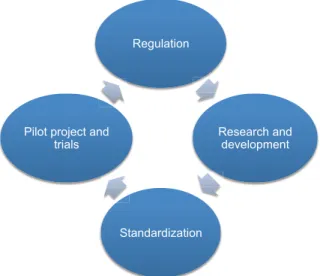
The third point is the air interface for WS communi- cations. Many interfaces will be candidates for several use cases. Wireless regional area network (WRAN) [13], [20], wireless local area network (WLAN) [14] and wireless per- sonal area network (WPAN) [15], [20] including sensor net- work and machine-to-machine (M2M) communications are the representative air interfaces. The air interfaces must be standardized to reduce price of wireless unit and to in- crease the number of unit suppliers, and to expand applica- tion fields. There are several standardization organizations (SDOs) or bodies to discuss the standardization. IEEE is one of major standardization bodies. Moreover, several white space pilot projects have been launched in the world by us- ing wireless units compliant with standards and WSDB. If missing parts in the current regulations are found in the pilot projects, regulators may modify their regulations. In sum- mary, the ecosystem between regulation, research and de- velopment, standardization, and pilot project is configured as shown in Fig. 1.
In this paper, current regulation status and standardiza- tion activities on white space are summarized. Regarding standardization, activities on IEEE 802 and IEEE Dyspan- SC (IEEE 1900.x) are summarized. Then this paper de- scribes current status of several pilot projects in the world.
Finally future recommended direction is described.
Fig. 1 Ecosystem between regulation, research and development, standardization, and pilot project.
Copyright c2014 The Institute of Electronics, Information and Communication Engineers
2. White Space Communication Systems
2.1 System Configuration
Figure 2 shows a fundamental configuration of WS commu- nication systems. As assumptions, all primary users and sec- ondary users can access to WSDBs. The primary users op- erate licensed systems. In TV band, primary users provide TV services. Secondary users operate their wireless com- munication systems by using white space devices (WSD).
The WSDBs can decide possibility of WS usage by pre- dicting service contour of primary and secondary systems.
The WSDB has information on radio parameters of primary systems. The radio parameters may include location, an- tenna height, transmission power, antenna pattern, and an- tenna tilt.
2.2 Function of WSDB
In order to protect interference to primary systems from sec- ondary systems and share spectrum between primary and secondary systems, WSDB has the following functions:
a Predict contour of primary systems by using informa- tion on radio parameters (location, antenna pattern, transmission power, etc.).
b Predict contour of secondary systems by using infor- mation on radio parameters (location, antenna pattern,
Fig. 2 A fundamental configuration of WS communication systems.
transmission power, etc.). This is an optional function.
By the two contour prediction results and threshold level of interference, the WSDB provides radio parameters of sec- ondary systems to keep coexistence between primary and secondary systems. As shown in Fig. 2, all secondary sys- tems can coexist with primary systems because the contours of primary and secondary systems are not overlapped. How- ever, it is something difficult to keep coexistence between secondary systems. This means that some secondary sys- tems may interfere with the others. So to reduce the in- terference, WSDB for the coexistence between secondary systems is needed. The WSDB has the following functions:
i Predict contour of secondary systems by using infor- mation on radio parameters (location, antenna pattern, transmission power, etc.)
By the contour prediction results and threshold level of in- terference, the WSDB provides radio parameters of sec- ondary systems to keep coexistence between secondary sys- tems. The secondary systems may use different wireless access schemes or common wireless access schemes. So the WSDB for coexistence between secondary users may be categorized into two; for secondary systems used different wireless access schemes and for ones used common wire- less access schemes shown in Fig. 2. Table 1 summarizes the categories.
2.3 Category of WSDB
To introduce the WSDBs in the real situation, there are three stages shown in Table 2. The difference between stages is the response time to get available WS frequency map. In the first stage, the response time is longer than 24 hours because it may take longer time to predict contour of pri- mary and secondary systems and calculate recommended radio parameters for the secondary systems. In the stage, only fixed wireless communication is available, because the WS radios cannot move until available WS frequency map is obtained. As the second stage, the response time will be reduced within 24 hours. Moreover the WS radios need to access to WSDB and get the map again when the equipment works every certain meter. In the case, the WS radios with a small mobility may be supported. As the third stage, the response time becomes much faster within several seconds and the WSDB will support WS radios under highly mobile environment.
2.4 Discussion Points
To make WS communications feasible, the following points need to be discussed.
1. Radio regulations for WS communications: Opera- tional frequency bands, maximum transmission power, spectrum mask, and so on.
2. WSDB specifications and operational guideline.
3. Requirement and category for WSD.
4. Specification of WSD
Table 1 Category of WSDB.
Table 2 Scenario of WSDB Introduction.
3. Radio Regulations for WS Communications
3.1 United States 3.1.1 History [1]–[6]
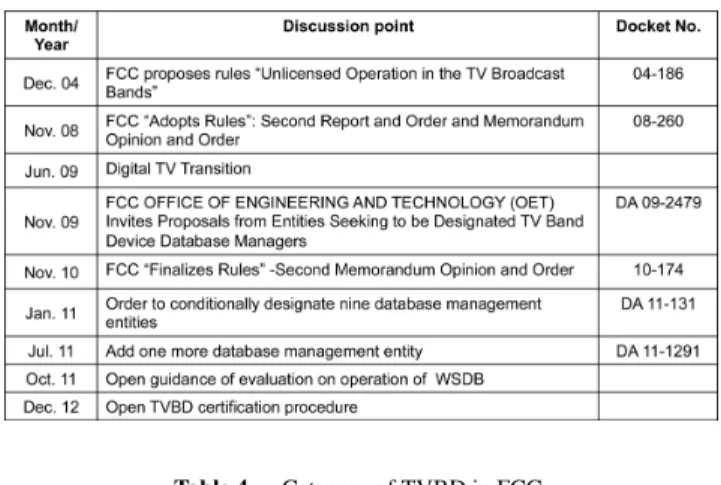
In United States, Federal Communications Commission (FCC) is mainly discussing on the regulation for WS com- munication systems. Table 3 summarizes the history of reg- ulation. United states considered TV bands for the WS com- munication systems, and WSD in TVWS is called televi- sion band device (TVBD). TVBD is discussing in licence- exempt category.
3.1.2 Category of TVBD
As category of TVBD, there are two classes: fixed and per- sonal/portable devices. Table 4 summarizes requirements of the devices. The personal/portable devices are moreover categorized into two: Mode I and Mode II. The Mode I is a client device and activated by a fixed device or a Mode II de- vice. Mode II device is an independent device with capabil- ity to access WSDB to access available channels. In Table 4, there is one more category, sensing only personal/portable device that required performing spectrum sensing prior to operation.
3.1.3 Requirement for WSDB
The requirement for WSDB in FCC is summarized in Ta- ble 5. FCC requests TVBD to access WSDB every 24 hours.
Table 3 History of regulation in FCC.
Table 4 Category of TVBD in FCC.
Table 5 Requirement for WSDB in FCC.
All devices except for Mode I and sensing only device must have a geolocation capability with accuracy up to+/−50 m and send the information to WSDB.
3.1.4 Transmission Power and Spectrum Mask
As shown in Table 4, fixed devices are permitted to trans- mit up a 4 W equivalent of effective isotropic radiated power (EIRP). The EIRP 4 W includes 1 W output power and a 6 dBi gain antenna as maximum value, respectively. Per- sonal/portable device are permitted to transmit up to 20 dBm equivalent of EIRP. However, the transmission power is lim- ited to 16 dBm in operating in a channel adjacent to an in- cumbent licensed user and within the protected area of the WS communication services. Moreover, spectrum density is constrained to 12.6 dBm and 2.6 dBm per 100 kHz for fixed and personal portable devices, respectively.
Regarding spectrum mask, it is required to achieve ad- jacent channel attenuation of 55 dB below the highest power in a 6 MHz operating channel in 100 kHz bandwidth.
3.1.5 Operational TV Channel
The channel spacing of TV channel is 6 MHz. Fixed devices can use VHF channels 2-13 and UHF channels 14-51 except for 3, 4 and 37 channels. Personal/portable devices can use UHF channels 14-51 except for 14-20 and 37 channels.
3.2 United Kingdom 3.2.1 History [7]–[12]
In United Kingdom, Office of Communications (Ofcom) is mainly discussing on the regulation for WS communica- tion systems. Table 6 summarizes the history of regulation.
TVBD is discussing in licence-exempt category.
3.2.2 Category of TVBD
As category of TVBD, there are two classes: master and slave devices. The master deices can contact a WSDB to
obtain a set of available frequencies in their area. In the op- eration, device model number tells whether it has antennas mounted outdoor. The master devices then manage slave devices, maintaining record of slave devices. The slave de- vices obtain the relevant information from master devices but do not contact the WSDB themselves and communi- cate with only master devices. The master devices moreover cease transmission immediately when instructed by the mas- ter device or within 5 seconds of not receiving a response from the master devices to transmission.
3.2.3 Requirement for WSDB
The requirement for WSDB is summarized in Table 7.
WSDB must provide a response within 10 seconds. Time- validity stamp to the WSDB is required. Push technology can be implemented but not as a regulatory requirement.
The WSDB returns an information set which must include start and end frequencies for available bands, associated maximum power levels, a time validity for the information, and a notification of any requirement for sensing to be used in addition.
3.2.4 Transmission Power and Spectrum Mask
The maximum transmit power is determined based on dig- ital terrestrial TV (DTT) protection levels i.e. the cognitive signal should be at least 33 dB below the received DTT sig- nal.
3.2.5 Operational TV Channel
The channel spacing of TV channel is 8 MHz. The opera- tional channel starts from 470 MHz and ends 790 MHz by using channel numbers from 21 to 60. TVBD can use chan- nels 21 to 60 except for 31-38 channels.
3.3 Japan 3.3.1 History
Since Nov. 2009, white space operation has been discussed
Table 6 History of regulation in Ofcom.
Table 7 Requirement for WSDB in Ofcom.
in Ministry of Internal Affairs and Communications (MIC) in order to secure bandwidth. Table 8 summarizes the his- tory of regulation. Five main applications are under discus- sion in the Council for White Space Promotion in MIC.
- Wireless microphone - Area broadcasting - Sensor network - Wireless broadband
- Wireless access systems for emergency situation (dis- aster)
Currently area broadcasting services have been permitted to do actual services in TV white space. This is a license-based system, and the actual services have started in several places of Japan.
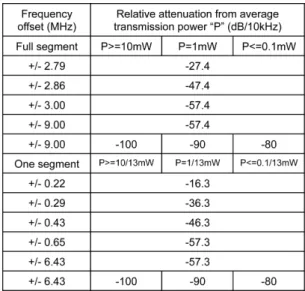
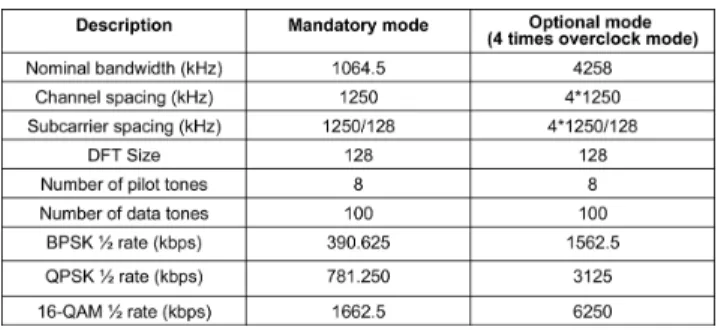
The area broadcasting service is based on ISDB-T (ARIB STD-B31) and standardized as ARIB STD-B55. The ISDB-T has 13 OFDM segments in a channel. The ARIB STD-B55 standardized specifications in the case when one
segment or full segment is used. Table 9 shows fundamental specification of one segment type area broadcasting. Most Japanese mobile phone have capability to receive one seg- ment ISDB-T broadcasting services. New service operators can start new area-dedicated broadcasting services by using the standard in TVWS. The spectrum mask is also shown in Table 10.
Currently usage of WSDB has not been discussed and MIC manages the spectrum license. To get license, the area broadcasting operators submit license application form to MIC and MIC provides license on the basis of radio regula- tion and interference level to primary users.
Wireless microphone is categorized in higher priority than other WS communications and area broadcasting ser- vices. This is because the wireless microphone is forced to move to white space from 700–900 MHz bands in order to secure bandwidth for next generation mobile phone sys- tem. To support usage of wireless microphone, MIC pro- vides WS channel lists. The wireless microphone operators submit their license application forms to MIC and MIC pro- vides licenses on the basis of radio regulation.
Licensing to both systems looks good. But new issues arise, co-existing issue between area broadcasting and wire- less microphone. To discuss the coexistence mechanism, coexistence working group (WG) is launched under council for white space promotion [21] from the following view- points.
• Who will provide available channel map on white space?
• Who will permit to use white space?
• Will WSDB be used?
Table 8 History of regulation in Japan.
Table 9 Specification of one segment type area broadcasting.
• Who will manage coexistence between WS systems?
A coexistence procedure between wireless microphone and area broadcasting was issued in 2013.
3.3.2 Coexistence Mechanism
Figure 3 shows a coexistence mechanism considered in Japan. In the previous section, application procedure to get license of wireless microphone has been introduced. Af- ter getting the license, wireless microphone operators report the operational bands to the wireless microphone promotion alliance or forum. The alliance or forum may request the wireless microphone operators to do coexistence with pri- mary and secondary operators.
When area broadcasting service operators apply license to the MIC, the operators need to discuss with wireless mi-
Table 10 Spectrum mask of area broadcasting.
crophone alliance or forum to find white spaces that do not interfere with wireless microphone. After getting the infor- mation, area broadcasting service operators start to apply license to MIC. After area broadcasting service operators get licenses. The licenses information will be reported to area broadcasting promotion alliance or forum. Both wire- less microphone and area broadcasting promotion alliances or forums share the information of their operational bands.
4. Standardization of TVBD Specification in IEEE Table 11 summarizes standardization activities of TVBD specifications in IEEE. Currently IEEE 802 and IEEE Dys- pan standards committee (1900.x) have actively discussed
Fig. 3 A coexistence mechanism considered in Japan.
Table 11 Standardization activities of TVBD specifications in IEEE.
the topic. The IEEE 802 mainly has standardized air inter- faces for several WS use cases. For example, IEEE 802.22, IEEE 802.11af, and IEEE 802.15.4m standardize air inter- faces for WRAN, WLAN, and WPAN, respectively. On the other hand, the IEEE 1900 mainly has standardized enabling technologies to operate WS communications smoothly. In Table 11, IEEE 802.22, IEEE 802.11af, IEEE 802.15.4m, IEEE 802.19.1, IEEE 1900.4a and 1900.4.1 issued their specification document. This section introduces the stan- dards.
4.1 IEEE 802.22 [13]
IEEE 802.22 is a standard specification of PHY and MAC for wireless regional area networks: WRAN in TVWS. Ta- ble 11 shows the fundamental specifications. The IEEE 802.22 WRAN network is composed of base station (BS) and customer premise portable equipment (CPE). The BS and CPE can provide a point to multipoint network. The PHY layer specification is shown in Table 12. The MAC
Table 12 802.22 physical layer specification.
Fig. 4 Frame structure of MAC layer in 802.22.
layer adopts time division duplex (TDD) and OFDMA is mainly used. The frame structure of MAC layer is shown in Fig. 4. To do coexistence with primary systems, several functions are standardized as options. The first is to insert
“quiet period” in MAC frame to do spectrum sensing in each TVBD. In the quiet period, nobody send any message. The second allows CPE to send BS a message when primary users are detected by CPE. The third is a function of BS to request CPE shifting to new operational band. To promote the standard and to make the standard interoperable one, WhiteSpace alliance (http://www.whitespacealliance.org/) has actively been working.
Moreover, to support enhanced broadband services and monitoring application, 802.22b project that specifies al- ternate PHY and necessary MAC enhancements to IEEE 802.22-2011 standard was launched. The standard defines new classes of 802.22 devices to address these new appli- cations and supports more than 512 devices connection in a network.
4.2 IEEE 802.11af [14]
IEEE 802.11af is an amendment standard that defines mod-
Table 13 802.11af physical layer specification.
Fig. 5 Configuration of IEEE 802.11af.
ifications to both the 802.11 physical layers (PHY) and the 802.11 medium access control layer (MAC), to meet the legal requirements for channel access and coexistence in the TV whit space. Table 13 shows the fundamental specifications. As shown in Fig. 5, IEEE 802.11af stan- dard is a combination standard by IEEE 802.11 families and the PHY has compatibility with IEEE 802.11ac on the basis of OFDM. IEEE 802.11ac is based on 40 MHz bandwidth with 128-point FFT. In the case of TV chan- nel with 6 MHz channel spacing, the occupied bandwidth is 6 MHz*128/144=5.33 MHz Therefore downclocking of IEEE 802.11ac is required.
To protect primary users, a procedure to access to WSDB is defined. Also to keep coexistence with other sec- ondary users based on 802.11af system, the standard recom- mends using registered location secure server (RLSS) and the RLSS stores operational parameters of 802.11af based systems and control the parameters if there are interference between systems. To promote the standard and to make the standard interoperable one, WiFi alliance (http://www.wi-
Table 14 IEEE802.15.4m FSK specification.
Table 15 IEEE802.15.4m OFDM specification.
Table 16 IEEE802.15.4m NB-OFDM specification.
fi.org/) has actively been working.
4.3 IEEE 802.15.4m [15]
IEEE 802.15.4m is an amendment standard that specifies a PHY for 802.15.4 meeting TV white space regulatory re- quirements in as many regulatory domains as practical and also any necessary MAC changes needed to support this PHY. Tables 14–16 show the fundamental specifications.
IEEE 802.15.4m has three modes; FSK, OFDM, and NB- OFDM. The FSK supports up to several hundred kbps and NB-OFDM supports from several hundred kbps to several Mbps, and OFDM supports higher transmission rate. Re- garding MAC, IEEE 802.15.4m supports IEEE 802.15.4- 2012 including IEEE 802.15.4e. The standard also consid- ers a technique to do carrier aggregation between WS and frequency bands originally used for IEEE 802.15 such as sub-GHz or 2.4 or 5 GHz bands.
4.4 IEEE 1900.7
IEEE 1900.7 is developing a draft standard that specifies a
Fig. 6 System architecture of IEEE 802.19.1.
radio MAC sublayer(s) and PHY layer(s) of WS dynamic spectrum access radio systems supporting fixed and mobile operation in white space frequency bands, while avoiding causing harmful interference to incumbent users in these fre- quency bands. The consideration of radio regulations, use cases, general requirements, and channel model was final- ized in March 2012. Selection of frequency bands and topol- ogy was done in June 2012. The potential topics for the draft development phase, which is the current on for the WG, are as follows: Reference model, PHY layer, MAC sub- layer, Convergence sublayer, Security sublayer, and Cogni- tive plane. IEEE 1900.7 is still preparing its draft document.
4.5 IEEE 802.19.1 [16]
IEEE 802.19.1 specifies radio technology independent methods for coexistence among dissimilar or independently operated TVBD networks and dissimilar TVBD. In short, the standard defines specification of WSDB for the coexis- tence between secondary systems. Figure 6 shows a sys- tem architecture of the standard. The architecture is com- posed of three entities: coexistence manager (CM), coex- istence enabler (CE), and coexistence discovery and infor- mation server (CDIS). Table 17 describes details of the en- tities. In Fig. 6, CM obtains radio operational parameters from TVBD network or devices through CE. By using the information and also using information from WSDB related to primary systems, the CDIS calculates the interference level and finally the CM decided the capability of coexis- tence between TVBD networks or devices.
4.6 IEEE 1900.4a and 1900.4.1 [17]–[19]
A coexistence mechanism similar to IEEE 802.19.1 is stan- dardized in IEEE 1900.4a. IEEE 1900.4a is based on IEEE 1900.4. IEEE 1900.4 is a baseline standard to provide a framework for developing intelligent management system having the capability to optimize spectrum usage across dif- ferent frequency bands, radio access technologies (RATs), and operators. To reach this goal, the standard defines an architecture of the management system, which is comprised of the component entities of the management system, ser-
Table 17 Details of the entities in IEEE 802.19.1.
vice access points (SAPs) of these entities, and interfaces between them.
As shown in Fig. 7, four management entities are de- fined on the network side: the Operator Spectrum Manager (OSM), the RAN Measurement Collector (RMC), the Net- work Reconfiguration Manager (NRM) and the RAN Re- configuration Controller (RRC). The details are summarized in Table 18. To support scalable operation, the RMC, the NRM, and the RRC may be implemented in a distributed manner.
On the other hands, three management entities are defined on the terminal side: the Terminal Measurement Collector (TMC), the Terminal Reconfiguration Manager (TRM) and the Terminal Reconfiguration Controller (TRC).
Each terminal has one TMC, one TRM, and one TRC. The details are also summarized in Table 17.
IEEE 1900.4a amends the IEEE 1900.4 to enable mo- bile wireless access service in white space frequency bands without any limitation on used radio interface (physical and media access control layers, carrier frequency, etc) by defin- ing additional components of the IEEE 1900.4 system. Cur- rently considered architecture of IEEE 1900.4a is shown in Fig. 7. Compared to IEEE standard 1900.4, four new enti- ties are currently considered in IEEE 1900.4a: the Cognitive Base Station (CBS) Measurement Collector (CBSMC), the CBS Reconfiguration Manager (CBSRM), the CBS Recon- figuration Controller (CBSRC), and the White Space Man- ager (WSM). The details are also summarized in Table 18.
Based on system architecture in Fig. 7, IEEE 1900.4.1 Fig. 7 System architecture of IEEE 1900.4 and 1900.4a.
Table 18 Details of the entities in IEEE 1900.4 and 1900.4a.
provides detailed description of interfaces and service ac- cess points defined in the IEEE 1900.4. In the standard, message and interface between 1900.4 management entities, service access point, and primitives are defined.
5. Pilot Projects and Trials of WS Communications There are several pilot projects and trials in the world. But the projects and trials are categorized into two: international collaboration trials and domestic collaboration trials. For example, Japan has done only domestic collaboration trials for WS communications. Table 19 summarizes the interna- tional projects and trials [22]–[28]. In the Table, there are several tendencies.
• WS communication trials have been doing in Africa [27], [28], Europe [23], [24], [26], South East Asia [22], [25] and so on and adopting the WS system to reduce digital divide between city central and country- side.
• Fixed point-to-multipoint rural broadband access ap- plications are taken.
• UHF band is mainly used and WSDB may be used because some countries still have enough vacant fre- quency bands in TV bands. So dynamic spectrum shar- ing by cognitive radio technique may not be needed.
• All finished trials have not used radio equipment taken
existing WS standard.
Regarding first to third bullets, TVWS communication systems can achieve a longer-range communication in com- parison with microwave band communications. So rural broadband access is one of important applications. But as shown in Table 20, other applications must be considered.
Especially WLAN for wireless broadband in house and pub- lic area and WPAN for smart utility, smart grid and sensor network are the representative applications. This is because currently the frequency bands for both use cases are fully oc- cupied and new bands are needed. In addition, for both use cases, carrier aggregation between WS and frequency bands originally used for WLAN and WPAN must be considered.
Regarding fourth bullet, there is no development of standard compliant WS communication equipment except for NICT for the time being. NICT has developed world’s first IEEE 802.11af, IEEE 802.22, and IEEE 802.15.4m (NB-OFDM). Figure 8 summarizes the developed proto- types [15], [29], [30]. The important points are to provide low price WS radio equipment by manufacturers and the developed equipment shall meet regulation provided by reg- ulators. But to develop low price equipment, a big market that includes several to several tens million users must be produced. This is a further discussion point.
Table 19 International projects and trials on WS communications.
Table 20 Applications by WS communications.
6. Conclusions
This paper summarized current status on regulations, stan- dardization and trials in the world regarding WS commu- nications. After defining system configuration and func- tion and category of WSDB, radio regulations in United States, United Kingdom, and Japan were summarized from the viewpoint of history, TVBD category, TVWS require- ment, transmission power, spectrum mask and operational TV channel. Then as status of standardization for TVBD, IEEE 802 and IEEE 1900 standard related to WS were sum- marized. Finally pilot projects and trials of WS commu-
nications were summarized and trend and future direction of promotion on WS communication systems were summa- rized.
As conclusions, WS communications are expected to realize two benefits: longer communication range and achievement of more capacities. And several trials of ru- ral broadband access are being actively pursued and trials of new applications are needed. For the regulation, there are several discussions in several regions. But to have com- mon knowledge and sense and to promote dynamic spec- trum sharing based communication systems, the establish- ment of a worldwide alliance is needed.
Fig. 8 Prototype of standardized WS communication systems: (a) 802.11af, (b) 802.22, and (c) 802.15.4m.
Acknowledgments
The author would like to express sincere thanks to Mr. Homare Murakami, Dr. Fumihide Kojima, Dr. Kentaro Ishizu, Dr. Zhou Lan, Dr. Ha Nguyen Tran, Dr. Chin Sean Sum, and Dr. Chang-Woo Pyo for their supports to summa- rize status of standardization and trial. This research was conducted under a contract of R&D for radio resource en- hancement, organized by the Ministry of Internal Affairs and Communications, Japan.
References
[1] FCC, “Unlicensed operation in the TV broadcast bands additional spectrum for unlicensed devices below 900 MHz and in the 3 GHz band,” Docket no. 04-186, Dec. 2004.
[2] FCC, “Second report and order and memorandum opinion and or- der,” Docket no.08-260, Nov. 2008.
[3] FCC, “Office of engineering and technology invites proposals from entities seeking to be designated TV band device database man- agers,” DA 09-2479, Nov. 2009.
[4] FCC, “Second memorandum opinion and order,” Docket no.10-174, Sept. 2010.
[5] FCC, “ORDER,” DA 11-131, Jan. 2011.
[6] FCC,“ORDER,” DA 11-1291, July 2011.
[7] Ofcom, “Digital dividend review: A statement on our approach to awarding the digital dividend,” Dec. 2007.
[8] Ofcom, “Digital dividend: Cognitive access consultation on licence- exempting cognitive devices using interleaved spectrum,” Feb. 2009.
[9] Ofcom, “Digital dividend: Cognitive access: Statement on licence- exempting cognitive devices using interleaved spectrum,” July 2009.
[10] Ofcom, “Digital dividend: Geolocation for cognitive access: A dis- cussion on using geolocation to enable license-exempt access to the interleaved spectrum,” Nov. 2009.
[11] Ofcom, “Implementing geolocation,” Nov. 2010.
[12] Ofcom, “Implementing geolocation, summary of consultation re- sponses and next steps,” Sept. 2011.
[13] IEEE Std 802.22TM-2011.
[14] IEEE P802.11afTM/D5.0.
[15] H. Harada et al., “IEEE 802.15.4m compliant OFDM radio equip- ment for white space wireless smart utility network,” IEICE Techni- cal Report, SR2013-1, May 2013.
[16] IEEE P802.19, 19-11-0069-00-0001-chapter-4.pdf [17] IEEE 1900.4aTM-2012.
[18] IEEE 1900.4.1TM-2013.
[19] H. Harada et al., “IEEE dynamic spectrum access networks (DyS- PAN) standards committee,” Crowncom 2011, June 2011.
[20] H. Harada et al., “Research, development, and standards related ac- tivities on dynamic spectrum access and cognitive radio,” IEEE Dys- pan 2010, pp.1–12, April 2010.
[21] http://www.soumu.go.jp/main content/000129708.pdf
[22] http://www.ida.gov.sg/∼/media/Files/PCDG/Licensees/SpectrumMg mt/SpectrumNumMgmt/CognitiveRadioVenues.pdf
[23] http://www.wirelesswhitespace.org/
[24] http://www.microsoft.com/presspass/emea/presscentre/pressreleases/ April2012/24-04CambridgeTVWhiteSpacesConsortium.mspx [25] http://whitespace.i2r.a-star.edu.sg/swspg/
[26] http://wise.turkuamk.fi/
[27] http://www.microsoft.com/africa/4afrika/white spaces project.aspx [28] http://www.tenet.ac.za/tvws
[29] K. Mizutani, et al., “Prototype hardware of IEEE 802.11af/D5.0 for wi-reless LAN systems operating on TV white spaces,” IEICE Tech- nical Report, SR2013-65, Oct. 2013.
[30] http://www.nict.go.jp/en/press/2013/01/30-1.html
Hiroshi Harada is director of smart wire- less laboratory at National Institute of Informa- tion and communications technology (NICT).
He joined the Communications Research Lab- oratory, Ministry of Posts and Communications, in 1995 (currently NICT). Since 1995, he has re- searched Software Defined Radio (SDR), Cog- nitive Radio, Dynamic Spectrum Access Net- work, Smart Utility Network (SUN) and broad- band wireless access systems on the VHF, TV white space, microwave and millimeter-wave band. He also has joined many standardization committees and forums in United States as well as in Japan and have fulfilled important roles for them.
He has served currently on the board of directors of Wireless Innovation Forum (formerly SDR Forum), WhiteSpace Alliance, DSA Alliance, and Wi-SUN alliance, and also the chair of IEEE Dyspan Standards Committee (formerly, IEEE SCC41 and IEEE 1900) since 2009 and the vice chair of IEEE P1900.4, IEEE P802.15.4g, TIA TR-51, and IEEE P802.15.4m since 2008, 2009, 2011, and 2011, respectively. He moreover was the chair of the IEICE Technical Committee on Software Radio (TCSR) in 2005–2007 and has been the chair of Public Broadband Mobile Communication Devel- opment Committee, ARIB since in 2010. He is also involved in many other activities related to telecommunications. He has been a visiting professor of the University of Electro-Communications, Tokyo, Japan, since 2005 and is the author of Simulation and Software Radio for Mobile Commu- nications (Artech House, 2002). He received the achievement award and fellow of IEICE in 2006 and 2009, respectively and the achievement award of ARIB and Funai Prize for Science in 2009 and 2010, respectively, on the topic of cognitive radio research and development.