“
U
nder - per f or m
i ng”
or r es i l i ent Fi l i pi no
boys i n educ at i on? : l i s t eni ng t o s t udent s ’
and adul t s ’
per s pec t i ves and bac kgr ounds : a
W
es t er n Vi s ayas c as e
著者
O
kabe M
as ayos hi
権利
Copyr i ght s 日本貿易振興機構(ジェトロ)アジア
経済研究所 / I ns t i t ut e of D
evel opi ng
Ec onom
i es , J apan Ext er nal Tr ade O
r gani z at i on
( I D
E- J ETRO
) ht t p: / / w
w
w
. i de. go. j p
j our nal or
publ i c at i on t i t l e
I D
E D
i s c us s i on Paper
vol um
e
705
year
2018- 03
INSTITUTE OF DEVELOPING ECONOMIES
IDE Discussion Papers are preliminary materials circulated
to stimulate discussions and critical comments
Keywords: High school; Boys’ Under-performance; Poverty; Dropout; Resilience; Barkada
JEL classification: I21, I24, I31, J24
*Overseas Research Fellow, IDE-JETRO, Chiba, Japan; Visiting Research Fellow, School of
Labor Economics and Industrial Relations, University of the Philippines (UP-SOLAIR),
Diliman, Philippines (
[email protected]
and
[email protected]
).
IDE DISCUSSION PAPER No. 705
“Under-Performing” or Resilient Filipino
Boys in Education? Listening to Students’
and Adults’ Perspectives and Backgrounds:
A Western Visayas Case
Masayoshi OKABE*
March 2018
Abstract
The Institute of Developing Economies (IDE) is a semigovernmental,
nonpartisan, nonprofit research institute, founded in 1958. The Institute merged
with the Japan External Trade Organization (JETRO) on July 1, 1998.
The
Institute conducts basic and comprehensive studies on economic and related
affairs in all developing countries and regions, including Asia, the Middle East,
Africa, Latin America, Oceania, and Eastern Europe.
The views expressed in this publication are those of the author(s). Publication does
not imply endorsement by the Institute of Developing Economies of any of the views
expressed within.
INSTITUTE OF DEVELOPING ECONOMIES (IDE), JETRO
3-2-2, WAKABA,MIHAMA-KU,CHIBA-SHI
CHIBA 261-8545, JAPAN
©2018 by Institute of Developing Economies, JETRO
1
“UNDER-PERFORMING” OR RESILIENT FILIPINO BOYS IN EDUCATION?
LISTENING
TO
STUDENTS’
AND
ADULTS’
PERSPECTIVES
AND
BACKGROUNDS:
A
WESTERN
VISAYAS
CASE*
M
ASAYOSHIOKABE
**March 2018
Abstract
Through our field research in the province of Antique, the Western Visayas, the Philippines, we did interviews and interactive discussions with high school students who have had difficulties in pursing continuously school education, as well as with school principal and teachers. The major research concerns of this study include the gender patterns in schooling and education, and then focus on several unique male students. In particular, this study tries to show resilience among previously out-of-school students who succeeded in returning to high out-of-school. In so doing, it identifies the obstacles that tend to keep Filipino boys out of school and, in contrast to their somewhat stereotyped images to date, presents an alternative image of “resilient” boys.
Keywords: high school; boys’ underperformance; poverty; dropout; resilience; barkada JEL classification: I21, I24, I31, J24
___________
*Note: As nature of discussion paper, this version is a work-in-progress, subject to revisions
and changes before formal submission to a suitable journal or media and their publication.
**Author’s information: Masayoshi Okabe, Visiting Research Fellow, School of Labor
Economics and Industrial Relations, University of the Philippines (UP-SOLAIR), Diliman, Quezon City, Metro Manila, Philippines, concurrently appointed as an Overseas Research Fellow, Institute of Developing Economies, JETRO, Chiba, Japan. Email:
I. INTRODUCTION AND MOTIVATIONS
Education has, in itself, the ultimate value of developing individuals, but it also serves
as one of the key engines for socioeconomic development and poverty alleviation,
serving as a cumulative process throughout the lifecycles even up to the next generation
and thus contributing to sustainable development (Heckman 2013; Sachs 2015).
International development and aid communities have promoted the delivery of
“education for all” in developing countries (e.g., Education for All [EFA] in 1990, Dakar
Action Framework in 2000, Millennium Development Goals [MDGs] in 2000, and these
philosophies are taken over by the post-MDG Sustainable Development Goals [SDGs]
from 2015).
The Philippines, which is the country discussed in this study, has achieved
almost universal primary education since the 1990s with an enrolment ratio of at least
90 percent. Despite such improvements in access to education, the gender gaps in
education have persisted though this might not be easily accepted when considering the
country’s high level of gender equality in international discourse, which always
describes Filipino women as having greater participation and empowerment in society
than their counterparts in major parts of the developing world. Generally, in many
countries, both education and labor markets favor males (King and Hill 1998). In this
sense, the reverse is true for education in education in the Philippines.1 King and Hill
(1998: p. 251) explained that “the Philippines has made strong advances in educating
girls and women […]. Even before World War II, and especially afterward, the country
implemented a massive expansion of its education system.”2
As part of the global discourse, the Philippines’ gender equality in the
1 The “reverse” pattern of inequality disadvantaging men is also referred to by Miralao
(2008: p. 129), where it refers to another sense of reverse. Miralao (2008) states that educational patterns are reversed in comparison with older generations, when there were fewer women who could pursue higher education than the current generations now do. Miralao (2008) also used the expression “boys’ crisis” in terms of contemporary Filipino boys lagging behind girls in education.
2 King and Hill (1998: p. 255) also add that although the Philippines spends less public
3
socioeconomic field is illustrated by the comparable cross-country indices from the
World Economic Forum (WEF). The WEF releases the global gender gap index (Table
1) for easy comparison of gender gaps across countries. In the WEF indices, the
Philippines has ranked highly in achieving gender equality; the index indicates the
highest possible score, 1 (equality), and the lowest possible score, 0 (inequality). Indeed,
the Philippines has outranked the Asian countries and ranked among the top ten countries
in terms of achieving gender equality along with some developed countries. The higher
ranked countries include the northern European countries—Iceland, Norway, Finland,
Sweden, and Ireland.3 With respect to gender equality, one can already say that the
Philippines has established its impressive status in comparison to other Asian and even
developed countries.
--- Table 1 around Here ---
The global gender gap index (hereafter, GGGI) is measured by or
decomposed into equality indices on economic activity, education, and health and
survival, respectively. The GGGI aggregates these economic and human
development dimensions concerning men and women. Table 2 shows the
disaggregated indices concerning economic, educational, and health and survival
information. Apparently, the Philippine’s high GGGI contributes to high scores in
human development fields such as education and health. The education and health
scores are all ranked in first place, and the scores are counted as one. This merely
indicates that, if a particular female rate is equal to the corresponding male rate, it
counts as one, the highest rank.
However, the educational information shows in fact that more females are
successful as they pursue higher educational attainment than their male counterparts.
Nonetheless, as long as we rely on a version of female-based gender equality that
refers to whether or not females caught up with males, once females become equal
3 Although not shown on Table 1, Japan pales in comparison beside the Philippines and the
to males in the figures, the index will then always take a value of one even when
females outperform males. It is noteworthy that the index-based information per se
no longer captures the reverse situation in which males started to underperform. In
turn, in economic activity, there is still clearly a gender gap that is unfavorable to
women: Male labor force participation is much higher (81%) than that of their female
counterparts (52%), where the ratio of females over males is 0.65; likewise, the
female wage rate is 80% that of males, and income earned by women is also 69% of
that earned by men.4 Members of the national Congress party consist of more men
than women. Still, the country profile GGGI of the Philippines is high owing to high
achievements in education and health, despite the lower achievements related to the
wider labor market. Only a portion of professional occupations show more women
engaged in them than men.5
--- Table 2 around Here---
Can we then be optimistic enough to take the Philippines for granted as
“already sufficient” (okey na) in achieving gender equality? When it comes now to
education, indeed, a UN Report titled Why Are Boys Under-performing in Education?
Gender Analysis of Four Asia-Pacific Countries raised concerns about an issue of “boys’
under-performing” in education (UNGEI 2012), and described Filipino boys in this term.
In UNGEI (2012), the Philippines was studied as one of the four case study countries6
that have been suffering from boys’ under-performing in education. Although
gender-equal international education cooperation has always focused on girls’ education, in
some regions boys’ performance is also emerging as a newly recognized concern. From
a post-feminist viewpoint, Miralao (2008) is already alarmed and uses another expression––
4 This kind of unfavoring factors and situations against women in female labor participations
were already stated by Serrano and Carteza (2014).
5 As another viewpoint in disguise, it would be hasty at the same time to say conclusive
judgement on favorability against either gender by relying on gender comparisons of labor force participation (rates) and average wage (rate). Considering that the female’s rate of those who engage in “professionals” ranks highly in contrast to labor force participation and wage rate (Table 2), it is not until controlling other individual background variables that we can say conclusively.
5
“boys’ crisis”––to describe the phenomenon: boys’ lagging behind their female counterparts
in education, which has the future potential, once again,7 to burden Filipino females by the
requirement on women to be more responsible in laboring outside and inside their families.
The background on why Filipino boys have tended to lag behind the girls has
yet to be studied further. UNGEI (2012) proposed detailed studies to discuss the more
disaggregated factors the Filipino boys face (and how these contrast with those for girls)
to better understand the backgrounds and factors differentiating boy–girl educational
attainment. This study aims at showing selected observations in the rural areas of the
country by focusing on adult and student perspectives on understanding their
circumstances. This paper attempts further hypothesis formation to understand the way
to interpret the aforementioned seemingly reversed gender gap through these
observations and analyses. UNGEI (2012) relied on Torres (2011) when discussing the
Philippines case; upon reviewing and summarizing desk reviews and examining
secondary data indicating that boys’ dropout rates are remarkable in lower secondary and
in the transition from lower to upper secondary school, it was found that out-of-school
boys are likely to be engaged in economic activities sooner than their female counterparts,
and boys’ functional literacy rates are lower (both in and out of school) than those of
girls. Torres (2011) explains that such boys’ underachievement in education is driven by
adults’ (teachers) low expectations for boys; higher expectations that boys will be
economically viable; boys’ passive classroom experience (low-skilled teachers; a
gender-biased environment); and the stereotyping that boys are subject to. In the
Philippine context, she insists, Filipino boys seem to face particular barriers in accessing
primary, lower secondary, and upper secondary education, the latter two of which are of
typicality. Yet the kinds of barrier that will matter are not necessarily analyzed and
explicated.
This study tries to explore the backgrounds and stories in which Filipino male
students are situated by using an inductive approach. By interactively and directly
listening to voices and discussing stories of selected students who have had difficulties
in pursing continuous schooling, this study shows some “resilience” among those
7 Critical perspectives on historical burdens to which Filipino women owed from
previously out-of-school students, who succeeded in returning to high school and
discussing the hindrances to their education. In so doing, this research aims to show what
obstacles tend to keep Filipino boys away from schools and provides an alternative image
of “resilient” boys that contrasts with their somewhat stereotyped images to date.
The paper is structured as follows: Section II introduces the research aims,
research site, outlines the field study, and positions it in the nationwide Philippine context.
Section III provides a case study from school observations and discussion with the
aforementioned eight male students who experienced dropping out first and then
returning to school. This section, in particular, identifies the socioeconomic and familial
factors that they refer to as hindering them from continuing in school and what
encouraged them to return to school. Finally, Section IV summarizes some concluding
remarks and limitations to be addressed in future.
II. THE RESEARCH SITE AND OUTLINE OF THE FIELDWORK
As a starting point to investigate the circumstances in which boys and girls are placed,
we planned preliminary research fieldwork. Through disaggregation and analysis of the
Philippines’ recent nationally representative statistics, it turned out that the boys’
underperformance is more obviously dominant in provincial, rural, or poorer regions
than in cities, urban, or richer regions such as Metro Manila. For example, according to
the Philippine Statistics Authority’s (PSA) latest 2017 Philippine Statistical Yearbook,
the regional level net enrolment rates (NER) of secondary education were aggregated
(Figure 1). The Figure 1 tells us that: (1) it is consistent with the UNGEI’s discourse of
boys’ underperformance in education that more female students than males are enrolling
in high schools across the Philippines; (2) NERs are higher in the national capital Metro
Manila and regions in Luzon island (Regions I, II, III, IV-A, and CAR), while rates are
lower in regions outside of Luzon such as the MIMAROPA, Visayan, and Mindanaoan
regions (Regions IV-B, V, VI, VII, VIII, IX, X, XI, XII, XIII, and ARMM); and (3)
ARMM (Autonomous Region in Muslim Mindanao) stands out from other regions in
terms of having the lowest enrolment rate.
7
differences between male and female NERs and the relative proportions in percentages
that account for the differences in total NER across regions. The visual information in
Figure 2 is clearer in the male-female gaps in NER across the regions. Likewise, the
regions outside of Luzon, such as MIMAROPA, Visayas, and Mindanao show higher
gaps unfavorable to male students.
--- Figures 1 and 2 around Here ---
We selected a specific province from the Visayan regions. The UNICEF East
Asia and Pacific Regional Office mentioned that “[i]n the Philippines, disparities
favouring girls are consistent across all provinces but to varying degrees of severity. In
provinces with highest overall survival rates, the disparity between boys and girls tends
to be smallest. Metro Manila reported the most equitable rates of survival between the
sexes, with just over one percentage point separating boys and girls. Western Mindanao
(10.55), Western Visayas (11.38) and Central Visayas (13.03) report the largest
percentage gaps between boys and girls” (UNICEF East Asia and Pacific Regional
Office, 2009: 33). To see the more typical places where gender disparity does not favor
boys, we explored places outside of Luzon Island, and visited the province of Antique.
Antique belongs to the Region VI, the Western Visayas Region.
In the Western Visayas Region, the local language is not Tagalog, which is the base
for the national language Filipino. The languages Karay-a (Kinaray-a) and more regional
common Hiligaynon (Ilonggo) are primarily spoken in Antique, and are part of the
Visayan languages. In practice, however, people understand Filipino (Tagalog) because
partly of education and the mass media, such as TV programs, music, news reports, etc.
We stayed there from July 23 to 30, 2017 within the local residential areas. Interviews
and research visits were conducted in English and Filipino (Tagalog) by this author.
Some responses in the local Visayan languages by local students and adults were
translated into Filipino or English by the school teachers and local research assistant so
that they could be understood more easily.
The research site is located in the northern part of the province of Antique
(Figure 3), accessible in less than two hours by car from the regional airport Kalibo on
Panay Island. The province of Antique runs vertically north and south along the western
coast of Panay Island facing the Sulu Sea. Taking advantage of this proximity to the sea,
fishery and agriculture are the main industries, thus people’s livelihoods rely on fish and
agriculture production. Whereas Boracay Island, a tourism-driven economy, is located
north near to Panay Island, most areas elsewhere are part of a regional economy
dominated by primary industries. One farmers’ meeting that we attended indicated that
irrigation has been provided in some rice paddies while others remain less well equipped.
In the rice paddies, rice seeds are still sown directly. This practice is certainly less labor
intensive but eventually results in lower yields compared to the more labor-intensive
equal-distance sowing.
We visited three elementary schools, two high schools, and one vocational
school. Except for one high school, other schools were located near the poblacion—the
municipality’s central area. The other high school is located on a mountainous site where
the school buildings are built on a steep slope: the buildings for the younger students are
located on the lower parts of the slope and the buildings for senior grade students are on
the hilly, higher part of the site. In this study, we selected observations of the students
from one school (hereafter, called school A) among the schools that were visited.
III. INVESTIGATING MALE STUDENTS WHO LEFT SCHOOL BUT LATER
RETURNED: A CASE STUDY
In the School A, we conducted a group discussion and interview with eight male students
to discuss their schooling histories. All of these students dropped out of the high school
and later returned to this high school. In addition to this discussion, we also held
preliminary household interviews in selected barangays, among those whose children
go to school A, to listen to parental perceptions about education and livelihood, and
especially about the features of the rural economy. This subsection examines the stories
9
Before turning to the results found in the School A, we introduce the school
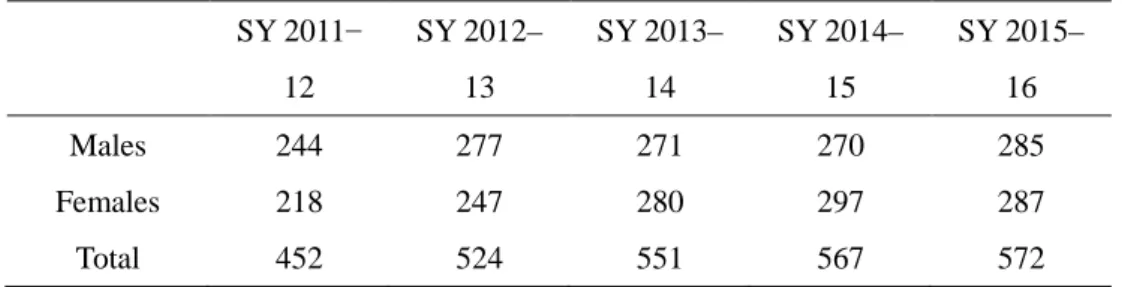
characteristics by some data provided by the school principal. Table 3 displays the trends
in enrolment data (by head count) of male and female students over the recent five school
years (SY) from 2011–12 to 2015–16. Unlike the previous data mentioned above, these
enrolment data do not show significant differences between male and female students.
During the SY 2011–12 to SY 2012–13, more boys attended than girls (244 vs 218, and
277 vs 247, respectively). However, these numbers do not disclose information about the
population as a term in probability theory. Schools can capture only the school-enrolling
youths, but the school teachers admitted that they have no idea about the “out-of-school”
youth who are not enrolled in schools but live in the community.
--- Table 3 around here ---
We turn now to the dropout numbers of the last four school years from SY
2012–13 to SY 2015–16. Although Table 3 does not show significant male-female
differences in the number of students enrolled, dropping out look obviously like a
phenomenon more typical of male students (Table 4). Likewise, even if students can
barely stay in school, the promotion rates (≡ 100% – failure rates) show the same trend:
it is always more male students who fail the grade (Table 5). The Philippine educational
system requires students in the same grade to be held over unless they pass the exams.
--- Tables 4–5 around here---
The typical provincial phenomenon of “boys under-performing” in education
(UNGEI 2012), “boys’ crisis” (Miralao 2008), or the aforementioned note by UNICEF
(2009) is also the case in School A. These male students commonly had had a noteworthy
experience: they had dropped out of school and then returned. Our research design
attempted to delve deeper into their schooling histories, and household and family
circumstances through interacting with them. A school teacher served as the facilitator
and translator of local Kinaray-a into Tagalog or English as well as our local assistant
them.
A. Observations and Results on the Backgrounds of Dropouts
The discussion with them was held in the afternoon of July 24, 2017 for two
hours. Each student is now enrolled in this school, so all of them wore the school
uniform. They were aged from 13 to 19. Some students looked very tanned and
grown-up with an air of roughness while others seemed passive. First, we observed their
discussion on why they needed to leave school. The facilitator initially raised the topic
to the students who began to answer and discuss their own backgrounds and reasons.
The reasons that students gave included:
being “engaged in seasonal trabaho (occupation) of selling merchandise to
acquire tuition fees (₱15 per hour)8
having “no financial assistance from parents”
providing “help for additional household income by working in the fishery”
because of “lack of interest”
because of “mother’s shrewish attitude”
“nag-enjoy” (to enjoy) going to Manila to see his aunt”
being “addicted to computer online games” (two students reported this as a
reason)
having “felt lazy so hung out with barkada (peer group friends)” (two
students reported this)
because of “asthma (physical problem)”
because of being “bullied by classmates”
1. Economic reasons and hindrances
First, students discussed their economic backgrounds and obstacles to
attending school. As previously noted in the literature, students themselves mentioned
labor-related reasons, such as being “engaged in a seasonal trabaho (occupation) of
selling merchandise to acquire the tuition fee” at a wage of ₱15 per hour. At the same
8 As of the date of interview, ₱15 was equal around to 296¢ (US$0.296) (http://www.xe.com/
11
time, as high school students they already faced the necessity and demand to work for
various reasons, which typically involved poverty and lack of finances; these reasons
were directly stated: “no financial assistance from parents” and (providing) “help for
additional household income by fishery working.”
According to the teachers and students, many people in this village live by
fishery and agriculture, but the fishery work was “unstable in getting income.” For
example, fishermen occasionally cannot go fishing when the weather is bad, and almost
half a year corresponds to the rainy season in the Philippines. Rain and wind hinder the
operations. Depending both on the weather and on the probability of a haul of fish,
fishermen tend to cope with fluctuations over the short run, which in turn requires
children to help their parents improve their family’s livelihood by sometimes working.
As a related opinion, one elementary school teacher from this village referred
to a cultural attitude whereby boys tend to be more expected than girls to help improve
the family income by helping their parents’ and neighbors’ (ng mga kapitbahay) in
income-creating activities, and particularly agricultural and fishery activities. The
teacher also felt that it would not always be viewed as culturally unacceptable if students
started to work in the fields out of need. While work under the legal age would count as
child labor, it was not negatively perceived as in normative discussions elsewhere against
child labor. This teacher also noted that, “from her own personal opinion,” it was always
true that the less demand we have for child labor, regardless of reasons, the better the
educational situation is; “therefore” she sometimes personally assisted the students from
her own pocket.
2. Personal dispositions or non-cognitive skills in learning
Aside from poor backgrounds, other students stated that dropping out was
because they always felt “lazy” in learning in school, and another expressed himself as
“walang interes” (having “no interest” or “not finding it interesting”). These two cases
may relate to each other because they reference seemingly personal dispositions, or
personality and character. Once their interests in studying at high school starts to
decrease, their internal motivations to keep themselves in school will also decline. As a
more interesting.
The respondent who answered “laziness,” explained that he actually hung out
with a so-called “barkada” (peer group). When asked what they did when together, the
student explained haltingly that the barkada enjoyed early drinking (e.g., gin, hard beer),
smoking (manigarilyo), roaming around outside, and playing basketball for example. In
listening to this, other boys added that, “actually, they do not have initial plans from the
beginning [regarding] what to do.” They do not always have a certain purpose. Rather,
activities as “barkada-ship” are viewed as ad hoc.9
Also, two students repeatedly expressed themselves as “addicted” to online
computer games. According to them, there are what they called “computer-game shops”
in the villages that are equipped with up to a dozen computers. For comparatively
reasonable fees (e.g., ₱15 for 30 minutes), those who do not own their own computers
can go to the shop and enjoy online internet service. Youth are said to be keenly sensitive
to “bandwagon” trends such as fashion, games, and celebrities. The SNS (social network
services), such as Facebook, Messenger, and Instagram, are also important in their daily
lives. The lack of interest in school or feelings of laziness may easily be translated into
a fondness for visiting computer game shops. It was concurrently pointed by some
mothers whom we visited that their sons visit too often to continue their schooling.
Sometimes, mothers cannot control how frequently their sons engage in these activities
as they become older adolescents.
3. Negative experiences physically or mentally
The next points raised included negative experiences both physical and
mental. As one student referred to this as “asthma,” it is easy to imagine that sickness or
physical disability hinders students from continuous studying through their loss of ability
to concentrate. Likewise, bullying or teasing also hinders students terribly from
continuing their schooling. After our interviews and discussions, one student secretly
confessed that dropping out was because he was called “biggums” (referring to his body
size). However, these problems are not specific or unique to the Philippines but are
9 We can also understand that the lack of interest or feelings of laziness are potentially
13
universal.
B. Parents’ Reactions to their sons’ Dropouts
We then listened to their parents’ reactions to school dropouts. Some students
had indicated that “mother got angry,” (I was) “scolded by [my] parents,” (I was)
“reprimanded by [my] parents,” or (my) “parents got angry.” Some parents reacted by
saying “paumanhin (deep excuses),”10 or that they felt sorry. These statements
correspond only to the cases where parents could no longer afford to keep sending their
son to school. However, what is noteworthy here is that some students referred to their
parents as having said “nothing special” on the occasion. Although the students
themselves could not fully understand why their parents responded in this way when
their children dropped out of school, the school teacher suggested that it is possible that
parents are unconcerned with their children’s schooling, and even perhaps on how they
act more generally.
While it is difficult to pursue empirical evidence of such parents’ attitude of
non-involvement in regard to their children, it is crucially important at the same time as
it implies the parents’ lack of capacity to monitor their children. With such parents,
children will have a much greater difficulty in making every decision on their own.
C. How and why they finally managed to return to school
1. Awakening
Eventually, the students referred to their reasons and motivations for finally
managing to return to school. One student recalled a previous time when he was playing
with his barkada and realized that such barakada-ship is “a waste of time.” He
continuously expressed that he eventually became “fed-up na” (became fed up) and
“nag-sawa ako” (tired of it). In listening to these statements, other students also added
that joining in and hanging around with the barkada involves costs such as buying
10 In local expressions, to the best of this author’s knowledge, the term “paumanhin” is a
alcohol and cigarettes. They also expressed their emerging concerns toward the future
pessimistically, “what if [they] continued staying out of schools and such barkada-ship.”
At a certain point, they recognized the negative impact(s) on their future of having
dropped out.
While more literature has relatively been approaching the reasons of not
attending school so far, an intriguing point in our observation in School A is that the
informants were composed of not only “not attending” but also “returned” students. Not
only the senior age group (e.g., 17 or 18) are represented but also the younger students,
such as those aged 13. Their histories eloquently tell us of the boys’ potential to realize
what is good and what is bad for their futures.
2. The social significance of barakda-ship
Not only the eight students, but the local people report that boys are prone to
play in their barkada to the extent that barkada-ship has the potential to keep them away
from education. This observation is also reported by the empirical literature (e.g., Bouis
et al. 1998). In an ethnographic survey conducted as a part of longitudinal panel data
collection in the Province of Bukidnon, Northern Mindanao (Region X), Bouis et al.
(1998) described local parental perceptions of strong associations between boys and
barkada. Although beyond the direct scope in this study, it is essential to try to
understand the social significance and role of barkada-ship. According to Takahashi
(1972: 197), the barkada is part of a “primary group” in Philippine society whereby
Filipino people place high value on tayo-tayoism. The term “tayo” literally means “we”
in English, the first-person plural. Unlike English, the Filipino language distinguishes
the first-person plural through using two categories—one is “tayo,” which includes the
second person(s) and “kami,” which excludes the second person(s); this implies that
Filipinos are already keenly sensitive to distinguish who are insiders—us (“tayo”)—and
who are outsiders. The importance of keeping a good barkada-ship may also reflect this
idea. Takahashi (1972) explained that the solidarity and affection within one’s own
attribution group plays a crucial role over the norms of group. Aside from barkada, the
kapitbahay (neighborhood) also plays a key role based on direct face-to-face
15
It is noteworthy that some students, who were absorbed in playing in their
barkada, eventually became aware of its negative impact on their future through the lens
of education. Yet, as Takahashi (1972) explained, the barkada is not necessarily linked
to vice as such. In the value system of the Philippines, the barkada is treated as a means
of harmonizing human relations and as the fundamental basis of social networks that
individuals would acquire. In considering the relation to school education, the
barkada-ship seems to frequently have been reported as a harmful factor undermining education.
However, it could have a positive character as a local social network expands among
Filipino individuals. The significance of the barkada-ship in enhancing educational
attainment is a topic requiring further study.
IV. SUMMARY AND DISCUSSIONS
This study investigated male students who had dropped out of a high school in Antique,
Western Visayas, and interviewed teachers and adults as well. Through discussions with
them, an image of Filipino boys lagging behind their female counterparts in education
reconfirmed results in the literature (King and Hill 1998; Miralao 2008; UNGEI 2012;
Yamauchi and Tiongo 2013). Economic deprivation was a crucial factor. Some teachers
in an elementary school on the same site also stated that in agricultural/rural settings,
boys would be expected to help their family more than girls by contributing to the
family’s livelihood. Yet, labor and education have an ambivalent relationship. While
starting work at a young age is regarded as child labor, there may be a possibility that in
these settings some adults (parents and even school teachers) accept the norm that boys
should help their families by working outside the home once they are physically capable.
Non-cognitive skills also matter (Heckman 2013; Sachs 2015), as such skills determine
whether boys continue to find it interesting or necessary to study in school. Otherwise,
these youths are prone to losing interest in attending school.
The peer group, barkada, is also frequently cited as a key factor undermining
school education. The barkada-ship is here interpreted as a social network that expands
horizontally. In rural settings, the computer-game shop may have a strong power to
boys compared to girls, these factors may foster attitudes related to the “laziness” of boys.
Some school data provided by School A, although neither representative nor of sufficient
size, also support this proposition.
However, the male students participating in our study eloquently exhibited
some examples of the invertible nature of the school dropout problem. While those
students also reported having suffered from similar hindrances and obstacles to those
noted above, they finally managed to make a decision to return to school. We can
interpret this as an instance of their “resilience.”
So far, the dropout problems have been regarded as “irreversible”; once
students drop out of school or left school, we may tend to regard that they will no longer
be able to recover their history of formal education easily somewhere outside of the
contemporary formal education system unless on life-learning system or nonformal
education. Yet they showed their resilient attitude by continuing to consider what role
the school plays in their future. Some became fed up and eventually found the time spent
with their barkada to be a waste of time. They came to care once again about their own
lives and future.
The data on male students illustrated here by this study provide another
viewpoint from which to see Filipino boys as resilient, and capable of recovery. We have
yet to study and understand which backgrounds will factor into their decisions to return
to school and potentially mitigate the gap caused by boys’ so-called underperformance.
To reconstruct a framework for better understanding Filipino boys in education, our
continued willingness to undertake empirical studies is essential. In particular, we are
yet to identify when, and under what conditions, the existence of such forward-looking
attitudes is enhanced.
REFERENCES
Asuncion, Ronahlee. 2017. “Aging Societies and Gender Mainstreaming in Human
Capital Development: The Philippine Case.” Chapter 5 in Why Asia Must Up
Female Workforce Participation by Asian Productivity Organization (APO). Tokyo:
17
Bouis, Howarth E., Palabrica-Costello, Marilou, Solon, Orville, Westbrook, Daniel and
Limbo, Azucena B. (1998), “Gender Equality and Investments in Adolescents in the
Rural Philippines,” Research Report, (108), Washington, D.C.: International Food
Policy Research Institute.
Eviota, Elizabeth Uy. 1992. The Political Economy of Gender: Women and the Sexual
Division of Labour in the Philippines. London: Zed Books.
Heckman, James J. 2013. Giving Kids a Fair Chance. Massachusetts Institute of
Technology Press.
King, Elizabeth M., and Anne Hill. 1998. Women’s Education in Developing Countries:
Barriers, Benefits, and Policies. Washington, DC: World Bank.
Miralao, Virginia A. 2008. “Towards Post-Feminism in Philippine Education.” In The
Paradox of Philippine Education and Education Reform: Social Scientific
Perspectives, edited by Bernado, A. Quezon City: Philippine Social Science
Council: 113–132.
Sachs, Jeffrey D. 2015. The Age of Sustainable Development. New York: Columbia
University Press.
Serrano, Melisa R., and Ramon A. Certeza. 2014. “Gender, Unions and Collective
Bargaining in the Philippines: Issues and Critical Factors.” In Labor and
Globalization, Vol. 4, edited by Christoph Scherrer. Munich: Rainer Hampp Verlag,
pp. 55–94.
Takahashi, Akira. 1972. “The Value System of the Phippines” [Firipin no kachi taikei].
In The Value Systems of the Southeast Asia [Tonan azia no kachi taikei] Vol. 4,
edited by Yoshiyuki Hagiwara and Akira Takahashi. Tokyo: Gendai Azia
Shuppankai (in Japanese).
Torres, Amaryllis. 2011. “Gender Dimensions of School to Work Transition: Focus on
the Philippines.” An East Asia and Pacific Regional United Nations Girls' Education
Initiative Study. Unpublished Manuscript.
United Nations Children’s Fund (UNICEF) East Asia and Pacific Regional Office. 2009.
Education for All Mid-Decade Assessment: Gender Equality in Education: Easy
Asia and Pacific Progress Note. Bangkok: UNICEF East Asia and Pacific Regional
Office.
rforming in Education? Gender Analysis of Four Asia-Pacific Countries. https:
//www.unicef.org/eapro/report_why_are_boys_underperforming_FINAL.pdf (acc
essed June 2, 2017).
Yamauchi, Futoshi, and Marites Tiongco. 2013. “Why Women Are Progressive in
Education? Gender Disparities in Human Capital, Labor Markets, and Family
19
Table1. Global Gender Gap Index: Top 10
Rank 2014 2015 2016
Country Score Country Score Country Score
1 Iceland 0.8594 Iceland 0.881 Iceland 0.874
2 Finland 0.8453 Norway 0.850 Finland 0.845
3 Norway 0.8374 Finland 0.850 Norway 0.842
4 Sweden 0.8165 Sweden 0.823 Sweden 0.815
5 Denmark 0.8025 Ireland 0.807 Rwanda 0.800
6 Nicaragua 0.7894 Rwanda 0.794 Ireland 0.797
7 Rwanda 0.7854 Philippines 0.790 Philippines 0.786
8 Ireland 0.7850 Switzerland 0.785 Slovenia 0.786
9 Philippines 0.7814 Slovenia 0.784 New Zealand 0.781
10 Belgium 0.7809 New Zealand 0.782 Nicaragua 0.780
Note: In the 2014 column, figures are reported in five digits while other years are
reported in four.
Table 2. Gender Gap on Economic, Education, and Health Indices of the
Philippines (2016)
Indices Rank Score
World
Average
Female Male
Female/
Male
Economic Activity: 21 0.780 0.586 0.78
Labor force participation 107 0.648 0.665 52 81 0.65
Wage rate equality 7 0.798 0.622 — — 0.80
Earned income(US$,
PPP)
31 0.692 0.502 5,691 8,223 0.69
Congress people 5 0.871 0.358 47 53 0.87
Professionals 1 1.000 0.862 61 39 1.60
Education: 1 1.000 0.955 1.00
Literacy rate 1 1.000 0.897 97 96 1.01
Elementary enrolment 1 1.000 0.980 98 94 1.04
Secondary enrolment 1 1.000 0.970 74 62 1.19
Tertiary enrolment 1 1.000 0.930 40 31 1.28
Health and Survival 1 0.980 0.957 0.98
Birth sex ratio 1 0.944 0.918 — — 0.95
Life expectancy 1 1.060 1.043 63 57 1.11
Source: Country Score Card—Philippines, World Economic Forum
21
Table 3. School A’s Enrolment Data (head count by sex)
SY 2011–
12
SY 2012–
13
SY 2013–
14
SY 2014–
15
SY 2015–
16
Males 244 277 271 270 285
Females 218 247 280 297 287
Total 452 524 551 567 572
Table 4. Number of Dropouts for the Last Four School Years, School A (by sex)
SY 2012–13 SY 2013–14 Y 2014–15 SY 2015–16
M F Both M F Both M F Both M F Both
Grade 7 4 1 5 1 3 4 5 0 5 1 0 1
Grade 8 6 1 7 4 0 4 7 0 7 0 0 0
Grade 9 2 1 3 2 0 2 3 0 3 0 0 0
Grade 10 4 1 5 1 0 1 0 0 0 1 0 1
Total in
number 16 4 20 8 3 11 15 0 15 2 0 2
(in %) (80) (20) (100) (73) (27) (100) (100) (0) (100) (100) (0) (100)
Notes: 1. “M” refers to “Male” and “F” to “Female.”
2. Grade 7 refers to the first grade in high school.
23
Table 5. Promotion Rates and Failure Rates, School A (by sex)
SY 2014–15 SY 2015–16
Promotion Rate Failure Rate Promotion Rate Failure Rate
M F Both M F Both M F Both M F Both
Grade 7 92 100 97 8 0 3.4 87 98 93 12.6 0 7.2
Grade 8 92 100 96 8 0 4 91 99 95 9 1 5
Grade 9 95 100 98 5 0 2.4 95 97 94 5 3 4
Grade 10 100 100 100 0 0 0 98 98 98 1 1 2
Notes: 1. “M” refers to “Male” and “F” to “Female.”
2. Grade 7 refers to the first grade in high school.
24
Figure 1. Net Enrolment Rate in Public and Private Secondary Level Schools
(2012)
Notes: NCR = National Capital Region (referring to Metro Manila); CAR = Cordillera
Administrative Region; CALABARZON = Cavite–Laguna–Batangas–Rizal–
Quezon; MIMAROPA = Mindoro–Marinduque–Romblon–Palawan;
SOCCSKSARGEN = South Cotabato–Cotabato City–North Cotabato–Sultan
Kudarat–Sarangani–General Santos City; ARMM = Auronomous Region in
Muslim Mindanao.
Source: 2017 Philippine Statistical Yearbook, Philippine Statistics Authority.
20 30 40 50 60 70 80 N at io n al A ve . N C R C AR Il oc os R eg io n C ag ay an V al le y C en tr al L u zo n C AL AB AR Z O N M IMA R O P A B ic ol R eg io n W es te rn V is ay as C en tr al V is ay as E as te rn V is ay as Z am b oan ga P en in su la N or th er n M in d ana o D av ao R eg io n S O C C S K S A R G E N C ar ag a A R MM
AVENCRCAR I II III IV-AIV-B V VI VII VIII IX X XI XII XIIIARMM
25
Figure 2. Gender Gap Disaggregation of Net Enrolment Rates in Public and
Private Secondary Level Schools (2012)
Notes: NCR = National Capital Region (referring to Metro Manila); CAR = Cordillera
Administrative Region; CALABARZON = Cavite–Laguna–Batangas–Rizal–
Quezon; MIMAROPA = Mindoro–Marinduque–Romblon–Palawan;
SOCCSKSARGEN = South Cotabato–Cotabato City–North Cotabato–Sultan
Kudarat–Sarangani–General Santos City; ARMM = Auronomous Region in
Muslim Mindanao.
Source: 2017 Philippine Statistical Yearbook, Philippine Statistics Authority.
0.0% 5.0% 10.0% 15.0% 20.0% 25.0% 30.0% 35.0% 40.0% 0.00 2.00 4.00 6.00 8.00 10.00 12.00 14.00 N at io n al A ve . N C R R eg io n Il oc os R eg io n C ag ay an V al le y C en tr al L u zo n C AL AB AR Z O N M IMA R O P A B ic ol R eg io n W es te rn V is ay as C en tr al V is ay as E as te rn V is ay as Z am b oan ga P en in su la N or th er n M in d ana o D av ao R eg io n S O C C S K S A R G E N C ar ag a A R MM
NCRCAR I II III IV-AIV-B V VI VII VIII IX X XI XII XIIIARMM
Figure 3. PHILIPPINES MAP
Source: Adapted from http://www.freemap.jp11
11 The author would like to thank “Free Map” (Sankakkei) for their free provision of