26
令和2年度厚生労働科学研究費補助金(
長寿科学施策
研究事業)アルツハイマー病患者に対する生活行為工程分析に基づいたリハビリテーション介入の標準化に関する研究 分担研究報告書
認知機能障害を有する高齢者における生活行為レベルの目標設定可否の割合とその要因に関する検討
研究分担者 友利 幸之介
東京工科大学 医療保健学部 リハビリテーション学科 作業療法学専攻 准教授
研究協力者 大野 勘太
東京工科大学 医療保健学部 リハビリテーション学科 作業療法学専攻 助教
研究協力者 赤坂竜一
善常会リハビリテーション病院 リハビリテーション部 作業療法士
研究協力者 小山貴士
つくばセントラル病院 リハビリテーション科
研 究 要 旨
本 研 究 で は ,認 知 症 者 の 目 標 設 定 に つ い て ,既 存 の 知 見 を 整 理 す る 目 的 で ス コ ー ピ ン グ レ ビ ュ ー を 実 施 し た .デ ー タ ベ ー ス 検 索 の 結 果 ,全 1021編 を 得 た .重 複 論 文 の 除 外 と ,タ イ ト ル・
本 文 の 読 み 込 み を 行 い , 最 終 的 に 適 格 基 準 に 合 致 し た 研 究 33 編 を 読 み 込 み 対 象 と し て 採 用 し た .目 標 設 定 に 介 入 も 含 ま れ て い る 報 告 が 22 編(60.6%)で ,そ の う ち ラ ン ダ ム 化 比 較 試 験 が 10 編 だ っ た . 介 入 に 用 い ら れ て い た 目 標 設 定 を 含 む フ レ ー ム ワ ー ク と し て は Cognitive Rehabilitation が 最 も 多 く , 目 標 設 定 の ツ ー ル と し て カ ナ ダ 作 業 遂 行 測 定 ,Goal-Attainment Scaling,Bangor Goal-Setting Interviewが あ っ た .い ず れ も 認 知 症 者 の 生 活 に お け る 意 味 の あ る 活 動 に 焦 点 を あ て た 目 標 設 定 が 行 わ れ て い た .目 標 設 定 に 関 す る フ レ ー ム ワ ー ク や ツ ー ル 等 の 開 発 は 進 ん で い る よ う だ が ,重 度 認 知 症 者 に 対 応 し た も の は 少 な か っ た .今 後 ,重 度 認 知 症 者 を 対 象 と し た 研 究 が 望 ま れ る .
A.研究目的
1)研 究 背 景 ( 文 献 レ ビ ュ ー )
厚 生 労 働 省 か ら 平 成 30 年 に 発 表 さ れ た 「 認 知 症 の 人 の 日 常 生 活 ・ 社 会 生 活 に お け る 意 思 決 定 支 援 ガ イ ド ラ イ ン 」1)に よ れ ば ,認 知 症 者 本 人 の 意 思 決 定 能 力 へ の 配 慮 と し て ,「 認 知 症 の 症 状 に か か わ ら ず ,本 人 に は 意 思 が あ り ,意 思 決 定 能 力 を 有 す る と い う こ と を 前 提 に し て , 意 思 決 定 支 援 を す る 」,「 本 人 の そ の 時 々 の 意 思 決 定 能 力 の 状 況 に 応 じ て 支 援 す る 」 と 述 べ ら れ て い る 1).ま た ,「 意 思 決 定 能 力 は ,認 知 症 の 状 態 だ け で は な く ,社 会 心 理 的・環 境 的・
医 学 身 体 的・精 神 的・神 経 学 的 状 態 に よ っ て 変 化 す る の で , よ り 認 知 症 の 人 が 決 め る こ と が で き る よ う に , 残 存 能 力 へ の 配 慮 が 必 要 に な る 」と の 記 載 も あ り 1),認 知 症 者 本 人 を 意 思 決 定 に 巻 き 込 む こ と の 重 要 性 の 他 に , 残 存 能 力 等 の 評 価 を 加 味 す る こ と の 必 要 性 が 示 唆 さ れ て い る .
し か し ,認 知 障 害 や コ ミ ュ ニ ケ ー シ ョ ン 障 害
は ,ニ ー ズ を 明 確 に し た り ,目 標 設 定 に 関 与 し た り す る 上 で の 個 人 的 な 障 壁 と し て 認 識 さ れ て お り ,よ り 重 度 の 認 知 症 者 は ,日 常 生 活 に 関 わ る 臨 床 上 の 意 思 決 定 か ら 除 外 さ れ る 傾 向 に あ る . リ ハ ビ リ テ ー シ ョ ン で の 目 標 設 定 の ツ ー ル と し て 用 い ら れ る こ と の 多 い カ ナ ダ 作 業 遂 行 測 定 ( 以 下 ,COPM)2)や Goal attainment scaling( 以 下 ,GAS)3)は ,潜 在 的 な リ ハ ビ リ テ ー シ ョ ン 目 標 の 特 定 と 言 語 化 を 支 援 す る た め の 戦 略 は 明 記 さ れ て お ら ず , ほ と ん ど が 言 語 的 コ ミ ュ ニ ケ ー シ ョ ン に 依 存 し て い る た め , 中 等 度 か ら 重 度 の 認 知 症 者 に 適 用 す る こ と は 困 難 で あ る と 言 わ れ て い る 4).
2)研 究 目 的
本 研 究 で は ,認 知 症 者 に 対 す る 目 標 設 定 の 知 見 を 整 理 し( マ ッ ピ ン グ ),ま た 未 解 明 点( リ サ ー チ ギ ャ ッ プ )を 明 ら か に す る 目 的 で ,ス コ ー ピ ン グ レ ビ ュ ー(Scoping review:ScR)5)を 行 う こ と と し た .
27 B . 研 究 方 法
1)研 究 デ ザ イ ン
本 研 究 で は ,文 献 や 情 報 を 網 羅 的 に 検 索 し ,既 存 の 知 見 を 要 約 し , 研 究 ギ ャ ッ プ を 特 定 す る 手 法 で あ る ScR を 採 用 し た .ScR で は , 研 究 疑 問 を 作 成 す る た め の 枠 組 み と し て Patient
( 患 者 ), Concept( 概 念 ), Context( 文 脈 )を 設 定 す る 5). 本 研 究 に お け る 研 究 疑 問 の た め の フ レ ー ム ワ ー ク を 表 1に 示 す .
表 1 ス コ ー ピ ン グ レ ビ ュ ー の 枠 組 み Participant 認 知 症 者
Concept 認 知 症 者 , リ ハ ビ リ テ ー シ ョ ン ,
( 個 別 的 ) 目 標 設 定 , Context 国 内 外 の 研 究 , 領 域 を 問 わ な い
2)デ ー タ 収 集 ・ 研 究 選 択
デ ー タ ベ ー ス 検 索 は ,PubMed, MEDLINE, ProQuest, CINAHL, Web of Science, Scopusを 使 用 し た . 設 定 し た 検 索 フ レ ー ム ワ ー ク を 網 羅 的 に 抽 出 で き る 検 索 式 を 作 成 し ( 表 2), 各 デ ー タ ベ ー ス で 検 索 を 行 っ た ( 最 終 検 索 日 : 2020 年 10 月 26 日 ). デ ー タ 収 集 は 2 名 以 上 の 研 究 者 が 独 立 し て 行 っ た . そ れ ぞ れ の デ ー タ ベ ー ス か ら 収 集 さ れ た 結 果 を エ ク セ ル フ ァ イ ル に て 統 合 し , 重 複 し て 検 索 さ れ た 研 究 を 除 外 し た 後 に , 本 文 を 精 読 し て 事 前 に 設 定 し
た 検 索 フ レ ー ム ワ ー ク に 該 当 す る 論 文 を 本 研 究 に お け る 適 格 論 文 と し た .
3)デ ー タ 抽 出
認 知 症 あ る い は MCI を 対 象 と す る リ ハ ビ リ テ ー シ ョ ン に お け る 目 標 設 定 の 実 践 状 況 に つ い て 統 合 ,要 約 す る こ と を 目 的 に ,各 研 究 の 発 刊 年 や 実 施 地 域 な ど の 文 献 情 報 に 加 え , 対 象 者 の 診 断 名 や 重 症 度 , 目 標 設 定 を 行 う た め に 使 用 さ れ た ツ ー ル や , 目 標 設 定 が プ ロ セ ス に 含 ま れ た 介 入 パ ッ ケ ー ジ を 抽 出 , 比 較 し た .
C.研究結果 1)研究選択(図1)
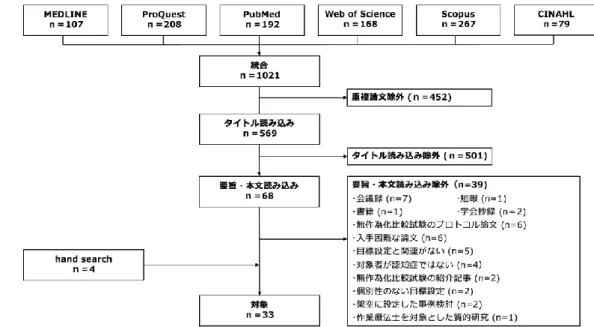
図 1 に検索過程の概略であるフローチャートを示 す.データベース検索の結果,全1021編を得た.重 複論文の除外と,タイトル・本文の読み込みを行い,
最終的に適格基準に合致した研究 33 編を読み込み 対象として採用した.
2)研究デザイン
研究デザインは無作為化比較試験(Randomized controlled trial; RCT)が10編と最多となったが6-15),
10編中4編がClareらの研究チームによる認知リハ
ビリテーション(Cognitive rehabilitation: CR)を用い た報告であり6,7,10,14),それらのPilot study10)も含まれ
表2 検索式(Pubmed)
#1 (dement*[tw]) OR (alzheimer*[tw]) OR ("lewy bod*"[tw]) OR (exp dementia/)
#2 goal*[tw] OR "goal setting"[tw] OR "goal-setting"[tw] OR "goal-oriented"[tw]
#3 (rehabilitation[tw] OR "occupational therap*"[tw] OR "physical therap*"[tw] OR phisio*[tw])
#4 #1 AND #2 AND #3
図1. 論文選別のフローチャート
28 ていた.全33編の適合論文の中で介入が含まれて いる事例報告(Case study/Case series)が5編16-20), 準実験的研究(Quasi-experimental study)が 5 編21-
25),混合研究法(Mixed method)が2編26,27),無作 為化比較試験(RCT)は10編の,合計22編(66.7%)
だった6-15).他には,Systematic reviewが2編28,29),
観察研究(Observational study)が3編30-32),質的研 究(Qualitative study)が3編33-35),介入パッケージ の紹介やコラムなどのGray literatureが3編36-38)含 まれていた.
3) 認知症の種類
今回,複数の診断名を対象とした研究の場合は,重 複して集計した.認知症の診断名のうち,最も多か ったものはアルツハイマー型認知症(Alzheimer's Disease; AD)であり14編6-8,12-14,17,22,29,31,34,35,37,38)あっ た.次いで,軽度認知障害(MCI)が9編8,11,12,16,18,25,28,32,
34,35),血管性認知症(Vascular Dementia; VaD)が5編
6,7,19,31,35),認知症を伴うパーキンソン病(Parkinson's
Disease with Dementia; PDD)が3編10,16,27), レビー小 体型認知症(Dementia with Lewy Bodies; DLB)が2
編10,27)だった.また,認知症者本人だけでなく,家
族や介護者なども同時に研究対象に含まれていた 報告が20編6,7,9-11,13-17,19,23-27,31,33-35)あった.
4)重症度
対象論文の多くが対象者の包含基準や初回評価に Mini-Mental State Examination(MMSE)を使用してい た.本研究では,重症度の分類としてMMSEの得点
が24点以上をMCI,20~23点を軽度認知症,10~19
点を中等度認知症,4~9点以下を重度認知症,3点以 下を最重度認知症とするPerneczky らの基準を採用 した39).なお,1つの論文の中で複数の重症度の対 象者が含まれていた場合,重複して集計を行った.
軽度を対象として含んだ報告が23編(69.7%)と最 も多く6-8,10-15,17,19,20,22-24,26-28,30-34),次いで中等度が11 編(33.3%)8,10,12,13,17, 20,23,27,30,32,33),MCI が 12 編
8,11,12,16,18,20,22,25,32-35)(36.3%),重度が2編(6.0%)20,32), 最重度が2編(6.0%)20,32)だった.本研究の適合論 文においては,重度〜最重度認知症者を対象と報告 が少なく,重度認知症者を対象とした論文は,目標 設定評価ツールのカットオフ値の検証論文32)や,軽 症例も含めた事例集積報告のみ20)であり,重症例に 特化した方法論は見られなかった.
表3 目標設定に使用されたフレームワークやツール
フレームワーク名(順不同) 数(編)
Cognitive rehabilitation (CR) 10
MAXCOG 2
Tailored Activity Program involving veterans with dementia (TAP-VA) 2
Model Of Human Occupation model (MOHO) 1
Goal Management Training (GMT) 1
Skill-building through Task-Oriented Motor Practice (STOMP) 1
COTiD program 1
Bandura’s Self-Efficacy for caring model 1
MINDVital 1
Person-Environment-Occupation Model (PEO) 1
ICF-oriented framework 1
なし 9
31
ツール名(順不同) 数(編)
Canadian Occupational Performance Measure (COPM) 9
Goal attainment scaling (GAS) 6
Bangor Goal-Setting Interview (BGSI) 6
GMT-Questionnaire 1
ICF-oriented questionnaire 1
Everyday Memory Questionnaire (EMQ) 1
Aid for Decision-making in Occupation Choice (ADOC) 1
It's Never 2 Late (iN2L) 1
面接 4
なし 4
34
29
5) 目標設定に使用されていたツール等
表 5 に介入に用いられていたフレームワークとツ ールに示す.介入に用いられていた目標設定を含む フレームワークとして,Cognitive Rehabilitation(認 知 リ ハ ) が 最 も 多 く 6,7,10,12,14,17,18,25,27,35), そ の 他 Tailored Activity Program involving veterans with dementia(TAP-VA)9,29),Most significant change' and the maximising cognition (MAXCOG)11,34),Goal Management Training (GMT)16)などが挙げられた.
目標設定のツールとしては,COPM8,11,12, 14,18,19,20,24,25)
が最も多く,ついでGAS15,20,24,26,28,31),Bangor Goal- Setting Interview (BGSI)6,7,10,17,22,27)があった.今回 は介入を含むフレームワークとして認知リハ,目標 設定のツールとして GAS と BGSI を詳しく解説す る.
Cognitive Rehabilitation(認知リハビリテーション)
認知リハとは,認知機能の訓練や改善を目的とし たものではなく、より個別に焦点を当て,個別に設 定された目標指向型のアプローチである10).後述す るBGSIによって,半構成的面接を実施しながら,
対象者にとって意味のある目標を設定し,代償的手 段(リマインダー,カレンダー,アラームなど),お よび/または回復的介入(感覚反復学習など)や,認 知戦略トレーニングも用いながら,目標に関連する 生活機能実現に向けた介入を行う10).具体例を表4 に示す.
Clareら6)は,軽度から中等度の認知症者に対して,
個別的な目標指向型認知リハを実施した群と,通常 のケア群をランダム化比較試験(GREAT trial)で比 較検証した結果,前者において,プライマリアウト カムである個別的な目標の達成度は有意な向上が 見られた.しかしながら,自己効力感,不安,記憶,
QOL といったセカンダリアウトカムのいずれにお いても改善は認められなかった.
Goal Attainment Scaling(GAS)
目標設定では,長期目標と短期目標と記載するこ とが一般的かと思われるが,GASでは,介入後に到 達すると予測される目標を5段階で作成する(表5). 現実的に到達可能な結果を(0)として,それより少 し高いレベルを(+1),最も高いレベルを(+2),予 測より低いレベルを(−1),最も低いレベルを(−2) とする(現時点の状態を[−1],もしくは[-3]とするこ ともある).GASの本来の使用方法は,公式を用いて スコアを算出するが,臨床で簡便にフォローアップ を行うために,5 段階評定のまま使用することもあ る.
Bangor Goal-Setting Interview (BGSI)40)
BGSI は認知リハで用いられている目標設定のた めのツールであり,下記に示す通り,全部で4つの ステップに分かれている.
Step 1) 取り組む領域を特定する
これは初期評価も含まれるが,記憶,視空間,認 知,言語の機能などを評価し,個人の興味関心があ る実際的な問題を特定する.例として,健康,食事,
身体的活動,認知的活動,社会的活動が挙げられて いるが,重要なのは,改善可能で,本人にとって重 要で意味がある活動を選択することである.
Step 2) SMARTな目標を設定する
目標は,対象者の能力の範囲内で,達成可能ある 必要がある.そのため,対象者の能力と活動遂行に 必要な事項の両方を理解し,不一致がある部分への 対処やサポートを決める.目標を現実的なものにす るために,SMARTにてチェックを行う:Specific(具 体的に)、Measurable(測定可能な)、Attainable(達成 可能な)、Relevant/Reasonable(妥当な/不合理的な)、
Time-bound(期限がある).そして,目標達成を,現
時点を0%として,25%,50%,75%,100%の5つに 段階づけて表記する(この辺は GAS に類似する). 表4. 認知リハビリテーションの具体例(文献10より著者翻訳)
目標 介入戦略
iPadを使ってEmailを送れる ようになる
代償的:手順ごとの説明が記載されたキューカードを使う.iPad のスタイラスペン を使う(指より簡単).介護者やセラピストと一緒に練習する.回復的:活動ベース の学習:iPad とキューカードを可視化して使用を促す.フローチャートを使用し て,活動を細分化する.
財布,鍵,補聴器,老眼鏡を 見つけることができる
代償的:それらの物を置く場所を決める.それらの物を置く可能性がある他の場 所にはプロンプトカードを配置して,それらを適切な場所に置くことを促す.物の 認識を促すためにカラーを利用する:色付けされたメガネひも,財布の色付き飾 り.
食事の際に,ただ食べること に集中するだけでなく,会話 に興味を持っているように見 るように社交的になる
代償的:聴力検査と新しい補聴器.会話で使用可能な情報を記録するためのノ ート.回復的:他の人への認識のアウェアネスを高める.食事の代わりに積極的に 話を聞く,ナイフやフォークを置いてアイコンタクトをとる,会話する.
30
Step 3) 現在の目標達成度と,変化に対する動機や重
要度を評定する
3 つの指標を 10 段階で評定する.1)目標達成度
(1:出来ないあるいは上手にできない,10:出来る あるいは上手にできる),2)変化に対する動機(1:
取り組みたいと思えない,10:取り組みたいと思っ ている),3)目標の重要度(1:全く重要ではない,
10:かなり重要である).評定した後,1)目標達成度 が高い場合,2)準備状態および3)重要度が低い場合 は,目標の内容を再検討するか,他の目標を検討す る.理想的には,達成度が6以下,動機や重要度が 4以上とされている.
Step 4) 目標達成の再評価
介入後に,ステップ2で評定した 0-100%の5段 階の目標達成度に関して,活動状況がどのレベルに あるかを評定する.
D.考察
今回のScRにおいて,対象論文は33編で,その うち目標設定に関するフレームワークや.介入も含 まれている報告が22編(66.7%)であった.介入に 用いられていた目標設定を含むフレームワークと して,認知リハが最も多かった.また目標設定のツ ールでは,COPM最も多く,ついでGAS,BGSIが 挙げられた.これらは,いずれも対象者中心の,オ ーダーメイドな目標設定が推奨されている.
認知リハの第一人者であるClare41)は,「リハビリテ ーションの哲学は純粋にパーソンセンタードであ り,それは良質な認知症ケアの基本となる重要な価 値を反映している.リハビリテーションは,対象者 にとって重要な目標を達成するために様々な人た ちで取り組む.それは画一的なアプローチではなく 個別的な計画に基づいており,個人の経験,価値観,
動機,強み,およびニーズが尊重される」と述べて いる.この定義に基づくならば,認知症者へのリハ では,個別的な目標設定および目標達成に向けたプ ランの立案が重要になる.
またvan Weertら42)のシステマティックレビューに よれば,高齢者へ意思決定支援ツールの活用はSDM を促進すると述べられており,具体的にはケアやリ
スクに関する知識の向上,意思決定に伴う葛藤の軽 減,意思決定への参加の向上などが期待できること から42),認知症者への目標設定においても,多くの 意思決定支援ツールが利用されていたと推察され る.しかし今回の結果からも,重度認知症者を対象 とした研究は少なく,用いられていたツールも言語 を介するものが多かったため,重度認知症者を対象 とした研究が望まれる.
E.結論
認知症者の目標設定では,対象者中心かつ個別的 な目標設定が行われており,その中で,実践的なフ レームワークやツールなどの開発も進んでいた.し かしいずれも軽度〜中等度の認知症者を対象とし たものであり,今後は重度認知症の目標設定に関す る研究が求められる.
F.研究発表 1.論文発表
1) Ohno K, Tomori K, et al. Systematic review of the Measurement Properties of the Canadian Occupational Performance Measure. American Journal of Occupational Therapy, 2020 (in press) 2) Sawada T, Tomori K, et al. Routine use proportion
and determining factors of the Canadian Occupational Performance Measure in the real- world setting: A retrospective cross-sectional study in Japan. British Journal of Occupational Therapy, 2020 (in press).
3) Strubbia C, Tomori K, et al. Use of technology in supporting goal setting in rehabilitation for adults:
a scoping review. Bmj Open 10, e041730, 2020.
4) Tokuda K, Tomori K, Tabira T, et al. Self-selection of interesting occupation facilitates cognitive response to the task: an Event-related potential study. Frontiers Human Neuroscience. 2020.
5)
友利幸之介. 目標設定 up-to-date. 臨床作業 療法
NOVA 17(2): 9-16, 2020.6)
石川哲也,友利幸之介 他. 入院患者に対して 作 業 選 択 意 思 決 定 支 援 ソ フ ト
(Aid for Decision-making in Occupation Choice)を用い表5. Goal Attainment Scaling (GAS)での目標作成例
段階 例:洗濯ができるようになる
+2 予測よりかなり高い A さんは自宅で洗濯機を適切に使い,洗濯物を干し,取り込んでたたむことがで きる
+1 予想より高い Aさんは自宅で洗濯機に洗剤を適量入れてスタートボタンを押すことができる 0 予測されるレベル Aさんは自宅で洗濯機に洗濯物を入れることができる
-1 予想より低い Aさんは自宅で3人分の洗濯物をたたむことができる -2 予想よりかなり低い Aさんは自宅で1人分の洗濯物をたたむことができる
31 た目標設定の可否に関する後方視的研究.日本臨床 作業療法研究 7: 46-51, 2020.
2.学会発表 なし
G.知的財産権の出願・登録状況(予定を含 む)
なし
引用文献
1.
厚生労働省:認知症の人の日常生活・社会生活 における意思決定支援ガイドライン.2018.
https://www.mhlw.go.jp/file/06-Seisakujouhou- 12300000-Roukenkyoku/0000212396.pdf
2. Law MC, Baptiste S, Carswell A, McColl MA, Polatajko HJ, Pollock N. Canadian Occupational Performance Measure. 2015.
3. Krasny-Pacini A, Hiebel J, Pauly F, Godon S, Chevignard M. Goal Attainment Scaling in rehabilitation: A literature-based update. Annals of Physical and Rehabilitation Medicine. 2013 Apr 1;56(3):212–30.
4. Stevens A, Beurskens A, Ko ̈ke A, van der Weijden T. The use of patient-specific measurement instruments in the process of goal- setting: a systematic review of available instruments and their feasibility. Clin Rehabil 2013;27:1005–19.
5.
友利幸之介,澤田辰徳,大野勘太,高橋香代子,
沖田勇帆:スコーピングレビューのための報告 ガイドライン日本語版:
PRSMA-ScR.日本臨床作業療法研究 7: 70-76, 2020.
6. Clare L, Kudlicka A, Oyebode JR, Jones RW, Bayer A, Leroi I,et al. Individual goal-oriented cognitive rehabilitation to improve everyday functioning for people with early-stage dementia:
A multicentre randomised controlled trial (the GREAT trial). Int J Geriatr Psychiatry. 2019 May;34(5):709-721.
7. Clare L, Kudlicka A, Oyebode JR, Jones RW, Bayer A, et al. Goal-oriented cognitive rehabilitation for early-stage Alzheimer's and related dementias: the GREAT RCT. Health Technol Assess. 2019 Mar;23(10):1-242.
8. Burton RL, O'Connell ME. Telehealth Rehabilitation for Cognitive Impairment:
Randomized Controlled Feasibility Trial. JMIR Res Protoc. 2018 Feb 8;7(2):e43. doi:
10.2196/resprot.9420.
9. Gitlin LN, Arthur P, Piersol C, Hessels V, Wu SS, et al. Targeting Behavioral Symptoms and Functional Decline in Dementia: A Randomized Clinical Trial. J Am Geriatr Soc. 2018
Feb;66(2):339-345.
10. Hindle JV, Watermeyer TJ, Roberts J, Brand A, Hoare Z, et al. Goal-orientated cognitive rehabilitation for dementias associated with Parkinson's disease-A pilot randomised controlled trial. Int J Geriatr Psychiatry. 2018 May;33(5):718- 728.
11. Regan B, Wells Y, Farrow M, O'Halloran P, Workman B. MAXCOG-Maximizing Cognition: A Randomized Controlled Trial of the Efficacy of Goal-Oriented Cognitive Rehabilitation for People with Mild Cognitive Impairment and Early
Alzheimer Disease. Am J Geriatr Psychiatry. 2017 Mar;25(3):258-269.
12. Kim S. Cognitive rehabilitation for elderly people with early-stage Alzheimer's disease. J Phys Ther Sci. 2015 Feb;27(2):543-6. doi:
10.1589/jpts.27.543. Epub 2015 Feb 17.
13. Schmid AA, Spangler-Morris C, Beauchamp RC, Wellington MC, Hayden WM,et al. The Home- Based Occupational Therapy Intervention in the Alzheimer's Disease Multiple Intervention Trial (ADMIT). Occup Ther Ment Health. 2015 Jan 1;31(1):19-34.
14. Clare L, Linden DE, Woods RT, Whitaker R, Evans SJ, et al. Goal-oriented cognitive rehabilitation for people with early-stage Alzheimer disease: a single-blind randomized controlled trial of clinical efficacy. Am J Geriatr Psychiatry. 2010 Oct;18(10):928-39.
15. Rockwood K, Stolee P, Howard K, Mallery L. Use of Goal Attainment Scaling to measure treatment effects in an anti-dementia drug trial.
Neuroepidemiology. 1996;15(6):330-8.
16. Giguère-Rancourt A, Plourde M, Doiron M, Langlois M, Dupré N, et al. Goal management training ® home-based approach for mild cognitive impairment in Parkinson's disease: a multiple baseline case report. Neurocase. 2018 Oct- Dec;24(5-6):276-286.
17. Kelly ME, Lawlor BA, Coen RF, Robertson IH, Brennan S. Cognitive rehabilitation for early stage Alzheimer's disease: a pilot study with an Irish population. Ir J Psychol Med. 2019 Jun;36(2):105- 119.
18. Clare L, van Paasschen J, Evans SJ, Parkinson C, Woods RT, Linden DE. Goal-oriented cognitive rehabilitation for an individual with Mild Cognitive Impairment: behavioural and neuroimaging outcomes. Neurocase. 2009 Aug;15(4):318-31.
19. Graff MJL, Vernooij-Dassen MJM, Zajec J, Olde- Rikkert MGM, Hoefnagels WHL,et al. How can occupational therapy improve the daily
performance and communication of an older patient with dementia and his primary
32 caregiver?: A case study. Dementia. 2006;5(4):503- 532.
20. Hartman D, Borrie MJ, Davison E, Stolee P. Use of Goal Attainment Scaling in a Dementia Special Care Unit. American Journal of Alzheimer’s Disease. 1997;12(3):111-116.
21. Zarit SH, Chiusano C, Harrison AS, Sewell L, Krause C, Liu Y. Rehabilitation of persons with dementia: using technology to improve
participation. Aging Ment Health. 2021 Mar;25(3):543-550.
22. Øksnebjerg L, Woods B, Vilsen CR, Ruth K, Gustafsson M, Ringkøbing SP, Waldemar G. Self- management and cognitive rehabilitation in early stage dementia - merging methods to promote coping and adoption of assistive technology. A pilot study. Aging Ment Health. 2020
Nov;24(11):1894-1903.
23. Chenoweth L, Stein-Parbury J, White D, McNeill G, Jeon YH, et al. Coaching in self-efficacy improves care responses, health and well-being in dementia carers: a pre/post-test/follow-up study.
BMC Health Serv Res. 2016 May 4;16:166.
24. Ciro CA, Poole JL, Skipper B, Hershey LA.
Comparing Differences in ADL Outcomes for the STOMP Intervention for Dementia in the Natural Home Environment Versus a Clinic Environment.
Austin Alzheimers Parkinsons Dis.
2014;1(1):1003.
25. Londos E, Boschian K, Lindén A, Persson C, Minthon L, et al. Effects of a goal-oriented rehabilitation program in mild cognitive impairment: a pilot study. Am J Alzheimers Dis Other Demen. 2008 Apr-May;23(2):177-83.
26. Jennings LA, Ramirez KD, Hays RD, Wenger NS, Reuben DB. Personalized Goal Attainment in Dementia Care: Measuring What Persons with Dementia and Their Caregivers Want. J Am Geriatr Soc. 2018 Nov;66(11):2120-2127.
27. Watermeyer TJ, Hindle JV, Roberts J, Lawrence CL, Martyr A, et al. Goal Setting for Cognitive Rehabilitation in Mild to Moderate Parkinson's Disease Dementia and Dementia with Lewy Bodies. Parkinsons Dis. 2016; 2016:8285041.
28. Allan LM, Wheatley A, Smith A, Flynn E, Homer T, et al. An intervention to improve outcomes of falls in dementia: the DIFRID mixed-methods feasibility study. Health Technol Assess. 2019 Oct;23(59):1-208.
29. Scott I, Cooper C, Leverton M, Burton A, Beresford-Dent J, et al. Effects of
nonpharmacological interventions on functioning of people living with dementia at home: A
systematic review of randomised controlled trials.
Int J Geriatr Psychiatry. 2019 Oct;34(10):1386- 1402.
30. Dutzi I, Schwenk M, Kirchner M, Bauer JM, Hauer K. "What would you like to achieve?" Goal- Setting in Patients with Dementia in Geriatric Rehabilitation. BMC Geriatr. 2019 Oct 22;19(1):280.
31. Chew J, Chong MS, Fong YL, Tay L. Outcomes of a multimodal cognitive and physical rehabilitation program for persons with mild dementia and their caregivers: a goal-oriented approach. Clin Interv Aging. 2015 Oct 22;10:1687-94.
32. Tomori K, Nagayama H, Saito Y, Ohno K,
Nagatani R, et al. Examination of a cut-off score to express the meaningful activity of people with dementia using iPad application (ADOC). Disabil Rehabil Assist Technol. 2015 Mar;10(2):126-31.
33. Leven NV, de Lange J, Groenewoud J, van der Ploeg E, Pot AM. Exploring the usefulness of indicators for referring people with dementia and their informal caregivers to activating
interventions: a qualitative analysis of needs assessments. BMC Geriatr. 2019 Aug 23;19(1):230.
34. Regan B, Wells Y. 'Most significant change' and the maximising cognition (MAXCOG)
intervention: The views of clients, supporters and counsellors. Australas J Ageing. 2017
Dec;36(4):324-326.
35. Burton R, O'Connell ME, Morgan DG. Exploring interest and goals for videoconferencing delivered cognitive rehabilitation with rural individuals with mild cognitive impairment or dementia.
NeuroRehabilitation. 2016 Jun 30;39(2):329-42.
36. Douglas N, Brush J, Bourgeois M. Person- Centered, Skilled Services Using a Montessori Approach for Persons with Dementia. Semin Speech Lang. 2018 Jul;39(3):223-230.
37. Ciro C. Second nature: Improving occupational performance in people with dementia through role- based, task-specific training. OT Practice.
2013;18(3):9-12.
38. Borell L, Sandman P-O, Kielhofner, G. Clinical Decision Making in Alzheimer's Disease.
Occupational Therapy in Mental Health 11(4), 111–124. 1991
39. Clare L, Nelis SM, Kudlicka A: Bangor Goal- Setting Interview Manual Setting goals with the BGSI Version 2.
<https://medicine.exeter.ac.uk/media/universityofe xeter/schoolofpsychology/reach/documents/The_B angor_Goal-
Setting_Interview_Version_2_Manual_(BGSI_v.2) _Dec_2016.pdf> 2021-02-17.
40. Perneczky R, Wagenpfeil S, Komossa K, Grimmer T, Diehl J, Kurz A. Mapping scores onto stages:
mini-mental state examination and clinical
33 dementia rating. Am J Geriatr Psychiatry. 2006
Feb;14(2):139-44.
41. Clare, L Rehabilitation for people living with dementia: a practical framework of positive support. PLoS medicine, 14(3), e1002245. 2017.
42. van Weert JC, Van Munster BC, Sanders R, Spijker R, Hooft L, et al. Decision aids to help older people make health decisions: a systematic review and meta-analysis. BMC medical
informatics and decision making, 16(1):1-20, 2016.