原
著
二重課題下の持ち上げ動作に関する筋電図学的研究
藤村 昌彦,波之平晃一郎
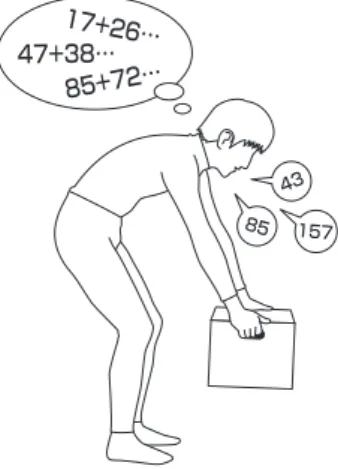
広島大学大学院保健学研究科 (平成 22 年 12 月 21 日受付) 要旨:本研究は,二重課題下における持ち上げ動作の影響を明らかにするために,計算問題を課 した条件下で重量物を持ち上げさせた.その際の,腰部傍脊柱筋の働きについて表面筋電計を用 いて検討した.対象は,健常男子大学生 14 名とした. 筋電図は,表面筋電計にて双極誘導にて測定した.導出筋は,右側の腰部傍脊柱筋とした.重 量物の質量は体重の 10% とした.対象者の右側の肩峰,大転子,膝関節関節裂隙,外果にマーカー を貼付し対象者の右側よりビデオカメラ撮影した. 持ち上げ動作の開始は,重量物が離床した時点とし,動作の終了は重量物の底面が身長の 1!2 の高さに到達した時点とした.持ち上げ方法は任意とし,持ち上げ動作を 10 回行った.重量物を 持ち上げる動作中に,音声再生ソフトを用いて 2 桁の数字の足し算問題を連続して出題した(以 下,暗算群).対象者は連続して出題される問題に声を出して回答した.一方,対照群には暗算を 課さなかった. 筋電図の解析は,得られた波形を全波整流化した後,等尺性最大随意収縮時の筋活動量を基に 正規化を行った.持ち上げ動作開始から終了までを解析区間とし平均積分値を算出した.次に, 動作について経時的変化を調べるために,10 回の試行において持ち上げ時間が中央値を示した データを用いて,1 動作を 100% として 4 区に等分割して区間毎の積分値を算出した.また,動作 開始時の画像から膝関節屈曲角度を計測した. その結果,腰部傍脊柱筋の平均積分値において暗算群が有意に小さかったことから,筋性支持 力の低下が推察され,その低下分を補うために後部脊柱靭帯群や関節包などに負荷が増大すると 考えた.経時的変化では,動作開始から最初の 25% に当たる持ち上げ初期に大きな差が確認され た.さらに動作開始時の膝関節屈曲角度において暗算群が有意に小さかったことから,暗算群は 膝関節伸展筋群を十分に活用できていない可能性が示唆された. (日職災医誌,59:120─124,2011) ―キーワード― 持ち上げ動作,二重課題,表面筋電図 I.はじめに 持ち上げ動作は,労働現場のみならず日常生活におい ても頻繁に行われる動作である.持ち上げ動作を行うと き脊柱基部に大きな圧迫力,張力,剪断力を生じる.こ のため,持ち上げ動作は,腰痛発生リスクの一因となっ ている.過去の研究では重量物の質量,荷台の高さ,持 ち上げ方法の違いなど多くの研究がなされてきたが,精 神的側面からの検証は少ない.人は様々な環境下で情報 を瞬時に処理しながら,目的とする行動を遂行している. 本研究では,二重課題下における持ち上げ動作の影響を 明らかにするために,計算(暗算)問題を課した条件下 で重量物を持ち上げさせた.その際の,腰部傍脊柱筋の 働きについて表面筋電計を用いて検討した. II.対 象 対象は,筋骨格障害の既往がない健常男子大学生 14 名(年 齢:22.1±3.1 歳,身 長:170.1±6.9cm,体 重: 61.8±4.9kg)とした(表 1).対象者には,測定前に研究 の内容および方法について十分説明し,書面にて同意を 得た.なお,本研究を行うにあたり,広島大学大学院保 健学研究科心身機能生活制御科学講座倫理委員会の承認 を得た(No. 0938).図 1 暗算群の持ち上げ動作 対象者 性別 年齢(years) 身長(cm) 体重(kg) A 男性 21 175 65 B 男性 19 175 63 C 男性 22 170 63 D 男性 32 165 67 E 男性 21 182 69 F 男性 21 163 62 G 男性 23 168 59 H 男性 19 170 58 I 男性 21 179 64 J 男性 22 167 60 K 男性 23 164 60 L 男性 23 175 67 M 男性 20 156 49 N 男性 22 173 60 III.方 法 1.測定条件
筋電図は,表面筋電計(Noraxon 社製,Tele Myo2400, 米国)を用い,双極誘導にて測定した.導出されたアナ ログ信号は,サンプリング周波数 1,500Hz にて,パーソナ ルコンピュータに取り込んだ.導出筋は,右側の腰部傍 脊柱筋とした.貼付位置は,電極間距離 35mm で導出筋 の走行に沿って貼付した.アース電極は第 12 肋骨とし た.電極は,表面電極(Ambu 社製,blue sensor dis-porsable electrodes,デンマーク)を用いた.皮膚前処理 は,スキンピュア(日本光電社製,日本)を用いて十分 に行った.重量物(40.7×27.0×21.8cm)の質量は体重の 10% とした.対象者の右側の肩峰,大転子,膝関節関節 裂隙,外果にマーカーを貼付した.また,対象者の右側 よりビデオカメラ(SONY 社製,日本)で撮影した. 2.測定方法 各動作間で筋活動量の比較を行うために,筋の等尺性 最大随意収縮時の筋活動電位(maximum isometric vol-untary contraction:以下,MIVC)を測定した.測定肢 位 は 腰 背 部 筋 の 評 価 と し て 用 い ら れ る Sorensen の trunk holding test の肢位に準じた1)
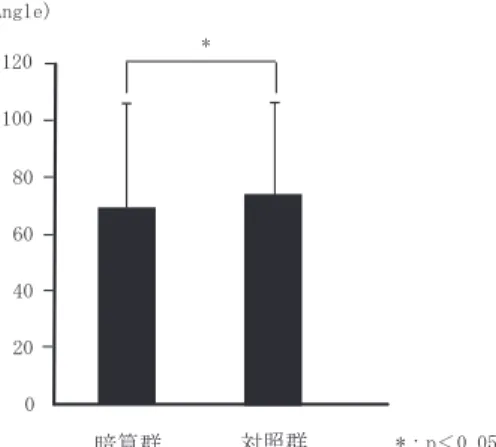
.腹臥位で臍部から 上半身をベッドの端から浮かせて,検者の徒手により加 えられた抵抗に抗して体幹の水平位を維持させて腰部傍 脊柱筋に等尺性最大随意収縮を行わせた.測定は 1 回 5 秒間実施し,その中で最大となる 1 秒間あたりの MIVC を 100%MIVC とした. 持ち上げ動作の開始は,重量物が離床した時点とし, 動作の終了は重量物の底面が身長の 1!2 の高さに到達し た時点とした.持ち上げ方法は任意とし,14 名の対象者 に 2 試行の持ち上げ動作を課した.ひとつは,重量物を 持ち上げる動作中に,音声再生ソフトを用いて 2 桁の数 字の足し算問題を連続して出題した(以下,暗算群).対 象者は連続して出題される問題に声を出して回答した (図 1).音声再生速度は 1 分間に 10 題とした.他方の試 行には,暗算を課さなかった(対照群).2 試行とも持ち 上げ動作は 10 回行った.動作を行う順番はランダムとな るよう設定し,2 試行の持ち上げ動作間に十分な休憩を 設け筋疲労の影響がないよう配慮した. 3.解析および統計処理 筋電図の解析は,表面筋電図解析ソフト MyoResearch 2.11.15(Noraxon 社製)を用い,得られた波形を全波整流 化した後,MIVC を基に正規化を行った.持ち上げ動作 開始から終了までを解析区間とし平均積分値を算出し た.次に,動作について経時的変化を調べるために,10 回の試行において持ち上げ時間が中央値を示したデータ を用いて,1 動作を 100% として 4 区に等分割して区間 毎の積分値を算出した.2 次元画像解析ソフト(Scion 社製,Scion Image,米国)を用いて,動作開始時の画像 から,膝関節屈曲角度(大転子―膝関節関節裂隙線と膝 関節関節裂隙―外果線の間の角)を計測した2) .統計学的 処理には,JSTAT for windows を用い,暗算群と対照群 の比較には Paired t-test を行った.なお,有意水準は 5% 未満とした. IV.結 果 1.筋活動量(図 2 および図 3) 腰部傍脊柱筋の平均積分値において暗算群(22.88± 7.83)と対照群(24.50±7.52)を比較すると暗算群が有意 に小さかった(p<0.05).経時的変化では,二重課題の有 無により筋活動電位の経時的変化に違いがみられた.特 に大きな差がみられたのは,動作開始から最初の 25% に 当たる第 1 区であった(p<0.01). 2.動作開始時の膝関節の関節角度(図 4) 動 作 開 始 時 の 膝 関 節 の 関 節 角 度 に お い て 暗 算 群 (71.58±32.96)と対照群(76.42±28.39)を比較すると暗 算群が有意に小さかった(p<0.05).
図 2 腰部傍脊柱筋の平均積分値 図 3 腰部傍脊柱筋の平均積分値の経時的変化 図 4 動作開始時の膝関節の関節角度 V.考 察 本研究は,計算問題を課し注意力を分散させた条件下 で重量物を持ち上げさせた.主に注意力は前頭葉におい てその機能を有し,注意機能検査の代表とされる trail masking testにおいて前頭葉の活性化が確認されてい る3)4) .今日,二重課題下の研究は,歩行や転倒に関する 報告が多く見受けられる5)6) .計算や語想起の課題を伴い ながらの歩行では,歩行速度遅延や動揺の増大が報告さ れている7)8) .それは,前頭連合野の注意資源の注意分散 機能が関与しているとされている9) .これらと同様に,本 研究においても暗算群の持ち上げ動作は注意資源が計算 処理に向けられて,結果的に持ち上げ作業への注意量が 減少したと考える. 暗算による注意力の分散は,持ち上げ動作時の腰部傍 脊柱筋の働きに影響を与えることが確認された.暗算群 と対照群を比較すると暗算群において筋活動量が有意に 小さかったことから,持ち上げ動作に必要な筋活動量が 得られていないと思われる.したがって,持ち上げ動作 に必要な筋活動量が得られるまでの間はその低下分を補 うために後部脊柱靭帯群や関節包などが体幹を支持して いると考えられ,それらの組織にかかる負担が増大して いると思われる.経時的変化から検討すると,持ち上げ 初期に腰部傍脊柱筋の働きが顕著に低下していた.体幹 前屈位から持ち上げる場合,まず骨盤周囲筋が収縮し, その後体幹前屈 45 度付近から体幹固定筋が機能して身 体を安定させて腰部傍脊柱筋を補助すると報告されてお り10) ,さらに重量物持ち上げ時の胸・腰椎移行部のモー メント値のピークは,持ち上げ作業前半にみられる11) .他 方,椎間板への影響も懸念される.体幹前屈位は椎間板 の変形を引き起こし不均一な負荷が加わるため,髄核を 変形させて腰椎椎間板ヘルニアの原因にもなり得る.標 準的な体格の人が物を持ち上げる場合,第 5 腰椎椎間板 にかかるストレスは,体幹前傾角度が大きいほど増強す る12) .特に,急激な負荷がかかる場合,椎間板が損傷を受 ける可能性が大きくなると報告されている13)14) .したがっ て,注意力低下状態での持ち上げ動作は,動作初期時に おいて腰部への傷害リスク管理が重要であると考える. さらに,動作開始時の膝関節の関節角度に有意な差が 認められた.対照群は膝関節伸展筋群を利用した持ち上 げ方,すなわち Squat 法であることに対して,暗算群は 膝関節伸展筋群を十分に活用しない Stoop 法に類似する 持ち上げ方である可能性が示唆された.Squat 法は膝関 節伸展筋群の力を利用し,腰部伸展筋群の負担を軽減す る方法とされている.一方,Stoop 法は膝関節伸展筋群の 力よりも腰部伸展筋群の力を主に働かせる方法であ る15) .安全な持ち上げ動作を行う際,腰部筋に要求される 力を最小にするために,股関節,膝関節伸筋を十分に使 用することが推奨されている16) .腰部伸展筋群に代表さ れる腰部傍脊柱筋は,腰椎の正常な前彎を維持するため に重要な筋である.この筋が強く緊張した状態で腰部に ストレスが加わると腰痛の一因となると推察する.さら に,通常の緊張であれば耐えうる負荷量であっても,過 剰なストレスを生じることで,腰部組織に損傷を起こす
横突起への距離が短いため,筋の支点として不十分な一 面を有する.重量物の持ち上げに際しては,重量物の重 心から離れたところで筋が作用するため損傷のリスクは 高まると考える.これらのことから,筋性支持力の低下 している腰部に負荷が増大することが懸念される. 今日の産業現場における持ち上げ動作は,厚生労働省 の指導の下,機械化が進んでいるとはいえ,機器が入ら ない場所やコスト軽減の見地から人力作業も残存してい る.そのような作業環境の整備が整わない現場では,重 量物取り扱い者が作業に集中できる環境を確保する必要 がある.一例として,同じ姿勢の持続,暑い場所など過 酷な作業環境下での作業を避け,重量物取り扱い作業と 他の作業を組み合わせたり,適宜休憩することで作業に 対する集中力を維持できると考える.振動・騒音の大き い現場も注意力が散漫になるので,配慮が必要であろう. いずれにせよ,作業管理者がリスクを把握して作業に相 応しい環境を確保することが肝要である. 今回の研究は対象者を健常男子学生とし,疲労のない 条件下で行った.しかし,実際の労働現場は,長時間に わたり繰り返し作業を行っており,筋疲労が蓄積した状 況にあると考えられる.さらに,中高年者では,椎間板 や椎間関節の変性などの加齢的要素も加わる17) .これら のことをふまえ,今後条件設定を多様化し対象数を増や して,より実際の労働環境に近い状況での腰痛リスクを 検討したい. VI.結 語 本研究は,注意力の有無が持ち上げ動作におよぼす影 響を明らかにするために,計算問題を課した条件下で重 量物を持ち上げさせた.暗算群において筋活動量が有意 に小さかったことから筋性支持力の低下が推察され,そ の低下分を補うために後部脊柱靭帯群や関節包などに負 荷が増大すると考える.経時的変化から検討すると,持 ち上げ初期に腰部傍脊柱筋の働きが顕著に低下すること が確認された.動作開始時の膝関節の関節角度に有意な 差が認められた.暗算群は膝関節伸展筋群を十分に活用 できていない可能性が示唆された. 文 献
1)Kankaanpaa M, Laaksonen D, Taimela S, et al: Related Articles Age, sex, and body mass index as determinants of back endurance test. Arch Phys Med Rehabil 79: 1069―2075, 1998.
2)Maruta K, Watanebe K: Electromyographic Analysis of the Erector Spinae and Lower Limb Muscles during Han-dling of Objects on Low Surfaces from a Standing Position.
Japanese).
3)Zakzanis KK, Mraz R, Graham SJ: An fMRI study of the Trail Making Test. Neuropsychologia 43: 1878―1886, 2005. 4)Shibuya T, Sumitani S, Kikuchi K, et al: Activation of the prefrontal cortex during the Trail-Making Test detected with multichannel near-infrared spectroscopy. Psychiatry Clin Neurosci 61: 616―621, 2007.
5)Liu-Ambrose T, Katarynych LA, Ashe MC, et al: Dual-task gait performance among community-dwelling senior women: the role of balance confidence and executive func-tions. J Gerontol A Biol Sci Med Sci 64: 975―982, 2009. 6)de Hoon EW, Allum JH, Carpenter MG, et al:
Quantita-tive assessment of the stops walking while talking test in the elderly. Arch Phys Med Rehabil 84: 838―842, 2003. 7)Woollacott M, Shumway-Cook A: Attention and the
con-trol of posture and gait: a review of an emerging area of re-search. Gait Posture 16: 1―14, 2002.
8)Schrodt LA, Mercer VS, Giuliani CA, et al: Characteris-tics of stepping over an obstacle in community dwelling older adults under dual-task condition. Gait Posture 19: 279―287, 2004.
9)Koechlin E, Basso G, Pietrini P, et al: The role of the ante-rior prefrontal cortex in human cognition. Nature 399: 148―151, 1999.
10)Nelson JM, Walmsley RP, Stevenson JM: Relative lum-bar and pelvic motion during loaded spinal flexion !exten-sion. Spine 20: 199―204, 1995.
11)Fujimura M, Yuge R: An Study of personal joint mo-ment in heavy object lifting action. J Occupational med Traumatology 54: 129―136, 2006.
12)河端正也:腰痛テキスト―正 し い 理 解 と 予 防 の た め に―.東京,南江堂,1998, pp 21.
13)高橋利幸:筋骨格系と姿勢―ヒトの姿勢とその変遷―. 理学療法科 10:149―160, 1995.
14)Norris CM: Spinal stabilisation. 2. Limiting factors to end-range motion in the lumbar spine. Physiotherapy 81: 64―72, 1995.
15)嶋田智明,平田総一郎:筋骨格系のキネシオロジー 第 1 版.東京,医歯薬出版,2005, pp 314―316.361―369. 16)Neumann DA:筋骨格系のキネシオロジー. 嶋田智明,
平田総一郎(監訳).東京,医歯薬出版,2007, pp 361.368. 17)Bertagnoli R, Yue JJ, Nanieva R, et al: Lumbar total disc
arthroplasty in patients older than 60 years of age: a pro-spective study of the ProDisc prosthesis with 2-year mini-mum follow-up period. J Neurosurg Spine 4: 85―90, 2006. 別刷請求先 〒734―8551 広島市南区霞 1―2―3
広島大学大学院保健学研究科 藤村 昌彦
Reprint request: Masahiko Fujimura
Institute of Health Sciences, Faculty of Medicine, Hiroshima University, 1-2-3, Kasumi, Minamiku, Hiroshima, 734-8551, Ja-pan
Electromyographic Investigation of Lifting Motion in a Dual-Task Situation in Humans
Masahiko Fujimura and Koichiro Naminohira
Institute of Health Sciences, Faculty of Medicine, Hiroshima University
In this study, human subjects were asked to lift a heavy object while simultaneously performing mental arithmetic calculations in order to clarify the effect of lifting motion on muscle activity during a dual-task per-formance. Fourteen healthy male university students were selected as the test subjects. During this experi-ment, the function of lumbar paraspinal muscles was inspected using surface electromyography.
The surface electromyographic study was made with bipolar lead. The induction muscle was presented with the lumbar paraspinals on right side of human body. The mass of the object to be lifted was set at 10% of a subject s body weight. Markers were installed on the acromion, trochanter major, knee joint space and malleo-lus lateralis of the right side of subjects. Then, a video camera recorded them from the right side of their bodies. The start of the lifting motion was defined as the time when the heavy object was raised from the floor and completion of the motion was defined as the time when the bottom of the object reached half the stature of the subject. Lifting motion was repeated 10 times. While performing sequential motion of lifting the heavy object, one group among the subjects were required to perform mental calculations comprising addition of 2-digit num-bers using voice reproducing software (henceforth referred to the mental arithmetic group ). The subjects in this group answered the questions orally. On the other hand, the control group members were not required to perform mental calculations.
After full-wave rectification of the obtained waveform, an electromyographic analysis was performed to implement regulation of movement on the basis of the amount of human muscle activity at maximal isometric voluntary contraction. Interval analysis was set from the start to completion of the lifting motion and subse-quently, the mean integrated value was calculated. Then, to check the change over time for the movement, time taken to perform one cycle of lifting motion was regarded as 100% and divided into 4 equal intervals to calculate the integrated value at each interval on the basis of data indicating the median value of the lifting time in 10 test trials. The knee joint flexion angle was also measured on a video monitor at the start of the motion.
Results showed that the mental arithmetic group had a significantly smaller mean integrated value for lumbar paraspinal muscles in comparison to the control group. It is thought that the muscle support force de-creases and the load in the posterior vertebral ligament group or intervertebral joint capsules inde-creases to sup-plement the lowered force. In the change over time for lifting motion, the initial interval of 25% after the start of motion showed a greater difference. It was also proven that the mental arithmetic group might not be able to make full use of the knee extensor muscles because this group had a significantly smaller knee joint flexion an-gle at the start of the lifting motion compared to the control group.
(JJOMT, 59: 120―124, 2011) ⒸJapanese society of occupational medicine and traumatology http:!!www.jsomt.jp