Re-evaluation of Urinary Trypsin Inhibitor on Pregnancy Course in Patients with
Threatened Preterm Delivery: A Single-Center Retrospective Study
Hiroaki Komatsu,* Fuminori Taniguchi,† Takashi Harada,† Takaya Nakaso,† Noriko Nishimura,* Satoru Tsukihara,* Masako Sarugami,* Tasuku Harada† and Yasunobu Kanamori*
*Department of Obstetrics and Gynecology, Japanese Red Cross Yamaguchi Hospital, Yamaguchi 753-0092, Japan, and †Division of Reproductive-Perinatal Medicine and Gynecologic Oncology, Department of Surgery, School of Medicine, Tottori University Faculty of Medicine, Yonago 683-8503, Japan
ABSTRACT
Background We evaluated the necessity of urinary trypsin inhibitor for patients with threatened premature labor.
Methods We enrolled 146 women with singleton pregnancies who were treated for threatened premature labor as inpatients. The uterine cervical length of each patient was ≤ 25 mm at 22–35 weeks of gestation on transvaginal ultrasonography. The patients were divided into two groups: the urinary trypsin inhibitor group (91 patients treated with urinary trypsin inhibitor daily) or non-urinary trypsin inhibitor group (55 patients not treated with urinary trypsin inhibitor). The childbirth outcomes were retrospectively assessed.
Results The median cervical length measured on the day of admission was almost similar between the uri-nary trypsin inhibitor and non-uriuri-nary trypsin inhibitor groups. Depending on the symptoms of uterine contrac-tions, we determined whether ritodrine hydrochloride and/or magnesium sulfate would be appropriate for treatment. The median gestational week at birth was 38 weeks in the urinary trypsin inhibitor group, and no obvious differences were observed when compared with the non-urinary trypsin inhibitor group. With regard to birth weight, no significant difference was found be-tween the two groups (urinary trypsin inhibitor group, 2776 g; non-urinary trypsin inhibitor group, 2800 g).
Conclusion Our data showed no significant beneficial effects of urinary trypsin inhibitor in the maternal course and delivery outcomes.
Key words premature labor; ulinastatin; urinary tryp-sin inhibitor
Preterm delivery is caused by numerous pathological factors, and accounts for 2%–18% of all pregnancies.1, 2
According to the 2017 Clinical Practice Guidelines of the Japan Society of Obstetrics and Gynecology, preg-nant women presenting with regular cervical ripening (i.e., cervix dilatation or shortening of cervical length) at 22–36 weeks of gestation should be diagnosed with threatened preterm delivery.3 The preferred timing of
cervical length measurement for the diagnosis of uterine cervix shortening has been considered to be 18–24 weeks of gestation because this period is considered appropriate for distinguishing the lower uterine segment and cervix by using vaginal ultrasound.4
No evidence has shown that assessment of cervical length for all pregnant women would result in better prognosis.5 No randomized controlled trial concerning
prevention or treatment of threatened preterm labor has been previously conducted in our country. Other guide-lines for threatened preterm labor in countries besides Japan primarily exhibit the therapeutic efficacies of fetal fibronectin test, therapeutic steroids, and antibiotics with regard to preterm delivery.6–9
Intravaginal treatment using urinary trypsin inhibitor (UTI) has been reported to inhibit an increase in neutrophil elastase level in the uterine cervical secre-tions of pregnant women, which is considered to cause preterm delivery.10, 11 However, few studies have been
conducted concerning the effect of UTI outside Japan because it was only used in Japan. In addition, preven-tive or therapeutic intervention for preterm delivery depends on the decision of each attending physician and institution on whether UTI should be used. Although the use of UTI for pregnant women has not been cov-ered by health insurance in Japan, an extensive discus-sion of the clinical efficacy and cost-effectiveness of the use of UTI for workforces (obstetricians, midwives, and pharmacists) should be necessary. Therefore, the extent of the effect of UTI must be objectively verified.
MATERIALS AND METHODS
We enrolled 146 women diagnosed with threatened preterm labor and required treatment as inpatients at
Corresponding author: Fuminori Taniguchi, MD, PhD [email protected]
Received 2019 March 1 Accepted 2019 April 26 Online published 2019 June 20
Abbreviations: MMP, matrix metalloproteinase; NICU, neonatal intensive care unit; nUTI, non- urinary trypsin inhibitor; UTI, urinary trypsin inhibitor
the Japanese Red Cross Yamaguchi Hospital between January 2017 and June 2018. Written informed consent was obtained from all participants, and the study was approved by the institutional review board of Japanese Red Cross Yamaguchi Hospital (number: H30-9). In patients with cervical length of < 25 mm, which was measured using transvaginal ultrasonography, or insufficient response to oral administration of ritodrine hydrochloride, a tocolytic drug, ritodrine hydrochloride was intravenously and continuously administered. Magnesium sulfate was additionally administered if suf-ficient control of uterine contraction using intravenous ritodrine hydrochloride was not achieved. The patients were examined on the day of admission to exclude the possibility of chorioamnionitis.
The study subjects were women with singleton pregnancy at 22–35 weeks of gestation, traceable parto-gram, and shortened cervical length. They were retro-spectively divided into two groups: the (i) UTI group (91 patients treated with UTI) and (ii) non- urinary trypsin inhibitor (nUTI) group (55 patients not treated with UTI). Delivery outcomes (gestational age at birth, birth weight, record of neonatal intensive care unit [NICU] admission, presence of preterm rupture of membrane, use of steroids to aid maturing of fetal lungs), change in cervical length during hospitalization, and length of hospitalization were retrospectively analyzed. We measured cervical length before the administration of UTI (ulinastatin), and the cervix was disinfected using povidone–iodine, followed by administration of 5000-unit dose of UTI tablet into a portion of the vaginal fornix. The uterine cervical length was measured once
weekly in the nUTI group. The Mann–Whitney U-test, Fisher exact test, and log-rank (Mantel–Cox) test were used for analysis; P < 0.05 was considered statistically significant.
RESULTS
The patient’s characteristics are summarized in Table 1. The median age of the patients was 36 (range, 16–43) and 31 (range, 19–45) years for the UTI and nUTI groups, respectively. No difference was observed in parity between the groups (P = 0.432). The gestational week at the time of admission was almost similar (30 [range, 22–35] and 31 [range, 23–35] weeks for the UTI and nUTI groups, respectively), and no significant dif-ference was found between the two groups (P = 0.067).
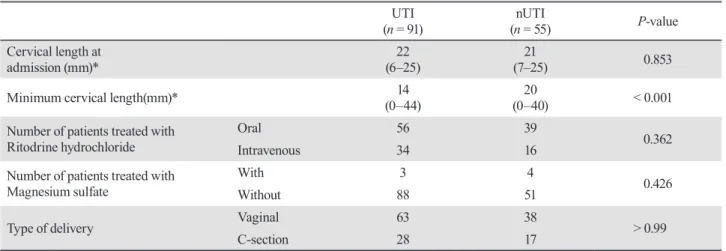
The data in Table 2 shows that the median uterine cervical length on the day of admission was almost sim-ilar in both groups (22 [range, 6–25] and 21 mm [range, 7–25] for the UTI and nUTI groups, respectively). The median minimum cervical length measured during hospitalization was 14 (range, 0–44) and 20 (range, 0–40) mm for the UTI and nUTI groups, respectively. Contrary to our expectations that UTI can continue to lengthen the cervix, the cervical length significantly shortened in the UTI group (P < 0.001). In contrast, this difference was not found in the nUTI group (P = 0.408) (Fig. 1). When similar cervical length groups were com-pared, there was the same result between both groups at perinatal outcome.
The proportion of patients who were administered intravenous ritodrine hydrochloride was almost similar between the UTI and nUTI groups (UTI: 37.3%: 34/91
Table 1. Patient's characteristics
UTI
(n = 91) (n = 55)nUTI P-value
Age (year)* (16–43)36 (19–45)31 0.432
Parity 0 43 33 0.171
1 or more 48 22
History of threatened premature labor Yes 18 11 > 0.99
No 73 44
Days of hospital stay* (6–121)30 (6–102)27 0.439
Gestational weeks at admission* (22–35)30 (23–35)31 0.067
Average number of UTI used in a patient Total 2346 units (10–106)25 n.a. n.a. *: Each value is shown as the median. The parenthesis indicated the ranges of data. Fisher exact test was used.
vs. nUTI: 29.0%: 16/55) (P = 0.362, Table 2). No sig-nificant difference was found in the use of magnesium sulfate between the two groups (P = 0.426). Moreover, no significant difference was observed between the two groups regarding the mode of delivery. The proportion of patients who underwent cesarean section was 30.7% (28/91) and 30.9% (17/55) (P > 0.99) in the UTI and nUTI groups, respectively.
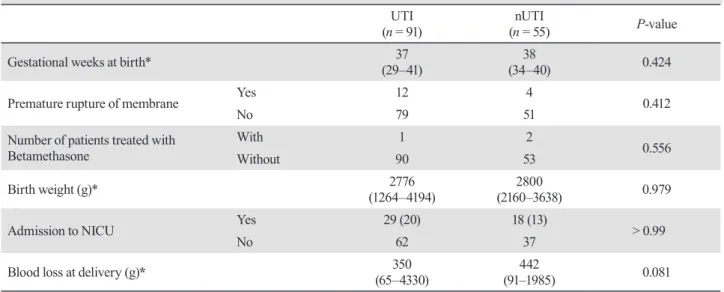
The median gestational week at birth was 37 (range, 29–41) weeks for the UTI group, and no significant dif-ference was found when compared with the nUTI group (P = 0.424) (Table 3). In cases of preterm delivery, chorioamnionitis was not seen during the pathological examinations of the placenta. The proportion of cases with premature rupture of membranes showed no significant difference between the two groups, with
Table 2. Data of maternal course and treatment
UTI
(n = 91) (n = 55)nUTI P-value
Cervical length at
admission (mm)* (6–25)22 (7–25)21 0.853
Minimum cervical length(mm)* (0–44)14 (0–40)20 < 0.001
Number of patients treated with
Ritodrine hydrochloride OralIntravenous 5634 3916 0.362
Number of patients treated with
Magnesium sulfate WithWithout 883 514 0.426
Type of delivery Vaginal 63 38 > 0.99
C-section 28 17
*: Each value is shown as the median. The parenthesis indicated the ranges of data. Fisher exact test was used. nUTI, non- urinary trypsin inhibitor; UTI, urinary trypsin inhibitor.
Fig. 1 Comparison of cervical length between the UTI and nUTI groups on admission and mimimum length during hospitalization. The horizontal bars indicate the median of each group obtained by using the Mann–Whitney test. nUTI, non- urinary trypsin inhibitor; UTI, urinary trypsin inhibitor.
13.1% (12/91) and 7.2% (4/55) (P = 0.412) in the UTI and nUTI groups, respectively, and no difference was found in the frequency of use of betamethasone (P = 0.556). The mean birth weight was 2776 (range, 1264–4194) and 2800 (range, 2160–3638) g for the UTI and nUTI groups, respectively (P = 0.979). The frequency of NICU admission was 31.8% (29/91) and 32.7% (18/55) for the UTI and nUTI groups, respectively, with no sig-nificant difference (P > 0.99). No differences were found between the two groups even if only neonates hospital-ized less than 30 weeks of gestation were examined
(Table 4).
Figure 2 shows no significant difference between the two groups in the number of days from admission until childbirth (P = 0.081). As shown in Fig. 3, we assessed the course of patients from the appearance of threatening symptoms to hospital discharge before delivery by using the Kaplan–Meier method. This ex-amination showed that patients in the nUTI group were discharged from the hospital earlier than those in the UTI group (P = 0.009).
Table 3. Data at delivery and childbirth outcomes
UTI
(n = 91) (n = 55)nUTI P-value
Gestational weeks at birth* (29–41)37 (34–40)38 0.424
Premature rupture of membrane Yes 12 4 0.412
No 79 51
Number of patients treated with
Betamethasone WithWithout 901 532 0.556
Birth weight (g)* (1264–4194)2776 (2160–3638)2800 0.979
Admission to NICU Yes 29 (20) 18 (13) > 0.99
No 62 37
Blood loss at delivery (g)* (65–4330)350 (91–1985)442 0.081
*: Each value is shown as the median. The parenthesis indicated the ranges of data. Fisher exact test was used. NICU, neonatal intensive care unit; nUTI, non- urinary trypsin inhibitor; UTI, urinary trypsin inhibitor.
Table 4. Patients on admission before 30 gestational weeks UTI
(n = 41) (n = 21)nUTI P-value
Gestational weeks at birth* (32–41)37 (34–40)38 0.116
Premature rupture of membrane Yes 4 2 > 0.99
No 37 19
Type of delivery Vaginal 28 15 0.771
C-section 13 6
Birth weight (g)* (1878–4194)2708 (2326–3638)2966 0.116
Admission to NICU Yes 14 (10) 8 (2) 0.785
No 27 13
Blood loss at delivery (g)* (65–1680)252 (223–1985)479 0.399
*: Each value is shown as the median. The parenthesis indicated the ranges of data. Fisher exact test was used. NICU, neonatal intensive care unit; nUTI, non- urinary trypsin inhibitor; UTI, urinary trypsin inhibitor.
DISCUSSION
We enrolled 146 cases for hospitalization on the condi-tions that cervical length was < 25 mm during 22–35 weeks of gestation, and retrospectively examined whether the administration of UTI resulted in differenc-es in delivery outcomdifferenc-es. No significant differencdifferenc-es were observed between the nUTI and UTI groups in terms of gestational age at birth, birth weight, and hospitalization in the NICU.
Several crucial molecules [prostaglandin (PG) E2, PGF2α, and oxytocin], their receptors, and expression of their degrading enzymes are involved in uterine contraction.12, 13 PGE2 and PGF2α are produced from
the decidua, amnion, and myometrial cells, and proin-flammatory cytokines, such as IL1β, are closely related to the production of these molecules. For instance, microbial infections or non-specific inflammatory re-sponses trigger the production of IL-1β by microphages, facilitating the production of PGs. The production of IL-8 by macrophages or endocervical cells induces neutrophil migration; elastase is then released from these neutrophils, causing the collagen to dissolve, thereby promoting cervical ripening. Moreover, IL-8 facilitates the production and release of the endogenous collagen-degrading enzyme matrix metalloproteinase (MMP), thereby promoting cervical ripening. Recently, chorioamnionitis has been considered to be caused by the microbiome in the amniotic fluid.14 In this study, we
also examined all patients who delivered preterm for the
presence of clinical chorioamnionitis, and pathological chorioamnionitis was not found in their placentas.
A large-scale observational study in the Japanese population showed that the cervical length in women at 20–24 weeks of gestation was 42.2 ± 8.5 mm (primi-gravida: 42.5 ± 8.4 mm; multi-(primi-gravida: 38.4 ± 9.6 mm), and that 41.7% and 75.0% of women with cervical length of < 25 mm and < 20 mm, respectively, resulted in preterm delivery.15 Based on this finding, we
con-sidered women with cervical length of < 25 mm at the hospital as patients with threatened preterm labor. The cervical length changed daily during hospitalization.
The present study suggests that the administration of UTI does not contribute to the improvement of cervi-cal length. However, there was a limitation regarding this issue. We examined the cervical length daily at administering UTI and once weekly in the UTI and nUTI groups, respectively. We should consider the pos-sibility that the frequencies of measurement for cervical length were not the same between the two groups, while indicating that the environment in the vagina may be possibly disrupted by iodine disinfection and UTI administration. In addition, the patient cannot be easily discharged because the length of the cervix shortens, and the hospitalization period is extended.
Although we did not assess the presence of neutro-phil elastase in cervical mucus, it has been described to be efficacious in the prediction of preterm delivery.16, 17
Another study showed a correlation between cervical length and prognosis in 54 patients with twin pregnan-cies, and the combination of assessment of cervical length and neutrophil elastase was particularly useful.18
In addition, pregnant women considered positive for
Fig. 2. Comparison of the periods between the UTI and nUTI groups from admission to delivery. Data are represented by box-and-whisker plots. The lines inside boxes indicate median value, and the upper and lower limits of the boxes and whiskers indicate the interquartile and total ranges. nUTI, non- urinary trypsin inhibitor; UTI, urinary trypsin inhibitor.
Fig. 3. Courses of patients from admission due to appearance of threatening symptoms until the transient hospital discharge before delivery. nUTI, non- urinary trypsin inhibitor; UTI, urinary trypsin inhibitor.
fetal fibronectin in cervical secretions have been report-ed to have a high risk of preterm delivery.6, 19 However,
the specimens for detecting the fetal fibronectin were not collected in this study. If we had examined factors, such as fibronectin and neutrophil elastase in addition to cervical length, we would have obtained more solid data to resolve this issue.
The management of threatened preterm labor was different in Japan and other countries, particularly in western countries. In western countries, based on the evidence that the effect of tocolysis with tocolytic agents lasts only for <48 h, short-term tocolysis is generally performed by the administration of steroids for fetal lung maturity and intravenous oxytocic agent within 48 h until the onset of effect.20 Conversely, ritodrine
hydrochloride for long-term tocolysis is generally used in Japan.21 The results of this study indicated the
pos-sibility that using UTI could prolong hospital admission. Several adverse effects associated with ritodrine hydro-chloride, such as hepatic dysfunction, rhabdomyolysis, and pulmonary edema have been reported. Therefore, long-term use of ritodrine hydrochloride should be pre-scribed under strict observation. No obvious differences were observed in delivery outcomes even when the use of ritodrine hydrochloride was restricted within 48 h, leading to the diminished use of drugs.21
This study has some limitations. First, our study is a single-center retrospective study, and because our hospital is a secondary perinatal center, we primarily deal with relatively low-risk cases. In the future, a multi-center joint study should be conducted to examine the efficacy of UTI, including high-risk cases with poor prognosis. Second, ritodrine hydrochloride was used for all patients, and long-term tocolysis was performed; however, the effects and use of ritodrine hydrochloride were not studied in detail. The usefulness of long-term administration of other tocolytic agents, except for UTI, must be reconsidered. Third, our study did not mention the cost of treatment, hours on duty of obstetricians and midwives, and efforts of pharmacists for pharmaceutical preparation. However, we cannot waste the effort to cre-ate 2346 vaginal tablets or labor force to insert vaginal tablets after washing the vagina. We speculate that adaptation as a medication should be considered well if there is no effect far beyond great efforts.
The administration of UTI in patients with threatened preterm delivery did not induce beneficial effects in delivery outcomes, suggesting the prospect of avoiding daily vaginal washing and UTI administration during their hospitalization, while keeping patients at rest and administering tocolytic agents.
The authors declare no conflict of interest. REFERENCES
1 Romero R, Dey SK, Fisher SJ. Preterm labor: one syndrome, many causes. Science. 2014;345:760-5. PMID: 25124429, DOI: 10.1126/science.1251816
2 Romero R, Espinoza J, Kusanovic JP, Gotsch F, Hassan S, Erez O, et al. The preterm parturition syndrome. BJOG. 2006;113(suppl 3):17-42. PMID: 17206962, DOI: 10.1111/ j.1471-0528.2006.01120.x
3 Minakami H, Maeda T, Fujii T, Hamada H, Iitsuka Y, Itakura A, et al. Guidelines for obstetrical practice in Japan: Japan Society of Obstetrics and Gynecology (JSOG) and Japan Association of Obstetricians and Gynecologists (JAOG) 2014 edition. J Obstet Gynaecol Res. 2014;40:1469-99. PMID: 24888907,DOI: 10.1111/jog.12419
4 Society for Maternal-Fetal Medicine Publications Committee, with assistance of Vincenzo Berghella. Progesterone and preterm birth prevention: translating clinical trials data into clinical practice. Am J Obstet Gynecol. 2012;206:376-86. PMID: 22542113, DOI: 10.1016/j.ajog.2012.03.010
5 Li Q, Reeves M, Owen J, Keith LG. Precocious cervical ripening as a screening target to predict spontaneous preterm delivery among asymptomatic singleton pregnancies: a systematic review. Am J Obstet Gynecol. 2015;212:145-56. PMID: 25017411, DOI: 10.1016/j.ajog.2014.07.003
6 Leitich H, Egarter C, Kaider A, Hohlagschwandtner M, Berghammer P, Husslein P. Cervicovaginal fetal fibronectin as a marker for preterm delivery: A meta-analysis. Am J Obstet Gynecol. 1999;180:1169-76. PMID: 10329873, DOI: 10.1016/S0002-9378(99)70612-5
7 Roberts D, Dalziel S. Antenatal corticosteroids for accelerat-ing fetal lung maturation for women at risk of preterm birth. Cochrane Database Syst Rev. 2006;CD004454. PMID: 16856047
8 Dalziel SR, Walker NK, Parag V, Mantell C, Rea HH, Rodgers A, et al. Cardiovascular risk factors after antenatal exposure to betamethasone: 30-year follow-up of a ran-domised controlled trial. Lancet. 2005;365:1856-62. PMID: 15924982, DOI: 10.1016/S0140-6736(05)66617-2
9 Thinkhamrop J, Hofmeyr GJ, Adetoro O, Lumbiganon P, Ota E. Antibiotic prophylaxis during the second and third trimester to reduce adverse pregnancy outcomes and morbid-ity. Cochrane Database Syst Rev. 2015;CD002250. PMID: AMBIGUOUS 26092137,25621770
10 Kanayama N, El Maradny E, Yamamoto N, Tokunaga N, Maehara K, Terao T. Urinary trypsin inhibitor: a new drug to treat preterm labor: a comparative study with ritodrine. Eur J Obstet Gynecol Reprod Biol. 1996;67:133-8. PMID: 8841801, DOI: 10.1016/0301-2115(96)02454-2
11 Hayashi M, Oya A, Miyake H, Nakai A, Takeshita T. Effect of urinary trypsin inhibitor on preterm labor with high granu-locyte elastase concentration in cervical secretions. J Nippon Med Sch. 2010;77:80-5. PMID: 20453419,DOI: 10.1272/ jnms.77.80
12 Tropper PJ, Goland RS, Wardlaw SL, Fox HE, Frantz AG. Effects of betamethasone on maternal plasma cortiocotropin releasing factor, ACTH and cortisol during pregnancy. J Perinat Med. 1987;15:221-6. PMID: 2828596, DOI: 10.1515/ jpme.1987.15.3.221
13 Shimoya K, Matsuzaki N, Taniguchi T, Jo T, Saji F, Kitajima H, et al. Interleukin-8 in cord sera: a sensitive and specific marker for the detection of preterm chorioamnionitis. J Infect Dis. 1992;165:957-60. PMID: 1569349, DOI: 10.1093/ infdis/165.5.957
14 Urushiyama D, Suda W, Ohnishi E, Araki R, Kiyoshima C, Kurakazu M, et al. Microbiome profile of the amniotic fluid as a predictive biomarker of perinatal outcome. Sci Rep. 2017;7:12171. PMID: 28939908,DOI: 10.1038/s41598-017-11699-8
15 Shiozaki A, Yoneda S, Nakabayashi M, Takeda Y, Takeda S, Sugimura M, et al. Multiple pregnancy, short cervix, part-time worker, steroid use, low educational level and male fetus are risk factors for preterm birth in Japan: A multicenter, prospective study. J Obstet Gynaecol Res. 2014;40:53-61. PMID: 23937716, DOI: 10.1111/jog.12120
16 Nakai A, Taniuchi Y, Miyake H, Nakai M, Yokota A, Takeshita T. Increased level of granulocyte elastase in cervi-cal secretion is an independent predictive factor for preterm delivery. Gynecol Obstet Invest. 2005;60:87-91. PMID: 15809507, DOI: 10.1159/000084839
17 Ai F, Li GQ, Jiang J, Dong XD. Neutrophil elastase and fetal fibronectin levels as predictors of single-birth prematurity. Exp Ther Med. 2015;10:665-70. PMID: 26622372, DOI: 10.3892/etm.2015.2508
18 Tanaka K, Yamada K, Matsushima M, Izawa T, Furukawa S, Kobayashi Y, et al. Prediction of spontaneous preterm delivery in asymptomatic twin pregnancies using cervical length and granulocyte elastase. Taiwan J Obstet Gynecol. 2017;56:188-91. PMID: 28420506,DOI: 10.1016/ j.tjog.2016.07.014
19 van Baaren GJ, Vis JY, Wilms FF, Oudijk MA, Kwee A, Porath MM, et al. Predictive value of cervical length mea-surement and fibronectin testing in threatened preterm labor. Obstet Gynecol. 2014;123:1185-92. PMID: 24807328,DOI: 10.1097/AOG.0000000000000229
20 Neilson JP, West HM, Dowswell T. Betamimetics for inhibiting preterm labour. Cochrane Database Syst Rev. 2014;CD004352. PMID: 24500892
21 Nakamura M, Hasegawa J, Arakaki T, Hamada S, Takita H, Oba T, et al. Comparison of perinatal outcomes between long-term and short-long-term use of tocolytic agent: a historical cohort study in a single perinatal hospital. J Obstet Gynaecol Res. 2016;42:1680-5. PMID: 27642169, DOI: 10.1111/jog.13104