The overview of professional standards and competence assessments
for special education teachers in Vietnam: By comparison with
the United States, United Kingdom, and Australia
Nga Thi Hoang
1, Yusuke Eda
21
Ho Chi Minh City University of Education,2
Wakayama University
Abstract
The article tried to clarify the situation of the competence assessment on teachers who educate students with disabilities at primary schools by comparative studies between Vietnam and Western countries. Assessing competence of teachers at regular schools has been receiving a reasonable attention in Vietnam because there are a variety of Occupational Standards for teachers which have been used as effective assessment tools. However, evaluating competence of special education teachers has not attracted attention yet, although high speciality is required on the education. Thatʼs why there is a requirement to develop an assessment tool for special education teachers in Vietnam.
Keywords:Teacherʼs Competence, Professional Standard, Special Education, Vietnam
1. Rationale
Education quality is considered as a center of every educational system over the world. Altering this quality is involved in a change of multiple factors including facilities, curricula, textbooks and management system and the teacher which is considered as a determinant (Dinh Quang Bao, 2013; Nguyen Tung Lam, 2013; Rivkin, Hanushek, and Kain, 1998; Rice, 2003; Tucker & Stronge, 2005). Thus, ensuring and enhancing the quality of teachers are referred to a very important task in the educational system of each country. Developed countries consider that improving knowledge, skills and attitudes of what is a critical step in changing student achievement (King & Newman, 2000; Hightower, Delgado, Lloyd, Wittenstein, Sellers, & Swanson, 2011). In Vietnam, The Regulation Number 29 about basic and comprehensive innovation in Education and Training of the eleventh Party Central Executive Committee at the eighth Conference has also emphasized solutions to a comprehensive educational reform. In this reform, the development of teachers and administrators is a crucial solution which needs standardization of teachers at different levels of education.
How to improve teacher qualification and then changing schools and developing effective learning? The first answer for this question is the assessment of teachers. Teachers need feedback to know how effective their work is, so that they can continue to enhance and refine their skills. In order for the assessment become a catalyst for the professional development of the teacher, the teacher should trust the fairness and the real benefit of the assessment. It is this purpose that motivates educators and administrators to spend centuries in the quest for the most effective ways of communication. It is this purpose that has motivated educational researchers and administrators over the centuries to continue seeking the most effective ways of evaluating.
In developed countries, the use of standards of assessing teachers has been discussed since the 1980s. According to Darling Hammond (1988; 1999), in order to avoid criticisms among others, evaluating teachers should be based on the teaching standard. Using standards for evaluation is so different from other previous red tape of assessing. In addition to occupational standards for teachers in general, developed countries including the United States, United Kingdom and Australia have occupational standards for special education teachers. Especially, United States has created standards for these teachers in different kinds of disability such as visual impairment, autism, hearing impairment, learning disabilities, and intellectual disability. These standards are the foundation of developing an assessment system of special education teachers (CEC, 2009). Meanwhile in Vietnam, though common teacher occupational standards in the 21st century have already been drawn, occupational standards for special education teachers have not been yet.
2. The overview of assessing special education teachers in the United States, United
Kingdom and Australia
Teacher assessment is a concept that has been mentioned since the 17th century. However, the development of this definition can be divided based on the historical researches.
2.1. Before World War II (1939-1945)
Teaching capacity was not taken into consideration but appearance and characteristics of teachers were under consideration in terms of teacher assessment. Teachers who were polite, delicate, emotive and enthusiastic were considered as good teachers. However, this view has been gradually changed by the second decade in the 20th century based on the idea that educational outcomes must be linked to goals, and reflecting expectations of a society. This view has always posed a big question related to management approaches and assessment teachers that followed after and until now is that the real purpose of teacher assessment is to meet the requirements or the standard of the unit or to lead to professional development for teachers based on effective interactions with students. This is also the period, the model of educational inspectorate applied in the teacher assessment (Shinkfield & Stufflebeam, 1995).
2.2. From the aftermath of World War II to the early 1970s of the 20th century
Teacher assessment was transformed from inspection into supervision because of research findings and discussion of this field. Educational managers and researchers thought that it was time to focus on what teachers need to do and how to promote the learning process. Many new concepts and elements related to teacher assessment were discussed and pointed out. Concepts of Teacher Competence and Process Assessment, as premises for extensive researches, were first mentioned during this period (Danielson & McGreal, 2000).
2.3. From the late 70's of the 20th century to the early 21st century
There were abundant researches and discussions of teacher evaluation stemming from the publication of the National Message and an urgent need to improve American education. Rarely teaching capacity and expertise have been tremendously discussed in the United States before. As a result, improving the quality of teaching received attention of educators and researchers during this period. Hence, formative and performance based evaluations have been researched because these types of assessment helps to measure a relationship between teaching and learning as well as between teacherʼs actions and studentʼs learning outcome. In addition, the educational managers and researchers in this period focused on research and promulgation of standards of vocations since
these standards could assess teacher competence, developing vocational qualifications and firing those who were unqualified from their jobs (Wise, Hammond, McLaughlin & Bernstein, 1984; Gullickson, 2009; Shinkfield & Stufflebeam, 1995).
In United State, occupational standards for teacher education have been utilized since 1987 under direction and guidance of the National Board for Professional Teaching Standards. These standards connected with reasonable and reliable assessment tools helped to maintain stringent and adequate standards of skills and knowledge professional teachers should know and be able to perform as well as to be a foundation of being licensed to teach (Peterson, 2000; National Academy of Sciences, 2001).
In particular, occupational training standards for special education teachers were published in the United States by the Council of the Exceptional Children (CEC) in 1966. This marked the remarkable development of the special education in the United States in recognition of special education as a profession with specialized requirements of knowledge and professional skills. On impact of the CEC, standards for the development of newly recruited teachers on special education have been approved by the National Council for Accreditation of Teacher Education (NCATE) since 1980. Strong growth in quantity of special education teachers and increasing demand for professional competence of these teachers have motivated endless activities of CEC. Thus, CEC announced standards for special education teachers in 1983 including the basic standards of ethics and professional practice for teachers and standards for newly recruited teachers on special education. These standards are globally published in the book titled “What Every Special Educators Must Know”. Since then, this book has been updated several times in 1985, 1991, 1997, 2003, 2009, and 2015 (CEC, 2003; 2009; 2015).
The professionalism of education in general and special education in particular in the United States is reflected in the standardization of teachers teaching students with different types of disabilities such as visual impairment, hearing impairment, intellectual disabilities, learning disabilities, etc. Requirements of knowledge and skills of teachers based on different kinds of disabilities have been established in a project to develop standards for special education teachers since 1966. Thus, the CEC has identified that teaching visually impaired students required specialized skills which were so different from those of teachers in regular schools. Many research documents have shown that teachers teaching visually impaired students taught not only alternative skills such as Braille and Soroban to helps student accessing popular educational curriculum but also skills in expanded core curriculum including social interaction skills, communication, orientation and mobility and self-help. These standards provide important foundations for The Interstate New Teacher Assessment and Support Consortium in the United States to develop current teacher assessment tools (INTASC, 1992).
Moreover, due to the explosion of standards based assessment tools in the United States, the Joint Committee on Standards for Educational Evaluation published three sets of evaluation standards. One of them was The Personnel Evaluation Standards published in 1988. These standards included four areas and 21 standards. It provided rules that any assessment system must adhere in order to evaluate effectively. The four areas contained Propriety, Utility, Feasibility, and Accuracy. Accordingly, teacher evaluation needs to be performed technically and completely to ensure proper judgments and decisions. The assessment methodology should be appropriate to assessment purposes and teachers are assessed in the context in which they are working (Gullickson, 2009).
In the United Kingdom (UK), inclusive education is considered as the dominant mode of education and thus special education needs coordinators (SENCos) were trained to work with special children. These people play an important role in providing support services for children with special needs. The title of Special Education Needs Coordinator was first defined in 1994 and considered as the national framework with the specific knowledge and skills in 1998 (Teacher Training Agency, 1998; Department for Education -DfE, 1994). This standard was updated in 2001 and was a basis for the development of assessment system for special education teachers in the UK. Compared to the standards for special education teachers in the United States, those for the Special Education Coordinators in the UK have similar and different characteristics. The noticeable similarities are criteria related to the identification and evaluation of children with special needs, language proficiency-communication, teaching strategies and collaborative skills. The most obvious difference is that US Special Education Teacher Career Standards emphasize competency of comprehension of students and educational environments to directly educate students while standards for Special Education Coordinators focus on ability management, leadership skills and influencing skills. This comes from different roles of special education teachers in the United States and Special Education coordinators in the UK.
In Australia, standards-based assessments appeared later than those of the United Kingdom and the United States for many decades. Until 2003, the national framework and standards of teaching in Australia were established by The Ministerial Council on Education, Employment, Training and Youth Affairs (MCEECDYA) for fours groups of teachers including graduate teachers, proficient teachers, highly accomplish teachers, and lead teachers. The set of standards for each group included four areas: professional knowledge, professional practice, professional values and professional relationships. These standards provided general guidelines for local states and remote areas to develop their own occupational standards. However, occupational standards for special education teachers have not been developed in this country (Dempse & Dally, 2014).
In conclusion, theories and researches on teacher assessment dramatically developed, focusing on the development of effective teacher assessment systems during this period, and emphasizing that the outcomes of an assessment needed to identify the relationship between teaching and academic achievements of students and to promote the professional qualifications of teachers. Therefore, process assessment and outcome assessment were discussed and studied during this period. Moreover, standards-based assessment has been applied and shown values. The United States has the earliest occupational standards including the standards for special education teachers. Standards for Special Education Coordinators have also been established in the UK. In Australia, the general framework guideline for teaching standards was available, but there were no official standards for teachers in general and Special Education teachers in particular.
2.4. From the early 21st century to the present
The concept of global workers and the demands of international integration forced the world's education into changing constantly. Teacher evaluation must also be improved to meet its important purposes of developing professional competence of teacher and promoting the learning process.
Countries including the United States, United Kingdom, and Australia using occupational standards or teaching standards to develop teacher assessment systems continued researching to improve their assessment
systems. In accordance with constantly updating and supplying standards-based assessment systems, the United States, United Kingdom, and Australia also paid attention to improve occupational standards for special education teachers which become foundations of developing effective assessment systems and tools.
In the United States, these studies during this period have raised a question of whether assessment tools for regular teachers measured the competence of Special Education teachers. The answer to this concern was a definite no based on research findings in Virginia in 2011 and Michigan in 2015. Research study in Virginia stated that these general assessment tools did not reflect unique capabilities of special education teachers. Hence, it was necessary to supply these qualifications including many other knowledge and skills such as understanding of the law and regulations on disability, completion of the documents on time, an ability to work with others and leadership skills (Widener, 2011).
Similarly, research findings in Michigan found that up to 76% of managers said their assessment tools or systems were focusing on teaching strategies that were unsuitable for special education teachers and up to 70% of managers believed that their assessment tools needed to be adapted to meet special competence of special education teachers (Guiney & MartyAnn, 2015).
Additionally, the study of Holdheide and Reschly at Peabody College at Vanderbilt University also found that up to 92% of respondents agreed to bring teaching strategies of special educational teachers into assessment tools or systems for these teachers. These special skills included developing and performing Individualized Education Programs, collaboration, transition programs, behavioral management, an understanding of policies and regulations on disabled people, and teaching methods involved in direct instructions, teaching through researching, and instructions on studying strategies. According to these researchers, special education teachers took part in applied behavior analysis process, assessing students based on curricula or tools, specific directions, comprehensive
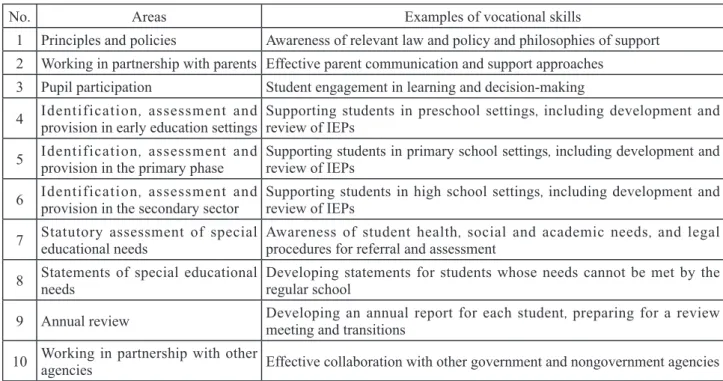
Table 1 Professional Standard for Australian Special Education Teachers
No. Areas Examples of vocational skills
1 Principles and policies Awareness of relevant law and policy and philosophies of support 2 Working in partnership with parents Effective parent communication and support approaches
3 Pupil participation Student engagement in learning and decision-making
4 Identification, assessment and provision in early education settings Supporting students in preschool settings, including development and review of IEPs 5 Identification, assessment and provision in the primary phase Supporting students in primary school settings, including development and review of IEPs 6 Identification, assessment and provision in the secondary sector Supporting students in high school settings, including development and review of IEPs 7 Statutory assessment of special educational needs Awareness of student health, social and academic needs, and legal procedures for referral and assessment 8 Statements of special educational needs Developing statements for students whose needs cannot be met by the regular school 9 Annual review Developing an annual report for each student, preparing for a review meeting and transitions 10 Working in partnership with other agencies Effective collaboration with other government and nongovernment agencies Sources: Translating from a science article, Professional Standards for Australian Special Education
strategies, instructions for learning math and writing, as well as teaching based on learning styles of students (Holdheide & Reschly, 2013).
In 2009, when clear orientations and official confirmations of assessment of special education teachers were lacking in the United States, the Council for the Exceptional Children (CEC) summoned a group of experts who were educators, professionals conducting researches or experiments on modern models of teacher assessment from cities and states in the country to consider the current status of teacher assessment and help CEC to have orientations of this issue (CEC, 2012). In 2011, CEC continued focusing on this matter. The committee of the Council discussed a situation of teacher assessment, determined an importance of it, identified its major role in collaborating with experts to objectively find out the fact as well as challenges of teacher assessment in special education field and offered solutions to these issues. The 12th Conference of CEC has attracted attention of numerous leading experts and developed assessment systems of special education teachers. This organization believed that the assessment of these teachers was effective when it was based on an understanding of various roles of teachers, measurement, supports for intervention, teaching strategies and solutions to manage human resources.
Accordingly, the CEC also emphasized that teacher assessment tool must match with occupational standards for special education teachers which were pointed out in the book, “What Every Special Educator Must Know: Ethics, Standards and Guidelines”. The CEC also believed that it was necessary to have research evidences which clarify contributions of special education teachers to the development of disabled students. However, this was only one of multiple factors to evaluate teachers and assessment tools needed to pave the way for the development of teachers.
In United Kingdom, new requirements of knowledge and skills were established for Special Education Coordinators in 2008 (The National Archives, UK, 2013b). In the following years, regulations were amended to meet new roles of the Special Education Coordinators (The National Archives, UK, 2013c). As a result, training courses continued being opened to supply Special Education Coordinators with updated knowledge to meet standards. These skills are the basis for assessment tools for Special Education teachers in United Kingdom. The table below lists occupational skills of the teachers in United Kingdom.
In Australia, although this country has well-developed education systems, it has been spending many years to research on professional standards of teachers in the United States and United Kingdom. In 2014, the Australian Institute for Teaching and Learning School Leadership (AITSL) issued professional standards for teachers. These standards has been considered as effective tools to support improving teaching process as well as professional competence of teacher until now. However, numerous educators and educational managers focused on an issue which was a shortage of occupational standards for special education teachers (Dempse & Dally, 2014). Dempsey and Dally (2014) reviewed standards for these teachers in the United States and the United Kingdom as well as researches conducted in Australia and concluded that there were various activities to identify special skills of these teachers in Australia and these actions were foundations of following steps of the development of professional standards.
practice and professional engagement and is divided into four levels: graduate teachers; proficient teachers, highly accomplished teachers and lead teachers. Each level contained 7 standards, in which professional knowledge domain is comprised of two standards: (1) Know students and how they learn, and (2) Know the content and how to teach it. The Professional Practice domain comprises of three standards: (3) Plan for and implement effective teaching and learning, (4) Create and maintain supportive and safe learning environments, and (5) Assess, provide feedback and report on student learning. The final two standards covered in Professional Engagement are standard (6) Engage in professional learning and standard (7) Engage professionally with colleagues, parents/carers and the community. According to Dempsey and Dally (2015), the development of professional standards for special education teachers could follow the process created by Delgado-Rico, Carretero-Dios and Ruch (2012) to identify a structure of standards, contents of criteria, and an assessment process. Thus, these authors created professional standards for special education teachers by relying on professional standards for regular teachers including three areas, 7 standards and 37 criteria and research findings of special skills of special education teachers. This process was similar to the procedure in the United States that is it based on the structure of professional standard for regular teachers and develops criteria which was necessary for special education teachers (Dempse & Dally, 2015).
In a nutshell, developed countries like the United States, United Kingdom, and Australia are increasingly using professional standards to develop assessment system for special education teachers. Moreover, in the United States, due to the availability of a clear policy system, impacts of special education, practical experiences of implementing inclusive education and researches on a comparison between regular teacher assessment and special Education teacher assessment, innovative ideas were developed. The efforts of leading experts in the United States have brought achievements to special education teacher assessment in this country.
3. The overview of Special Education Teacher Assessment in Vietnam
It can be said that the term "teacher evaluation" in Vietnam appeared rather late in comparison with other countries in the world because of the patriotic war in this country lasting until 1975 and its consequences. During the period from 1975 to 1992, Vietnamese education mainly performed the most important task which was integrating educational contents in different regions throughout the country into a unified educational program (Pham Thi Minh Hanh , 2007).
Improving the quality of education attracted attention after 1992. Educational administrators and researchers began to carry out a search for solutions to improve the quality of education. In December, 1996, The 2nd Conference of 8th The Central Committee of the Communist Party of Vietnam made alteration to the quality of education and training (the Central Committee of the Communist Party VIII, 1996, Resolutions of 2nd National Assembly of development strategic directions of education and training in the industrialization and modernization process and on a mission until 2000). The "learner-centered" model and promoting active learning which were hugely popular led to alterations on teaching methods.
However, during the early period, studies mainly focused on the quality of education at schools and emphasized the quality of the learning process. Furthermore, the quality of teaching was first considered as a criterion for evaluating the quality of education. Assessing teacher competence has not yet been studied and considered as an independent element.
The quality of teachers and managers were really concentrated and accordingly, the evaluation of teacher qualifications was also widely discussed based on the directive of Number 40 in 15th June, 2004 of Secretariat Committee of the IX course of Communist Party of Vietnam. The Political Bureau emphasized that it was needed to build the capacity of teachers and managers to ensure the successful implementation of Education Development Strategy from 2001 to 2010 and to develop the country.
Under the direction of the Political Bureau, the Ministry of Education and Training has quickly approached teacher professional standards of foreign countries, and motivated educational experts to conduct projects and researches to develop teacher assessment systems which became the foundation of vocational qualifications. As a result, multiple professional standards for teachers and guidance for teacher assessment were published. The standard for primary teachers was promulgated in 2007. Then, the standard for preschool teachers was issued in 2008 and the final one for secondary school and high school teachers was published in 2009 (The Ministry of Education and Training, 2007; 2008; 2009). Basically, Vietnamese professional standards of teachers at different educational levels were structured similarly to those in United Kingdom and Australia.
The establishment of a series of professional standards demonstrated the progress of the Vietnamese education system in transforming from empirical assessment to standard based assessment. This is the remarkable achievement of Vietnamese education.
It can be clearly seen that Vietnam's education has been successful in building a system of professional standards for staff at all levels of preschool, primary and secondary schools. These standards, over the years, have become an important measure in assessing the quality of teachers and the basis for fostering and developing qualified human resources for education. However, Vietnam still has no special education teacher education standards. At present, special education schools have been using the general education teacher standards to evaluate special education teachers. Research findings of assessing teachers teaching visually impaired students undertook by Hoang Thi Nga et al. in 2017 showed that 70% of managers and 60% of teachers thought the main factor that needs modified was assessment tool and it was necessary to do that.
In conclusion, the teacher evaluation in Vietnam generally quickly followed the achievements of teacher assessment around the world, which is based on the teacher professional standard. This made not only teacher assessment become reasonable and objective but also each and every teacher develop self-regulation to design plans for professional development. However, this seemed to be impossible for special education teachers due to lack of professional standards for special education teachers in Vietnam. Doing comparison research between evaluation systems for special education teacher in developed country like United State, United Kingdom and Australia Vietnam will help to figure out of good way to develop the similar system which is appropriate to Vietnam currently.
REFERENCES
1) Central Party Executive Committee of the Communist Party VIII (1996) The regulation on national assembly II - orientations of
developmental strategies in education in the period of industrialization and modernization and missions until 2000.
2) Council for exceptional children (2003) What every special educator should know: Ethics, standards, and guidelines for special
educators, the fifth edition, Council for Exceptional Children, 2900 Crystal Drive, Suite 100 Arlington, U.S.A.
4) Council for exceptional children (2015) What every special educators must know: professional ethics & standards, the seventh
edition, Council for Exceptional Children, 2900 Crystal Drive, Suite 100 Arlington, U.S.A.
5) Danielson, C. & McGreal, T. L. (2000) Teacher evaluation: To enhance professional practice, Educational testing service, p.13. 6) Dempse, I. & Dally, K. A. (2015) Content validation of statements describing the essential work of Australian special education
teachers, Australian journal of Teacher Education, Volume 40, Issue 2, Article 8.
7) Dempse, I. & Dally, K. A. (2014) Professional standards for Australian special education teachers, teacher professional standards,
accountability, and ideology: Alternative discourses, Australian Journal of Teacher Education, Volume 38, Issue 01, 2014, http://journals.cambridge.org/abstract_S1030011214000013.
8) Department for education (DfE) (1994) Special educational needs code of practice. Nottingham: DfE.
9) Dinh Quang Bao, (2013) Teachers - decisive factor in the qualified education, Nhan Dan online newspaper, uploaded in 19
November, 2013, 18:11:00.
http://www.nhandan.com.vn/giaoduc/item/21695502-%C3%B0oi-ngu-giao-vien-yeu-to-quyet-dinh-chat-luong-giao-duc.html
10) Gullickson, A. R. (2009) The Personnel evaluation standards: How to assess systems for evaluating educators, Joint Committee on
Standards for Educational Evaluation. pp. 6-7.
11) Hightower, A. M., Delgado, R. C., Lloyd, S. C., Wittenstein, R., Sellers, K., & Swanson, C.B. (2011) Improving student learning by
supporting quality teaching: Key Issues, Effective Strategies, Editorial Projects in Education.
12) Holdheide, L. & Reschly, D. (2013) Challenges in evaluating special education teachers and English language learner specialists,
National Comprehensive Center for Teacher Quality, U.S.A.
13) Kleinhenz, E. & Ingvarson, L. (2007) Standards for teaching: Theoretical Underpinnings and Applications, New Zealand Teachers
Council.
14) National Academy of Sciences, committee on science and mathematics teacher preparation, enter for education, National Research
Council (2001) Educating teachers of science, mathematics, and technology, New Practices for the New Millennium, National Academy of Sciencesʼ Press, P.48.
15) National Board for Professional Teaching Standard, U.S.A.(1983) What Teachers should know and able to do.
http://accomplishedteacher.org/wp-content/uploads/2016/12/NBPTS-What-Teachers-Should-Know-and-Be-Able-to-Do-.pdf.
17) Nguyen Tung Lam (2013) Vietnamese education online newspaper.
http://giaoduc.net.vn/Giao-uc-24h/Tay-nghe-nha-giao-la-nhan-to-quyet-dinh-nang-cao-hat-luong-giao-duc-ost127432.gd.
18) Peterson, K. D. (2000) Teacher evaluation: A comprehensive guide to new directions and practices. Corwin Press. A Sage
Publications Company, Thousand Oaks, California.
19) Pham Thi Minh Hanh (2007) A research on the assessment system of competence of high school teachers in France and an
application in Vietnam, Ph.D. thesis in education, Number: 62140101. Vietnam.
20) Rice, J.K.(2003) Teacher quality: Understanding the effectiveness of teacher attributes, 2016 Economic Policy Institute,
http://www.epi.org/publication/books_teacher_quality_execsum_intro/
21) Robert Edward, E. R. (2011) Evaluating special education teachers: Do we get the job done? A regional perspective. Electronic
theses and dissertations. paper 1287. http://dc.etsu.edu/etd/1287
22) Shinkfield, A. J. & Stufflebeam, D. (1995) Teacher evaluation: Guide to effective practice, Kluwer Academic Publishers, London. 23) Teacher Training Agency (1998) National standards for special educational needs coordinators. Teacher Training Agency, London. 24) The Ministry of Education and Training Vietnam (2007) The regulation on professional standards for primary teachers.
25) The Ministry of Education and Training Vietnam (2008) The regulation on professional standards for preschool teachers.
26) The Ministry of Education and Training Vietnam (2009) The regulation on Professional Standards for secondary school and high
school teachers.
27) The Ministry of Education and Training Vietnam (2010) The guidance for assessment of primary teachers based on decision
number 14/2007.
28) The Party Central Secretariat Board (2004) The directive number 40 - the development and improvement of qualifications of
teachers and managers in 15 June, 2004.
29) The Schools White Paper (2010) The Importance of Teaching, Department for Education, https://www.gov.uk/government/uploads/
system/uploads/attachment_data/file/175429/CM-7980.pdf
30) Tucker, P. D. & Stronge, J. H. (2005) Association for supervision and curriculum development. 31) United Kingdom Department of Education (2012) Teachers' standards. Online at www.education.gov.uk
32) Wise, A.E., Darling-Hammond, L., McLaughlin, M.W., & Harriet T. Bernstein (1984) Case studies for teacher evaluation: A Study