THE DYNAMICS OF PRODUCT ARCHITECTURE AND
ORGANIZATION IN JAPANESE DSC INDUSTRY ─
FOCUSING ON THE CANON AND NIKON’S CASES─
著者
郭 媛瑜
著者別名
GUO, Yuanyu
journal or
publication title
Bulletin of the Graduate School, Toyo
University
volume
55
page range
45-69
year
2019-03
ABSTRACT
There are certain and uncertain factors existing in complex products, including product architecture and organizational structure. This paper assume there are some connections between these factors. But we couldn’t anticipate the deterministic result of the survey, just to make some conjectures in a period of time. This paper will focus on Japanese digital still camera (DSC) industry as a case, from the viewpoint of product architecture to uncover sustainable competitiveness with the progress of modularization and architectural hierarchy. A research perspective on strategic and organizational theory such as product architecture, organizational capability of Japanese DSC companies was focused on.
In the global market, the DSC industry has a competitive power of integral type since the 1980's in the electronics. Especially, based on the time from 1990 to 2000, the DSC industry evolved to modularization within products. And then, after 2000, the Japanese DSC brand manufacturers were able to maintain high international competitiveness and performance. Meanwhile, in order to respond to the fierce competition of smartphones, the Japanese DSC competitive strategies such as reduction of lead time, division of labor structure and compatibility between product architecture and organizational capabilities in product development are explored within Japanese companies.
This paper based on the architectural hierarchy and focused on partial integration within the DSC products to analyze the suitability with the appropriate organizational form. In addition, by comparing the cases of Canon and Nikon, which are the representative of * Doctoral Program in Graduate School of Business Administration, Course of Business Administration, First Year Student,
Toyo University.
THE DYNAMICS OF PRODUCT ARCHITECTURE
AND ORGANIZATION IN JAPANESE DSC INDUSTRY
─FOCUSING ON THE CANON AND
NIKON’S CASES─
Japanese DSC manufacturers, especially its production information’s fl ow, we can extract two forms in Japanese DSC companies. Moreover, from Canon's integrated product architecture, integral organizational capability and Nikon's division of labor structure in product development and its organizational capabilities, we can draw a conclusion that there exists certain fi ts between product architecture and organizational capability in Japanese DSC industry whether it's dynamic or stable.
Keywords: product architecture, modularization, architectural hierarchy, Japanese DSC industry, competitiveness
CONTENTS 1. Introduction 2. Related literature 3. Analysis frameworks
4. Systemic architecture analysis 5. Case illustration
6. Discussion and conclusion
1. INTRODUCTION
From 2000 through 2008, the overseas sales volume (red line) of the Japanese DSC products signifi cantly increased, meanwhile, as a comparison, the sales volume of Japanese
Figure 1 – The sales volume of annual trend in Japanese DSC industry
(Source: Camera & Imaging Products Association 1999-2016)
Overseas
Japan
DSC products (blue line) is stable in the Japanese market. There was a turning point in 2009. The fact is that the sales had been decreasing since 2011. The decrease during this period, especially in 2012 and 2013, increasingly caught our attention to (see Fig.1).
Figure 2 – Global market share of Japanese DSC brand manufacturers
(Source: Nikkei market access, 2003, p.7; 2004a, p.406; 2004b, p.50; 2005a, p.430; 2005b, p.54; 2006a, p.472; 2006b, p.52; 2007, p.96; 2008, p.31).
Figure 3 – DSC manufacturers’ global market shares
(Source:
Nikkei market access, 2003, p.37; 2004a, p.406; 2004b, p.50; 2005a, p.430; 2005b, p.54; 2006a, p.472; 2006b, p.52; 2007, p.96).Although the global market for DSC has complicatedly changed in recent years, Japanese DSC manufacturers have maintained a strong competitiveness (see Fig.2 & Fig.3).
In Fig.2 and Fig.3, we can clearly see that Japanese brand manufacturers’ global share is over 70% from 2000 to 2007, and can find each DSC brand manufacturers’ market shares also. For example, the top three manufacturers in the global market are: Canon, Sony, and Nikon, which are all Japanese brands (see Fig.3).
So, why did the Japanese DSC industry can maintain high international competitiveness? We can try to find the answer through product architecture and organizational capabilities in this paper. Specifically, we have a research question, what are the strengths of Japanese DSC in dynamics of product architecture between 1990s to 2010. We need to clarify Japanese companies’ strategies and the features of organization during this period. By doing so, we can reveal the implications of Japanese DSC companies’ architecture strategies.
2. RELATED LITERATURE
Western literature research
① First of all, Ulrich, K.T. (1995)1 clearly proposed the definitions of product structure, types, performance and changes in the field of business. According to Ulrich’s research, not only they provide a conceptual framework of product architecture, but also they consider concrete trade-offs and that product architecture is directly related to these decisions that are made in the concept development and system engineering stages, and it will make a contribution to research of product architecture. Secondly, based on empirical research regarding product architecture, Ulrich discussed it in three different research directions. That is:
○Most of the trade-offs related to product architecture choices are not useful because they are too complicated as a developed product, not as a single model. A noteworthy problem is point out whether it can be completely separated, analyzed and modeled. In particular, integrated marketing, science models and production cost models can be used for the necessary and optimal evaluation of production for each of the two product architectures, which are integral product architecture and a modular product architecture. The integral architecture and the modular architecture each have their own cost structures and each can cause optimal product variations at different levels. Such a model makes it possible to adjust the decision on product architecture through market segment information and production cost information in the system design coordinate system. If a similar model is constructed, it can support the standardization of components, the investment in the
flexibility of the production process, and the order lead time.
○A number of findings were obtained from many companies based on empirical research. Ulrich also referred to the different elements of the product architecture between the manufactured products.
○Furthermore, it is clear that there is a mutual relationship between company's organization and product architecture. As Ulrich said, it is important to understand what kind of organization structure maximizes the flexibility of product architecture hypotheses and it should be verified.
②Based on Ulrich’s prior research2, Baldwin and Clark discussed the knowledge of combined designs and ”visibility” of modularization, and clarified the features and power of the modular architecture3. For example, by using DMS or TSM (design and task structure matrix), we can define the concept of general design and task structure and explain how a structure transfers to another structure. In particular, the new modular architecture has its own evolutionary pathway, which determines the core internal structure.
③The notion that different types of innovation call for different organizational arrangements is well known at least since the seminal contribution of Henderson and Clark (1990). Henderson and Clark made the important distinction between architectural and modular innovations. Architectural innovations change how components interact within a product, while leaving untouched their inner functions. Henderson and Clark (1990)4 demonstrated the misleading viewpoint of incremental or radical innovation and proposed architectural innovation that destroy the usefulness of the architectural knowledge of established firms, and that since architectural knowledge tends to become embedded in the structure and information-processing procedures of established organizations, this destruction is difficult for firms to recognize and hard to correct(Henderson and Clark, 1990). Henderson and Clark examined architectural innovation is more closely and, distinguishing between the components of a product and the ways they are integrated into the system that is the product ”architecture,” define them as innovations that change the architecture of a product without changing its components (Henderson and Clark, 1990).
④ Richard N. Langlois and Paul L. Robertson (1992) examined theoretically and through cases studied the phenomenon of the modular system, and suggested that innovation in a modular system can lead to vertical and horizontal disintegration, as firms can often best appropriate the rents of innovation by opening their technology to an outside network of competing and cooperating firms. Langlois and Robertson concluded by speculating on the increased importance of modular systems in the future, since flexible manufacturing and
rising incomes are likely to increase the driving requisites of modular systems: low economies of scale in assembly and sophisticated consumer tastes (Langlois and Robertson, 1992). In addition, Richard N.Langlois (2002)5 raid both the literature on modular design and the literature on property rights to create the outlines of a modularity theory of the firm. Richard N.Langlois’ theory assert that organizations reflect nonmodular structures, that is, structures in which decision rights, rights of alienation, and residual claims to income do not all reside in the same hands ( Richard N.Langlois,2002).
⑤ R Garud and A Kumaraswamy (1993)6 employed theoretical insights on technological systems and network externalities to understand Sun's open systems strategy and explored Sun's unconventional strategy in a market characterized by network externalities and built around technological system (Garud and Kumaraswamy, 1993).
⑥ Sanchez and Mahoney (1996)7 investigated the interrelationships of product design, organization design, processes for learning and managing knowledge, and competitive strategy. And used the principles of nearly decomposable systems to investigate the ability of standardized interfaces between components in a product design to embed coordination of product development processes. Sanchez and Mahoney proposed a new strategic approach to the management of knowledge based on an intentional, carefully managed loose coupling of a firm's learning processes at architectural and component levels of product creation processes (Sanchez and Mahoney, 1996).
⑦ Chesbrough and Kusunoki (1999)8 introduced a dynamic element into the analysis of organizational arrangements for innovation. Using empirical evidence from the hard disk drive industry, they argued that technologies follow a dynamic cycle that goes from integral to modular. In the integral phase, usually the first stage of technological development, the interactions between systems elements are fast changing and poorly understood. The integral phase calls for tight co-ordination mechanisms typical of the centralized organization. Such interactions eventually become articulated and codified as industry standards. In the modular phase, when sub-systems and components and their interactions are better understood and modularized, co-ordination is better achieved through decentralized or virtual arrangements of organization.
Accordingly, firms should align their organizational arrangements to the phase of the technology. Firms that do not adapt their organizational arrangements fall into what Chesbrough and Kusunoki defined as ‘traps’. A ‘modularity trap’ emerges when the technology shifts from the modular to the integral phase but firms maintain a decentralized organizational arrangement. Virtual organizational arrangements lack the systems
knowledge required to co-ordinate integral technologies. An ‘integrality trap’ emerges when an integral technology becomes modular and firms retain a centralized organization. In other words, when component interactions are well articulated and codified and innovation activities can be organized via arms’ length market relationships, centralized organizations become cumbersome arrangements of co-ordination (S. Brusoni, Andrea Prencipe, 2011)9.
2. Japanese literature research
In Japan, Takahiro Fujimoto is one of the representatives of product architecture’ research. He examined the process of capacity accumulation and adaptation in the Japanese automobile industry and proposed five models at the stage of capability accumulation. Furthermore, Fujimoto (2005) pointed out that Japanese companies are weak in modular product architecture. Meanwhile, based on the proposition raised by Fujimoto (2005), some conceptual problems of Japanese companies from the viewpoint of organizational capability were investigated and analyzed. Based on that, we began to do hypotheses and empirical analyses of the conceptual framework in product architecture.
In modular architecture, the adjustment between components is not necessarily required, so the importance of selection and procurement of optimum parts to be combined (Fujimoto, 2004) is well understood. At the same time, in the manufacturing of modular product architecture, many Japanese companies’ weakness can be well recognized. For example, Kentaro Nobeoka (2006) pointed out the problem of cost, the creation of a global framework, the problem of platform leaders and so forth. So, Japanese firms must deeply consider the current state of modular product architecture’s weak selection ability and the decline of integration ability at the level of current product architecture. Besides, how should Japanese companies face an environment with high uncertainty and focus on modular product architecture? Do Japanese companies have the possibility and necessity of converting from integration ability to selection ability? (Fujimoto, 2003). By considering the above problem circumstances, enhancing the strategic choice capability of Japanese companies and making the operation integration capability should be a business choice.
In addiiton, with regard to DSC’s literature research, Aoshima (2010)10 proposed the delayed strategy shift and strategical change for modularization of DSC products and division of industrial structure. Besides, Ito (2003, 2004)11 12pointed out software and hardware’s technological changes in DSC are not exogenous but endogenous factors within companies. Nakamiti (2014)13 choose the DSC manufacturers’ strategical research perspective to cope with the spread of smartphones with advanced camera functions.
3. ANALYSIS FRAMEWORKS
There are two frameworks which can be used.
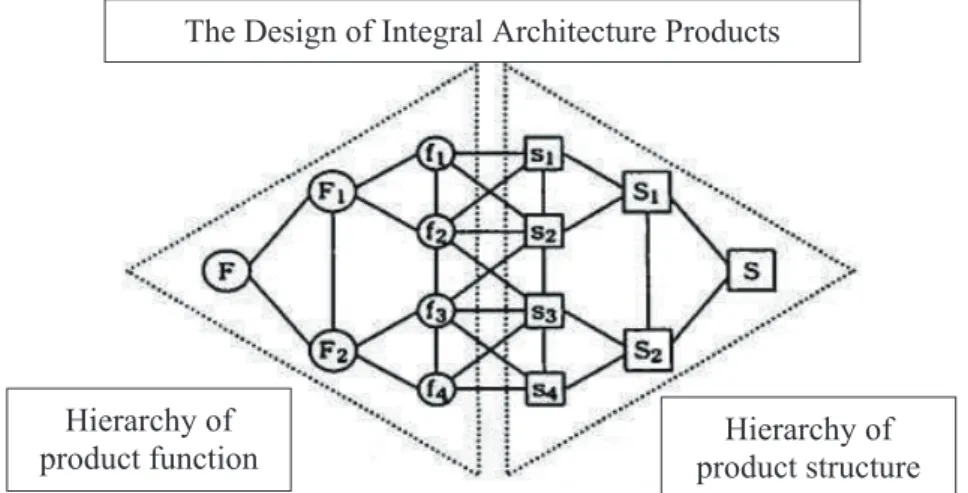
The first framework is the hierarchical structure of product architecture. Originally, the product architecture is recognized as the basic design concept, which contains integral and modular architecture. Product architecture in a narrow sense is defined as the correspondence between ”hierarchy of product functions” and ”hierarchy of product structure” (Fujimoto, 2006). Regarding the modularization of product architecture, Takeishi, Fujimoto (2001) discussed the difference at three levels, which is a category of modularization in product development, modularization of production, and modularization of inter-company systems (collection of spare parts).
Specifically, the modularization of the product architecture refers to (1) interdependence of functions with other parts, (2) the structure of other parts, dependency relations such as
Figure 5 – Design of modular architecture products
(Source:
Takahiro Fujimoto, 2006)
Hierarchy of
product function product structureHierarchy of The Design of Modular Architecture Products
Figure 4 – Design of integral architecture products
(Source:
Takahiro Fujimoto, 2006)
The Design of Integral Architecture Products
Hierarchy of
mutual dependency, (3) interdependence with the design of the entire product, (4) interdependence among subsystems (Fujimoto, 2001). In the case of modularization, in order to reduce the number of parts, we maintain a one-to-one correspondence between parts and functions so as to recognize it (see Fig.4 & Fig.5).
Furthermore, the concept of hierarchical structure in modular architecture products is initially analyzed in the field of DVD (Shintaku, 2006)14. On the basis of a case analysis of the optical disk industry, the phenomena of capsularization and distribution of integral know-how of Japanese companies into products, materials, equipment, and firmware in an environment conducive to modularization and new market entrants has explored. And using this structure, a case is then presented wherein Japanese and foreign companies successfully formulated an effective collaborative model (Shintaku, 2006)(see Fig.6).
However, if the interface is designed based on the design rules, the interface must be changed once the design rules are changed. Furthermore, the interface between lower modules are outsourced; acquiring the control of the interface is a competitive advantage of taking control of the module division for companies, and positively outsourcing the modularized parts from another company can be constructed.
Figure 6 – Hierarchical structure in modular product architecture of DVD
(Source: Shintaku
,Ogawa, Yoshimoto, 2006, p. 42, figure 1-2-3)
DVD Recorder
Modular
Control
circuit
HDD
DVD
drive
Integral
System LSI
Soft
LSI
Optical
pickup
motor
Modular
Integral
FMemory
For DSC, there are some parts such as lens, image sensor, image processing circuit, ASIC, battery, liquid crystal monitor, viewfinder, and so forth. They have corresponding functions where each correspondence is one-to-one. However, compared to the dependency relationship between subsystems in 1990s, the one-to-one correspondence between the lower-level modules, interfaces, functions and structures partially changed after 2000. On the other hand, with these changes, the organizational structure and organizational capability will be changed to adapt to the constantly changing external environment. As a result, we focus on the hierarchical structure in DSC’s product architecture, which is one of the frameworks in this paper.
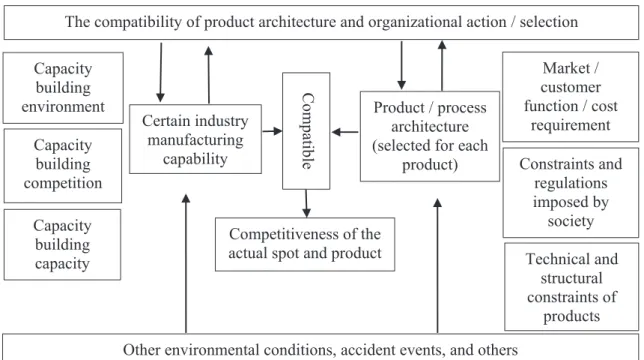
The second framework is product architecture and the organization’s relevance (see Figure 7). According to Fujimoto's framework (2006), we can find the competitiveness of the manufacturing industry. In this framework, the structure, function, and dynamics of organizational capabilities have been analyzed. Also, the dynamics of the product / process architecture have been elucidated. Furthermore, we can explore the compatibility or suitability of both and analyze the competitiveness and superiority of Japanese manufacturing industries.
Figure 7 – Analysis framework of organizational capability, architecture, competitiveness at the industry level
(Source:
Takahiro Fujimoto, 2009, “Manufacturing concept and industrial competitiveness” p.6) The compatibility of product architecture and organizational action / selectionCertain industry manufacturing
capability
Product / process architecture (selected for each
product) Market / customer function / cost requirement Technical and structural constraints of products Capacity building environment Capacity building competition Capacity building capacity Co m pa tib le Competitiveness of the actual spot and product
Other environmental conditions, accident events, and others
Constraints and regulations imposed by
4. SYSTEMIC ARCHITECTURE ANALYSIS
Compared with the lens design of common silver halide cameras, DSC lenses are produced as a simple modular architecture in 1990s. DSC manufacturers are equipped with fixed focus lenses, and high-speed general-purpose risk chips that was a feature of DSC in 1990s. At that time, the DSC optical system played a role of forming the subject image of the design information on the image sensor, mainly CCD, and only the lens unit. The spherical lens and the aspheric lens were combined with each other and fixed from the lens of the focal length to the zoom lenses which were widely used according to the application.
Therefore, there exists a relationship for DSC as a whole system between functional parts such as optical lenses and image sensors, which correspond one-to-one with each part. There is no mutual dependence between structural parts. Inside DSC, the structural interdependence is relatively weak where the number of interfaces between parts is less, and the design of parts is intensive and standardized.
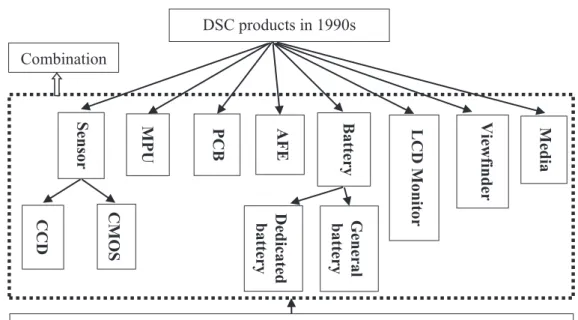
Briefly, technologies such as image sensors, lens units and image processing processors within the DSC products evolved to become a simple modularization among components in 1990s. There is also a weak relationship between manufacturing and sales. The modular architecture does not require much effort from interdisciplinary integration and intermodule coordination over interdisciplinary approach. Because design rules or standards are designed between the modules, anyone can make products combining parts. Besides, dealing with industrial standards is better than organizational integration, which is an important competitive strategy. In 1990s, Japanese DSC manufacturers monopolized the global market such as Canon and Sony. They have built a vertically integrated organization and an industrial structure in its organizations. At the same time, the product is unevenly distributed in the modular architecture. By doing so, Japanese DSC manufacturers can build a competitive advantage not only at the product level, but also at the organizational level. We can fully demonstrate the strength of Japanese DSC product architecture in 1990s (see Fig.8).
However, with the increase of pixels, there are some technical challenges we have to face (Aojima, 2009). In order to cope with these technical problems, Japanese DSC manufacturers mutually adjusted the lens and CCD, assembled accuracy of lens and achieved high alignment. DSC manufacturers need to make solutions such as improvement of noise processing technology by Analog Front End (AFE) and double-balloon endoscopy (DBE), then matching of sensor and processor,the improvement of ASIC’s design rule, and so forth. Specifically, the improvement of the optical system is sensitivity, resolution and moire. To
improve the sensitivity, CCD’s internal structure and the brightness of the lens are required to make further improvement. Yet it is difficult to maintain the brightness due to the big diameter of lens. So we let micro-lenses form on the upper surface of the light receiving element of CCD and increase the light collection efficiency and intensity. Since the micro-lens can increase the light’s collection efficiently, an optimized design matching the micro-lens specification is necessary.
In order to realize high resolution, it is not enough to merely improve the performance
Figure 8 – Simple modularization of Japanese DSC products in 1990’s
(Source: GUO, 2017)
DSC products in 1990s MP U PCB AFE Batter y LCD M on ito r V iewf ind er M ed ia CC D D ed ic ate d ba ttery Combination Se nso r C M O S G en era l ba tteryHigh interdependency between DSC’s parts and the dedication of main units
Figure 9 – Hierarchical structure of architecture in DSC products since 2000
(Source: GUO, 2017)
DSC products Integration Capsule of know-how Integration Le ns CCD Image pr oc ess in g circ uit LS I s yst em Modularization A SIC Batter y PC B― 57 ―
of individual component units. The miniaturization of pixel size needs the improvement of lens performance.
Altogether, since 2000, DSC products have not only a simple combination among modular parts (such as main component units), but also a combination of CCD and lens, CCD and image processing circuit in order to achieve high function and high performance. There is a possibility to solve the technical problems associated with the realization of higher image quality, noise reduction, and increase of pixels (see Fig.9).
5. CASE ILLUSTRATION
Generally speaking, Japanese DSC manufacturers need to actively utilize their organizational capabilities in order to respond to the diversity of consumer demands and the high uncertainty of the external environment.
With respect to Japanese DSC manufacturers, they must consider carefully whether the image sensors are produced in-house or purchased from other companies. Besides, Japanese DSC manufacturers must think about the cost of products, the quality of products and future technology accumulation.
Here, we selected the top three Japanese brand makers (Canon, Sony and Nikon) in the global market to make an analysis. In addition, both Canon and Sony belong to an integrated model, while Nikon is the representative of a division model. We only chose Canon and Nikon as cases to discuss because they are the top two Japanese DSC brand manufacturers. ① A case of Canon
Table 1 – Utilization of OEM / ODM companies of Japanese DSC brand makers
Japanese DSC brand makers
-2001 -2003 -2005 -2007 -2009 -2011
Canon Minton
Sony Premier Foxconn, Ability
Panasonic Ability Sanyo
Electric ElectricSanyo Foxconn Nikon Ability Sanyo Electric asia optical Ability Sanyo Electric Flextron ics Ability Altek Sanyo Electric Olympus Asia
Optical Optical,Asia Premier Asia Optical, Premier Foxconn ,Sanyo Electric Ability Foxconn ,Ability
FujiFilm Primax Premier Asia
Optical Optical,Asia Sanyo Electric Ability, Altek,Fl extronic s Sanyo Electric Ability, Altek
Casio Primax Ability Ability Ability, Flextron ics Ability, Flextron ics Ability
As shown in table 1, Canon produces almost all parts in-house and possesses high-technologies such as LSI design, image processing, imaging technology and so forth, which are all Canon's core technologies.
In order to optimize the image quality, Canon owns this know-how as an asset and develops an image processing processor in-house. Besides, Canon is commissioned as a manufacture such as compact digital still cameras for Sony and Nikon , in order to reduce costs and increase the efficiency.
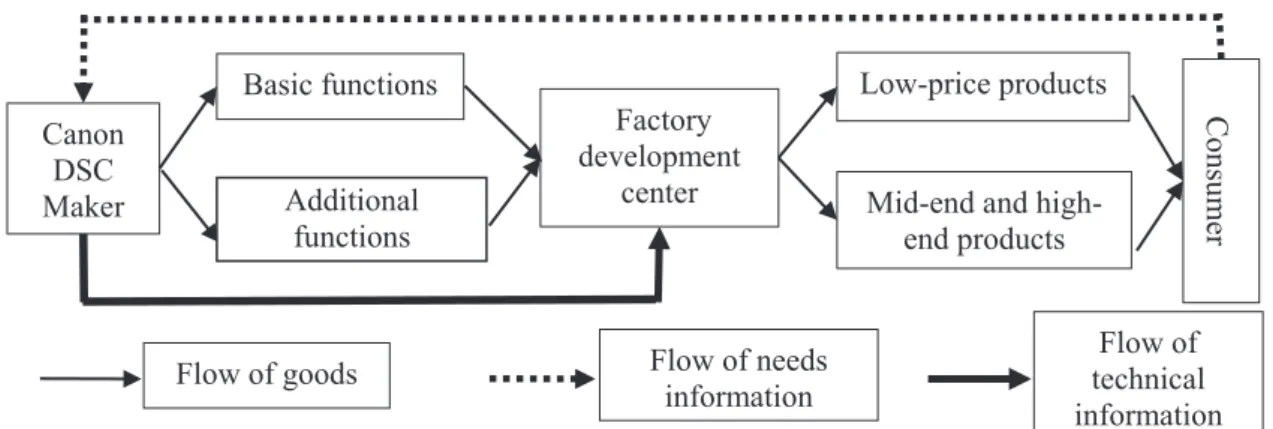
Canon produces almost all parts such as DSC's basic functions and additional functions within its own company. The core technology based on the closed-architecture production method is transferred through the internal production line. In any case, Japanese manufacturers design these productive activities and do research based on multiple design parameters for the functions required for products from the first manufacturer. The DSC production process is directly transferred to the product design’s information medium (within the factory, R & D center), and finally, the products that fit consumers’ needs are put on the market. Because of the diversity of customer’s needs and products’ functional limitations, the mid-end and high-end models (which belong to closed-modular architecture) and the low-priced and low-function models (which belong to open-modular architecture) have been put on the market by Canon. Meanwhile, the information medium such as customers’ needs and diversity (high uncertainty of the external market) is transferred to the manufacturer-Canon (design medium), and the manufacturer preliminarily simulates the structural design information is expected to implement it. Hence, from the latest DSC structural design information and functional design information (casual relationship of structure and function), Canon can obtain the structural design plan (Fujimoto, 2013) that
Table 1 – Utilization of OEM / ODM companies of Japanese DSC brand makers
Japanese DSC brand makers
-2001 -2003 -2005 -2007 -2009 -2011
Canon Minton
Sony Premier Foxconn, Ability
Panasonic Ability Sanyo
Electric ElectricSanyo Foxconn Nikon Ability Sanyo Electric asia optical Ability Sanyo Electric Flextron ics Ability Altek Sanyo Electric Olympus Asia
Optical Optical,Asia Premier Asia Optical, Premier Foxconn ,Sanyo Electric Ability Foxconn ,Ability
FujiFilm Primax Premier Asia
Optical Optical,Asia Sanyo Electric Ability, Altek,Fl extronic s Sanyo Electric Ability, Altek
Casio Primax Ability Ability Ability, Flextron ics Ability, Flextron ics Ability Ricoh Asia
Optical OpticalAsia OpticalAsia Optical,Asia Sanyo Electric
AOF, Sanyo Electric
realizes the translation of functional design of consumer needs, products functional design and do some design activities of DSC's basic functions and additional functions in the internal production line. On the other hand, closed and shared communication, inner know-how, which among research and development departments, production departments of DSC parts (such as Canon's digital system development department, production engineering department, optical device division, etc.) have gradually developed and formed its own circuitous system (see Fig.10).
Moreover, based on the partial integration of the DSC subsystem, the organization departments, such as imaging devices, optical systems, and image processing systems which are all related to image sensors, lenses, image processing technologies, to create new product groups through design rules formed in the product development factory.
Now, Canon maintains the product modular design. The design rules as well as the adjustment between the parts is not necessarily required. In the case that it is necessary for a new model, minor adjustments between the parts are sufficient enough. Therefore, it is possible to clarify the boundaries among Canon's organization departments. These organizations and design concepts can promote production more effectively than division structure and external procurement. In addition, it is possible that the DSC with partial hierarchical architecture can be finely adjusted between CCD and lens, and between CCD and image processing circuits. By doing so, DSC companies can improve the competitiveness of products and organization. Also, over looking the market, manufacturers can select the optimal product modular architecture which creates more value and then develops into a new modular architecture within products. For Canon, there is a circuitous route of information in products. The design concept as well as information on the new model and
Figure 10 – Production information’ s flow of Canon
(Source: GUO, 2017)
Canon DSC Maker Basic functions Factory development center Low-price products Mid-end andhigh-end products
Con
su
m
er
Flow of goods Flow of needs
information Flow of technical information Additional functions
the old model are always recycled and supersessioned, the partial integration of lower subsystems (integral architecture), with long-term recycling, is shifting from the integrated two component part to one, which is new and optimal modular architecture. At the same time, the corresponding organization that is an integrated model can be well adjusted to these minor adjustments only within the products by new product architecture and design concepts. Finally, they can maintain Canon’s integrated competitiveness, thus assuring a higher profit.
In a word, there is a certain compatibility (fit) between the design concept, the product architecture and organizational capability in the Canon model. What’s more, there exists clear changes and dynamism in a company’s external competitiveness, such as satisfaction of customer’s needs and the uncertainty in the external market, while the organizational capability as company’s core competence is extremely difficult to change by the external environment.
② A case of Nikon
Nikon is the world's leading optical products designer and manufacturer. Its optical products are known as having outstanding performance in the world. Nikon’s optical technologies plays an important role in imaging, optical fibre, semiconductor, vision, scientific and other areas. The Nikon brand gives people the impression of high-quality, high-tech, and high-precision image.
Compared with the Canon model, Nikon transfers its design information to another company or overseas subsidiary, thus it creates an open production system (see Fig.11).
Figure 11 – Production information’ s flow of Nikon
(Source: GUO, 2017 )
Nikon DSC Maker Domestic (Sendai) Overseas (Thailand, China) Single-lens high-end model Compact digital still camera Mirror-less Single-lens ConsumerNikon’s manufacturer chose Sony as its image sensor’s main manufacturer of compact digital still cameras, and Panasonic as its subcontract. In many cases, single-lens camera’s image sensors and mirror-less interchangeable lens camera’s image sensors are entrusted to Sony, and Renesas is the secondary manufacturer. In addition, most of the production of compact digital still cameras have been entrusted to OEM firms. The designers of each part of a Nikon camera acquire prior knowledge of interface design rules about modular architecture. Each component of Nikon’s manufactures not only make the internal common parts in DSC products, but also make domestic and overseas industrial standard parts, which belong to open modular architecture products. Furthermore, with the functional division of product architecture, it is possible to achieve a clear separation between design and production, related to open-modular products. The corresponding organization gradually forms an organizational division structure. However, unlike the internal information exchange within the integrated organization, it is possible to clarify the boundary between the design process and the production process due to the design rules which are already clearly defined and shared in open-modular architecture products. As a result, compared with the Canon integrated information flow, Nikon overlaps the design process and the production process. For Nikon, it is necessary to exchange the information more closely between domestic and overseas manufactures.
6. DISCUSSION AND CONCLUSION
Through the above case studies, one of the most significant findings is that the way of product design and technology accumulation in Japanese DSC companies is quite different. The above studies have shown that Nikon pursues a competitive advantage by developing high-quality technology and using the relative single competitive strategy to make profits, while Canon focuses on setting-up its integrated model, applying its developed technology to new products and finally putting the new products on to consumer markets.
Specifically, many parts in the mid-end and high-end Canon model belong to modular architecture, but the strength of the integrated organization model by partial integration can be fully demonstrated. Canon decides the design rules of DSC products on itself, while the core technology, such as image sensors (closed modular architecture), as well as the interface of parts are owned by Canon. Among the image sensors, lenses and image processing circuits with architecture hierarchy, there are tight and fine adjustments where the context is shared in advance and manufacturing capability is strong. When the interface changes, it will be possible to respond promptly and effectively between departments.
There also exists innovations on new design rules. In conclusion, with the dynamics of the DSC product architecture, the open modular architecture model (compact digital still cameras) and closed modular architecture model (digital single-lens cameras, mirror-less interchangeable lens cameras) can be corresponded by Canon model. There should be a certain relationship between the product architecture and the integrated organization model (see Fig. 12).
On the other hand, Nikon’s design rules are socially shared in DSC products. The parts of compact digital still cameras, digital single-lens cameras, mirror-less interchangeable lens cameras, which belong to open modular architecture, are transferred to the outside. The image sensors, which are an important part unit that has partial integration in the architecture hierarchy, are purchased from Sony and Panasonic because of the insufficient ability to develop these units by themselves. Meanwhile, the steppers which is a specialty field in Nikon decide the lens’s performance. It is Nikon's important competitive strategy to make excellent lenses, which is based on closed modular architecture. Thus, as a representative of the division model, Nikon occupies the third position among Japanese DSC brand manufacturers in world markets. In addition, as Nikon's main products, the mid-end and high-end models tend to be open architecture, which can be procured and combined with the modules from outside. In order to maintain the competitiveness of its products, Nikon selected the division organizational model for adapting to high quality and
Figure 12 – Canon’s positioning strategy
(Source: GUO, 2017)
Integral Modular Canon Clo sed O pe n Image sensor Lens Assembly Assemblyfew production technologies within the architectural hierarchy. There should be a certain relationship between the product architecture and the integrated organizational model (see Fig. 13).
It also shown that Canon and Nikon, which are the representatives of Japanese DSC brand manufacturers, are located in the opposite directions in the schematic diagram (see
Figure 13 – Nikon’s positioning strategy
(Source: GUO, 2017 )
Integral Modular Nikon Clo sed O pe n Image sensor Lens Assembly Mid-end and high-end model CompactLens
Figure 14 – The fitness of product architecture and organization capability in Canon & Nikon
(Source: GUO, 2017 )
Organizational capability
Integral Division of labor
M od ula r a rch itec tur e clo sed op en Canon Nikon Fit
Fig.14).
By repeating the differentiation competition and homogeneity competition, Japanese DSC brand makers are strengthening the corporate system and achieving its competitiveness and then semicontinuously adjust, morph so as to maintain it.
As discussed, there are obvious tensions and interrelationships between product architecture and organizational capability. Based on uncertainty of the external environment and consumer different needs, product architecture design rules has changed whether Japanese DSC manufacturers choose modularization or integration. Successful DSC companies must sense and seize these external market changes (smartphone’s improved camera function, the diversity of consumer needs and so forth) as soon as possible, and then choose corresponding organizational model that has a better strong competitiveness. Once a new organizational model is built or adjusted, it must be address and create technological opportunities while staying in alignment with customer needs. Put differently, once the product architecture and organization capability’s cospecialization (Teece, 2007) has found, it must show ‘dynamic correlation’ to achieve and maintain sustainable competitiveness in Japanese DSC industry. The correspondence and cospecialization that exist in product architecture and organizational capability also has implications for other industries in different countries.
REFERENCES
Magazine
Aoshima Yaichi (2009) , “Delayed Strategy Shift : The role of ” performance illusion” in the digital still camera industry,” The Journal of Science Policy and Research Management, Vol.24, No.1, pp.16-34.
Asanuma, B. (1989), “Manufacturer-supplier relationships in Japan and the concept of relation-specific skill,” Journal of the Japanese and international economies, Vol.3, No.1, pp. 1-30. Baldwin, C. Y. and Clark, K. B. (1997), “Managing in an age of modularity,” Harvard Business
Review, Vol.75, No.5, pp. 84-93.
Barnett, D. Brent and Clark, K. B. (1998), “Problem solving in product development: a model for the advanced materials industries,” International Journal of Technology Management, Vol.15, No.8, pp. 805-820.
Clark, K. B. and T. Fujimoto (1990), “The power of product integrity,” Harvard Business Review, Vol. 68, No.6, pp. 107-118.
evolution,” Research policy, Vol.14, Issue 5, pp. 235-251.
Henderson, R.M. and Clark, K. B. (1990), “Architectural innovation: The reconfiguration of existing product technologies and the failure of established firms,” Administrative Science Quarterly, Vol. 35, No. 1, Special Issue: Technology,Organizations, and Innovation, pp. 9-30. Junichi Tomita, and Shintaku Junjiro (2009), “Positioning strategy of Japanese companies based
on architecture theory,” International management strategy of manufacturing, Yuhikaku Press. pp. 326-350.
Kazushi Nakamichi (2005), “The international competitiveness of Japanese digital still camera industry in terms of industrial characteristics,” Annals of the Society for Industrial Studies, Issue 21.
Kazushi Nakamichi (2009), “Advancement of competition dimension and Japanese digital still camera industry’ international competitiveness-focuse on spread and depth of competition dimension,” Kochi Ronso, Issue 94.
Kazushi Nakamichi (2014), “The strategy of Japanese digital still camera manufacturers for spread of smartphone,” Annals of the Society for Industrial Studies, Issue 29, pp. 169-181. Munehiko Ito (2003), “Dynamics of system architecture - transition of system architecture of
digital camera,” Kobe University Institute of Economic Management, Discussion Paper Series No. J49.
Munehiko Ito (2004), “The transition of the product system’ s structure in digital cameras,” Kobe University Economic Management Institute, Discussion Paper Series No. J55.
Nakamichi Kazushi (2014), “The Strategy of Japanese Digital Still Camera Manufacturers for Spread of Smartphone, Annals of the Society for Industrial Studies, Japan, Vol.29, pp.169-181. Pil, F. K. and Cohen, S. K. (2006), “Modularity: Implications for imitation, innovation,and sustained
advantage,” Academy of Management Review, Vol.31, No.4, pp.995-1011.
Richard N.Langlois (2002), “ Modularity in technology and organization,” Journal of Economic Behavior & Organization, Vol. 49, Issue 1, pp.19-37.
R. Garud and A. Kumaraswamy (1993), “Changing Competitive Dynamics in Network Industries: An Exploration of Sun Microsystems' Open Systems Strategy,” Strategic Management Journal, Vol. 14, No. 5, pp. 351-369.
Sanchez, R. and Mahoney, J. T. (1996), “Modularity, flexibility, and knowledge management in product and organization design,” Strategic management journal, Vol.17, Issue. S2, pp. 63-76. S.Brusoni and A.Prencipe (2001) , “Managing knowledge in loosely coupled networks: Exploring
the links between product and knowledge dynamics,” Journal of management studies, 2004, Wiley Online Library.
Schilling, M. A. (1996), “Toward a general modular systems theory and its application to interfirm product modularity,” Academy of management review, Vol.25, No.2, pp. 312-334.
Schilling, M. A. and Steensma, H. K. (2001), “The use of modular organizational forms: An industry-level analysis,” Academy of management journal, Vol.44, No.6, pp. 1149-1168.
Shintaku Junjiro (2006), “Competition in the optical disk industry and the international collaboration model:Modularization through the capsularization of integral elements,” Akamon Management Review, Vol. 5, No.2, pp.35-66.
Sosa, M.E., Eppinger, S.D. and Rowles, C.M. (2004), “The misalignment of product architecture and organizational structure in complex product development,” Management science, Vol.50, No.12, pp. 1674-1689.
Takahiro Fujimoto (2005), “A study on the comparative advantage of architecture,” MMRC, Discussion Paper, No. 24.
Takahiro Fujimoto (2008), “Globalization and comparative advantage -from architecture and organizational capabilities’ viewpoint,” Quality Management, Vol.59, No.5 pp.10-17.
Ulrich,K.T. (1995), “The role of product architecture in the manufacturing firm,” Research Policy, 24: pp. 419-440.
Ulrich,K.T. , Ramdas K. and Fisher M. (2003), “Managing Variety for Assembled Products: Modeling Component Systems Sharing,” Manufacturing & Service Operations Management, pp. 132-143.
Yaichi Aoshima (2003), “Delay in strategy change-the role of “performance illusion” in digital camera industry,” Research, Technology, Plan, Vol.24, No.1.
Yasumoto,M. and Fujimoto,T. (2005), “Does cross-functional integration lead to adaptive capabilities? Lessons from 188 Japanese product development projects,” International Journal of Technology Management, Vol.30, No.3/4, pp. 265-298.
Monograph
Baldwin, C.Y. and Clark, K.B.(2000)Design Rules: The Power of Modularity, Boston, MA:MIT Press.
Clark, K.B. and T. Fujimoto (1991), Product development performance: strategy, organization, and management in the world auto industry, Boston, MA:Harvard Business School Press. Chesbrough and Kusunoki (1999)The modularity trap: innovation, technologyphase-shifts, and the
resulting limits of virtual organizations, Knowledge and the Firm. Oxford: Oxford University Press.
Mass: Blackwell Publishing.
Hayes, R.H., and Clark, K.B. (1988), Dynamic Manufacturing: Creating the Learning Organization, New York: Free Press.
Iansiti, M. (1998), Technology integration: making critical choices in a dynamic world, Boston, MA:Harvard Business School Press.
Langlois, R. N. (1999), “Modularity in technology, organization, and society,” Department of Economics Working Paper Series.
Ulrich,K.T., Eppinger, S.D. (2003), Product design and development, New York: McGraw-Hill. Editorial books
Fuji Chimera Research Institute (each year version), “Worldwide Electronics Market Survey,” Fuji Chimera Research Institute.
The Nikkei Market Access Edition (2001), “Nikkei market access yearbook IT basic data 2001edition,” Nikkei BP consulting.
The Nikkei Market Access Edition (2003), “Nikkei market access special edition digital appliances market generalview in 2004,” Nikkei BP consulting.
The Nikkei Market Access Edition (2004), “Nikkei market access special edition digital appliances market generalview in 2005,” Nikkei BP consulting.
The Nikkei Market Access Edition (2005), “Nikkei market access special edition digital appliances market generalview in 2006,” Nikkei BP consulting.
1 The role of product architecture in the manufacturing firm ( Ulrich,K.T., 1995, pp. 419-440 ). 2 Managing variety for assembled products: Modeling component systems sharing ( Ulrich,K.T.,
2003, pp. 132-143); Product Design and Development ( Ulrich,K.T. and Eppinger, S.D., 2003, New York: McGraw-Hill ) and so forth.
3 Baldwin, C. Y. and K. B. Clark(2000)Design Rules: The Power of Modularity, The MIT Press.
4 Henderson and Clark (1990) Architectural Innovation:The Reconfiguration of Existing Product Tech nologies and the Failure of Established Firms, Administrative Science Quarterly, Vol. 35, No. 1, Special Issue: Technology,Organizations, and Innovation, pp. 9-30. 5 Richard N.Langlois(2002) Modularity in technology and organization, Journal of Economic
Behavior & Organization, Vol. 49, Issue 1, pp.19-37.
Industries: An Exploration of Sun Microsystems' Open Systems Strategy, Strategic Management Journal, Vol. 14, No. 5, pp. 351-369.
7 Sanchez, R. and Mahoney, J. T.(1996) Modularity, flexibility, and knowledge management in product and organization design, Strategic management journal, Vol.17, Issue. S2, pp. 63-76. 8 Chesbrough and Kusunoki (1999)The modularity trap: innovation, technologyphase-shifts,
and the resulting limits of virtual organizations, In Nonaka, I. and Teece,D. J. (Eds), Knowledge and the Firm. Oxford: Oxford University Press.
9 S Brusoni, A Prencipe (2001) Managing knowledge in loosely coupled networks: Exploring the links between product and knowledge dynamics, Journal of management studies, 2004, Wiley Online Library.
10 Aoshima Yaichi(2009) Delayed Strategy Shift : The role of ” performance illusion” in the digital still camera industry, The Journal of Science Policy and Research Management, Vol. 24, No.1, pp.16-34.
11 Munehiko Ito (2003) Dynamics of system architecture-the transition of digital camera system architecture, Kobe University Economic Management Institute, Discussion Paper Series No. J 49.
12 Munehiko Ito (2004) The transition of productive system’ s structure in digital camera, Kobe University Economic Management Institute, Discussion Paper Series No. J 55.
13 Nakamichi Kazushi (2014) The Strategy of Japanese Digital Still Camera Manufacturers for Spread of Smartphone, Annals of the Society for Industrial Studies, Japan, No.29, pp.169-181. 14 Shintaku Junjiro(2006) Competition in the optical disk industry and the international
collaboration model:Modularization through the capsularization of integral elements, Akamon Management Review, Vol. 5, No.2, pp.35-66.
要 旨 2000年以後、日本エレクトロニクス産業の競争力が急速に低下していく状況の中で、日本 DSC産業には高い競争力を維持しつつ、その製品アーキテクチャの移行と転換に伴いなが ら、新たな変化にも生じた。1990年代から2000年頃および2000年以後にも、外部市場の不確 実性に直面し、日本DSC産業は高い国際競争力をそのまま維持していた。その原因について、 アーキテクチャという汎用的な枠組みを使い、戦略論と組織論の視点から新たな知的解読を 試みる研究も増えている。 世界市場において、家電分野におけるDSC産業は、80年代からもともと擦り合せ型(イン テグラル型)の競争力を持ったが、1990年代から2000年以後の時間軸においてDSC産業で は、製品のモジュラー化が進み、アーキテクチャの階層化により、高い国際競争力をギップ したのである。 一方で、スマホの急速な参入と熾烈な競争に対応するために、製品開発におけるリードタ イムの短縮化および設計思想と分業構造、アーキテクチャと組織能力の相性といった競争戦 略の構築と、アーキテクチャの階層化に基づくDSC製品における部品要素の階層化(部分的 擦り合わせ)に着目して、その組織形態との適合性に関する分析も必要となってきた。 本論文では、日本を代表する大手メーカーであるキャノンとニコンの事例を通じて、日本 DSC企業内部の2つの形態を抽出し、キャノンの統合型製品開発と統合型組織能力の構築と ニコンの製品開発における分業構造とオープン型の組織能力構築という異なる特徴を明らか にした。これを通じて、日本の家電製品における製品アーキテクチャと組織能力の静態的か つ動態的な適合性が存在するという結論を得ることができた。 キーワード: アーキテクチャ、モジュラー化、ヒエラルキー、日本デジタルスチルカメラ産 業、競争力