Foreign Language Anxiety
journal or
publication title
国際教育交流研究
volume
1
page range
37-49
year
2017-03-01
URL
http://hdl.handle.net/10098/10174
1. Introduction
In the past 20 years several dozen studies have been published focusing on foreign language anxiety (FLA) within the context of Japanese students learning English, with roughly one third of them employing the FLCAS (Kawashima, 2009; Williams & Andrade, 2008). Several dozen studies focusing on FLA in Japan were reviewed in preparation for this research and only two of these papers (Asano 2003; Shillaw & Iwaki 2004) focused on changes in FLA over the medium term (weeks or months) utilizing a pre/post-test design, a gap this research aims to fill. While a negative correlation between FLA and foreign language proficiency has been well documented and is widely accepted (MacIntyre & Gardner, 1989; 1991a; 1991b; 1991c; 1994b; Gardner, 1985; Horwitz, 1986; Kondo & Yang, 2003), "[t]he puzzle about the characteristics of anxious foreign
lan-The Effect of Communicative Based Teaching
on Foreign Language Anxiety
Robert Dykes
Abstract
Research into foreign language anxiety (FLA) is plentiful yet is an area of study and re-search that remains incomplete due to anxiety's unique complexity that is affected not only by each learner's innate disposition, by reaction to certain stressors and stimuli, but also by the immediate context of anxiety. Results from pre-test/post-test experiments measuring FLA in the classroom have varied widely. In an attempt to get some clarify-ing data in this area, this project measured the FLA of a large group of Japanese univer-sity students (N=397) over the course of a mandatory 16-week univeruniver-sity English course to determine if a change in FLA would occur in a Japanese university classroom con-text. A secondary research goal was to explore what effects a student centered commu-nicative curriculum would have on FLA. The study found that a significant decrease in FLA did occur between the beginning and end of the 16-week mandatory English course. Initial conclusions of the secondary research goal indicated that stressors such as speaking or peer evaluation in one situation may increase FLA, while the same stres-sors in a different situation such as a classroom with a strong sense of community may help decrease FLA. However, it was also determined that the research design needs to be improved in a number of ways for subsequent studies.
Keywords: language learning anxiety, foreign language anxiety, communicative based teaching, peer support
guage learners is still incomplete" (Dewaele & Al-Saraj, 2015, p. 206). This study aims to add one more piece to this puzzle by examining possible changes in FLA with Japanese university stu-dents in the first semester of their freshman year. A secondary objective of the project is to ex-amine the effects of a presentation oriented and student centered foreign language curriculum using a communicative approach on the FLA of Japanese university students in their first semes-ter, freshman year.
Mandates from the Japanese board of education (known as Monbukagakusho or MEXT) were put into place to change the EFL landscape in the public school system in Japan to a more com-municative environment as early as 2002 (Hosoki, 2011; Tahira, 2012); however, it has been ob-served that high school and junior high school English classes in Japan are still teacher focused and exam centered, offering students very little chance for communication or interaction, with the majority of class instruction taking place in Japanese (Hosoki, 2011; Kawashima, 2009; Kavanagh, 2012; Tahira, 2012). University EFL classes in Japan, often offer a stark contrast to those found in the Japanese public junior and high school systems, largely due to the absent pres-sure of teaching for entrance exams and MEXT's push in universities for more practical English skills (Hosoki, 2011).
This study aims to measure and explore just such a university context. The entire freshman class at a national Japanese university was invited to take the FLCAS at the beginning and end of their first semester of English classes. All teachers and classes that participated in this study were assigned the same student presentation centered curriculum with a lesson template that strongly recommended heavy student participation, allotted numerous opportunities for commu-nication, as well as a reduced emphasis on tests and quizzes. The text book assigned to these classes was In My life: Strategies for Personal Communication (Kluge & Taylor, 2011) which is de-signed to put the students in the center of learning activities and promote communication and conversation.
While such a stark contrast in classroom environments may initially cause the student's FLA to increase, this paper hypothesizes that anxiety will decrease due to the absent pressure of test performance and a language learning environment which is, at least in theory, designed to offer small group support and extensive opportunities for lightly monitored peer to peer commu-nication as opposed to highly scrutinized peer to peer and/or student to instructor centered com-munication.
2. Literature review
FLA is an anxiety unique to the language learning process. It can best be summed up as "the feeling of tension and apprehension specifically associated with second language contexts, includ-ing speakinclud-ing, listeninclud-ing, and learninclud-ing" (MacIntrye & Gardner, 1994b, p. 284). Horwitz, Horwitz, &
Cope defined FLA as, "a distinct complex of self-perceptions, beliefs, feelings and behaviors re-lated to classroom language learning arising from the uniqueness of the language learning proc-ess" (1986, p.128).
The relationship between anxiety and foreign language learning was first remarked upon in Dunkel (1947) who noticed that students' 'anxious thinking' negatively correlated with profi-ciency in Latin class. Soon after this Hobart (1950) published a theory of learning and anxiety within the general learning context. The concepts borrowed from Mowrer (1950) would further influence research into foreign language anxiety. By the 1970s, the concept of FLA had been firmly established and was further cemented into a growing area of research with the publica-tion of Chastain (1975) and Scovel (1978). The field of FLA would again go on to borrow and adapt a key concept from general education theory; Tobias (1979; 1986) created a model of learning and anxiety broken down into three stages, input, processing, and output. This model soon influenced research, which would focus these stages within the FLA context. It was also around this time that Horwitz created the Foreign Language Classroom Anxiety Scale (FLCAS) consisting of 33 Likert items. The scale was completed in 1983; however, the FLCAS remained unpublished for a number of years until Horwitz et al. (1986). Since the inception of the highly influential FLCAS, and accompanying papers (Horwitz, 1986; Horwitz et al., 1986), as well as projects influenced from Tobias's model (MacIntyre & Gardner, 1994a; 1994b; Onwuegbuzie, Bailey, & Daley, 2000) the amount of research and interest in the field of FLA has continued to rise (Dewaele & Al-Saraj, 2015).
Two seminal literature reviews (MacInterye & Gardner, 1991c; Scovel, 1978) have been con-ducted on the subject of FLA and both concluded that research in the field is rife with contradic-tory results and conclusions. While arguments and contradictions still exist in the field today, the last 20 years saw a clearer picture begin to emerge from the myriad of studies.
Throughout FLA's history many quantitative methods have been employed in an attempt to accurately gauge a student's language anxiety. Some notable examples include the French Class Anxiety Scale (Gardner, 1985; Gardner & Smythe, 1975), English Use Anxiety (Cl!ment, Gardner, & Smythe, 1977), English Test Anxiety Scale (Cl!ment, Gardner, & Smythe, 1980), Foreign Lan-guage Classroom Anxiety Scale (FLCAS; Horwitz et al., 1986), Foreign LanLan-guage Reading Anxi-ety Scale (Saito, Garza, & Horwitz, 1999), a single item visual analog called the 'anxometer' (MacIntyre & Gardner, 1991b), Input, Processing and Output Anxiety Scale (MacIntyre & Gard-ner 1994b), English Language Classroom Anxiety Scale (Kondo & Yang 2003), and the Arabic Foreign Language Anxiety Questionnaire (AFLAQ; Al-Saraj, 2014). Other tests have been adapted for measuring FL anxiety such as the Test Anxiety Scale (Sarason, 1977), the Willing-ness to Communicate Scale (McCroskey, 1992), and the Attitude Motivation Test Battery (it should be noted that the French Class Anxiety Scale was used in the creation of this test)
ner, 1985). Among all these methods, the FLCAS became the most popular tool to measure FLA after its publication in 1986.
3. The Study
3-1. Purpose of the Study
Studies of this nature, within the context of Japan, are often ideal because of the consistency in most English education in Japan. Hosoki (2011) detailed that due to the close supervision of the
Monbukagakusho (Japanese board of education), the curriculum, content, quality and standard of education is virtually identical all across the Japanese public school system. Observations report a teacher-centric environment, focusing lessons on passing exams rather than practical commu-nicative skills, with the majority of lessons being taught using Japanese instruction (Hosoki, 2011; Kavanagh, 2012). The purpose of this research is to investigate what changes may occur when the students step into an English classroom that offers them a vastly different experience, more specifically, how does this change effect their levels of FLA. In summary the main goals are (re-search goal 1) to measure if a change in FLA occurred during the semester and (re(re-search goal 2) if a change is present, determine/narrow down what affective variables may contribute to a change in FLA.
3-2. Methodology 3-2-1. Participants
The number of participants who adequately completed both administrations of the FLCAS were 397 first-year students at a public national university in Japan. Adequate survey comple-tion required a signed consent form, inclusion of their unique identificacomple-tion number (in order to match up pre and post surveys), and completion of at least 30 of the 33 questions. The English course examined was a mandatory class for all respondents. The participants included students from 21 different English classes, covered by 15 different English instructors, with the students coming from 12 different academic majors or departments.
3-2-2. Procedure
The questionnaire was distributed during the first two weeks of the first freshman semester of the mandatory English course and again during the last two weeks of the same semester (se-mester length is roughly 16 weeks long in total). The approximate time between administrations was between 12 and 14 weeks (see Figure 1 below). During the 12-14 week period between ad-ministrations the students focused on the In my Life textbook which focused on pair/small group work and the creation and preparation of a scrapbook which served as the centerpiece for small group presentations and/or student-led conversations.
1 2 3 4 5 6 7 8 9 10 11 12 13 14 15 16
Post-Test 12 to 14 Week Period Between Administrations
Pre-Test
3-2-3. Instrument
The respondents were administered a two-part questionnaire. Part one included an 'instruc-tion' and 'purpose of study' section, a consent form, as well as fields to collect age, gender, and stu-dent id numbers (to be used as a unique istu-dentifier). The second part of the questionnaire con-sisted of the FLCAS translated into Japanese. The translated version was taken from Yashima et al. (2009). The version employed consisted of the original 33 items taken from Horwitz et al. (1986); however, the 5-point Likert scale found in the original FLCAS was changed to a 'forced choice hybrid' 6-point system in order to eliminate neutral responses. This decision was based on two factors, both in order to clarify the existence or lack of anxiety. In this researcher's opinion, a neutral response would most likely indicate a lack of anxiety; however, the neutral response's purpose is to indicate ambivalence, indifference, or confliction of an item or question (Nowlis, Kahn, & Dhar, 2002) which is more appropriate for some research (e.g., in a marketing study) than it is for other contexts. The second factor supporting this decision is based on research that has shown that Asian (Chinese and Japanese) respondents are more likely to choose a middle re-sponse (Wang, Hempton, Dugan, & Komives, 2013), these findings are also supported by Harzing (2006) who examined the response patterns of 26 different countries and found that Japanese re-spondents have the highest prevalence to choose the middle answer (when given an odd number of choices). It is theorized that Asians, Japanese respondents in particular, are not choosing a neu-tral response due to ambivalence, indifference, or confliction as it was designed, but rather due a unique cultural element prevalent in collectivist societies (Wang et al., 2013).
The modified 6-point scale includes the following measures and weights, strongly agree (1), moderately agree (2), lightly agree (3), lightly disagree (4), moderately disagree (5), and strongly disagree (6). Statements on the FLCAS that were negatively worded, items 2, 5, 8, 11, 14, 18, 22, 28, and 32, had their scores reversed and recoded for the data analysis portion of this project.
4. Results
4-1. Data analysis of the FLCAS
Parametric analysis methods were chosen over non-parametric because the FLCAS and its sub scales are Likert scales which "should be analyzed at the interval measurement scale", as op-posed to ordinal Likert-Type data (Boone & Boone, 2012, p. 3). This decision is also supported by
Figure 1: FLCAS Pre-Test and Post-Test Administration
Allen and Seaman (2007) who state that composite Likert items (i.e., scales) should be analyzed as interval data. Utilizing SPSS (v.22) data analysis was performed in order to determine:
1. If a significant change in FLA had occurred between administrations 2. If any of the variables correlated to the measured change in anxiety
The first step of the analysis was to determine if a change in FLA took place, if that change was statistically significant, and if a significance was found, what was the effect size of the change. In order to measure a possible change in the students' FLA, a paired-sample t test was conducted (see Table 1). The test confirmed there was a significant decrease in FLA which oc-curred between the first FLCAS administration (M = 126.00, SD = 23.87,) and the second admini-stration (M = 115.16, SD = 23.63), t (396) = 14.361, p < .001 (2-tailed). The effect size of the results can be considered large (d =.72). The 95% confidence interval for the mean difference between the two scores was 9.36 and 12.32. It should also be noted that the internal consistency (Cron-bach's alpha coefficient) was calculated to be to be .93 for both administrations which is compara-ble to Horwitz's original findings.
Table 1: FLCAS Administrations − Pre vs Post Mean Standard
Deviation
t-value (n=396)
Significance
p-value (2-tail) Effect Size
Pre-Test 126.00 23.87 14.361 Significant p< 0.001 Large d=0.72 Post-Test 115.16 23.63
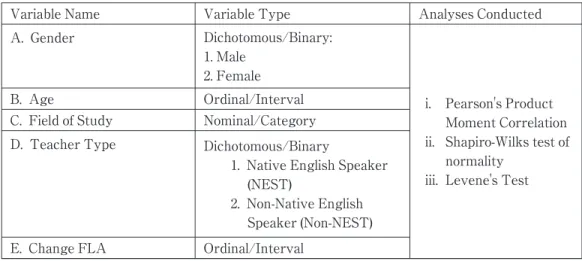
The next step of the analysis was to determine if any of the recorded variables correlated to the measured change in anxiety observed in the previous paragraph. In total, five variables were run through a Bivariate Correlation analysis to determine the Pearson Correlation, r. Two of the factors analyzed were dichotomous (or binary) in nature. Point-biseral correlation would be the more appropriate tool of analysis; however, output of this analysis is the Pearson r (the same as the
Bivariate Correlation output) and SPPS automatically adjusts calculations for dichotomous data when running a Bivariate Correlation analysis. Table 2 shows the variable names, variable types and analyses conducted.
Table 2: Variable Names, Types and Analyses Conducted
Variable Name Variable Type Analyses Conducted
A. Gender Dichotomous/Binary:
1. Male 2. Female
i. Pearson's Product Moment Correlation ii. Shapiro-Wilks test of
normality iii. Levene's Test
B. Age Ordinal/Interval
C. Field of Study Nominal/Category D. Teacher Type Dichotomous/Binary
1. Native English Speaker (NEST)
2. Non-Native English Speaker (Non-NEST) E. Change FLA Ordinal/Interval
In regard to E.) Change in FLA, the Pearson Correlations output data indicated no signifi-cant correlation between A.) Gender, B.) Age, or C.) Field of Study. It did; however, determine that the NEST/Non-NEST variable possess a small, but statistically significant positive correla-tion with the change in FLA (n=397, r=0.109, p=0.03).
To further examine the NEST/Non-NEST variable some descriptive statistics can show a little more detail on the meaning of the correlation. The mean change in anxiety was determined for NEST (n=332) to be (M=11.57, SD=15.32) and the non-NEST (n=65) to be (M=7.14, SD=13.05). It can be inferred from these descriptive statistics and the previously mentioned correlation analysis that there is a small, but positive correlation that the students in this study who have a native speaking English teacher are statistically more likely to report a slightly larger decrease in anxiety than students in a non-native English-speaking teachers' English class. While this find-ing is interestfind-ing, it should be noted that the strength of this correlation makes it of limited utility.
5. Discussion
The hypothesis of this project was that due to a decreased testing pressure paired with a curriculum designed to increase peer support, FLA would decrease. The statistical analysis run on the data seems to support the hypothesis that the curriculum design helped to lower the FLA of the students over the course of their first freshman English class; however, this claim cannot be further substantiated without the inclusion of an additionally comparative group and/or con-trol group. This result directly contradicts a similar study (Asano, 2003) which examined 70 stu-dents in their university freshman class who were taught using audio-visual approaches and found no significant difference between pre and post-test using a slightly modified FLCAS using 23 of the original question (pre alpha =.93, post alpha =.91). A number of factors may explain the contrasting results. Asano notes that the students examined were of very low proficiency (using
both EATJ and EATS scores and the final test scores of their university Freshman English class). There are also distinct differences between the audio-visual approach described in Asano (2003) compared to the presentation/communication curriculum examined in this research. Instructor bias could be another reason for Asano's results and should not be ruled out since no details on the nature or number of instructors are offered. It was assumed, given the large number of in-structors involved in this study instructor bias would be negated. This is further substantiated in that no significant difference was found between FLCAS score and any of the individual instruc-tors (only that as a group, non-NEST teachers showed a smaller decrease in anxiety).
The findings in this paper open interesting research avenues into questions about what types of speaking activities create FLA, whether peer-to-peer activities (such as group work) or student-class/teacher activities (such as speeches and presentations) should be grouped to-gether into a single category when considering FLA. Horwitz et al. (1986) and Price (1991) claimed that speaking, as opposed to reading, writing and listening, is the most anxiety-provok-ing stressor. Yet the classes involved in this study were designed with a curriculum that cen-tered around speaking in the form of presentation style classes. It may be possible to hypothesize that with extensive speaking practice, initial speaking oriented anxiety decreased as speaking ac-tivities became more regular and familiar. It could also be due to the peer-to-peer nature of the communication and/or the fact that a large proportion of the communication was occurring in small group activities in which the teacher simply could not heavily scrutinize. It is conceivable that the test anxiety factor from the FLCAS dropped so low as to bring the students overall FLA score down, but going back to the result of the data, there is not a significant difference between the three factors of the FLCAS, test anxiety, communication apprehension, and fear of negative evaluation.
The NEST/non-NEST correlation found in the analysis leads to another avenue of research that needs to be explored further. While Effiong reported that "classes taught by NES[T]s are usually more communicative in nature" (2015, p.149), the variables at hand are much more com-plex. It would seem that the simply examining NEST/non-NEST is too simple of a comparison as Effiong (2015) found that teacher dress code, age, tone of voice, friendliness, gender all play a role in FLA.
Kitano (2001), Price (1991), and Young (1990, 1991) all stated that they found being evaluated by classmates elevates levels of FLA; however, peer evaluation was a central component of this project's classes curriculum. Further examination of this issue shows not a contradiction, but a need to clearly define the nature of the peer evaluation involved. Young (1999) reported that pair and small group work can lower FLA. This does not directly contradict the earlier publications' sentiments (Young 1990, 1991), but does bring to light that group work and peer evaluation should clearly be differentiated. Suwantarathip and Wichadee (2010) completed a study using the
FLCAS focusing on cooperative learning. Their findings more closely resemble those of this pa-per's study. They concluded that working in groups decreased anxiety when it created a sense of community and when students felt alone they also felt more self-conscious. It is perfectly reason-able to imagine scenarios where peer evaluation occurs in a classroom with little sense of com-munity, and scenarios where peer evaluation occurs classroom where a strong sense of commu-nity exists. The most important conclusion to be drawn here is that peer evaluations should be supportive and constructive as opposed to an instrument that may only serve to further alienate students, increasing their self-conscious feelings. It would seem that one factor which contributes to the quality of peer evaluations is a strong sense of community in the classroom.
6. Conclusions
To summarize as broadly as possible, stressors in one situation may increase FLA while in a different situation may help decrease FLA. This study has shown that there is variation in FLA over the medium-term, but failed to find a strong statistical correlation with any of the variables examined. This is tremendously important as the literature shows that FLA is negatively corre-lated with language learning achievement. Having shown that FLA is subject to modification over the medium-term, it now remains to identify the key elements. It needs to be noted that while some of the claims in the discussion may lead to some exciting conclusions this project lacked a control group. This project has shown the need for further research in order to replicate this work and isolate the key variable(s) in medium-term affecting decreases in FLA, but the re-search methodology must be further refined and improved upon. Some recommendation for sub-sequent projects include adding a control or additional comparative group, changing and improv-ing upon the type of variables used in analysis, and conductimprov-ing a systematic analysis of the differ-ent classroom environmdiffer-ents experienced by the learners in order to evaluate any other factors that are affecting the anxiety of the learners.
References
Allen Elaine & Seaman Christopher (2007) "Likert Scales and Data Analyses," Quality Progress, 40 (7), pp. 64-65
Al-Saraj Taghreed (2014) "Revisiting the Foreign Language Classroom Anxiety Scale (FLCAS): The Anxiety of Female English Language Learners in Saudi Arabi," L2 Journal, 6(1), pp. 50 -76
Asano Sachiko (2003) "Some effects of Audio-visual approaches on foreign language learning anxi-ety," Bulletin of Osaka University of Health and Sports Science, 34, pp. 65-82
Boone Harry & Boone Deborah (2012) "Analyzing likert data," Journal of Extension, 50(2), pp. 1-5 Chastain Kenneth (1975) "Affective and ability factors in second language acquisition," Language
Learning, 25(1), pp. 153-161
Cl!ment Richard, Gardner Robert & Smythe Padric (1977) "Motivational variables in second lan-guage acquisition: A study of Francophones learning English," Canadian Journal of
Behav-ioural Science/Revue canadienne des sciences du comportement, 9(2), pp. 123-133
Cl!ment Richard, Gardner Robert & Smythe Padric (1980) "Social and individual factors in second language acquisition," Canadian Journal of Behavioural Science/Revue canadienne des sciences
du comportement, 12(4), pp. 293-302
Dewaele Jean-Marc & Al-Saraj Taghreed (2015) "Foreign Language Classroom Anxiety of Arab learners of English: The effect of personality, linguistic and socio-biographical variables,"
Studies in Second Language Learning and Teaching, 5(2), pp. 205-228
Dunkel Harold (1947) "The effect of personality on language achievement," Journal of educational
psychology, 38(3), pp. 177-182
Effiong Okon (2015) "Getting Them Speaking: Classroom Social Factors and Foreign Language Anxiety," TESOL Journal, 7(1), pp. 132-161
Gardner Robert (1985) Social psychology and second language learning: The role of attitudes and
moti-vation, London. UK: Edward Arnold
Gardner Robert & Smythe Padric (1975) "Second Language Acquisition: A Social Psychological Approach," Research Bulletin No. 332
Harzing Anne-Wil (2006) "Response Styles in Cross-national Survey Research A 26-country Study," International Journal of Cross Cultural Management, 6(2), pp. 243-266
Horwitz Elaine (1986) "Preliminary evidence for the reliability and validity of a foreign language anxiety scale," TESOL Quarterly, 20(3), pp. 559-562
Horwitz Elaine, Horwitz Michael & Cope Joann (1986) "Foreign language classroom anxiety," The
Modern Language Journal, 70(2), pp. 125-132
Hosoki Yukiko (2011) "English language education in Japan: Transitions and challenges," Kokusai
Kankeigaku Bulletin, 6(1), pp.199-215
Kavanagh Barry (2012) "The Theory and Practice of Communicative Language Teaching in Ja-pan," Academic Research International, 2(2), pp. 730-738
Kawashima Tomoyuki (2009) "FL anxiety studies of Japanese EFL learners: A critical review," in A. M. Stoke (Ed.), JALT 2008 conference proceedings. Tokyo: JALT
Kitano Kazu (2001) "Anxiety in the college Japanese language classroom," The Modern Language
Journal, 85(4), pp.549-566
Kluge David & Taylor Mathew (2011) In my life: Strategies for Personal Communication, MacMillan Language House
Kondo Shinji & Yang Ying-Ling (2003) "The English language classroom anxiety scale: Test con-struction, reliability, and validity," JALT journal, 25(2), pp. 187-196
MacIntyre Peter & Gardner Robert (1989) "Anxiety and second language learning: Toward a theoretical clarification," Language learning, 39(2), pp. 251-275
MacIntyre Peter & Gardner Robert (1991a) "Investigating language class anxiety using the fo-cused essay technique," The Modern Language Journal, 75, pp. 296-304
MacIntyre Peter & Gardner Robert (1991b) "Language anxiety: Its relation to other anxieties and to processing in native and second languages," Language Learning, 41, pp. 85-117
MacIntyre Peter & Gardner Robert (1991c) "Methods and results in the study of foreign language anxiety: A review of the literature," Language Learning, 41, pp. 85-117
MacIntyre Peter & Gardner Robert (1994a) "The effects of induced anxiety on three stages of cognitive processing in computerized vocabulary learning," Studies in Second Language
Ac-quisition, 16, pp. 1-17
MacIntyre Peter & Gardner Robert (1994b) "The subtle effects of language anxiety on cognitive processing in the second language," Language Learning, 44, pp. 283-305
McCroskey James (1992) "Reliability and validity of the willingness to communicate scale,"
Com-munication Quarterly, 40(1), pp. 16-25
Mowrer Orval (1950) Learning theory and personality dynamics: selected papers
Nowlis Stephen, Kahn Barbra & Dhar Ravi (2002) "Coping with ambivalence: The effect of re-moving a neutral option on consumer attitude and preference judgments," Journal of
Con-sumer Research, 29(3), pp. 319-334
Onwuegbuzie Anthony, Bailey Phillip & Daley Christine (2000) "The Validation of Three Scales Measuring Anxiety at Different Stages of the Foreign Language Learning Process: The Input Anxiety Scale, the Processing Anxiety Scale, and the Output Anxiety Scale,"
Lan-guage Learning, 50(1), pp. 87-117
Price Mary Lou (1991) "The subjective experience of foreign language anxiety: Interviews with highly anxious students," Language anxiety: From theory and research to classroom
implica-tions, pp. 101-108
Saito Yoshiko, Garza Thomas & Horwitz Elaine (1999) "Foreign Language Reading Anxiety," The
Modern Language Journal, 83, pp. 202-218
Sarason Irwin (1977) "The Test Anxiety Scale: Concept and Research (No. SCS-CS-003)," Washing-ton University Seattle Department of Psychology
Scovel Thomas (1978) "The effect of affect on foreign language learning: A review of the anxiety research," Language Learning, 28(1), pp. 129-142
Shillaw John & Iwaki Nami (2004) "The effect of oral communication practice on three measure of anxiety," Academia, Journal of the Nanzan Academic Society, Literature and Language, Nanzan
University, 75, pp. 95-210
Suwantarathip Ornprapat & Wichadee Saovapa (2010) "The impacts of cooperative learning on anxiety and proficiency in an EFL class," Journal of College Teaching & Learning, 7(11), pp. 51-57
Tahira Masumi (2012) "Behind MEXT's new Course of Study Guidelines," The Language Teacher,
36(3), pp. 3-8
Tobias Sheila (1986) "Anxiety and cognitive processing of instruction," in R. Schwarzer (Ed.), Self−
related cognitions in anxiety and motivation. Hillsdale, NJ: Lawrence Erlbaum Associates Tobias Sigmund (1979) "Anxiety research in educational psychology," Journal of Educational
Psy-chology, 71(5), pp. 573-582
Wang Rui, Hempton Brian, Dugan John & Komives Susan (2013) "Cultural Differences: Why Do Asians Avoid Extreme Responses?," Survey Practice, 1(3)
Williams Kenneth and Andrade Melvin (2008) "Foreign language learning anxiety in Japanese EFL university classes: Causes, coping, and locus of control," Electronic Journal of Foreign
Language Teaching, 5(2), pp. 181-191
Yashima Tomoko, Noels Kimberly, Shizuka Tetsuhito, Takeuchi Osuma, Yamane Shigeru & Yoshizawa Kiyomi (2009) "The interplay of classroom anxiety, intrinsic motivation, and gender in the Japanese EFL context," Journal of Foreign Language Education and Research,
17, pp. 41-64
Young Dolly (1990) "An investigation of students' perspectives on anxiety and speaking," Foreign
Language Annals, 23(6), pp. 539-553
Young Dolly (1991) "Creating a Low-Anxiety Classroom Environment: What Does Language Anxiety Research Suggest?," The Modern Language Journal, 75(4), pp. 426-437
Young Dolly (1999) Affect in foreign language and second language learning: A practical guide to
creat-ing a low anxiety classroom atmosphere, McGraw-Hill Humanities/Social Sciences/Lan-guages
コミュニカティブ・ベース・ティーチングの外国語言語不安への効果 ダイクス・ロバート 第二言語不安(FLA)にはまだ調査、研究の余地があるものの、各学習者の傾向、ストレス 要因や刺激、そして不安の直接的な背景などに影響を受けるという複雑さから、まだ十分に行わ れていない。プレテスト・ポストテストで測定した教室内での実験結果にはばらつきがみられる。 本研究では明確なデータを得るため、大規模な日本人大学生の集団(N=397)の FLA に、16週 間の必須科目の英語の授業内で起こる変化を測った。また、本研究の第二目的として生徒中心の コミュニカティブなカリキュラムが FLA にもたらす影響も探った。調査の結果、16週間の授業 開始から終了までに FLA が大きく減少していた。また、スピーキングや学生同士の評価などの ストレス要因はある状況下では FLA を増加させることが示唆されたが、その一方で同要因が教 室という強いコミュニティ的な状況下では FLA の減少に関係するかもしれないとも分かった。 しかし、研究のデザインには改善が必要で、今後の研究に検討が必要である。 キーワード:言語習得不安、外国語不安、コミュニカティブベースティーチング、ピアサポート ―49―