著者
中井 文子
著者別名
Ayako NAKAI
雑誌名
観光学研究
巻
19
ページ
48-56
発行年
2020-03
URL
http://doi.org/10.34428/00011824
Creative Commons : 表示 - 非営利 - 改変禁止 http://creativecommons.org/licenses/by-nc-nd/3.0/deed.jaJournal of Tourism Studies (2020) 47
The Effects of Learning Environmental Issues through a
Short-term Study Abroad Program in California
Ayako NAKAI
Abstract
The purpose of this study is to examine Japanese university students' attitudes toward environmental issues through a three-week program in California. The sample consisted of 24 undergraduate students majoring in tourism and participating in the program in California in March 2019. Before the program, the students made presentations about the causes of wildfires in California and the Zero Emission Vehicle program. This students were asked to shoot videos about environmental issues and pro-environmental behaviors in the US. Through shooting videos, the students realized a large amount of water usage and food wastes in the hospitality industry. After the program, they watched their videos together and held discussions. The results on a pre-and post-test of the New Ecological Paradigm Scale were used to analyze their attitudes toward environmental problems. However, the students’ attitude toward environmental issues did not show a statistical difference after the program. (t(23)=.709,
p=.486). It appeared that the program was too short to influence their attitudes significantly. However,
the contents of the students’ videos showed that the program had a positive effect on their understanding of environmental problems. The short-term study abroad program where they shot videos and interviewed hotel managers about pro-environmental activities encouraged the students to pay further attention to environmental problems and the differences in attitudes between the US and Japan.
1.
Introduction
In Japanese higher education, short-term study abroad programs during the spring and summer recess are gaining popularity, because it offers students opportunity to learn foreign culture and improve their English-speaking skills. In addition, teachers accompany them for their safety. According to JASSO (Japan Student Services Organization), the number of Japanese students who studied abroad increased by about 13 percent from 84,456 in 2016 to 96,641 in 2017. Meanwhile, figures released by OECD showed that the number of students studying overseas declined from 54,912 in 2014 to 54,676 in 2015, down 0.04 percent. Between 2015 and 2017 the number of students who studied abroad dramatically increased significantly on account of Tobitate Ryugaku Japan scholarships, supported by MEXT (Ministry of Education, Culture, Science and Technology).
migrate overseas for long-term studies. Iwaki's research (2012) indicated that owning to the short-term study abroad programs, students looked forward to participating in one-year exchange programs.
Previous research on overseas studies focused on changes in English proficiency and attitudes towards foreign cultures. However, this study seeks to highlight students’ interest towards environmental issues. Learning not only English and the target countries’ culture, but also environmental problems and environmental protection is important for young people who can work toward making Earth a more sustainable place for future generations. The purpose of this study is to examine Japanese university students' attitudes toward issues concerning the environment through a three-week program in an English-speaking country. The sample consisted of 24 Japanese undergraduate students majoring in tourism and participating in a study program in California in March 2019. The study focuses on students’ attitudes and the contents of the video related to environmental problems which they shot in the US. This study will include students’ understanding of critical situations and a comparisons of actions in the US toward environmental problems with those in Japan. The results on a pre- and post-test of the New Ecological Paradigm (NEP) Scale were used to analyze the attitudes.
2.
Literature Review
2.1 Short term study abroad programs to improve language proficiency
Fujio (2010) conducted a longitudinal study focusing on two students’ English speaking proficiency such as their turn-taking styles, fluency and the complexity of their language production. The participants joined a short-term overseas program in Canada. However, a year later, interviews revealed that the students regressed to almost the same level of speaking as it was prior to studying abroad, suggesting that after the short-term program, teachers should continue to support students’ learning.
Meanwhile, the participants in this study were asked to watch videos they had shot in California and discuss environmental issues after studying overseas.
Yamakawa et al (2015) emphasized the importance of students registering English mediated specialized courses at the participants’ university after a short study program in California. The participants answered an original scale which was developed by the author. According to the results, about 30 percent of the students faced a gap between the learning styles in the US, which offered students opportunities to make presentations and write essays, and in Japan, where the didactic style of using textbooks and teaching terminologies is standard. About 70 percent of the students studying abroad preferred the same method of learning in Japan.
On the other hand, in this research, the teacher is expected to follow the US teaching style in Japan. The teacher is not a speaker but an observer who will monitor the students’ level of understanding of environmental issues and help them find appropriate resources for making their presentations and shooting videos. It was predicted that these actions would enable the students to become autonomous learners and change their attitudes towards the environment.
NAKAI:The Effects of Learning Environmental Issues through a Short-term Study Abroad Program in California 49
2.2 Short-term study abroad programs and attitudes towards different cultures
Iwai (1992) analyzed the impressions of participants toward Americans and American culture. The students took part in a short term study program in California. About 45 percent of the students showed preferable impressions toward Americans and about 80 percent noticed the differences between the lifestyles and mode of thinking of Americans and the Japanese. According to the students’ self-evaluations of English speaking and listening proficiency, after the program, about 60 percent of the students did not believe that their oral skills had improved. Therefore, the author discussed the necessity of the speaking and listening training prior to the program. In this study, the students were asked to make presentations to improve their English-speaking skills before studying abroad.
Takahama and Tanaka (2011) developed an original questionnaire to examine undergraduate students’
attitudes toward foreign cultures after the short-term program. Ten students participated in the experiment, and in the free description part of the questionnaire, some students mentioned that they had some knowledge about various cultures and understood the values and behaviors in the countries. Takahama and Tanaka’s study revealed that, after returning to Japan, more than half of the participants had difficulty adjusting themselves in Japanese society, even though the duration of the program was less than a year. To overcome a reverse culture shock, the students realized the importance of sharing their feelings with others who also studied abroad and setting new goals.
This research suggests that after their experience studying abroad, teachers should provide opportunities to the participants of short-term study abroad programs to help them communicate with each other and analyze their experiences. Therefore, the participants of this study took part in discussions to share their experiences abroad and deliberate on pro-environmental actions there.
The aforementioned studies used questionnaires and the Likert scale developed by the researchers. However, they did not investigate the internal consistency and validity statistically. Therefore, the quality of the questionnaires was not guaranteed to examine the students’ cross-cultural awareness precisely. To analyze the students’ impressions about participating in study abroad programs statistically, the existing psychological scale which was prevalent in each special field should be adopted.
In this study, the scale which is widely recognized among a large number of researchers was adopted, and the content of the scale will be described in the following sections.
2.3 New Ecological Paradigm Scale
In 1978, Dunlap and Van Liere developed New Ecological Paradigm (NEP) Scale related to pro-environment attitudes. According to Dunlap et al (2000), a Washington State survey stated that the items of the scale showed an internal consistency. Pierce et al (1987) used the scale to examine environmental beliefs of the Japanese elite and the general public. In addition, it has recently been adopted in higher educational settings for comparing American, Mexican, and Brazilian students’ pro-environmental beliefs (Bechtel, Verdugo, & Pinheiro, 1999). According to this previous research, the NEP Scale is appropriate to analyze the attitudes of Japanese college students towards environmental issues.
published (Dunlap et al, 2000). In this study the new version of the NEP Scale was utilized for the participants. The eight-odd-numbered items indicate the agreement with pro-ecological perspectives, while the seven-even numbered items show disagreement with pro-ecological worldview. Although the items were supposed to be selected to include five factors such as the reality of limits to growth, anti-anthropocentrism, the fragility of nature’s balance, rejection of exemptionalism, and the possibility of an eco-crisis, new NEP Scale currently was proved to have one dominant factor due to the results of the previous Washington survey.
3.
Methodology
3.1 The participants
The participants include 24 first-year undergraduate students recruited from a department related to international tourism at a university located in Tokyo. They are mostly female and aged between 19 and
20. Their 2017 TOEIC test scores (listening and reading test) organized by ETS are between 355 and 735
points, so their English proficiency is different in terms of the TOEIC test.
3.2 Data collection
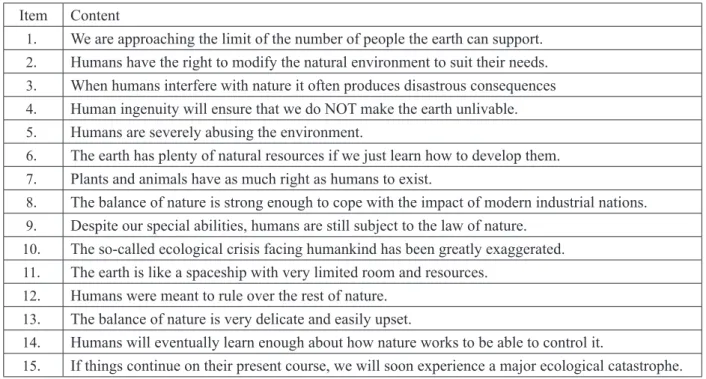
The NEP Sale (Dunlap et al, 2000) was used to measure students’ attitudes towards environmental problems. The students answered a 15-item questionnaire (see Table 1) in January 2019.
Table 1 New Ecological Paradigm Scale
Item Content
1. We are approaching the limit of the number of people the earth can support.
2. Humans have the right to modify the natural environment to suit their needs.
3. When humans interfere with nature it often produces disastrous consequences
4. Human ingenuity will ensure that we do NOT make the earth unlivable.
5. Humans are severely abusing the environment.
6. The earth has plenty of natural resources if we just learn how to develop them.
7. Plants and animals have as much right as humans to exist.
8. The balance of nature is strong enough to cope with the impact of modern industrial nations.
9. Despite our special abilities, humans are still subject to the law of nature.
10. The so-called ecological crisis facing humankind has been greatly exaggerated.
11. The earth is like a spaceship with very limited room and resources.
12. Humans were meant to rule over the rest of nature.
13. The balance of nature is very delicate and easily upset.
14. Humans will eventually learn enough about how nature works to be able to control it.
NAKAI:The Effects of Learning Environmental Issues through a Short-term Study Abroad Program in California 51
3.3 The procedures of the treatment
Before beginning the short-term study abroad program, the participants answered a questionnaire based on the Scale. After that, they were divided into five groups and asked to make presentations about the recent catastrophic fires in California and the Zero Emission Vehicle program. Between February
24th and March 17th, 2019, the students participated in a three-week program related to tourism and environmental problems at a university in California. The students visited luxury and local hotels and interviewed hotel managers about the facility’s pro-environmental actions, such as using recyclable materials.
In addition, they worked as chefs or waitresses in a cafeteria at the university in California as part of their internships. During the program, they stayed at a local hotel.
During their stay, all the students were asked to shoot six-minute videos regarding the differences in pro-environmental behaviors between Japan and the US. After the program between March 18th and
26th, the students were asked to answer the same questionnaire, watch their videos and discuss environmental issues in a classroom in Japan.
3.4 Research Questions
As they participated in a three-week program, made presentation, shot videos, and held discussions, it was expected that their attitudes towards environmental issues would change. The following research questions were formulated;
1) Will the participants pay more attention to the environment after the short-term program?
2) Will their attitudes towards environmental issues change depending on their English proficiency?
4.
The contents of students
’
videos
The students shot six minute videos in California to reflect their thoughts about pro-environmental actions. The following photographs are screen shots from the students’ videos.
4.1 The contents of the first video: the rubbish bins
The OECD (2010) predicted that worldwide waste is expected to double by 2030. There is an urgent need for us to reduce waste and recycle resources. Some students focused on the rubbish bins at the cafeteria in the campus where the students did their internships as chefs and waitress during the program. They noticed that the garbage was not segregated into biodegradable and non-biodegradable in some areas. The Japanese students were surprised to see this, as they had different garbage bins at their university for recycling. In order to deliver reductions in CO2 emissions, the students learned that
4.2 The contents of the second video: food waste
Sloan (2013) stated that in the US and the UK, a quarter of the food from stores and restaurants go straight into the waste bin or are thrown away by these establishments.
In fact, the students realized the issue and shot the video about food wastage in the same cafeteria where they worked, given that American students tend to waste a lot of food. During their stay, they went to an all-you-can-eat-cafeteria in the campus every day, and Japanese students consumed everything they placed on their plates, while American students left behind a lot of pizzas. Eventually the left-over food was thrown away in the kitchen. In the video, the female students described the situation,saying, “Mottainai” in Japanese. “Mottainai” has various meaning in different contexts, and in this context, it means that it is not eco-friendly. The students understood that wasting food is a misuse of energy and ingredients, and that it would have a bad effect on preserving the environment.
1. The video: rubbish bins
NAKAI:The Effects of Learning Environmental Issues through a Short-term Study Abroad Program in California 53
4.3 The contents of the third video: SAVE OUR PLANET sign
The students stayed in a hotel in California for three weeks, and during that time some of them found the sign SAVE OUR PLANET in the washroom. The sign says, “Everyday millions of gallons of water are used to wash towels. You make the choice. A towel on the rack means, ‘I will use again’.” At first, one of the students did not notice the sign. Therefore, she hung the towel in the towel rack, but it was not washed because of the hotel policy. Later, she realized why the cleaner did not change the towel, and eventually she understood the hotel’s policy. Sloan (2013) stated that a large amount of water is used by guests ranging between 100 and 2,000 liters, per guest per night. The students realized that they could make a choice to save water to conserve the limited resources.
4.4 The contents of the fourth video: the laundry room
After shooting the SAVE OUR PLANET sign, the students visited the laundry room of the hotel where they stayed to examine water usage. They noticed that many laundry machines worked continuously. A lot of used towels and bed sheets were piled up even though they did not seem dirty. They were shocked to learn that washing towels everyday consumes a learge amount of water.
The UNEP (2003) estimated that all tourist and recreations spots combined, including hotels, consumed 946 million cubic meters of water per year, of which 60 percent is related to lodging and another 13 percent to food service. As mentioned above, lodging consumed a large amount of water and the guests who stay in the hotel for a long time need to learn strategies to reduce water usage. Eventually, through the shooting of the videos, the students realized the reality of water usage in a hotel, and became aware of the importance of making a choice as to whether to use the same towel during their stay.
5.
Results
5.1 The change in the students’ attitudes before and after the program
The data using the NEP Scale(five-point scale) was analyzed using a t-test. The students’ attitude toward environmental problems did not show a statistical difference after the program. (t(23)=.709,
p=.486)
5.2 The change in students’ attitudes based on their English proficiency
It was projected that based on the students’ English proficiency, their depth of understanding of environmental issues and pro-environmental actions in the US. would be different. The 24 participants were divided into two groups, Group A and Group B. It was expected that the students with a high proficiency of English would understand the importance of protecting the environment more deeply that those with low English proficiency.
However, Group A (13 students, with a high English proficiency of more than 500 points in the TOEIC test) did not project any change in their attitude toward environmental problems (t(12)=.1.324
p=.210). Similarly, Group B(11 students with a low proficiency of English, less than 500 points in the 4. The video: the laundry room
Table 1 The change in the students’ attitudes before and after the program
The participants (n=24)
M SD
Before 3.32 0.35
After 3.38 0.38
Table 2 The change of the students’ attitudes
Group A (n=13) Group B (n=11)
M SD M SD
Before 3.34 0.27 3.30 0.44
NAKAI:The Effects of Learning Environmental Issues through a Short-term Study Abroad Program in California 55
TOEIC test ) did not display any change in their attitude toward environmental issues (t(10)=.298
p=.772).
6.
Conclusion
Due to drastic climate change, various catastrophic disasters are occurring in the world. It is necessary to teach young people about the need to conserve environment for a better future. The United Nations World Water Development Report (2015) claimed that “The planet is facing a 40 per cent shortfall in water supply by 2030, unless we dramatically improve the management of this precious resource.”
The contents of the students’ videos showed that the program had a positive effect on their understanding of environmental problems. However, it appeared that the program was too short to influence their attitudes significantly.
Recently, hotels in Japan also adopted the SAVE OUR PLANET sign translated into Japanese. However, the students did not notice that when they were in Japan. By shooting the video abroad, they tried to identify pro-environmental behaviors in the hotel, and realized how the hotel industry saves water to protect the environment.
According to Scott (2012), perceptions of climate change impacts differ to some extent among travelers from different cultural contexts, as well as based on other demographic variables, such as age. Scott suggested that elderly people were more sensitive toward climate change especially global warming, than young people. In this study, the participants are young and they should have been educated more specifically to think about climate change, environmental issues, and pro-environmental actions by increasing the number of hours of learning environmental problems in the US.
The participants in this study belong to a university surrounded by buildings in the central Tokyo, while the campus where they studied in California had more greenery. In fact, in the video, some of the students praised the beautiful natural environment of the campus in California. Therefore, it seemed difficult for them to understand how serious climate change and environmental problems are in California, where major fires occurred a few months before they arrived there.
According to Sloan (2013), one-third of the population in the world faces severe water shortage. About three billion people will suffer from severe water shortage by 2020, if there is 4 degree in global temperature. It is an urgent matter for the younger generation to pay attention to water usage, food wastage, and recycling to reduce CO2 emissions. The short-term study abroad program where they shot videos and interviewed hotel managers about pro-environmental activities encouraged the students to pay further attention to environmental problems and the differences in attitudes between the US and Japan. In order to change their attitudes and take action to protect the Earth, apart from watching videos and having discussions new trials such as participating in eco-tour and understanding eco-tourism would be organized for the future short-term study abroad program in the US, to help the students to recognize the situations.
References
Bechtel, R. B., Verdugo, V. C., & Pinheiro, J. de Q. (1999). Environmental belief systems: United States, Brazil, and Mexico. Journal of Cross-Cultural Psychology, 30, 122–128.
Dunlap, R. E., Van Liere, K. D., Mertig, A. G., & Jones, R. E. (2000). New trends in measuring environmental attitudes: measuring endorsement of the new ecological paradigm: a revised NEP scale. Journal of social issues, 56(3), 425-442. Fujio, M. (2014). The retention and attrition of English ability by Japanese university students with short-term overseas
study experience. Keieironshu, (84), 25-39.
Hayashi, C. (2013). Tanki kyotei ryugaku no ibunka tekiou heno kouka [The effects of short-term overseas study programs on students’ cross-cultural adaptability]. Paper presentation at the JACET Kanto 7th Annual Convention. Tokyo: Aoyamagakuin University.
Iwai, C. (1992). Kaigai bunka eigo kenshu no eigokyoiku ni hatasu yakuwari [The role of overseas programs on English education]. Eigo Eibei Bungaku Ronshu, 17-31.
Iwaki, N (2012). Ryugakusuishin no torikumi ga koukanryugaku ni ataeru eikyo ni tsuiteno jittai chousa [Practical research on the effects of encouragement towards studying abroad for exchange student programs] Nagoya Daigaku Ryugakusei Center Kiyou,10,23-29.
JASSO(2018) ‘The number of Japanese students studying abroad with agreement and without agreement,’ Available at: https://www.jasso.go.jp/about/statistics/intl_student_s/2018/1307074_10364.html
MEXT (2019) ‘The number of Japanese students studying abroad,’ Available at: http://www.mext.go.jp/a_menu/koutou/ ryugaku/__icsFiles/afieldfile/2019/01/18/1412692_1.pdf
OECD(2010) OECD Environmental Outlook to 2030. Available at: https://www.oecd.org/environment/indicators-modelling-outlooks/40200582.pdf
Pierce, J. C., Lovrich, Jr., N. P., Tsurutani, T., & Takematsu, A. (1987). Environmental belief systems among Japanese and American elites and publics. Political Behavior, 9, 139–159.
Scott, D., Hall, C. M., & Stefan, G. (2012). Tourism and climate change: Impacts, adaptation and mitigation. Routledge. Sloan, P. Legrand, W., & Chen, J. S. (2013). Sustainability in the Hospitality Industry 2nd Ed: Principles of Sustainable
Operations. Routledge.
Takahama, A. & Takanaka, K.(2011). (Tanki koukanryugakusei no re-entry stage ni okeru kadai no bunseki-gyuaku culture shock wo chushin ni. [The problems for short term exchange students in the re-entry stage― focusing on reverse culture shock and utilizing their experiences studying abroad]. Jinbun Shizen Kenkyu, 5, 140-157.
UNEP (2009) ‘New UN report warns of increasing pressure on water, press release’, March 16, 2009.
UNEP(2015) ‘Ahead of World Water Day, UN Calls for Better Management of Water Resources’, press release. March 20, 2015, Available at: https://www.unenvironment.org/news-and-stories/press-release/ahead-world-water-day-un-calls-better-management-water-resources
Yamakawa, K,Hiramoto, S. Matsuoka, H. and Miyake, H. (2015).Integrating University Courses Conducted in English