全身性強皮症肺病変(間質性肺疾患)の重症度分類の作成
研究分担者 桑名正隆 日本医科大学大学院医学研究科アレルギー膠原病内科 教授 研究分担者 浅野善英 東京大学医学部附属病院皮膚科 講師
研究分担者 川口鎮司 東京女子医科大学リウマチ科 臨床教授 研究分担者 後藤大輔 筑波大学医学医療系内科 准教授
研究分担者 神人正寿 熊本大学大学院生命科学研究部皮膚病態治療再建学 准教授 研究分担者 竹原和彦 金沢大学医薬保健研究域医学系皮膚科学 教授
研究分担者 波多野将 東京大学医学部附属病院循環器内科 助教 研究分担者 藤本 学 筑波大学医学医療系皮膚科 教授
協力者 佐藤伸一 東京大学医学部附属病院皮膚科 教授
研究代表者 尹 浩信 熊本大学大学院生命科学研究部皮膚病態治療再建学 教授
研究要旨
全身性強皮症(SSc)の死因の第一位は間質性肺疾患(ILD)で、予後規定因子としてきわめて 重要である。ILD の経過は多様で、末期肺病変まで進行する例は半分以下である。初診時から進 行しない例から数年の経過で呼吸不全に陥る例まで幅広い。そこで、末期肺病変への進展あるい は生命予後不良例の予測に有用な重症度分類案を策定した。文献検索から SSc‑ILD の長期予後に 有用な臨床所見、を抽出し、それらの中から、わが国の SSc 診療施設で広く実施可能、かつ複数 の研究で予後予測因子として同定されている胸部高解像度 CT(HRCT)所見と肺機能検査を選択 した。その上で HRCT における病変の広がりと努力性肺活量(FVC)を組み合わせた第 1 案と、FVC のみを採用した第 2 案を策定した。今後、単施設あるいは多施設での履歴的研究によりこれら重 症度分類案の検証が必要である。
A. 研究目的
全身性強皮症(SSc)の死因の第一位は間質 性肺疾患で、予後規定因子としてきわめて重 要である。おもに支持療法の進歩により SSc の生命予後は改善傾向にあるが、死因に占め る ILD の割合はむしろ増えている。ILD の経 過は多様で、初診時から全く進行しない例か ら数年の経過を経て呼吸不全に陥る例まで幅
広い。ただし、特発性肺線維症にみられる急 性増悪や皮膚筋炎など他の膠原病に特に伴う 急速進行性の経過を呈することはない。北米 のコホートでは、ILD を有する例のうち全経 過を通じて努力肺活量(FVC)が 75%以下ま で低下した例は 40%、50%以下まで低下した 例は 13%に過ぎない 1)2)。拘束性換気障害は 発症早期(2‑5 年以内)に低下し、それ以降
は低下が緩徐になるか安定する1)3)。胸壁の皮 膚硬化の改善、気腫性変化の拡大により経時 的に FVC が改善する場合もある。
SSc における ILD は線維化、構造改変が主 体のため、進行すると機能回復は不可能であ る。そのため、機能障害が進行する前に予後 不良の進行例を見極め、適切な治療介入する ことが理想である。そこで、重症度分類を策 定するに当たっては、評価時の機能障害の程 度より、将来的な末期肺病変への進展、ある いは生命予後不良を勘案することが重要と考 えた。そこで、過去の SSc に伴う ILD を主題 とした報告の中で長期予後を予測する臨床所 見を解析した報告を抽出し、それに基づく重 症度分類の作成を試みた。
B. 研究方法
PubMed(http://www.ncbi.nlm.nih.gov/)
を 用 い て systemic sclerosis ま た は scleroderma と interstitial lung disease で論文を検索した、総説(review)、症例報 告(case report/case series)、言語が英語 以外の論文を除外した。抽出されたすべての 論文の抄録をから SSc における ILD の予後予 測因子を扱ったものを選び、全文を入手した。
最終的に、それら報告に基づいた重症度分類 案を作成した。
(倫理面への配慮)
本研究はオンライン上に公開されている情 報をもとに実施したため、倫理面への配慮は 不要である。
C. 研究結果
2014 年 11 月 10 日時点に PubMed で systemic sclerosis/scleroderma と interstitial lung disease で検索した 1226 件の論文のうち、
ILD の予後予測因子を主題とした 61 件の論文 が抽出された。履歴的研究が 92%と大半を占 め、エンドポイントとして死亡、末期肺病変、
拘束性換気障害の進行が用いられていた。以 下に主な予後予測因子の概要をまとめた。
1) 背景因子
生命予後不良因子として男性、心筋病変の 併存が報告されているが 1)、びまん皮膚硬化 型(dcSSc)/限局皮膚硬化型病型(lcSSc)の 病型、modified Rodnan skin thickness score
(MRSS)による皮膚硬化の程度、抗トポイソ メラーゼⅠ抗体を含めた自己抗体の有無で予 後に差はない。dcSSc 早期例でその後の FVC 低下リスクが高いことが示されている4)。 2) 自覚症状
各種 dyspnea index(Mahler、Borg、Saint George、MMRC など)、HAQ‑DI、SF‑36、咳の 頻度と程度は評価時の FVC と相関するが、進 行予測には有用でない5)6)7)。
3) 6 分間歩行試験(6MWT)
6MWT では歩行距離のみならず動脈血酸素飽 和度(SpO2)の低下度、終了後の回復時間な ど多くの情報が得られるが、生命予後との相 関が示されているのは最低 SpO2 のみである。
89%未満または 4%以上の低下は死亡リスク を 2.4 倍高める8)。
4) 肺機能検査
FVC、DLCO ともに低酸素血症の程度と相関 する 9)。FVC が 70%未満ではその後の死亡リ スクが 2.1 倍高く、生命予後不良を予測する
よい指標である 10)。しかし、早期例では FVC は正常範囲にとどまることから、経時的な FVC 測定が予後予測に有用である 11)。6 ヶ月の測 定間隔で 5%以上低下する場合はその後に末 期肺病変へと進行するリスクが高い。
5) 胸部高解像度 CT(HRCT)
SSc‑ILD ではすりガラス影、網状影、肺胞 間隔壁の肥厚、牽引性気管支拡張、蜂窩影、
嚢胞影が様々な程度で混在し、通常型間質性 肺炎(UIP)または非特異的間質性肺炎(NSIP)
パターンを呈する。牽引性気管支拡張など線 維化に伴う二次的な構造破壊により生じた不 可逆的な変化は FVC や DLCO 低下と相関する12)。 さらに、線維化所見の拡大は拘束性換気障害 や息切れの進行と相関し 3)、その後の肺機能 低下を予測するよい指標である13)。一方、す りガラス影は肺機能や息切れの程度と相関せ ず 、 ILD 進 行 を 予 測 す る 指 標 と な ら な い
14)15)16)17))。ILD の予後を予測するための様々な
HRCT スコアリングが提唱されてきたが 18)19)、 病変の広がり(面積比)が簡便かつ有用であ る。全てのパターンを包括した病変の広がり が 20%以上、35%以上で死亡リスクがそれぞ れ 2.5‑3.0、3.9 倍高い 10)20)21)。FVC と HRCT 上の病変の広がりを組み合わせたステージン グが広く用いられている10)。HRCT 上の病変が 20 % を 越 え る 、 ま た は FVC70 % 未 満 を extensive stage と呼び、それを満たさない limited stage に比べて死亡リスクが 3.5 倍 高い。
6) 気管支肺胞洗浄液(BALF)
BALF 回収細胞数の増加はあっても軽度のこ とが多く、その後の進行度と相関しない。分
画では好中球、好酸球、リンパ球の増加がみ られることがあるが、それらも ILD 進行予測 にならない22)23)24)。シクロホスファミド(CYC)
有効例でも、治療前後で BALF 所見に変化はな く、治療効果の判定にも有用でない25)。ただ し、BALF 中の B 細胞比率、IL‑2、TNF‑α、CXCL11 の増加はその後の FVC 低下と関連する26)27)28)。 7) 血中バイオマーカー
KL‑6 と SP‑D ともに呼吸苦の程度や FVC と の関連に乏しい29)。また、SP‑D は FVC 低下の 予測に有用でない30)。むしろ、これら指標の 上昇は HRCT 上のすりガラス影や BALF 中の炎 症性細胞比率上昇などの炎症性病態と関連す る29)。これまで FVC 低下予測に有用な血中バ イオマーカーとして CRP、CA15.3、IL‑6、CCL18、
COMP が報告されている31)32)33)34)35)。 8) その他の評価法
肺生検組織では、lcSSc に限定した報告で UIP の方が NSIP より予後不良の傾向が示され ている36)。67ガリウムシンチグラムは予後予 測に有効との報告はない。肺エコーでの B line またはコメットサインが線維化検出に有 用で、早期例での予後予測に有用な可能性が 示されている37)38)。その他、99mTc‑DTPA 肺ク リアランス39)、呼気中の一酸化窒素濃度40)、 HGF 遺伝子プロモーター領域の一塩基多型41) が FVC 低下予測に有用との報告がある。
9) 重症度分類案
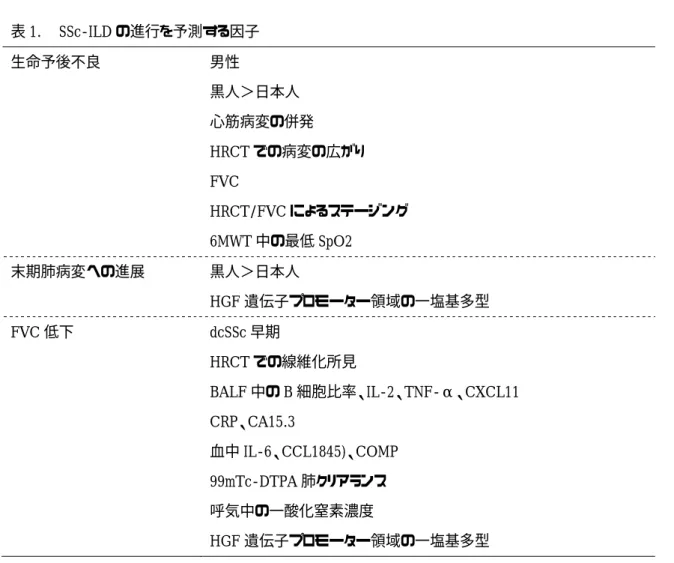
以上の研究を踏まえて長期予後を反映した 重症度分類案の作成を試みた。表 1 に SSc‑ILD の生命予後、末期肺病変への進展、FVC 低下 を予測する因子をまとめた。これらの因子の 中で、わが国の SSc 診療施設で広く実施可能、
かつ複数の研究で予後予測因子として同定さ れているものとして胸部 HRCT 所見と肺機能 検査(FVC)が挙げられた。HRCT の画像ソフ トウェアを用いたスコアリングは一般化し難 いため、最も単純かつ再現性が高いことが示 されている Goh らが提唱した病変の広がり10) を採用することが適切と考えられた。この基 準によれば、病変の広がりが 20%を越えると 死亡リスクが 2.5‑3 倍高まる。すりガラス影 が主体の早期例の場合は FVC 低下を伴わない ケースが多いことから、FVC より HRCT 所見を 上位に設定することで幅広く予後不良例を取 り込むことができる。そこで、Goh らの提唱 した FVC と HRCT 上の病変の広がりを組み合わ せたステージング10)に準じた第 1 案を作成し た(図 1)。ただし、HRCT の読影が全ての SSc 診療に携わる医師に受け入れられるかには疑 問があり、HRCT による病変の広がりを除いた FVC のみの第 2 案も作成した(図 2)。この場 合、FVC70%以外に長期予後予測での有用性が 示されているカットオフがないため、便宜的 に検査としての基準値として用いられている 80%を採用した。
D. 考 案
今回、文献検索から SSc‑ILD の長期予後を 勘案した重要度分類案を作成した。SSc‑ILD の中でも末期肺病変まで進行して生命予後を 悪化させるケースは 1/3 に過ぎないことから、
これら予後不良例の抽出が治療適応や治療薬 の選択など診療においてきわめて重要である。
そこで、評価時点での非可逆性の機能障害よ り、将来的な予後予測における有用性を重視
した。SSc‑ILD の予後予測因子として報告さ れている項目の中で、診療の場で広く普及し ている肺機能検査(スパイロメトリー)と胸 部 HRCT を用いた実践的な分類案を策定した。
今後は、単施設あるいは多施設での履歴的研 究により、それぞれの案の有用性を検証し、
どちらを採用するかを決めるべきである。
SSc‑ILD の長期予後を予測する臨床所見に関 する質の高い前向き研究がほとんどなかった から、わが国で作成した重症度分類の有用性 を前向きに検討する検証試験を実施し、世界 に発信することが望まれる。
E. 結 論
文献検索から長期予後を勘案した SSc‑ILD の重要度分類案を作成した。今後、これら分 類案の検証を行う必要がある。
F. 文 献
1. Steen VD, Conte C, Owens GR, et al.
Severe restrictive lung disease in systemic sclerosis. Arthritis Rheum 1994; 37(9): 1283‑9.
2. Morgan C, Knight C, Lunt M, et al.
Predictors of end stage lung disease in a cohort of patients with scleroderma.
Ann Rheum Dis 2003; 62(2): 146‑50.
3. Khanna D, Tseng CH, Farmani N, et al.
Clinical course of lung physiology in patients with scleroderma and
interstitial lung disease: analysis of the Scleroderma Lung Study Placebo Group.
Arthritis Rheum 2011; 63(10): 3078‑85.
4. Gilson M, Zerkak D, Wipff J, et al.
Prognostic factors for lung function in systemic sclerosis: prospective study of 105 cases. Eur Respir J 2010; 35(1):
112‑7.
5. Khanna D, Clements PJ, Furst DE, et al.
Correlation of the degree of dyspnea with health‑related quality of life, functional abilities, and diffusing capacity for carbon monoxide in patients with systemic sclerosis and active alveolitis: results from the
Scleroderma Lung Study. Arthritis Rheum 2005; 52(2): 592‑600.
6. Beretta L, Santaniello A, Lemos A, et al.
Validity of the Saint George's Respiratory Questionnaire in the evaluation of the health‑related quality of life in patients with interstitial lung disease secondary to systemic sclerosis. Rheumatology (Oxford) 2007; 46(2): 296‑301.
7. Theodore AC, Tseng CH, Li N, et al.
Correlation of cough with disease activity and treatment with cyclophosphamide in scleroderma interstitial lung disease: findings from the Scleroderma Lung Study. Chest 2012; 142(3): 614‑21.
8. Swigris JJ, Zhou X, Wamboldt FS, et al.
Exercise peripheral oxygen saturation (SpO2) accurately reflects arterial oxygen saturation (SaO2) and predicts
mortality in systemic sclerosis. Thorax 2009; 64(7): 626‑30.
9. Hudson M, Assayag D, Caron M, et al.
Comparison of different measures of diffusing capacity for carbon monoxide (DLCO) in systemic sclerosis. Clin Rheumatol 2013; 32(10): 1467‑74.Goh NS, Desai SR, Veeraraghavan S, et al.
Interstitial lung disease in systemic sclerosis: a simple staging system. Am J Respir Crit Care Med 2008; 177(11):
1248‑54.
10. Assassi S, Sharif R, Lasky RE, et al. Predictors of interstitial lung disease in early systemic sclerosis: a prospective longitudinal study of the GENISOS cohort. Arthritis Res Ther 2010;
12(5): R166.
11. Goldin JG, Lynch DA, Strollo DC, et al. High‑resolution CT scan findings in patients with symptomatic
scleroderma‑related interstitial lung disease. Chest 2008; 134(2): 358‑67.
12. Goldin J, Elashoff R, Kim HJ, et al. Treatment of
scleroderma‑interstitial lung disease with cyclophosphamide is associated with less progressive fibrosis on serial thoracic high‑resolution CT scan than placebo: findings from the scleroderma lung study. Chest 2009; 136(5): 1333‑40.
13. Vonk MC, van Die CE, Snoeren MM et al. Oesophageal dilatation on
high‑resolution computed tomography scan of the lungs as a sign of
scleroderma. Ann Rheum Dis 2008; 67(9):
1317‑21.
14. Goldin JG, Lynch DA, Strollo DC, et al. High‑resolution CT scan findings in patients with symptomatic
scleroderma‑related interstitial lung disease. Chest 2008; 134(2): 358‑67.
15. Goldin J, Elashoff R, Kim HJ, et al. Treatment of
scleroderma‑interstitial lung disease with cyclophosphamide is associated with less progressive fibrosis on serial thoracic high‑resolution CT scan than placebo: findings from the scleroderma lung study. Chest 2009; 136(5): 1333‑40.
16. Shah RM, Jimenez S, Wechsler R.
Significance of ground‑glass opacity on HRCT in long‑term follow‑up of patients with systemic sclerosis. J Thorac Imaging 2007; 22(2): 120‑4.
17. Camiciottoli G, Orlandi I, Bartolucci M, et al. Lung CT
densitometry in systemic sclerosis:
correlation with lung function, exercise testing, and quality of life.
Chest 2007; 131(3): 672‑81.
18. Kim HG, Tashkin DP, Clements PJ, et al. A computer‑aided diagnosis system for quantitative scoring of extent of lung fibrosis in scleroderma patients.
Clin Exp Rheumatol 2010; 28(5 Suppl 62):
S26‑35.
19. Wells AU, Cullinan P, Hansell DM, et al. Fibrosing alveolitis associated with systemic sclerosis has a better prognosis than lone cryptogenic fibrosing alveolitis. Am J Respir Crit Care Med 1994; 149(6): 1583‑90.
20. Moore OA, Goh N, Corte T, et al.
Extent of disease on high‑resolution computed tomography lung is a predictor of decline and mortality in systemic sclerosis‑related interstitial lung disease. Rheumatology (Oxford) 2013;
52(1): 155‑60.
21. Goh NS, Veeraraghavan S, Desai SR, et al. Bronchoalveolar lavage cellular profiles in patients with systemic sclerosis‑associated interstitial lung disease are not predictive of disease progression. Arthritis Rheum 2007;
56(6): 2005‑12.
22. Strange C, Bolster MB, Roth MD, et al. Bronchoalveolar lavage and response to cyclophosphamide in scleroderma interstitial lung disease. Am J Respir Crit Care Med 2008; 177(1): 91‑8.
23. Kowal‑Bielecka O, Kowal K, Highland KB, et al. Bronchoalveolar lavage fluid in scleroderma
interstitial lung disease: technical aspects and clinical correlations:
review of the literature. Semin Arthritis Rheum 2010; 40(1): 73‑88.
24. Mittoo S, Wigley FM, Wise R, et al.
Persistence of abnormal bronchoalveolar lavage findings after cyclophosphamide treatment in scleroderma patients with interstitial lung disease. Arthritis Rheum 2007; 56(12): 4195‑202.
25. Schmidt K, Martinez‑Gamboa L, Meier S, et al. Bronchoalveoloar lavage fluid cytokines and chemokines as markers and predictors for the outcome of interstitial lung disease in systemic sclerosis patients. Arthritis Res Ther 2009; 11(4): R111.
26. De Santis M, Bosello SL, Peluso G, et al. Bronchoalveolar lavage fluid and progression of scleroderma interstitial lung disease. Clin Respir J 2012; 6(1):
9‑17.
27. Sfriso P, Cozzi F, Oliviero F, et al. CXCL11 in bronchoalveolar lavage fluid and pulmonary function decline in systemic sclerosis. Clin Exp Rheumatol 2012; 30(2 Suppl 71): S71‑5.
28. Hant FN, Ludwicka‑Bradley A, Wang HJ, et al. Surfactant protein D and KL‑6 as serum biomarkers of interstitial lung disease in patients with scleroderma. J Rheumatol 2009; 36(4): 773‑80.
29. Elhaj M, Charles J, Pedroza C, et al. Can serum surfactant protein D or CC‑chemokine ligand 18 predict outcome
of interstitial lung disease in patients with early systemic sclerosis? J Rheumatol 2013; 40(7): 1114‑20.
30. Prasse A, Pechkovsky DV, Toews GB, et al. CCL18 as an indicator of pulmonary fibrotic activity in idiopathic interstitial pneumonias and systemic sclerosis. Arthritis Rheum 2007; 56(5):
1685‑93.
31. Hesselstrand R, Andréasson K, Wuttge DM, et al. Increased serum COMP predicts mortality in SSc: results from a longitudinal study of interstitial lung disease. Rheumatology (Oxford) 2012; 51(5): 915‑20.
32. Liu X, Mayes MD, Pedroza C, et al.
Does C‑reactive protein predict the long‑term progression of interstitial lung disease and survival in patients with early systemic sclerosis?
Arthritis Care Res 2013; 65(8): 1375‑80.
33. De Lauretis A, Sestini P,
Pantelidis P, et al. Serum interleukin 6 is predictive of early functional decline and mortality in interstitial lung disease associated with systemic sclerosis. J Rheumatol 2013; 40(4):
435‑46.
34. Celeste S, Santaniello A, Caronni M, et al. Carbohydrate antigen 15.3 as a serum biomarker of interstitial lung disease in systemic sclerosis patients.
Eur J Intern Med 2013; 24(7): 671‑6.
35. Cappelli S, Guiducci S, Bellando Randone S et al. Immunosuppression for interstitial lung disease in systemic sclerosis. Eur Respir Rev 2013; 22(129):
236‑43.
36. Gargani L, Doveri M, D'Errico L, et al. Ultrasound lung comets in systemic sclerosis: a chest sonography hallmark of pulmonary interstitial fibrosis. Rheumatology (Oxford) 2009;
48(11): 1382‑7.
37. Barskova T, Gargani L, Guiducci S, et al. Lung ultrasound for the screening of interstitial lung disease in very early systemic sclerosis. Ann Rheum Dis 2013; 72(3): 390‑5.
38. Goh NS, Desai SR, Anagnostopoulos C, et al. Increased epithelial
permeability in pulmonary fibrosis in relation to disease progression. Eur Respir J 2011; 38(1): 184‑90.
39. Tiev KP, Hua‑Huy T, Kettaneh A, et al. Alveolar concentration of nitric oxide predicts pulmonary function deterioration in scleroderma. Thorax 2012; 67(2): 157‑63.
40. Hoshino K, Satoh T, Kawaguchi Y, et al. Association of hepatocyte growth factor promoter polymorphism with severity of interstitial lung disease in Japanese patients with systemic sclerosis. Arthritis Rheum 2011; 63(8):
2465‑72.
G. 研究発表
1. 論文発表
Shirai Y, Okazaki Y, Inoue Y, Tamura Y, Yasuoka H, Takeuchi T, Kuwana M. Elevated pentraxin 3 in systemic sclerosis:
associations with vascular manifestations and defective vasculogenesis. Arthritis Rheumatol. In press.
2. 学会発表
桑名正隆:膠原病における肺障害. 第 58 回日 本リウマチ学会総会 (東京). 2014. 4.
H. 知的財産権の出願・登録状況
(予定を含む)
1. 特許取得 なし
2. 実用新案登録 なし
3. その他 なし
図 1.
図 2.
胸部 HRCT
FVC のみを採用した
HRCT による病変の広がりと
のみを採用した SSc
による病変の広がりと FVC
SSc-ILD 重症度分類(第
FVC の組み合わせを採用した
重症度分類(第 2 案)。
の組み合わせを採用した
案)。
の組み合わせを採用した SSc-ILD 重症度分類(第重症度分類(第 1
1 案)。
表 1. SSc-ILD の進行を予測する因子 生命予後不良
男性
黒人>日本人 心筋病変の併発
HRCT での病変の広がり FVC
HRCT/FVC によるステージング 6MWT 中の最低 SpO2
末期肺病変への進展
黒人>日本人
HGF 遺伝子プロモーター領域の一塩基多型 FVC 低下
dcSSc 早期
HRCT での線維化所見
BALF 中の B 細胞比率、IL-2、TNF-α、CXCL11 CRP、CA15.3
血中 IL-6、CCL1845)、COMP 99mTc-DTPA 肺クリアランス 呼気中の一酸化窒素濃度
HGF 遺伝子プロモーター領域の一塩基多型